
MACRO CLOSEUP PHOTOGRAPHY Presented by N David King
MACRO & CLOSE-UP PHOTOGRAPHY Presented by N. David King
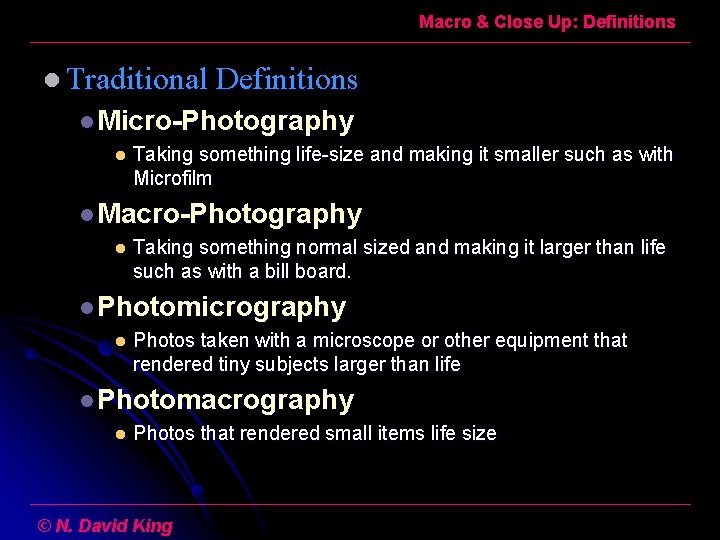
Macro & Close Up: Definitions l Traditional Definitions l Micro-Photography l Taking something life-size and making it smaller such as with Microfilm l Macro-Photography l Taking something normal sized and making it larger than life such as with a bill board. l Photomicrography l Photos taken with a microscope or other equipment that rendered tiny subjects larger than life l Photomacrography l Photos that rendered small items life size © N. David King
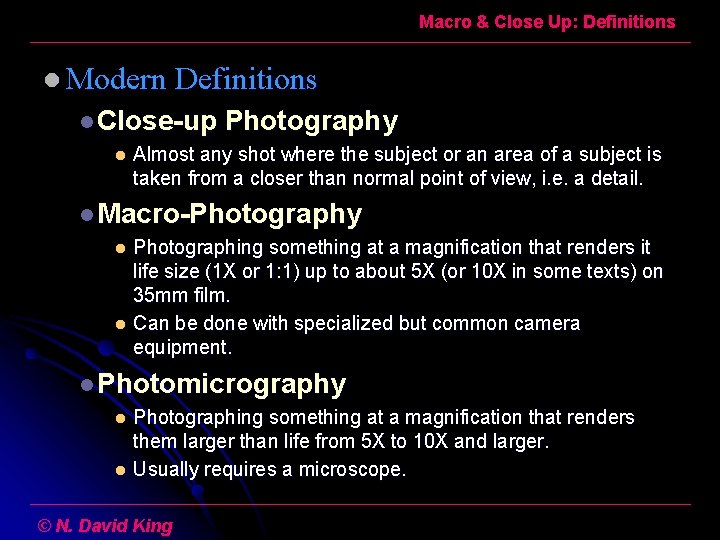
Macro & Close Up: Definitions l Modern Definitions l Close-up l Photography Almost any shot where the subject or an area of a subject is taken from a closer than normal point of view, i. e. a detail. l Macro-Photography Photographing something at a magnification that renders it life size (1 X or 1: 1) up to about 5 X (or 10 X in some texts) on 35 mm film. l Can be done with specialized but common camera equipment. l l Photomicrography Photographing something at a magnification that renders them larger than life from 5 X to 10 X and larger. l Usually requires a microscope. l © N. David King
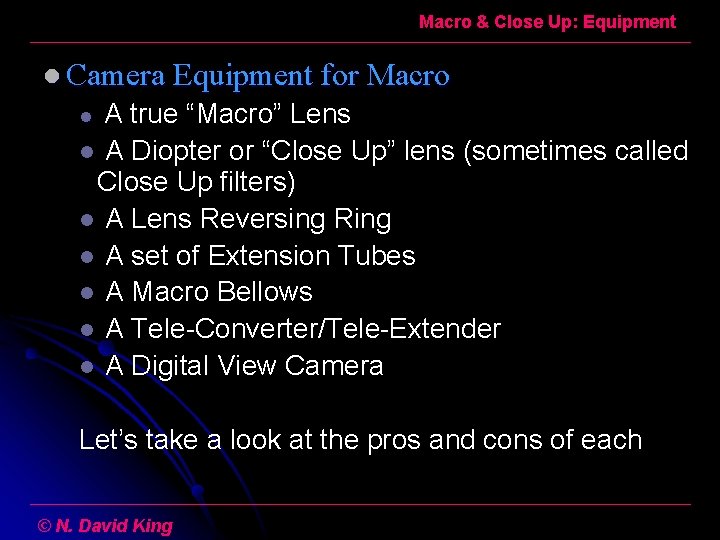
Macro & Close Up: Equipment l Camera Equipment for Macro A true “Macro” Lens l A Diopter or “Close Up” lens (sometimes called Close Up filters) l A Lens Reversing Ring l A set of Extension Tubes l A Macro Bellows l A Tele-Converter/Tele-Extender l A Digital View Camera l Let’s take a look at the pros and cons of each © N. David King
Macro & Close Up: Equipment l Macro Lenses l First… A WARNING… l The term “Macro” is used very loosely these days. l It properly means a lens capable of 1: 1 (lifesize) on 35 mm film but some manufacturers have come to apply it to lenses that can only do about 1: 4 (1/4 lifesize). l Some lenses cannot even do 1: 4 but are sold as “Close Up” lenses or even using the Flower Icon to imply macro without saying it. © N. David King
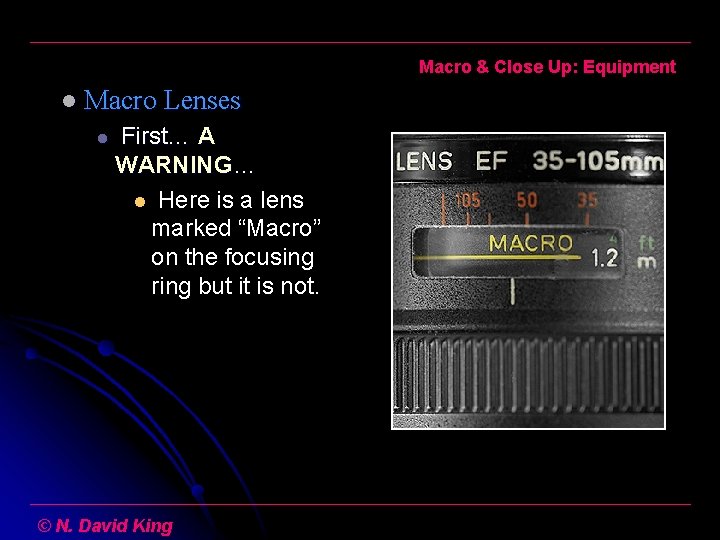
Macro & Close Up: Equipment l Macro Lenses l First… A WARNING… l Here is a lens marked “Macro” on the focusing ring but it is not. © N. David King
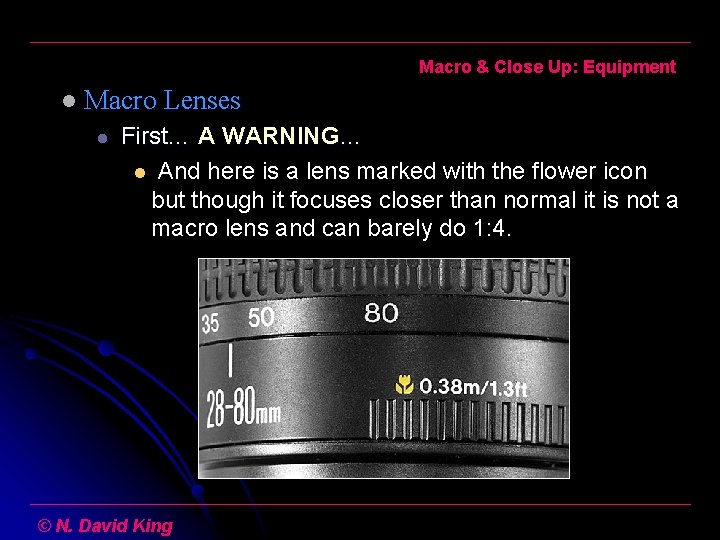
Macro & Close Up: Equipment l Macro Lenses l First… A WARNING… l And here is a lens marked with the flower icon but though it focuses closer than normal it is not a macro lens and can barely do 1: 4. © N. David King

Macro & Close Up: Equipment l Macro Lenses: Focal Lengths Macro Lenses usually come in slightly-longer than-normal to medium telephoto in length l Including… l l 60 mm l 90 mm l 105 mm l 180 mm l Why © N. David King get one or the other?
Macro & Close Up: Equipment l Macro Lenses: Focal Lengths l The longer the focal length, the greater your working distance (lens to subject) l Advantages of greater working distances… l Skittish subjects l Dangerous subjects l Lighting and shadows from camera © N. David King
Macro & Close Up: Equipment l Macro Lenses: Optical Issues l Macro lenses generally have superior optics compared to non-macro lenses. …HOWEVER… Macro lenses are optimized (meaning they are at their sharpest) when focusing very close). l Good Quality Macro Lenses are not cheap! l © N. David King
Macro & Close Up: Equipment l Macro Lenses: Conclusions True Macro Lenses are the easiest solutions for 1: 1 rendering. l For greater magnifications you generally need additional equipment (though Canon has a 5: 1 macro available). l Macro Lenses are the most expensive. l Macro lenses can be used for general photography but are far better at close-up work. l © N. David King
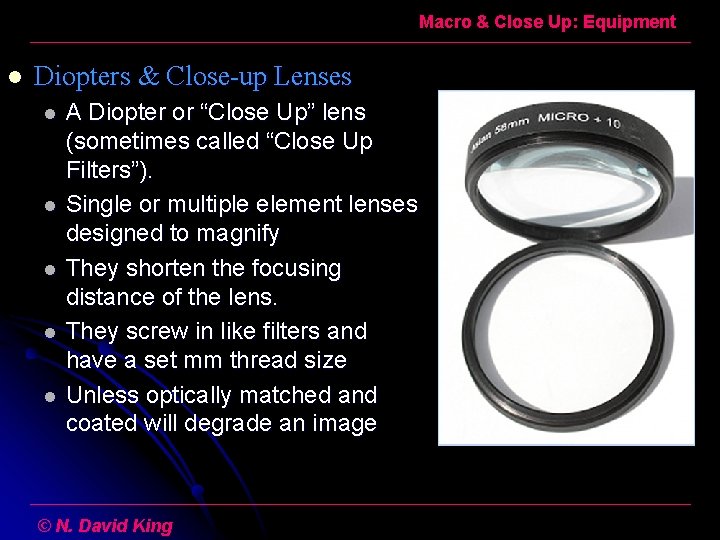
Macro & Close Up: Equipment l Diopters & Close-up Lenses l l l A Diopter or “Close Up” lens (sometimes called “Close Up Filters”). Single or multiple element lenses designed to magnify They shorten the focusing distance of the lens. They screw in like filters and have a set mm thread size Unless optically matched and coated will degrade an image © N. David King
Macro & Close Up: Equipment l Lens Reversing Ring l. A Lens Reversing Ring is designed to mount a camera lens backwards on a camera. l It reverses the normal optical action of taking something big and making it small. l It allows for closer focusing l It screws onto the lens using the filter threads l It does not add another optical element but it also presents the lens to the camera with the objective coatings hidden from the incoming light. © N. David King
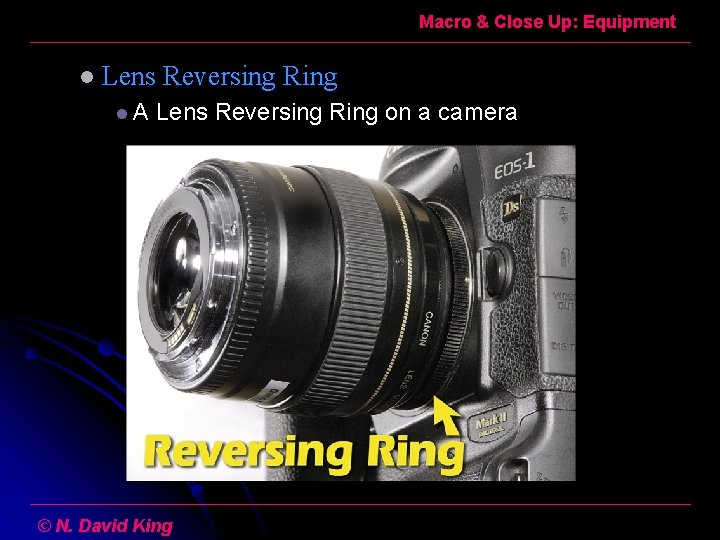
Macro & Close Up: Equipment l Lens Reversing Ring l. A Lens Reversing Ring on a camera © N. David King
Macro & Close Up: Equipment l Extension Tubes/Rings A set of Extension Tubes usually consists of three rings of differing lengths. l They are designed to set the lens further away from the focal plane resulting in the ability to focus closer. l Longer focal length lenses need longer rings for maximum magnification. l They have no optical impact on image quality l They force the light to travel further and therefore require increased exposure. l © N. David King
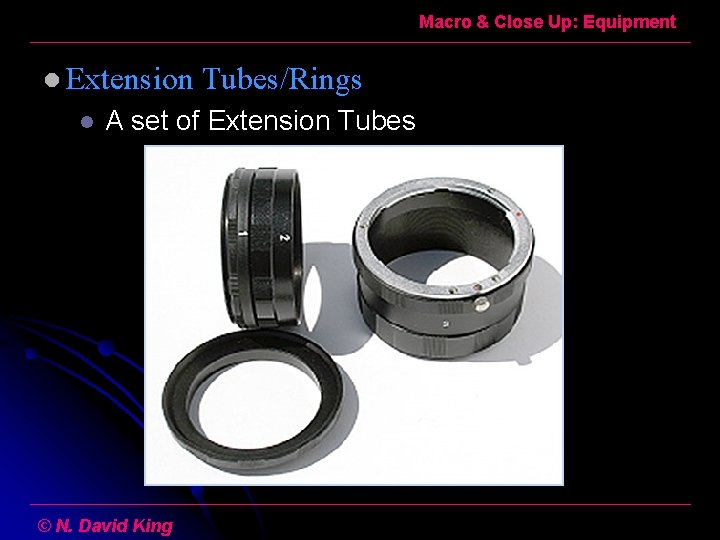
Macro & Close Up: Equipment l Extension Tubes/Rings l A set of Extension Tubes © N. David King
Macro & Close Up: Equipment l Macro Bellows l. A Macro Bellows is like an infinitely adjustable set of Extension Tubes. l It can be used in conjunction with other elements (diopters, tubes, reversing rings, etc. ) l Like tubes it requires exposure compensation (what view camera users call “Bellows Draw. ” l For ease of focusing it works best with a focusing rail. © N. David King
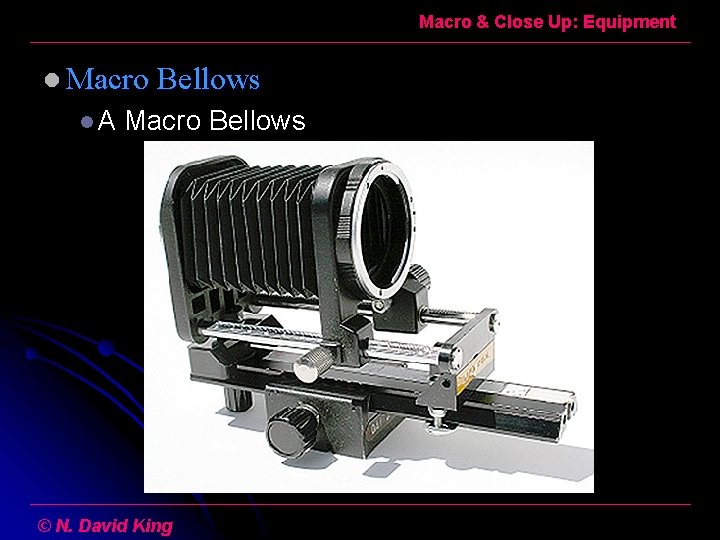
Macro & Close Up: Equipment l Macro Bellows l. A Macro Bellows © N. David King
Macro & Close Up: Equipment l Tele-converter / Tele-Extender A Tele-Converter/Tele-Extender is normally used to increase the focal length of a lens. l But that increased focal length lens combo now has the same close focusing range as the original lens. l Tele-converters also increase any optical problems with the lens. l Tele-converters require exposure compensation equal to their increased focal length. I. E. a 2 X tele-converter requires a 2 -stop increase in exposure. l © N. David King
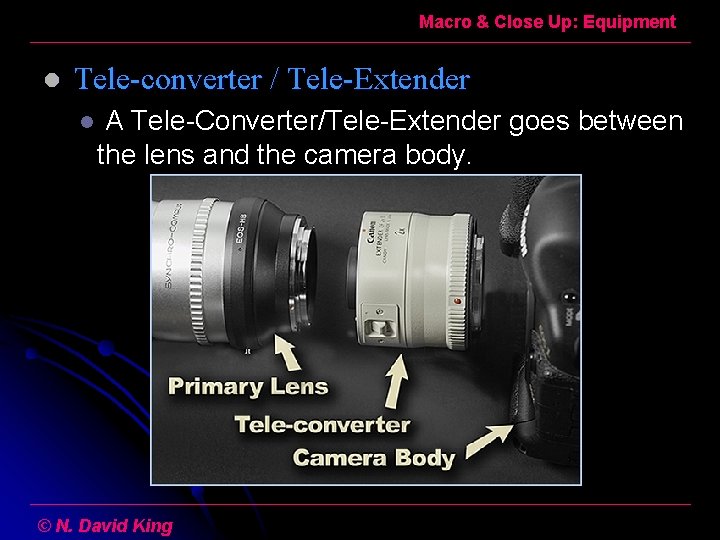
Macro & Close Up: Equipment l Tele-converter / Tele-Extender l A Tele-Converter/Tele-Extender goes between the lens and the camera body. © N. David King
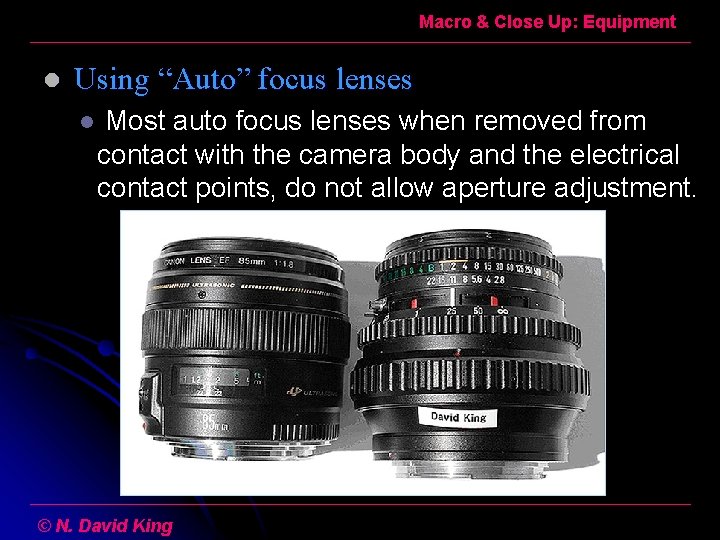
Macro & Close Up: Equipment l Using “Auto” focus lenses l Most auto focus lenses when removed from contact with the camera body and the electrical contact points, do not allow aperture adjustment. © N. David King
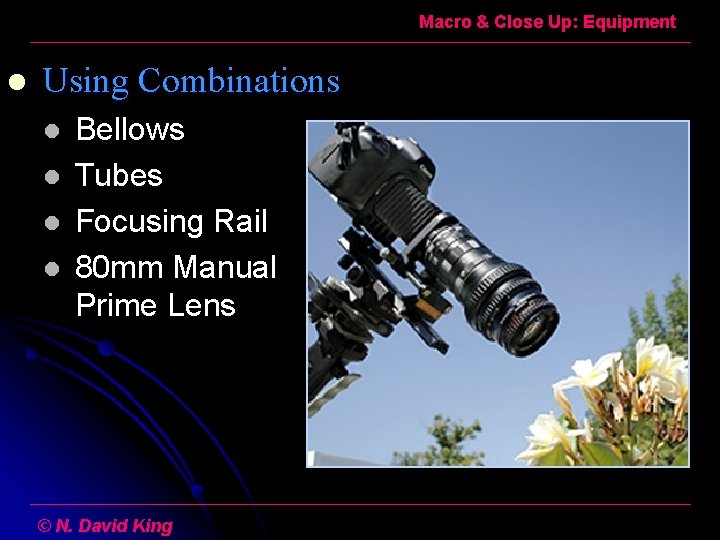
Macro & Close Up: Equipment l Using Combinations l l Bellows Tubes Focusing Rail 80 mm Manual Prime Lens © N. David King
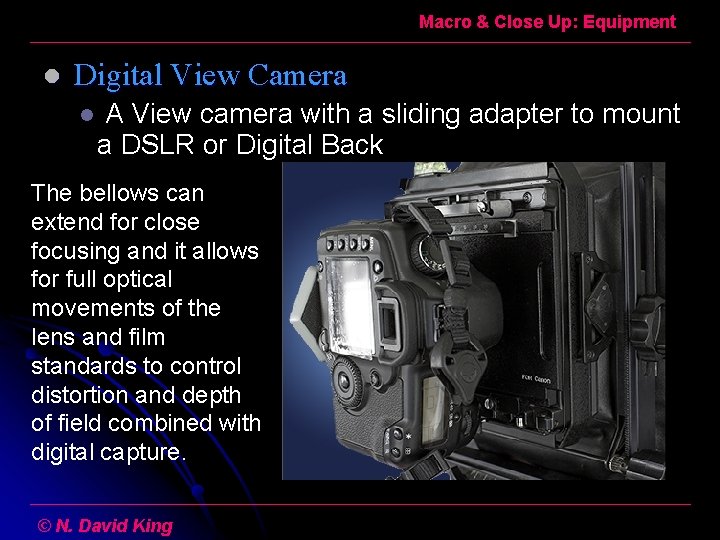
Macro & Close Up: Equipment l Digital View Camera l A View camera with a sliding adapter to mount a DSLR or Digital Back The bellows can extend for close focusing and it allows for full optical movements of the lens and film standards to control distortion and depth of field combined with digital capture. © N. David King
Macro & Close Up: Depth of Field l Depth of Field Issues l One of the rules of depth of field notes that “The closer the Focal Distance (focal plane to plane of critical focus or, more commonly, camera-to- subject distance) the shallower the depth of field. ” l Actually the underlying optical rule is that “The greater the magnification, the shallower the depth of field” which also explains why longer focal length lenses have less depth of field. l Macro photographs are focused VERY close with a lot of magnification and therefore have extremely shallow depth of field. © N. David King
Macro & Close Up: Depth of Field l Depth of Field Issues l The view camera can alter the angle of the plane of focus and often appear to increase depth of field. But optical movements cannot truly increase depth of field and therefore add nothing for subjects with near and far parts that need to be sharp. l Digital has the solution… © N. David King
Macro & Close Up: Depth of Field l Depth of Field Issues By taking multiple images with different parts of the subject in focus you can blend those frames where the in-focus parts of each is used to simulate increased or even extreme depth of field. l Shooting requires a very stable platform and steady hand so that nothing is moved as the plane of focus is changed for each shot. l You could then blend manually but software makes the editing process much easier l Helicon and Photoshop CS 4 to the rescue l © N. David King
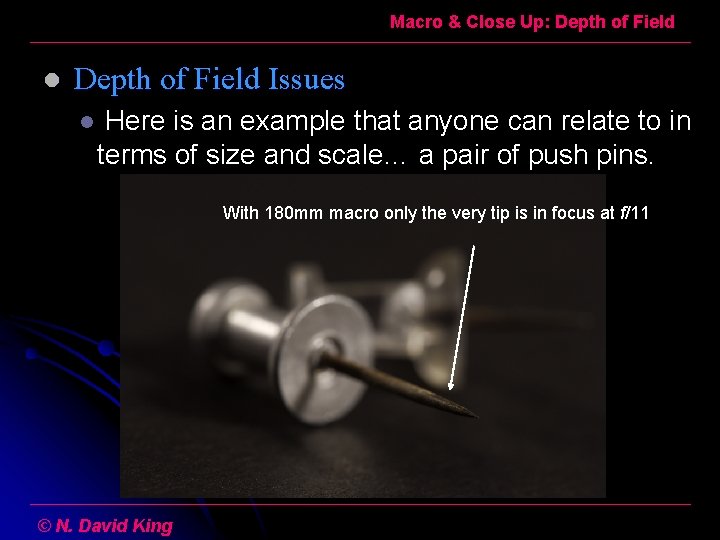
Macro & Close Up: Depth of Field l Depth of Field Issues l Here is an example that anyone can relate to in terms of size and scale… a pair of push pins. With 180 mm macro only the very tip is in focus at f/11 © N. David King
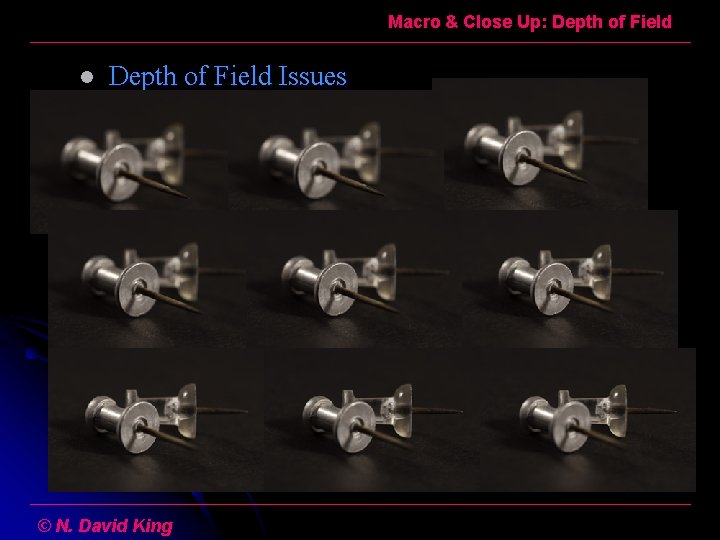
Macro & Close Up: Depth of Field l Depth of Field Issues l Here are individual shots moving the plane of focus from tip to back… © N. David King
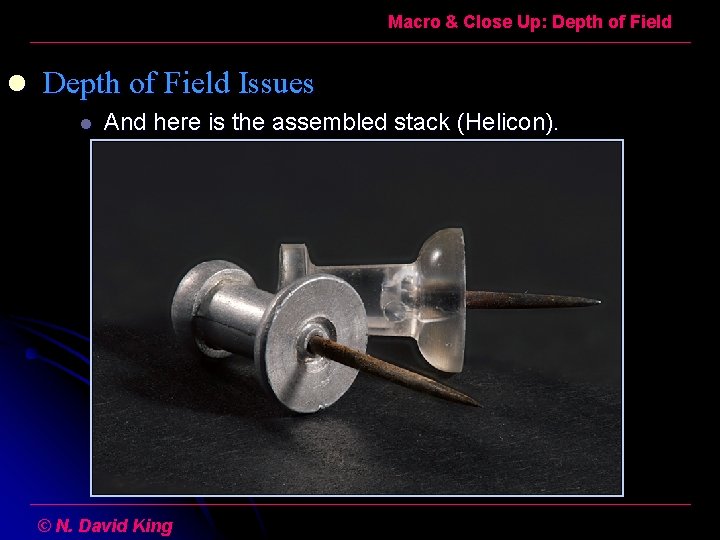
Macro & Close Up: Depth of Field l Depth of Field Issues l And here is the assembled stack (Helicon). © N. David King
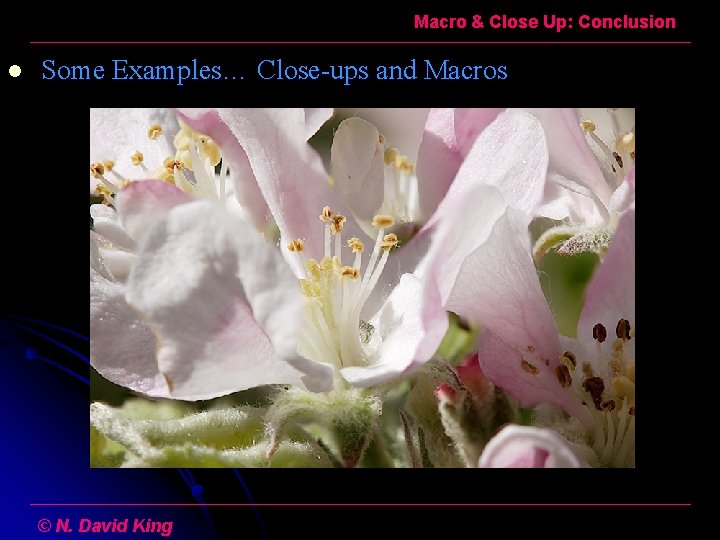
Macro & Close Up: Conclusion l Some Examples… Close-ups and Macros © N. David King

Macro & Close Up: Q&A QUESTIONS? © N. David King
- Slides: 31