
Mackies error theory Michael Lacewing enquiriesalevelphilosophy co uk
- Slides: 13
Mackie’s error theory Michael Lacewing enquiries@alevelphilosophy. co. uk © Michael Lacewing
Cognitivism and moral realism • What are we doing when we make moral judgments? • Cognitivism: moral judgments, e. g. ‘Murder is wrong’ – Aim to describe how the world is – Can be true or false – Express beliefs that the claim is true • Realism: there are moral properties – e. g. actions can have the property of being right – Moral judgments are true if they correctly describe the moral properties of an action, situation, person (c) Michael Lacewing
Mackie’s argument from relativity • Descriptive relativism: moral codes differ from one society to another – E. g. slavery, sexism… • Disagreement alone isn’t enough to show that moral realism is false – There is disagreement about empirical matters, e. g. the origin of the Earth, the possibility of magic • But with scientific disagreement, the best explanation is about available evidence • With moral disagreement, the best explanation is that moral codes reflect different ways of life © Michael Lacewing
Objection • Moral realism: but there are shared general moral principles – E. g. prohibitions on killing, lying; helping the weak • Moral differences reflect different particular conditions • Reply: At best, this shows that only basic principles are objective, and all other moral judgments are relative to society – And it isn’t how people think of morality, i. e. not on the basis of applying a basic principle to particular circumstances © Michael Lacewing
Realism refined? • Moral realism isn’t trying to describe how people think, but what is true – Both utilitarianism and Moore think that we should be realist about fundamental principles • What is relative can still be objective – ‘Chili plants will grow well’ – relative to geographical location, but still true or false – ‘Chili plants will grow well in hot countries’ – non-relative – Cp. ‘Stealing is wrong in conditions x’ – whether stealing is wrong depends on conditions, but it is objectively true that it is wrong in those conditions. © Michael Lacewing
Metaphysical ‘queerness’ • Moral judgments motivate us • But how can mere statements of fact be motivating? – How can there be an immediate, direct relation between some fact and our desires? – To know a truth is not enough to be motivated • If moral properties exist, they would be unique – They would have ‘to-be-pursuedness’ built in! © Michael Lacewing
Epistemological ‘queerness’ • If some acts had the objective property of being wrong – how would we discover this? – Intuition is no explanation – None of our usual methods of gaining knowledge work for moral knowledge (sense perception, introspection, hypothetical reasoning, conceptual analysis) • Response: the same is true for mathematics or necessary truths or the existence of substance – Mackie is an empiricist – if rationalism is true, then his objection fails © Michael Lacewing
Epistemological ‘queerness’ • What is the connection between natural properties (e. g. causing pain) and moral properties (e. g. being wrong)? – We can identify the psychological facts, but not the connection to some moral ‘fact’ • Moral judgments are subjective reactions – However, because this is not what they mean to express (that would be non-cognitivism), Mackie holds an error theory © Michael Lacewing
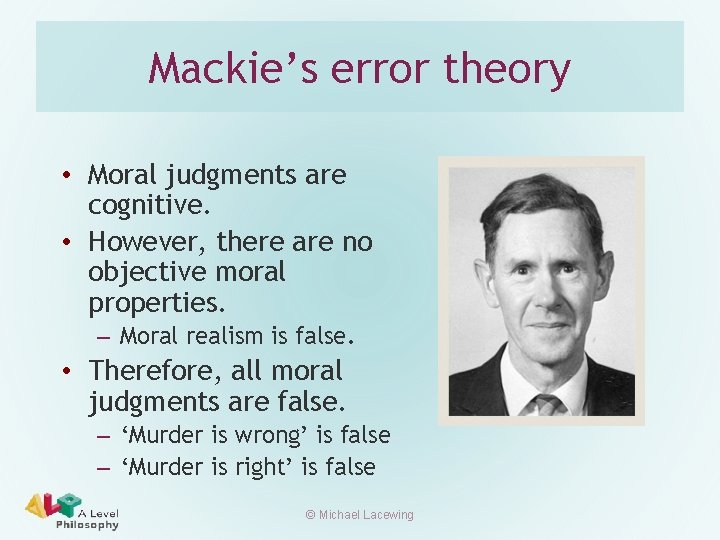
Mackie’s error theory • Moral judgments are cognitive. • However, there are no objective moral properties. – Moral realism is false. • Therefore, all moral judgments are false. – ‘Murder is wrong’ is false – ‘Murder is right’ is false © Michael Lacewing
Mackie’s error theory • Cp. Suppose everyone believed in fairies (that they really exist). An ‘error theory’ of fairies would say that talk about fairies is cognitivist, but there are no fairies. – It is not true that fairies have wings, because there are not fairies. – It is not true that fairies don’t have wings, because there are no fairies. • This is the case with moral judgments – they are all false. © Michael Lacewing
Objectivity • An objective claim has the following features: – – – It can be something we know. It can be true or false. Its truth is independent of what we want or choose. It is about something mind-independent. It is about something that is part of the ‘fabric of the world’. • Moral judgments aim to be objective, but are not. © Michael Lacewing
Replies to Mackie • Mackie’s argument rests on moral properties being mind-independent and part of ‘the fabric of the world’ – But obviously, science won’t reveal moral values – what is meant by ‘fabric of the world’? – Psychological states exist – but they aren’t mindindependent – Could moral facts be facts about our minds? © Michael Lacewing
Aristotle and Mill • Aristotle: Whether someone is eudaimon is objectively true or false, but it depends in part on facts about their mind. • Mill: our experience gives us evidence of what is good, viz. what we desire, which is happiness • Both theories can explain why moral judgments are motivating – because they are about what motivates us. © Michael Lacewing