
Machines Making Work Easier What Is A Machine
- Slides: 23
Machines Making Work Easier
What Is A Machine? n A machine is a device that makes work easier n 1. 2. 3. 4. 5. Examples Doorknob Pencil Sharpener Knife Crow Bar Axe
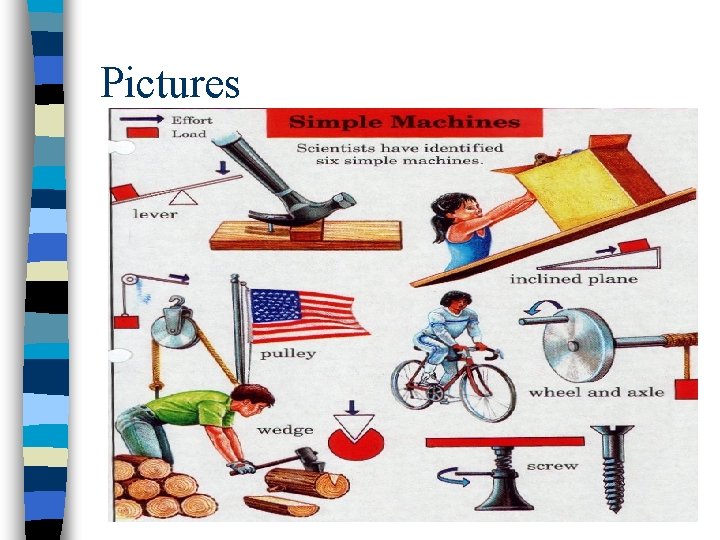
Simple Machines n n 1. 2. 3. 4. 5. 6. Simple machines are devices that do work with only one movement There are six types of simple machines: Levers Pulleys Wheel and axle Inclined plane Wedge Screw
Pictures
Advantages of Simple Machines n They help us overcome friction and gravity n A crowbar could help us move a heavy rock or pry the lid off a wooden crate n Machines make work easier by changing the force you exert in size, direction or both
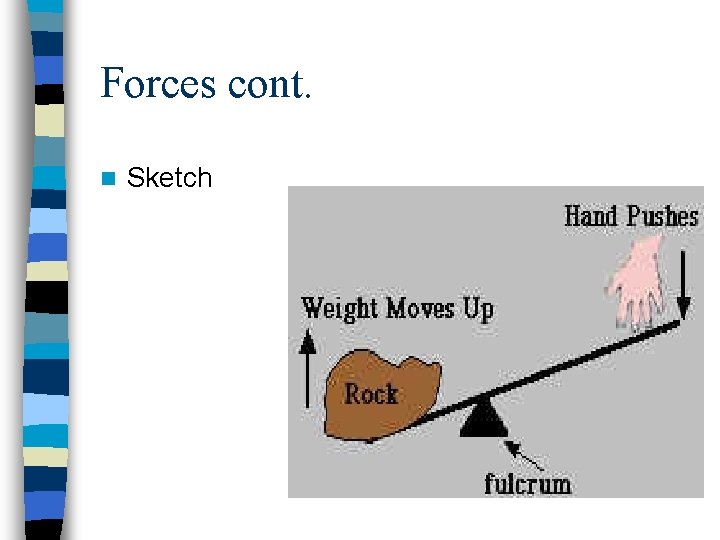
Effort and Resistance Forces n The force applied to the machine is called the effort force (Fe) n The force applied by the machine to overcome resistance is called the resistance force (Fr)
Forces cont. n Sketch
Two Kinds of Work n There is work done on the machine (Win) n There is also work done by the machine (Wout) n Win=Fexde n Wout=Frxdr
Ideal Machine n If there was a perfect machine with out energy being lost to friction and heat then work input would equal work output n perpetual machines - Google Search
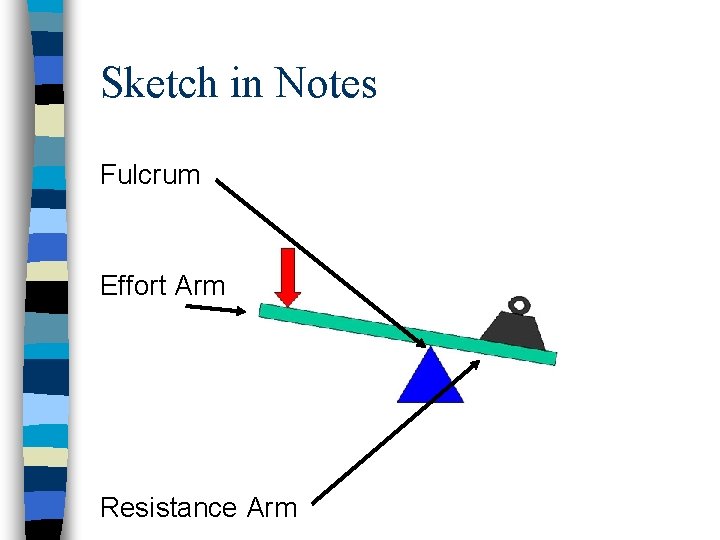
The Lever A lever is a simple machine that consists of three parts: 1. An effort arm 2. A Resistance arm 3. A fulcrum n
Sketch in Notes Fulcrum Effort Arm Resistance Arm
Levers There are three kinds of levers 1. 1 st class 2. 2 nd Class 3. 3 rd Class n
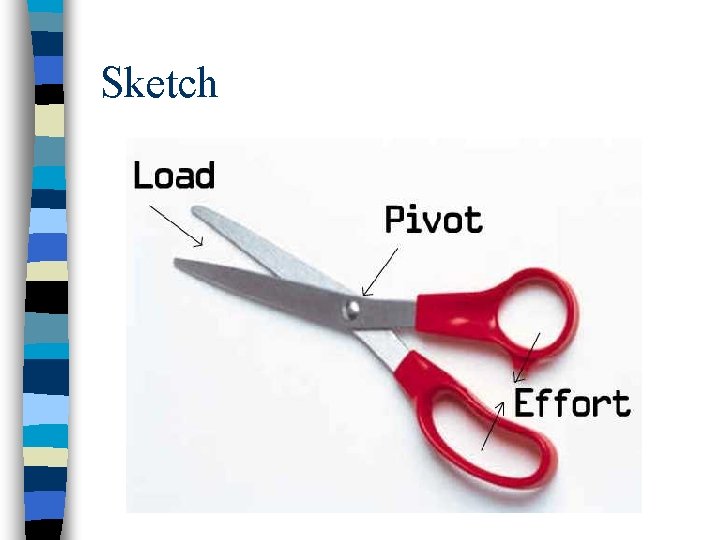
st 1 Class Lever n The 1 st class lever has the fulcrum in the middle of the two arms n Examples are the see-saw, can openers, and scissors
Sketch
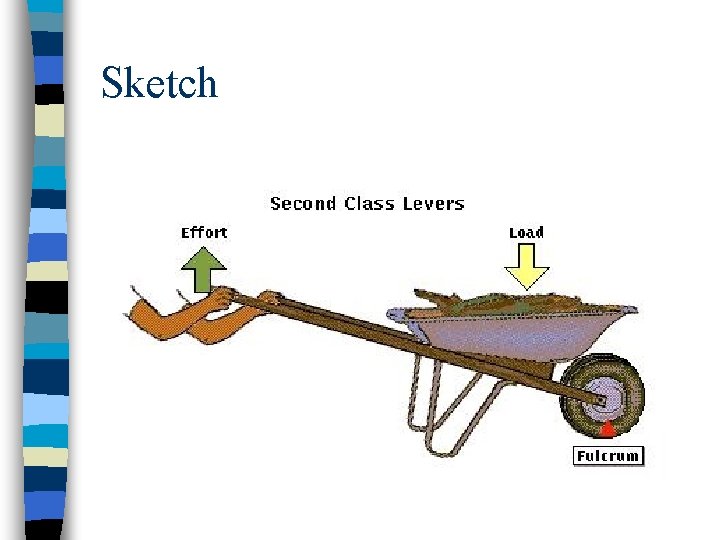
nd 2 Class Levers n 2 nd class levers have the resistance and effort arms on one end, and the fulcrum on the other. The resistance is in the middle here
Sketch
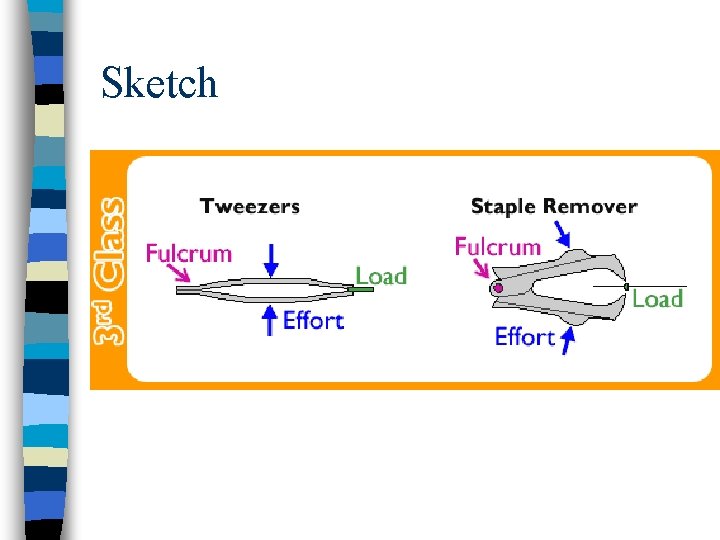
rd 3 Class Levers n The 3 rd class has the fulcrum on one end and the arms on the other, except reversed. Now the effort arm is in the middle
Sketch
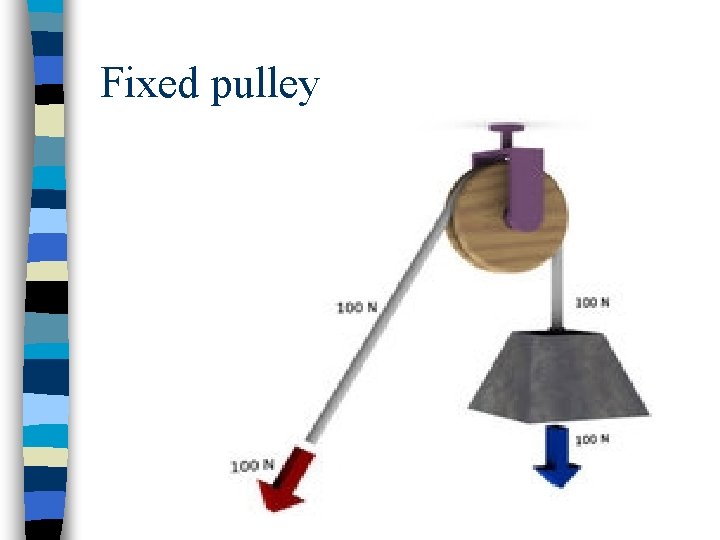
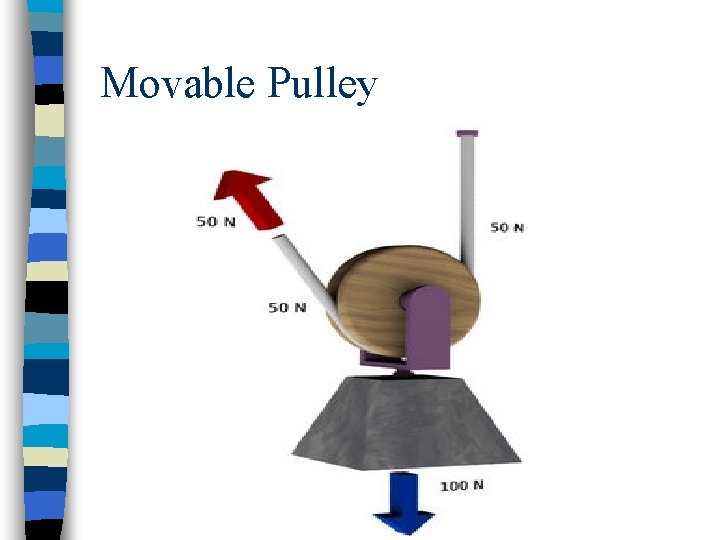
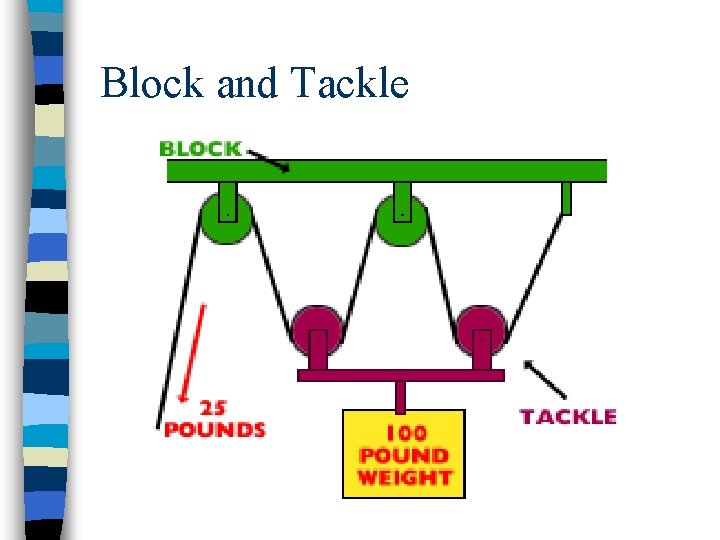
Pulley’s n. A pulley is like a 1 st class lever n There is a fulcrum in the middle (the wheel) and a resistance rope and effort rope n Pulleys can be fixed or movable
Fixed pulley
Movable Pulley
Block and Tackle
Compound Machines n. A machine made up of several simple machines make up a compound machine n Examples are a bicycle, a lawnmower, or a pencil sharpener