
Machines and Mechanical Advantage General Physics 1 Machines
- Slides: 11
Machines and Mechanical Advantage General Physics 1
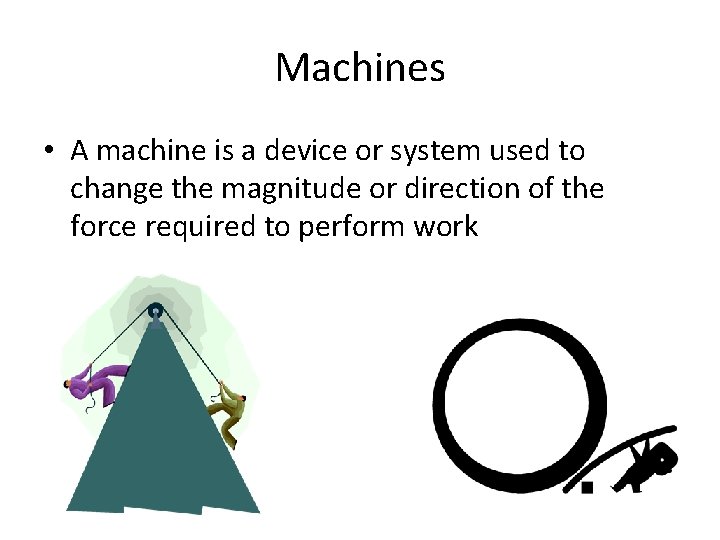
Machines • A machine is a device or system used to change the magnitude or direction of the force required to perform work
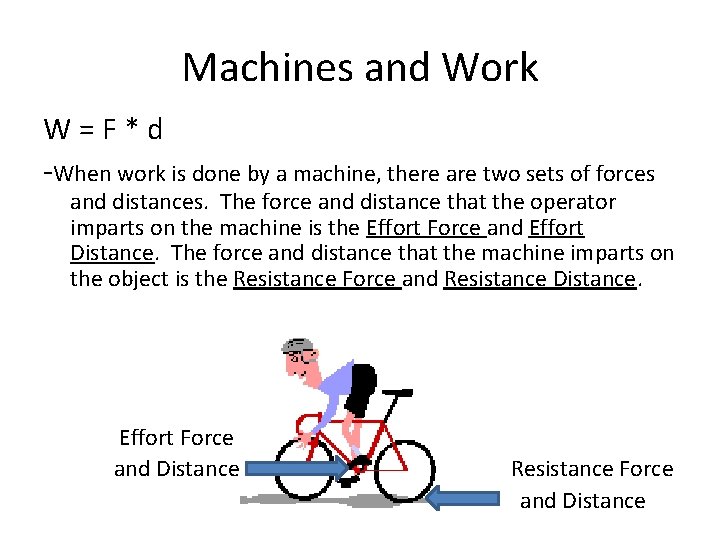
Machines and Work W=F*d -When work is done by a machine, there are two sets of forces and distances. The force and distance that the operator imparts on the machine is the Effort Force and Effort Distance. The force and distance that the machine imparts on the object is the Resistance Force and Resistance Distance. Effort Force and Distance Resistance Force and Distance
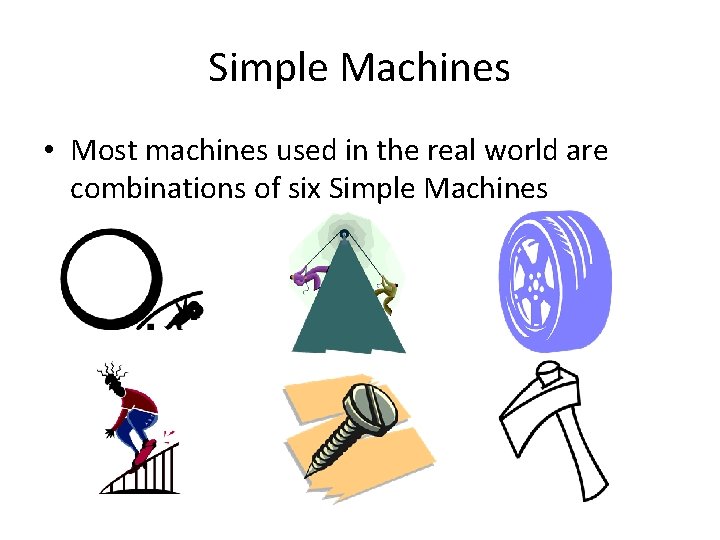
Simple Machines • Most machines used in the real world are combinations of six Simple Machines
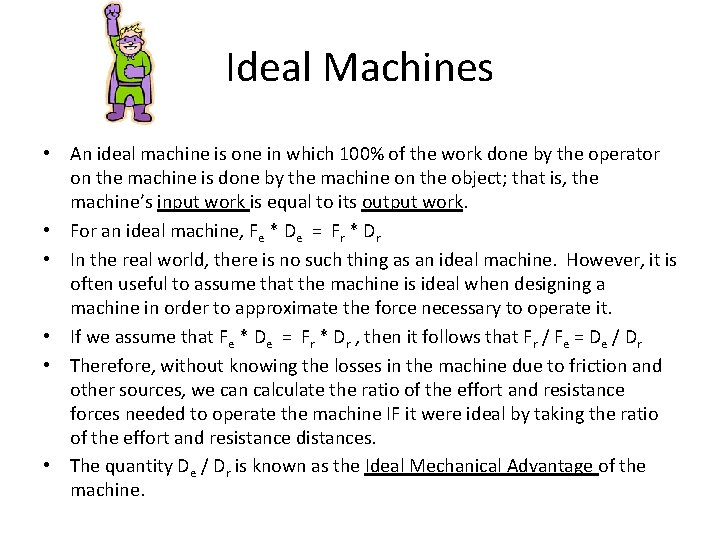
Ideal Machines • An ideal machine is one in which 100% of the work done by the operator on the machine is done by the machine on the object; that is, the machine’s input work is equal to its output work. • For an ideal machine, Fe * De = Fr * Dr • In the real world, there is no such thing as an ideal machine. However, it is often useful to assume that the machine is ideal when designing a machine in order to approximate the force necessary to operate it. • If we assume that Fe * De = Fr * Dr , then it follows that Fr / Fe = De / Dr • Therefore, without knowing the losses in the machine due to friction and other sources, we can calculate the ratio of the effort and resistance forces needed to operate the machine IF it were ideal by taking the ratio of the effort and resistance distances. • The quantity De / Dr is known as the Ideal Mechanical Advantage of the machine.
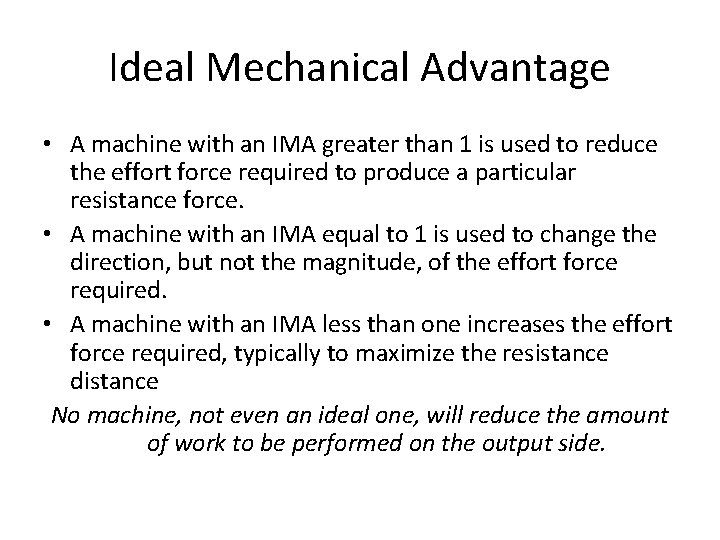
Ideal Mechanical Advantage • A machine with an IMA greater than 1 is used to reduce the effort force required to produce a particular resistance force. • A machine with an IMA equal to 1 is used to change the direction, but not the magnitude, of the effort force required. • A machine with an IMA less than one increases the effort force required, typically to maximize the resistance distance No machine, not even an ideal one, will reduce the amount of work to be performed on the output side.
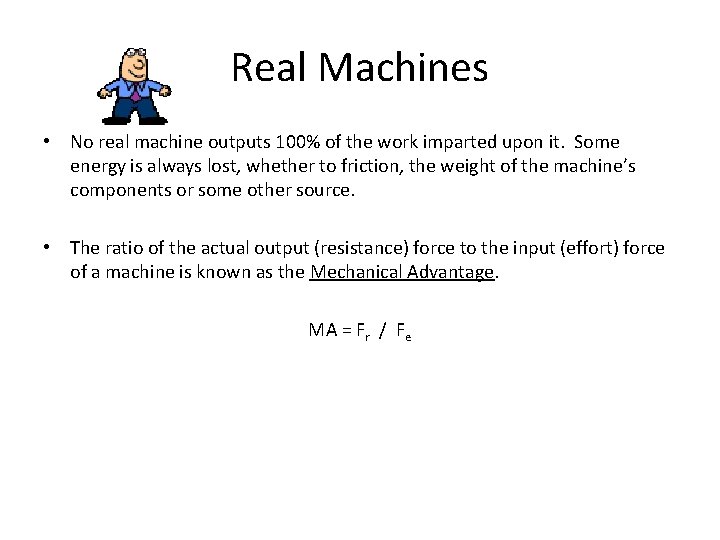
Real Machines • No real machine outputs 100% of the work imparted upon it. Some energy is always lost, whether to friction, the weight of the machine’s components or some other source. • The ratio of the actual output (resistance) force to the input (effort) force of a machine is known as the Mechanical Advantage. MA = Fr / Fe
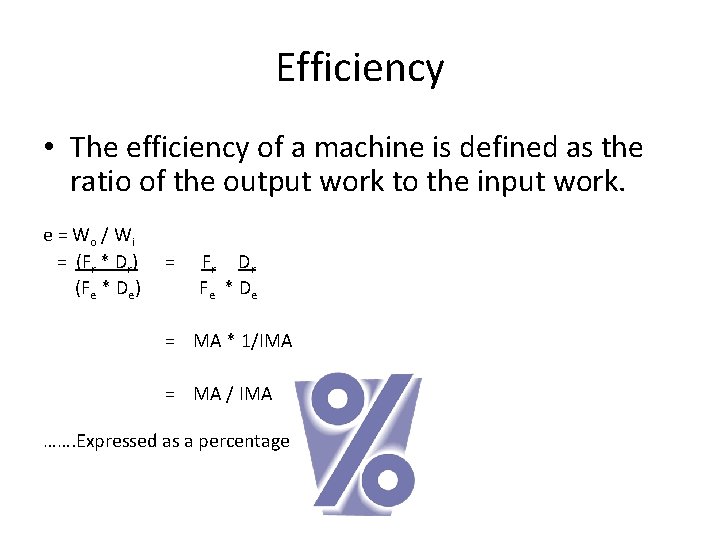
Efficiency • The efficiency of a machine is defined as the ratio of the output work to the input work. e = W o / Wi = (Fr * Dr) (Fe * De) = F r Dr F e * De = MA * 1/IMA = MA / IMA ……. Expressed as a percentage
Pulley Demonstration
Guided Practice Takeshi uses a series of pulleys to lift a 1200 -N Piano a distance of 5 m. He pulls 20 m of rope in making the lift. a) What is the input force required to lift the piano if the machine is ideal? b) If the actual force required to operate the machine is 340 N, what force is needed to counteract the internal friction of the machine? c) What is the output work of the machine? d) What is the input work to the machine? e) What is the mechanical advantage of the machine? f) What is the efficiency of the machine?
Independent Practice Carrie uses an 18 m frictionless inclined plane to slide a 25 -kg box up a vertical distance of 4. 5 m. a) What is the force required parallel with the plane to move the box up the plane at constant speed? b) What is the Ideal Mechanical Advantage of the Inclined Plane? c) What is the actual Mechanical Advantage and Efficiency of the Plane?