
Machinery and Machine Guarding l 29 CFR 1910



- Slides: 67
Machinery and Machine Guarding l 29 CFR 1910. 211– 219 l 29 CFR 1910. 241– 244 Presented by: ETTA, 919 -807 -2875 This presentation was created by the N. C. Department of Labor for safety and health training.
Objectives l To enable students to identify and understand the following: - Machine guarding hazards - Machine guarding abatement methods - Machine guarding standards This presentation was created by the N. C. Department of Labor for safety and health training.
Machinery and Machine Guarding l 1910. 211 – Definitions l 1910. 212 – General requirements for all machines l 1910. 213 – Woodworking machinery requirements l 1910. 215 – Abrasive wheel machinery l 1910. 217 – Mechanical power presses l 1910. 219 – Mechanical power-transmission apparatus This presentation was created by the N. C. Department of Labor for safety and health training.
Hand Portable Powered Tools l 1910. 241 – Definitions l 1910. 242 – Hand portable powered tools and equipment, general l 1910. 243 – Guarding of portable powered tools l 1910. 244 – Other portable tools and equipment This presentation was created by the N. C. Department of Labor for safety and health training.
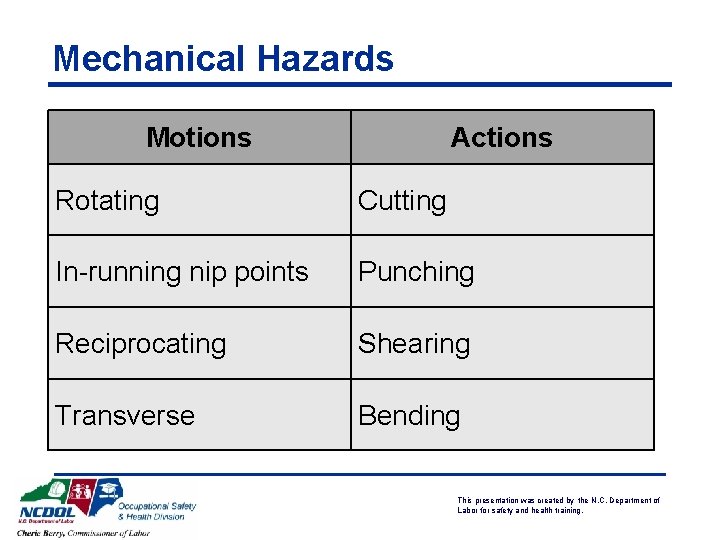
Mechanical Hazards Motions Actions Rotating Cutting In-running nip points Punching Reciprocating Shearing Transverse Bending This presentation was created by the N. C. Department of Labor for safety and health training.
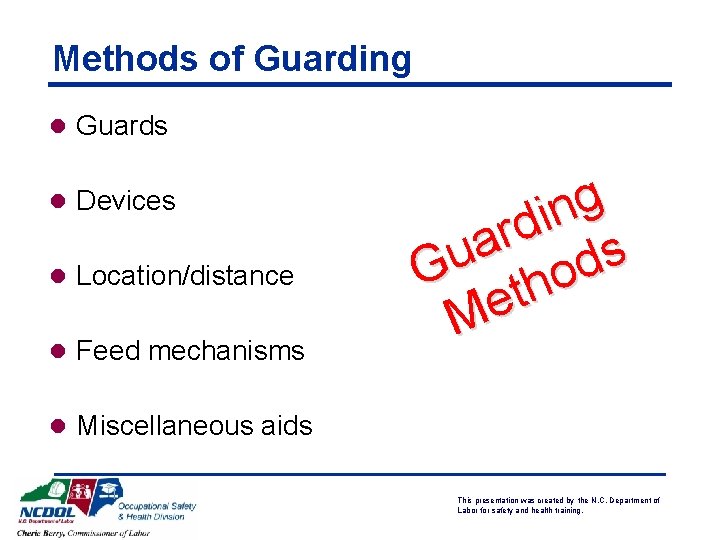
Methods of Guarding l Guards l Devices l Location/distance l Feed mechanisms g n i d r a s u d G tho e M l Miscellaneous aids This presentation was created by the N. C. Department of Labor for safety and health training.
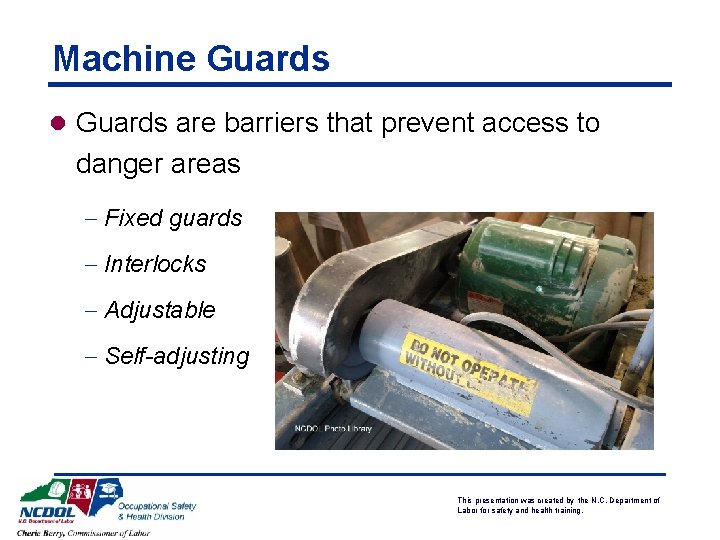
Machine Guards l Guards are barriers that prevent access to danger areas - Fixed guards - Interlocks - Adjustable - Self-adjusting This presentation was created by the N. C. Department of Labor for safety and health training.
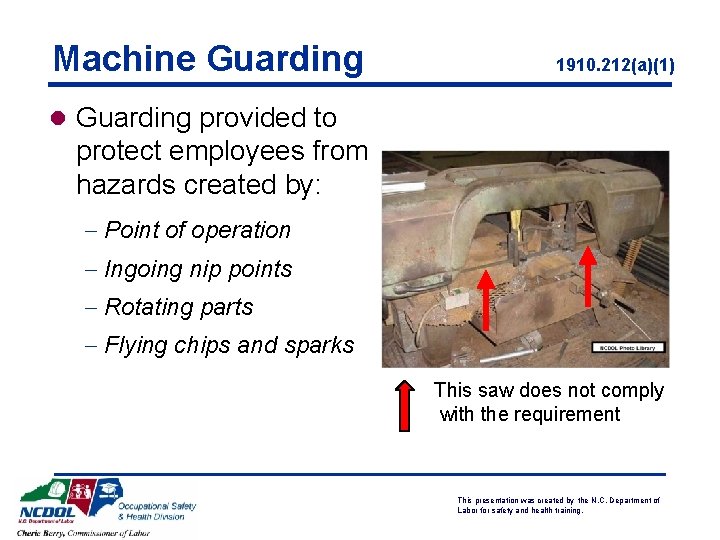
Machine Guarding 1910. 212(a)(1) l Guarding provided to protect employees from hazards created by: - Point of operation - Ingoing nip points - Rotating parts - Flying chips and sparks This saw does not comply with the requirement This presentation was created by the N. C. Department of Labor for safety and health training.
Machine Guarding 1910. 212(a)(1) l Barrier guards This presentation was created by the N. C. Department of Labor for safety and health training.
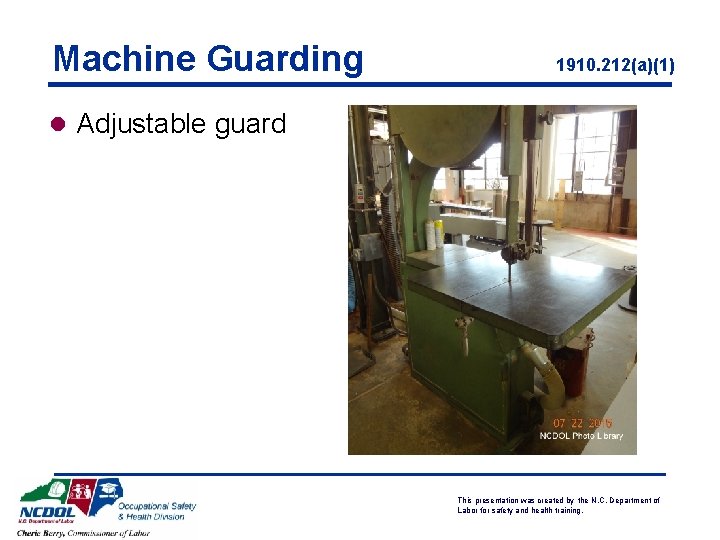
Machine Guarding 1910. 212(a)(1) l Adjustable guard This presentation was created by the N. C. Department of Labor for safety and health training.
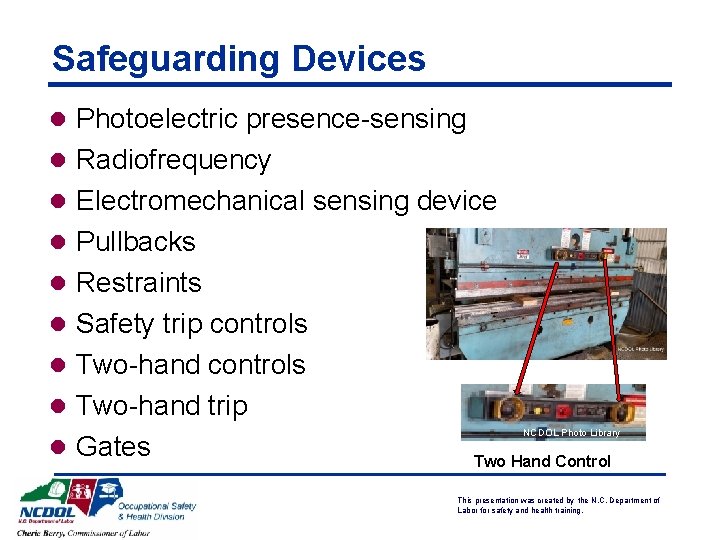
Safeguarding Devices l Photoelectric presence-sensing l Radiofrequency l Electromechanical sensing device l Pullbacks l Restraints l Safety trip controls l Two-hand trip l Gates NCDOL Photo Library Two Hand Control This presentation was created by the N. C. Department of Labor for safety and health training.
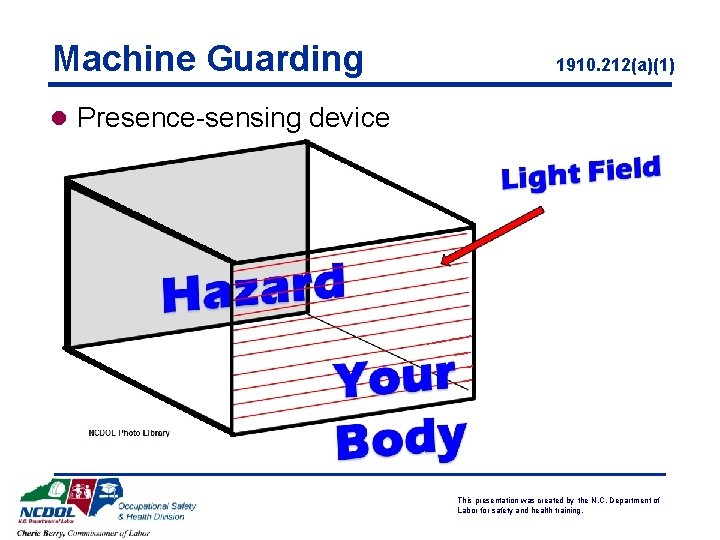
Machine Guarding 1910. 212(a)(1) l Presence-sensing device This presentation was created by the N. C. Department of Labor for safety and health training.
Machine Guarding 1910. 212(a)(1) l Pull-out device e c i k v c e a d b p s a d r n t s a / h Cable perator’s ps o o l e e v n i e d ch d a r n a m o i z t s a l r h e pu n p e o h f w o t n i o p e h t t a This presentation was created by the N. C. Department of Labor for safety and health training.
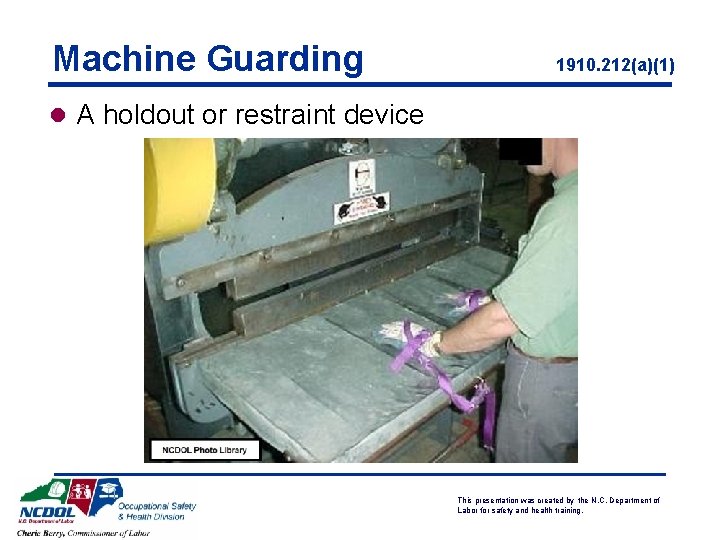
Machine Guarding 1910. 212(a)(1) l A holdout or restraint device This presentation was created by the N. C. Department of Labor for safety and health training.
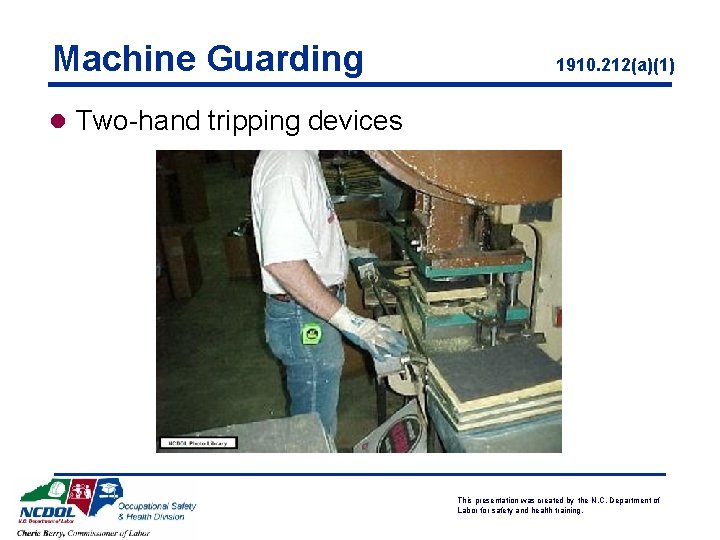
Machine Guarding 1910. 212(a)(1) l Two-hand tripping devices This presentation was created by the N. C. Department of Labor for safety and health training.
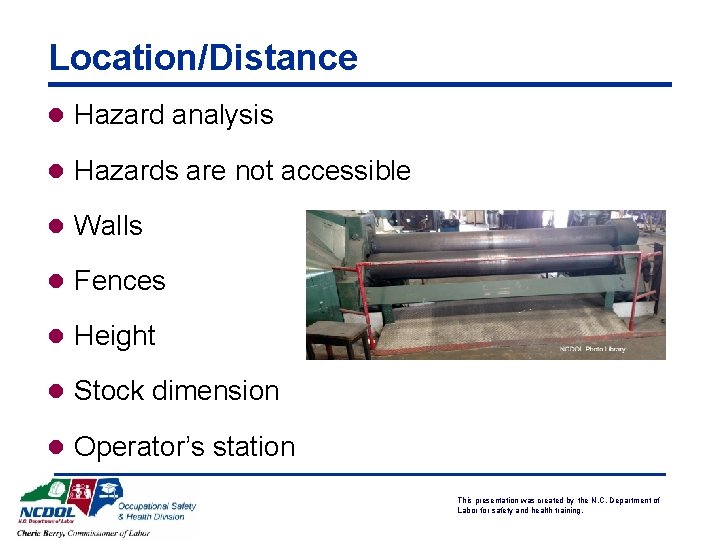
Location/Distance l Hazard analysis l Hazards are not accessible l Walls l Fences l Height l Stock dimension l Operator’s station This presentation was created by the N. C. Department of Labor for safety and health training.
Feed Mechanisms l Automatic feeding l Semi-automatic feed l Automatic ejection l Semi-automatic ejection l Robots ic t a m to u A ic t a m to u -a i m e S s t bo o R This presentation was created by the N. C. Department of Labor for safety and health training.
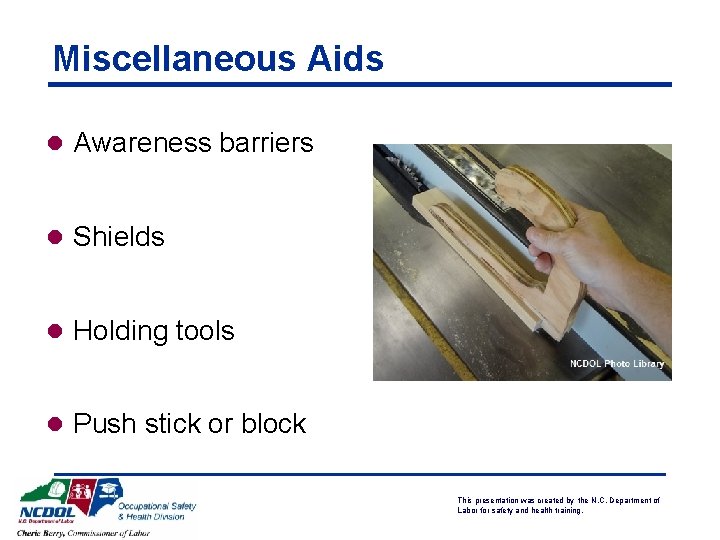
Miscellaneous Aids l Awareness barriers l Shields l Holding tools l Push stick or block This presentation was created by the N. C. Department of Labor for safety and health training.
Safeguard Requirements l Prevent contact l Properly secured l Protect from falling objects l Create no hazards l Create no interference (greater hazard) l Allow safe lubrication (removal of guards) This presentation was created by the N. C. Department of Labor for safety and health training.
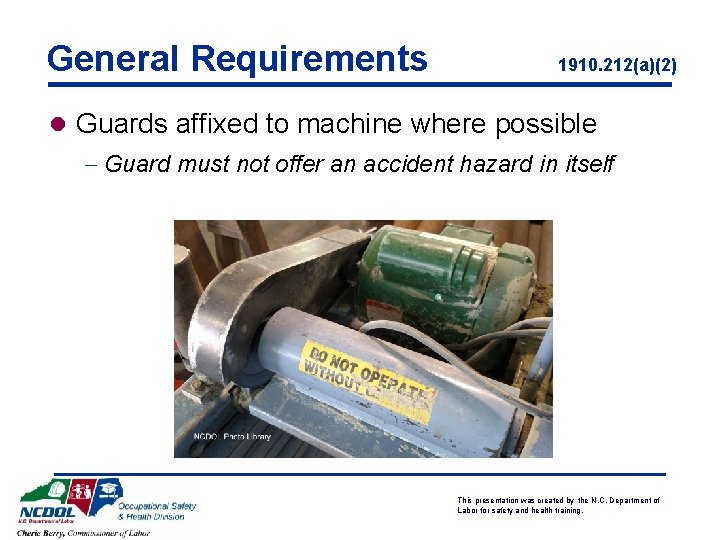
General Requirements 1910. 212(a)(2) l Guards affixed to machine where possible - Guard must not offer an accident hazard in itself This presentation was created by the N. C. Department of Labor for safety and health training.
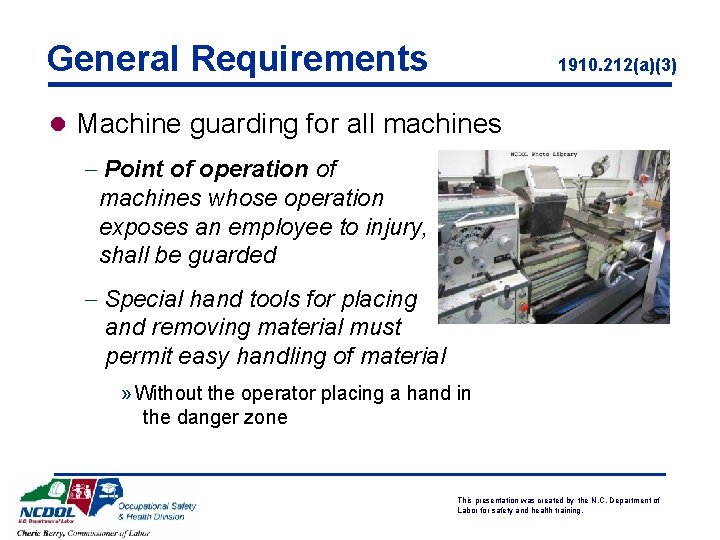
General Requirements 1910. 212(a)(3) l Machine guarding for all machines - Point of operation of machines whose operation exposes an employee to injury, shall be guarded - Special hand tools for placing and removing material must permit easy handling of material » Without the operator placing a hand in the danger zone This presentation was created by the N. C. Department of Labor for safety and health training.
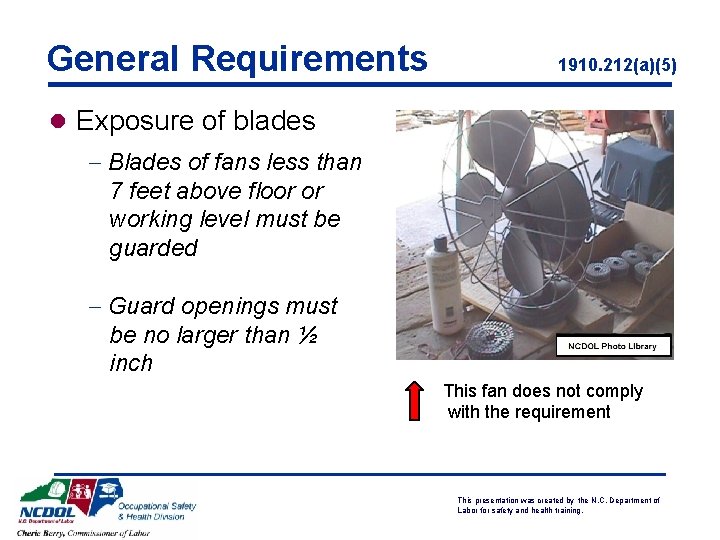
General Requirements 1910. 212(a)(5) l Exposure of blades - Blades of fans less than 7 feet above floor or working level must be guarded - Guard openings must be no larger than ½ inch This fan does not comply with the requirement This presentation was created by the N. C. Department of Labor for safety and health training.
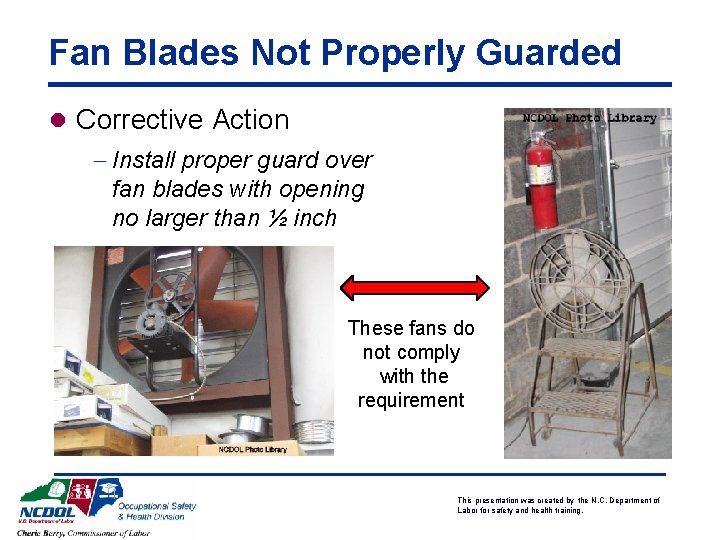
Fan Blades Not Properly Guarded l Corrective Action - Install proper guard over fan blades with opening no larger than ½ inch These fans do not comply with the requirement This presentation was created by the N. C. Department of Labor for safety and health training.
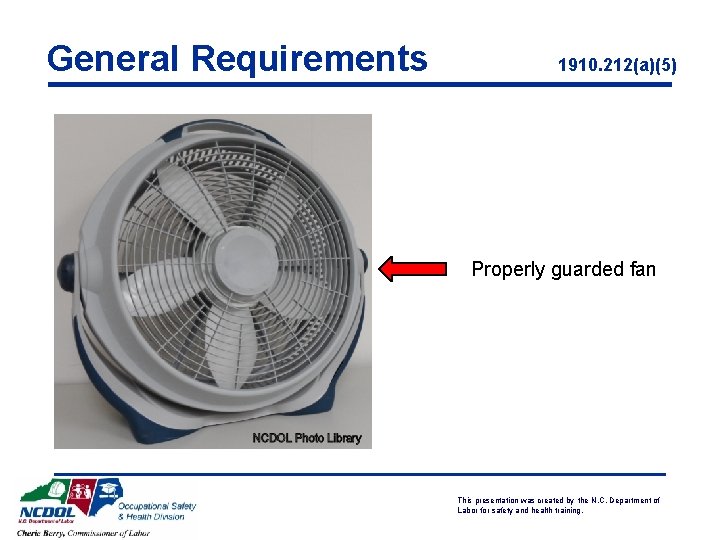
General Requirements 1910. 212(a)(5) Properly guarded fan USDOL Photo Archive This presentation was created by the N. C. Department of Labor for safety and health training.
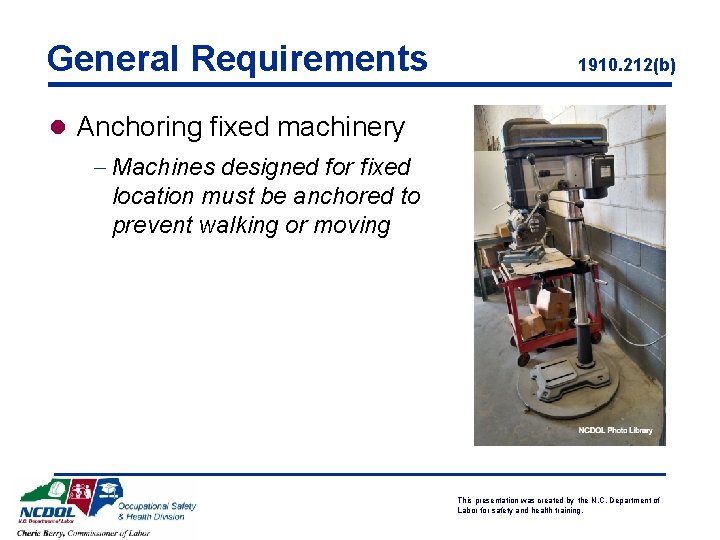
General Requirements 1910. 212(b) l Anchoring fixed machinery - Machines designed for fixed location must be anchored to prevent walking or moving This presentation was created by the N. C. Department of Labor for safety and health training.
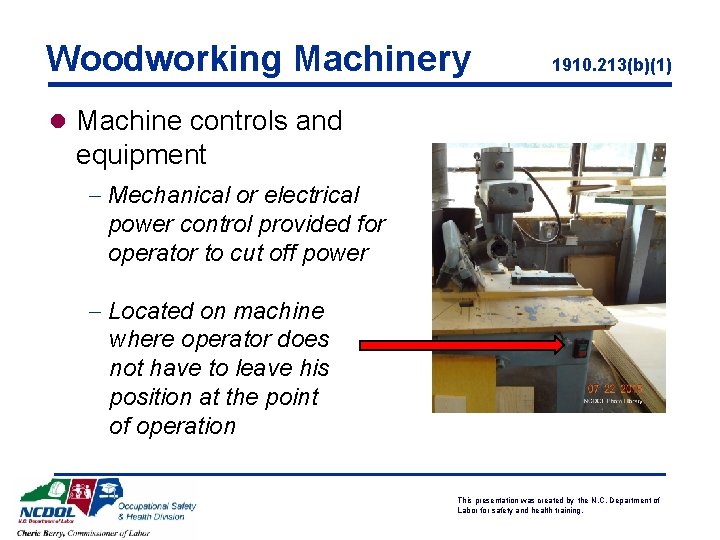
Woodworking Machinery 1910. 213(b)(1) l Machine controls and equipment - Mechanical or electrical power control provided for operator to cut off power - Located on machine where operator does not have to leave his position at the point of operation This presentation was created by the N. C. Department of Labor for safety and health training.
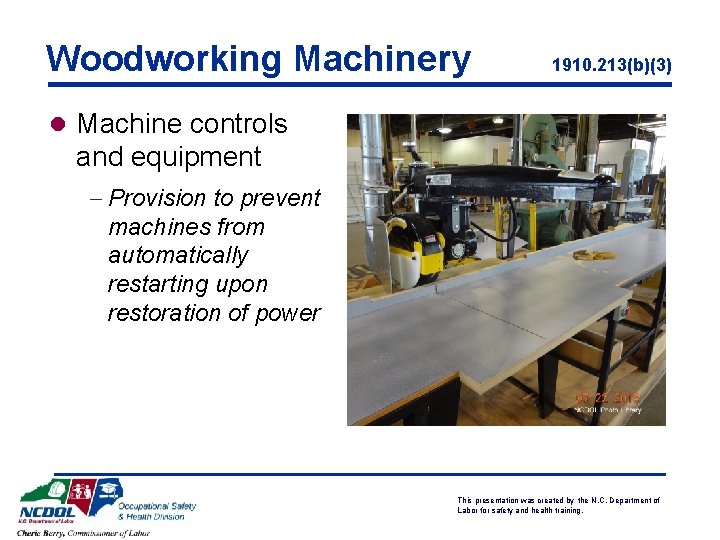
Woodworking Machinery 1910. 213(b)(3) l Machine controls and equipment - Provision to prevent machines from automatically restarting upon restoration of power This presentation was created by the N. C. Department of Labor for safety and health training.
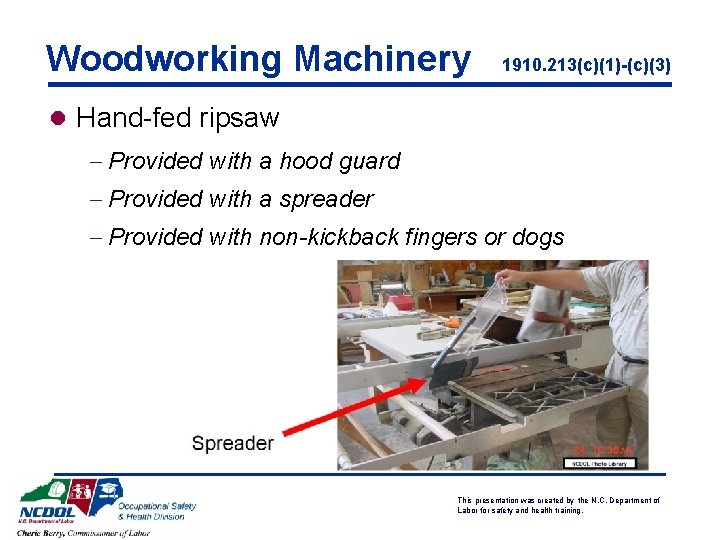
Woodworking Machinery 1910. 213(c)(1)-(c)(3) l Hand-fed ripsaw - Provided with a hood guard - Provided with a spreader - Provided with non-kickback fingers or dogs This presentation was created by the N. C. Department of Labor for safety and health training.
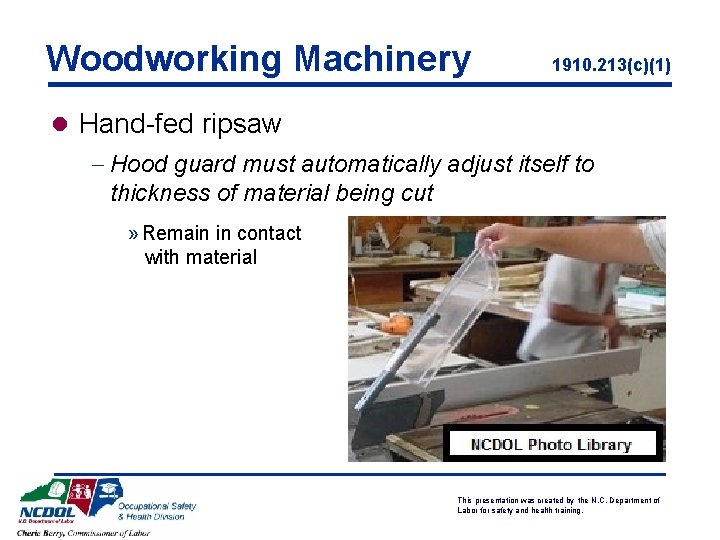
Woodworking Machinery 1910. 213(c)(1) l Hand-fed ripsaw - Hood guard must automatically adjust itself to thickness of material being cut » Remain in contact with material USDOL Photo Library This presentation was created by the N. C. Department of Labor for safety and health training.
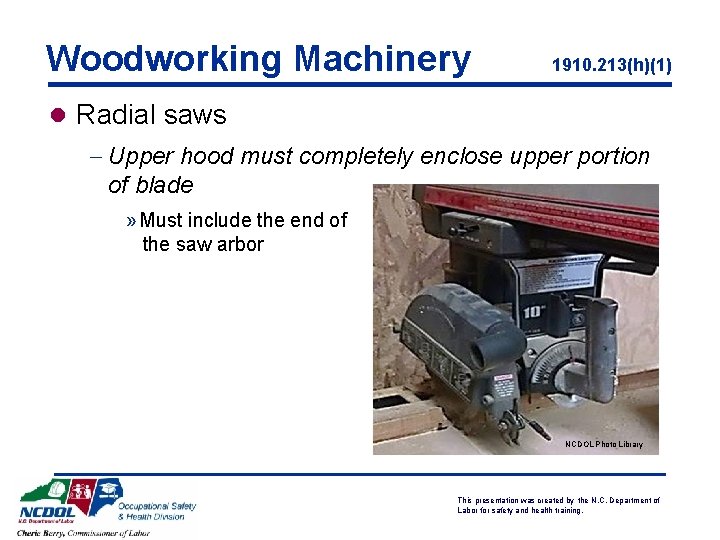
Woodworking Machinery 1910. 213(h)(1) l Radial saws - Upper hood must completely enclose upper portion of blade » Must include the end of the saw arbor NCDOL Photo Library This presentation was created by the N. C. Department of Labor for safety and health training.
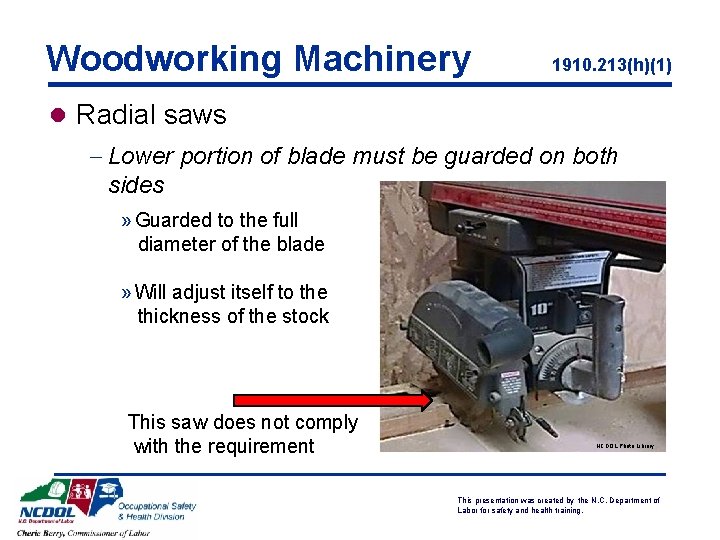
Woodworking Machinery 1910. 213(h)(1) l Radial saws - Lower portion of blade must be guarded on both sides » Guarded to the full diameter of the blade » Will adjust itself to the thickness of the stock This saw does not comply with the requirement NCDOL Photo Library This presentation was created by the N. C. Department of Labor for safety and health training.
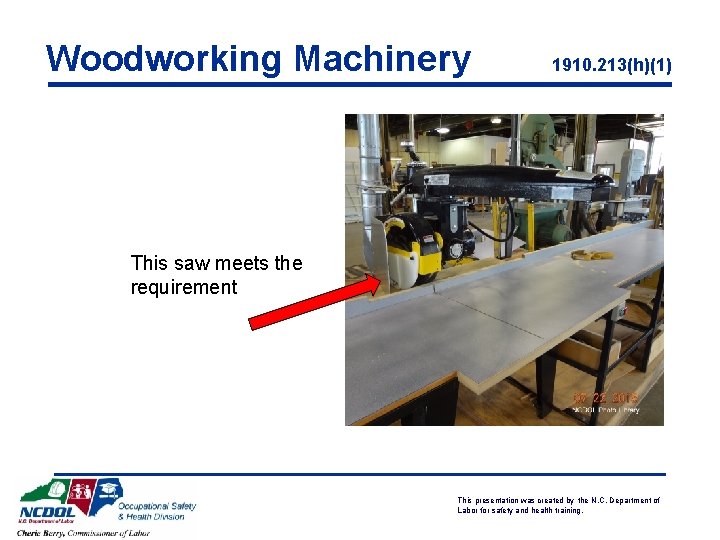
Woodworking Machinery 1910. 213(h)(1) This saw meets the requirement This presentation was created by the N. C. Department of Labor for safety and health training.
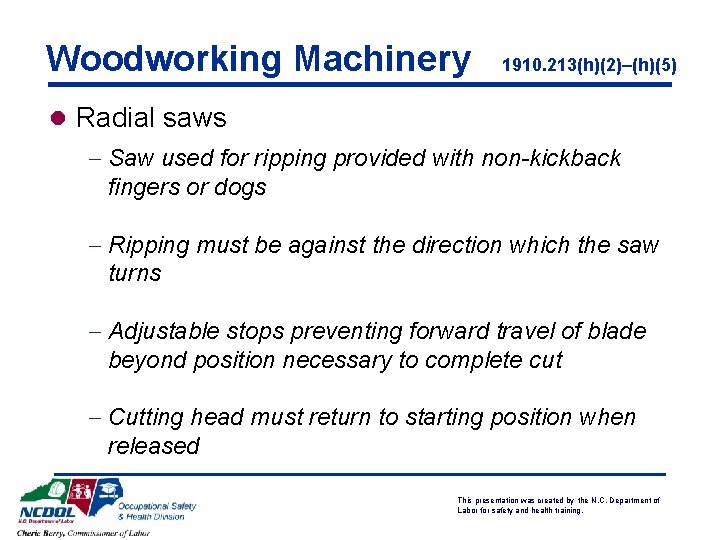
Woodworking Machinery 1910. 213(h)(2)–(h)(5) l Radial saws - Saw used for ripping provided with non-kickback fingers or dogs - Ripping must be against the direction which the saw turns - Adjustable stops preventing forward travel of blade beyond position necessary to complete cut - Cutting head must return to starting position when released This presentation was created by the N. C. Department of Labor for safety and health training.
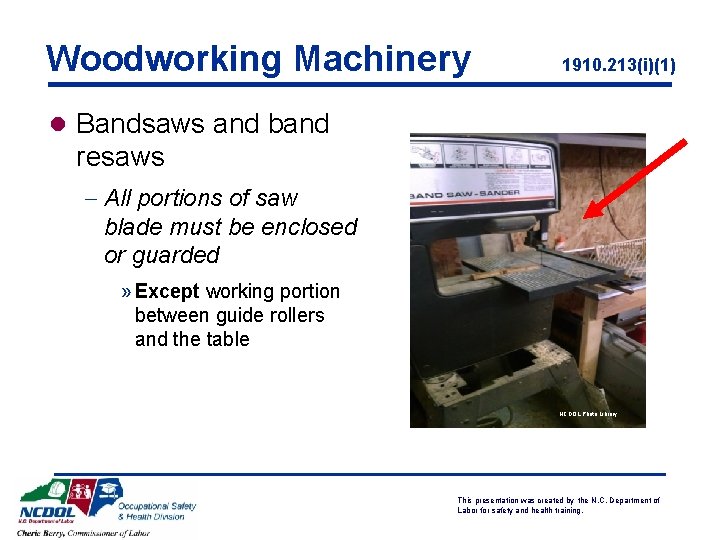
Woodworking Machinery 1910. 213(i)(1) l Bandsaws and band resaws - All portions of saw blade must be enclosed or guarded » Except working portion between guide rollers and the table NCDOL Photo Library This presentation was created by the N. C. Department of Labor for safety and health training.
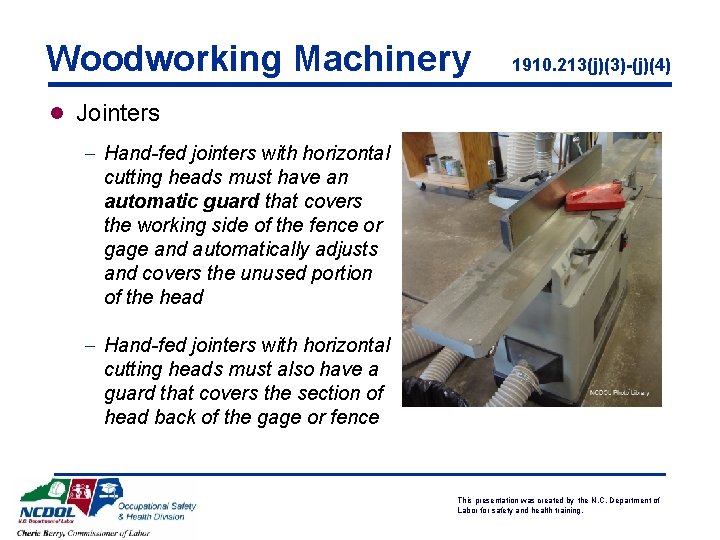
Woodworking Machinery 1910. 213(j)(3)-(j)(4) l Jointers - Hand-fed jointers with horizontal cutting heads must have an automatic guard that covers the working side of the fence or gage and automatically adjusts and covers the unused portion of the head - Hand-fed jointers with horizontal cutting heads must also have a guard that covers the section of head back of the gage or fence This presentation was created by the N. C. Department of Labor for safety and health training.
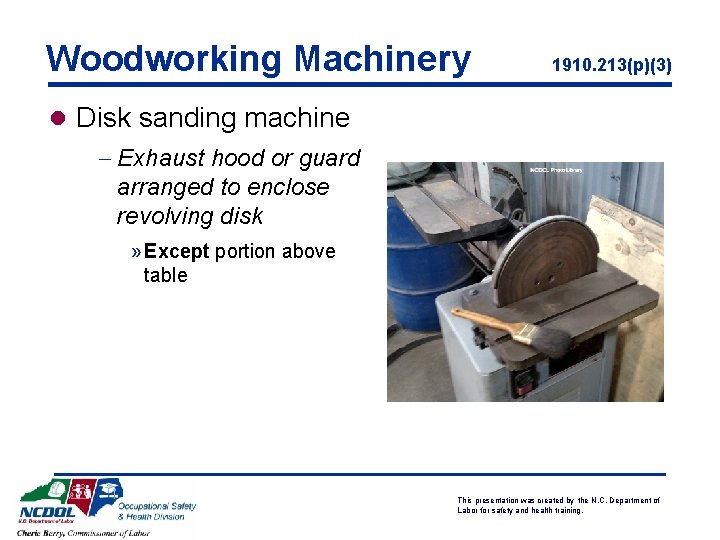
Woodworking Machinery 1910. 213(p)(3) l Disk sanding machine - Exhaust hood or guard arranged to enclose revolving disk » Except portion above table This presentation was created by the N. C. Department of Labor for safety and health training.
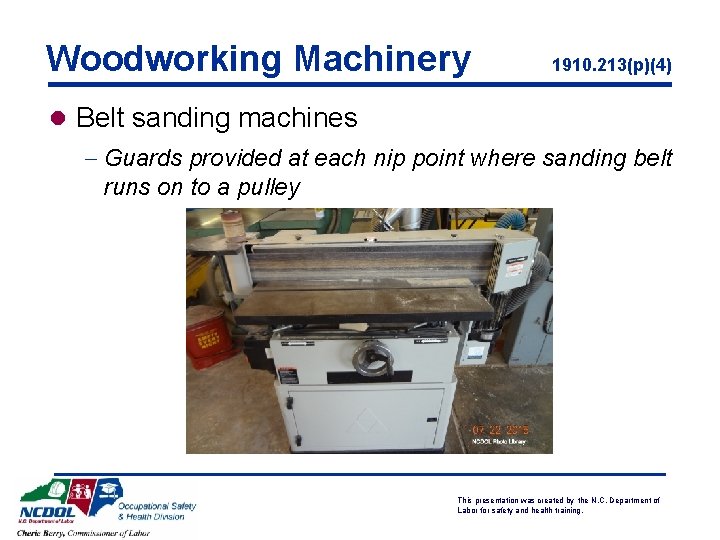
Woodworking Machinery 1910. 213(p)(4) l Belt sanding machines - Guards provided at each nip point where sanding belt runs on to a pulley This presentation was created by the N. C. Department of Labor for safety and health training.
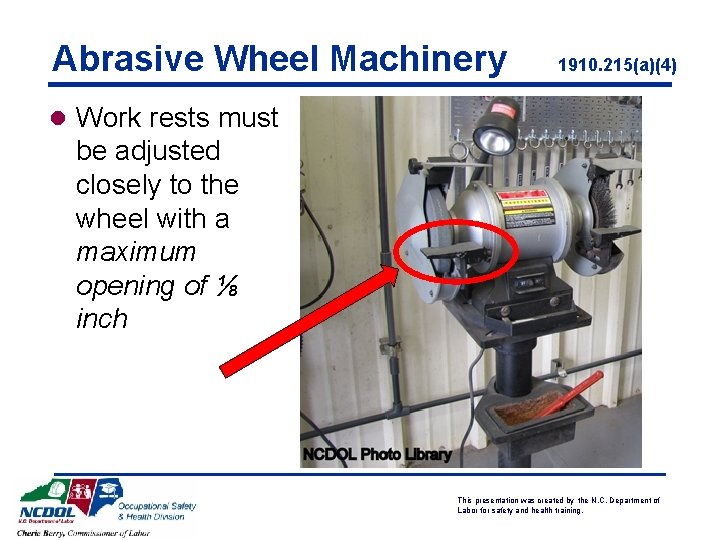
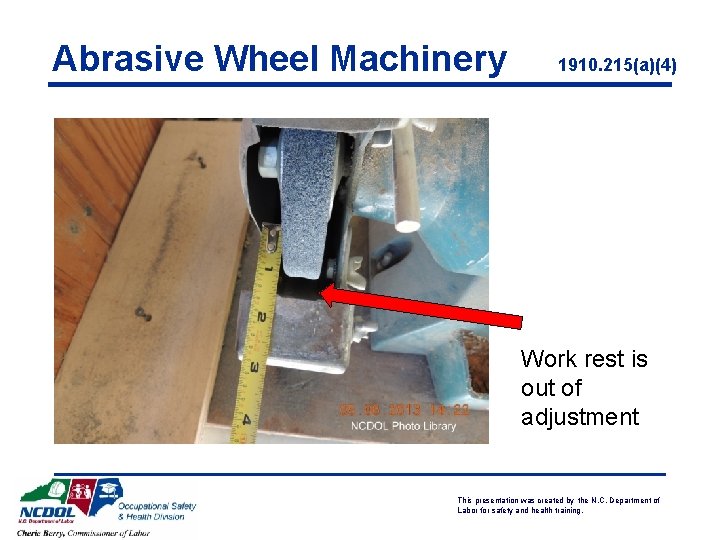
Abrasive Wheel Machinery 1910. 215(a)(4) l Work rests must be adjusted closely to the wheel with a maximum opening of ⅛ inch This presentation was created by the N. C. Department of Labor for safety and health training.
Abrasive Wheel Machinery 1910. 215(a)(4) Work rest is out of adjustment This presentation was created by the N. C. Department of Labor for safety and health training.
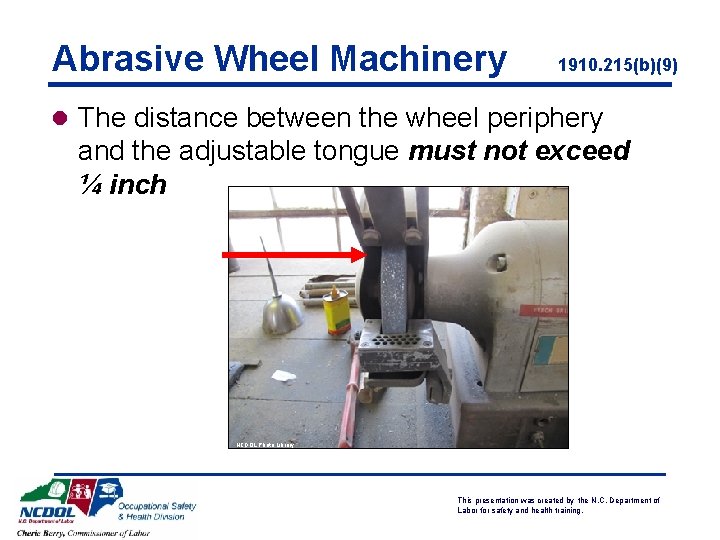
Abrasive Wheel Machinery 1910. 215(b)(9) l The distance between the wheel periphery and the adjustable tongue must not exceed ¼ inch NCDOL Photo Library This presentation was created by the N. C. Department of Labor for safety and health training.
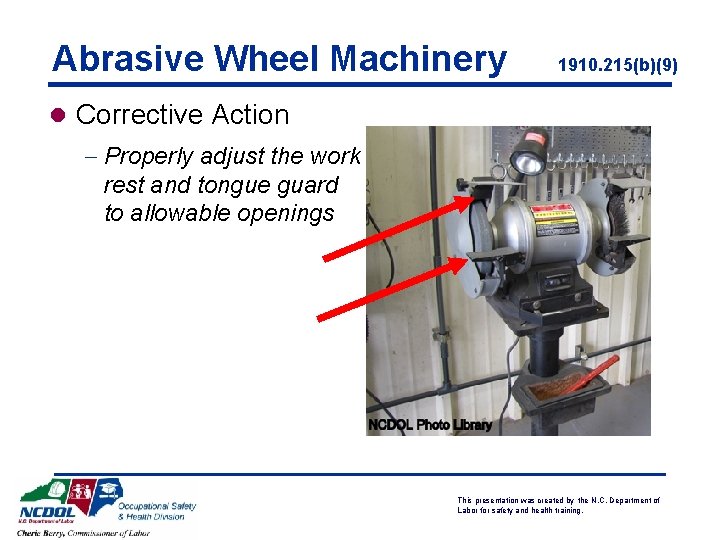
Abrasive Wheel Machinery 1910. 215(b)(9) l Corrective Action - Properly adjust the work rest and tongue guard to allowable openings This presentation was created by the N. C. Department of Labor for safety and health training.
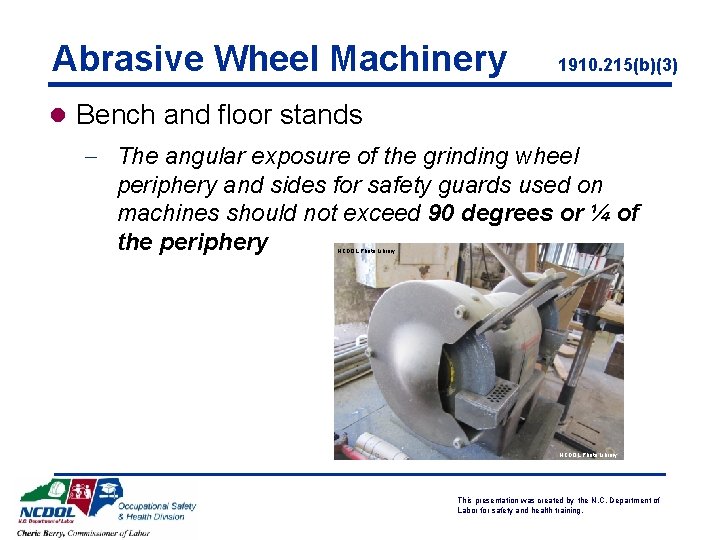
Abrasive Wheel Machinery 1910. 215(b)(3) l Bench and floor stands - The angular exposure of the grinding wheel periphery and sides for safety guards used on machines should not exceed 90 degrees or ¼ of the periphery NCDOL Photo Library This presentation was created by the N. C. Department of Labor for safety and health training.
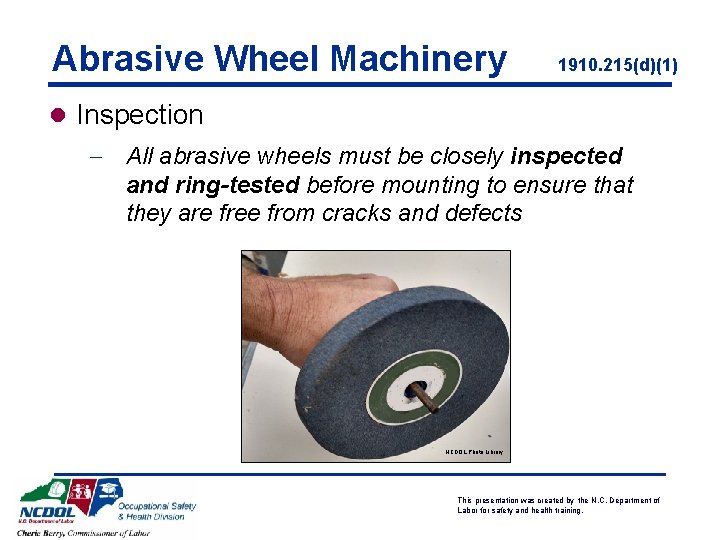
Abrasive Wheel Machinery 1910. 215(d)(1) l Inspection - All abrasive wheels must be closely inspected and ring-tested before mounting to ensure that they are free from cracks and defects NCDOL Photo Library This presentation was created by the N. C. Department of Labor for safety and health training.
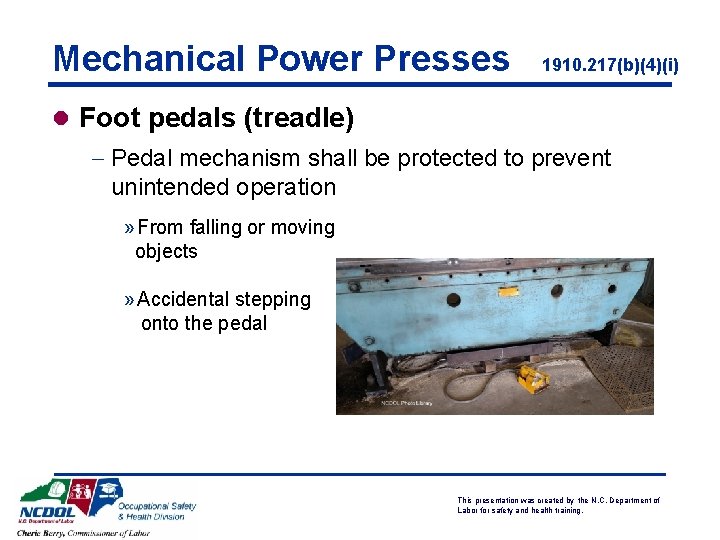
Mechanical Power Presses 1910. 217(b)(4)(i) l Foot pedals (treadle) - Pedal mechanism shall be protected to prevent unintended operation » From falling or moving objects » Accidental stepping onto the pedal This presentation was created by the N. C. Department of Labor for safety and health training.
Mechanical Power Presses 1910. 217(c)(1), (c)(3)(iii)-(iii)(a) l Safeguarding the point of operation - Point of operation must be provided with guards or point of operation devices l Presence sensing point of operation device - Must be interlocked into the control circuit to prevent or stop slide motion if part of operator’s body is within sensing field during down stroke of press slide l Presence sensing point of operation device - Presence sensing devices cannot be used on machines using full revolution clutches This presentation was created by the N. C. Department of Labor for safety and health training.
Mechanical Power Presses 910. 217(c)(3)(iv) l Pull-out device shall include attachments for each of operator’s hands - Connected to and operated only by press slide of upper die - Properly adjusted - Visually inspected and properly adjusted at start of each operator shift This presentation was created by the N. C. Department of Labor for safety and health training.
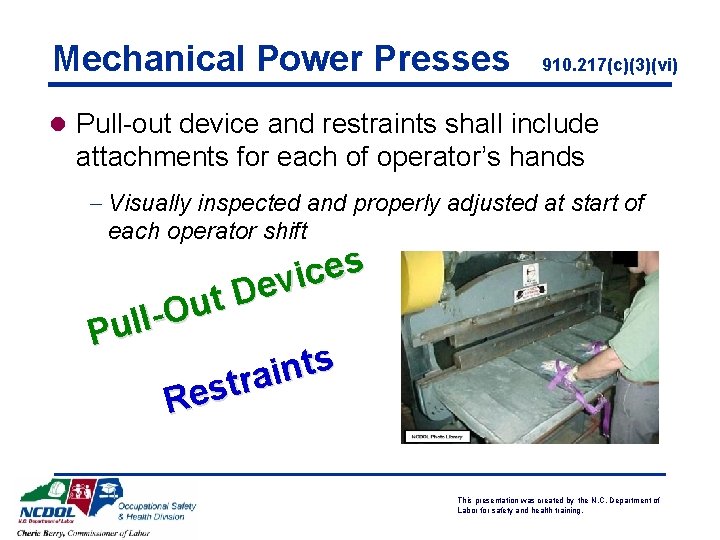
Mechanical Power Presses 910. 217(c)(3)(vi) l Pull-out device and restraints shall include attachments for each of operator’s hands - Visually inspected and properly adjusted at start of each operator shift s e c i v e D t u O l l u P s t n i a r t s Re This presentation was created by the N. C. Department of Labor for safety and health training.
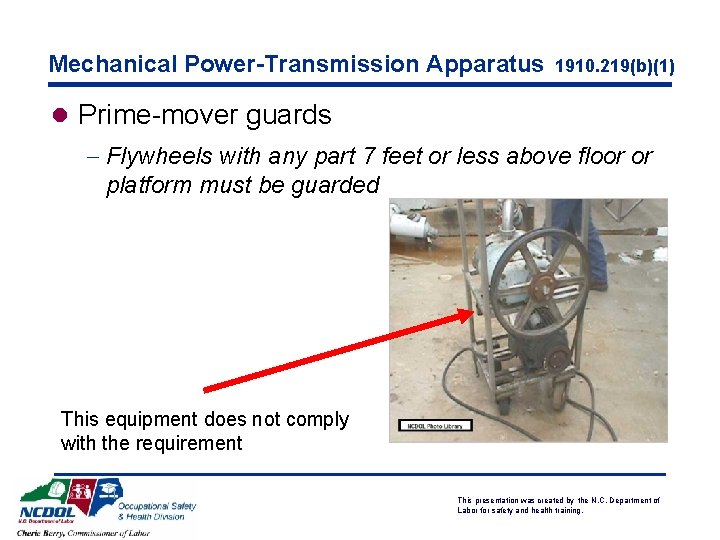
Mechanical Power-Transmission Apparatus 1910. 219(b)(1) l Prime-mover guards - Flywheels with any part 7 feet or less above floor or platform must be guarded This equipment does not comply with the requirement This presentation was created by the N. C. Department of Labor for safety and health training.
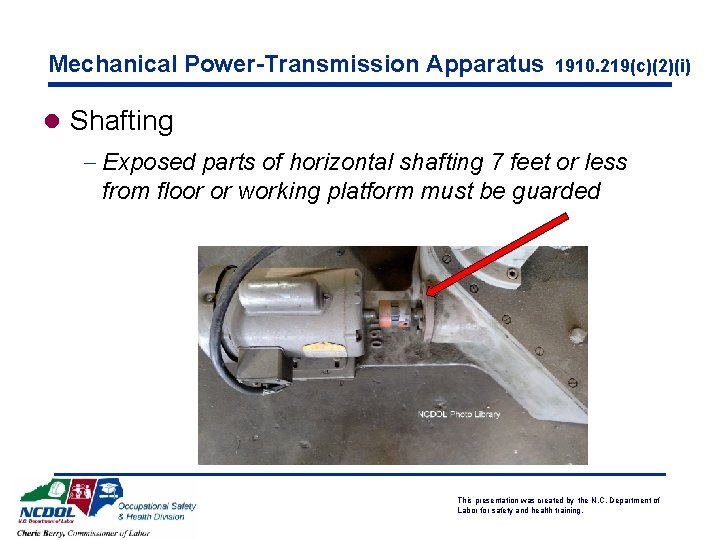
Mechanical Power-Transmission Apparatus 1910. 219(c)(2)(i) l Shafting - Exposed parts of horizontal shafting 7 feet or less from floor or working platform must be guarded This presentation was created by the N. C. Department of Labor for safety and health training.
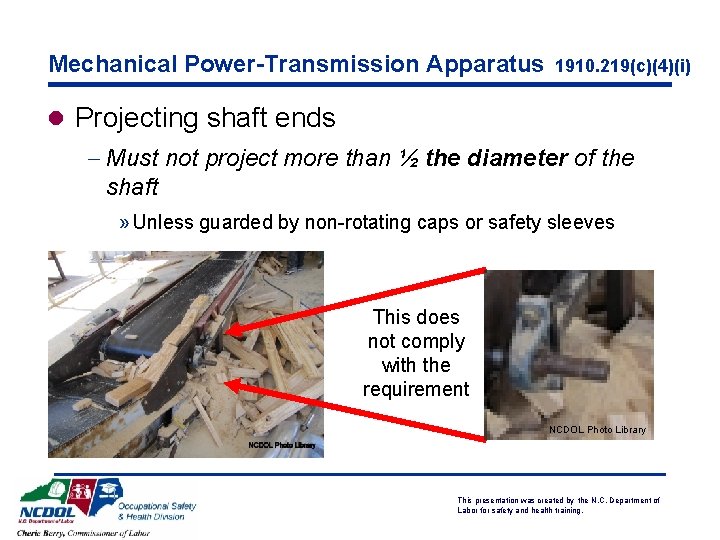
Mechanical Power-Transmission Apparatus 1910. 219(c)(4)(i) l Projecting shaft ends - Must not project more than ½ the diameter of the shaft » Unless guarded by non-rotating caps or safety sleeves This does not comply with the requirement NCDOL Photo Library This presentation was created by the N. C. Department of Labor for safety and health training.
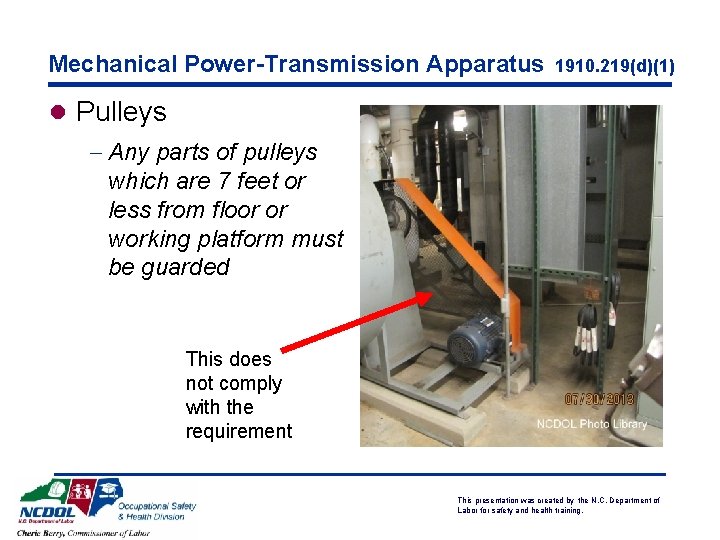
Mechanical Power-Transmission Apparatus 1910. 219(d)(1) l Pulleys - Any parts of pulleys which are 7 feet or less from floor or working platform must be guarded This does not comply with the requirement This presentation was created by the N. C. Department of Labor for safety and health training.
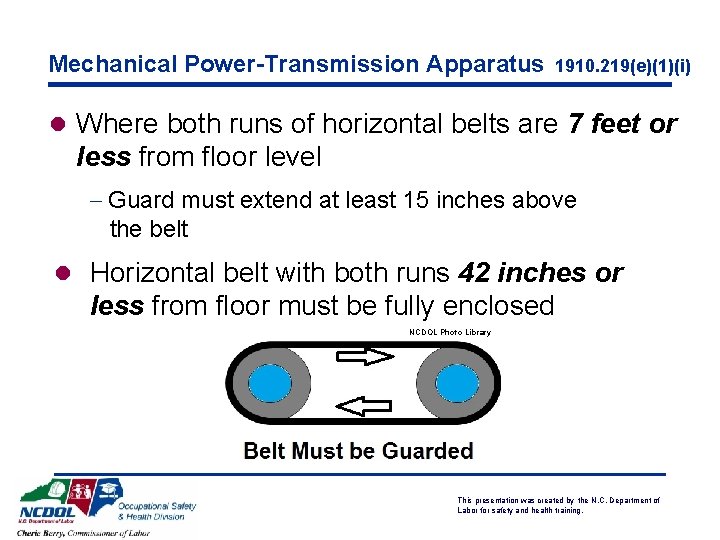
Mechanical Power-Transmission Apparatus 1910. 219(e)(1)(i) l Where both runs of horizontal belts are 7 feet or less from floor level - Guard must extend at least 15 inches above the belt l Horizontal belt with both runs 42 inches or less from floor must be fully enclosed NCDOL Photo Library This presentation was created by the N. C. Department of Labor for safety and health training.
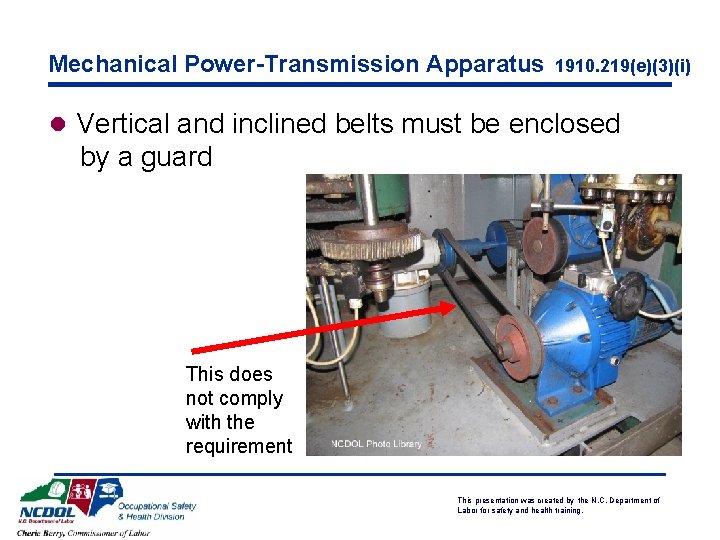
Mechanical Power-Transmission Apparatus 1910. 219(e)(3)(i) l Vertical and inclined belts must be enclosed by a guard This does not comply with the requirement This presentation was created by the N. C. Department of Labor for safety and health training.
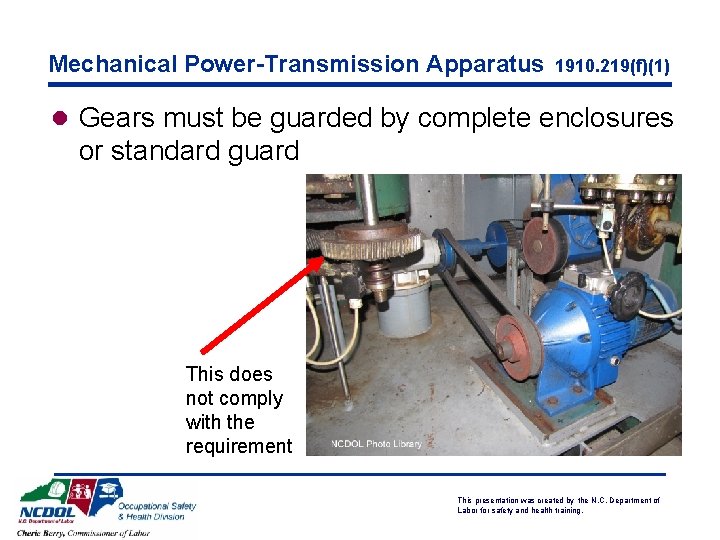
Mechanical Power-Transmission Apparatus 1910. 219(f)(1) l Gears must be guarded by complete enclosures or standard guard This does not comply with the requirement This presentation was created by the N. C. Department of Labor for safety and health training.
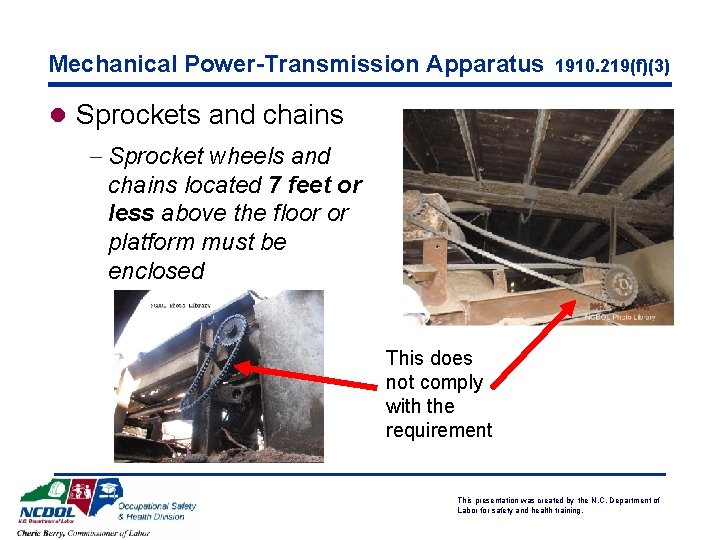
Mechanical Power-Transmission Apparatus 1910. 219(f)(3) l Sprockets and chains - Sprocket wheels and chains located 7 feet or less above the floor or platform must be enclosed This does not comply with the requirement This presentation was created by the N. C. Department of Labor for safety and health training.
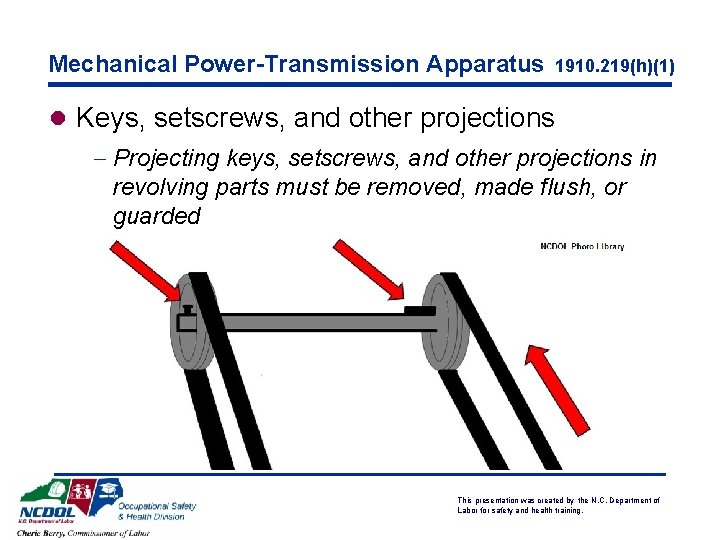
Mechanical Power-Transmission Apparatus 1910. 219(h)(1) l Keys, setscrews, and other projections - Projecting keys, setscrews, and other projections in revolving parts must be removed, made flush, or guarded This presentation was created by the N. C. Department of Labor for safety and health training.
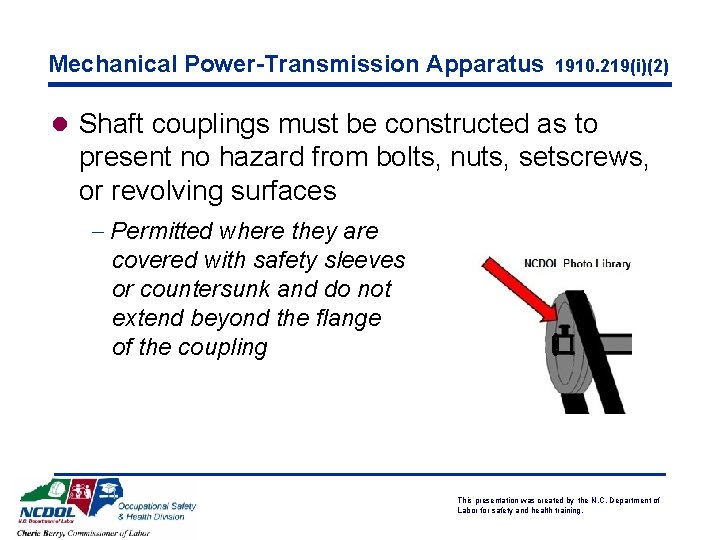
Mechanical Power-Transmission Apparatus 1910. 219(i)(2) l Shaft couplings must be constructed as to present no hazard from bolts, nuts, setscrews, or revolving surfaces - Permitted where they are covered with safety sleeves or countersunk and do not extend beyond the flange of the coupling This presentation was created by the N. C. Department of Labor for safety and health training.
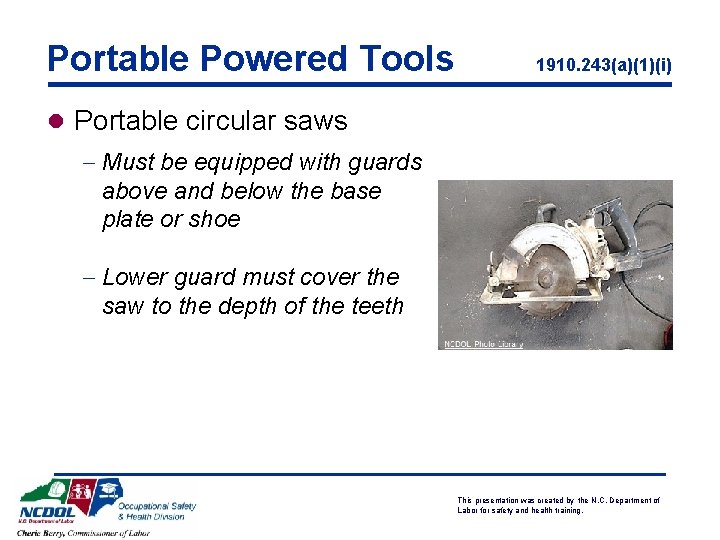
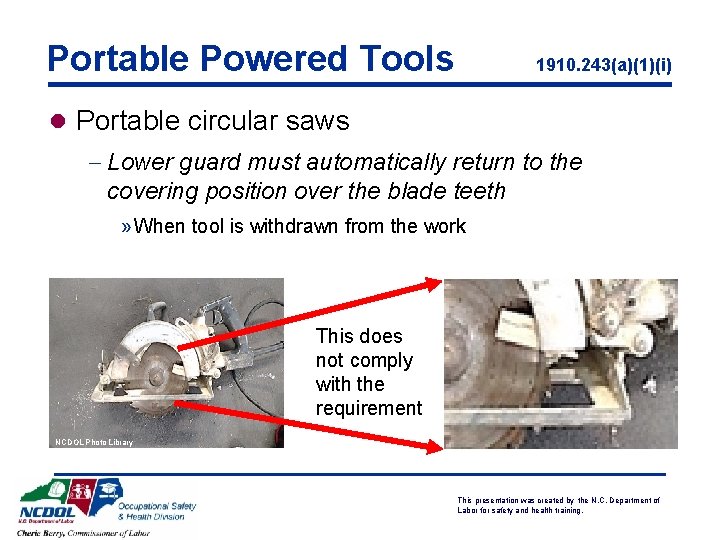
Portable Powered Tools 1910. 243(a)(1)(i) l Portable circular saws - Must be equipped with guards above and below the base plate or shoe - Lower guard must cover the saw to the depth of the teeth This presentation was created by the N. C. Department of Labor for safety and health training.
Portable Powered Tools 1910. 243(a)(1)(i) l Portable circular saws - Lower guard must automatically return to the covering position over the blade teeth » When tool is withdrawn from the work This does not comply with the requirement NCDOL Photo Library This presentation was created by the N. C. Department of Labor for safety and health training.
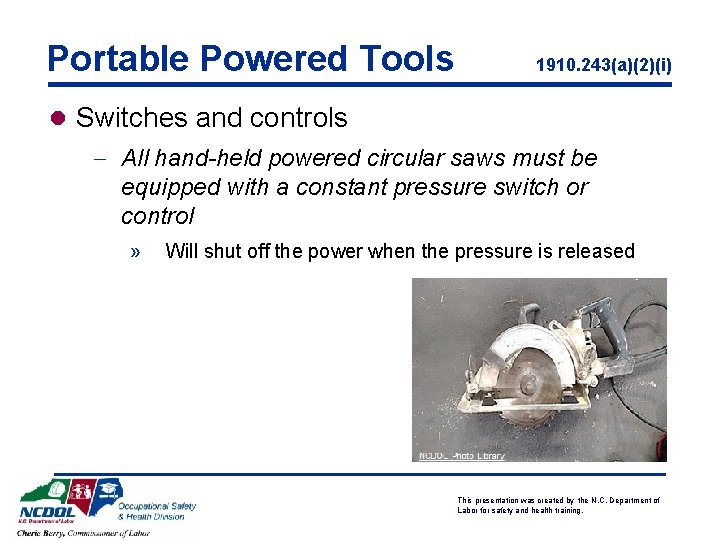
Portable Powered Tools 1910. 243(a)(2)(i) l Switches and controls - All hand-held powered circular saws must be equipped with a constant pressure switch or control » Will shut off the power when the pressure is released This presentation was created by the N. C. Department of Labor for safety and health training.
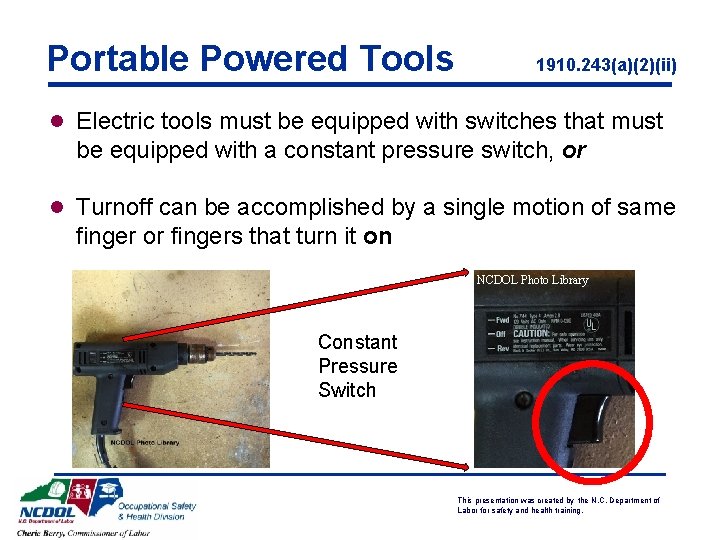
Portable Powered Tools 1910. 243(a)(2)(ii) l Electric tools must be equipped with switches that must be equipped with a constant pressure switch, or l Turnoff can be accomplished by a single motion of same finger or fingers that turn it on NCDOL Photo Library Constant Pressure Switch This presentation was created by the N. C. Department of Labor for safety and health training.
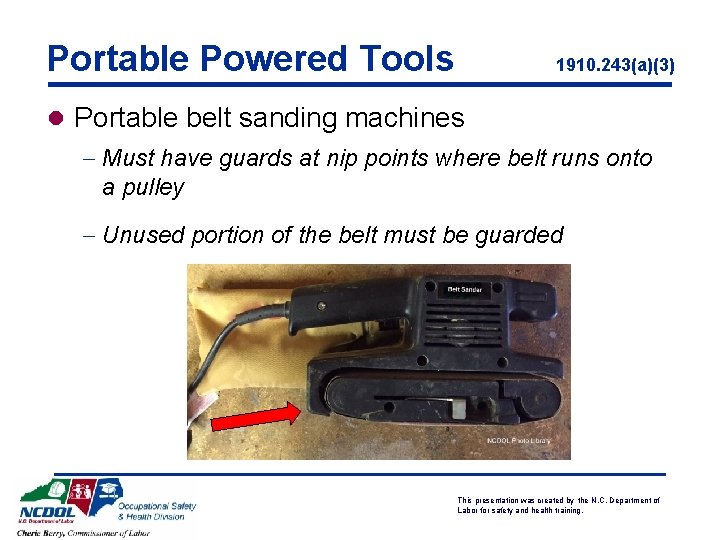
Portable Powered Tools 1910. 243(a)(3) l Portable belt sanding machines - Must have guards at nip points where belt runs onto a pulley - Unused portion of the belt must be guarded This presentation was created by the N. C. Department of Labor for safety and health training.
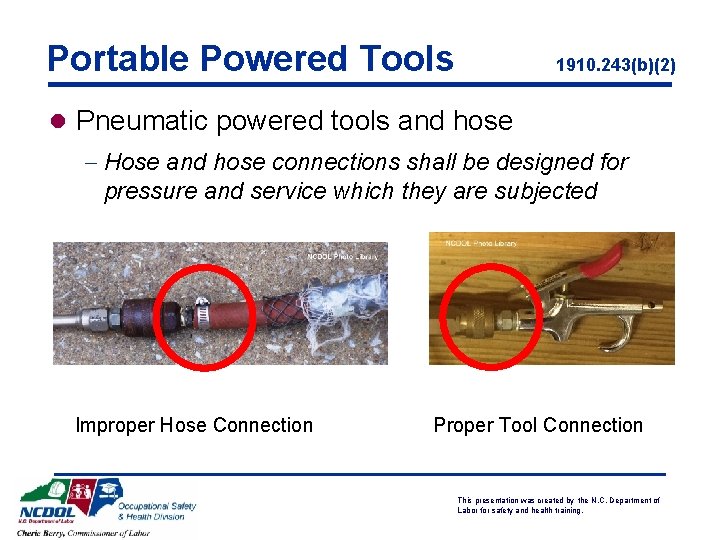
Portable Powered Tools 1910. 243(b)(2) l Pneumatic powered tools and hose - Hose and hose connections shall be designed for pressure and service which they are subjected Improper Hose Connection Proper Tool Connection This presentation was created by the N. C. Department of Labor for safety and health training.
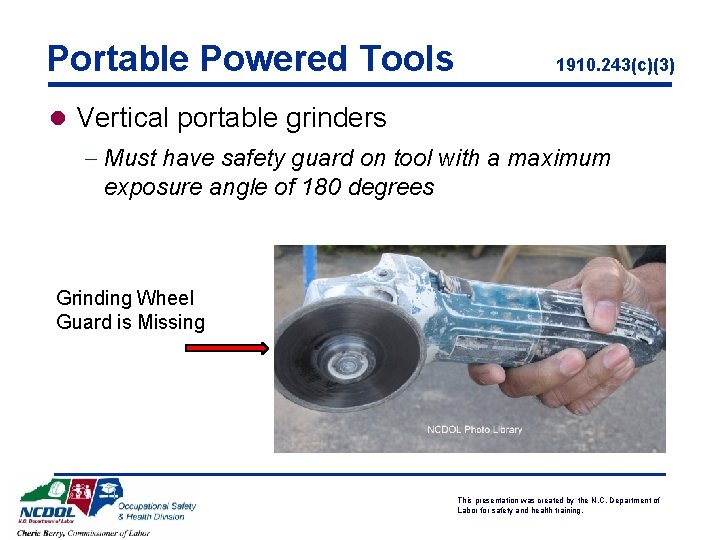
Portable Powered Tools 1910. 243(c)(3) l Vertical portable grinders - Must have safety guard on tool with a maximum exposure angle of 180 degrees Grinding Wheel Guard is Missing This presentation was created by the N. C. Department of Labor for safety and health training.
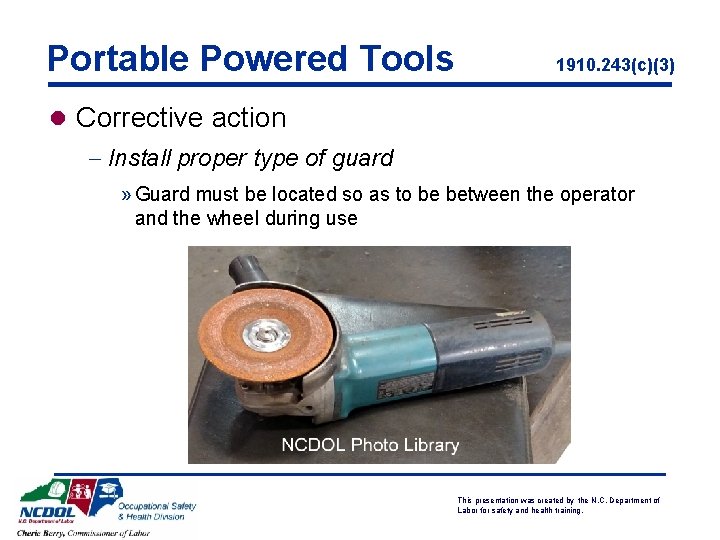
Portable Powered Tools 1910. 243(c)(3) l Corrective action - Install proper type of guard » Guard must be located so as to be between the operator and the wheel during use This presentation was created by the N. C. Department of Labor for safety and health training.
Summary l Students should now have a basic understanding of the following: - Machine guarding hazards - Machine guarding abatement methods - Machine guarding standards This presentation was created by the N. C. Department of Labor for safety and health training.
Thank You For Attending! Final Questions? This presentation was created by the N. C. Department of Labor for safety and health training.