
MACHINE VISION RAMESH JAIN RANGACHAR KASTURI BRIAN G
MACHINE VISION RAMESH JAIN – RANGACHAR KASTURI – BRIAN G. SCHUNCK MCGRAW-HILL INTERNATIONAL EDITIONS COMPUTER SCIENCE SERIES CHAPTER 08 OPTICS DR. MOSTAFA GAD
CONTENTS Introduction 8. 1 - Lens Equation 8. 2 - Image Resolution 8. 3 - Depth of Field 8. 4 - View Volume 8. 5 - Exposure
INTRODUCTION Machine Vision relies on the pinhole camera model. Pinhole camera model, models the geometry of perspective projection. Perspective projection assumes that the view volume is an infinite pyramid, limited by top, bottom, and sides of the viewable rectangle on the image plane. Optical effects - depth of field, light attenuation- limit the view volume by introducing limits on the distances to viewable objects.
INTRODUCTION (CONT) A pinhole camera is an idealization of the thin lens as aperture shrinks to zero. It assumes that the perspective rays pass through an infinitesimal aperture at the front of the camera Lenses are placed in the aperture to focus the bundle of rays from each point in the scene onto the corresponding point in the image plane.
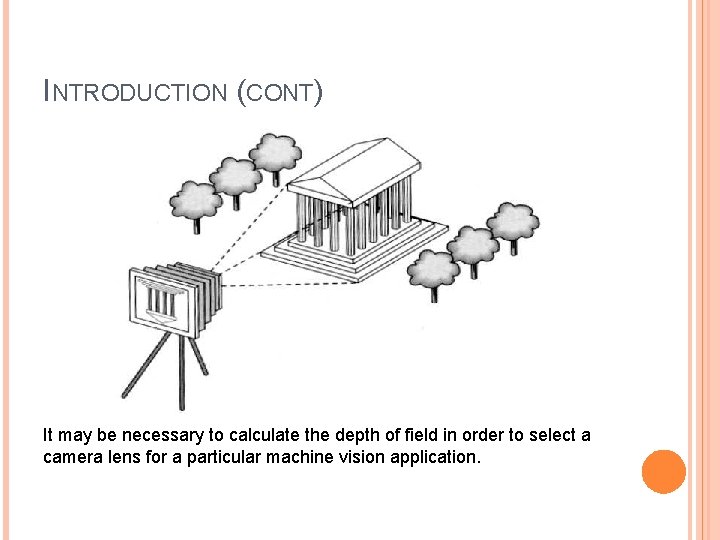
INTRODUCTION (CONT) It may be necessary to calculate the depth of field in order to select a camera lens for a particular machine vision application.
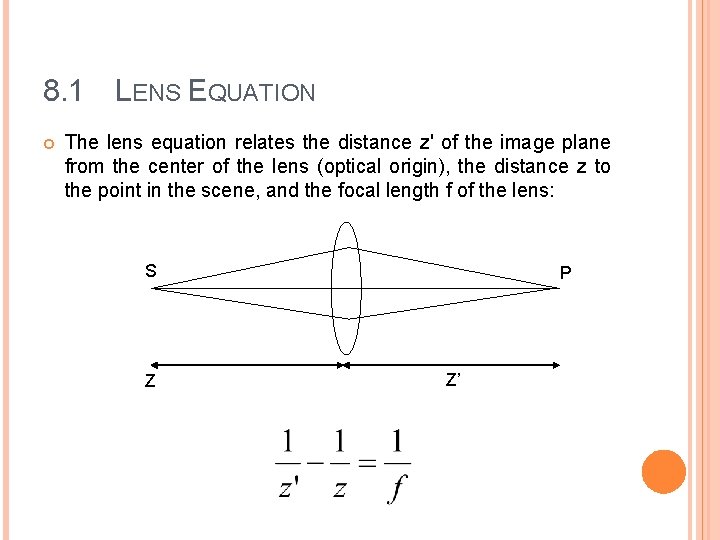
8. 1 LENS EQUATION The lens equation relates the distance z' of the image plane from the center of the lens (optical origin), the distance z to the point in the scene, and the focal length f of the lens: S Z P Z’
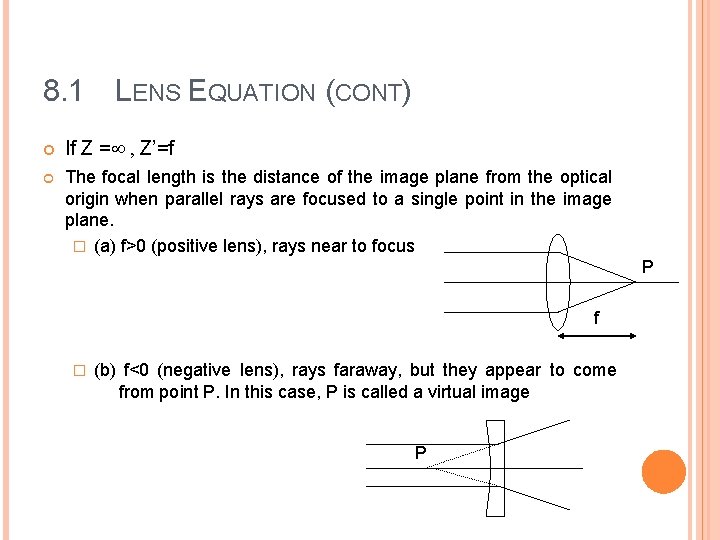
8. 1 LENS EQUATION (CONT) If Z =¥ , Z’=f The focal length is the distance of the image plane from the optical origin when parallel rays are focused to a single point in the image plane. � (a) f>0 (positive lens), rays near to focus P f � (b) f<0 (negative lens), rays faraway, but they appear to come from point P. In this case, P is called a virtual image P
8. 2 IMAGE RESOLUTION Image resolution describes the detail an image holds. Spatial resolution measures how closely lines can be resolved in an image. Spatial resolution is determined by the interplay between pixel spacing and depth of field. For ex: The spatial resolution of computer monitors is generally 72 to 100 lines per inch, corresponding to pixel resolutions of 72 to 100 ppi. Perceiving some separation between features requires at least one imaging element between the features. Ex: � In electronic cameras using photodiodes, the resolution of an image is limited by the spacing between the imaging elements (pixels) in a charge coupled imaging device.
8. 3 DEPTH OF FIELD DOF is the portion of a scene that appears acceptably sharp in the image The purpose of a lens is to allow a larger aperture to be used in the construction of the camera so more light can enter the camera, allowing the camera to function with less ambient illumination A smaller aperture provides more depth of field but admits less light; a larger aperture admits more light but reduces the depth of field.
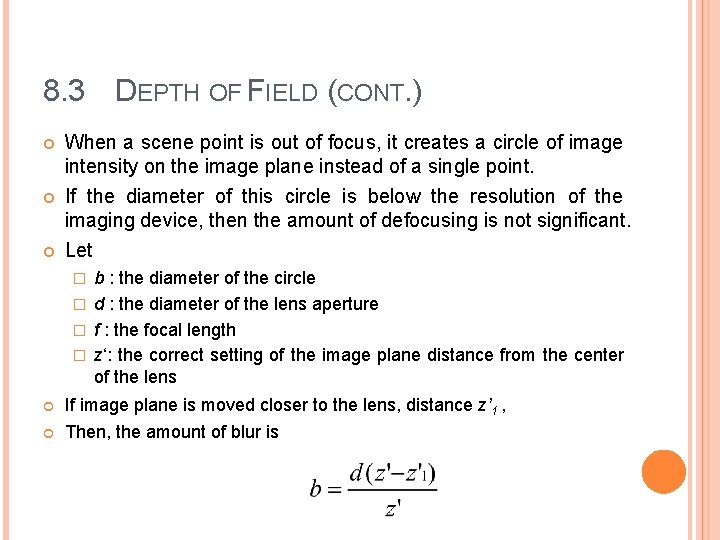
8. 3 DEPTH OF FIELD (CONT. ) When a scene point is out of focus, it creates a circle of image intensity on the image plane instead of a single point. If the diameter of this circle is below the resolution of the imaging device, then the amount of defocusing is not significant. Let b : the diameter of the circle � d : the diameter of the lens aperture � f : the focal length � z‘: the correct setting of the image plane distance from the center of the lens � If image plane is moved closer to the lens, distance z’ 1 , Then, the amount of blur is
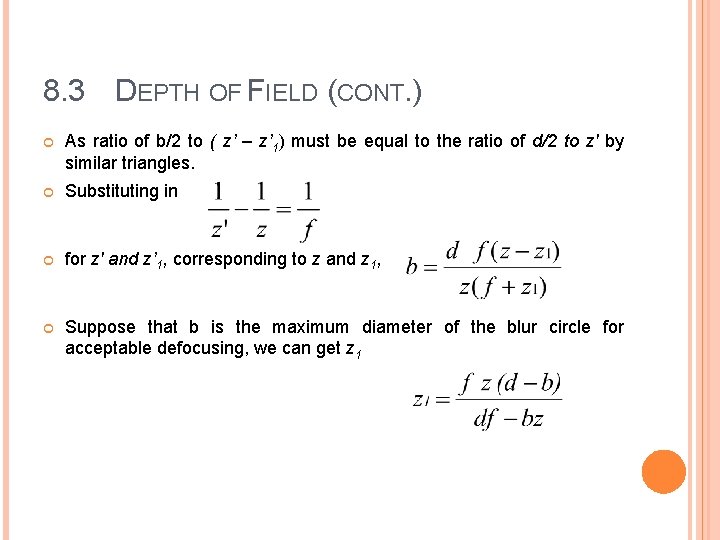
8. 3 DEPTH OF FIELD (CONT. ) As ratio of b/2 to ( z’ – z’ 1) must be equal to the ratio of d/2 to z' by similar triangles. Substituting in for z' and z’ 1, corresponding to z and z 1, Suppose that b is the maximum diameter of the blur circle for acceptable defocusing, we can get z 1
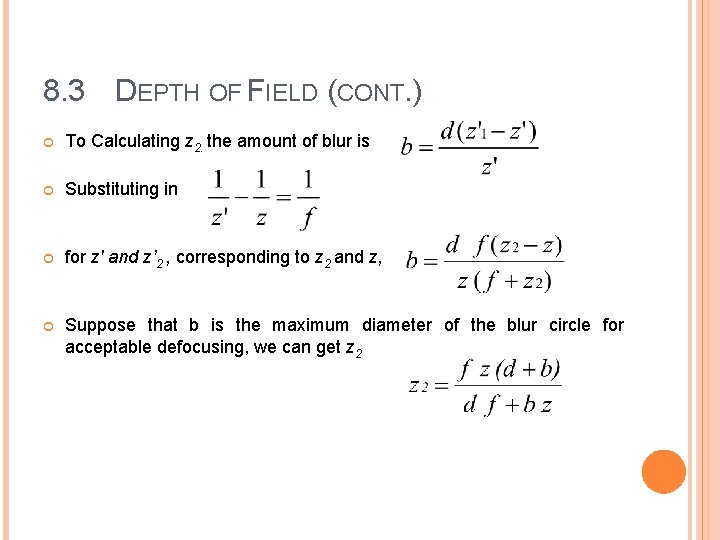
8. 3 DEPTH OF FIELD (CONT. ) To Calculating z 2. the amount of blur is Substituting in for z' and z’ 2 , corresponding to z 2 and z, Suppose that b is the maximum diameter of the blur circle for acceptable defocusing, we can get z 2
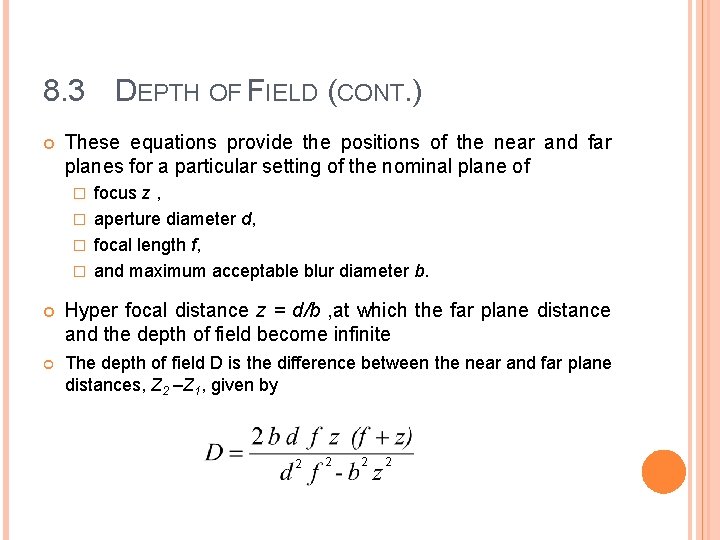
8. 3 DEPTH OF FIELD (CONT. ) These equations provide the positions of the near and far planes for a particular setting of the nominal plane of focus z , � aperture diameter d, � focal length f, � and maximum acceptable blur diameter b. � Hyper focal distance z = d/b , at which the far plane distance and the depth of field become infinite The depth of field D is the difference between the near and far plane distances, Z 2 –Z 1, given by 2 2
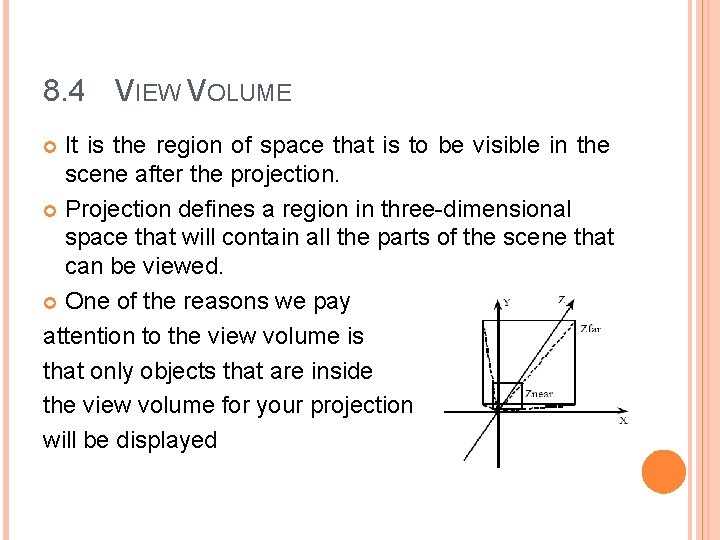
8. 4 VIEW VOLUME It is the region of space that is to be visible in the scene after the projection. Projection defines a region in three-dimensional space that will contain all the parts of the scene that can be viewed. One of the reasons we pay attention to the view volume is that only objects that are inside the view volume for your projection will be displayed
8. 5 EXPOSURE The amount of light collected by the camera depends on the intensity of light falling on the image plane (the image irradiance) and the duration of the exposure (shutter speed)
- Slides: 15