
Machine Translation Word alignment models Christopher Manning CS
![Centauri/Arcturan [Knight, 1997]: It’s Really Spanish/English Clients do not sell pharmaceuticals in Europe =>](https://slidetodoc.com/presentation_image_h2/f22d38455fafa9c5ade66efc0b23769a/image-2.jpg "Centauri/Arcturan [Knight, 1997]: It’s Really Spanish/English Clients do not sell pharmaceuticals in Europe =>")
![Centauri/Arcturan [Knight, 1997] Your assignment, translate this to Arcturan: Your assignment, put these words](https://slidetodoc.com/presentation_image_h2/f22d38455fafa9c5ade66efc0b23769a/image-3.jpg "Centauri/Arcturan [Knight, 1997] Your assignment, translate this to Arcturan: Your assignment, put these words")
- Slides: 42
Machine Translation: Word alignment models Christopher Manning CS 224 N [Based on slides by Kevin Knight, Dan Klein, Dan Jurafsky]
Centauri/Arcturan [Knight, 1997]: It’s Really Spanish/English Clients do not sell pharmaceuticals in Europe => Clientes no venden medicinas en Europa 1 a. Garcia and associates. 1 b. Garcia y asociados. 7 a. the clients and the associates are enemies. 7 b. los clients y los asociados son enemigos. 2 a. Carlos Garcia has three associates. 2 b. Carlos Garcia tiene tres asociados. 8 a. the company has three groups. 8 b. la empresa tiene tres grupos. 3 a. his associates are not strong. 3 b. sus asociados no son fuertes. 9 a. its groups are in Europe. 9 b. sus grupos estan en Europa. 4 a. Garcia has a company also. 4 b. Garcia tambien tiene una empresa. 10 a. the modern groups sell strong pharmaceuticals. 10 b. los grupos modernos venden medicinas fuertes. 5 a. its clients are angry. 5 b. sus clientes estan enfadados. 11 a. the groups do not sell zenzanine. 11 b. los grupos no venden zanzanina. 6 a. the associates are also angry. 6 b. los asociados tambien estan enfadados. 12 a. the small groups are not modern. 12 b. los grupos pequenos no son modernos.
Centauri/Arcturan [Knight, 1997] Your assignment, translate this to Arcturan: Your assignment, put these words in order: farok crrrok hihok yorok clok kantok ok-yurp { jjat, arrat, mat, bat, oloat, at-yurp } 1 a. ok-voon ororok sprok. 7 a. lalok farok ororok lalok sprok izok enemok. 1 b. at-voon bichat dat. 7 b. wat jjat bichat wat dat vat eneat. 2 a. ok-drubel ok-voon anok plok sprok. 8 a. lalok brok anok plok nok. 2 b. at-drubel at-voon pippat rrat dat. 8 b. iat lat pippat rrat nnat. 3 a. erok sprok izok hihok ghirok. 9 a. wiwok nok izok kantok ok-yurp. 3 b. totat dat arrat vat hilat. 4 a. ok-voon anok drok brok jok. 9 b. totat nnat quat oloat at-yurp. 10 a. lalok mok nok yorok ghirok clok. 4 b. at-voon krat pippat sat lat. 5 a. wiwok farok izok stok. 10 b. wat nnat gat mat bat hilat. 11 a. lalok nok crrrok hihok yorok zanzanok. 5 b. totat jjat quat cat. 6 a. lalok sprok izok jok stok. 11 b. wat nnat arrat mat zanzanat. 12 a. lalok rarok nok izok hihok mok. 6 b. wat dat krat quat cat. 12 b. wat nnat forat arrat vat gat. zero fertility
From No Data to Sentence Pairs • Really hard way: pay $$$ – Suppose one billion words of parallel data were sufficient – At 20 cents/word, that’s $200 million • Pretty hard way: Find it, and then earn it! – – – De-formatting Remove strange characters Character code conversion Document alignment Sentence alignment Tokenization (also called Segmentation) • Easy way: Linguistic Data Consortium (LDC)
Ready-to-Use Online Bilingual Data Millions of words (English side) + 1 m-20 m words for many language pairs (Data stripped of formatting, in sentence-pair format, available from the Linguistic Data Consortium at UPenn).
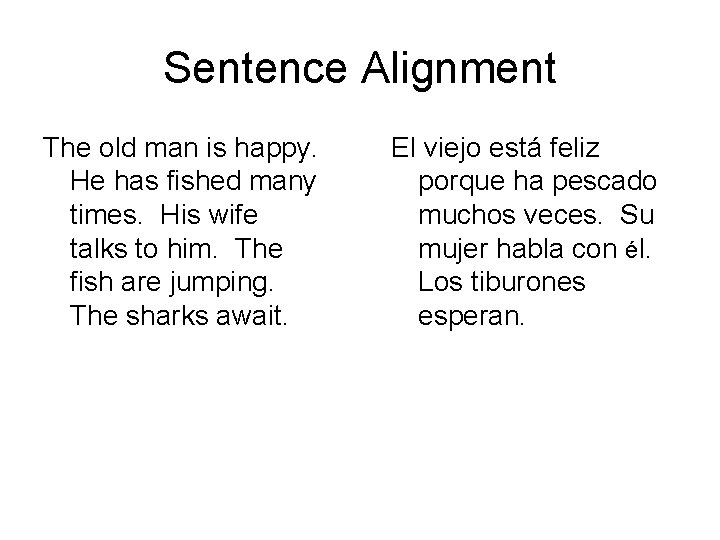
Sentence Alignment The old man is happy. He has fished many times. His wife talks to him. The fish are jumping. The sharks await. El viejo está feliz porque ha pescado muchos veces. Su mujer habla con él. Los tiburones esperan.
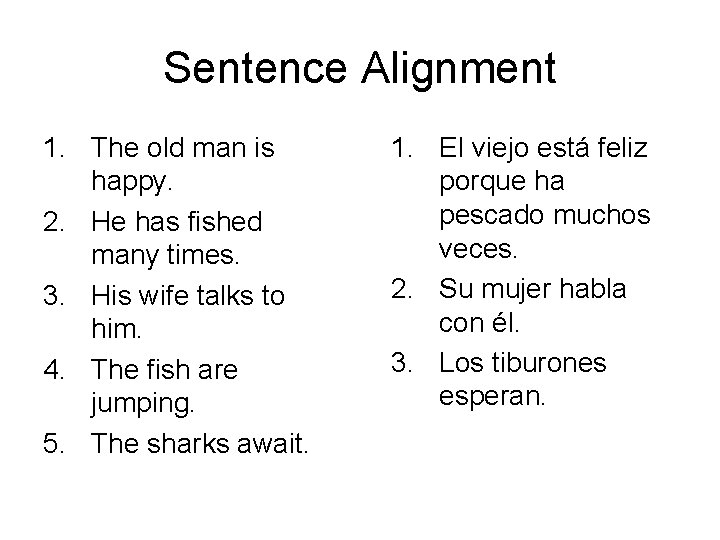
Sentence Alignment 1. The old man is happy. 2. He has fished many times. 3. His wife talks to him. 4. The fish are jumping. 5. The sharks await. 1. El viejo está feliz porque ha pescado muchos veces. 2. Su mujer habla con él. 3. Los tiburones esperan.
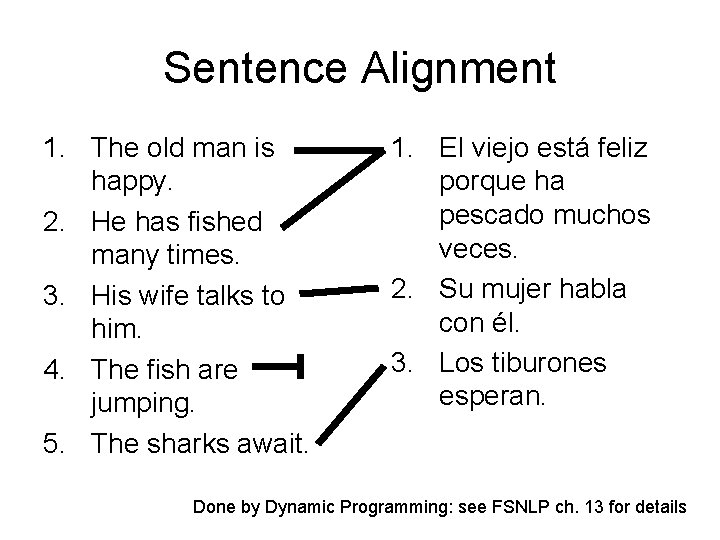
Sentence Alignment 1. The old man is happy. 2. He has fished many times. 3. His wife talks to him. 4. The fish are jumping. 5. The sharks await. 1. El viejo está feliz porque ha pescado muchos veces. 2. Su mujer habla con él. 3. Los tiburones esperan. Done by Dynamic Programming: see FSNLP ch. 13 for details
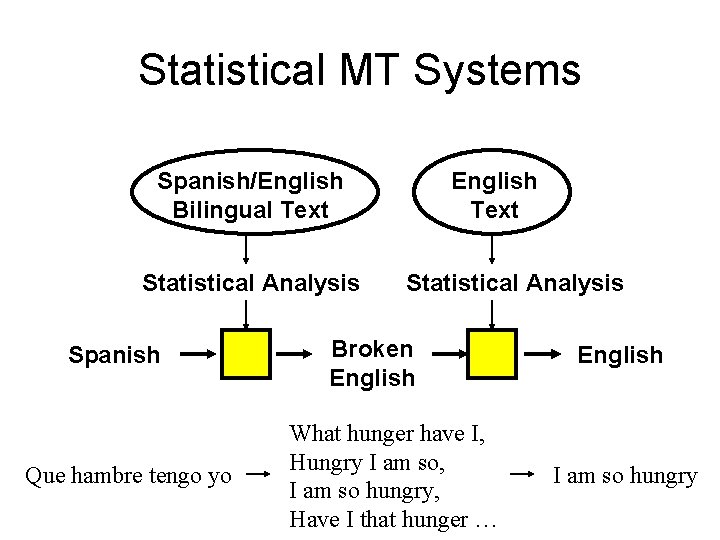
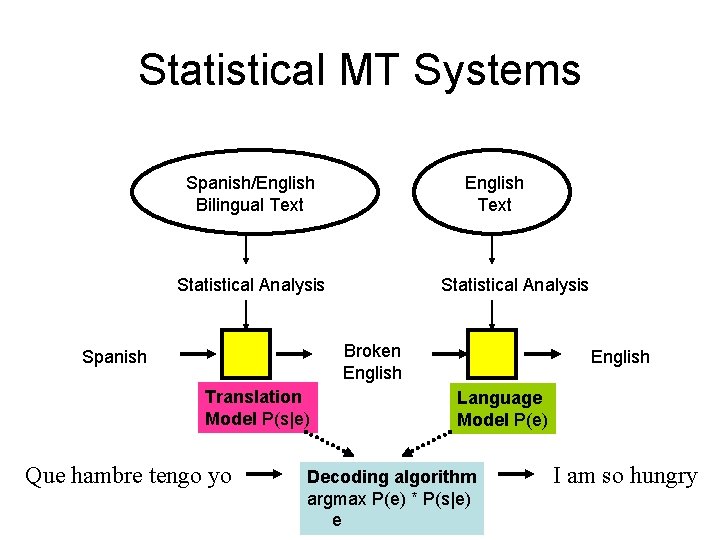
Statistical MT Systems Spanish/English Bilingual Text Statistical Analysis Spanish Que hambre tengo yo English Text Statistical Analysis Broken English What hunger have I, Hungry I am so, I am so hungry, Have I that hunger … English I am so hungry
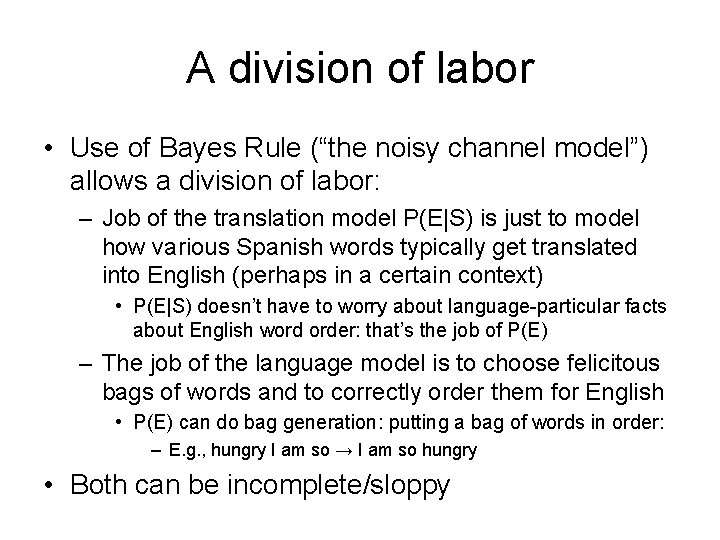
A division of labor • Use of Bayes Rule (“the noisy channel model”) allows a division of labor: – Job of the translation model P(E|S) is just to model how various Spanish words typically get translated into English (perhaps in a certain context) • P(E|S) doesn’t have to worry about language-particular facts about English word order: that’s the job of P(E) – The job of the language model is to choose felicitous bags of words and to correctly order them for English • P(E) can do bag generation: putting a bag of words in order: – E. g. , hungry I am so → I am so hungry • Both can be incomplete/sloppy
Statistical MT Systems Spanish/English Bilingual Text English Text Statistical Analysis Broken English Spanish Translation Model P(s|e) Que hambre tengo yo English Language Model P(e) Decoding algorithm argmax P(e) * P(s|e) e I am so hungry
Word Alignment Examples: Grid
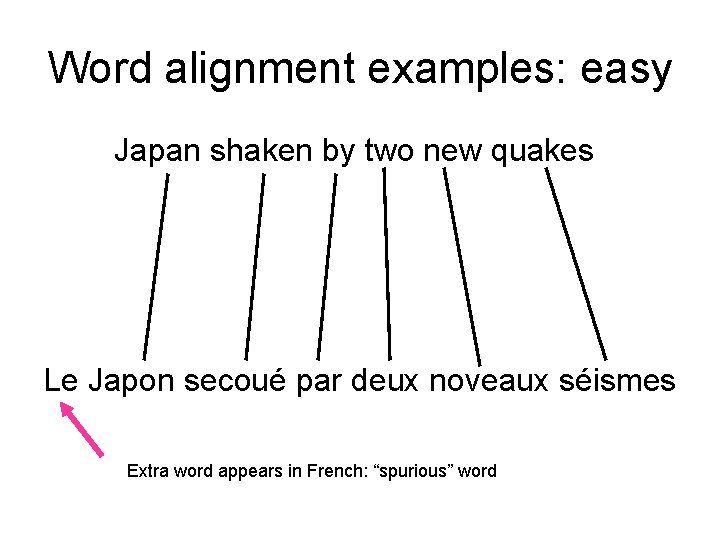
Word alignment examples: easy Japan shaken by two new quakes Le Japon secoué par deux noveaux séismes Extra word appears in French: “spurious” word
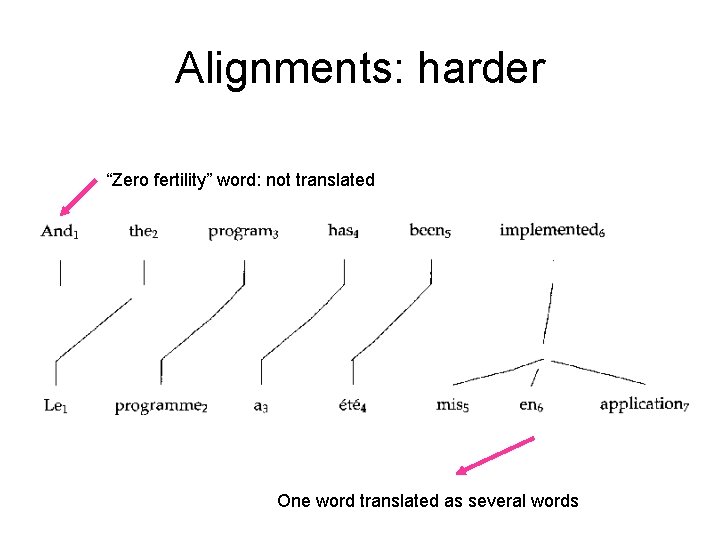
Alignments: harder “Zero fertility” word: not translated One word translated as several words
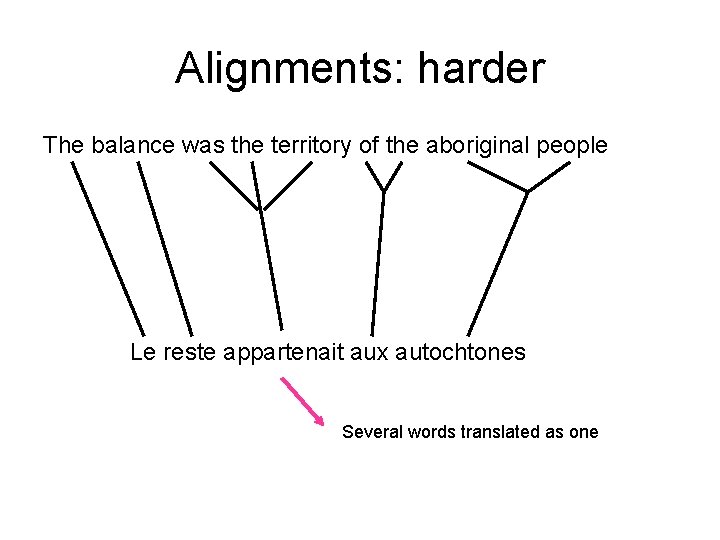
Alignments: harder The balance was the territory of the aboriginal people Le reste appartenait aux autochtones Several words translated as one
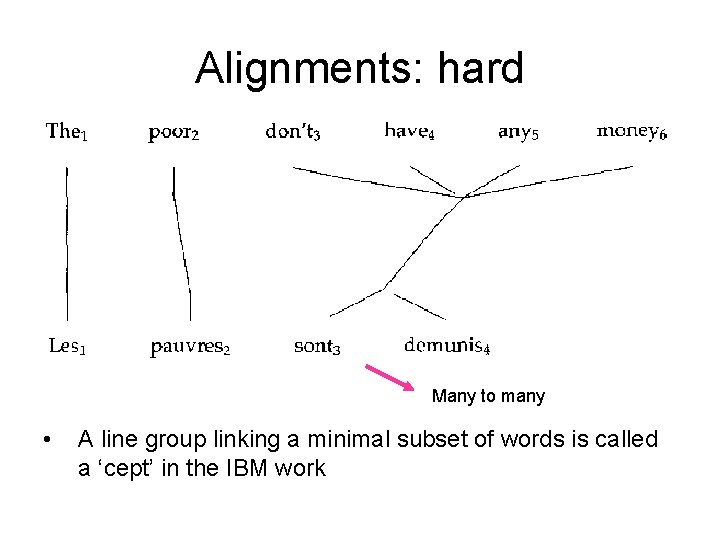
Alignments: hard Many to many • A line group linking a minimal subset of words is called a ‘cept’ in the IBM work
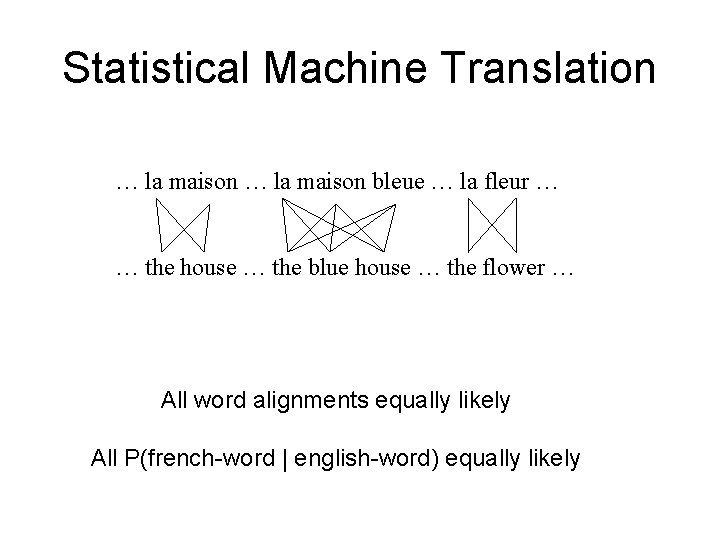
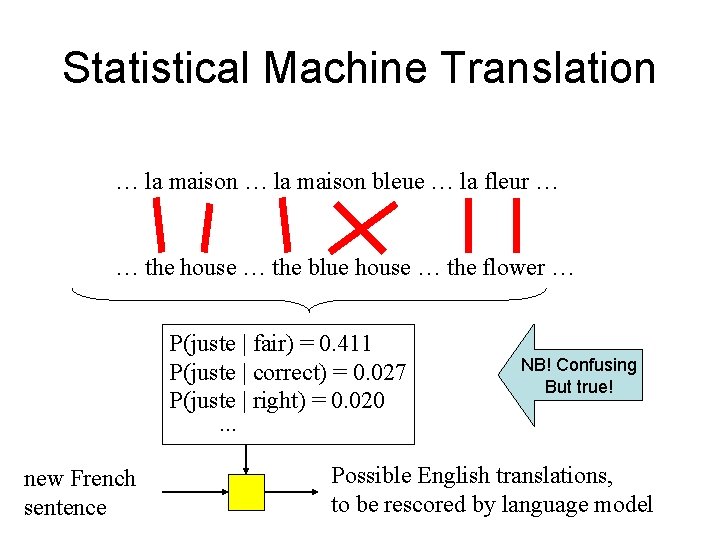
Statistical Machine Translation … la maison bleue … la fleur … … the house … the blue house … the flower … All word alignments equally likely All P(french-word | english-word) equally likely
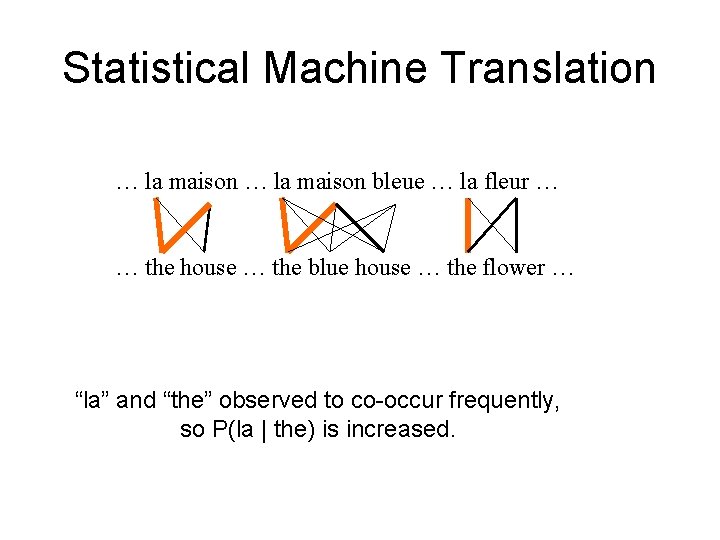
Statistical Machine Translation … la maison bleue … la fleur … … the house … the blue house … the flower … “la” and “the” observed to co-occur frequently, so P(la | the) is increased.
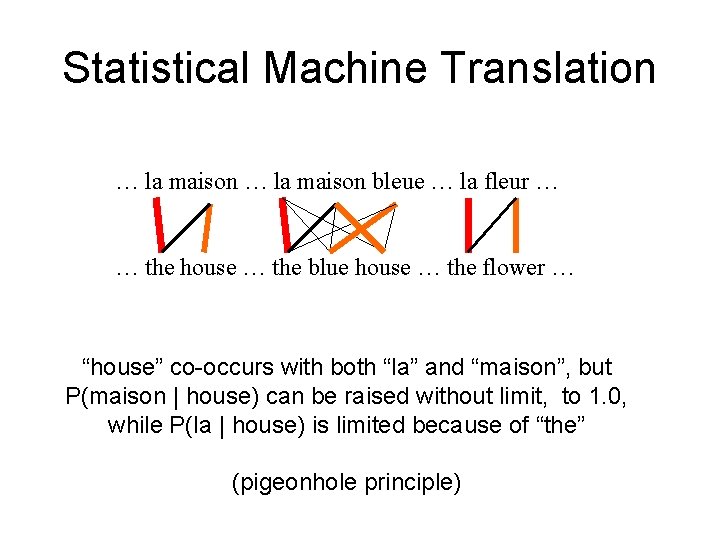
Statistical Machine Translation … la maison bleue … la fleur … … the house … the blue house … the flower … “house” co-occurs with both “la” and “maison”, but P(maison | house) can be raised without limit, to 1. 0, while P(la | house) is limited because of “the” (pigeonhole principle)
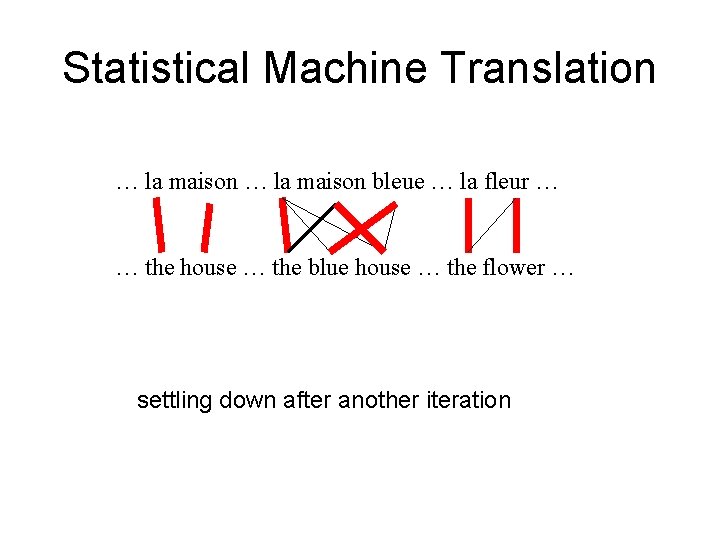
Statistical Machine Translation … la maison bleue … la fleur … … the house … the blue house … the flower … settling down after another iteration
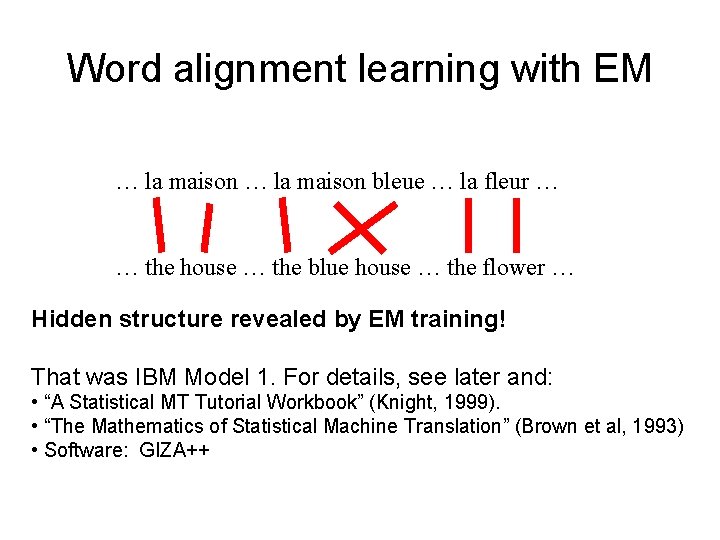
Word alignment learning with EM … la maison bleue … la fleur … … the house … the blue house … the flower … Hidden structure revealed by EM training! That was IBM Model 1. For details, see later and: • “A Statistical MT Tutorial Workbook” (Knight, 1999). • “The Mathematics of Statistical Machine Translation” (Brown et al, 1993) • Software: GIZA++
Statistical Machine Translation … la maison bleue … la fleur … … the house … the blue house … the flower … P(juste | fair) = 0. 411 P(juste | correct) = 0. 027 P(juste | right) = 0. 020 NB! Confusing But true! … new French sentence Possible English translations, to be rescored by language model
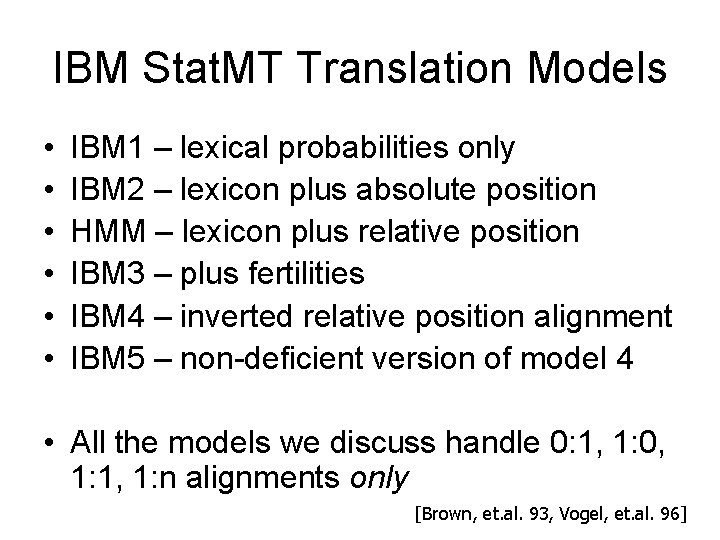
IBM Stat. MT Translation Models • • • IBM 1 – lexical probabilities only IBM 2 – lexicon plus absolute position HMM – lexicon plus relative position IBM 3 – plus fertilities IBM 4 – inverted relative position alignment IBM 5 – non-deficient version of model 4 • All the models we discuss handle 0: 1, 1: 0, 1: 1, 1: n alignments only [Brown, et. al. 93, Vogel, et. al. 96]
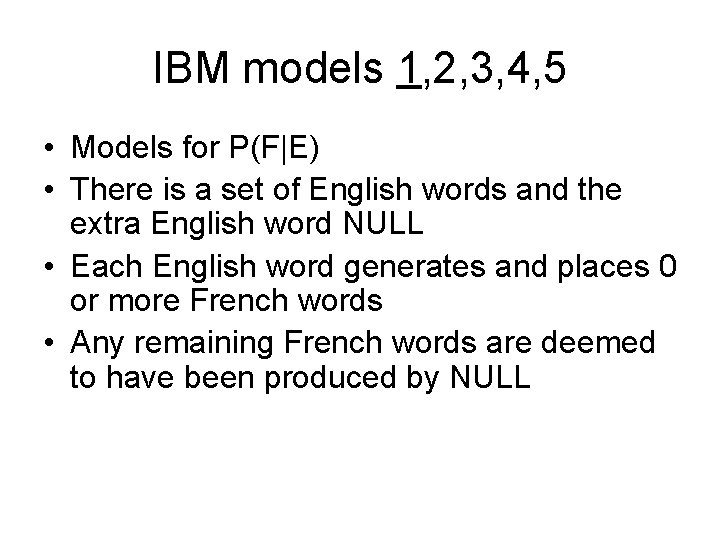
IBM models 1, 2, 3, 4, 5 • Models for P(F|E) • There is a set of English words and the extra English word NULL • Each English word generates and places 0 or more French words • Any remaining French words are deemed to have been produced by NULL
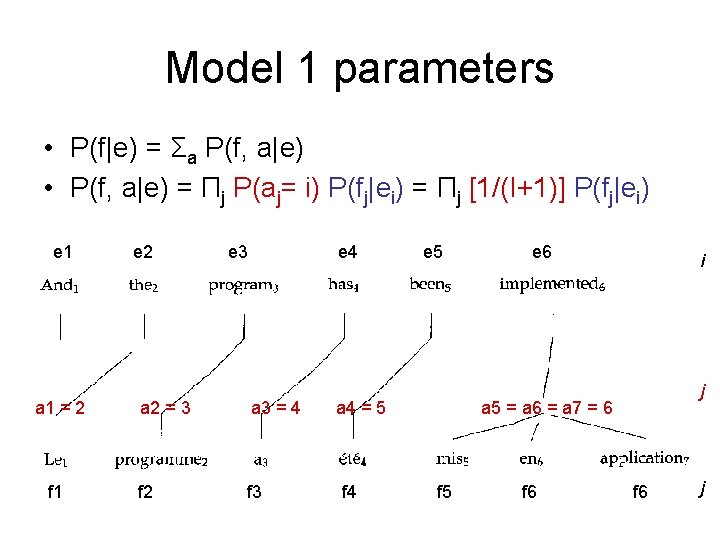
Model 1 parameters • P(f|e) = Σa P(f, a|e) • P(f, a|e) = Πj P(aj= i) P(fj|ei) = Πj [1/(I+1)] P(fj|ei) e 1 a 1 = 2 f 1 e 2 e 3 e 4 a 2 = 3 a 3 = 4 f 2 f 3 e 5 a 4 = 5 f 4 e 6 i j a 5 = a 6 = a 7 = 6 f 5 f 6 j
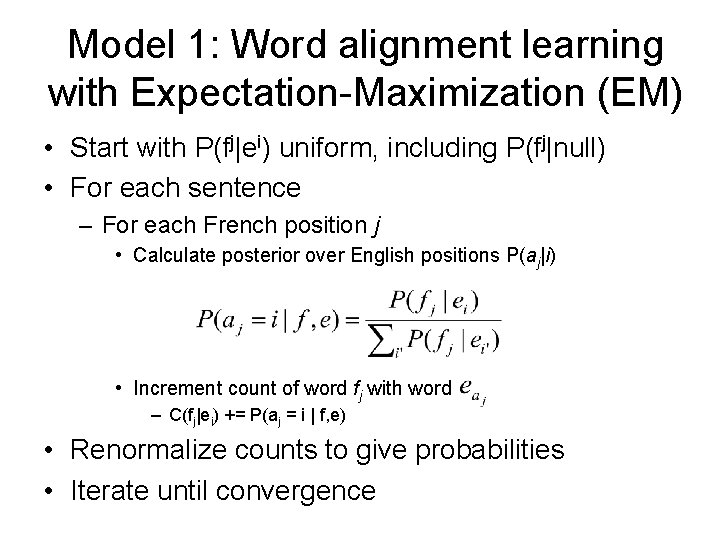
Model 1: Word alignment learning with Expectation-Maximization (EM) • Start with P(fj|ei) uniform, including P(fj|null) • For each sentence – For each French position j • Calculate posterior over English positions P(aj|i) • Increment count of word fj with word – C(fj|ei) += P(aj = i | f, e) • Renormalize counts to give probabilities • Iterate until convergence
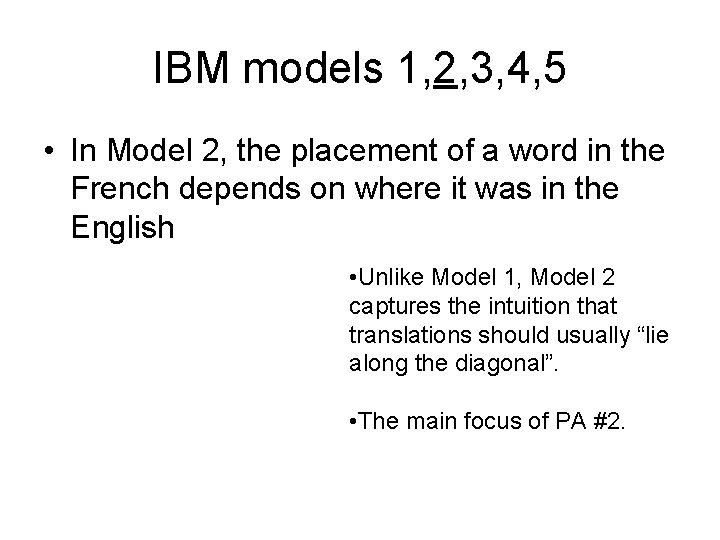
IBM models 1, 2, 3, 4, 5 • In Model 2, the placement of a word in the French depends on where it was in the English • Unlike Model 1, Model 2 captures the intuition that translations should usually “lie along the diagonal”. • The main focus of PA #2.
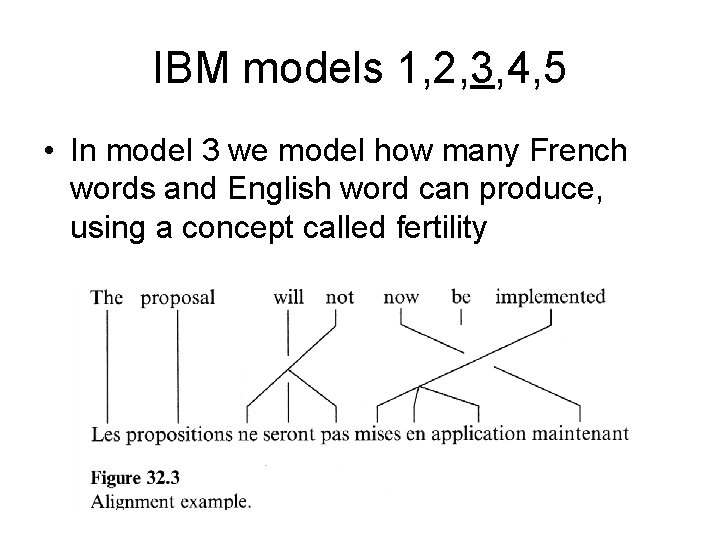
IBM models 1, 2, 3, 4, 5 • In model 3 we model how many French words and English word can produce, using a concept called fertility
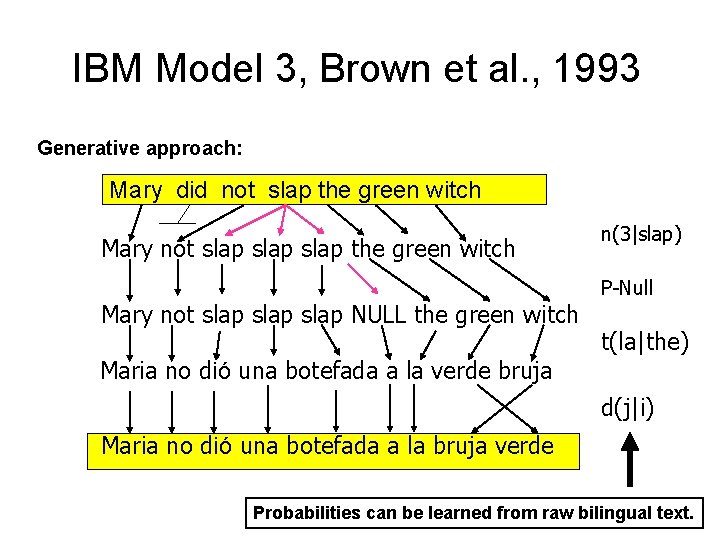
IBM Model 3, Brown et al. , 1993 Generative approach: Mary did not slap the green witch Mary not slap slap NULL the green witch n(3|slap) P-Null t(la|the) Maria no dió una botefada a la verde bruja d(j|i) Maria no dió una botefada a la bruja verde Probabilities can be learned from raw bilingual text.
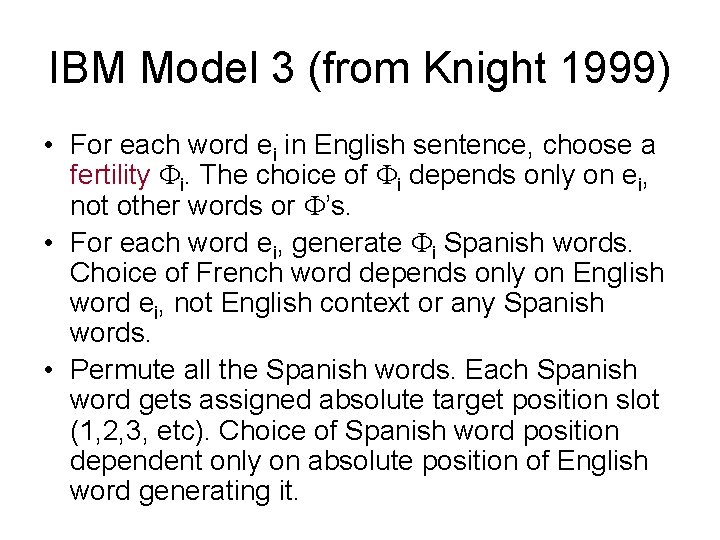
IBM Model 3 (from Knight 1999) • For each word ei in English sentence, choose a fertility i. The choice of i depends only on ei, not other words or ’s. • For each word ei, generate i Spanish words. Choice of French word depends only on English word ei, not English context or any Spanish words. • Permute all the Spanish words. Each Spanish word gets assigned absolute target position slot (1, 2, 3, etc). Choice of Spanish word position dependent only on absolute position of English word generating it.
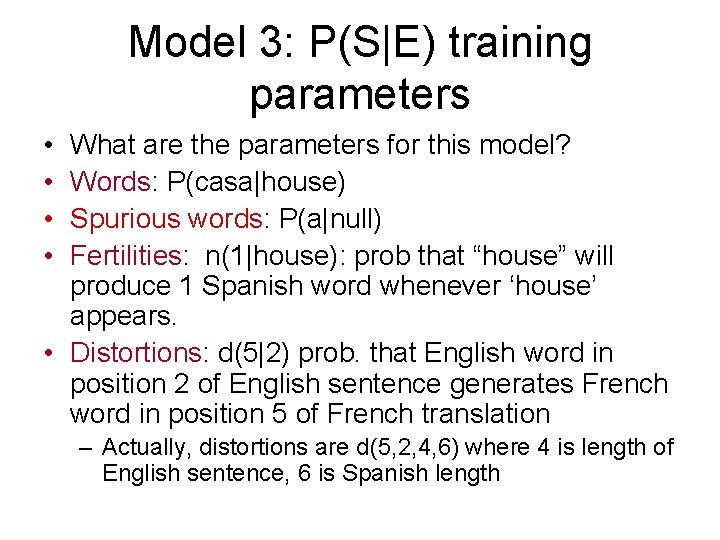
Model 3: P(S|E) training parameters • • What are the parameters for this model? Words: P(casa|house) Spurious words: P(a|null) Fertilities: n(1|house): prob that “house” will produce 1 Spanish word whenever ‘house’ appears. • Distortions: d(5|2) prob. that English word in position 2 of English sentence generates French word in position 5 of French translation – Actually, distortions are d(5, 2, 4, 6) where 4 is length of English sentence, 6 is Spanish length
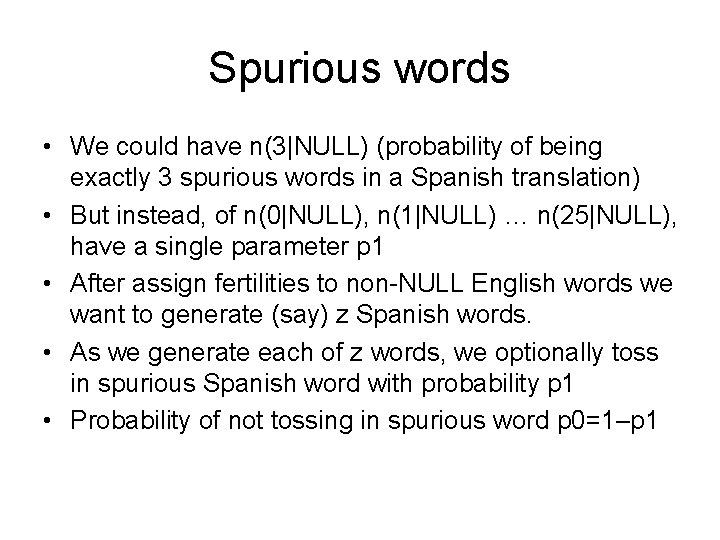
Spurious words • We could have n(3|NULL) (probability of being exactly 3 spurious words in a Spanish translation) • But instead, of n(0|NULL), n(1|NULL) … n(25|NULL), have a single parameter p 1 • After assign fertilities to non-NULL English words we want to generate (say) z Spanish words. • As we generate each of z words, we optionally toss in spurious Spanish word with probability p 1 • Probability of not tossing in spurious word p 0=1–p 1
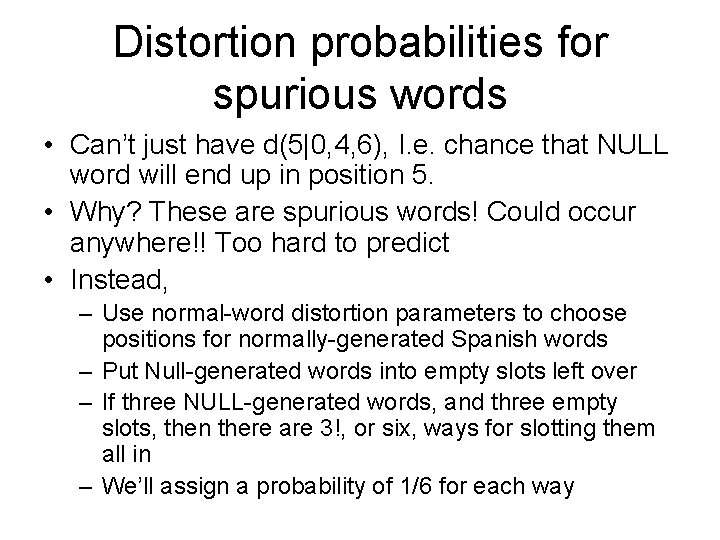
Distortion probabilities for spurious words • Can’t just have d(5|0, 4, 6), I. e. chance that NULL word will end up in position 5. • Why? These are spurious words! Could occur anywhere!! Too hard to predict • Instead, – Use normal-word distortion parameters to choose positions for normally-generated Spanish words – Put Null-generated words into empty slots left over – If three NULL-generated words, and three empty slots, then there are 3!, or six, ways for slotting them all in – We’ll assign a probability of 1/6 for each way
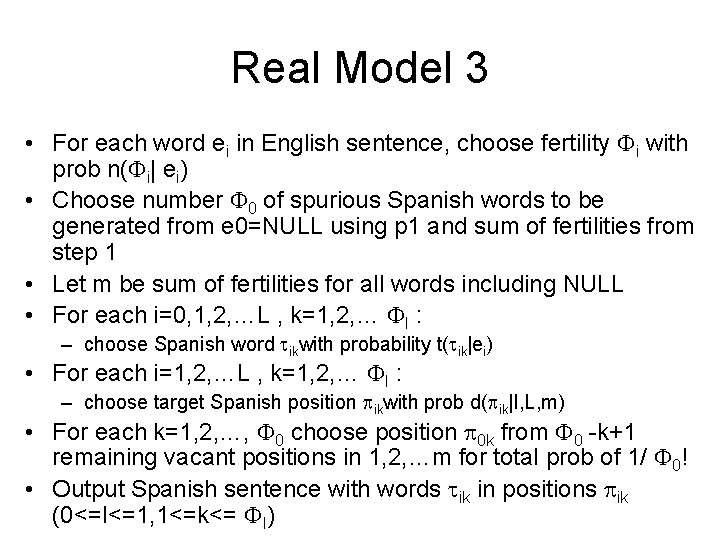
Real Model 3 • For each word ei in English sentence, choose fertility i with prob n( i| ei) • Choose number 0 of spurious Spanish words to be generated from e 0=NULL using p 1 and sum of fertilities from step 1 • Let m be sum of fertilities for all words including NULL • For each i=0, 1, 2, …L , k=1, 2, … I : – choose Spanish word ikwith probability t( ik|ei) • For each i=1, 2, …L , k=1, 2, … I : – choose target Spanish position ikwith prob d( ik|I, L, m) • For each k=1, 2, …, 0 choose position 0 k from 0 -k+1 remaining vacant positions in 1, 2, …m for total prob of 1/ 0! • Output Spanish sentence with words ik in positions ik (0<=I<=1, 1<=k<= I)
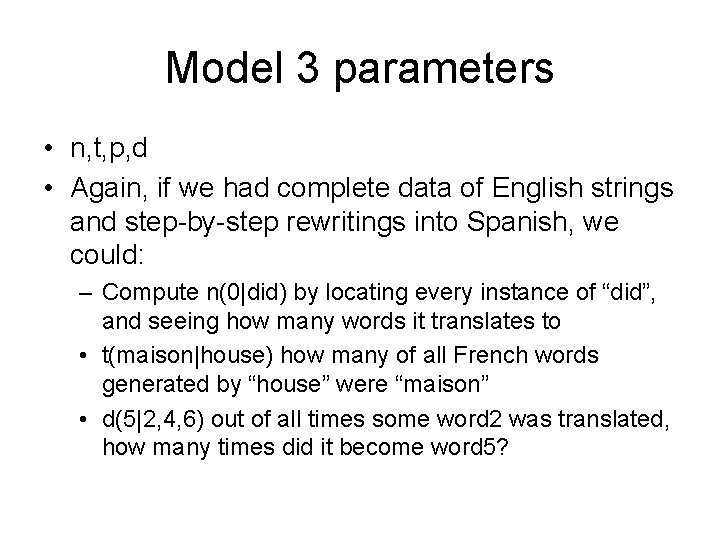
Model 3 parameters • n, t, p, d • Again, if we had complete data of English strings and step-by-step rewritings into Spanish, we could: – Compute n(0|did) by locating every instance of “did”, and seeing how many words it translates to • t(maison|house) how many of all French words generated by “house” were “maison” • d(5|2, 4, 6) out of all times some word 2 was translated, how many times did it become word 5?
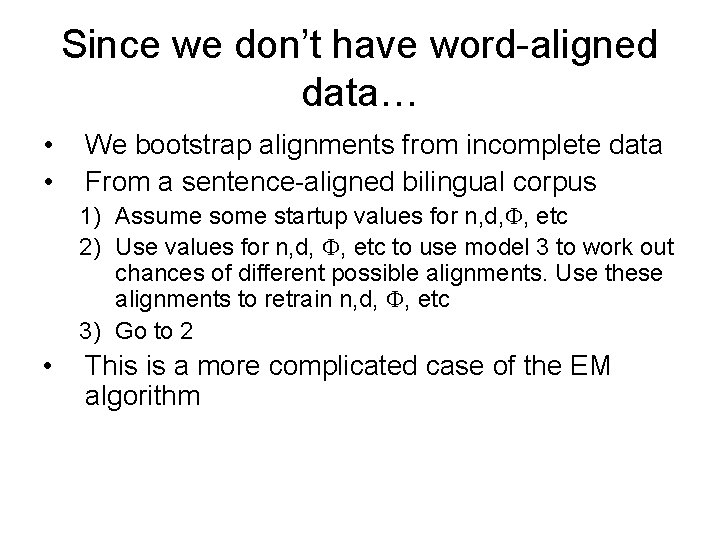
Since we don’t have word-aligned data… • • We bootstrap alignments from incomplete data From a sentence-aligned bilingual corpus 1) Assume some startup values for n, d, , etc 2) Use values for n, d, , etc to use model 3 to work out chances of different possible alignments. Use these alignments to retrain n, d, , etc 3) Go to 2 • This is a more complicated case of the EM algorithm
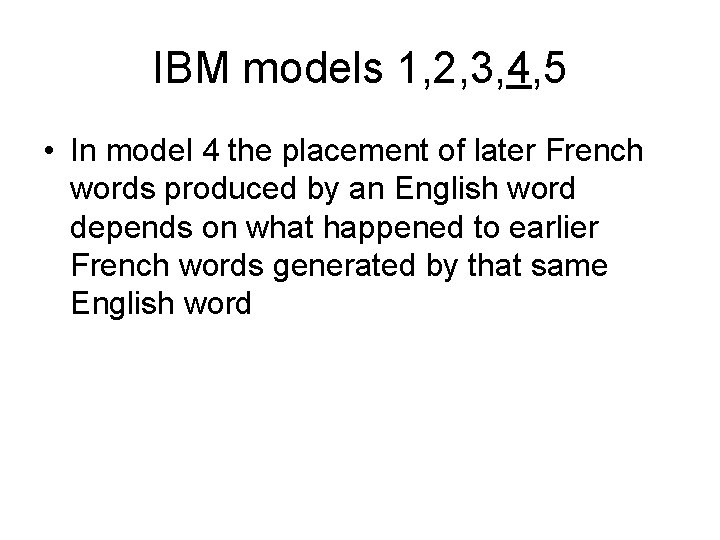
IBM models 1, 2, 3, 4, 5 • In model 4 the placement of later French words produced by an English word depends on what happened to earlier French words generated by that same English word
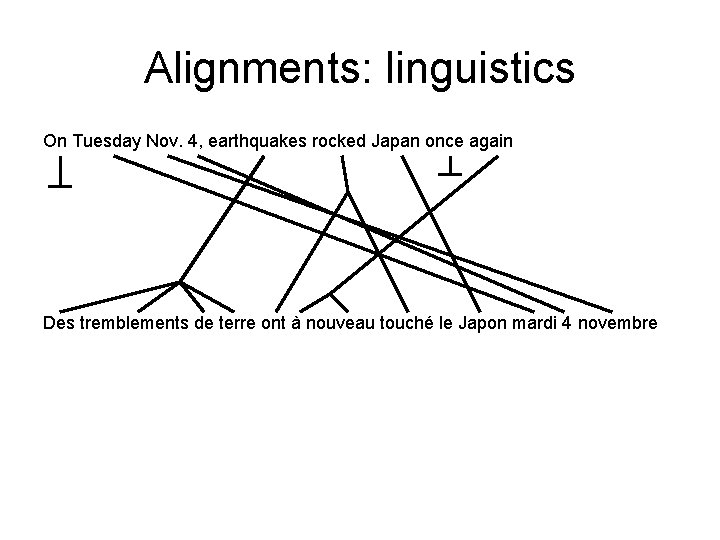
Alignments: linguistics On Tuesday Nov. 4, earthquakes rocked Japan once again Des tremblements de terre ont à nouveau touché le Japon mardi 4 novembre
IBM models 1, 2, 3, 4, 5 • In model 5 they do non-deficient alignment. That is, you can’t put probability mass on impossible things.
Why all the models? • We don’t start with aligned text, so we have to get initial alignments from somewhere. • Model 1 is words only, and is relatively easy and fast to train. • We are working in a space with many local maxima, so output of model 1 can be a good place to start model 2. Etc. • The sequence of models allows a better model to be found faster [the intuition is like deterministic annealing].
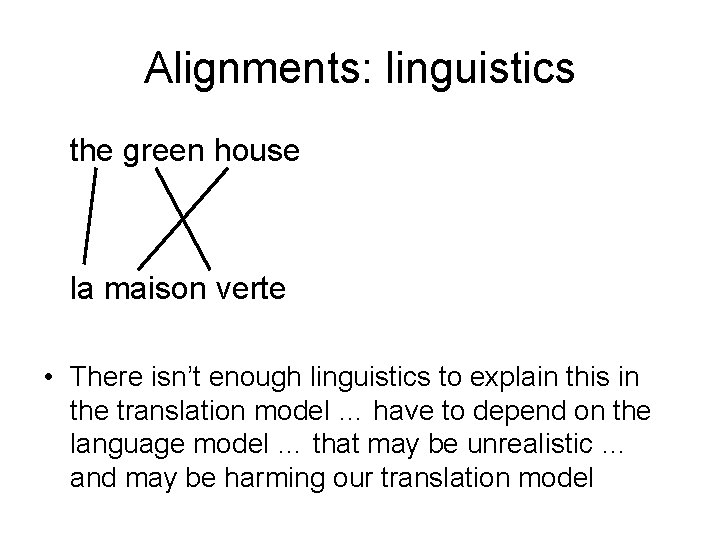
Alignments: linguistics the green house la maison verte • There isn’t enough linguistics to explain this in the translation model … have to depend on the language model … that may be unrealistic … and may be harming our translation model