
Machine Translation Phrase Alignment Stephan Vogel Spring Semester
- Slides: 59
Machine Translation Phrase Alignment Stephan Vogel Spring Semester 2011 Stephan Vogel - Machine Translation 1
Overview l Why Phrase Alignment? l Phrase Pairs from Viterbi Alignment l Heuristics l Some Analysis l Phrase Pair Extraction as Sentence Splitting l Additional Phrase Pair Features Stephan Vogel - Machine Translation 2
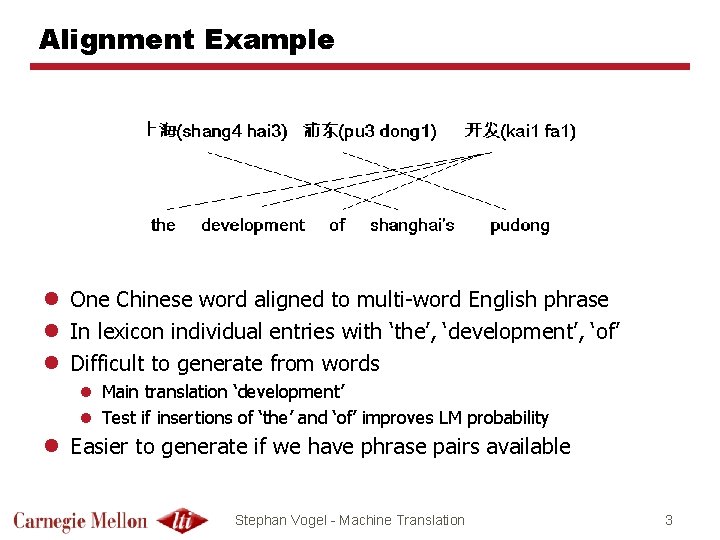
Alignment Example l One Chinese word aligned to multi-word English phrase l In lexicon individual entries with ‘the’, ‘development’, ‘of’ l Difficult to generate from words l Main translation ‘development’ l Test if insertions of ‘the’ and ‘of’ improves LM probability l Easier to generate if we have phrase pairs available Stephan Vogel - Machine Translation 3
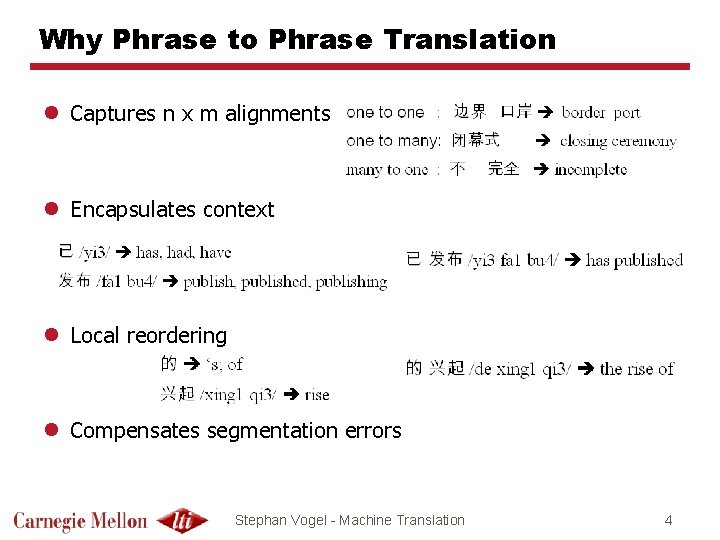
Why Phrase to Phrase Translation l Captures n x m alignments l Encapsulates context l Local reordering l Compensates segmentation errors Stephan Vogel - Machine Translation 4
How to get Phrase Translation l Typically: Train word alignment model and extract phrase-tophrase translations from Viterbi path l IBM model 4 alignment l HMM alignment l Bilingual Bracketing l Genuine phrase translation models l Integrated segmentation and alignment (ISA) l Phase Pair Extraction via full Sentence Alignment l Notes: l Often better results when training target to source for extraction of phrase translations due to asymmetry of alignment models l Phrases are not fully integrated into the alignment model, they are extracted only after training is completed – how to assign probabilities? Stephan Vogel - Machine Translation 5
Phrase Pairs from Viterbi Path l Train your favorite word alignment (IBMn, HMM, …) l Calculate Viterbi path (i. e. path with highest probability or best score) l The details …. Stephan Vogel - Machine Translation 6
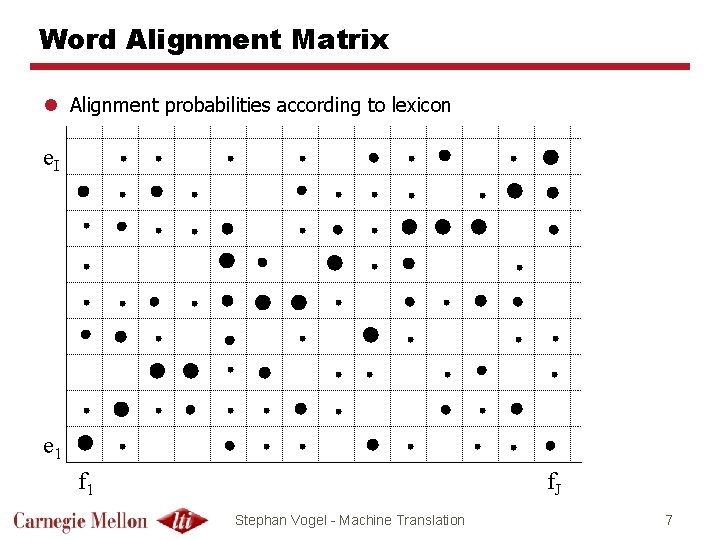
Word Alignment Matrix l Alignment probabilities according to lexicon e. I e 1 f. J Stephan Vogel - Machine Translation 7
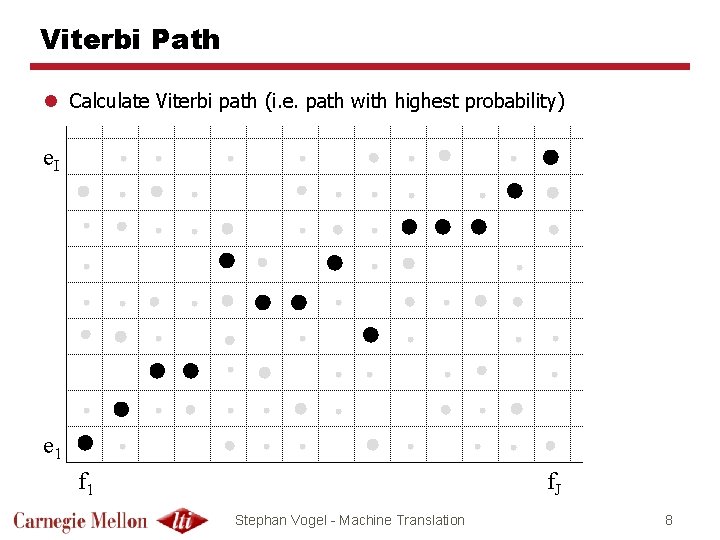
Viterbi Path l Calculate Viterbi path (i. e. path with highest probability) e. I e 1 f. J Stephan Vogel - Machine Translation 8
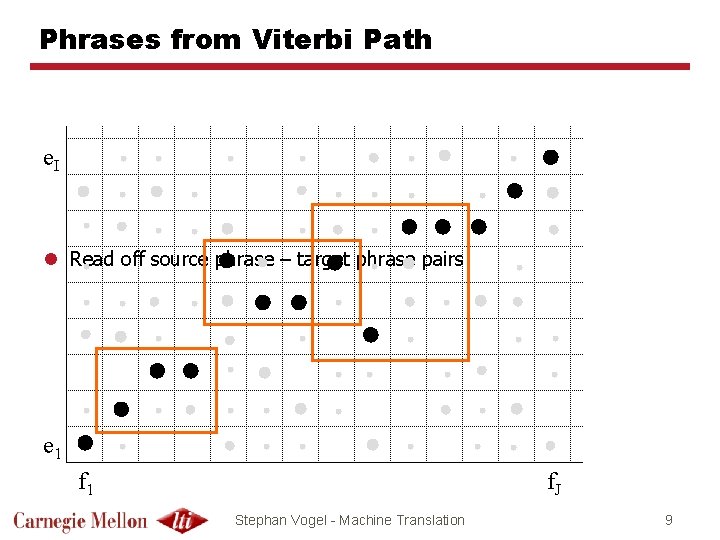
Phrases from Viterbi Path e. I l Read off source phrase – target phrase pairs e 1 f. J Stephan Vogel - Machine Translation 9
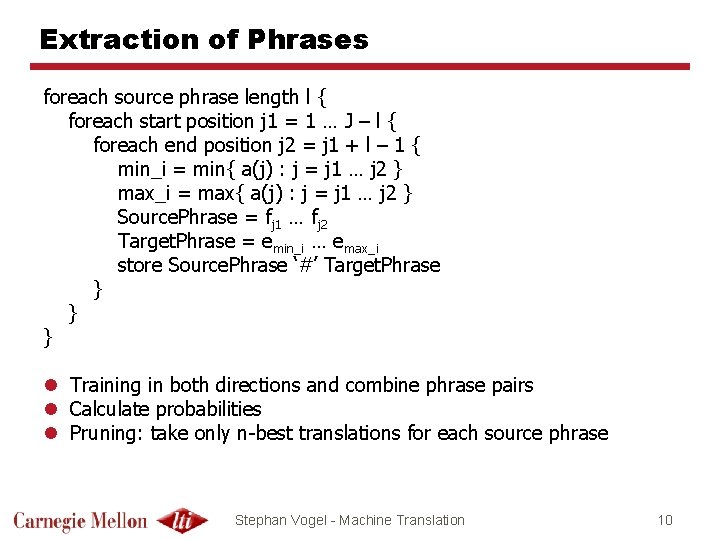
Extraction of Phrases foreach source phrase length l { foreach start position j 1 = 1 … J – l { foreach end position j 2 = j 1 + l – 1 { min_i = min{ a(j) : j = j 1 … j 2 } max_i = max{ a(j) : j = j 1 … j 2 } Source. Phrase = fj 1 … fj 2 Target. Phrase = emin_i … emax_i store Source. Phrase ‘#’ Target. Phrase } } } l Training in both directions and combine phrase pairs l Calculate probabilities l Pruning: take only n-best translations for each source phrase Stephan Vogel - Machine Translation 10
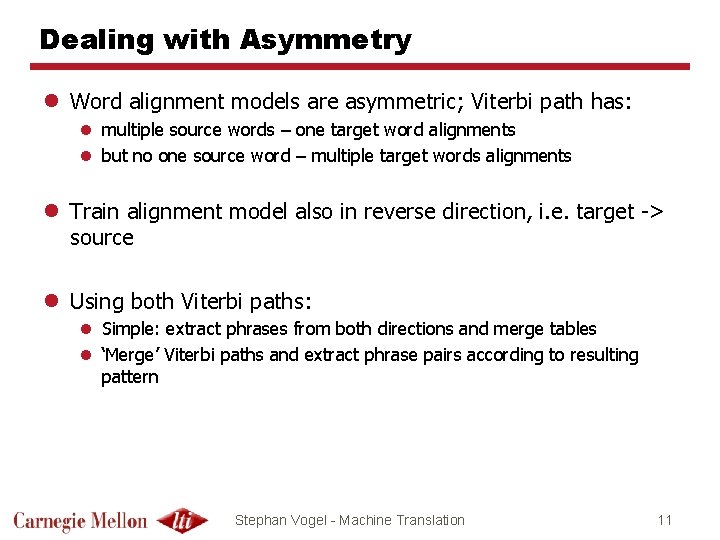
Dealing with Asymmetry l Word alignment models are asymmetric; Viterbi path has: l multiple source words – one target word alignments l but no one source word – multiple target words alignments l Train alignment model also in reverse direction, i. e. target -> source l Using both Viterbi paths: l Simple: extract phrases from both directions and merge tables l ‘Merge’ Viterbi paths and extract phrase pairs according to resulting pattern Stephan Vogel - Machine Translation 11
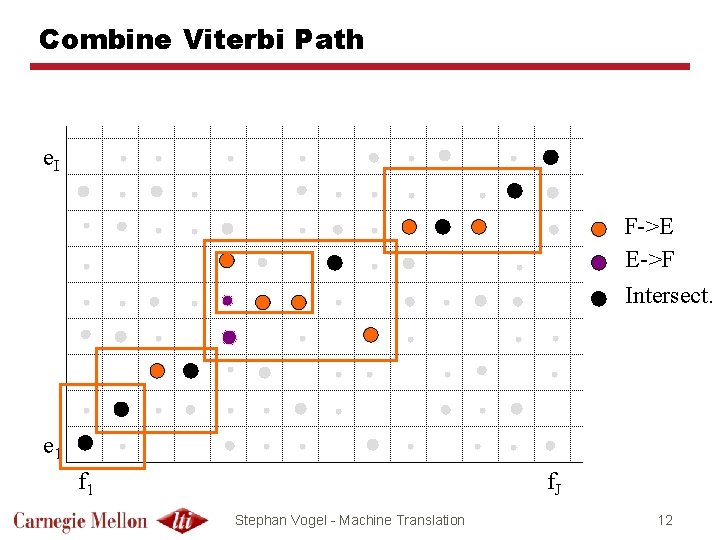
Combine Viterbi Path e. I F->E E->F Intersect. e 1 f. J Stephan Vogel - Machine Translation 12
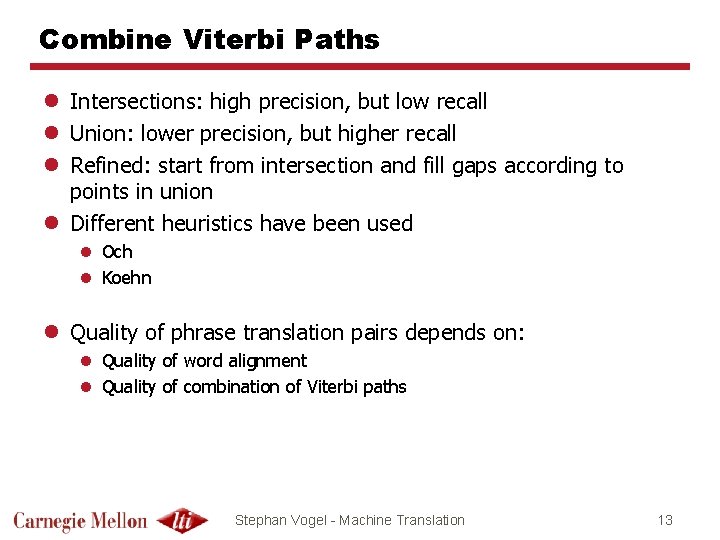
Combine Viterbi Paths l Intersections: high precision, but low recall l Union: lower precision, but higher recall l Refined: start from intersection and fill gaps according to points in union l Different heuristics have been used l Och l Koehn l Quality of phrase translation pairs depends on: l Quality of word alignment l Quality of combination of Viterbi paths Stephan Vogel - Machine Translation 13
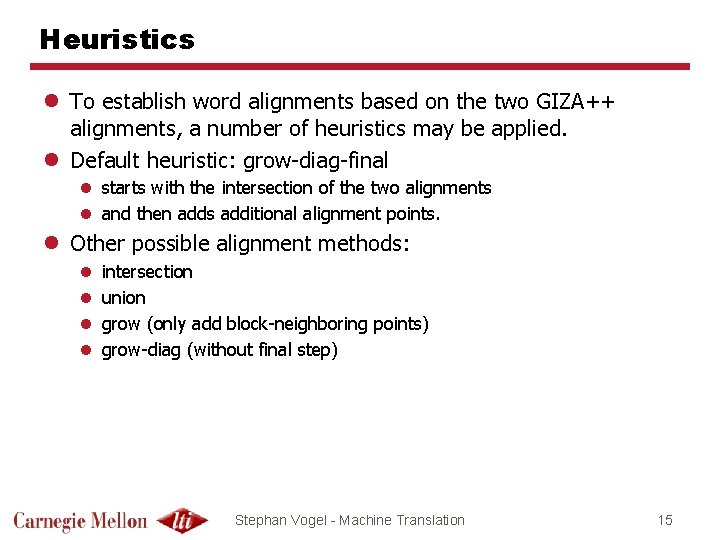
Heuristics l To establish word alignments based on the two GIZA++ alignments, a number of heuristics may be applied. l Default heuristic: grow-diag-final l starts with the intersection of the two alignments l and then adds additional alignment points. l Other possible alignment methods: l l intersection union grow (only add block-neighboring points) grow-diag (without final step) Stephan Vogel - Machine Translation 15
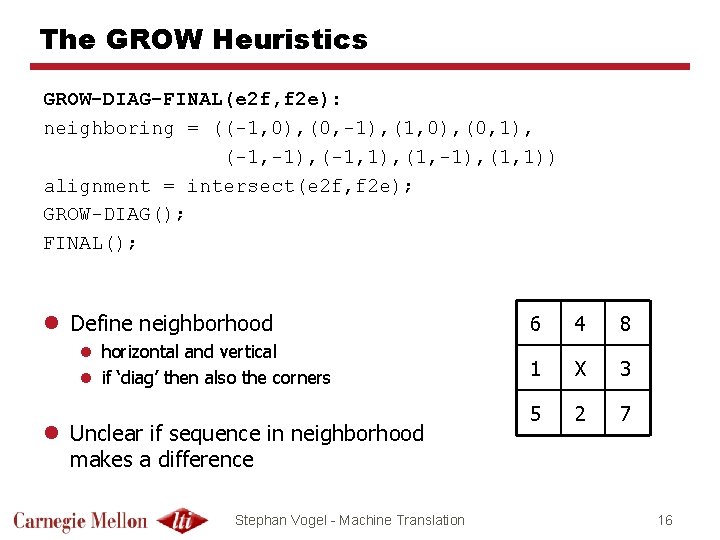
The GROW Heuristics GROW-DIAG-FINAL(e 2 f, f 2 e): neighboring = ((-1, 0), (0, -1), (1, 0), (0, 1), (-1, -1), (-1, 1), (1, -1), (1, 1)) alignment = intersect(e 2 f, f 2 e); GROW-DIAG(); FINAL(); l Define neighborhood l horizontal and vertical l if ‘diag’ then also the corners l Unclear if sequence in neighborhood makes a difference Stephan Vogel - Machine Translation 6 4 8 1 X 3 5 2 7 16
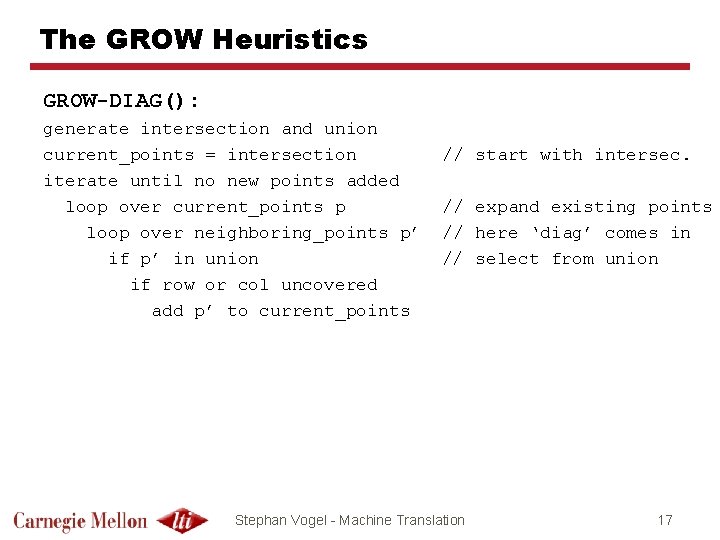
The GROW Heuristics GROW-DIAG(): generate intersection and union current_points = intersection iterate until no new points added loop over current_points p loop over neighboring_points p’ if p’ in union if row or col uncovered add p’ to current_points // start with intersec. // expand existing points // here ‘diag’ comes in // select from union Stephan Vogel - Machine Translation 17
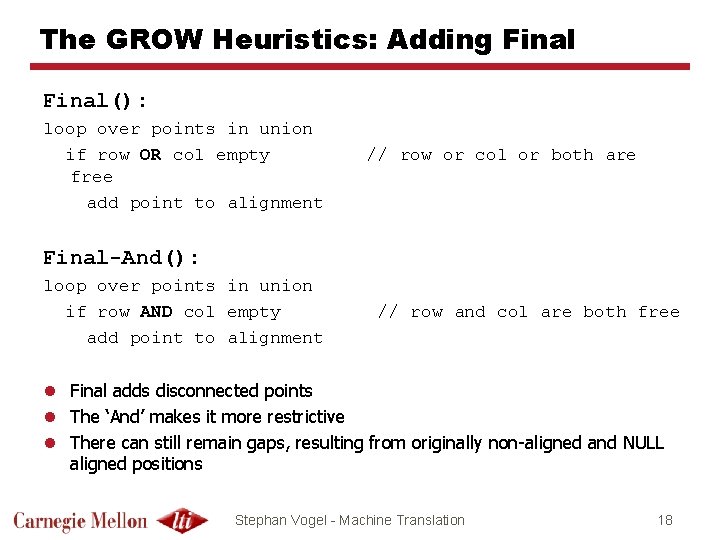
The GROW Heuristics: Adding Final(): loop over points in union if row OR col empty free add point to alignment // row or col or both are Final-And(): loop over points in union if row AND col empty add point to alignment // row and col are both free l Final adds disconnected points l The ‘And’ makes it more restrictive l There can still remain gaps, resulting from originally non-aligned and NULL aligned positions Stephan Vogel - Machine Translation 18
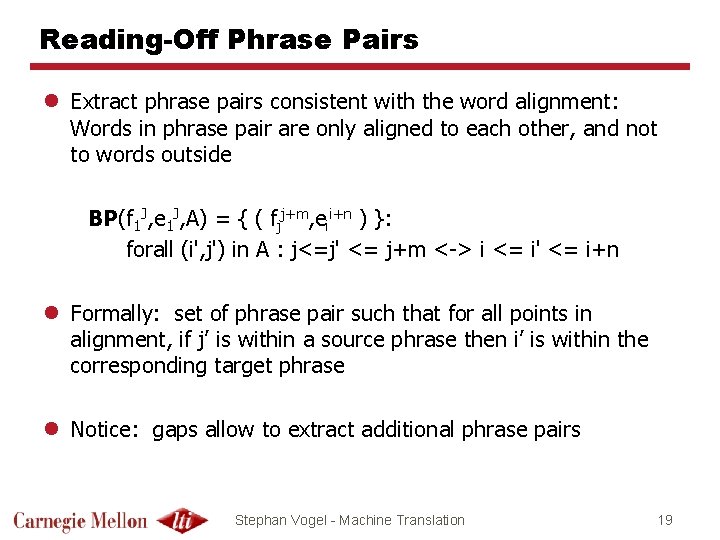
Reading-Off Phrase Pairs l Extract phrase pairs consistent with the word alignment: Words in phrase pair are only aligned to each other, and not to words outside BP(f 1 J, e 1 J, A) = { ( fjj+m, eii+n ) }: forall (i', j') in A : j<=j' <= j+m <-> i <= i' <= i+n l Formally: set of phrase pair such that for all points in alignment, if j’ is within a source phrase then i’ is within the corresponding target phrase l Notice: gaps allow to extract additional phrase pairs Stephan Vogel - Machine Translation 19
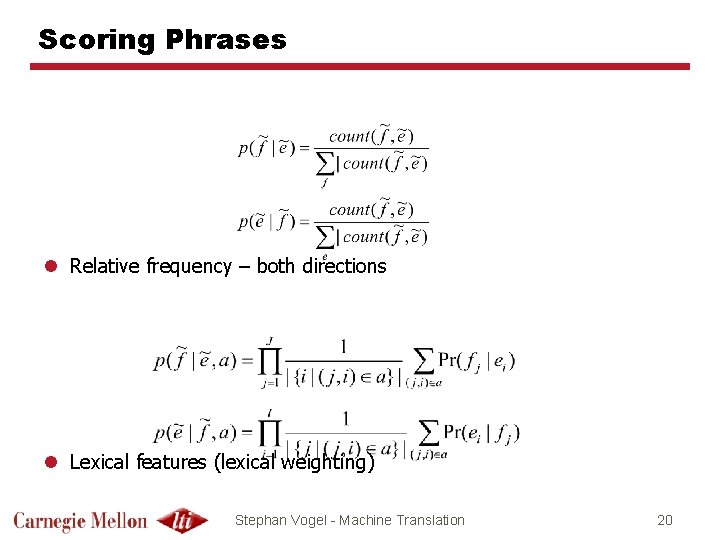
Scoring Phrases l Relative frequency – both directions l Lexical features (lexical weighting) Stephan Vogel - Machine Translation 20
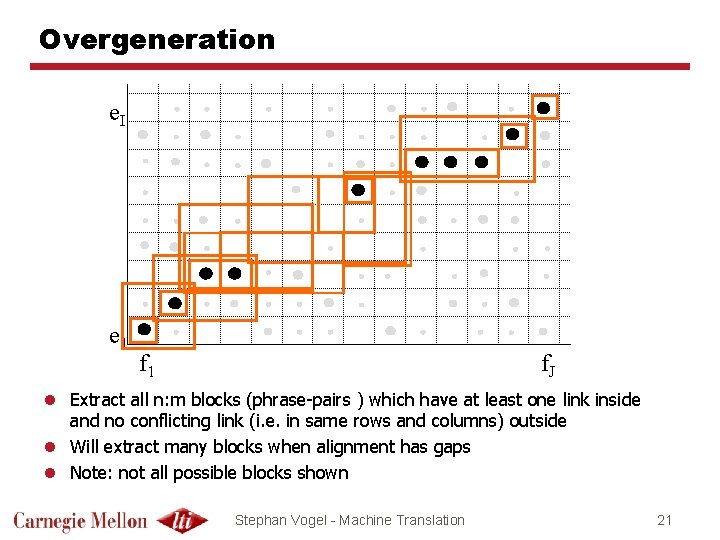
Overgeneration e. I e 1 f. J l Extract all n: m blocks (phrase-pairs ) which have at least one link inside and no conflicting link (i. e. in same rows and columns) outside l Will extract many blocks when alignment has gaps l Note: not all possible blocks shown Stephan Vogel - Machine Translation 21
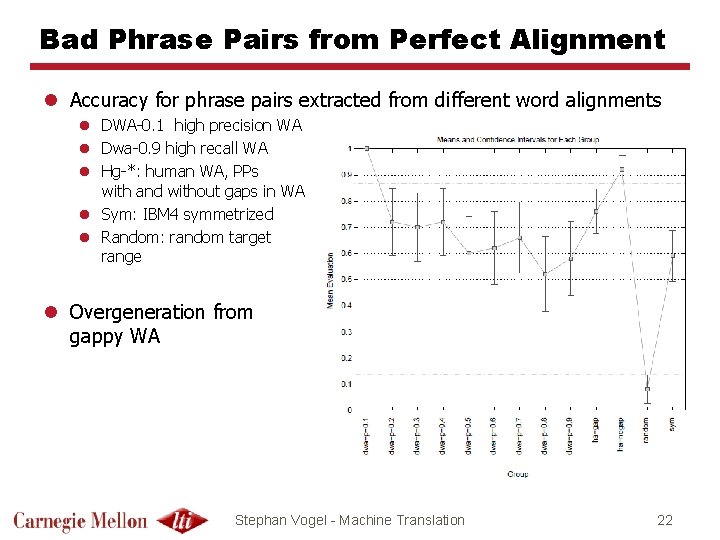
Bad Phrase Pairs from Perfect Alignment l Accuracy for phrase pairs extracted from different word alignments l DWA-0. 1 high precision WA l Dwa-0. 9 high recall WA l Hg-*: human WA, PPs with and without gaps in WA l Sym: IBM 4 symmetrized l Random: random target range l Overgeneration from gappy WA Stephan Vogel - Machine Translation 22
Dealing with Memory Limitation l Phrase translation tables are memory killers l Number of phrases quickly exceeds number of words in corpus l Memory required is multiple of memory for corpus l We have corpora of 200 million words -> >1 billion phrase pairs l Restrict phrases l Only take short ones (default: 7 words) l Only take frequent ones l Evaluation modus l Load only phrases required for test sentences (i. e. extract from large phrase translation table) l Extract and store only required phrase pairs (i. e. part of training cycle at evaluation time) Stephan Vogel - Machine Translation 23
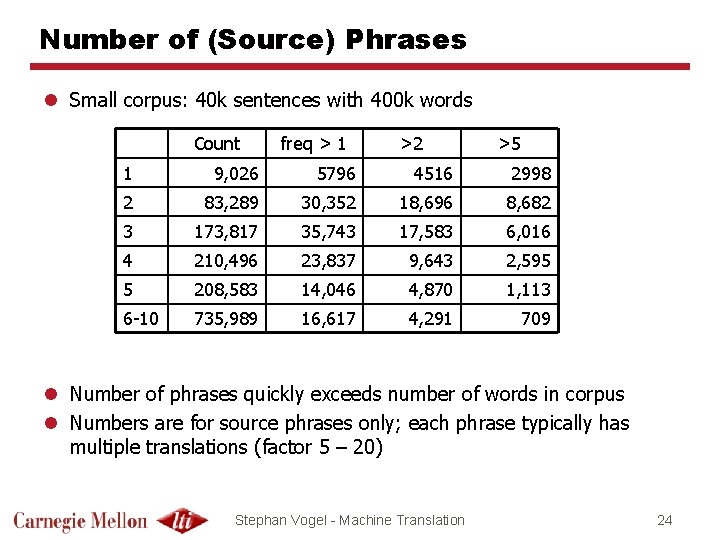
Number of (Source) Phrases l Small corpus: 40 k sentences with 400 k words Count freq > 1 >2 >5 1 9, 026 5796 4516 2998 2 83, 289 30, 352 18, 696 8, 682 3 173, 817 35, 743 17, 583 6, 016 4 210, 496 23, 837 9, 643 2, 595 5 208, 583 14, 046 4, 870 1, 113 6 -10 735, 989 16, 617 4, 291 709 l Number of phrases quickly exceeds number of words in corpus l Numbers are for source phrases only; each phrase typically has multiple translations (factor 5 – 20) Stephan Vogel - Machine Translation 24
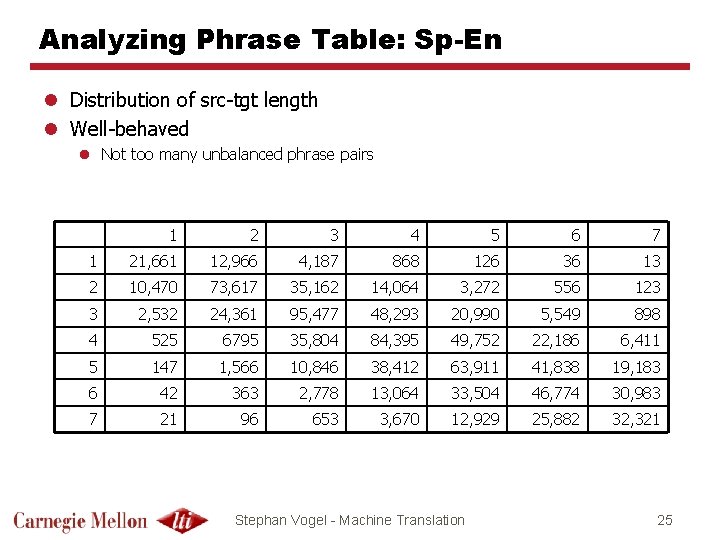
Analyzing Phrase Table: Sp-En l Distribution of src-tgt length l Well-behaved l Not too many unbalanced phrase pairs 1 2 3 4 5 6 7 1 21, 661 12, 966 4, 187 868 126 36 13 2 10, 470 73, 617 35, 162 14, 064 3, 272 556 123 3 2, 532 24, 361 95, 477 48, 293 20, 990 5, 549 898 4 525 6795 35, 804 84, 395 49, 752 22, 186 6, 411 5 147 1, 566 10, 846 38, 412 63, 911 41, 838 19, 183 6 42 363 2, 778 13, 064 33, 504 46, 774 30, 983 7 21 96 653 3, 670 12, 929 25, 882 32, 321 Stephan Vogel - Machine Translation 25
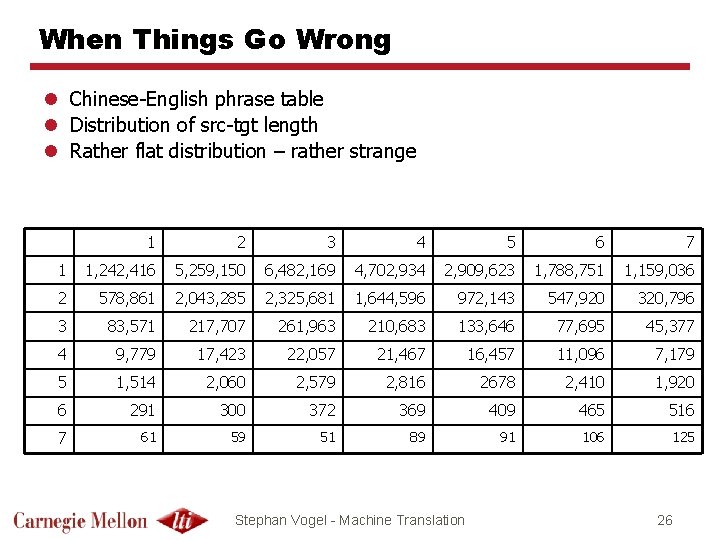
When Things Go Wrong l Chinese-English phrase table l Distribution of src-tgt length l Rather flat distribution – rather strange 1 2 3 4 5 6 7 1 1, 242, 416 5, 259, 150 6, 482, 169 4, 702, 934 2, 909, 623 1, 788, 751 1, 159, 036 2 578, 861 2, 043, 285 2, 325, 681 1, 644, 596 972, 143 547, 920 320, 796 3 83, 571 217, 707 261, 963 210, 683 133, 646 77, 695 45, 377 4 9, 779 17, 423 22, 057 21, 467 16, 457 11, 096 7, 179 5 1, 514 2, 060 2, 579 2, 816 2678 2, 410 1, 920 6 291 300 372 369 409 465 516 7 61 59 51 89 91 106 125 Stephan Vogel - Machine Translation 26
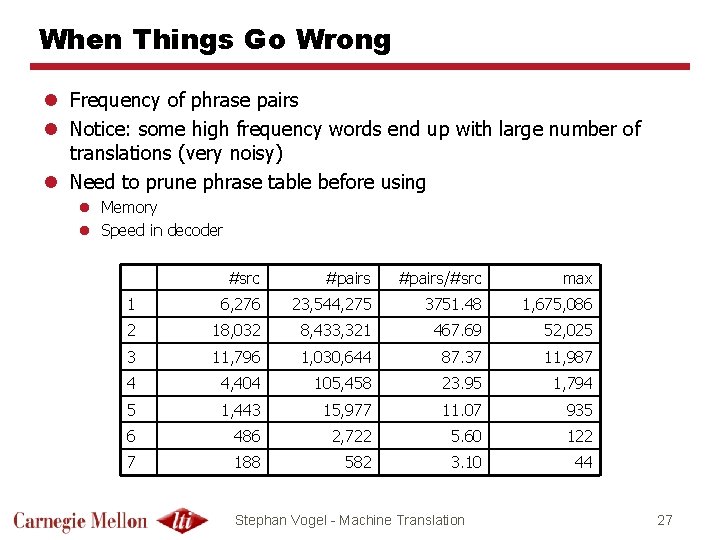
When Things Go Wrong l Frequency of phrase pairs l Notice: some high frequency words end up with large number of translations (very noisy) l Need to prune phrase table before using l Memory l Speed in decoder #src #pairs/#src max 1 6, 276 23, 544, 275 3751. 48 1, 675, 086 2 18, 032 8, 433, 321 467. 69 52, 025 3 11, 796 1, 030, 644 87. 37 11, 987 4 4, 404 105, 458 23. 95 1, 794 5 1, 443 15, 977 11. 07 935 6 486 2, 722 5. 60 122 7 188 582 3. 10 44 Stephan Vogel - Machine Translation 27
Non-Viterbi Phrase Alignment l Desiderata: l Use phrases up to any length Can not store all phrase pairs -> search them on the fly l High quality translation pairs l Balance with word-based translation Stephan Vogel - Machine Translation 28
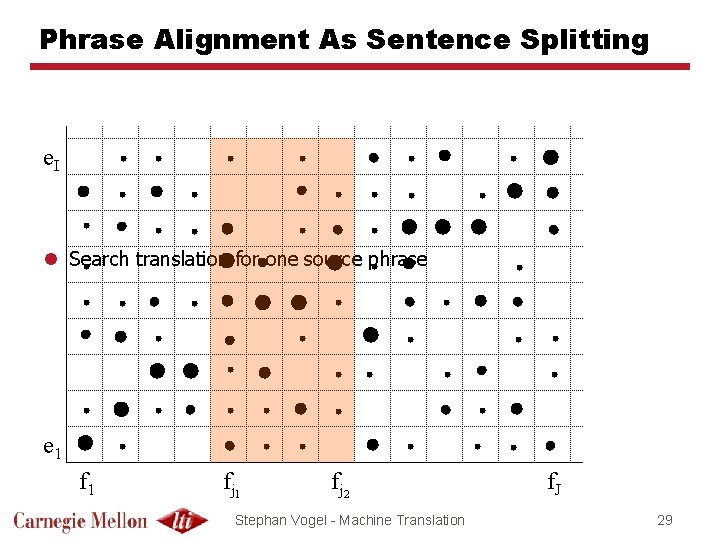
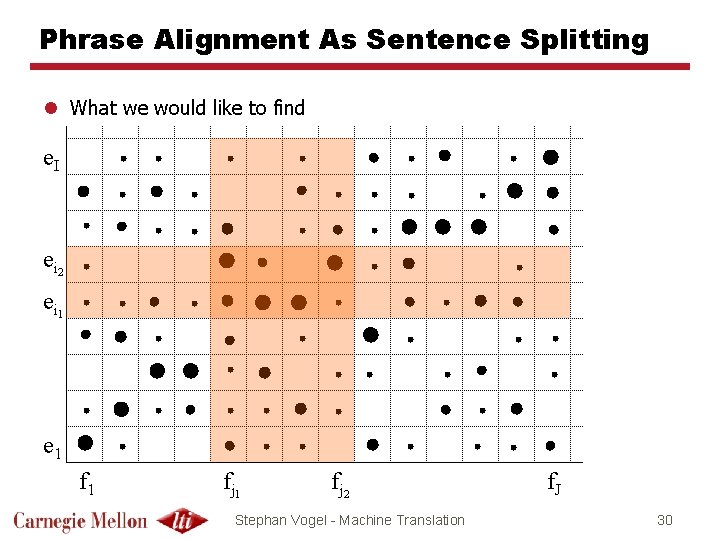
Phrase Alignment As Sentence Splitting e. I l Search translation for one source phrase e 1 fj 2 Stephan Vogel - Machine Translation f. J 29
Phrase Alignment As Sentence Splitting l What we would like to find e. I e i 2 e i 1 e 1 fj 2 Stephan Vogel - Machine Translation f. J 30
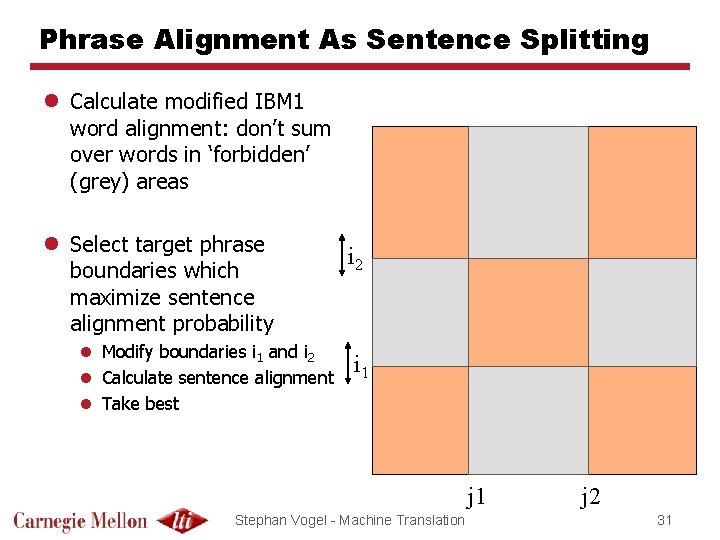
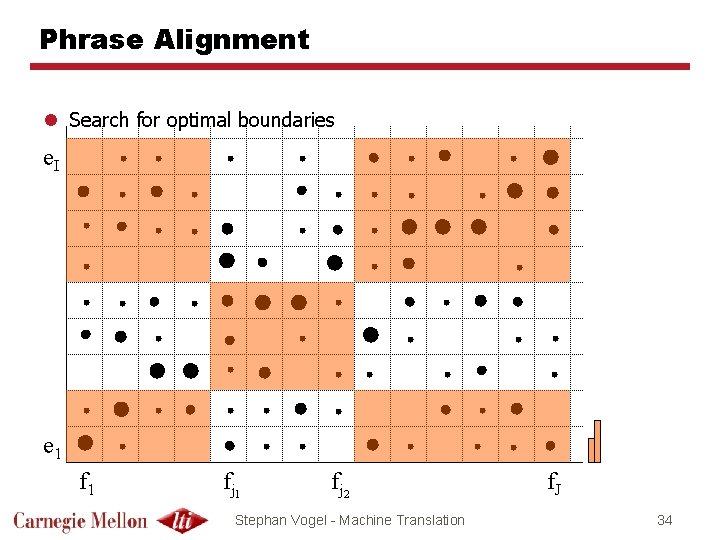
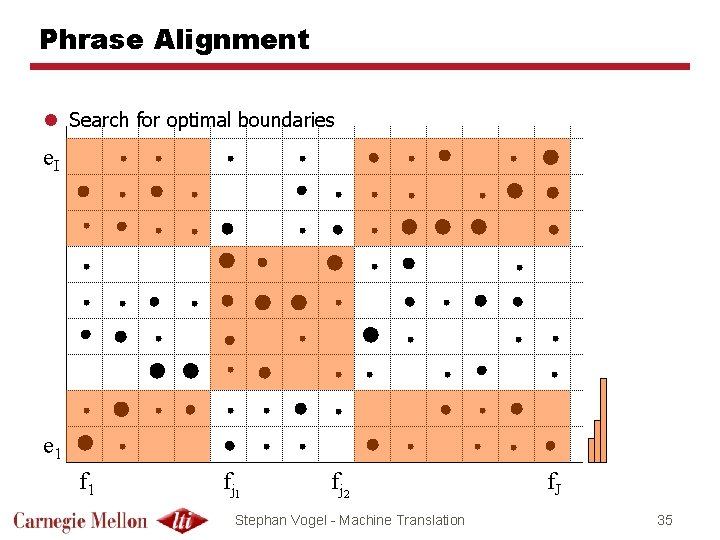
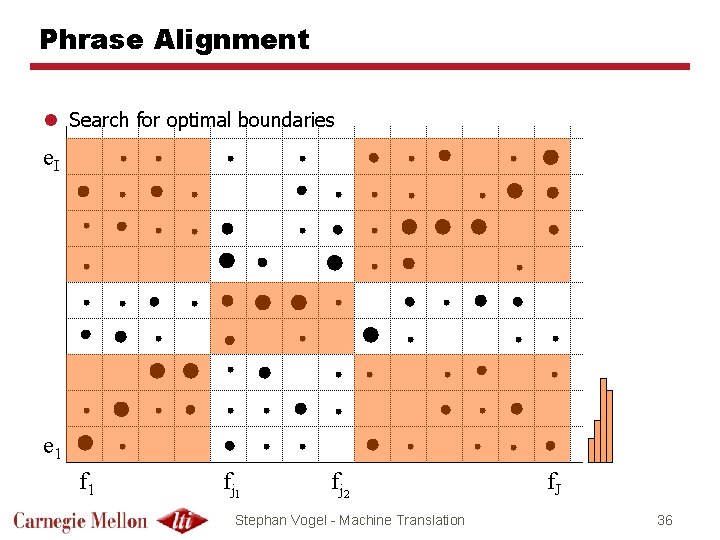
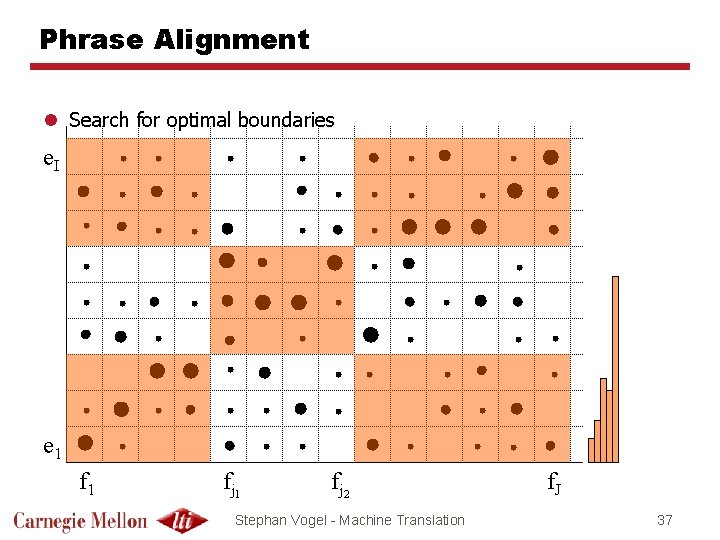
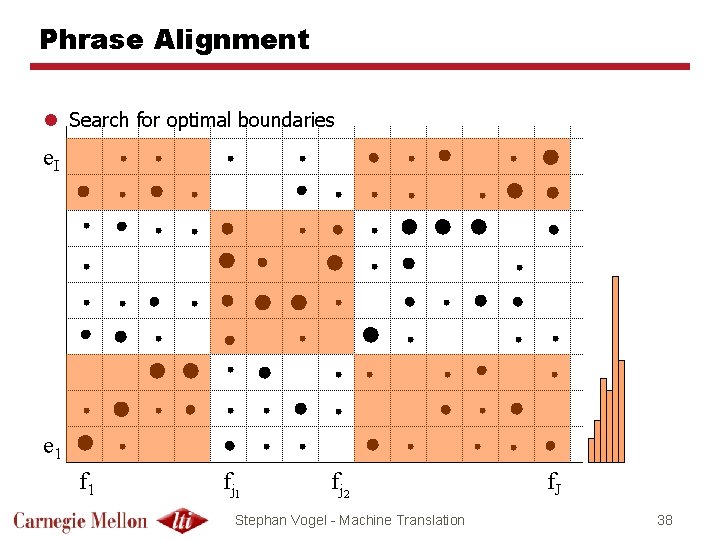
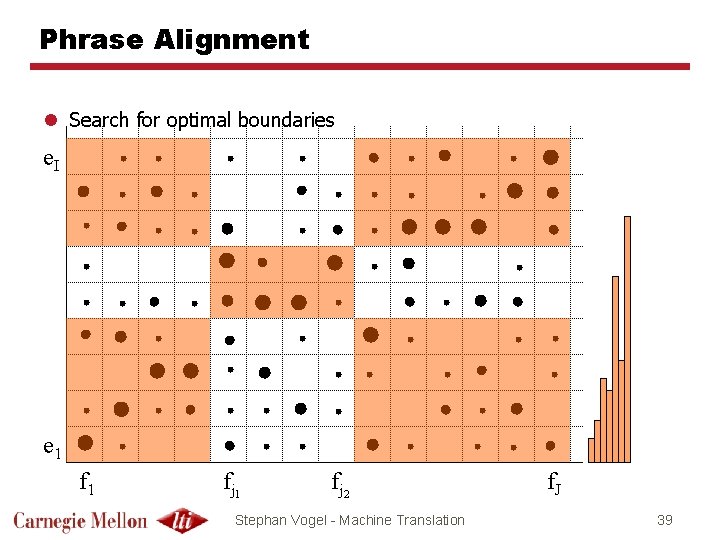
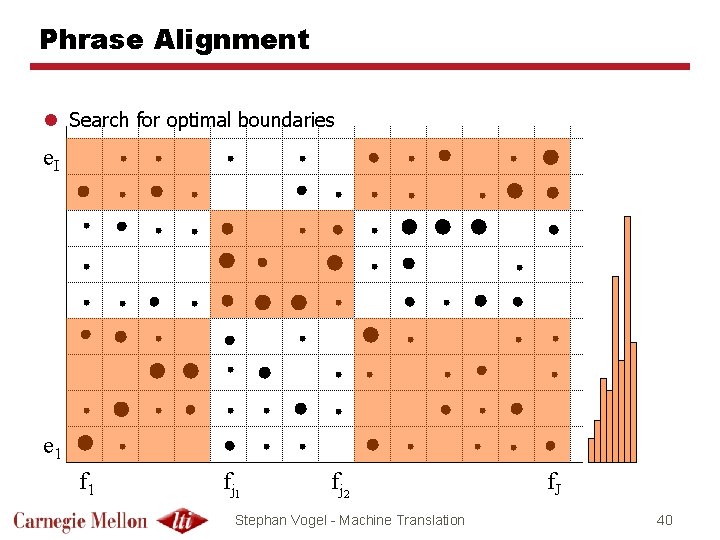
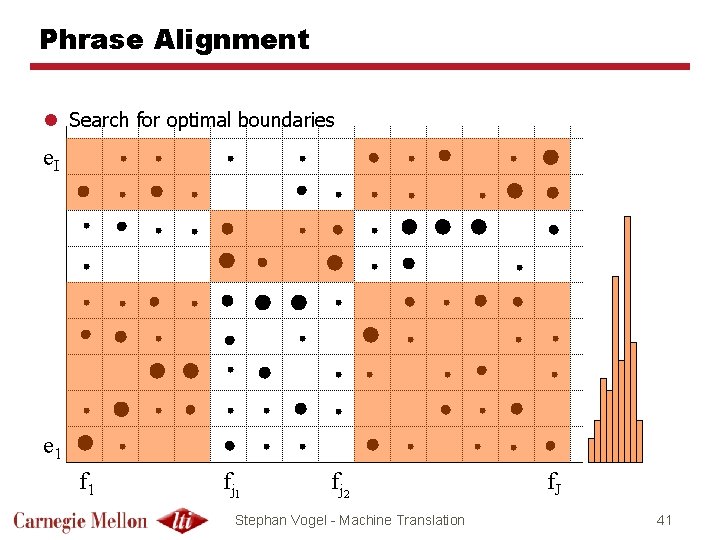
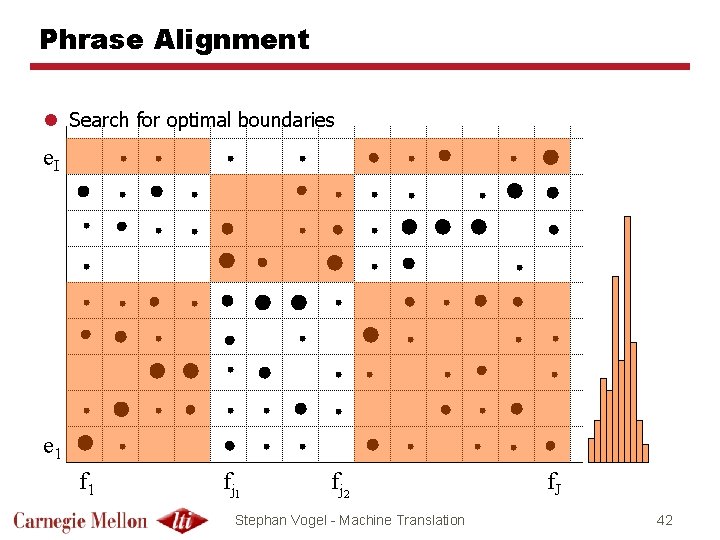
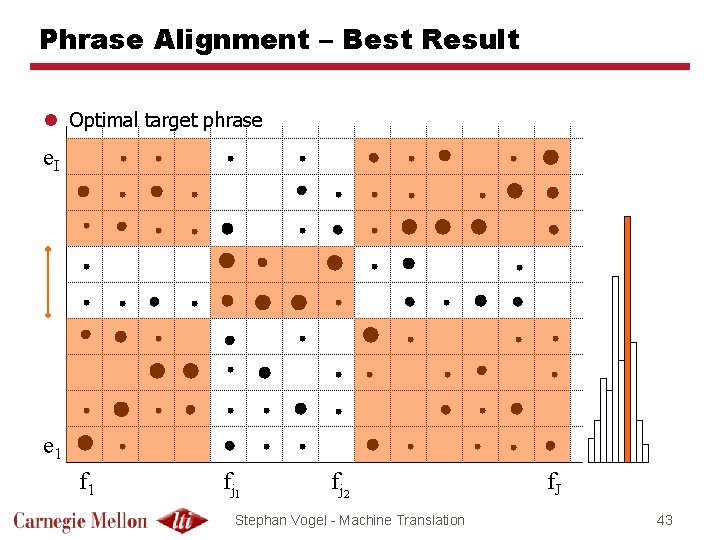
Phrase Alignment As Sentence Splitting l Calculate modified IBM 1 word alignment: don’t sum over words in ‘forbidden’ (grey) areas l Select target phrase boundaries which maximize sentence alignment probability l Modify boundaries i 1 and i 2 l Calculate sentence alignment l Take best i 2 i 1 j 1 Stephan Vogel - Machine Translation j 2 31
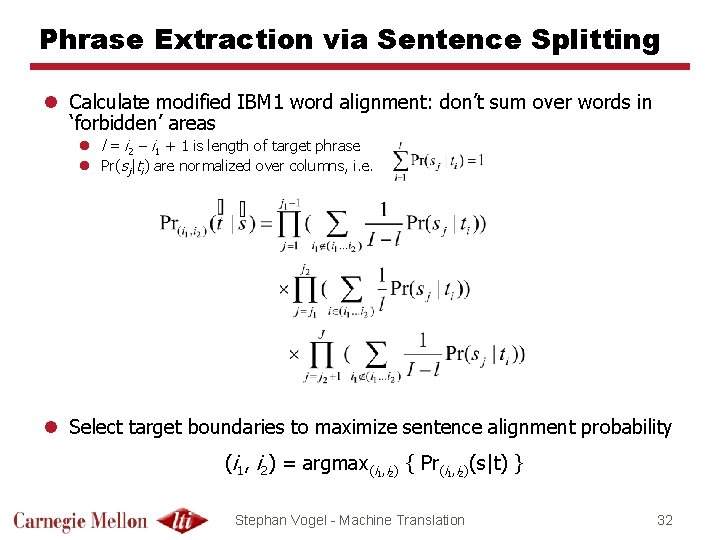
Phrase Extraction via Sentence Splitting l Calculate modified IBM 1 word alignment: don’t sum over words in ‘forbidden’ areas l l = i 2 – i 1 + 1 is length of target phrase l Pr(sj|ti) are normalized over columns, i. e. l Select target boundaries to maximize sentence alignment probability (i 1, i 2) = argmax(i 1, i 2) { Pr(i 1, i 2)(s|t) } Stephan Vogel - Machine Translation 32
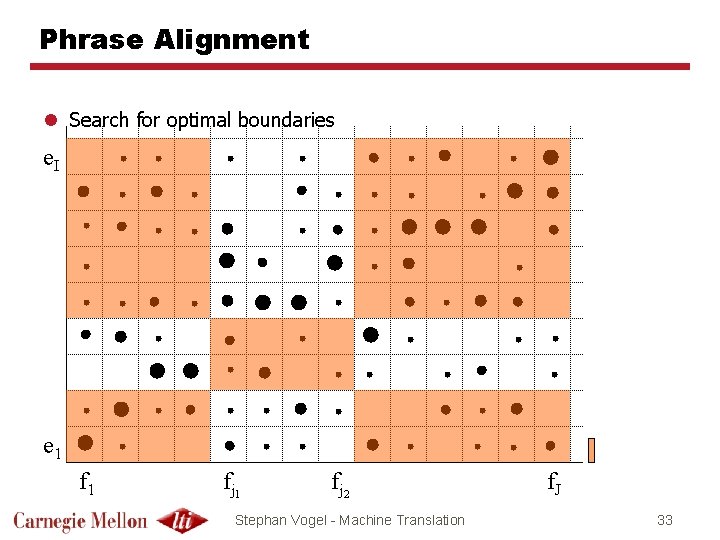
Phrase Alignment l Search for optimal boundaries e. I e 1 fj 2 Stephan Vogel - Machine Translation f. J 33
Phrase Alignment l Search for optimal boundaries e. I e 1 fj 2 Stephan Vogel - Machine Translation f. J 34
Phrase Alignment l Search for optimal boundaries e. I e 1 fj 2 Stephan Vogel - Machine Translation f. J 35
Phrase Alignment l Search for optimal boundaries e. I e 1 fj 2 Stephan Vogel - Machine Translation f. J 36
Phrase Alignment l Search for optimal boundaries e. I e 1 fj 2 Stephan Vogel - Machine Translation f. J 37
Phrase Alignment l Search for optimal boundaries e. I e 1 fj 2 Stephan Vogel - Machine Translation f. J 38
Phrase Alignment l Search for optimal boundaries e. I e 1 fj 2 Stephan Vogel - Machine Translation f. J 39
Phrase Alignment l Search for optimal boundaries e. I e 1 fj 2 Stephan Vogel - Machine Translation f. J 40
Phrase Alignment l Search for optimal boundaries e. I e 1 fj 2 Stephan Vogel - Machine Translation f. J 41
Phrase Alignment l Search for optimal boundaries e. I e 1 fj 2 Stephan Vogel - Machine Translation f. J 42
Phrase Alignment – Best Result l Optimal target phrase e. I e 1 fj 2 Stephan Vogel - Machine Translation f. J 43
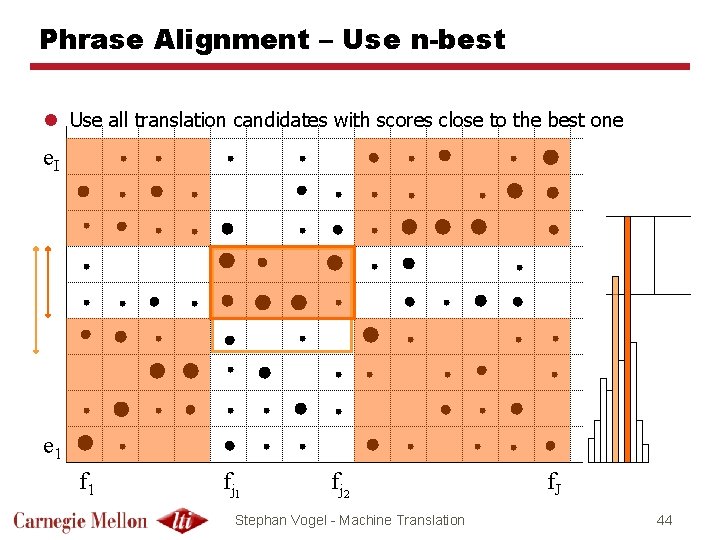
Phrase Alignment – Use n-best l Use all translation candidates with scores close to the best one e. I e 1 fj 2 Stephan Vogel - Machine Translation f. J 44
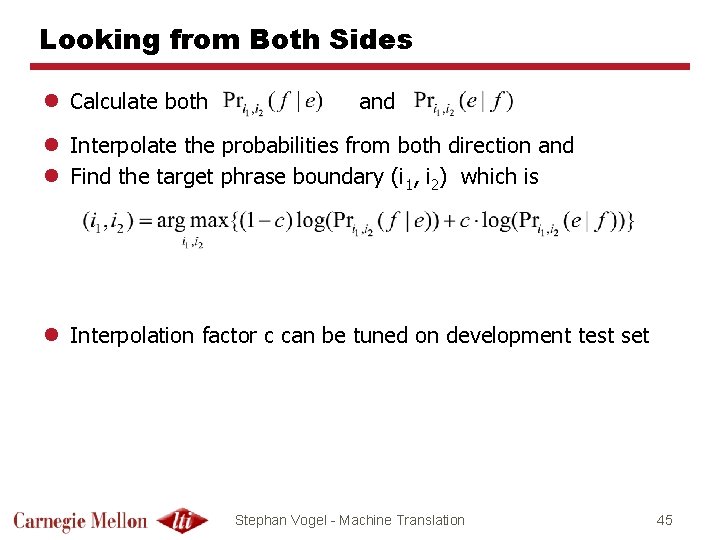
Looking from Both Sides l Calculate both and l Interpolate the probabilities from both direction and l Find the target phrase boundary (i 1, i 2) which is l Interpolation factor c can be tuned on development test set Stephan Vogel - Machine Translation 45
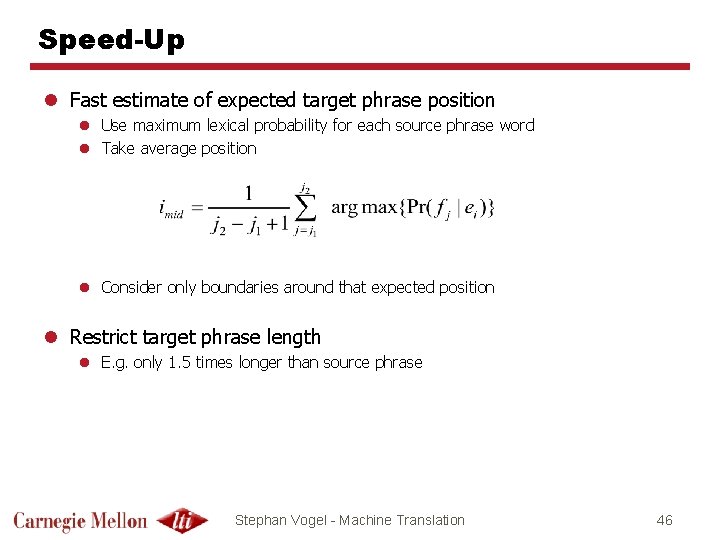
Speed-Up l Fast estimate of expected target phrase position l Use maximum lexical probability for each source phrase word l Take average position l Consider only boundaries around that expected position l Restrict target phrase length l E. g. only 1. 5 times longer than source phrase Stephan Vogel - Machine Translation 46
Additional Phrase Pair Features l Length balance feature l Use |len(f) - len(e)| as feature l Use fertility-based length model l High frequency word features l We over-generate and under-generate punctuations and high frequency words (the, a, is, and, …) l Add counts, how often words are seen in target phrase l Or use word pairs as binary features (seen – not seen) l POS match, i. e. each Src. POS – Tgt. POS pair is a binary feature l Syntactic features: chunk boundaries, sub-tree alignment, … l Feature weights trained on dev data Stephan Vogel - Machine Translation 47
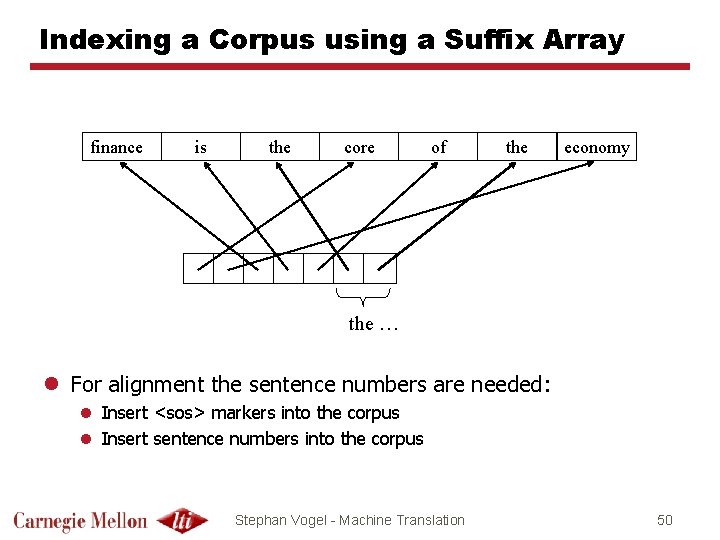
Just-In-Time Phrase Pair Extraction l Given a test sentence: find occurrences of all substrings (ngrams) in the bilingual corpus l Use suffix array to index source part of corpus l Space efficient (for each word – one pointer) l Search requires binary search l Can find n-grams up to any n (restricted within sentence boundaries) l Extract phrase-translation pairs l Find phrase alignment based on word alignment l Can use Viterbi alignment (could be pre-calculated) l Or use new phrase alignment approach l Mixed approach: high frequency phrases aligned offline, low frequency phrases aligned online Suffix array toolkit by Joy Ying Zhang http: //projectile. sv. cmu. edu/research/public/tools/salm. htm) Stephan Vogel - Machine Translation 48
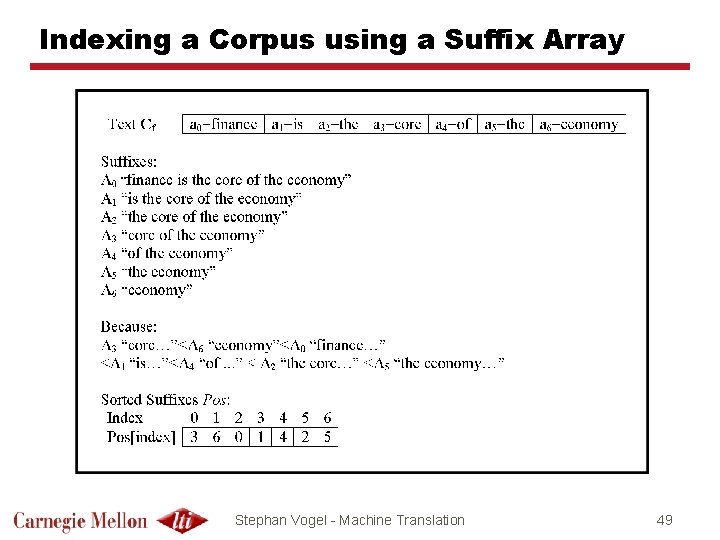
Indexing a Corpus using a Suffix Array Stephan Vogel - Machine Translation 49
Indexing a Corpus using a Suffix Array finance is the core of the economy the … l For alignment the sentence numbers are needed: l Insert <sos> markers into the corpus l Insert sentence numbers into the corpus Stephan Vogel - Machine Translation 50
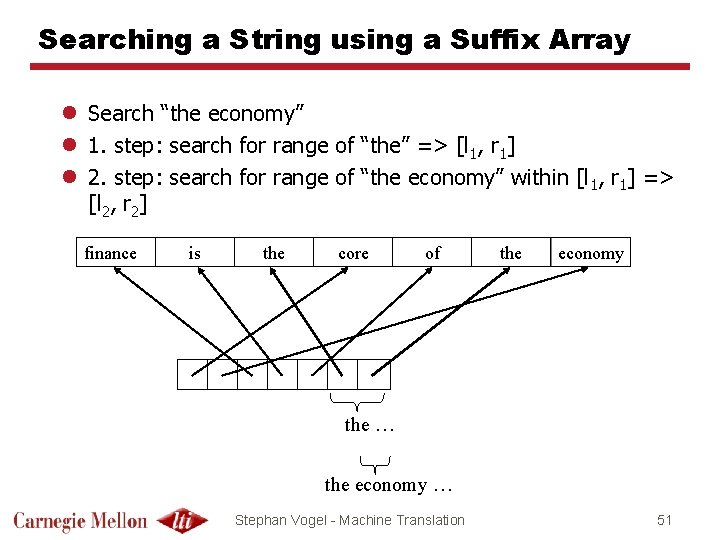
Searching a String using a Suffix Array l Search “the economy” l 1. step: search for range of “the” => [l 1, r 1] l 2. step: search for range of “the economy” within [l 1, r 1] => [l 2, r 2] finance is the core of the economy the … the economy … Stephan Vogel - Machine Translation 51
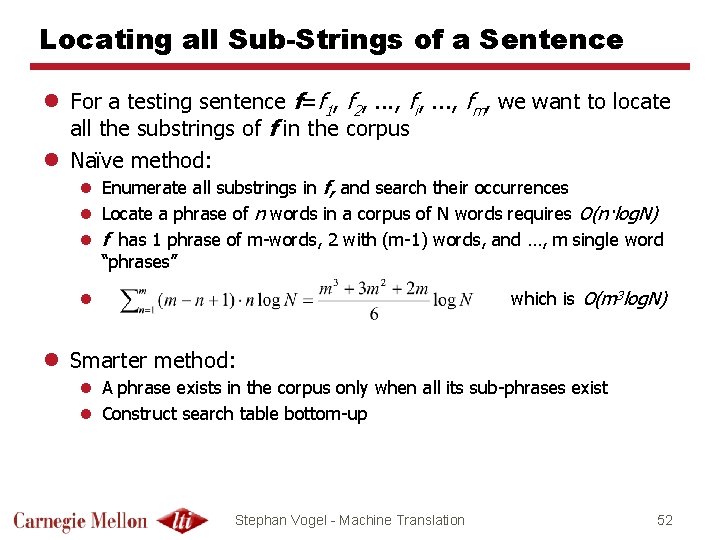
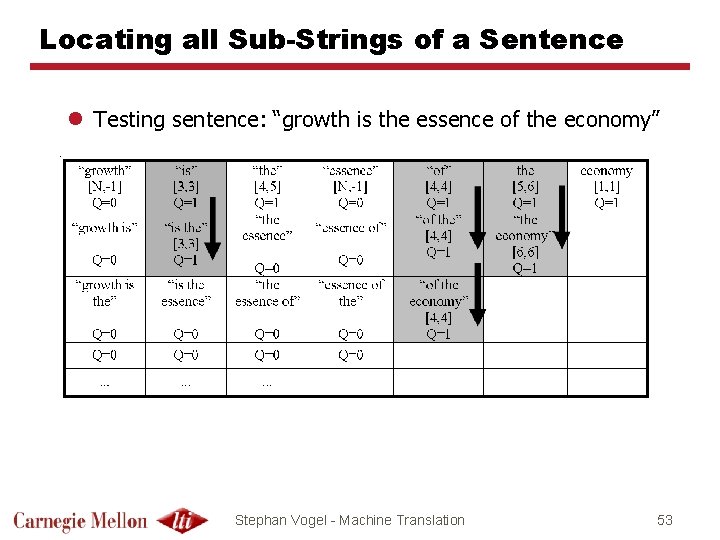
Locating all Sub-Strings of a Sentence l For a testing sentence f=f 1, f 2, . . . , fi, . . . , fm, we want to locate all the substrings of f in the corpus l Naïve method: l Enumerate all substrings in f, and search their occurrences l Locate a phrase of n words in a corpus of N words requires O(n·log. N) l f has 1 phrase of m-words, 2 with (m-1) words, and …, m single word “phrases” which is O(m 3 log. N) l l Smarter method: l A phrase exists in the corpus only when all its sub-phrases exist l Construct search table bottom-up Stephan Vogel - Machine Translation 52
Locating all Sub-Strings of a Sentence l Testing sentence: “growth is the essence of the economy” Stephan Vogel - Machine Translation 53
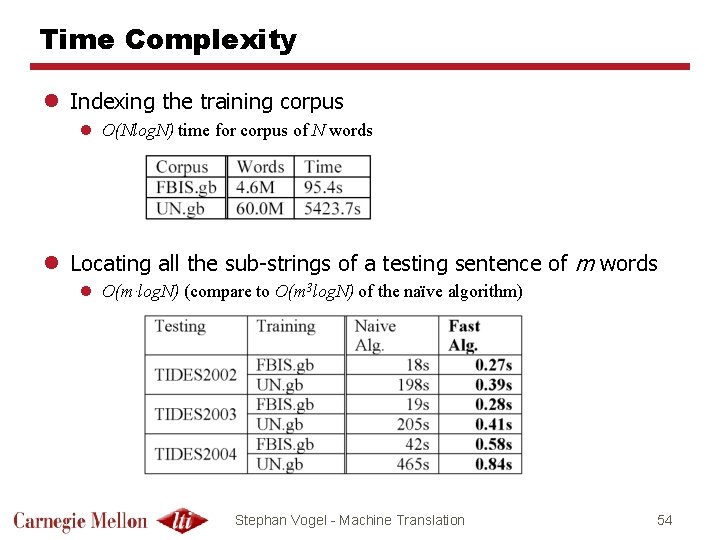
Time Complexity l Indexing the training corpus l O(Nlog. N) time for corpus of N words l Locating all the sub-strings of a testing sentence of m words l O(m·log. N) (compare to O(m 3 log. N) of the naïve algorithm) Stephan Vogel - Machine Translation 54
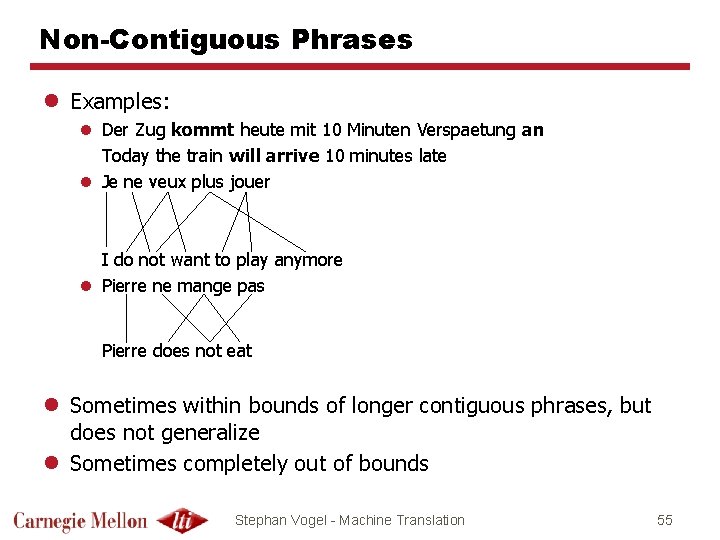
Non-Contiguous Phrases l Examples: l Der Zug kommt heute mit 10 Minuten Verspaetung an Today the train will arrive 10 minutes late l Je ne veux plus jouer I do not want to play anymore l Pierre ne mange pas Pierre does not eat l Sometimes within bounds of longer contiguous phrases, but does not generalize l Sometimes completely out of bounds Stephan Vogel - Machine Translation 55
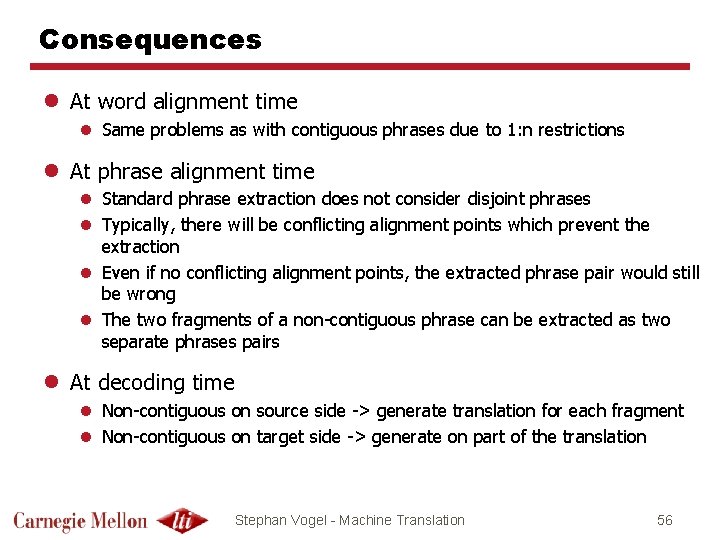
Consequences l At word alignment time l Same problems as with contiguous phrases due to 1: n restrictions l At phrase alignment time l Standard phrase extraction does not consider disjoint phrases l Typically, there will be conflicting alignment points which prevent the extraction l Even if no conflicting alignment points, the extracted phrase pair would still be wrong l The two fragments of a non-contiguous phrase can be extracted as two separate phrases pairs l At decoding time l Non-contiguous on source side -> generate translation for each fragment l Non-contiguous on target side -> generate on part of the translation Stephan Vogel - Machine Translation 56
Some Work on Non-Contiguous Phrases l Simard et al. Translating with non-contiguous phrases, 2005 l Cancedda et al. An elastic-phrase model for statistical machine translation l Galley and Manning. Accurate non-hierarchical phrase-based translation l Notice: hierarchical models (e. g. Hiero) extract noncontiguous phrases l ne X pas : : not X l je ne veux plus X : : I do not want X anymore Stephan Vogel - Machine Translation 57
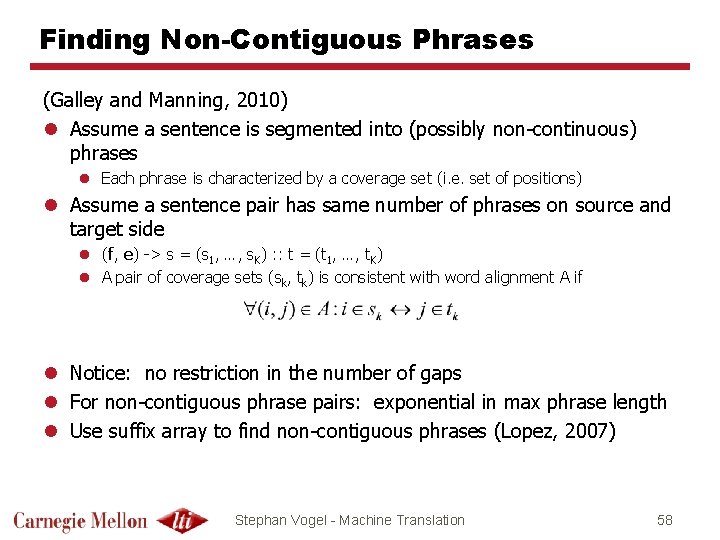
Finding Non-Contiguous Phrases (Galley and Manning, 2010) l Assume a sentence is segmented into (possibly non-continuous) phrases l Each phrase is characterized by a coverage set (i. e. set of positions) l Assume a sentence pair has same number of phrases on source and target side l (f, e) -> s = (s 1, …, s. K) : : t = (t 1, …, t. K) l A pair of coverage sets (sk, tk) is consistent with word alignment A if l Notice: no restriction in the number of gaps l For non-contiguous phrase pairs: exponential in max phrase length l Use suffix array to find non-contiguous phrases (Lopez, 2007) Stephan Vogel - Machine Translation 58
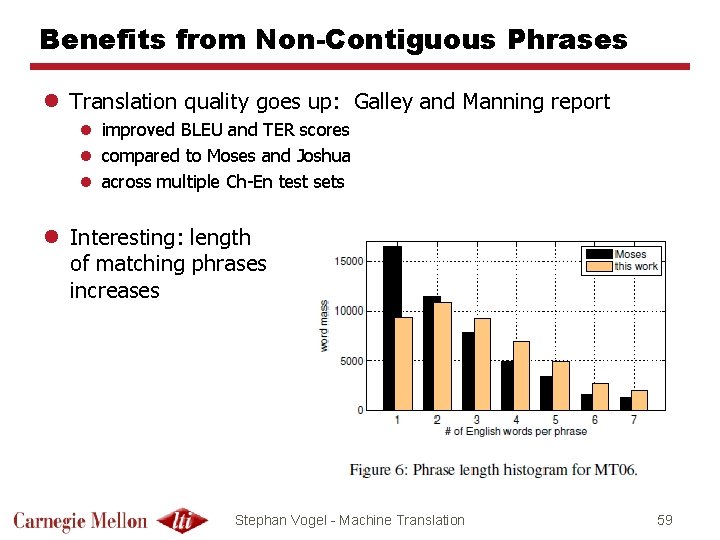
Benefits from Non-Contiguous Phrases l Translation quality goes up: Galley and Manning report l improved BLEU and TER scores l compared to Moses and Joshua l across multiple Ch-En test sets l Interesting: length of matching phrases increases Stephan Vogel - Machine Translation 59
Summary l Phrase alignment based on underlying word alignment l Different phrase alignment approaches l From Viterbi paths l Phrase alignment as optimizing sentence splitting l Looking from both side to cope with asymmetry of word alignment models l Phrase translation table is huge: Restrict phrase to short and/or high frequency phrases l Online phrase alignment l Use suffix array to index all phrases in corpus l Efficient way to find all phrase in a sentence l Actual alignment takes time l Non-contiguous phrases l Efficient search with suffix array l Significant improvement in translation quaility l Longer matching phrases Stephan Vogel - Machine Translation 60