
Machine Translation Challenges and Language Divergences Alon Lavie

- Slides: 35
Machine Translation Challenges and Language Divergences Alon Lavie Language Technologies Institute Carnegie Mellon University 11 -731: Machine Translation January 12, 2011
Major Sources of Translation Problems • Lexical Differences: – Multiple possible translations for SL word, or difficulties expressing SL word meaning in a single TL word • Structural Differences: – Syntax of SL is different than syntax of the TL: word order, sentence and constituent structure • Differences in Mappings of Syntax to Semantics: – Meaning in TL is conveyed using a different syntactic structure than in the SL • Idioms and Constructions January 12, 2011 11 -731: Machine Translation 2
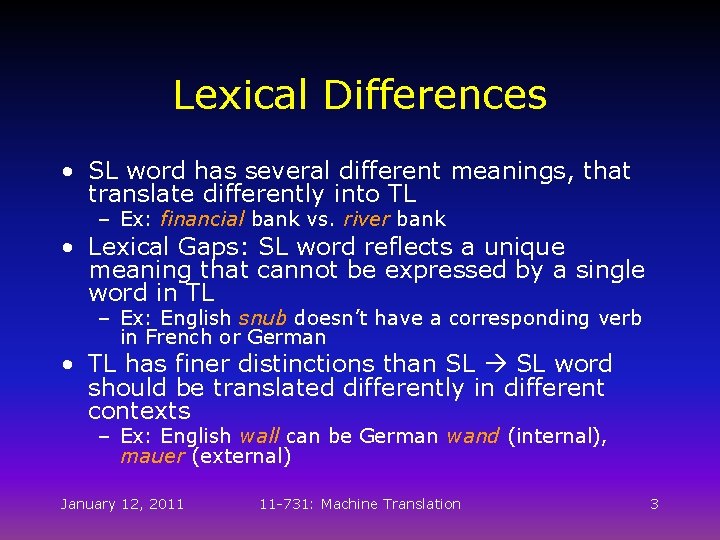
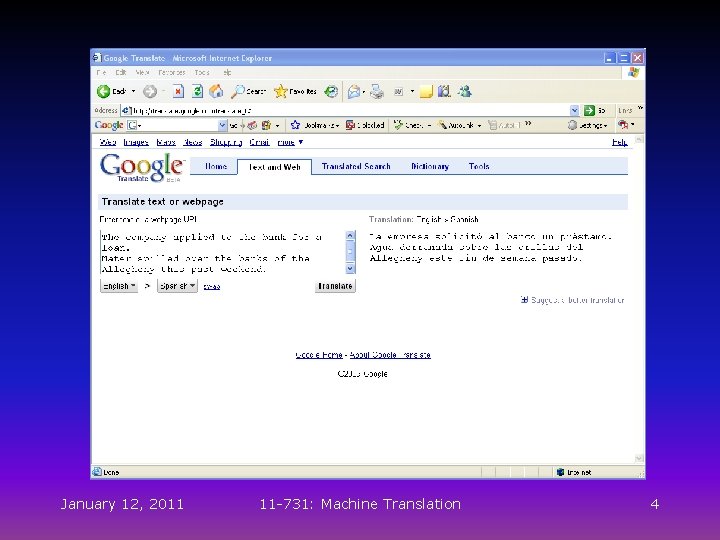
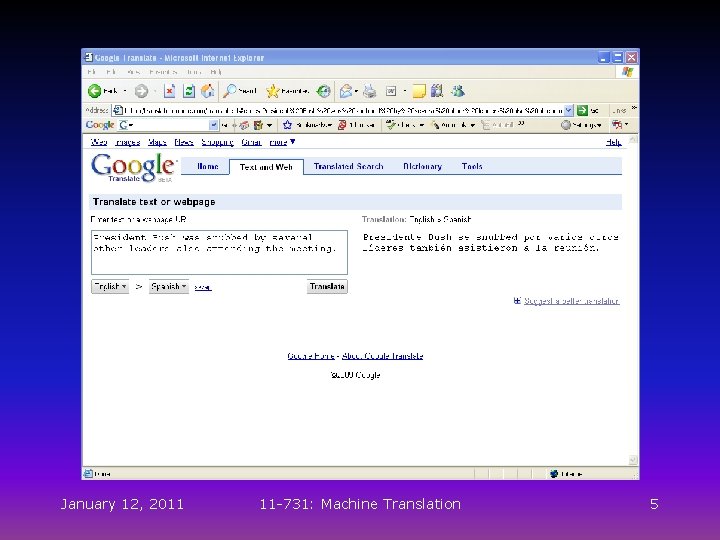
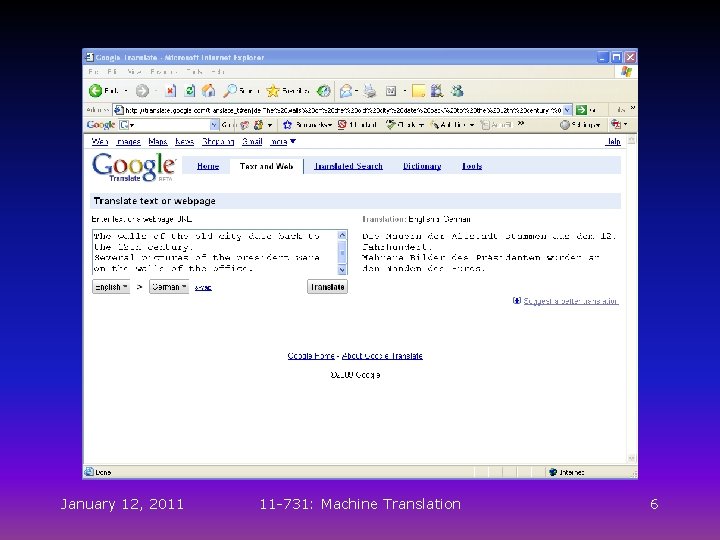
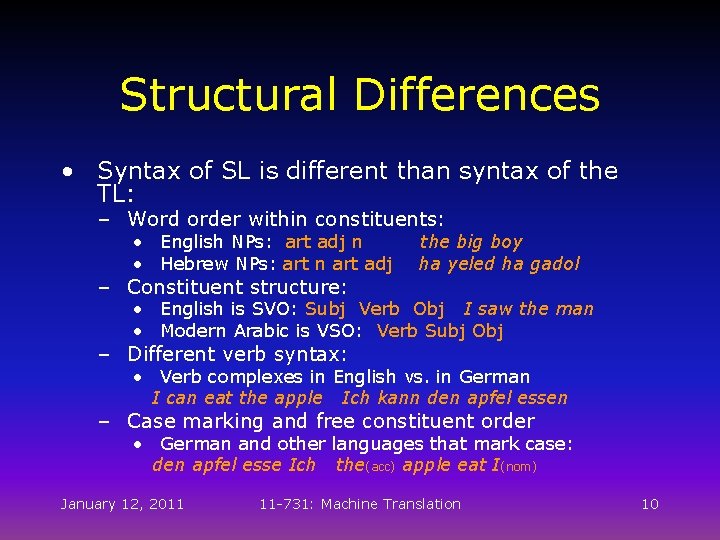
Lexical Differences • SL word has several different meanings, that translate differently into TL – Ex: financial bank vs. river bank • Lexical Gaps: SL word reflects a unique meaning that cannot be expressed by a single word in TL – Ex: English snub doesn’t have a corresponding verb in French or German • TL has finer distinctions than SL word should be translated differently in different contexts – Ex: English wall can be German wand (internal), mauer (external) January 12, 2011 11 -731: Machine Translation 3
Google at Work… January 12, 2011 11 -731: Machine Translation 4
January 12, 2011 11 -731: Machine Translation 5
January 12, 2011 11 -731: Machine Translation 6
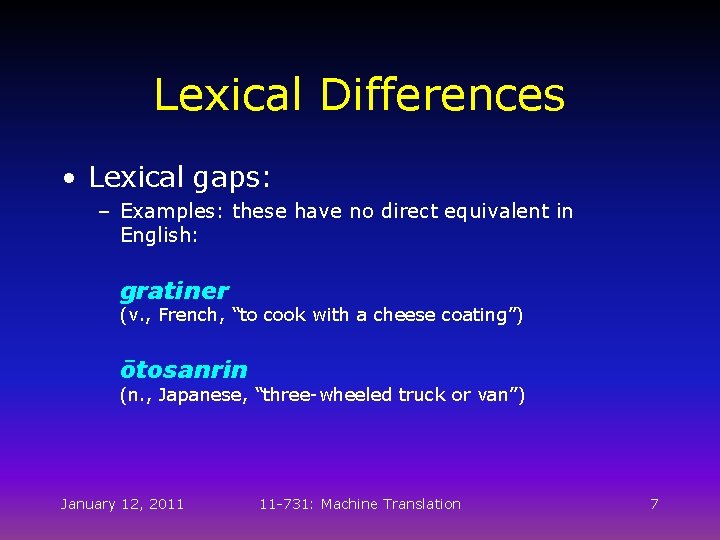
Lexical Differences • Lexical gaps: – Examples: these have no direct equivalent in English: gratiner (v. , French, “to cook with a cheese coating”) ōtosanrin (n. , Japanese, “three-wheeled truck or van”) January 12, 2011 11 -731: Machine Translation 7
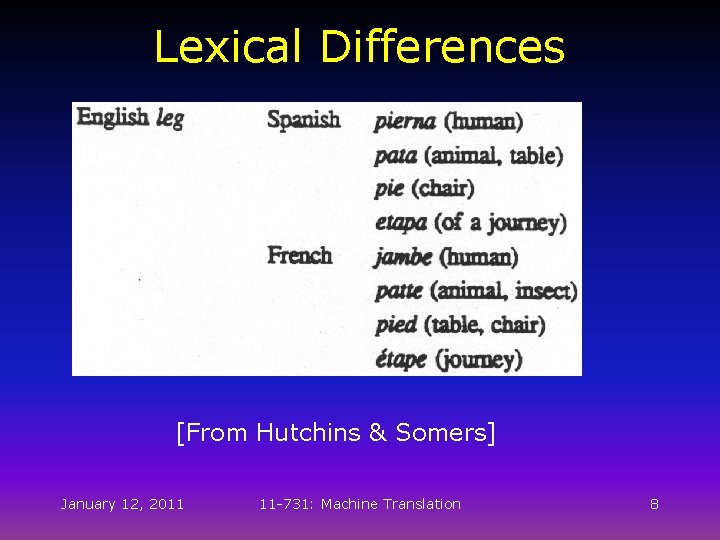
Lexical Differences [From Hutchins & Somers] January 12, 2011 11 -731: Machine Translation 8
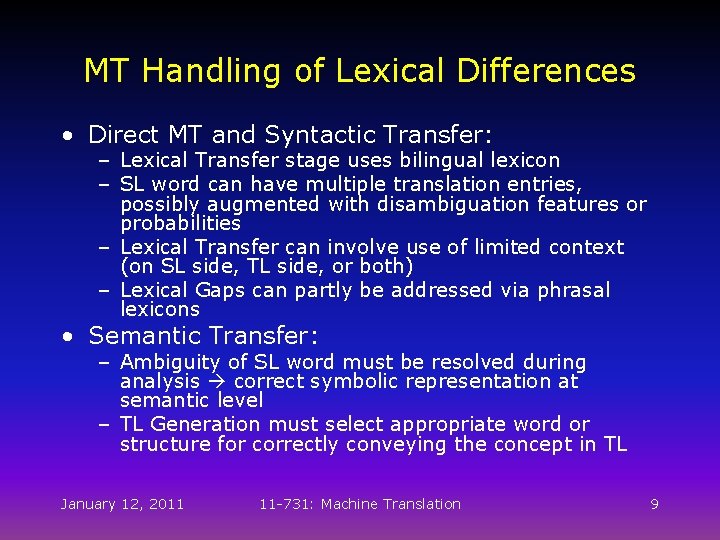
MT Handling of Lexical Differences • Direct MT and Syntactic Transfer: – Lexical Transfer stage uses bilingual lexicon – SL word can have multiple translation entries, possibly augmented with disambiguation features or probabilities – Lexical Transfer can involve use of limited context (on SL side, TL side, or both) – Lexical Gaps can partly be addressed via phrasal lexicons • Semantic Transfer: – Ambiguity of SL word must be resolved during analysis correct symbolic representation at semantic level – TL Generation must select appropriate word or structure for correctly conveying the concept in TL January 12, 2011 11 -731: Machine Translation 9
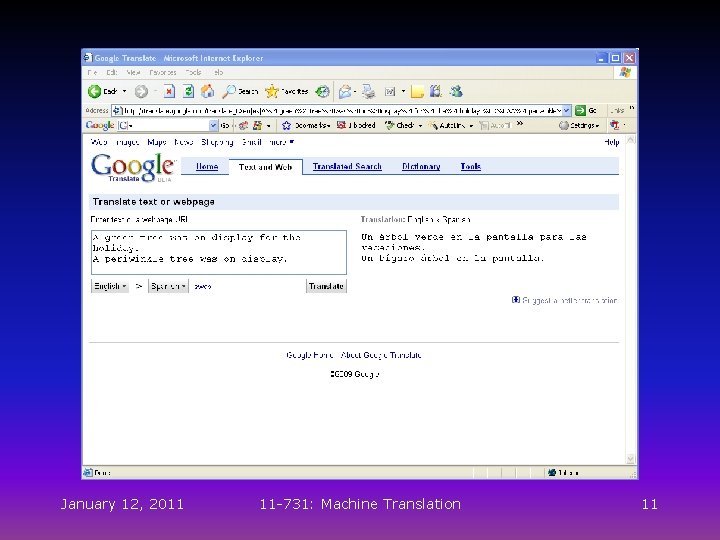
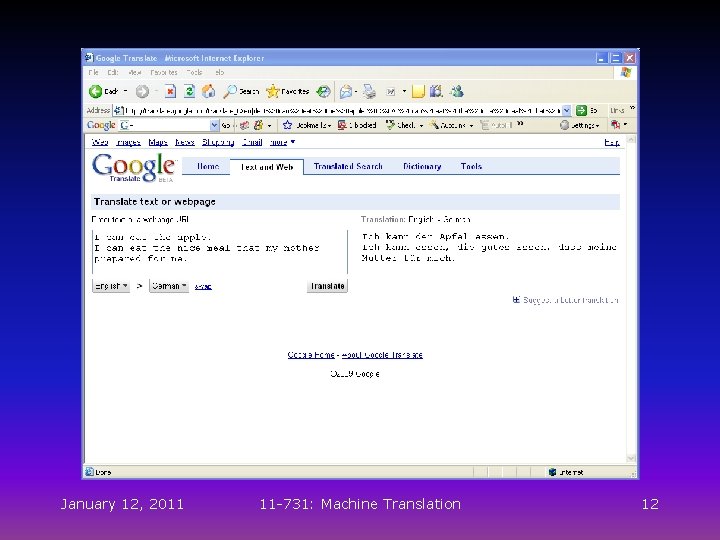
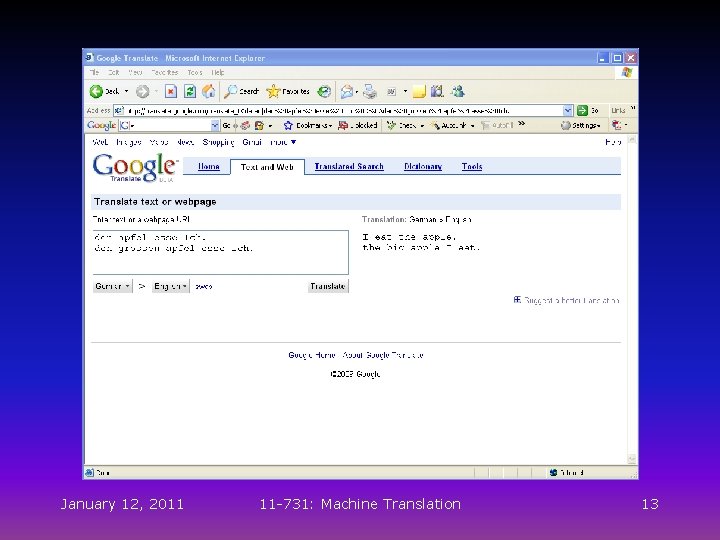
Structural Differences • Syntax of SL is different than syntax of the TL: – Word order within constituents: • English NPs: art adj n • Hebrew NPs: art n art adj – Constituent structure: the big boy ha yeled ha gadol • English is SVO: Subj Verb Obj I saw the man • Modern Arabic is VSO: Verb Subj Obj – Different verb syntax: • Verb complexes in English vs. in German I can eat the apple Ich kann den apfel essen – Case marking and free constituent order • German and other languages that mark case: den apfel esse Ich the(acc) apple eat I(nom) January 12, 2011 11 -731: Machine Translation 10
January 12, 2011 11 -731: Machine Translation 11
January 12, 2011 11 -731: Machine Translation 12
January 12, 2011 11 -731: Machine Translation 13
MT Handling of Structural Differences • Direct MT Approaches: – No explicit treatment: Phrasal Lexicons and sentence level matches or templates • Syntactic Transfer: – Structural Transfer Grammars • Trigger rule by matching against syntactic structure on SL side • Rule specifies how to reorder and re-structure the syntactic constituents to reflect syntax of TL side • Semantic Transfer: – SL Semantic Representation abstracts away from SL syntax to functional roles done during analysis – TL Generation maps semantic structures to correct TL syntax January 12, 2011 11 -731: Machine Translation 14
Syntax-to-Semantics Differences • Meaning in TL is conveyed using a different syntactic structure than in the SL – – Changes in verb and its arguments Passive constructions Motion verbs and state verbs Case creation and case absorption • Main Distinction from Structural Differences: – Structural differences are mostly independent of lexical choices and their semantic meaning addressed by transfer rules that are syntactic in nature – Syntax-to-semantic mapping differences are meaning-specific: require the presence of specific words (and meanings) in the SL January 12, 2011 11 -731: Machine Translation 15
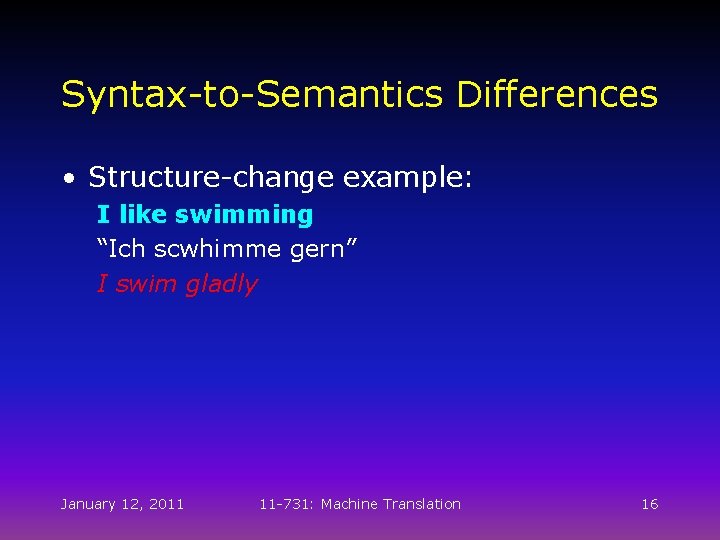
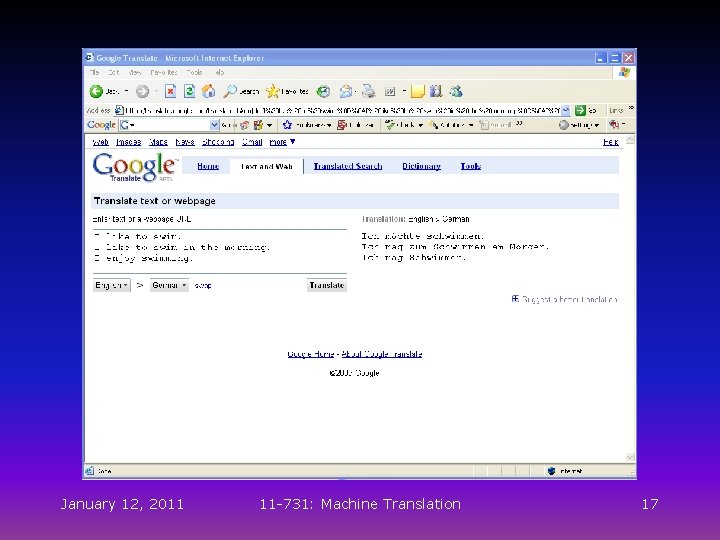
Syntax-to-Semantics Differences • Structure-change example: I like swimming “Ich scwhimme gern” I swim gladly January 12, 2011 11 -731: Machine Translation 16
January 12, 2011 11 -731: Machine Translation 17
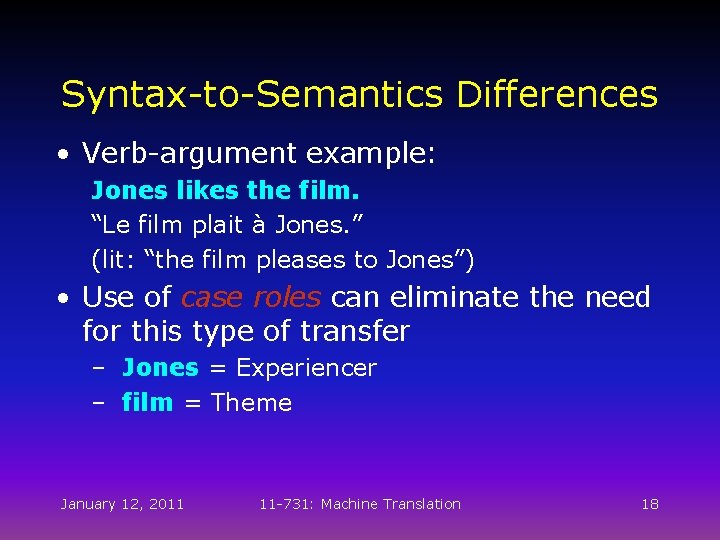
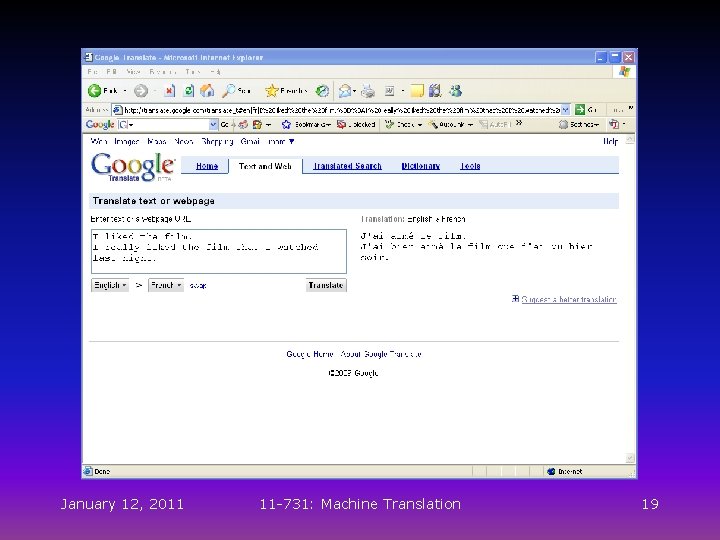
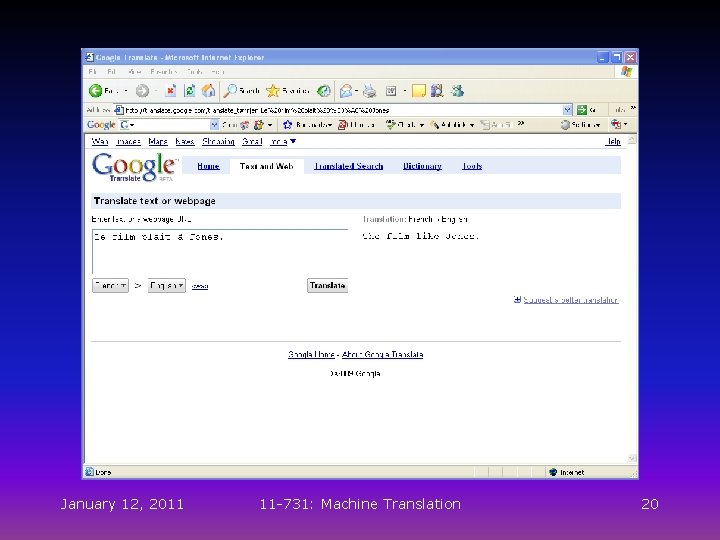
Syntax-to-Semantics Differences • Verb-argument example: Jones likes the film. “Le film plait à Jones. ” (lit: “the film pleases to Jones”) • Use of case roles can eliminate the need for this type of transfer – Jones = Experiencer – film = Theme January 12, 2011 11 -731: Machine Translation 18
January 12, 2011 11 -731: Machine Translation 19
January 12, 2011 11 -731: Machine Translation 20
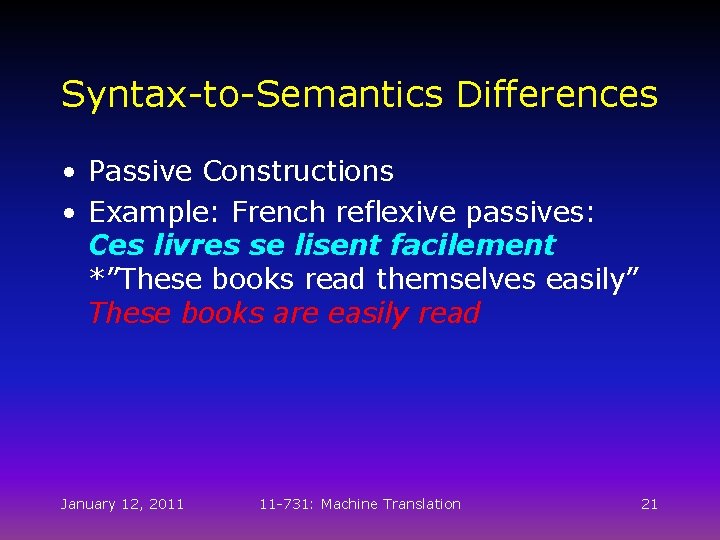
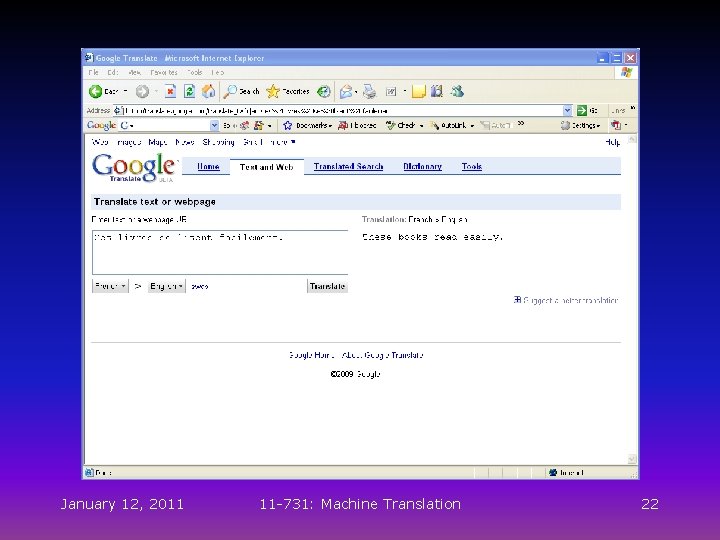
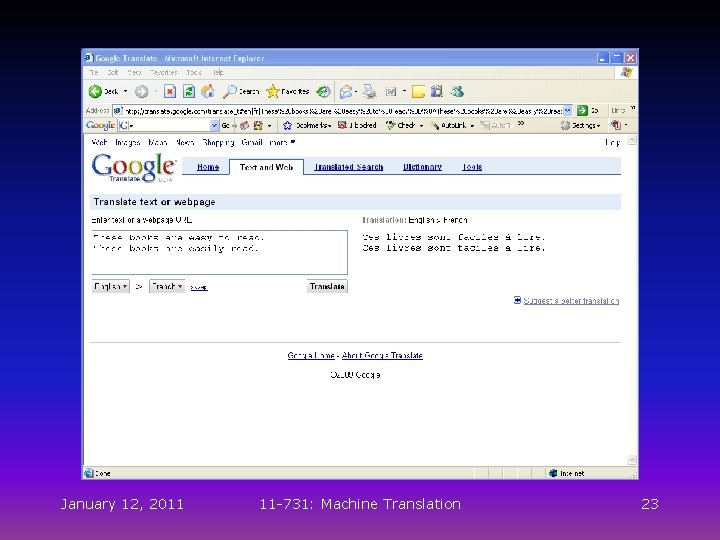
Syntax-to-Semantics Differences • Passive Constructions • Example: French reflexive passives: Ces livres se lisent facilement *”These books read themselves easily” These books are easily read January 12, 2011 11 -731: Machine Translation 21
January 12, 2011 11 -731: Machine Translation 22
January 12, 2011 11 -731: Machine Translation 23
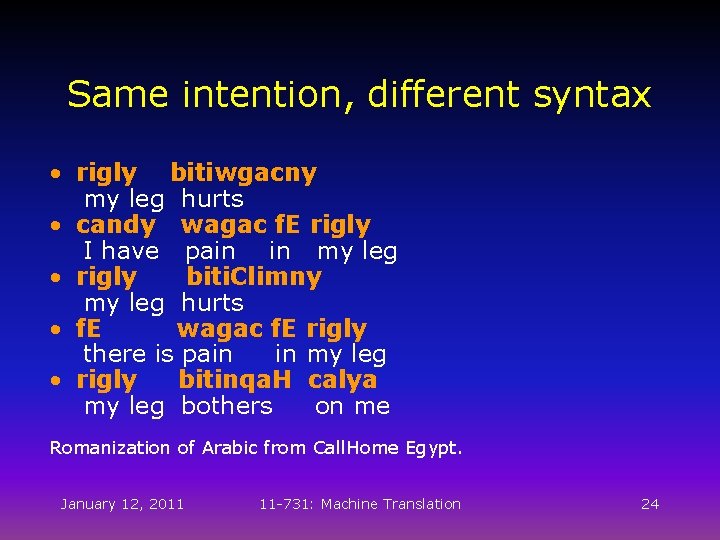
Same intention, different syntax • rigly bitiwgacny my leg hurts • candy wagac f. E rigly I have pain in my leg • rigly biti. Climny my leg hurts • f. E wagac f. E rigly there is pain in my leg • rigly bitinqa. H calya my leg bothers on me Romanization of Arabic from Call. Home Egypt. January 12, 2011 11 -731: Machine Translation 24
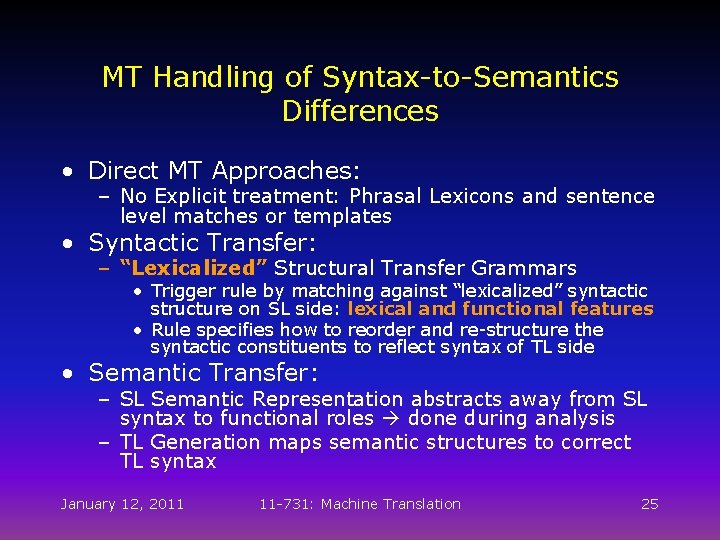
MT Handling of Syntax-to-Semantics Differences • Direct MT Approaches: – No Explicit treatment: Phrasal Lexicons and sentence level matches or templates • Syntactic Transfer: – “Lexicalized” Structural Transfer Grammars • Trigger rule by matching against “lexicalized” syntactic structure on SL side: lexical and functional features • Rule specifies how to reorder and re-structure the syntactic constituents to reflect syntax of TL side • Semantic Transfer: – SL Semantic Representation abstracts away from SL syntax to functional roles done during analysis – TL Generation maps semantic structures to correct TL syntax January 12, 2011 11 -731: Machine Translation 25
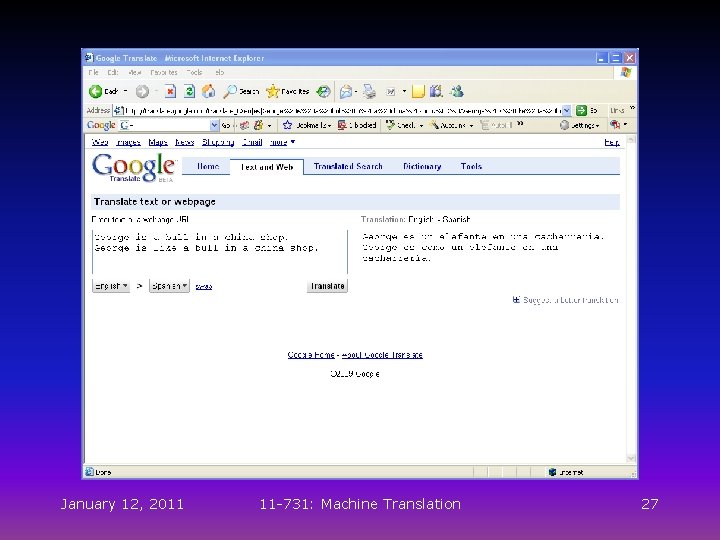
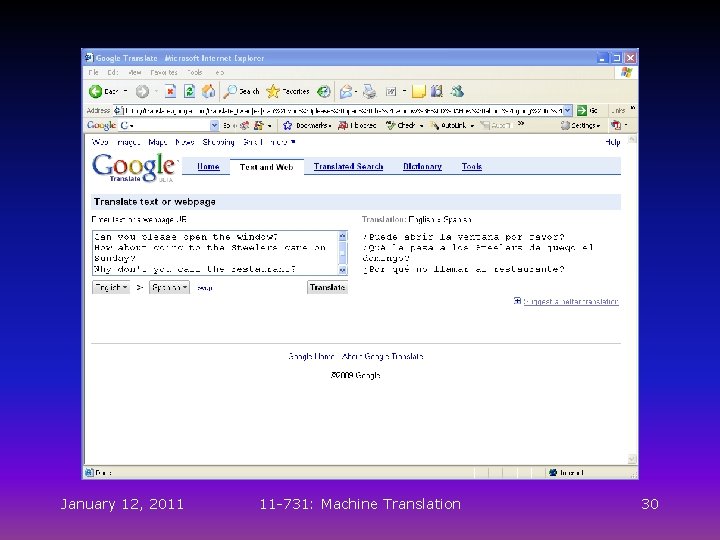
Idioms and Constructions • Main Distinction: meaning of whole is not directly compositional from meaning of its sub-parts no compositional translation • Examples: – George is a bull in a china shop – He kicked the bucket – Can you please open the window? January 12, 2011 11 -731: Machine Translation 26
January 12, 2011 11 -731: Machine Translation 27
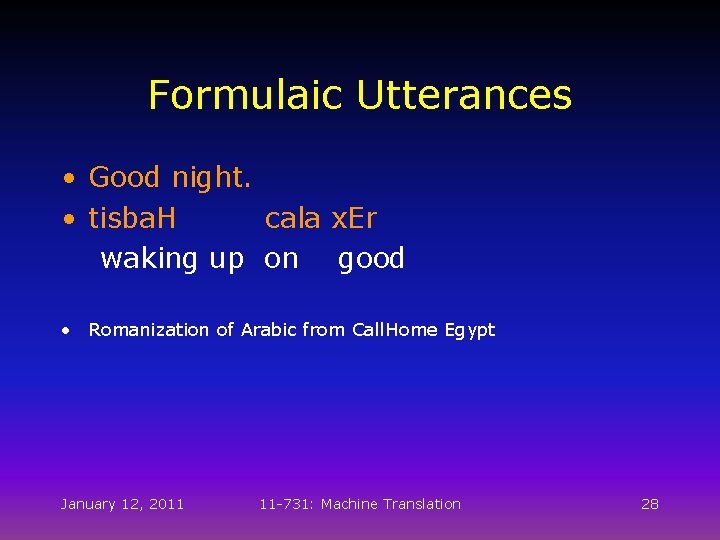
Formulaic Utterances • Good night. • tisba. H cala x. Er waking up on good • Romanization of Arabic from Call. Home Egypt January 12, 2011 11 -731: Machine Translation 28
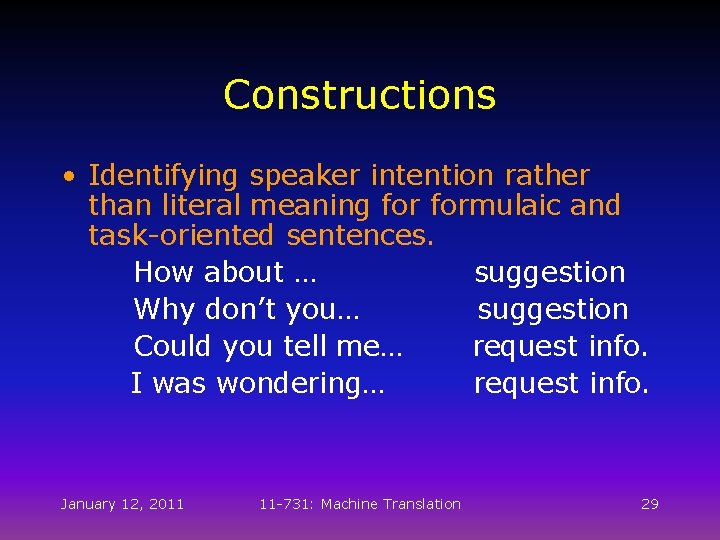
Constructions • Identifying speaker intention rather than literal meaning formulaic and task-oriented sentences. How about … suggestion Why don’t you… suggestion Could you tell me… request info. I was wondering… request info. January 12, 2011 11 -731: Machine Translation 29
January 12, 2011 11 -731: Machine Translation 30
MT Handling of Constructions and Idioms • Direct MT Approaches: – No Explicit treatment: Phrasal Lexicons and sentence level matches or templates • Syntactic Transfer: – No effective treatment – “Highly Lexicalized” Structural Transfer rules can handle some constructions • Trigger rule by matching against entire construction, including structure on SL side • Rule specifies how to generate the correct construction on the TL side • Semantic Transfer: – Analysis must capture non-compositional representation of the idiom or construction specialized rules – TL Generation maps construction semantic structures to correct TL syntax and lexical words January 12, 2011 11 -731: Machine Translation 31
Take Home Messages • Remember these types of language divergences as you learn about and apply the various steps in the MT system pipelines of different approaches! • Ask yourself how capable these various steps and approaches are in addressing these types of divergences! – Can the step/approach handle these divergences? – If so, does it model the divergence at the appropriate level of abstraction? • Keep these language divergences in mind when you analyze the errors of the MT system that you have put together and trained! – Are the errors attributable to a particular divergence? – What would be required for the system to address this type of error? January 12, 2011 11 -731: Machine Translation 32
Summary • Main challenges for current state-of-the-art MT approaches - Coverage and Accuracy: – Acquiring broad-coverage high-accuracy translation lexicons (for words and phrases) – learning syntactic mappings between languages from parallel word-aligned data – overcoming syntax-to-semantics differences and dealing with constructions – Effective Target Language Modeling January 12, 2011 11 -731: Machine Translation 33
Homework Assignment #1 January 12, 2011 11 -731: Machine Translation 34
Questions… January 12, 2011 11 -731: Machine Translation 35