
Machine Protection System Arden Warner PIPII Machine Advisory
- Slides: 22
Machine Protection System Arden Warner PIP-II Machine Advisory Committee 10 - 12 April, 2017
Outline • • • 2 MPS Scope – PIP 2 IT to PIP-II System Design and Configuration Technical Concerns MPS test and development at PIP 2 IT Summary Arden Warner | 2017 P 2 MAC 12/25/2021
Main Goals of the MPS The main goals of the MPS is to protect the machines from beam induced damage; thereby inhibiting the beam in case of excessive beam loss, equipment failures, or operator request. In achieving that objective, the system will also provide the following features: • Manage beam intensity and permit limits of MPS designated devices while providing post mortem data to the control system, • Provide a comprehensive overview of the machine state and readiness status to subsystems and the broader complex, • Provide a global synchronization trigger for beam related system faultanalysis, • Provide Linac beam status to the accelerator complex control system, • Provide high availability and fail safe operation where possible, • Manage and display MPS alarms. The MPS is not a personnel safety system, however it is required to operate in a fail-safe manner. 3 Arden Warner | 2017 P 2 MAC 12/25/2021
MPS Design The PIP 2 IT / PIP-II MPS comprise of a logic system that takes in signals from various subsystems and drives permits to beam enabling devices. These devices are divided into two (Primary and Secondary) categories based on criticality for mitigating beam damage Primary Devices : main actuators for beam and should guarantee that, when they function properly, no dramatic damage can be caused by the beam even if protection through secondary devices fail (includes sensing and beam inhibiting devices). § Are located in the Ion Source and the LEBT section and include: § LEBT Chopper § LEBT Dipole § Ion Source Modulator § Ion source Bias Power Supply § Primary devices are not mask during normal operation § Possible to mask during MPS commissioning Other Primary devices: § Special Instrumentation and diagnostics specifically developed for MPS use such as beam transmission loss system and permit signals from users indicating readiness for beam from the Linac 4 Arden Warner | 2017 P 2 MAC 12/25/2021
MPS Design Secondary Beam Inhibiting Devices are those whose malfunction will not create dramatic damage; either because the effects can be detected and mitigated by primary devices or because the device is included in the MPS for self protection Secondary Devices : § Insertion devices – scrapers etc. Secondary devices further decrease the likelihood of damage and possible irradiation of components. The list includes: § The System providing the beam request sequence from the complex § Status signals from Linac subsystems such as § RF amplifiers, Magnet power supplies, LCW § Quench detection system and Cryogenic system § Control System § Malfunctioning subsystems which can affect beam delivery and therefore drop the Linac beam permit (i. e. RF amplifiers) Other beam inhibiting secondary devices: Beam loss indication devices such as radiation monitors, current signals from scrapers, vacuum gauges, valves and position insertion devices MEBT Chopper is also a beam inhibiting device. 5 Arden Warner | 2017 P 2 MAC 12/25/2021
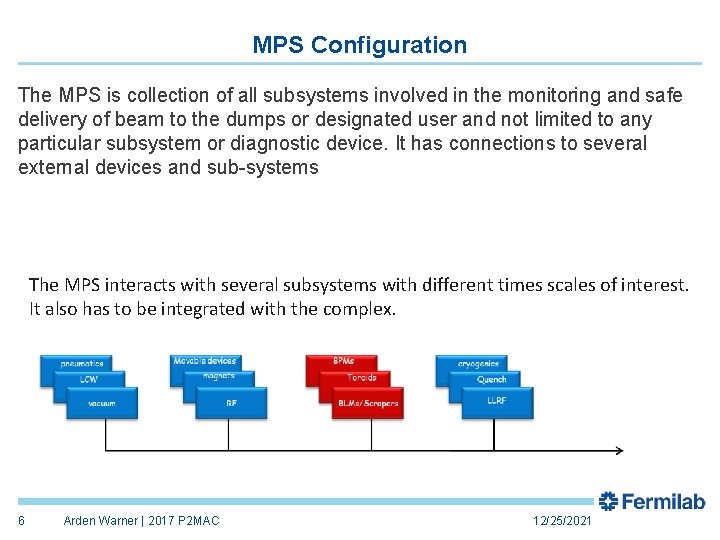
MPS Configuration The MPS is collection of all subsystems involved in the monitoring and safe delivery of beam to the dumps or designated user and not limited to any particular subsystem or diagnostic device. It has connections to several external devices and sub-systems The MPS interacts with several subsystems with different times scales of interest. It also has to be integrated with the complex. 6 Arden Warner | 2017 P 2 MAC 12/25/2021
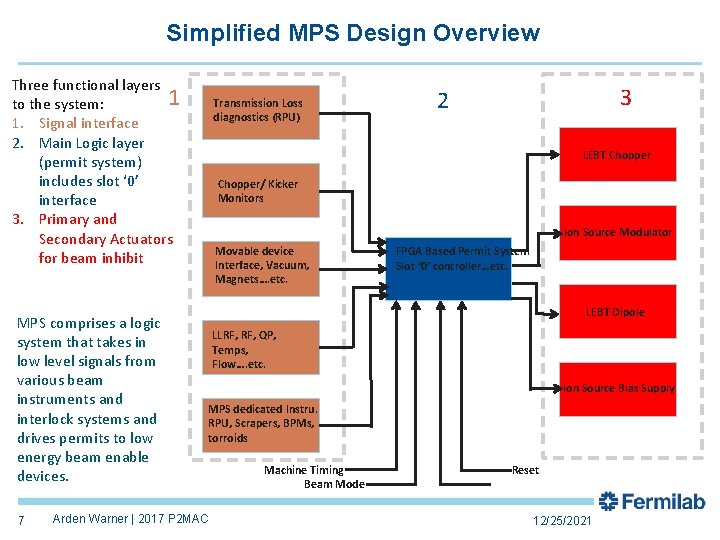
Simplified MPS Design Overview Three functional layers 1 to the system: 1. Signal interface 2. Main Logic layer (permit system) includes slot ‘ 0’ interface 3. Primary and Secondary Actuators for beam inhibit MPS comprises a logic system that takes in low level signals from various beam instruments and interlock systems and drives permits to low energy beam enable devices. 7 Transmission Loss diagnostics (RPU) 3 2 LEBT Chopper/ Kicker Monitors Ion Source Modulator Movable device Interface, Vacuum, Magnets…. etc. FPGA Based Permit System Slot ‘ 0’ controller…etc. LEBT Dipole LLRF, QP, Temps, Flow…. etc. Ion Source Bias Supply MPS dedicated Instru. RPU, Scrapers, BPMs, torroids Arden Warner | 2017 P 2 MAC Machine Timing Beam Mode Reset 12/25/2021
PIP 2 IT LEBT/MEBT-3 Test Bed PIP 2 IT is being developed in stages. Each configuration requires that the MPS expand to accommodate new diagnostics, machine hardware and higher damage potentials. This has driven the MPS development somewhat. Lesson learned and techniques developed in PIP 2 IT system are directly transferable to PIP -II MPS design. Beam Damage Potential - PIP 2 IT Machine Damage Potential: The maximum beam power that PI-Test front-end can generate is 21 k. W CW (10 m. A x 2. 1 Me. V). FY 17 operations will be limited to pulsed mode with maximum power of 2. 1 k. W (5 ms x 20 Hz x 10 m. A x 2. 1 Me. V). Standard Long-pulse mode for FY 17 for Booster injection scenario 105 W (0. 5 ms x 20 Hz x 5 m. A x 2. 1 Me. V Enough potential to damage invasive hardware, vacuum system and components. 8 Arden Warner | 2017 P 2 MAC 12/25/202
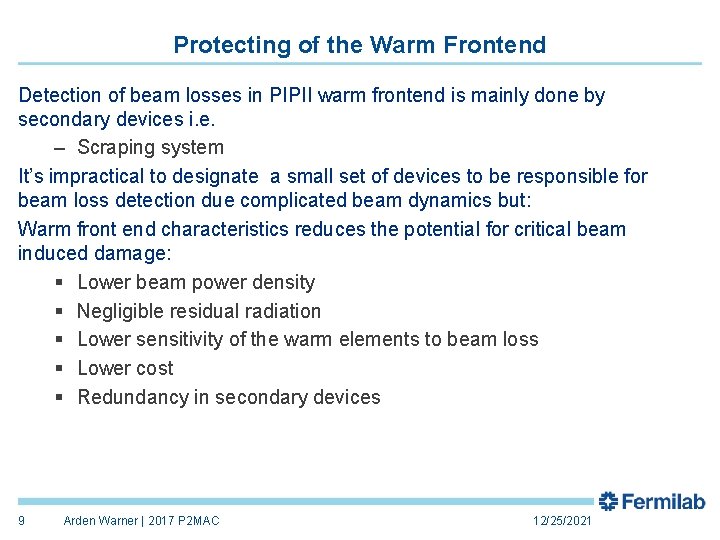
Protecting of the Warm Frontend Detection of beam losses in PIPII warm frontend is mainly done by secondary devices i. e. – Scraping system It’s impractical to designate a small set of devices to be responsible for beam loss detection due complicated beam dynamics but: Warm front end characteristics reduces the potential for critical beam induced damage: § Lower beam power density § Negligible residual radiation § Lower sensitivity of the warm elements to beam loss § Lower cost § Redundancy in secondary devices 9 Arden Warner | 2017 P 2 MAC 12/25/2021
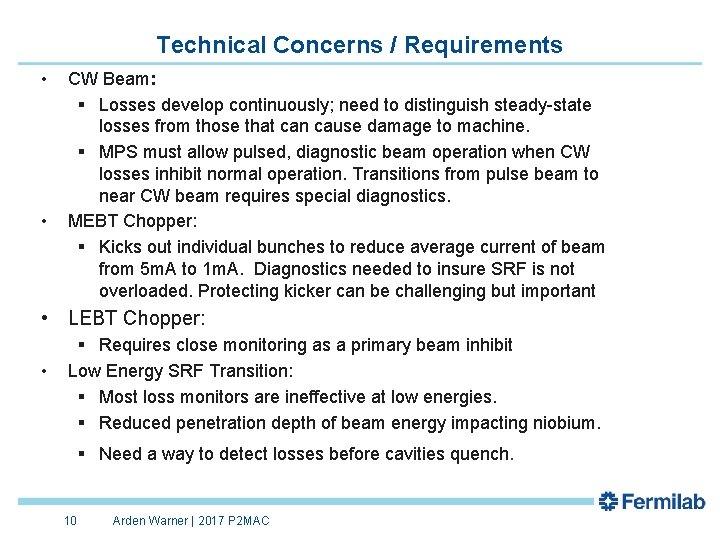
Technical Concerns / Requirements • • CW Beam: § Losses develop continuously; need to distinguish steady-state losses from those that can cause damage to machine. § MPS must allow pulsed, diagnostic beam operation when CW losses inhibit normal operation. Transitions from pulse beam to near CW beam requires special diagnostics. MEBT Chopper: § Kicks out individual bunches to reduce average current of beam from 5 m. A to 1 m. A. Diagnostics needed to insure SRF is not overloaded. Protecting kicker can be challenging but important • LEBT Chopper: • § Requires close monitoring as a primary beam inhibit Low Energy SRF Transition: § Most loss monitors are ineffective at low energies. § Reduced penetration depth of beam energy impacting niobium. § Need a way to detect losses before cavities quench. 10 Arden Warner | 2017 P 2 MAC
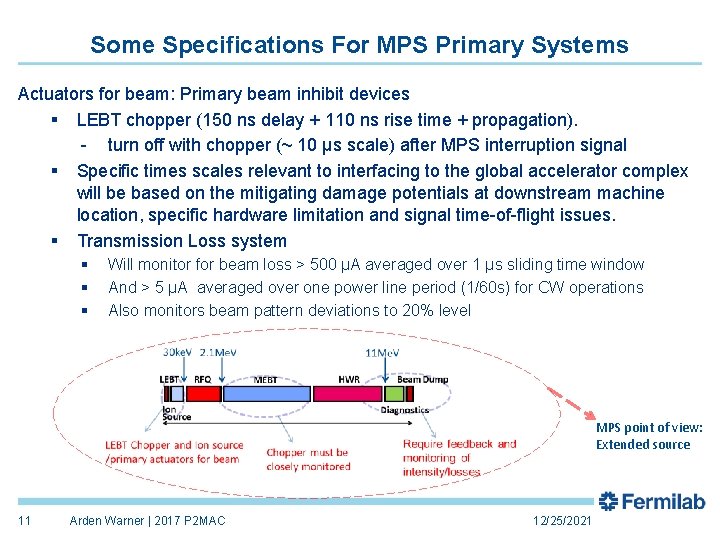
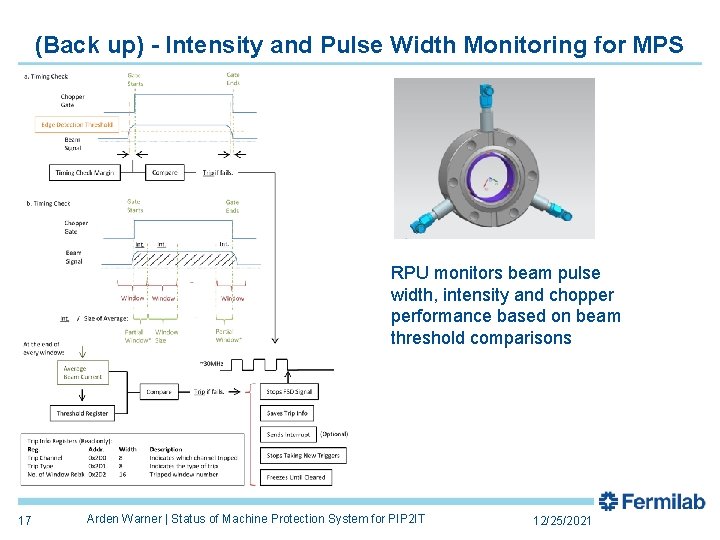
Some Specifications For MPS Primary Systems Actuators for beam: Primary beam inhibit devices § LEBT chopper (150 ns delay + 110 ns rise time + propagation). - turn off with chopper (~ 10 µs scale) after MPS interruption signal § Specific times scales relevant to interfacing to the global accelerator complex will be based on the mitigating damage potentials at downstream machine location, specific hardware limitation and signal time-of-flight issues. § Transmission Loss system § § § Will monitor for beam loss > 500 µA averaged over 1 µs sliding time window And > 5 µA averaged over one power line period (1/60 s) for CW operations Also monitors beam pattern deviations to 20% level MPS point of view: Extended source 11 Arden Warner | 2017 P 2 MAC 12/25/2021
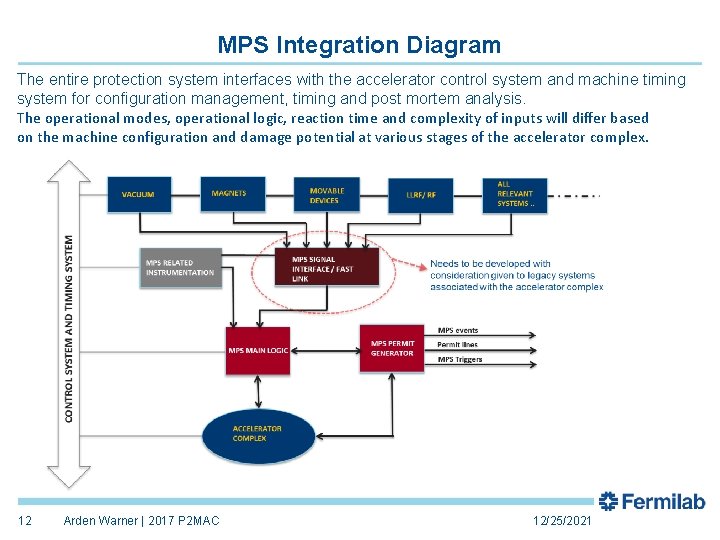
MPS Integration Diagram The entire protection system interfaces with the accelerator control system and machine timing system for configuration management, timing and post mortem analysis. The operational modes, operational logic, reaction time and complexity of inputs will differ based on the machine configuration and damage potential at various stages of the accelerator complex. 12 Arden Warner | 2017 P 2 MAC 12/25/2021
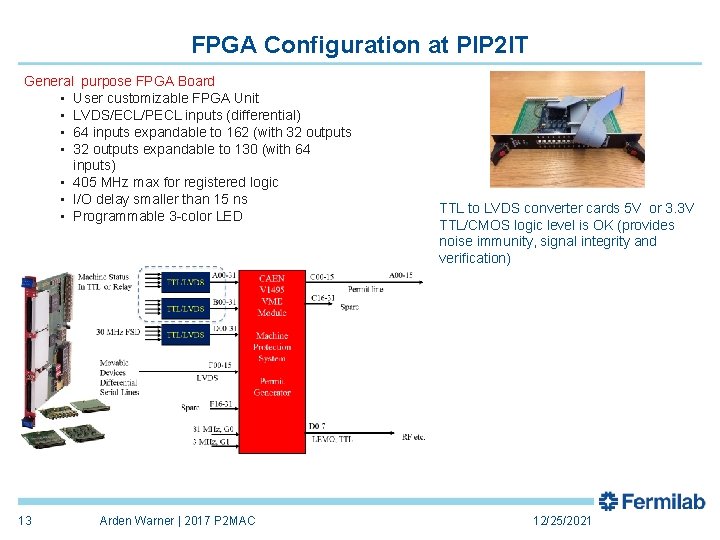
FPGA Configuration at PIP 2 IT General purpose FPGA Board • User customizable FPGA Unit • LVDS/ECL/PECL inputs (differential) • 64 inputs expandable to 162 (with 32 outputs • 32 outputs expandable to 130 (with 64 inputs) • 405 MHz max for registered logic • I/O delay smaller than 15 ns • Programmable 3 -color LED 13 Arden Warner | 2017 P 2 MAC TTL to LVDS converter cards 5 V or 3. 3 V TTL/CMOS logic level is OK (provides noise immunity, signal integrity and verification) 12/25/2021
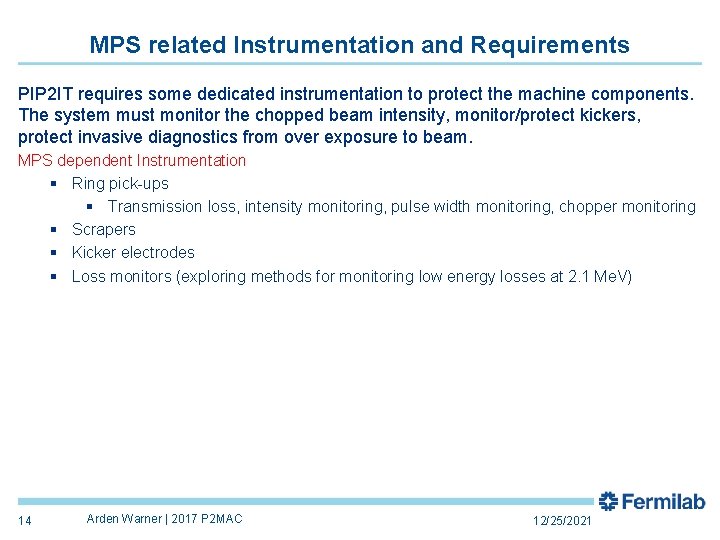
MPS related Instrumentation and Requirements PIP 2 IT requires some dedicated instrumentation to protect the machine components. The system must monitor the chopped beam intensity, monitor/protect kickers, protect invasive diagnostics from over exposure to beam. MPS dependent Instrumentation § Ring pick-ups § Transmission loss, intensity monitoring, pulse width monitoring, chopper monitoring § Scrapers § Kicker electrodes § Loss monitors (exploring methods for monitoring low energy losses at 2. 1 Me. V) 14 Arden Warner | 2017 P 2 MAC 12/25/2021
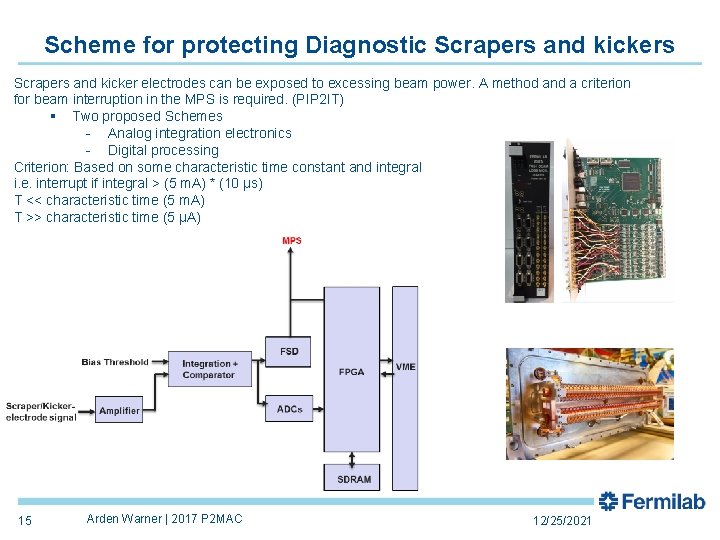
Scheme for protecting Diagnostic Scrapers and kickers Scrapers and kicker electrodes can be exposed to excessing beam power. A method and a criterion for beam interruption in the MPS is required. (PIP 2 IT) § Two proposed Schemes - Analog integration electronics - Digital processing Criterion: Based on some characteristic time constant and integral i. e. interrupt if integral > (5 m. A) * (10 µs) T << characteristic time (5 m. A) T >> characteristic time (5 µA) 15 Arden Warner | 2017 P 2 MAC 12/25/2021
Summary § MPS Development work at PIP 2 T is focus on the main technical challenges for protecting the warm front-end. § Will learn how to monitor and understand the complicated loss structure expected § Techniques transferable to PIP-II § Above 200 Me. V the PIP-II MPS hardware design and placement can be modeled after the SNS system. Protection system R&D aimed to § § § 16 Understand verify acceptable loss rates in the room temperature sections, Develop a strategy to monitor chopped beam from the MEBT, Estimate the particle shielding effects of superconducting cavities and cryomodules, Develop effective algorithms for the FPGA based logic system, Demonstrate effective integration with controls/instrumentation and all subsystems, Understand dark current effects as it relates to protection issues. Arden Warner | 2017 P 2 MAC 12/25/2021
(Back up) - Intensity and Pulse Width Monitoring for MPS RPU monitors beam pulse width, intensity and chopper performance based on beam threshold comparisons 17 Arden Warner | Status of Machine Protection System for PIP 2 IT 12/25/2021
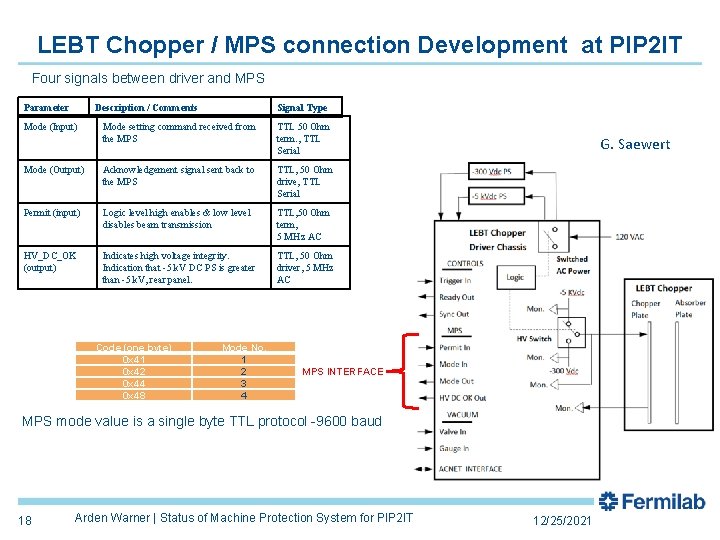
LEBT Chopper / MPS connection Development at PIP 2 IT Four signals between driver and MPS Parameter Description / Comments Mode (Input) Signal Type Mode setting command received from the MPS TTL 50 Ohm term. , TTL Serial Mode (Output) Acknowledgement signal sent back to the MPS TTL, 50 Ohm drive, TTL Serial Permit (input) Logic level high enables & low level disables beam transmission TTL, 50 Ohm term, 5 MHz AC HV_DC_OK (output) Indicates high voltage integrity. Indication that -5 k. V DC PS is greater than -5 k. V, rear panel. TTL, 50 Ohm driver, 5 MHz AC Code (one byte) 0 x 41 0 x 42 0 x 44 0 x 48 Mode No. 1 2 3 4 G. Saewert MPS INTERFACE MPS mode value is a single byte TTL protocol -9600 baud 18 Arden Warner | Status of Machine Protection System for PIP 2 IT 12/25/2021
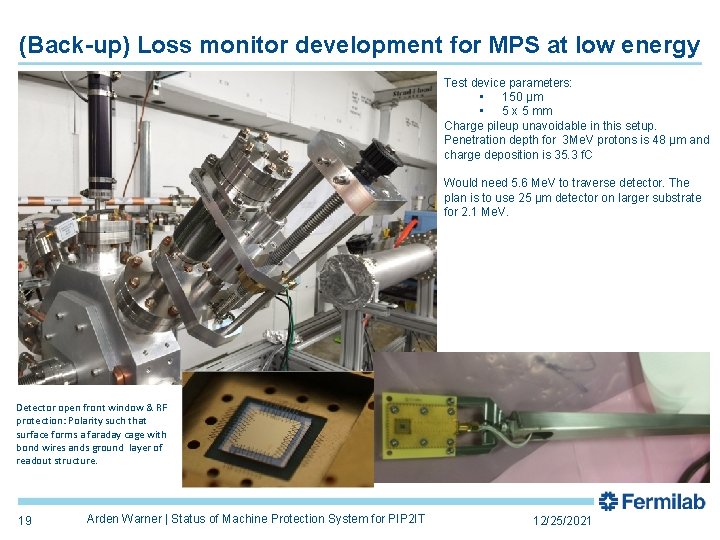
(Back-up) Loss monitor development for MPS at low energy Test device parameters: • 150 µm • 5 x 5 mm Charge pileup unavoidable in this setup. Penetration depth for 3 Me. V protons is 48 µm and charge deposition is 35. 3 f. C Would need 5. 6 Me. V to traverse detector. The plan is to use 25 µm detector on larger substrate for 2. 1 Me. V. Detector open front window & RF protection: Polarity such that surface forms a faraday cage with bond wires ands ground layer of readout structure. 19 Arden Warner | Status of Machine Protection System for PIP 2 IT 12/25/2021
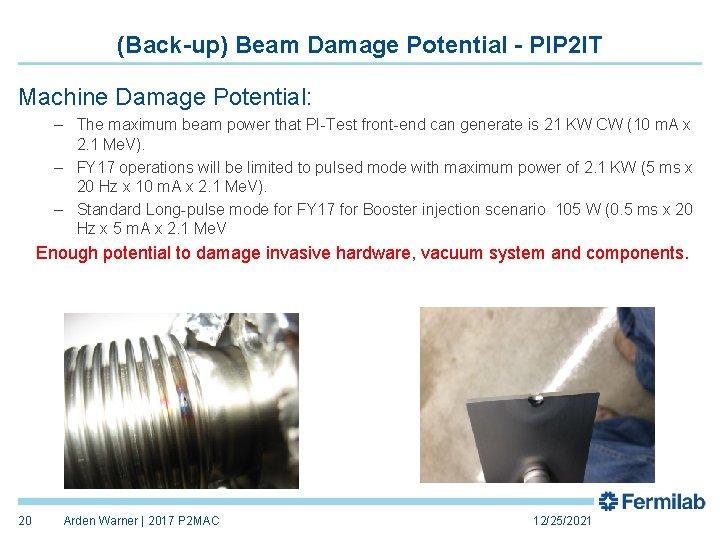
(Back-up) Beam Damage Potential - PIP 2 IT Machine Damage Potential: – The maximum beam power that PI-Test front-end can generate is 21 KW CW (10 m. A x 2. 1 Me. V). – FY 17 operations will be limited to pulsed mode with maximum power of 2. 1 KW (5 ms x 20 Hz x 10 m. A x 2. 1 Me. V). – Standard Long-pulse mode for FY 17 for Booster injection scenario 105 W (0. 5 ms x 20 Hz x 5 m. A x 2. 1 Me. V Enough potential to damage invasive hardware, vacuum system and components. 20 Arden Warner | 2017 P 2 MAC 12/25/2021
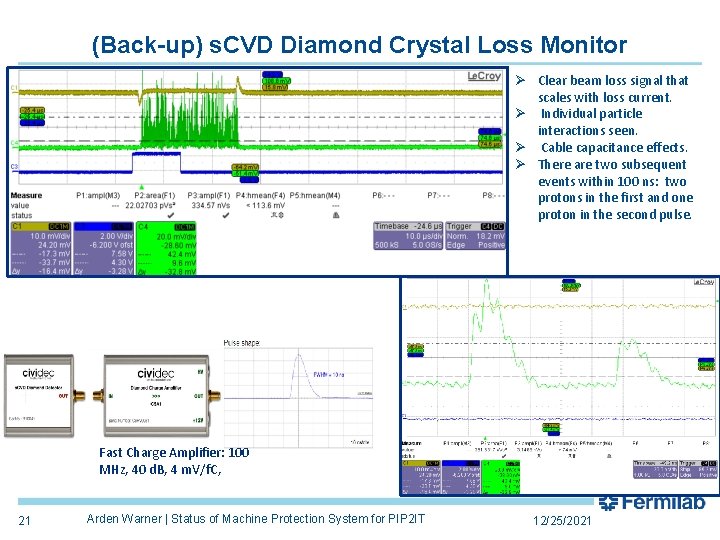
(Back-up) s. CVD Diamond Crystal Loss Monitor Ø Clear beam loss signal that scales with loss current. Ø Individual particle interactions seen. Ø Cable capacitance effects. Ø There are two subsequent events within 100 ns: two protons in the first and one proton in the second pulse. Fast Charge Amplifier: 100 MHz, 40 d. B, 4 m. V/f. C, 21 Arden Warner | Status of Machine Protection System for PIP 2 IT 12/25/2021
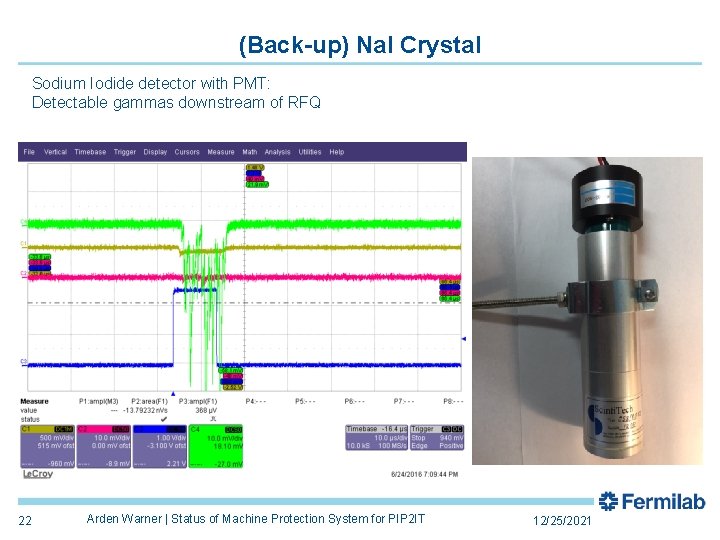
(Back-up) Na. I Crystal Sodium Iodide detector with PMT: Detectable gammas downstream of RFQ 22 Arden Warner | Status of Machine Protection System for PIP 2 IT 12/25/2021