
Machine protection Risk analysis for the RF system

- Slides: 11
Machine protection Risk analysis for the RF system (Medium Beta) Enric Bargallo Lead Analyst for Machine Protection and Dependability www. europeanspallationsource. se
MP Risk analyses for the RF System • The analysis is still undergoing • What we have now is enough to define the needs for the common elements (logic and actuation) • Cavity protection is still not clear (signals, criticality…) 2
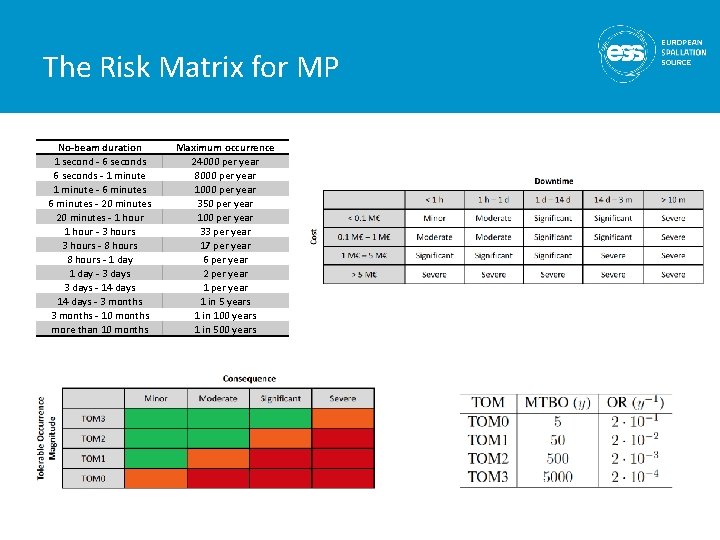
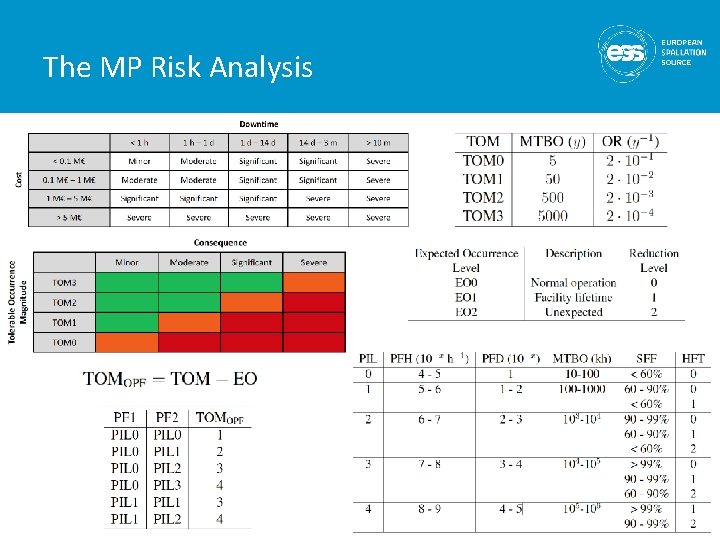
The Risk Matrix for MP No-beam duration 1 second - 6 seconds - 1 minute - 6 minutes - 20 minutes - 1 hour - 3 hours - 8 hours - 1 day - 3 days - 14 days - 3 months - 10 months more than 10 months Maximum occurrence 24000 per year 8000 per year 1000 per year 350 per year 100 per year 33 per year 17 per year 6 per year 2 per year 1 in 5 years 1 in 100 years 1 in 500 years
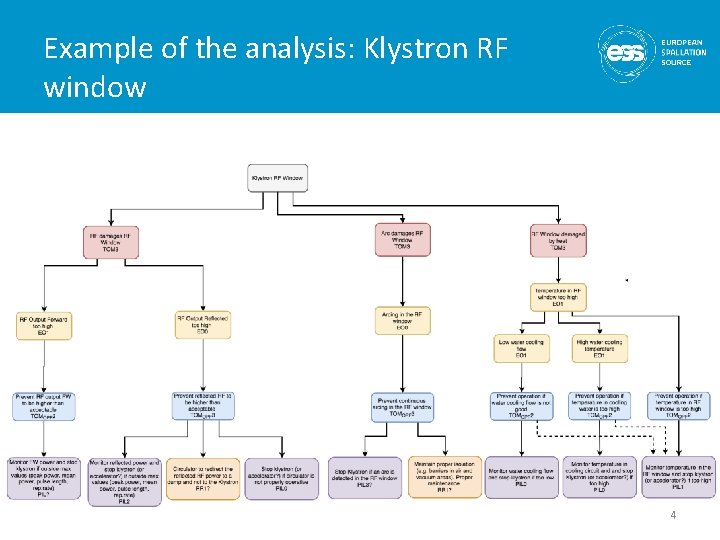
Example of the analysis: Klystron RF window 4
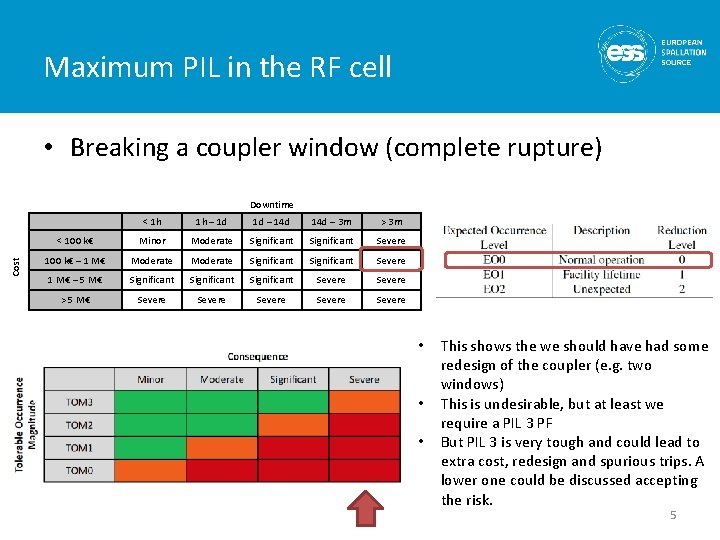
Maximum PIL in the RF cell • Breaking a coupler window (complete rupture) < 1 h 1 h – 1 d 1 d – 14 d – 3 m > 3 m < 100 k€ Minor Moderate Significant Severe 100 k€ – 1 M€ Moderate Significant Severe 1 M€ – 5 M€ Significant Severe > 5 M€ Severe Severe Cost Downtime • • • This shows the we should have had some redesign of the coupler (e. g. two windows) This is undesirable, but at least we require a PIL 3 PF But PIL 3 is very tough and could lead to extra cost, redesign and spurious trips. A lower one could be discussed accepting the risk. 5
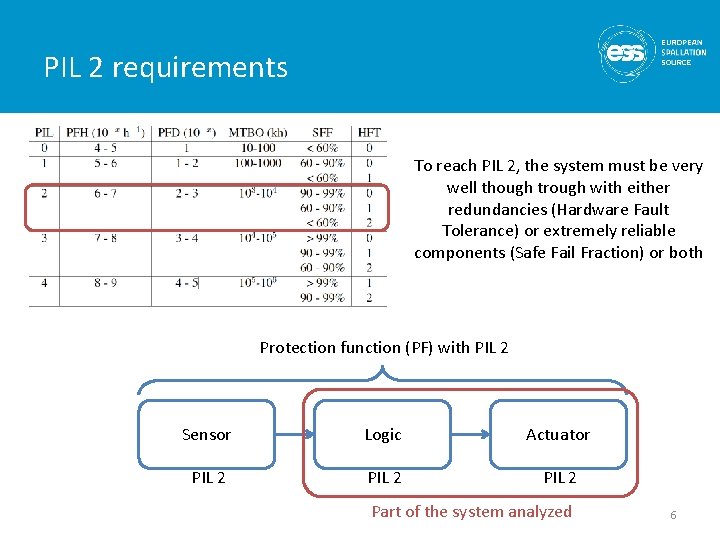
PIL 2 requirements To reach PIL 2, the system must be very well though trough with either redundancies (Hardware Fault Tolerance) or extremely reliable components (Safe Fail Fraction) or both Protection function (PF) with PIL 2 Sensor Logic Actuator PIL 2 Part of the system analyzed 6
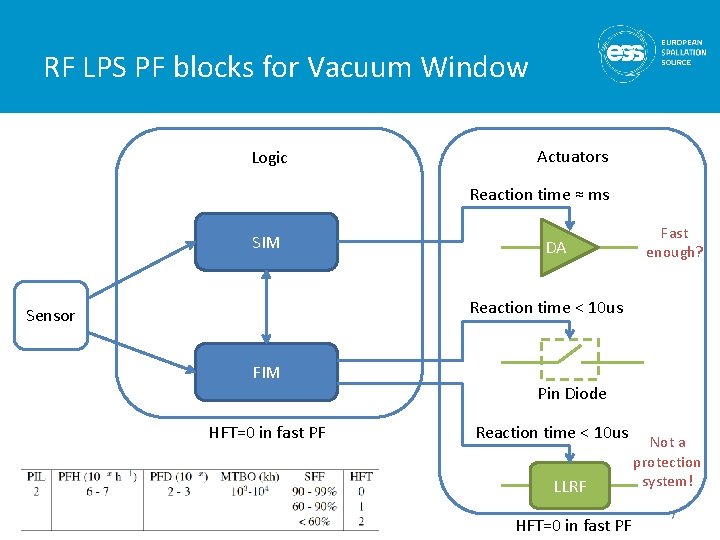
RF LPS PF blocks for Vacuum Window Logic Actuators Reaction time ≈ ms SIM DA Fast enough? Reaction time < 10 us Sensor FIM HFT=0 in fast PF Pin Diode Reaction time < 10 us LLRF HFT=0 in fast PF Not a protection system! 7
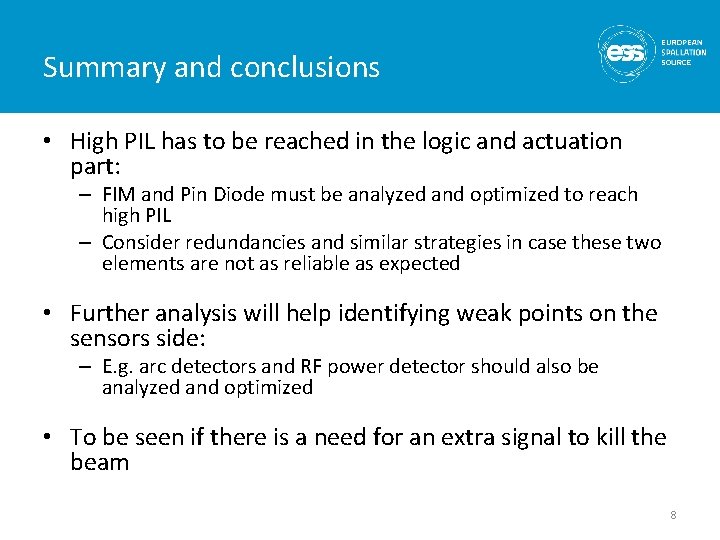
Summary and conclusions • High PIL has to be reached in the logic and actuation part: – FIM and Pin Diode must be analyzed and optimized to reach high PIL – Consider redundancies and similar strategies in case these two elements are not as reliable as expected • Further analysis will help identifying weak points on the sensors side: – E. g. arc detectors and RF power detector should also be analyzed and optimized • To be seen if there is a need for an extra signal to kill the beam 8
Extra slides 9
The MP Risk Analysis 10
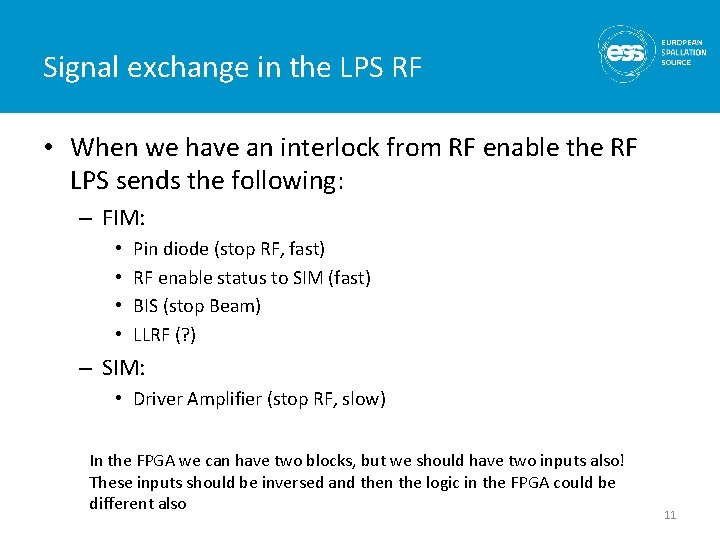
Signal exchange in the LPS RF • When we have an interlock from RF enable the RF LPS sends the following: – FIM: • • Pin diode (stop RF, fast) RF enable status to SIM (fast) BIS (stop Beam) LLRF (? ) – SIM: • Driver Amplifier (stop RF, slow) In the FPGA we can have two blocks, but we should have two inputs also! These inputs should be inversed and then the logic in the FPGA could be different also 11