
Machine Protection and Interlocks for Linac 4 Bruno
Machine Protection and Interlocks for Linac 4 Bruno Puccio (TE/MPE) Workshop on Availability of LINAC 4 and MYRTE 17/18 Nov. 2015 1
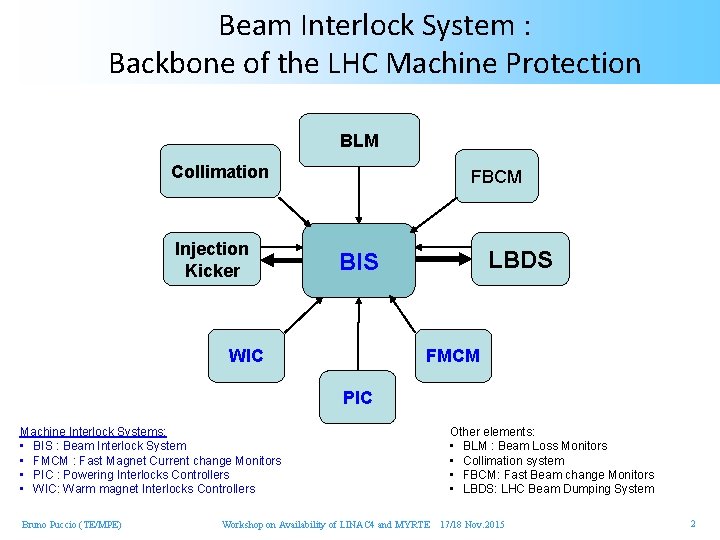
Beam Interlock System : Backbone of the LHC Machine Protection BLM Collimation Injection Kicker FBCM LBDS BIS FMCM WIC PIC Machine Interlock Systems: • BIS : Beam Interlock System • FMCM : Fast Magnet Current change Monitors • PIC : Powering Interlocks Controllers • WIC: Warm magnet Interlocks Controllers Bruno Puccio (TE/MPE) Other elements: • BLM : Beam Loss Monitors • Collimation system • FBCM: Fast Beam change Monitors • LBDS: LHC Beam Dumping System Workshop on Availability of LINAC 4 and MYRTE 17/18 Nov. 2015 2

BIS for LHC rings : the connected systems Timing LHC LHC Devices SMP Software Interlocks Movable Devices SEQ via GMT BCM Beam Loss Experimental Magnets CCC Transverse Operator Experiments Feedback Buttons Safe Beam Flag Collimator Positions Beam Aperture Kickers Environmental parameters Collimation System BTV screens FBCM Lifetime Mirrors BTV MKI Beam Dumping System Beam Interlock System Injection BIS PIC essential + auxiliary circuits WIC Magnets QPS (several 1000) FMCM Power Converters Power AUG Converters ~1500 Bruno Puccio (TE/MPE) Based on a R. Schmidt’s drawing RF System UPS Cryo OK BLM Monitors aperture limits (some 100) BPM in IR 6 Monitors in arcs (several 1000) Doors Access System EIS Workshop on Availability of LINAC 4 and MYRTE 17/18 Nov. 2015 Vacuum System Vacuum valves Timing System (PM) Access Safety Blocks RF Stoppers 3
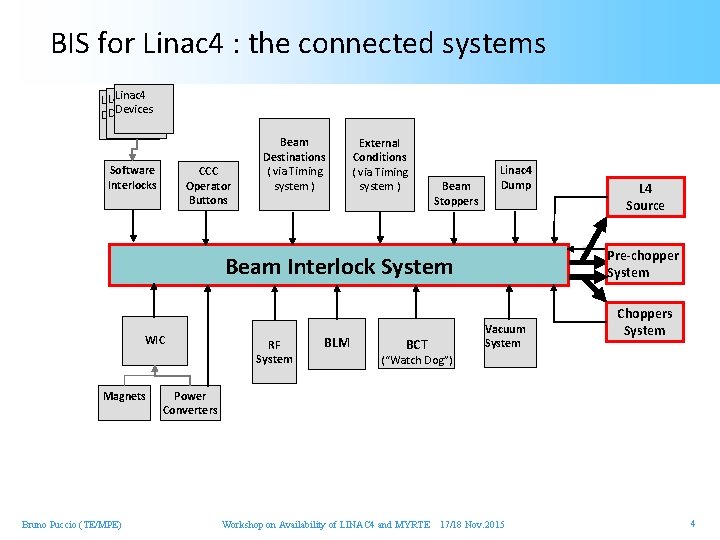
BIS for Linac 4 : the connected systems L 4 L 4 Linac 4 Devices Software Interlocks CCC Operator Buttons Beam Destinations ( via Timing system ) External Conditions ( via Timing system ) Beam Stoppers Linac 4 Dump Pre-chopper System Beam Interlock System WIC Magnets Bruno Puccio (TE/MPE) RF System BLM BCT L 4 Source Vacuum System Choppers System (“Watch Dog”) Power Converters Workshop on Availability of LINAC 4 and MYRTE 17/18 Nov. 2015 4
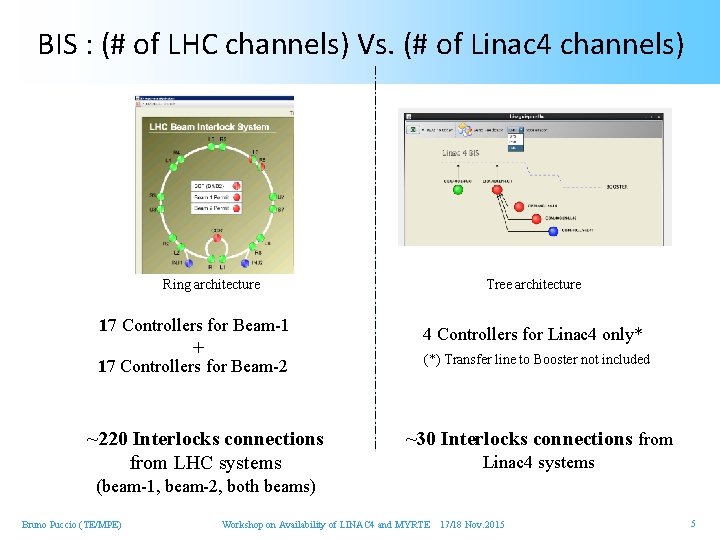
BIS : (# of LHC channels) Vs. (# of Linac 4 channels) Ring architecture 17 Controllers for Beam-1 + 17 Controllers for Beam-2 ~220 Interlocks connections from LHC systems Tree architecture 4 Controllers for Linac 4 only* (*) Transfer line to Booster not included ~30 Interlocks connections from Linac 4 systems (beam-1, beam-2, both beams) Bruno Puccio (TE/MPE) Workshop on Availability of LINAC 4 and MYRTE 17/18 Nov. 2015 5
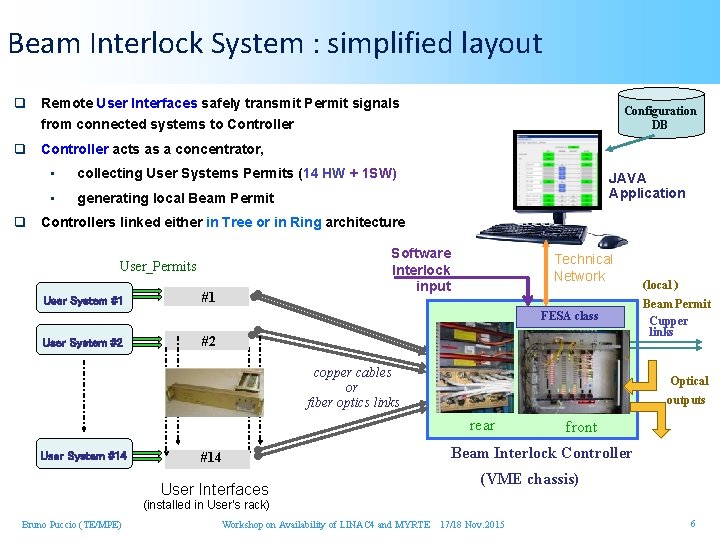
Beam Interlock System : simplified layout q Remote User Interfaces safely transmit Permit signals from connected systems to Controller q Controller acts as a concentrator, q • collecting User Systems Permits (14 HW + 1 SW) • generating local Beam Permit Configuration DB JAVA Application Controllers linked either in Tree or in Ring architecture Software Interlock input User_Permits User System #1 #1 Technical Network FESA class User System #2 #2 copper cables or fiber optics links Beam Permit Cupper links Optical outputs rear User System #14 (local ) front Beam Interlock Controller #14 User Interfaces (VME chassis) (installed in User’s rack) Bruno Puccio (TE/MPE) Workshop on Availability of LINAC 4 and MYRTE 17/18 Nov. 2015 6
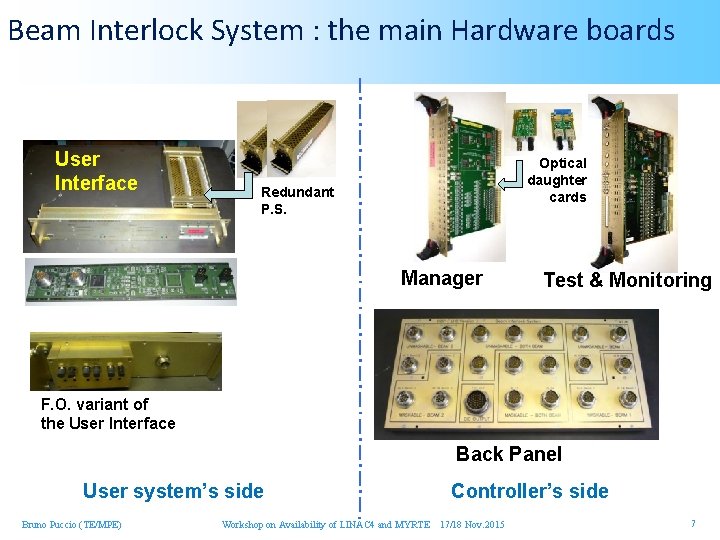
Beam Interlock System : the main Hardware boards User Interface Optical daughter cards Redundant P. S. Manager Test & Monitoring F. O. variant of the User Interface Back Panel User system’s side Bruno Puccio (TE/MPE) Controller’s side Workshop on Availability of LINAC 4 and MYRTE 17/18 Nov. 2015 7
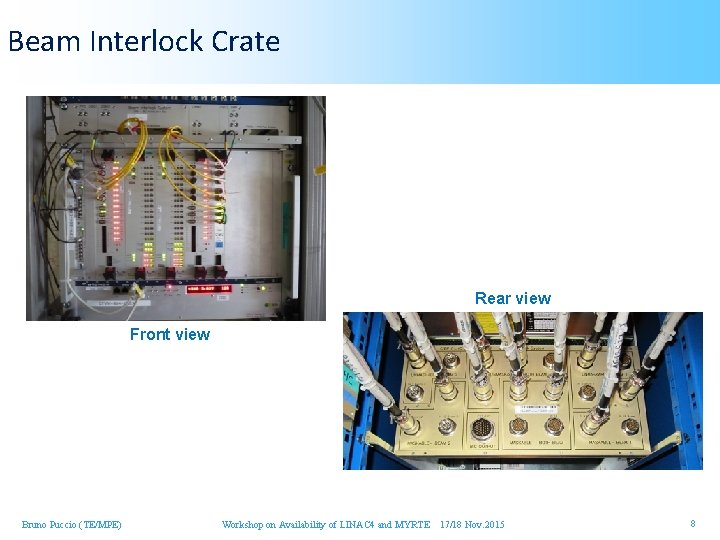
Beam Interlock Crate Rear view Front view Bruno Puccio (TE/MPE) Workshop on Availability of LINAC 4 and MYRTE 17/18 Nov. 2015 8
Quick overview of Beam Interlock System The main features Bruno Puccio (TE/MPE) Workshop on Availability of LINAC 4 and MYRTE 17/18 Nov. 2015 9
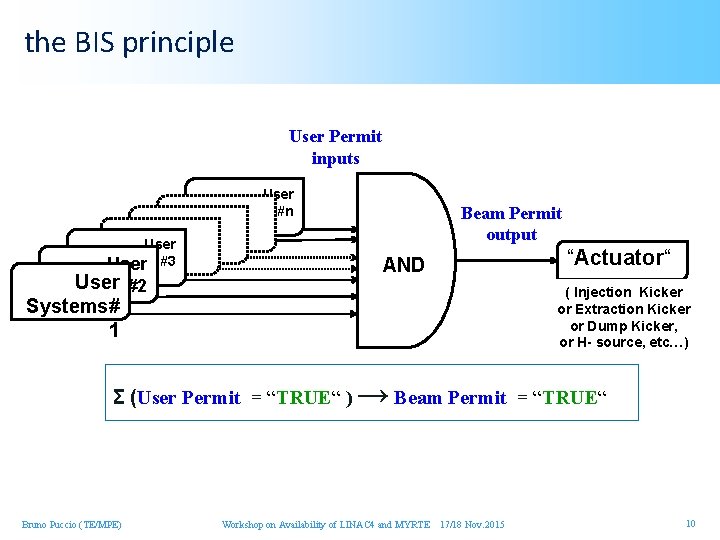
the BIS principle User Permit inputs User Systems#n User Systems#3 User Beam Permit output AND User Systems#2 ( Injection Kicker or Extraction Kicker or Dump Kicker, or H- source, etc…) Systems# 1 Σ (User Permit = “TRUE“ ) Bruno Puccio (TE/MPE) “Actuator“ → Beam Permit Workshop on Availability of LINAC 4 and MYRTE 17/18 Nov. 2015 = “TRUE“ 10
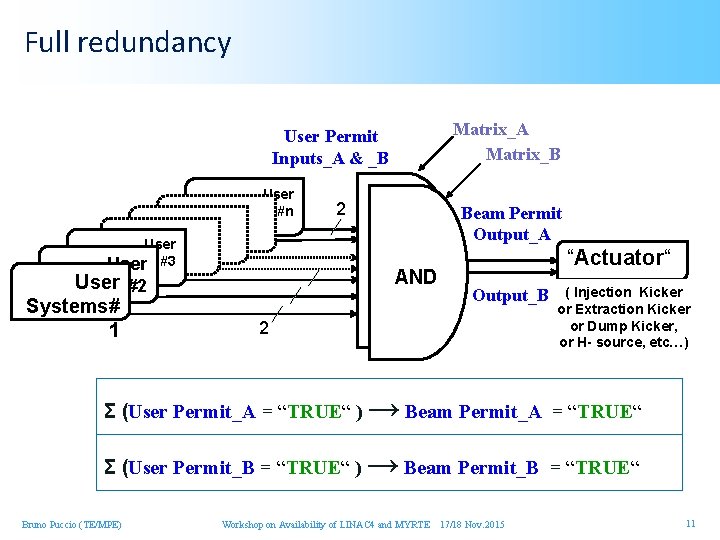
Full redundancy User Permit Inputs_A & _B User Systems#n 2 User Systems#3 User Systems# 1 Beam Permit Output_A AND User Systems#2 Matrix_A Matrix_B “Actuator“ Output_B 2 ( Injection Kicker or Extraction Kicker or Dump Kicker, or H- source, etc…) Σ (User Permit_A = “TRUE“ ) → Beam Permit_A = “TRUE“ Σ (User Permit_B = “TRUE“ ) → Beam Permit_B = “TRUE“ Bruno Puccio (TE/MPE) Workshop on Availability of LINAC 4 and MYRTE 17/18 Nov. 2015 11
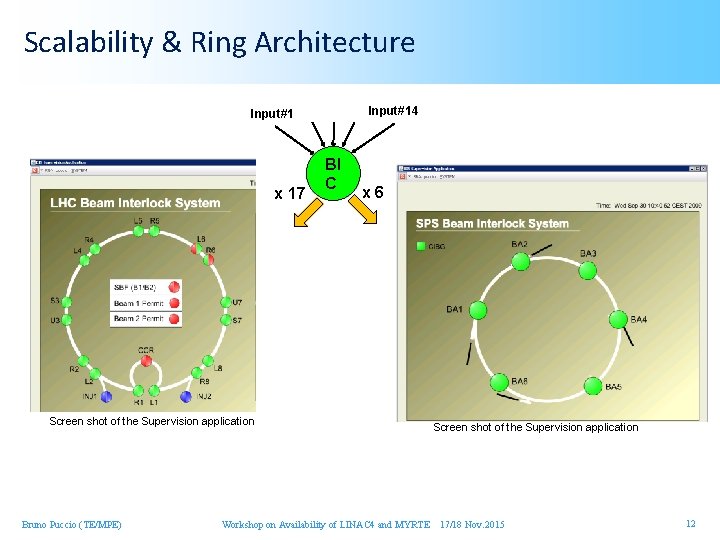
Scalability & Ring Architecture Input#14 Input#1 x 17 Screen shot of the Supervision application Bruno Puccio (TE/MPE) BI C x 6 Screen shot of the Supervision application Workshop on Availability of LINAC 4 and MYRTE 17/18 Nov. 2015 12
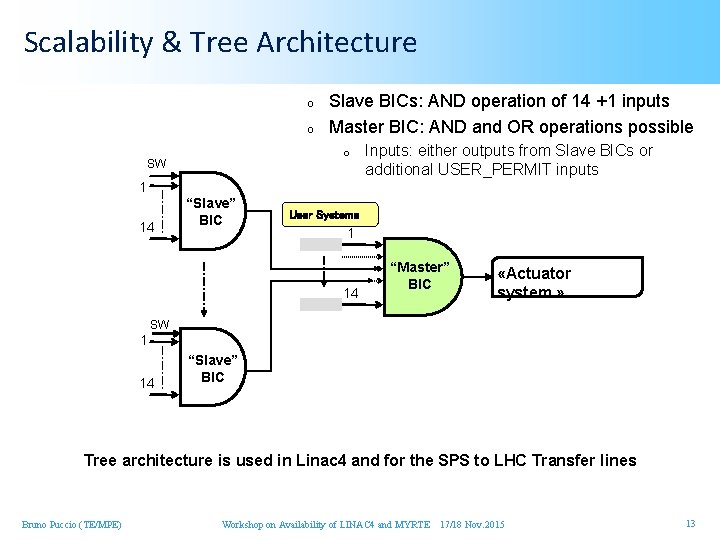
Scalability & Tree Architecture o o o SW 1 14 Slave BICs: AND operation of 14 +1 inputs Master BIC: AND and OR operations possible “Slave” BIC Inputs: either outputs from Slave BICs or additional USER_PERMIT inputs User Systems 1 14 “Master” BIC «Actuator system » SW 1 14 “Slave” BIC Tree architecture is used in Linac 4 and for the SPS to LHC Transfer lines Bruno Puccio (TE/MPE) Workshop on Availability of LINAC 4 and MYRTE 17/18 Nov. 2015 13
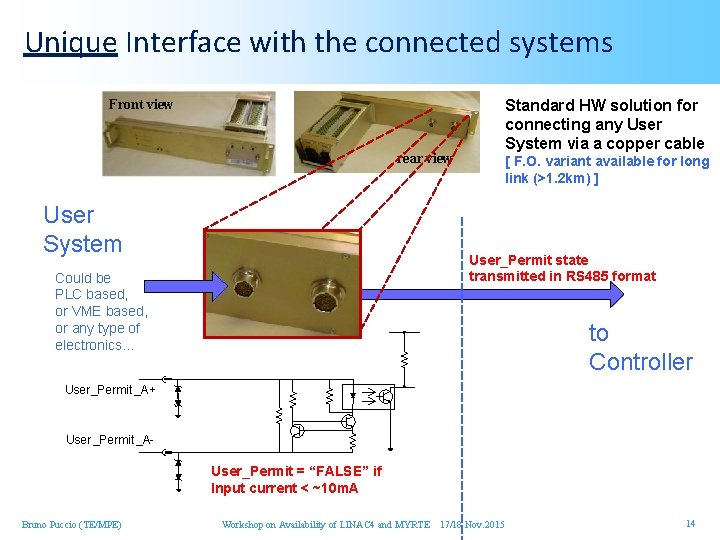
Unique Interface with the connected systems Front view Standard HW solution for connecting any User System via a copper cable rear view User System [ F. O. variant available for long link (>1. 2 km) ] User_Permit state transmitted in RS 485 format Could be PLC based, or VME based, or any type of electronics… to Controller User_Permit _A+ User _Permit _A- User_Permit = “FALSE” if Input current < ~10 m. A Bruno Puccio (TE/MPE) Workshop on Availability of LINAC 4 and MYRTE 17/18 Nov. 2015 14
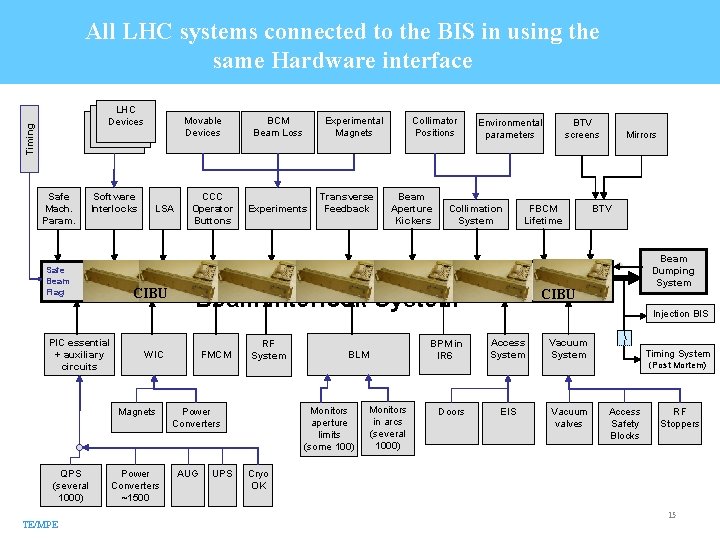
All LHC systems connected to the BIS in using the same Hardware interface Timing LHC LHC Devices Safe Mach. Param. Software Interlocks Safe Beam Flag PIC essential + auxiliary circuits Movable Devices LSA CIBU TE/MPE Power Converters ~1500 Experimental Magnets Experiments Transverse Feedback Collimator Positions Beam Aperture Kickers Environmental parameters Collimation System FMCM RF System Monitors aperture limits (some 100) Power Converters AUG UPS BLM Monitors in arcs (several 1000) BPM in IR 6 Doors BTV screens FBCM Lifetime Beam Interlock System WIC Magnets QPS (several 1000) CCC Operator Buttons BCM Beam Loss Mirrors BTV Beam Dumping System CIBU Injection BIS Access System Vacuum System EIS Vacuum valves Timing System (Post Mortem) Access Safety Blocks RF Stoppers Cryo OK 15
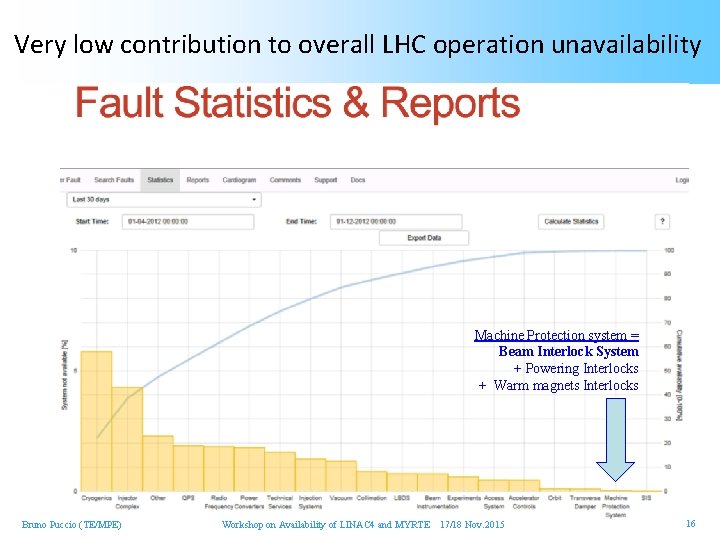
Very low contribution to overall LHC operation unavailability CK is R ur Co hr C y I ER D O tes Bruno Puccio (TE/MPE) Machine Protection system = Beam Interlock System + Powering Interlocks + Warm magnets Interlocks Workshop on Availability of LINAC 4 and MYRTE 17/18 Nov. 2015 16
System Performance (I) Dependable: By design (SIL 3 was used as a guideline) the system must react with a probability of unsafe failure of less than 10 -7 per hour; Beam abort less than 1% of missions due to internal failure (2 to 4 failures per year) Simple: On purpose, its just a “Go / No Go” system together with an ‟ AND‟ function and no more ! For a protection system: the Simplest is always the Best “Flexible”: since half of User Permit signals could be remotely masked by an Operator (the other half, i. e. the critical ones, can be never masked) Condition = “Safe Beam Flag” state; If FALSE => masks are no longer taken into account For LHC, “Safe Beam Flag” is derived from beam intensity and energy Bruno Puccio (TE/MPE) Workshop on Availability of LINAC 4 and MYRTE 17/18 Nov. 2015 17
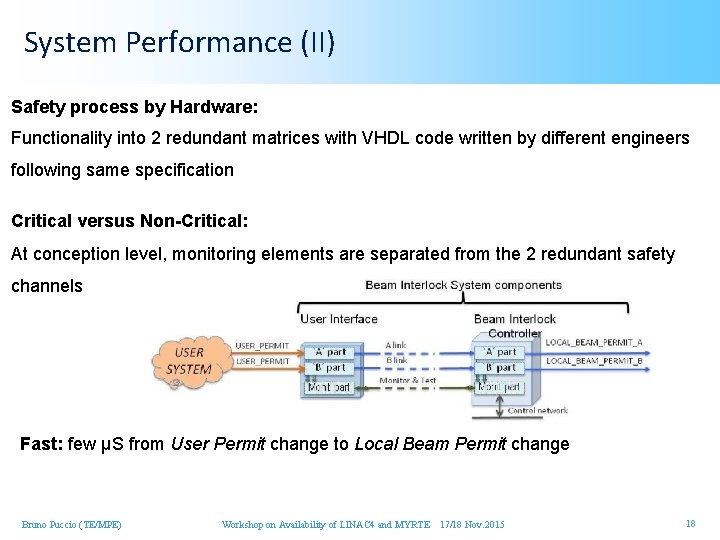
System Performance (II) Safety process by Hardware: Functionality into 2 redundant matrices with VHDL code written by different engineers following same specification Critical versus Non-Critical: At conception level, monitoring elements are separated from the 2 redundant safety channels Fast: few μS from User Permit change to Local Beam Permit change Bruno Puccio (TE/MPE) Workshop on Availability of LINAC 4 and MYRTE 17/18 Nov. 2015 18
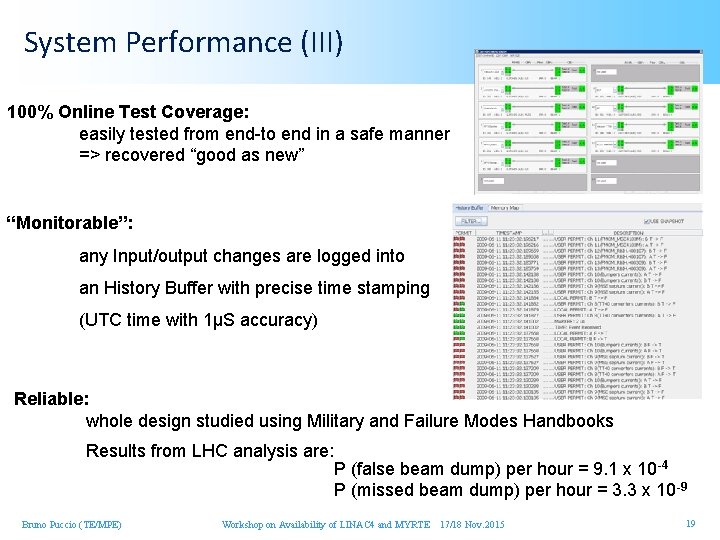
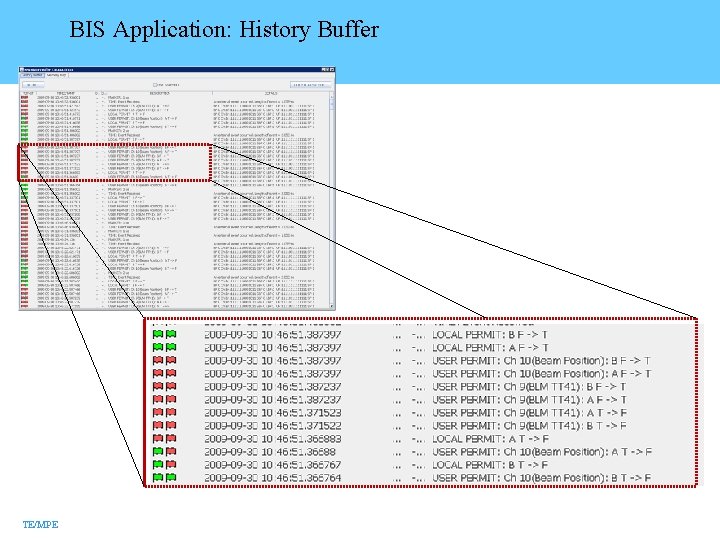
System Performance (III) 100% Online Test Coverage: easily tested from end-to end in a safe manner => recovered “good as new” “Monitorable”: any Input/output changes are logged into an History Buffer with precise time stamping (UTC time with 1μS accuracy) Reliable: whole design studied using Military and Failure Modes Handbooks Results from LHC analysis are: P (false beam dump) per hour = 9. 1 x 10 -4 P (missed beam dump) per hour = 3. 3 x 10 -9 Bruno Puccio (TE/MPE) Workshop on Availability of LINAC 4 and MYRTE 17/18 Nov. 2015 19
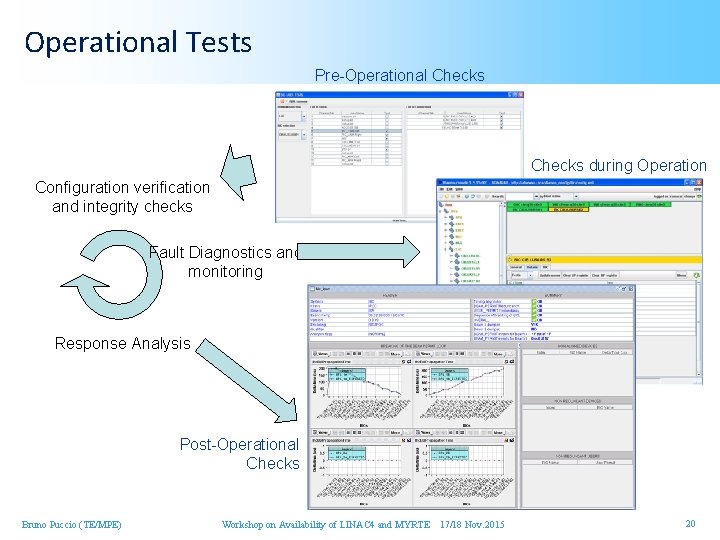
Operational Tests Pre-Operational Checks during Operation Configuration verification and integrity checks Fault Diagnostics and monitoring Response Analysis Post-Operational Checks Bruno Puccio (TE/MPE) Workshop on Availability of LINAC 4 and MYRTE 17/18 Nov. 2015 20
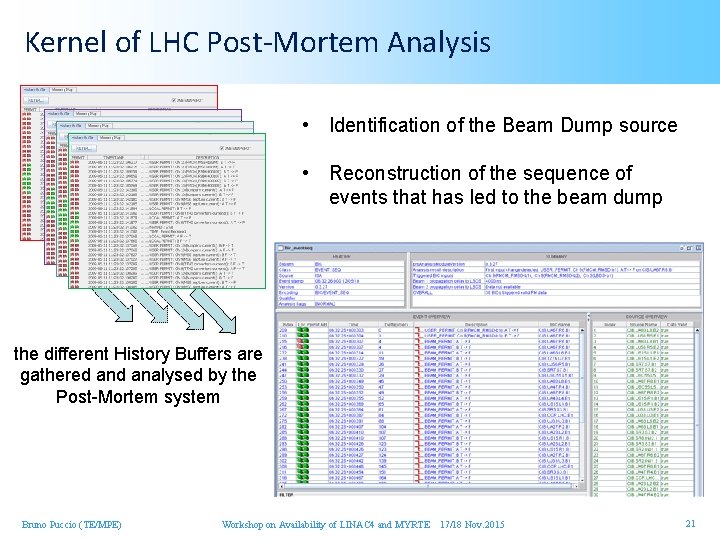
Kernel of LHC Post-Mortem Analysis • Identification of the Beam Dump source • Reconstruction of the sequence of events that has led to the beam dump the different History Buffers are gathered analysed by the Post-Mortem system Bruno Puccio (TE/MPE) Workshop on Availability of LINAC 4 and MYRTE 17/18 Nov. 2015 21
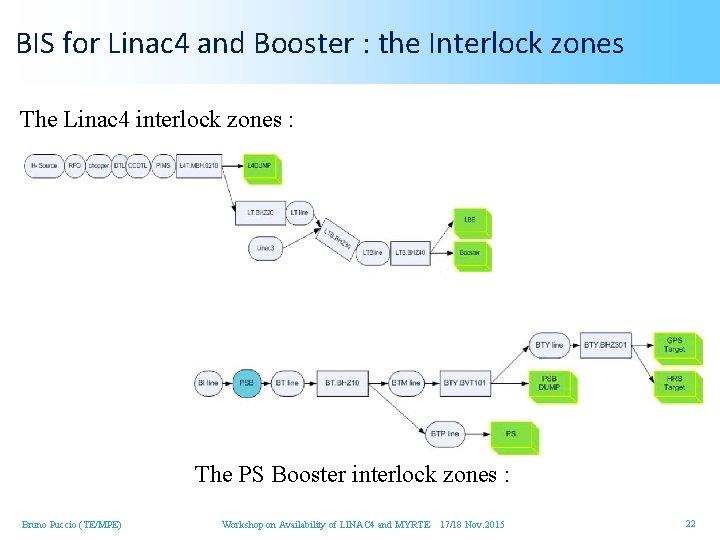
BIS for Linac 4 and Booster : the Interlock zones The Linac 4 interlock zones : The PS Booster interlock zones : Bruno Puccio (TE/MPE) Workshop on Availability of LINAC 4 and MYRTE 17/18 Nov. 2015 22
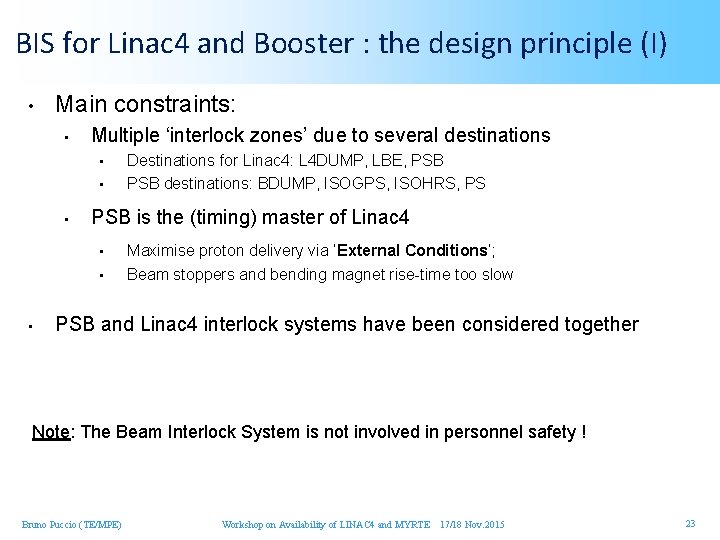
BIS for Linac 4 and Booster : the design principle (I) • Main constraints: • Multiple ‘interlock zones’ due to several destinations • • Destinations for Linac 4: L 4 DUMP, LBE, PSB destinations: BDUMP, ISOGPS, ISOHRS, PS PSB is the (timing) master of Linac 4 • Maximise proton delivery via ‘External Conditions’; • Beam stoppers and bending magnet rise-time too slow PSB and Linac 4 interlock systems have been considered together Note: The Beam Interlock System is not involved in personnel safety ! Bruno Puccio (TE/MPE) Workshop on Availability of LINAC 4 and MYRTE 17/18 Nov. 2015 23
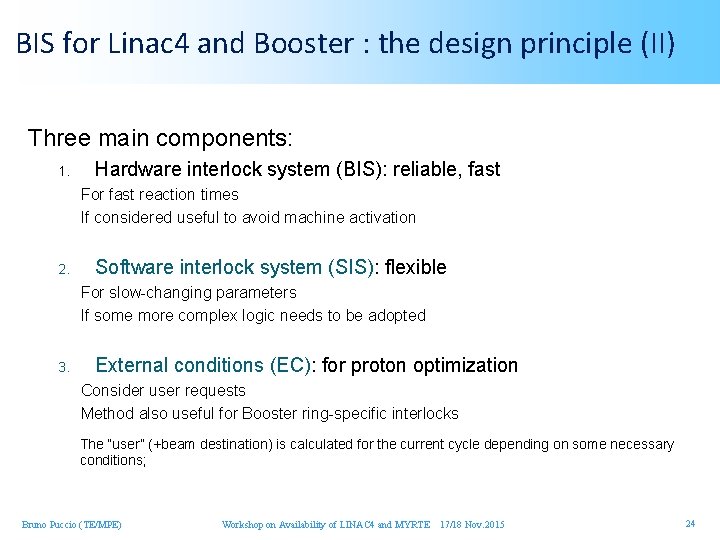
BIS for Linac 4 and Booster : the design principle (II) Three main components: 1. Hardware interlock system (BIS): reliable, fast For fast reaction times If considered useful to avoid machine activation 2. Software interlock system (SIS): flexible For slow-changing parameters If some more complex logic needs to be adopted 3. External conditions (EC): for proton optimization Consider user requests Method also useful for Booster ring-specific interlocks The “user” (+beam destination) is calculated for the current cycle depending on some necessary conditions; Bruno Puccio (TE/MPE) Workshop on Availability of LINAC 4 and MYRTE 17/18 Nov. 2015 24
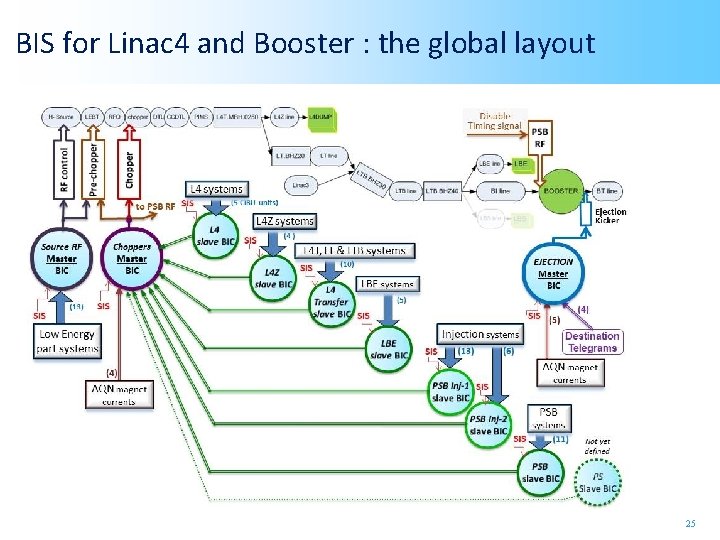
BIS for Linac 4 and Booster : the global layout Bruno Puccio (TE/MPE) Workshop on Availability of LINAC 4 and MYRTE 17/18 Nov. 2015 25
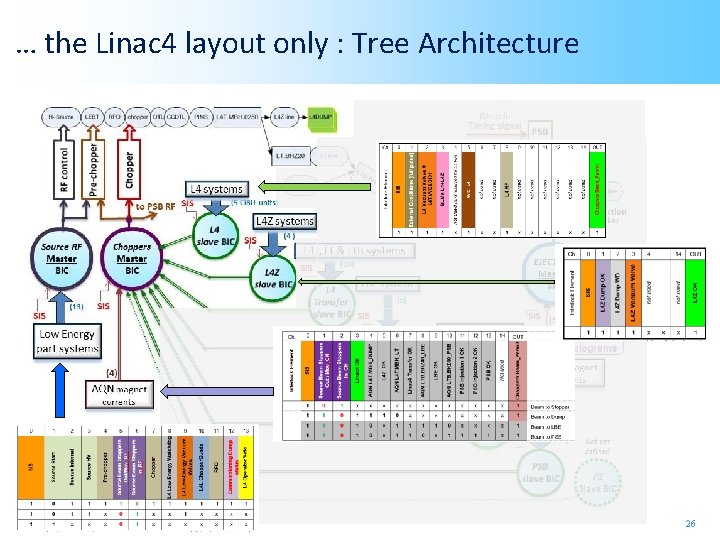
… the Linac 4 layout only : Tree Architecture Bruno Puccio (TE/MPE) Workshop on Availability of LINAC 4 and MYRTE 17/18 Nov. 2015 26
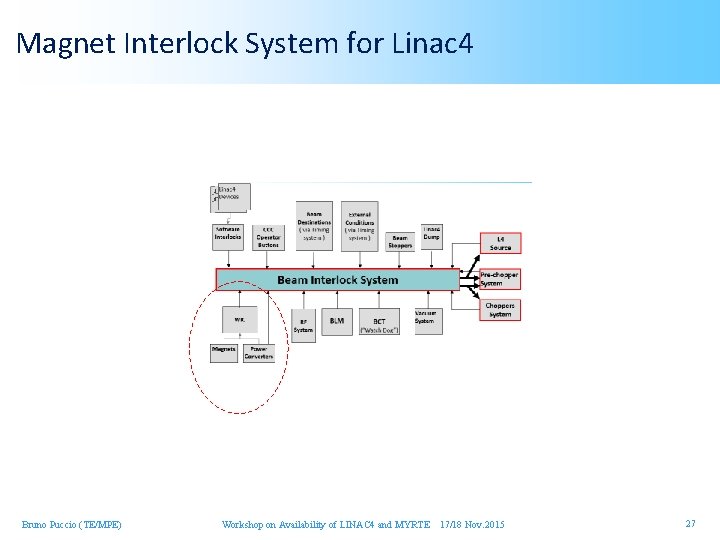
Magnet Interlock System for Linac 4 Bruno Puccio (TE/MPE) Workshop on Availability of LINAC 4 and MYRTE 17/18 Nov. 2015 27
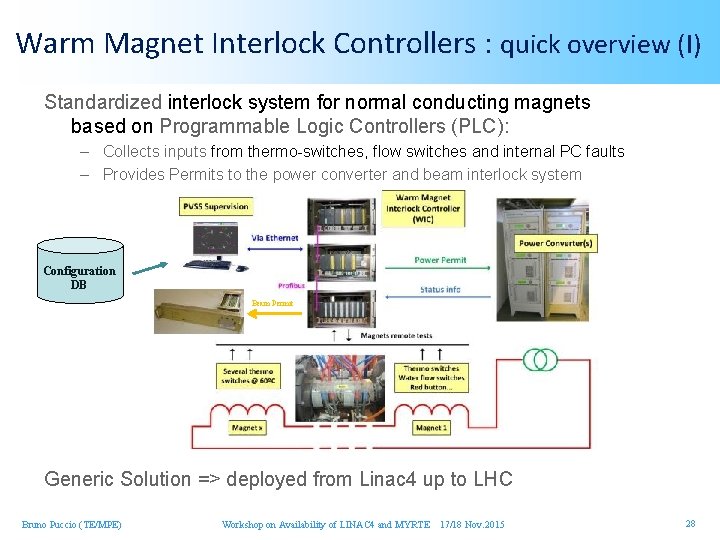
Warm Magnet Interlock Controllers : quick overview (I) Standardized interlock system for normal conducting magnets based on Programmable Logic Controllers (PLC): – Collects inputs from thermo-switches, flow switches and internal PC faults – Provides Permits to the power converter and beam interlock system Configuration DB Beam Permit Generic Solution => deployed from Linac 4 up to LHC Bruno Puccio (TE/MPE) Workshop on Availability of LINAC 4 and MYRTE 17/18 Nov. 2015 28
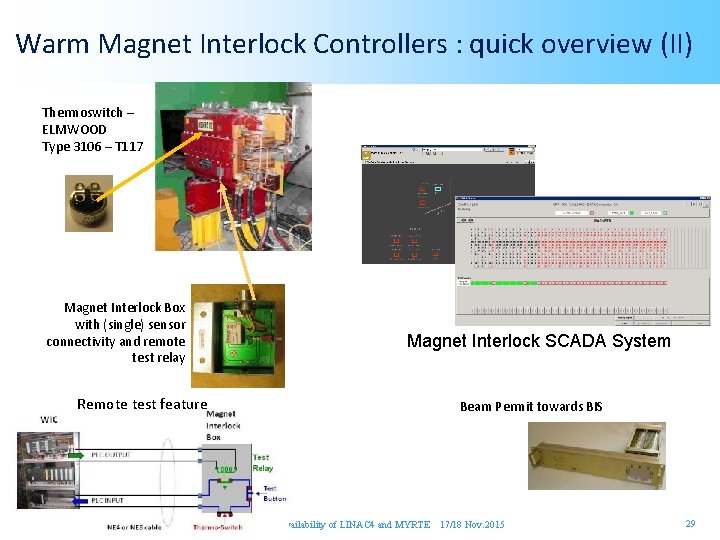
Warm Magnet Interlock Controllers : quick overview (II) Thermoswitch – ELMWOOD Type 3106 – T 117 Magnet Interlock Box with (single) sensor connectivity and remote test relay Remote test feature Bruno Puccio (TE/MPE) Magnet Interlock SCADA System Beam Permit towards BIS Workshop on Availability of LINAC 4 and MYRTE 17/18 Nov. 2015 29
That’s all ! Thanks for your attention Bruno Puccio (TE/MPE) Workshop on Availability of LINAC 4 and MYRTE 17/18 Nov. 2015 30
Additional slides TE/MPE 31
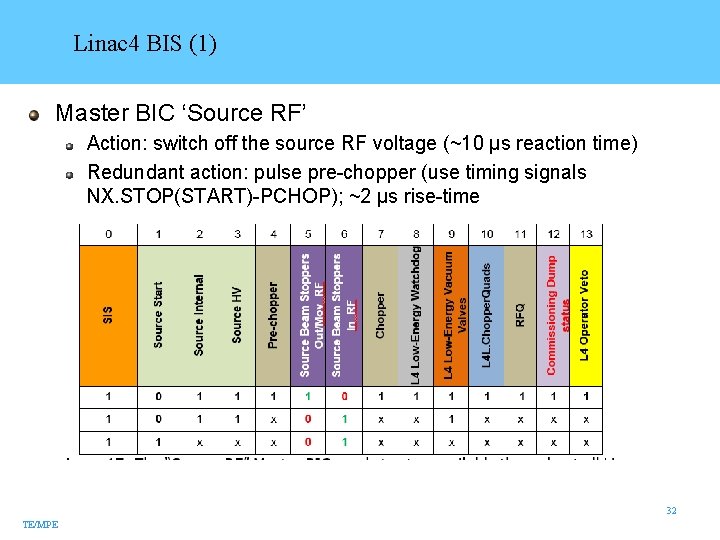
Linac 4 BIS (1) Master BIC ‘Source RF’ Action: switch off the source RF voltage (~10 μs reaction time) Redundant action: pulse pre-chopper (use timing signals NX. STOP(START)-PCHOP); ~2 μs rise-time 32 TE/MPE
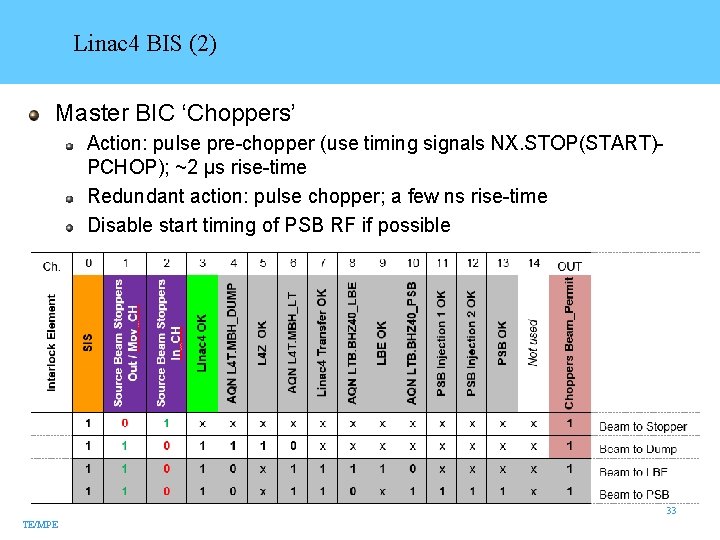
Linac 4 BIS (2) Master BIC ‘Choppers’ Action: pulse pre-chopper (use timing signals NX. STOP(START)PCHOP); ~2 μs rise-time Redundant action: pulse chopper; a few ns rise-time Disable start timing of PSB RF if possible 33 TE/MPE
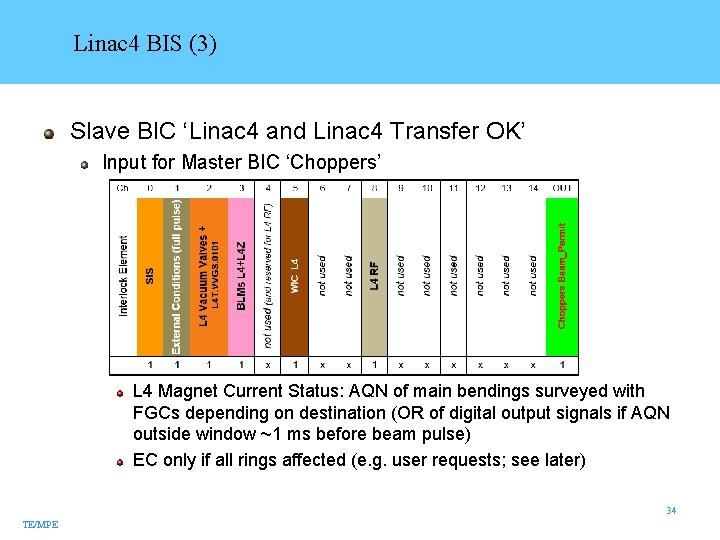
Linac 4 BIS (3) Slave BIC ‘Linac 4 and Linac 4 Transfer OK’ Input for Master BIC ‘Choppers’ L 4 Magnet Current Status: AQN of main bendings surveyed with FGCs depending on destination (OR of digital output signals if AQN outside window ~1 ms before beam pulse) EC only if all rings affected (e. g. user requests; see later) 34 TE/MPE
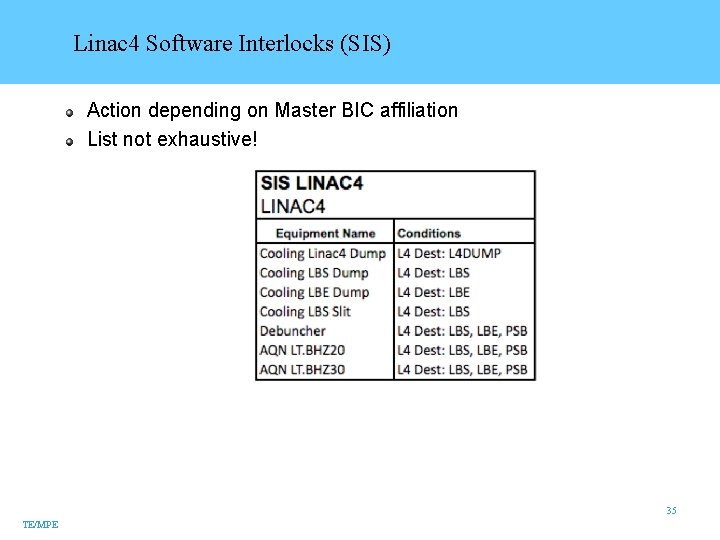
Linac 4 Software Interlocks (SIS) Action depending on Master BIC affiliation List not exhaustive! 35 TE/MPE
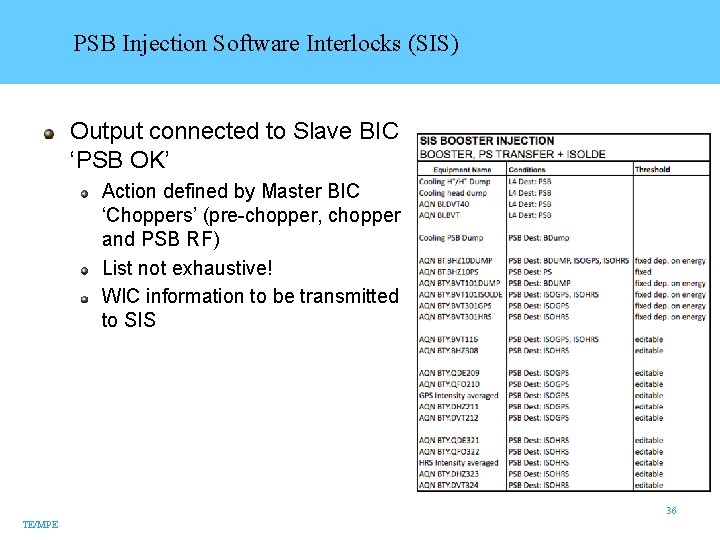
PSB Injection Software Interlocks (SIS) Output connected to Slave BIC ‘PSB OK’ Action defined by Master BIC ‘Choppers’ (pre-chopper, chopper and PSB RF) List not exhaustive! WIC information to be transmitted to SIS 36 TE/MPE
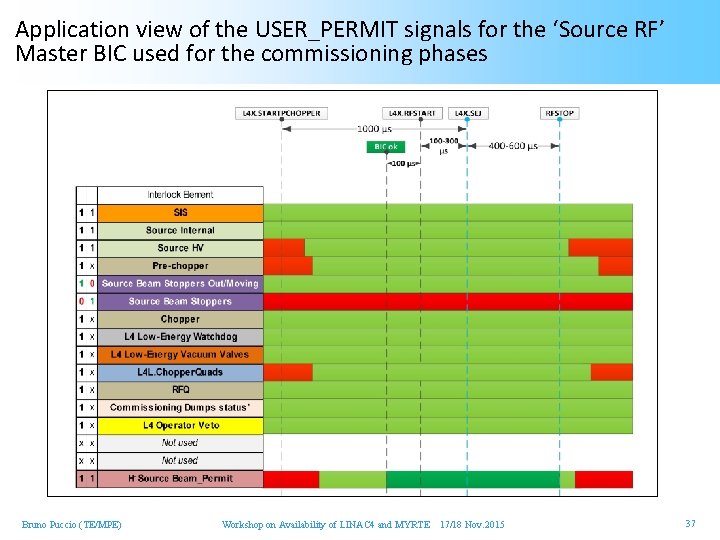
Application view of the USER_PERMIT signals for the ‘Source RF’ Master BIC used for the commissioning phases Bruno Puccio (TE/MPE) Workshop on Availability of LINAC 4 and MYRTE 17/18 Nov. 2015 37
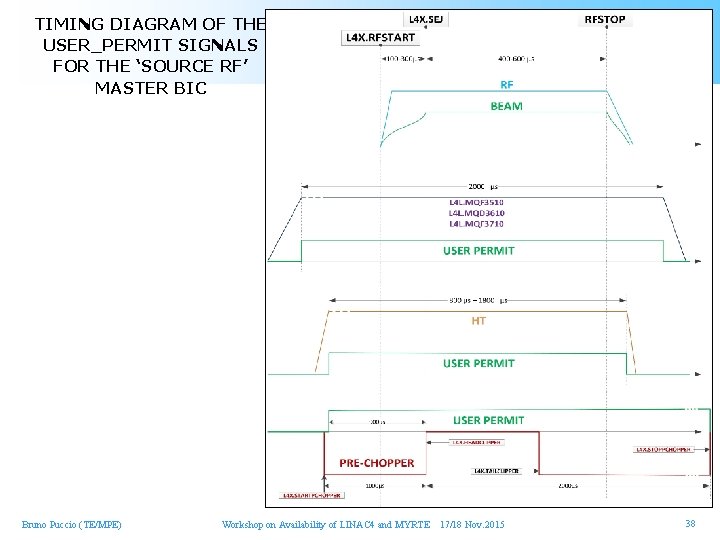
TIMING DIAGRAM OF THE USER_PERMIT SIGNALS FOR THE ‘SOURCE RF’ MASTER BIC Bruno Puccio (TE/MPE) Workshop on Availability of LINAC 4 and MYRTE 17/18 Nov. 2015 38
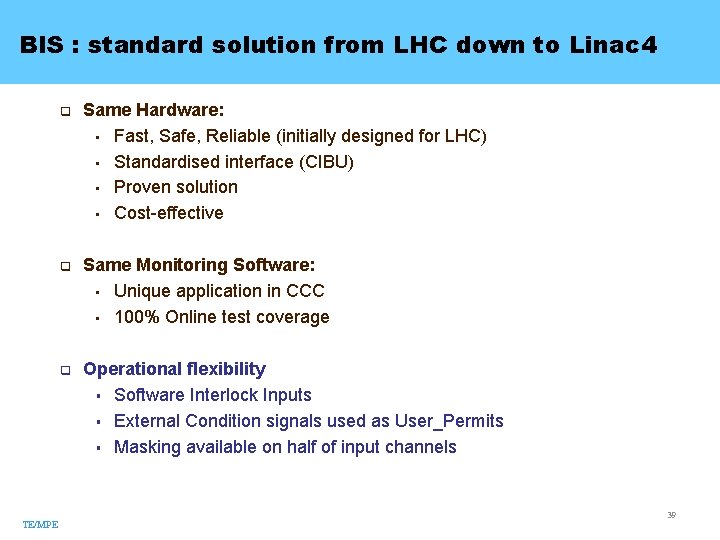
BIS : standard solution from LHC down to Linac 4 TE/MPE q Same Hardware: • Fast, Safe, Reliable (initially designed for LHC) • Standardised interface (CIBU) • Proven solution • Cost-effective q Same Monitoring Software: • Unique application in CCC • 100% Online test coverage q Operational flexibility § Software Interlock Inputs § External Condition signals used as User_Permits § Masking available on half of input channels 39
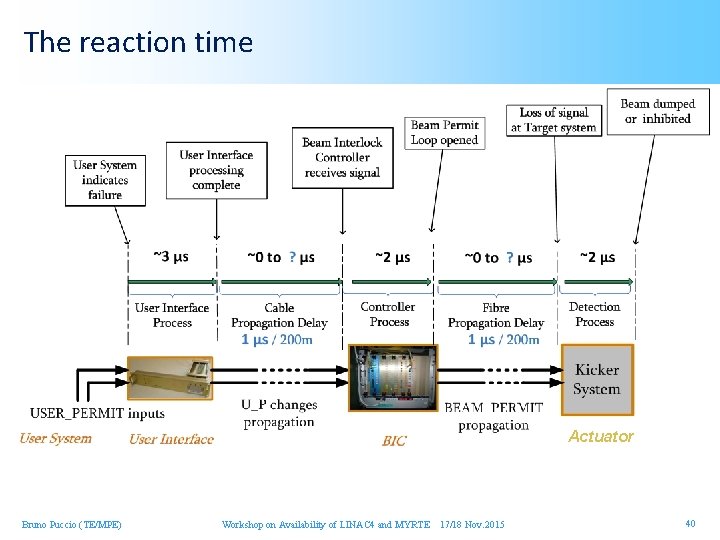
The reaction time Actuator Bruno Puccio (TE/MPE) Workshop on Availability of LINAC 4 and MYRTE 17/18 Nov. 2015 40
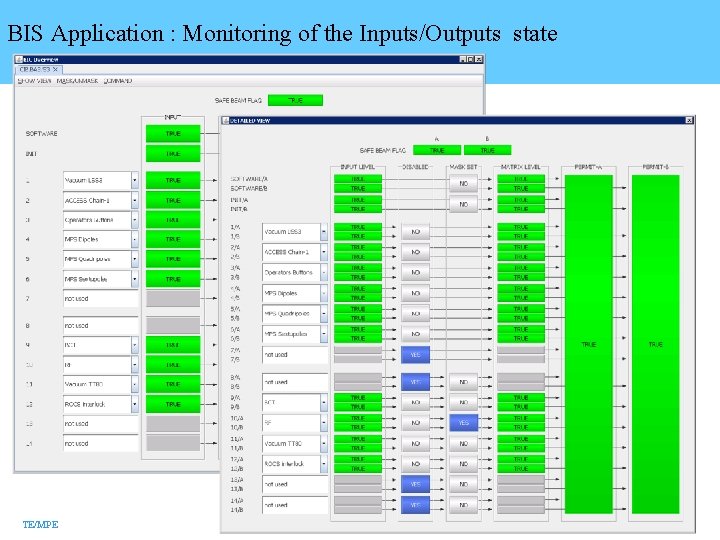
BIS Application : Monitoring of the Inputs/Outputs state TE/MPE
BIS Application: History Buffer TE/MPE
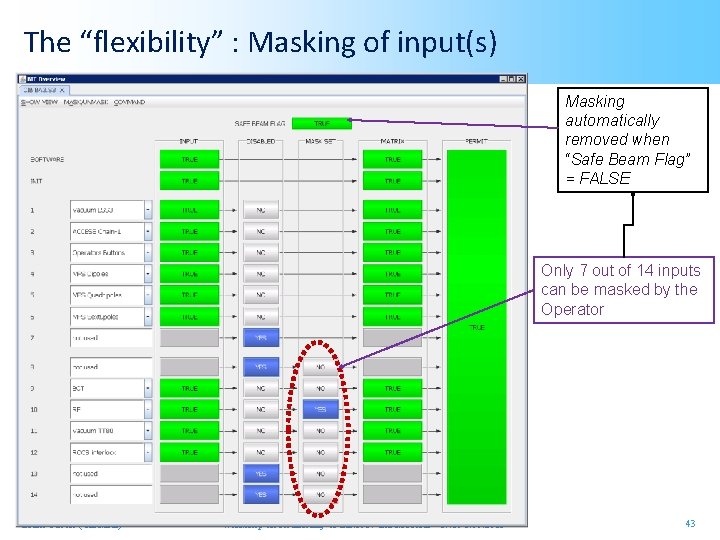
The “flexibility” : Masking of input(s) Masking automatically removed when “Safe Beam Flag” = FALSE Only 7 out of 14 inputs can be masked by the Operator Bruno Puccio (TE/MPE) Workshop on Availability of LINAC 4 and MYRTE 17/18 Nov. 2015 43
Safe Beam Flag ● For LHC: the Safe Beam Flag (SBF) is produced by a dedicated system (Safe Machine Parameters Controller) ● Based on Beam Energy and on Beam Intensity: if ( I · E < defined_Threshold ) then SBF = “TRUE” ; else SBF = “FALSE” ● The SBF value is transmitted to the LHC Timing generator => information broadcasted over the GMT network. ● Timing receiver installed in the BIC chassis gives the corresponding Hw signal value ● Note: Safe Beam Flag for SPS only depends on beam intensity. TE/MPE 44
- Slides: 44