
Machine Organization CS 570 Lecture 8 Memory Hierarchy

- Slides: 30
Machine Organization (CS 570) Lecture 8: Memory Hierarchy Design* Jeremy R. Johnson Wed. Nov. 15, 2000 *This lecture was derived from material in the text (Chap. 5 sec. 1 -5). Nov. 15, 2000 Systems Architecture II 1
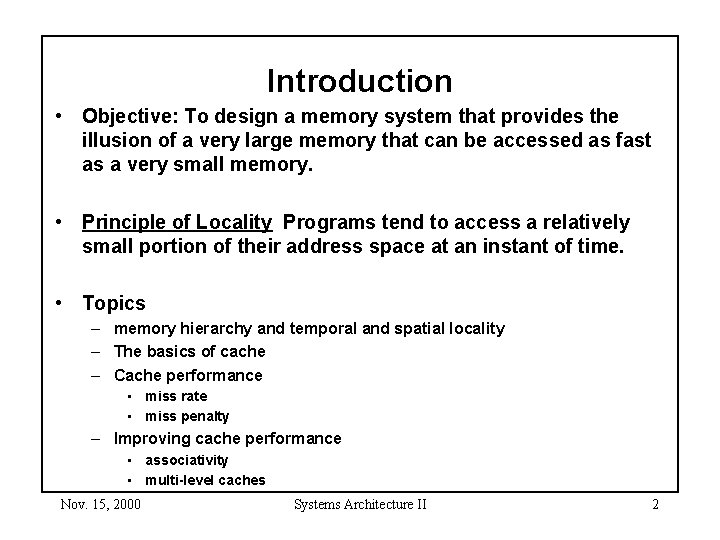
Introduction • Objective: To design a memory system that provides the illusion of a very large memory that can be accessed as fast as a very small memory. • Principle of Locality Programs tend to access a relatively small portion of their address space at an instant of time. • Topics – memory hierarchy and temporal and spatial locality – The basics of cache – Cache performance • miss rate • miss penalty – Improving cache performance • associativity • multi-level caches Nov. 15, 2000 Systems Architecture II 2
Processor-Memory Gap Nov. 15, 2000 Systems Architecture II 3
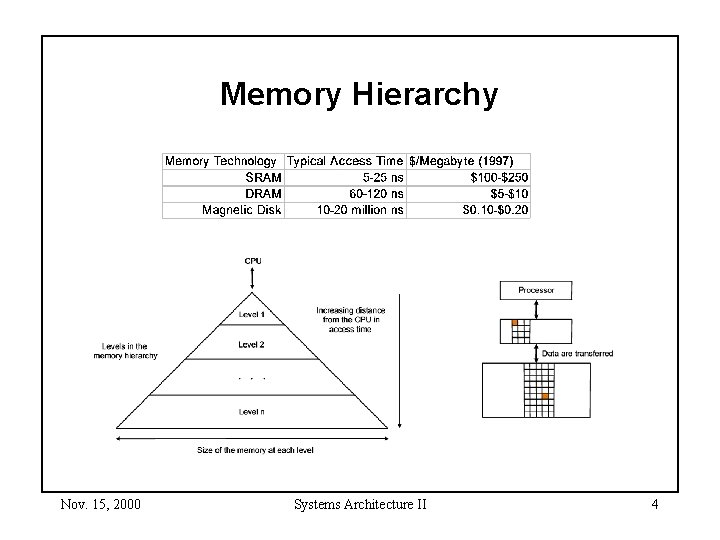
Memory Hierarchy Nov. 15, 2000 Systems Architecture II 4
Memory Access Speed on DEC 21164 Alpha • Clock Speed 500 MHz (= 2 ns clock rate) • Registers (2 ns) • L 1 On-Chip (4 ns) • L 2 On-Chip (5 ns) • L 3 Off-Chip (30 ns) • Memory (220 ns) Nov. 15, 2000 Systems Architecture II 5
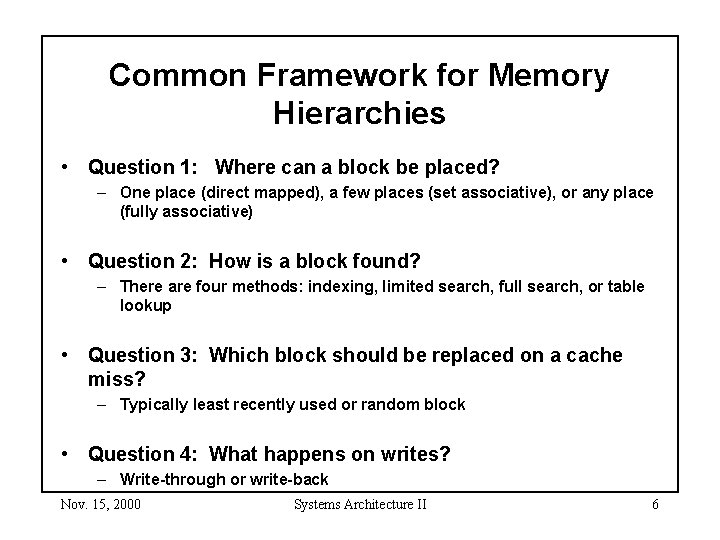
Common Framework for Memory Hierarchies • Question 1: Where can a block be placed? – One place (direct mapped), a few places (set associative), or any place (fully associative) • Question 2: How is a block found? – There are four methods: indexing, limited search, full search, or table lookup • Question 3: Which block should be replaced on a cache miss? – Typically least recently used or random block • Question 4: What happens on writes? – Write-through or write-back Nov. 15, 2000 Systems Architecture II 6
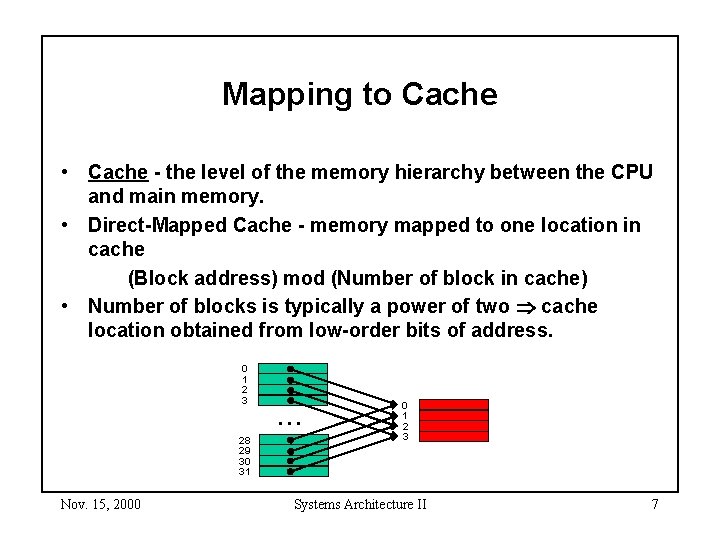
Mapping to Cache • Cache - the level of the memory hierarchy between the CPU and main memory. • Direct-Mapped Cache - memory mapped to one location in cache (Block address) mod (Number of block in cache) • Number of blocks is typically a power of two cache location obtained from low-order bits of address. 0 1 2 3 28 29 30 31 Nov. 15, 2000 . . . 0 1 2 3 Systems Architecture II 7
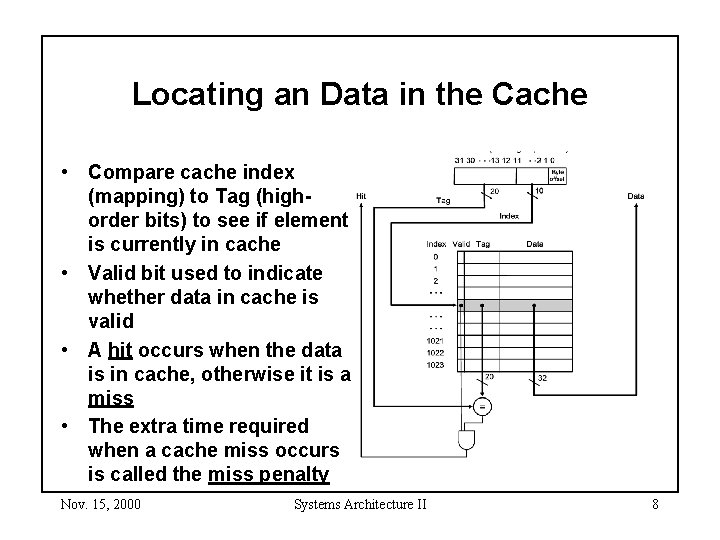
Locating an Data in the Cache • Compare cache index (mapping) to Tag (highorder bits) to see if element is currently in cache • Valid bit used to indicate whether data in cache is valid • A hit occurs when the data is in cache, otherwise it is a miss • The extra time required when a cache miss occurs is called the miss penalty Nov. 15, 2000 Systems Architecture II 8
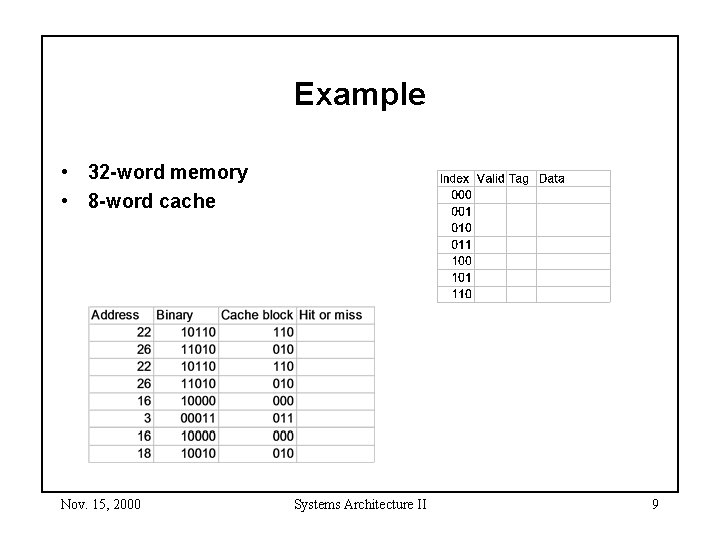
Example • 32 -word memory • 8 -word cache Nov. 15, 2000 Systems Architecture II 9
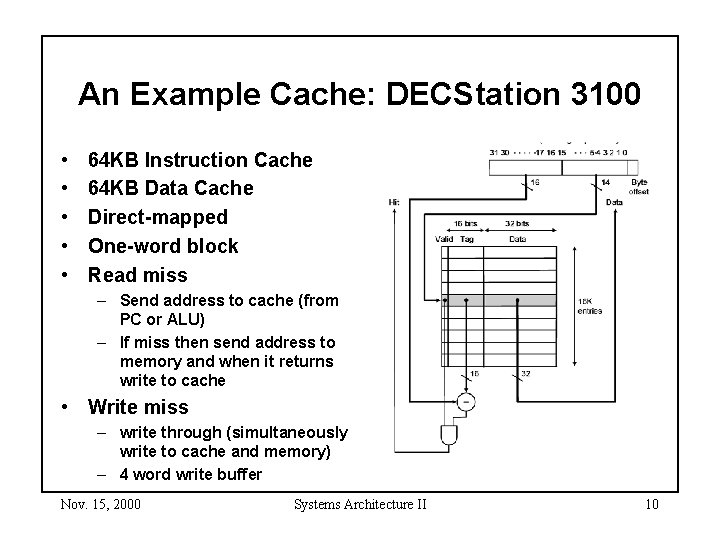
An Example Cache: DECStation 3100 • • • 64 KB Instruction Cache 64 KB Data Cache Direct-mapped One-word block Read miss – Send address to cache (from PC or ALU) – If miss then send address to memory and when it returns write to cache • Write miss – write through (simultaneously write to cache and memory) – 4 word write buffer Nov. 15, 2000 Systems Architecture II 10
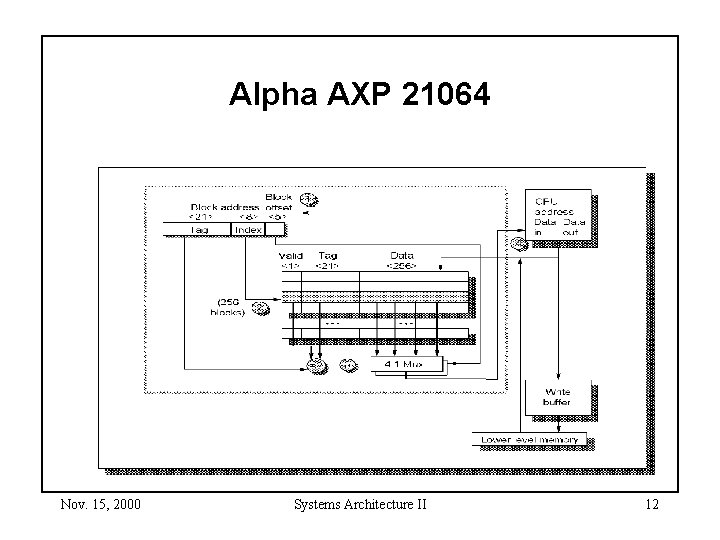
Example: Alpha AXP 21064 • • • 8 KB cache 32 -byte blocks direct mapped write through 4 -block write buffer write around • Figure 5. 5 (page 381) Nov. 15, 2000 Systems Architecture II 11
Alpha AXP 21064 Nov. 15, 2000 Systems Architecture II 12
2 -Way Set Associative Cache Nov. 15, 2000 Systems Architecture II 13
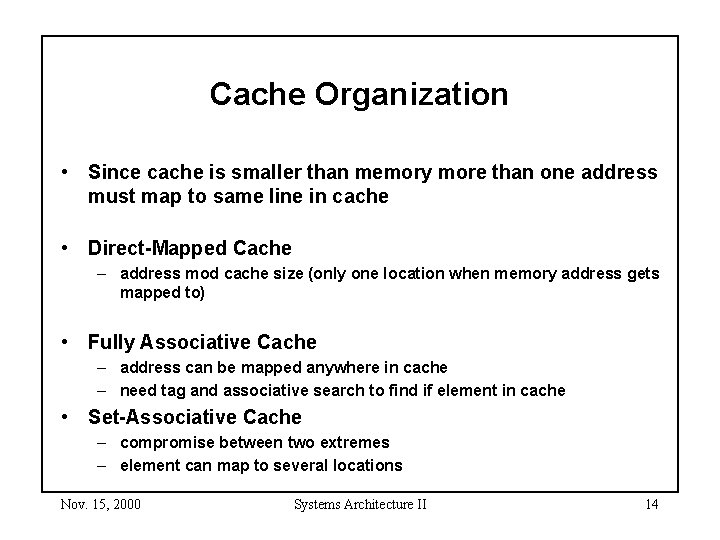
Cache Organization • Since cache is smaller than memory more than one address must map to same line in cache • Direct-Mapped Cache – address mod cache size (only one location when memory address gets mapped to) • Fully Associative Cache – address can be mapped anywhere in cache – need tag and associative search to find if element in cache • Set-Associative Cache – compromise between two extremes – element can map to several locations Nov. 15, 2000 Systems Architecture II 14
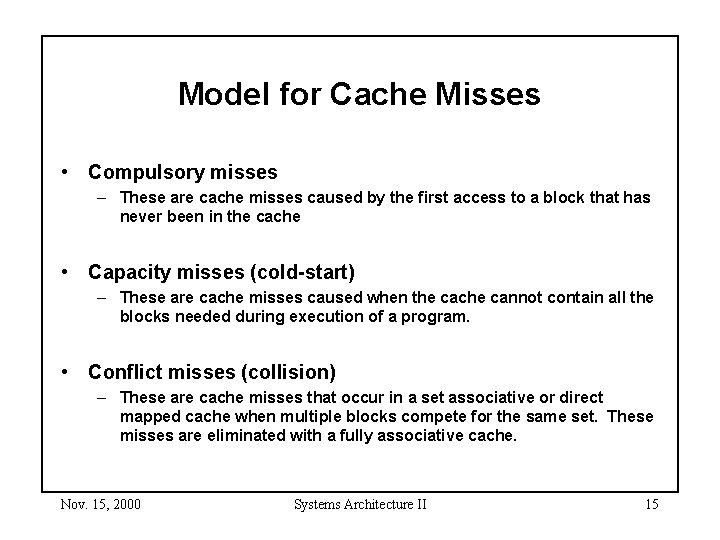
Model for Cache Misses • Compulsory misses – These are cache misses caused by the first access to a block that has never been in the cache • Capacity misses (cold-start) – These are cache misses caused when the cache cannot contain all the blocks needed during execution of a program. • Conflict misses (collision) – These are cache misses that occur in a set associative or direct mapped cache when multiple blocks compete for the same set. These misses are eliminated with a fully associative cache. Nov. 15, 2000 Systems Architecture II 15
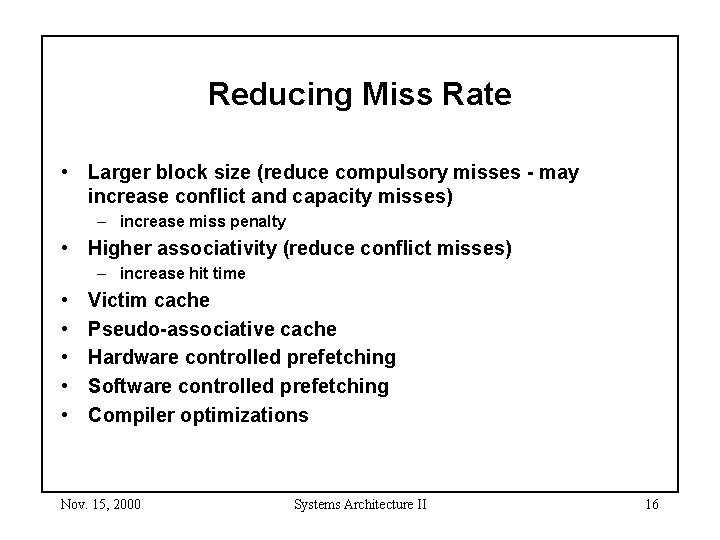
Reducing Miss Rate • Larger block size (reduce compulsory misses - may increase conflict and capacity misses) – increase miss penalty • Higher associativity (reduce conflict misses) – increase hit time • • • Victim cache Pseudo-associative cache Hardware controlled prefetching Software controlled prefetching Compiler optimizations Nov. 15, 2000 Systems Architecture II 16
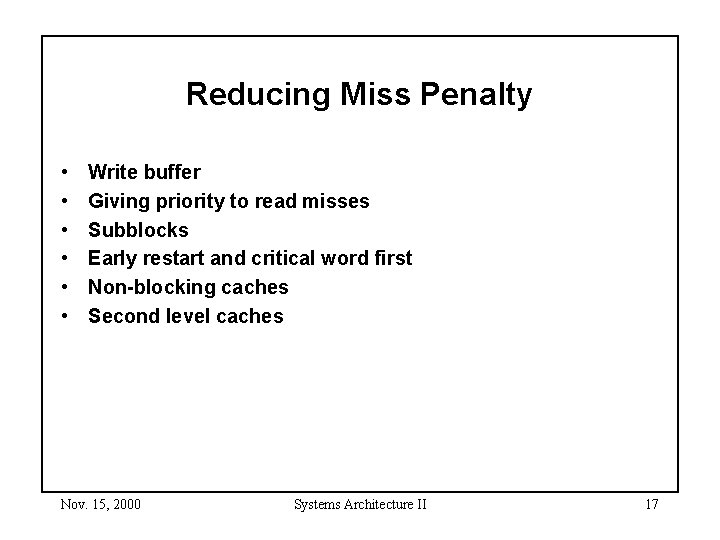
Reducing Miss Penalty • • • Write buffer Giving priority to read misses Subblocks Early restart and critical word first Non-blocking caches Second level caches Nov. 15, 2000 Systems Architecture II 17
Reducing Hit Time • Simple and small caches • Avoiding address translation during indexing of the cache • Pipelining writes for fast write hits – write hits usually take longer than read hits since writing must wait for tag match (to avoid overwriting data) Nov. 15, 2000 Systems Architecture II 18
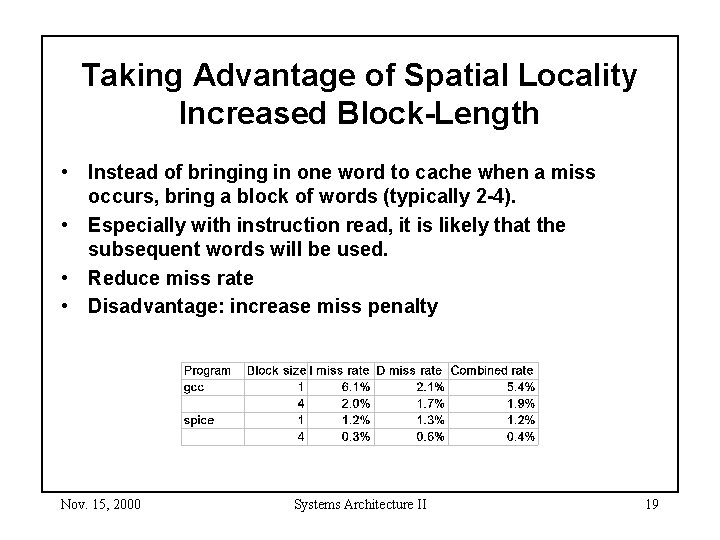
Taking Advantage of Spatial Locality Increased Block-Length • Instead of bringing in one word to cache when a miss occurs, bring a block of words (typically 2 -4). • Especially with instruction read, it is likely that the subsequent words will be used. • Reduce miss rate • Disadvantage: increase miss penalty Nov. 15, 2000 Systems Architecture II 19
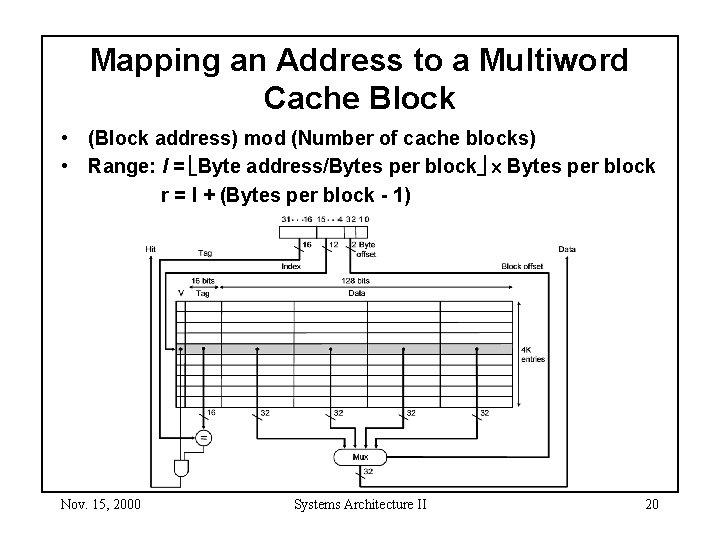
Mapping an Address to a Multiword Cache Block • (Block address) mod (Number of cache blocks) • Range: l = Byte address/Bytes per block r = l + (Bytes per block - 1) Nov. 15, 2000 Systems Architecture II 20
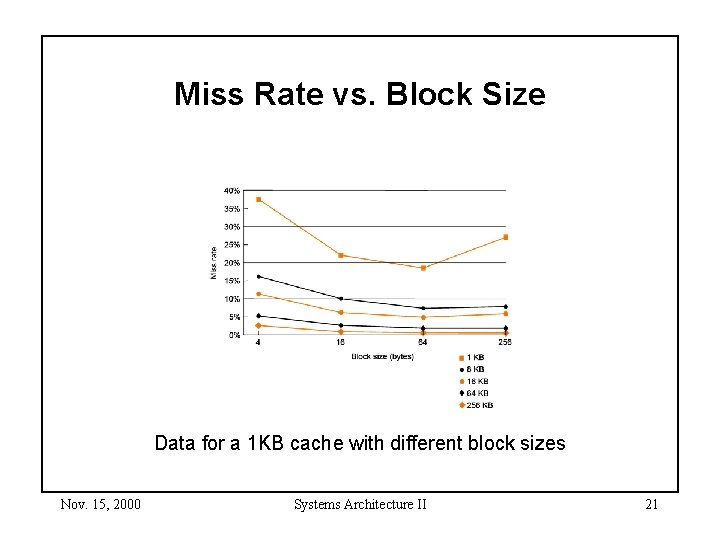
Miss Rate vs. Block Size Data for a 1 KB cache with different block sizes Nov. 15, 2000 Systems Architecture II 21
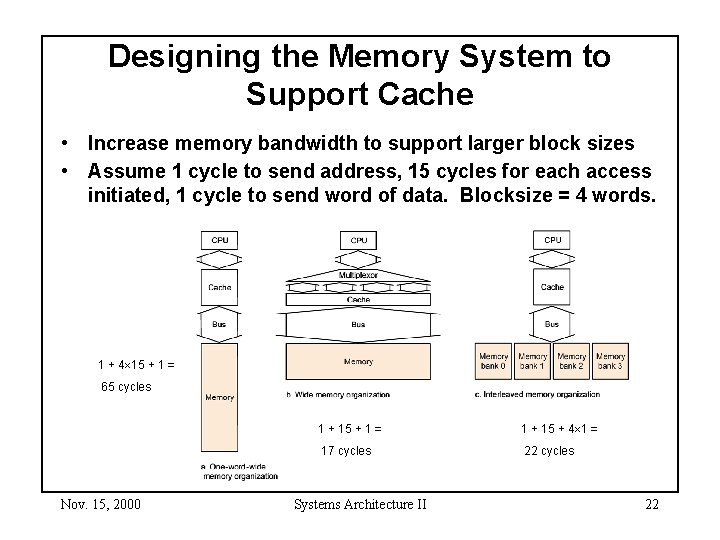
Designing the Memory System to Support Cache • Increase memory bandwidth to support larger block sizes • Assume 1 cycle to send address, 15 cycles for each access initiated, 1 cycle to send word of data. Blocksize = 4 words. 1 + 4 15 + 1 = 65 cycles Nov. 15, 2000 1 + 15 + 1 = 1 + 15 + 4 1 = 17 cycles 22 cycles Systems Architecture II 22
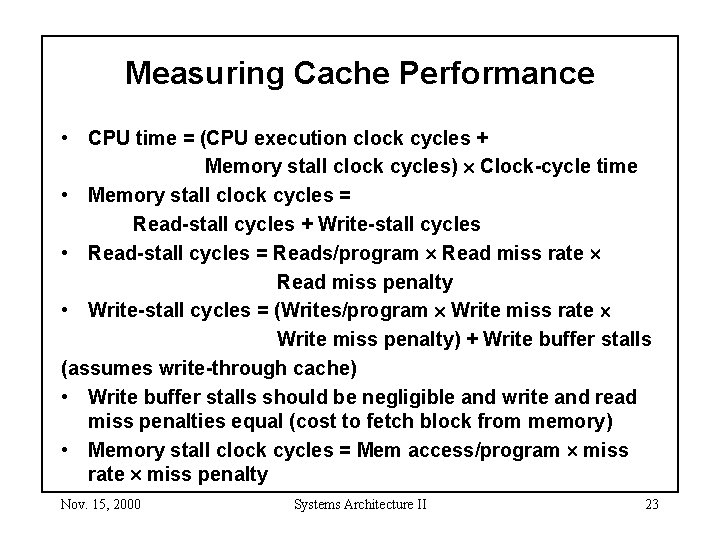
Measuring Cache Performance • CPU time = (CPU execution clock cycles + Memory stall clock cycles) Clock-cycle time • Memory stall clock cycles = Read-stall cycles + Write-stall cycles • Read-stall cycles = Reads/program Read miss rate Read miss penalty • Write-stall cycles = (Writes/program Write miss rate Write miss penalty) + Write buffer stalls (assumes write-through cache) • Write buffer stalls should be negligible and write and read miss penalties equal (cost to fetch block from memory) • Memory stall clock cycles = Mem access/program miss rate miss penalty Nov. 15, 2000 Systems Architecture II 23
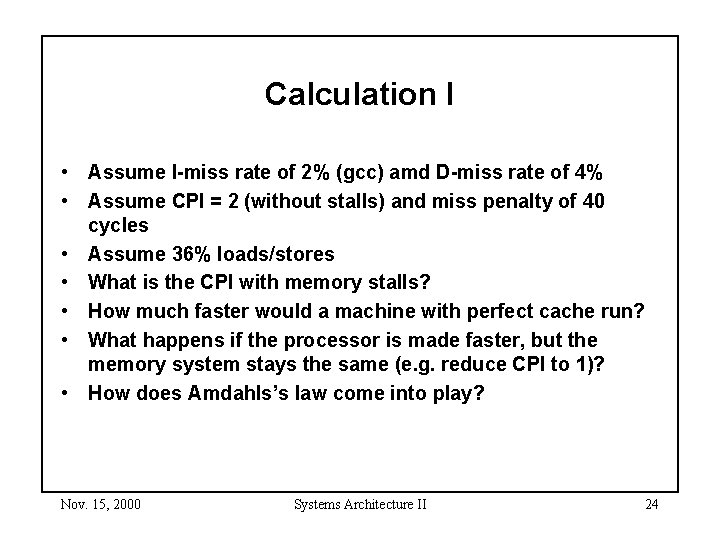
Calculation I • Assume I-miss rate of 2% (gcc) amd D-miss rate of 4% • Assume CPI = 2 (without stalls) and miss penalty of 40 cycles • Assume 36% loads/stores • What is the CPI with memory stalls? • How much faster would a machine with perfect cache run? • What happens if the processor is made faster, but the memory system stays the same (e. g. reduce CPI to 1)? • How does Amdahls’s law come into play? Nov. 15, 2000 Systems Architecture II 24
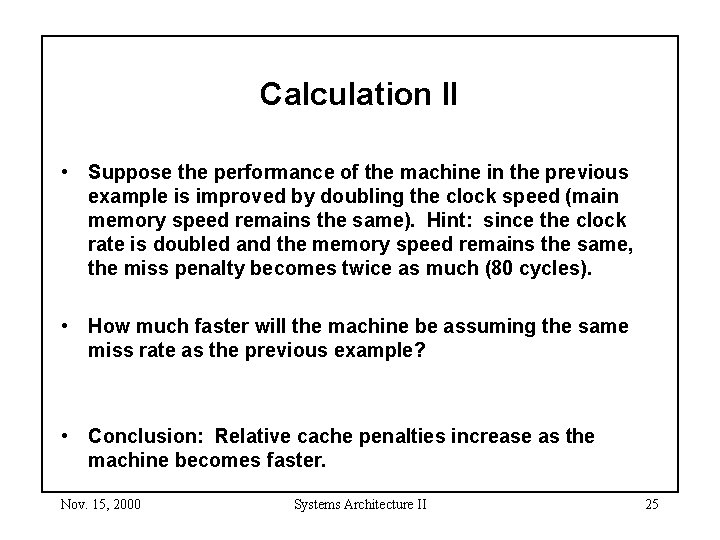
Calculation II • Suppose the performance of the machine in the previous example is improved by doubling the clock speed (main memory speed remains the same). Hint: since the clock rate is doubled and the memory speed remains the same, the miss penalty becomes twice as much (80 cycles). • How much faster will the machine be assuming the same miss rate as the previous example? • Conclusion: Relative cache penalties increase as the machine becomes faster. Nov. 15, 2000 Systems Architecture II 25
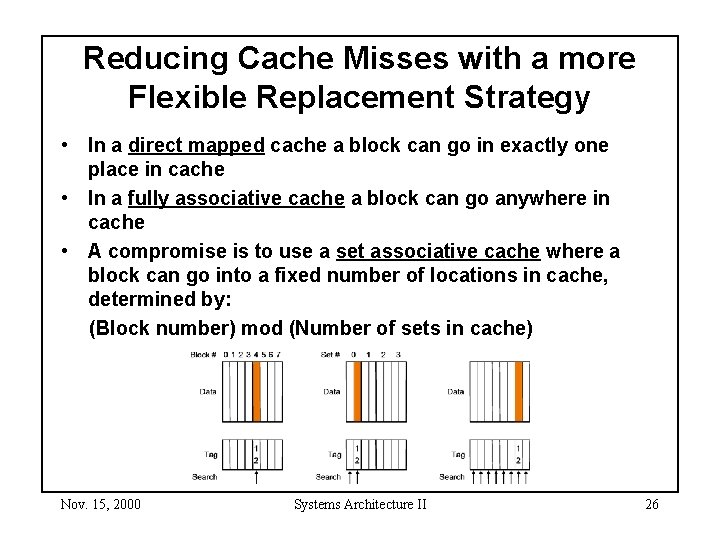
Reducing Cache Misses with a more Flexible Replacement Strategy • In a direct mapped cache a block can go in exactly one place in cache • In a fully associative cache a block can go anywhere in cache • A compromise is to use a set associative cache where a block can go into a fixed number of locations in cache, determined by: (Block number) mod (Number of sets in cache) Nov. 15, 2000 Systems Architecture II 26
Example • Three small 4 word caches: Direct mapped, two-way set associative, fully associative • How many misses in the sequence of block addresses: 0, 8, 0, 6, 8? • How does this change with 8 words, 16 words? Nov. 15, 2000 Systems Architecture II 27
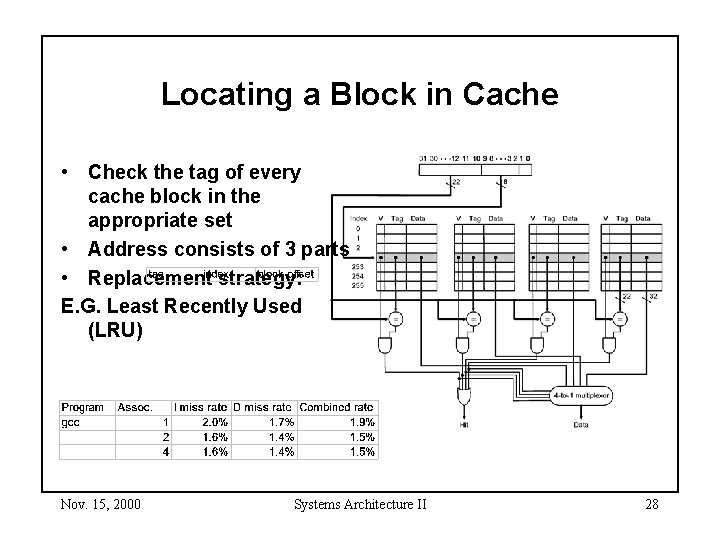
Locating a Block in Cache • Check the tag of every cache block in the appropriate set • Address consists of 3 parts • Replacement strategy: E. G. Least Recently Used (LRU) Nov. 15, 2000 Systems Architecture II 28
Size of Tags vs. Associativity • Increasing associativity requires more comparators, as well as more tag bits per cache block. • Assume a cache with 4 KB blocks and 32 bit addresses • Find the total number of sets and the total number of tag bits for a – – direct mapped cache two-way set associative cache four-way set associative cache fully associative cache Nov. 15, 2000 Systems Architecture II 29
Reducing the Miss Penalty using Multilevel Caches • To further reduce the gap between fast clock rates of CPUs and the relatively long time to access memory additional levels of cache are used (level two and level three caches). • The design of the primary cache is driven by the goal of a fast hit rate, which implies a relatively small size • A secondary cache is provided to reduce the miss rate and penalty needed to go to memory. • Example: – – – Assume CPI = 1 (with no misses) and 500 MHz clock 200 ns memory access time 5% miss rate for primary cache secondary cache with 20 ns access time and miss rate of 2% What is the total CPI with and without secondary cache? How much of an improvement does secondary cache provide? Nov. 15, 2000 Systems Architecture II 30