
Machine Learning on ASICs for Streaming ADCs Sandeep
- Slides: 17
Machine Learning on ASICs for Streaming ADCs Sandeep Miryala, Gabriella Carini, Grzegorz Deptuch, Jack Fried, Jin Huang, Florence Lucey, Yihui Ren, Shinjae Yoo Brookhaven National Laboratory smiryala@bnl. gov Sandeep | Workshop Streaming 2021
Outline • Introduction • Readout integrated circuits – signal processing chain • Proposed readout ASIC architecture for scientific applications • Investigating Machine Learning (ML) algorithms for waveform processing • Various neural networks (MLP, CNN etc. ) • Optimization of a neural network • Hardware-software co-design • Hardware design • Introduction of memristor • Behavioral modeling • Memristor crossbar arrays Sandeep | Workshop Streaming 2021
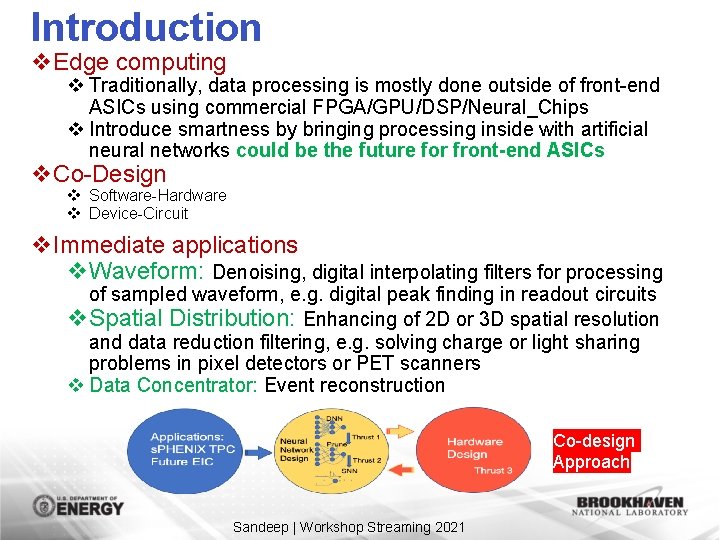
Introduction v. Edge computing v Traditionally, data processing is mostly done outside of front-end ASICs using commercial FPGA/GPU/DSP/Neural_Chips v Introduce smartness by bringing processing inside with artificial neural networks could be the future for front-end ASICs v. Co-Design v Software-Hardware v Device-Circuit v. Immediate applications v. Waveform: Denoising, digital interpolating filters for processing of sampled waveform, e. g. digital peak finding in readout circuits v. Spatial Distribution: Enhancing of 2 D or 3 D spatial resolution and data reduction filtering, e. g. solving charge or light sharing problems in pixel detectors or PET scanners v Data Concentrator: Event reconstruction Co-design Approach Sandeep | Workshop Streaming 2021
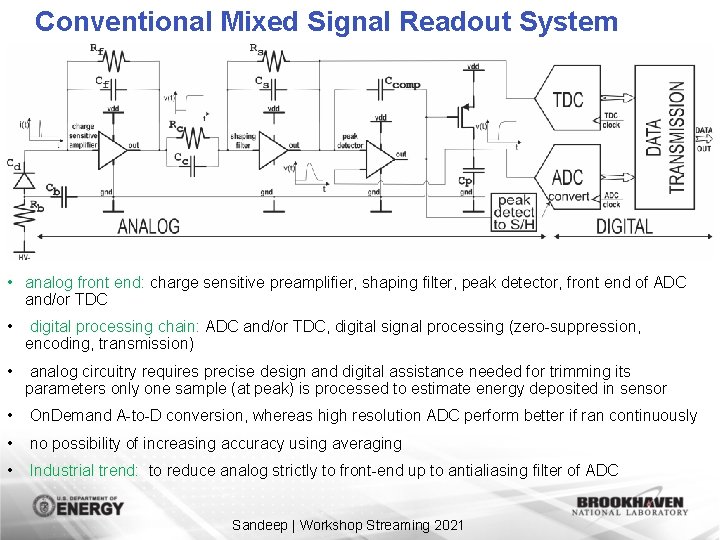
Conventional Mixed Signal Readout System • analog front end: charge sensitive preamplifier, shaping filter, peak detector, front end of ADC and/or TDC • digital processing chain: ADC and/or TDC, digital signal processing (zero-suppression, encoding, transmission) • analog circuitry requires precise design and digital assistance needed for trimming its parameters only one sample (at peak) is processed to estimate energy deposited in sensor • On. Demand A-to-D conversion, whereas high resolution ADC perform better if ran continuously • no possibility of increasing accuracy using averaging • Industrial trend: to reduce analog strictly to front-end up to antialiasing filter of ADC Sandeep | Workshop Streaming 2021
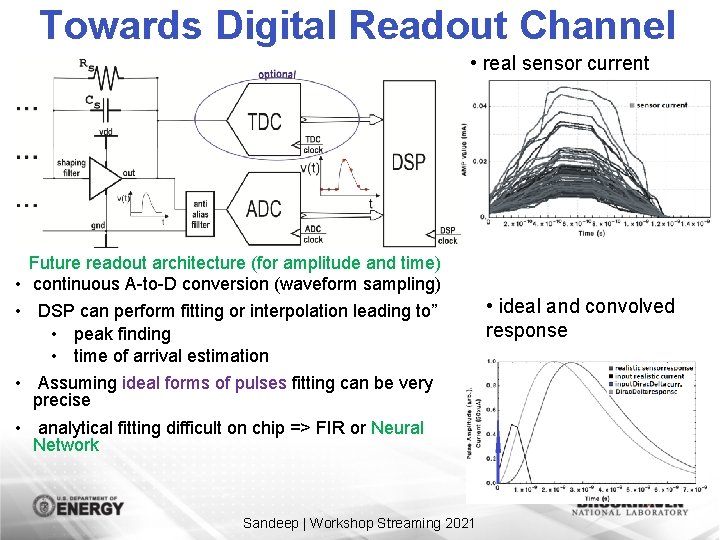
Towards Digital Readout Channel • real sensor current Future readout architecture (for amplitude and time) • continuous A-to-D conversion (waveform sampling) • DSP can perform fitting or interpolation leading to” • peak finding • time of arrival estimation • Assuming ideal forms of pulses fitting can be very precise • analytical fitting difficult on chip => FIR or Neural Network Sandeep | Workshop Streaming 2021 • ideal and convolved response
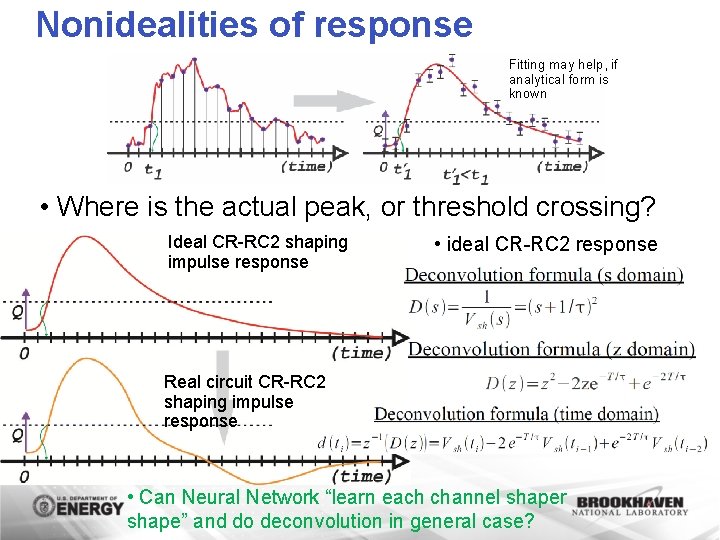
Nonidealities of response Fitting may help, if analytical form is known • Where is the actual peak, or threshold crossing? Ideal CR-RC 2 shaping impulse response • ideal CR-RC 2 response Real circuit CR-RC 2 shaping impulse response • Can Neural Network “learn each channel shaper shape” and do deconvolution in general case?
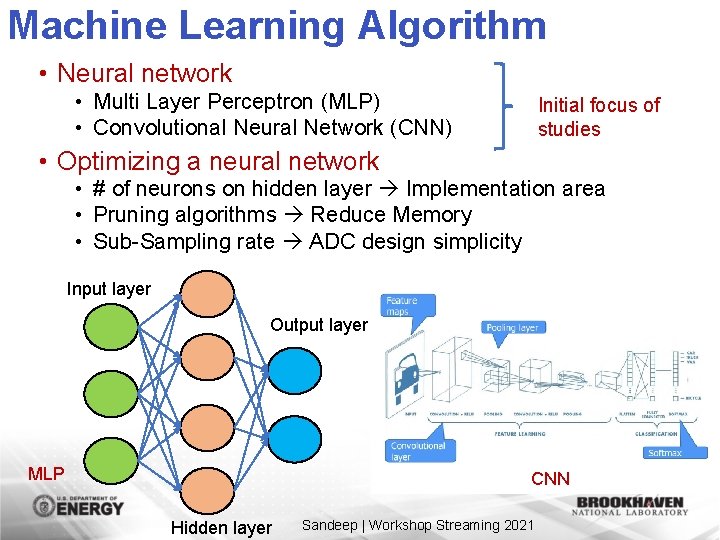
Machine Learning Algorithm • Neural network • Multi Layer Perceptron (MLP) • Convolutional Neural Network (CNN) Initial focus of studies • Optimizing a neural network • # of neurons on hidden layer Implementation area • Pruning algorithms Reduce Memory • Sub-Sampling rate ADC design simplicity Input layer Output layer MLP CNN Hidden layer Sandeep | Workshop Streaming 2021
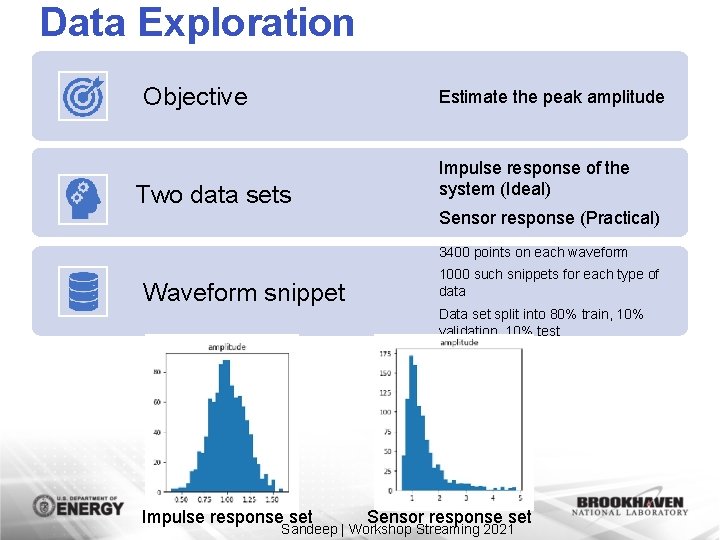
Data Exploration Objective Estimate the peak amplitude Two data sets Impulse response of the system (Ideal) Sensor response (Practical) 3400 points on each waveform Waveform snippet Impulse response set 1000 such snippets for each type of data Data set split into 80% train, 10% validation, 10% test Sensor response set Sandeep | Workshop Streaming 2021
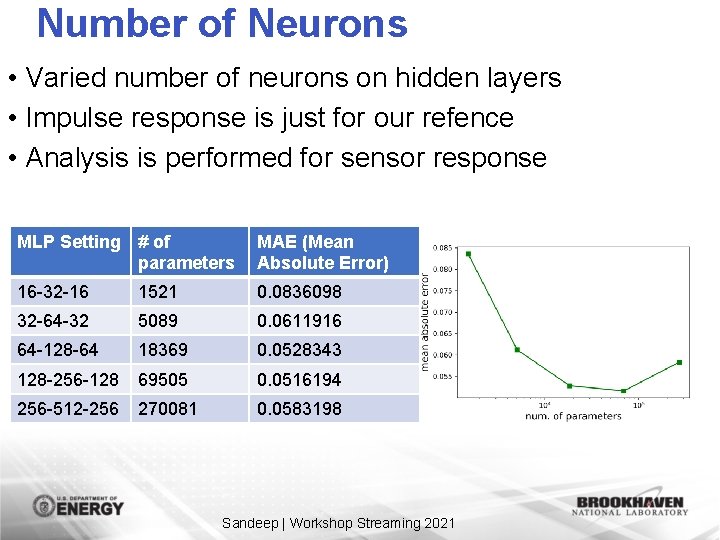
Number of Neurons • Varied number of neurons on hidden layers • Impulse response is just for our refence • Analysis is performed for sensor response MLP Setting # of parameters MAE (Mean Absolute Error) 16 -32 -16 1521 0. 0836098 32 -64 -32 5089 0. 0611916 64 -128 -64 18369 0. 0528343 128 -256 -128 69505 0. 0516194 256 -512 -256 270081 0. 0583198 Sandeep | Workshop Streaming 2021
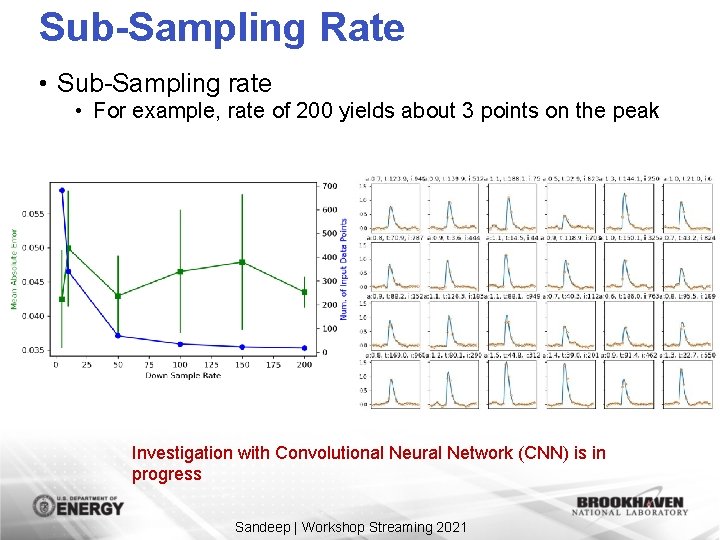
Sub-Sampling Rate • Sub-Sampling rate • For example, rate of 200 yields about 3 points on the peak Investigation with Convolutional Neural Network (CNN) is in progress Sandeep | Workshop Streaming 2021
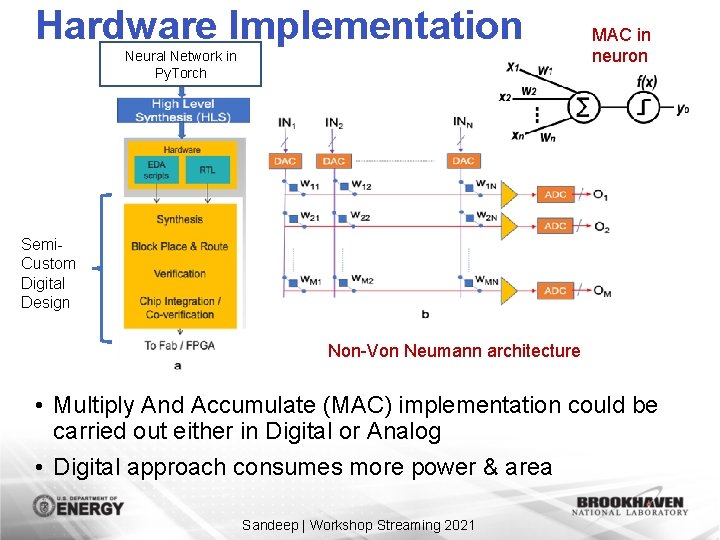
Hardware Implementation Neural Network in Py. Torch MAC in neuron Semi. Custom Digital Design Non-Von Neumann architecture • Multiply And Accumulate (MAC) implementation could be carried out either in Digital or Analog • Digital approach consumes more power & area Sandeep | Workshop Streaming 2021
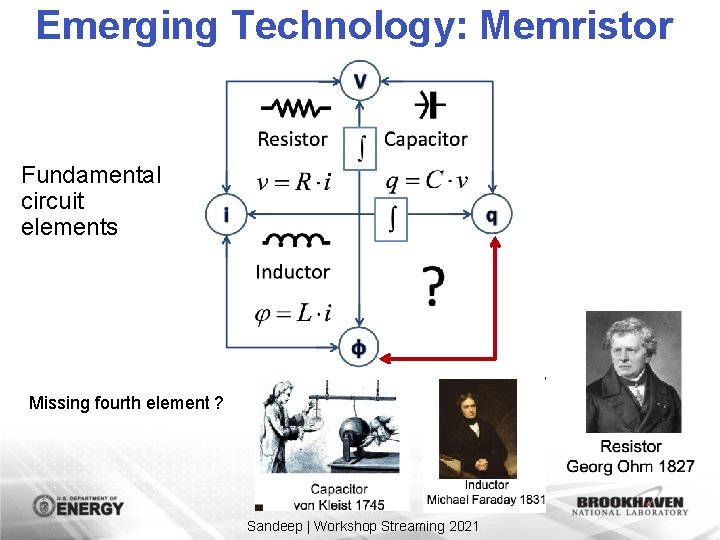
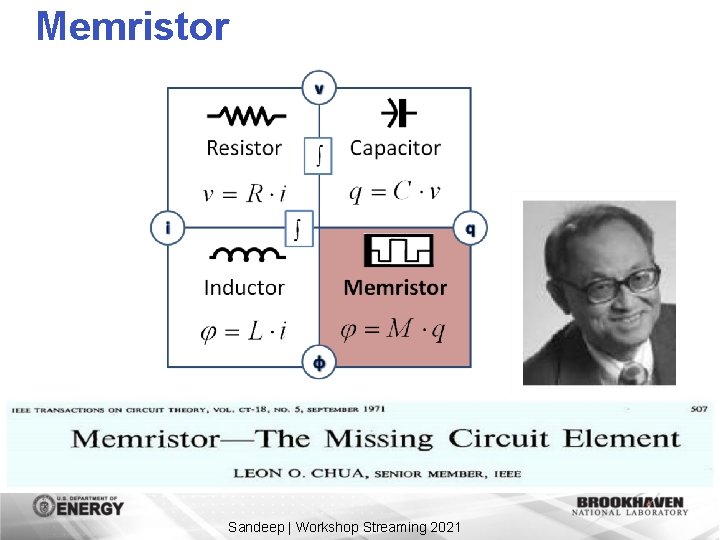
Emerging Technology: Memristor Fundamental circuit elements Missing fourth element ? Sandeep | Workshop Streaming 2021
Memristor Sandeep | Workshop Streaming 2021
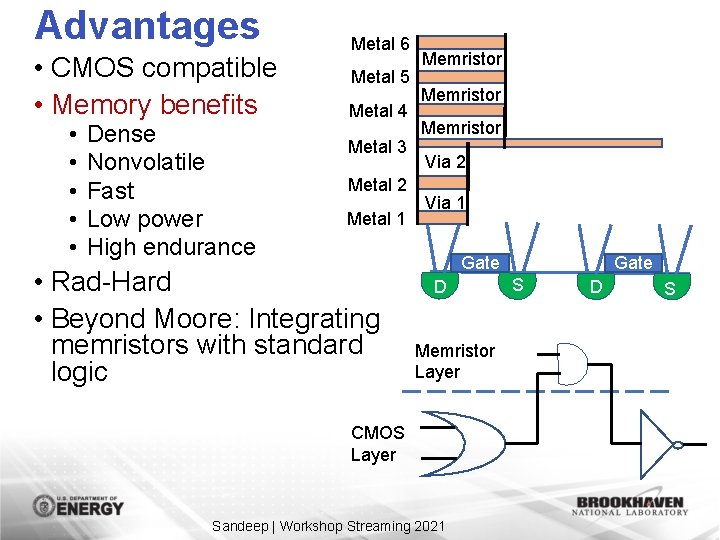
Advantages • CMOS compatible • Memory benefits • • • Dense Nonvolatile Fast Low power High endurance Metal 6 Metal 5 Metal 4 Metal 3 Metal 2 Metal 1 • Rad-Hard • Beyond Moore: Integrating memristors with standard logic Memristor Via 2 Via 1 Gate D Memristor Layer CMOS Layer Sandeep | Workshop Streaming 2021 S D S
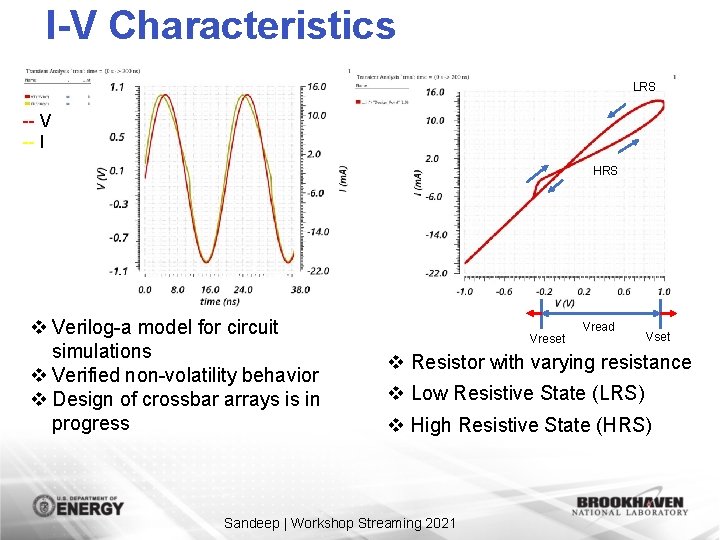
I-V Characteristics LRS -- V -- I HRS v Verilog-a model for circuit simulations v Verified non-volatility behavior v Design of crossbar arrays is in progress Vreset Vread Vset v Resistor with varying resistance v Low Resistive State (LRS) v High Resistive State (HRS) Sandeep | Workshop Streaming 2021
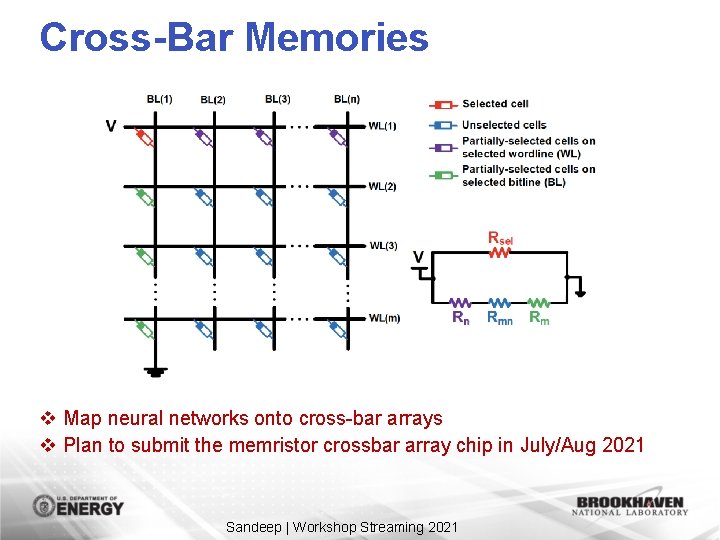
Cross-Bar Memories v Map neural networks onto cross-bar arrays v Plan to submit the memristor crossbar array chip in July/Aug 2021 Sandeep | Workshop Streaming 2021
Acknowledgements • Towards Edge Computing LDRD • Collaboration between Instrumentation Division (IO) and Computational Science Initiative (CSI) • https: //www. bnl. gov/ldrd/ • External collaborators • University of South Florida (USF) • Others … Sandeep | Workshop Streaming 2021