
Machine Learning Lecture 4 Multilayer Perceptrons G 53
- Slides: 43
Machine Learning Lecture 4 Multilayer Perceptrons G 53 MLE | Machine Learning | Dr Guoping Qiu 1
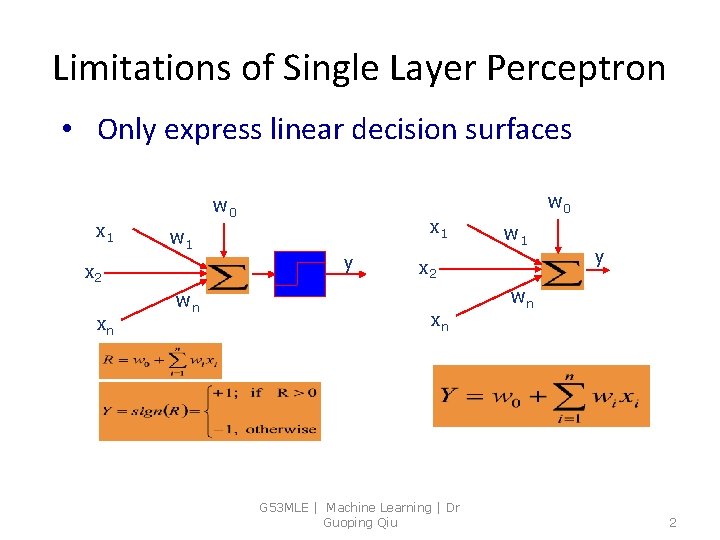
Limitations of Single Layer Perceptron • Only express linear decision surfaces x 1 w 0 w 1 x 2 xn wn x 1 y w 0 w 1 x 2 xn G 53 MLE | Machine Learning | Dr Guoping Qiu y wn 2
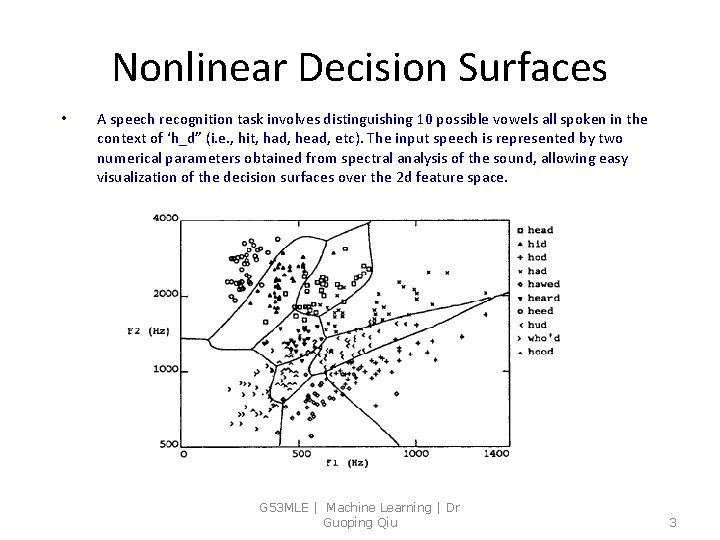
Nonlinear Decision Surfaces • A speech recognition task involves distinguishing 10 possible vowels all spoken in the context of ‘h_d” (i. e. , hit, had, head, etc). The input speech is represented by two numerical parameters obtained from spectral analysis of the sound, allowing easy visualization of the decision surfaces over the 2 d feature space. G 53 MLE | Machine Learning | Dr Guoping Qiu 3
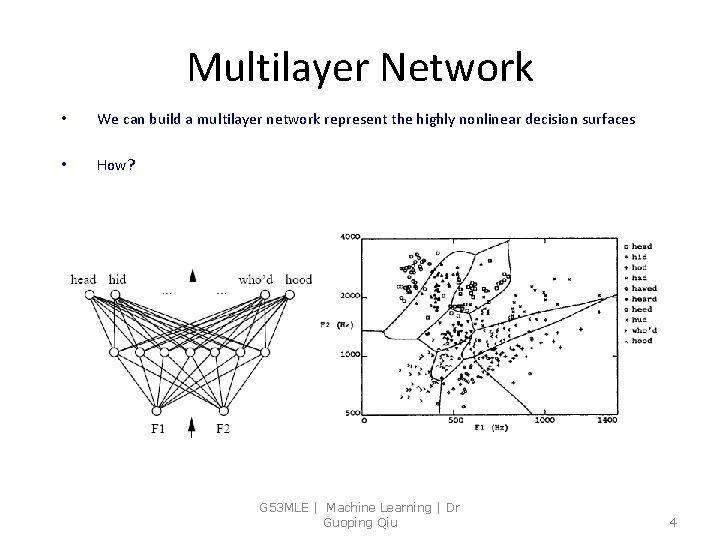
Multilayer Network • We can build a multilayer network represent the highly nonlinear decision surfaces • How? G 53 MLE | Machine Learning | Dr Guoping Qiu 4
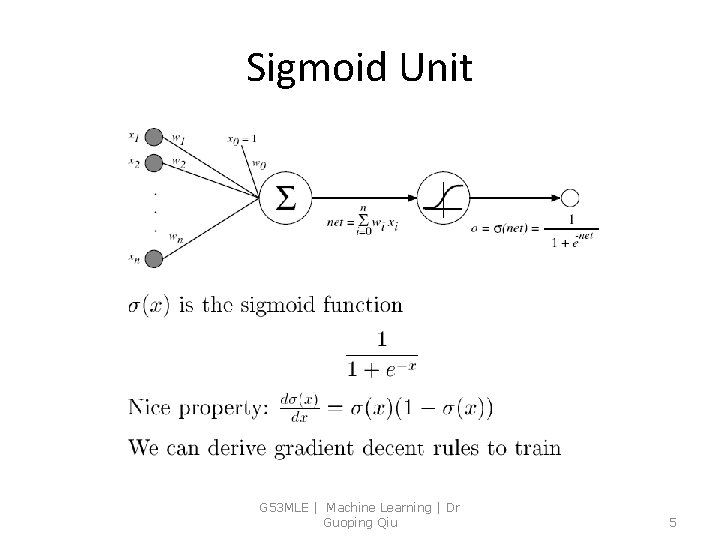
Sigmoid Unit G 53 MLE | Machine Learning | Dr Guoping Qiu 5
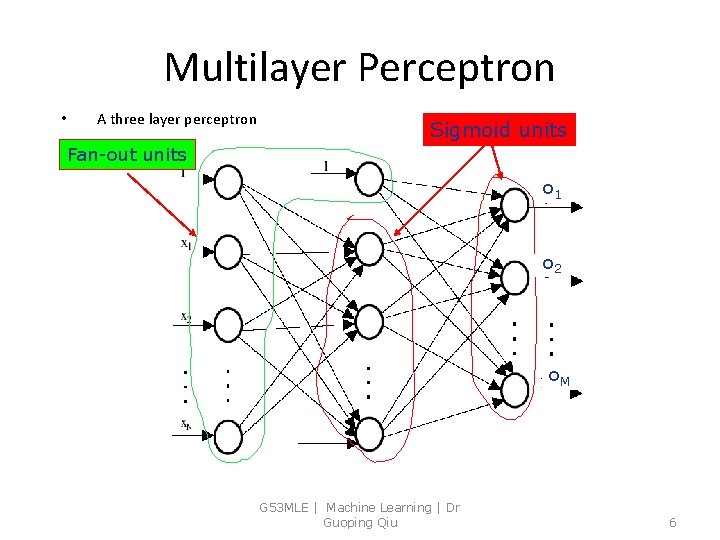
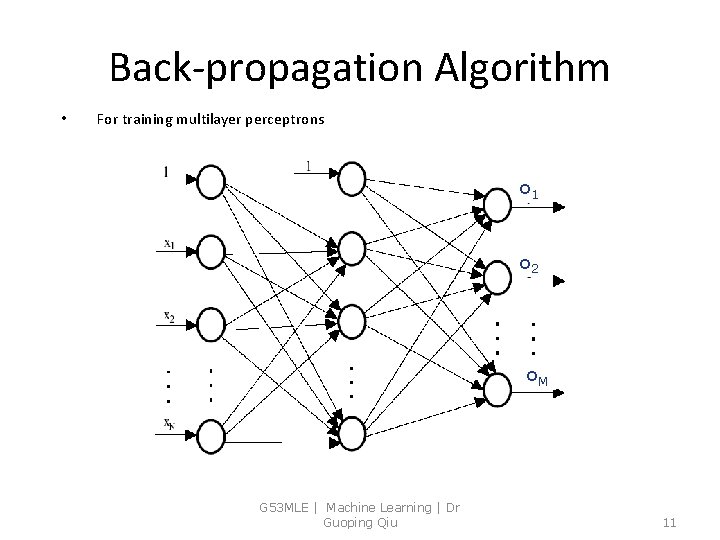
Multilayer Perceptron • A three layer perceptron Sigmoid units Fan-out units o 1 o 2 o. M G 53 MLE | Machine Learning | Dr Guoping Qiu 6
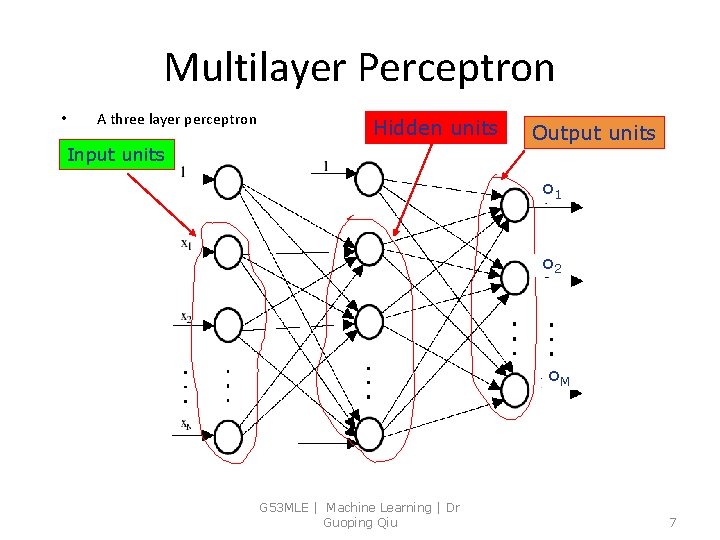
Multilayer Perceptron • A three layer perceptron Hidden units Input units Output units o 1 o 2 o. M G 53 MLE | Machine Learning | Dr Guoping Qiu 7
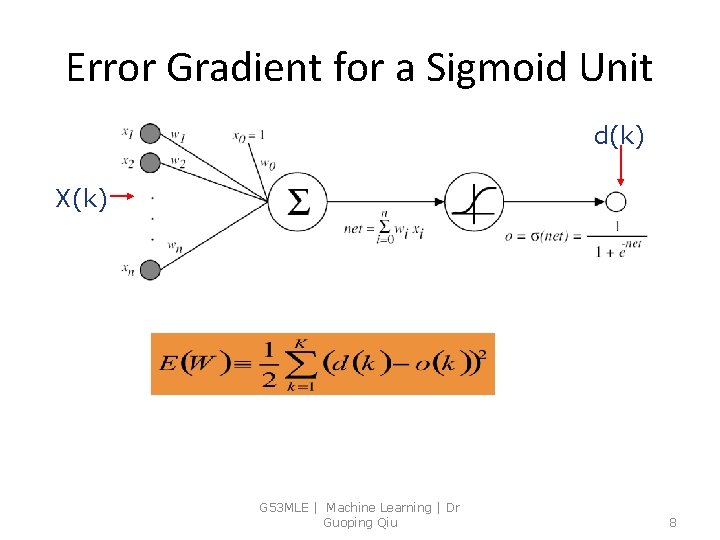
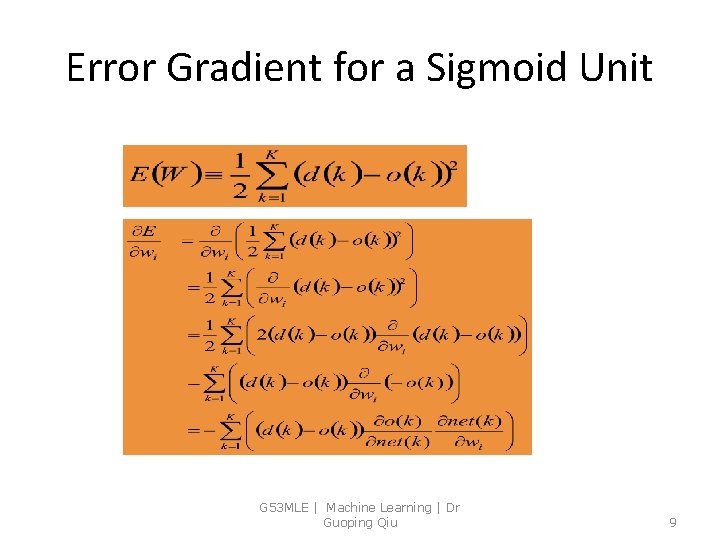
Error Gradient for a Sigmoid Unit d(k) X(k) G 53 MLE | Machine Learning | Dr Guoping Qiu 8
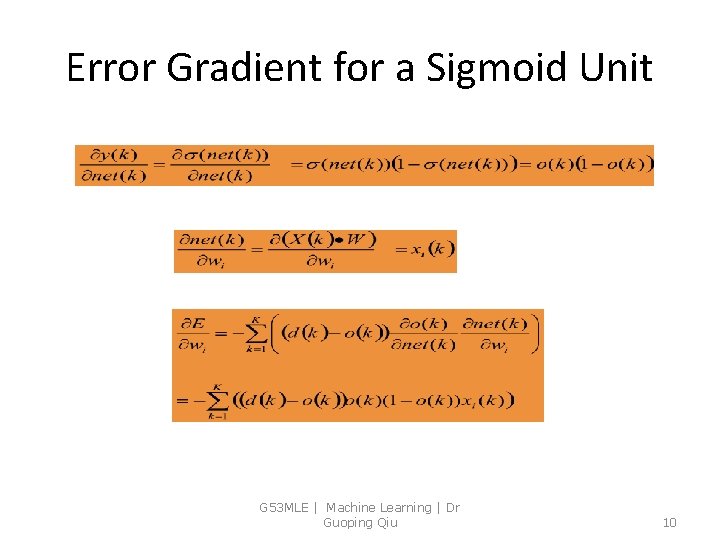
Error Gradient for a Sigmoid Unit G 53 MLE | Machine Learning | Dr Guoping Qiu 9
Error Gradient for a Sigmoid Unit G 53 MLE | Machine Learning | Dr Guoping Qiu 10
Back-propagation Algorithm • For training multilayer perceptrons o 1 o 2 o. M G 53 MLE | Machine Learning | Dr Guoping Qiu 11
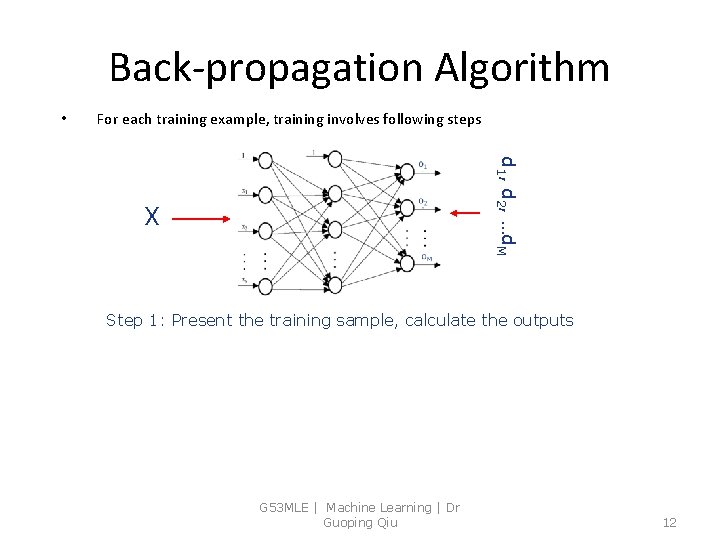
Back-propagation Algorithm • For each training example, training involves following steps d 1, d 2, …d. M X Step 1: Present the training sample, calculate the outputs G 53 MLE | Machine Learning | Dr Guoping Qiu 12
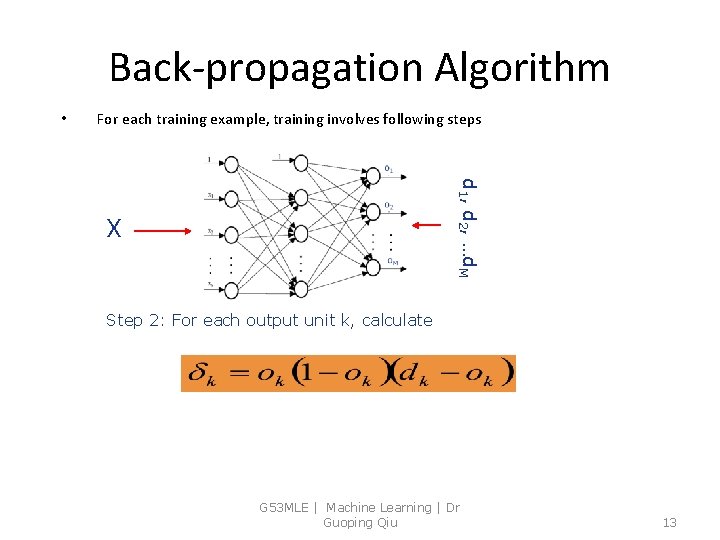
Back-propagation Algorithm • For each training example, training involves following steps d 1, d 2, …d. M X Step 2: For each output unit k, calculate G 53 MLE | Machine Learning | Dr Guoping Qiu 13
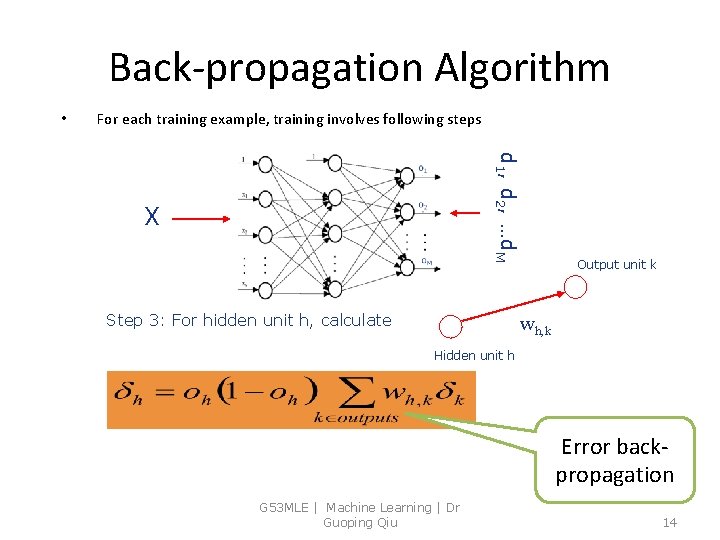
Back-propagation Algorithm • For each training example, training involves following steps d 1, d 2, …d. M X Step 3: For hidden unit h, calculate Output unit k wh, k Hidden unit h Error backpropagation G 53 MLE | Machine Learning | Dr Guoping Qiu 14
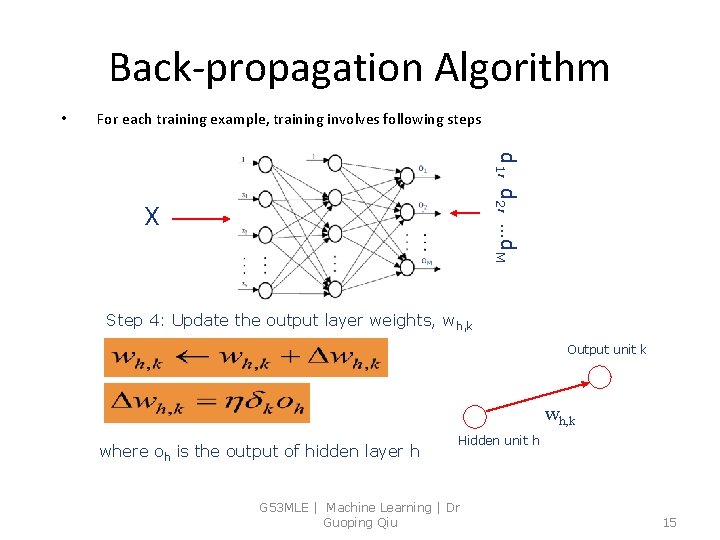
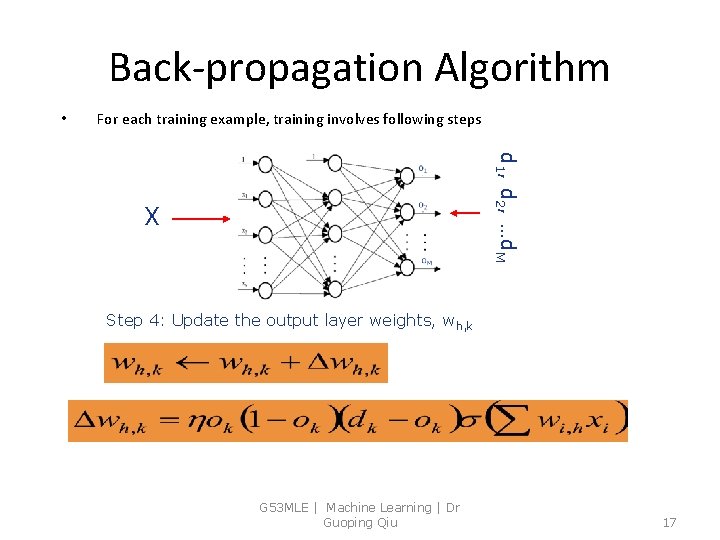
Back-propagation Algorithm • For each training example, training involves following steps d 1, d 2, …d. M X Step 4: Update the output layer weights, wh, k Output unit k wh, k where oh is the output of hidden layer h Hidden unit h G 53 MLE | Machine Learning | Dr Guoping Qiu 15
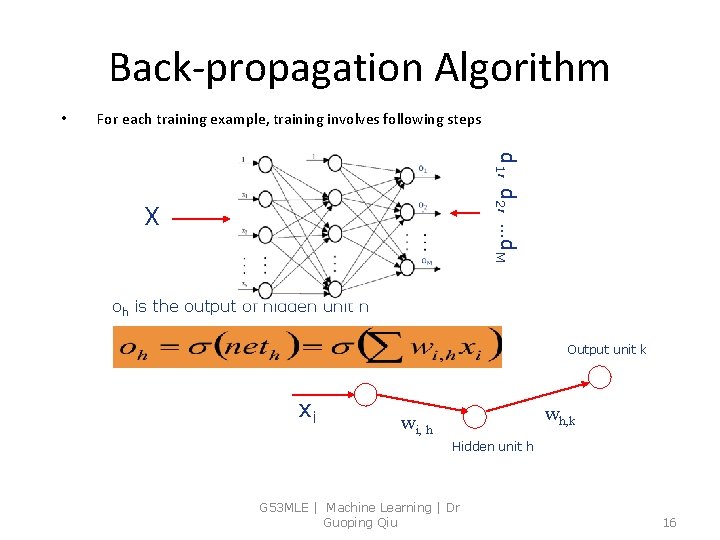
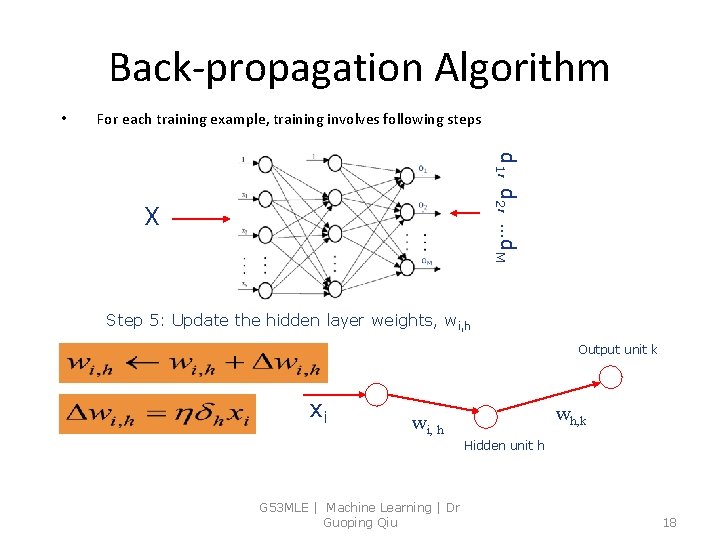
Back-propagation Algorithm • For each training example, training involves following steps d 1, d 2, …d. M X oh is the output of hidden unit h Output unit k xi wh, k wi, h Hidden unit h G 53 MLE | Machine Learning | Dr Guoping Qiu 16
Back-propagation Algorithm • For each training example, training involves following steps d 1, d 2, …d. M X Step 4: Update the output layer weights, wh, k G 53 MLE | Machine Learning | Dr Guoping Qiu 17
Back-propagation Algorithm • For each training example, training involves following steps d 1, d 2, …d. M X Step 5: Update the hidden layer weights, wi, h Output unit k xi wh, k wi, h Hidden unit h G 53 MLE | Machine Learning | Dr Guoping Qiu 18
Back-propagation Algorithm • Gradient descent over entire network weight vector • Will find a local, not necessarily a global error minimum. • In practice, it often works well (can run multiple times) • Minimizes error over all training samples – Will it generalize will to subsequent examples? i. e. , will the trained network perform well on data outside the training sample • Training can take thousands of iterations • After training, use the network is fast G 53 MLE | Machine Learning | Dr Guoping Qiu 19
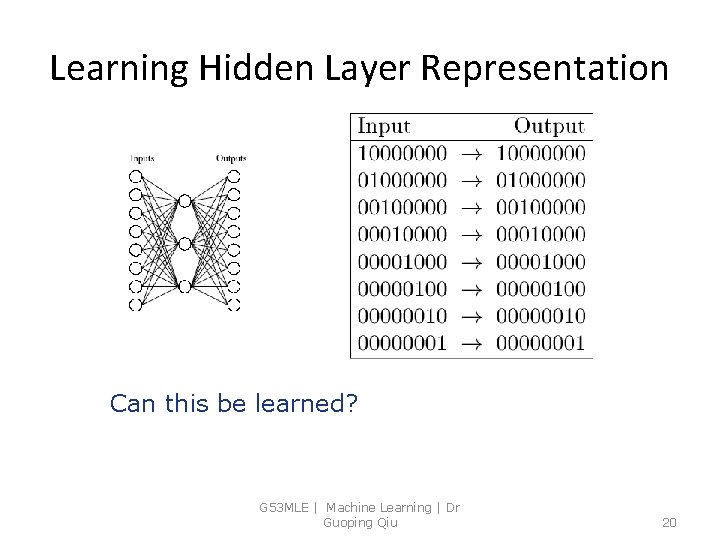
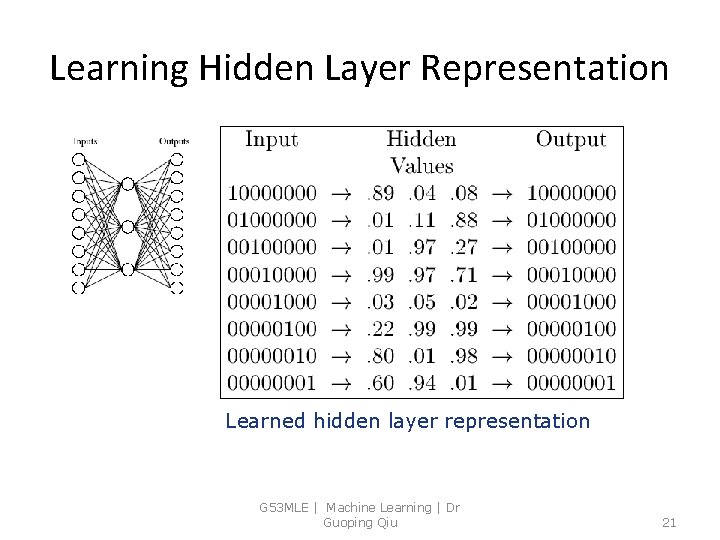
Learning Hidden Layer Representation Can this be learned? G 53 MLE | Machine Learning | Dr Guoping Qiu 20
Learning Hidden Layer Representation Learned hidden layer representation G 53 MLE | Machine Learning | Dr Guoping Qiu 21
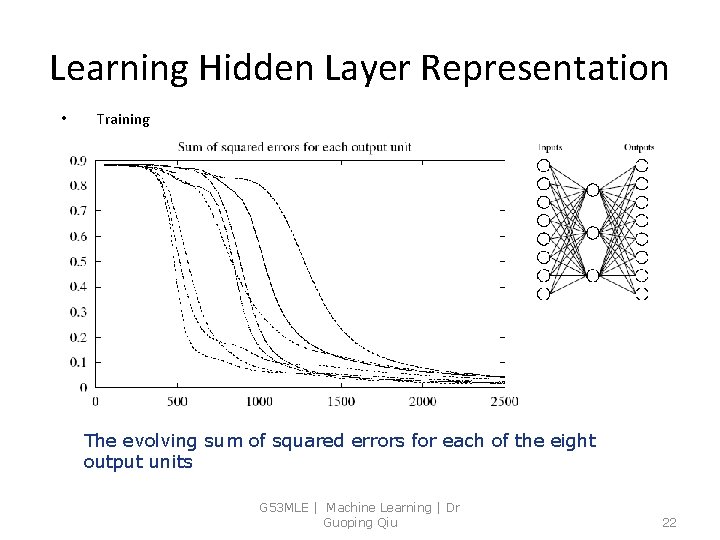
Learning Hidden Layer Representation • Training The evolving sum of squared errors for each of the eight output units G 53 MLE | Machine Learning | Dr Guoping Qiu 22
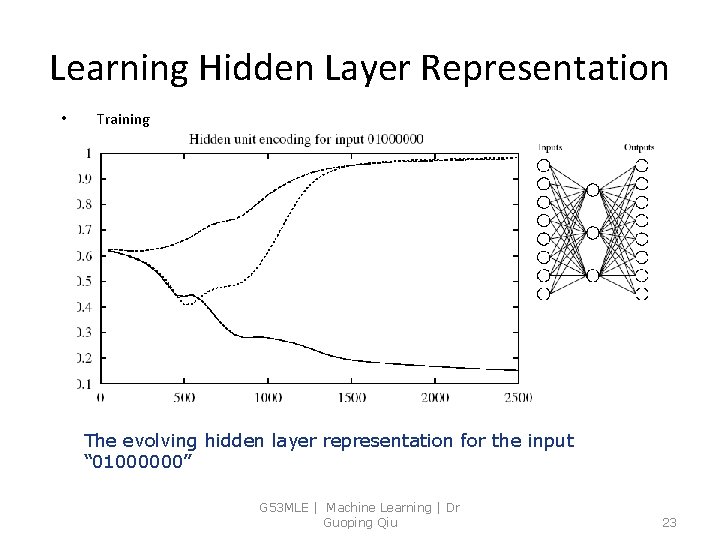
Learning Hidden Layer Representation • Training The evolving hidden layer representation for the input “ 01000000” G 53 MLE | Machine Learning | Dr Guoping Qiu 23
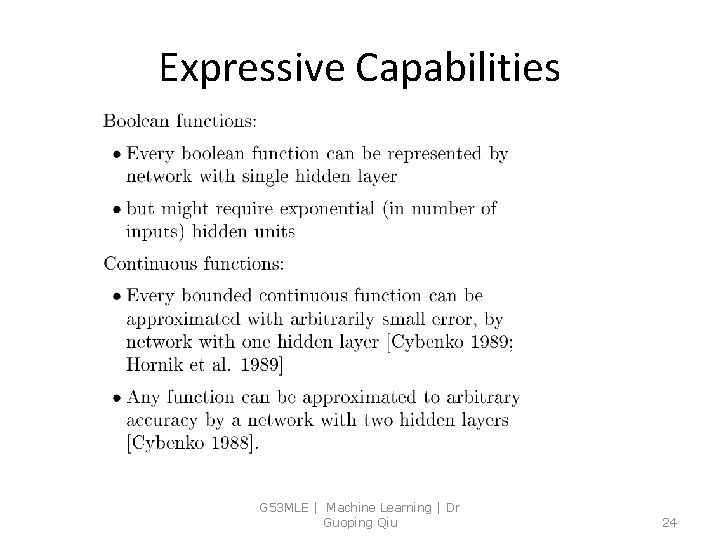
Expressive Capabilities G 53 MLE | Machine Learning | Dr Guoping Qiu 24
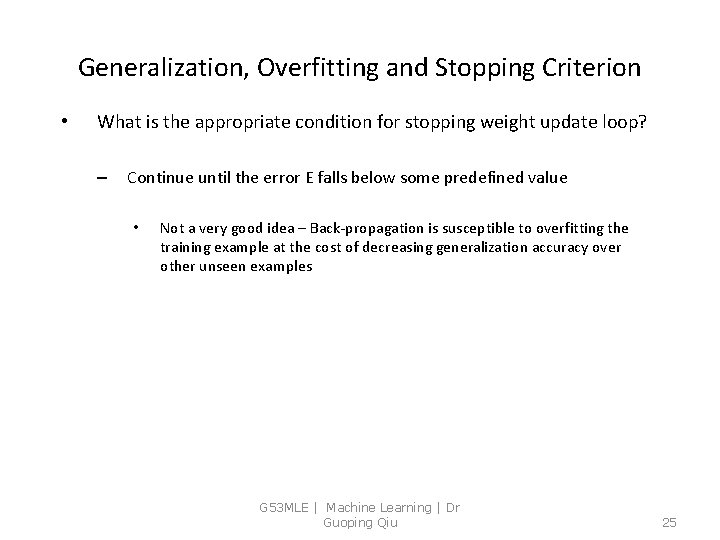
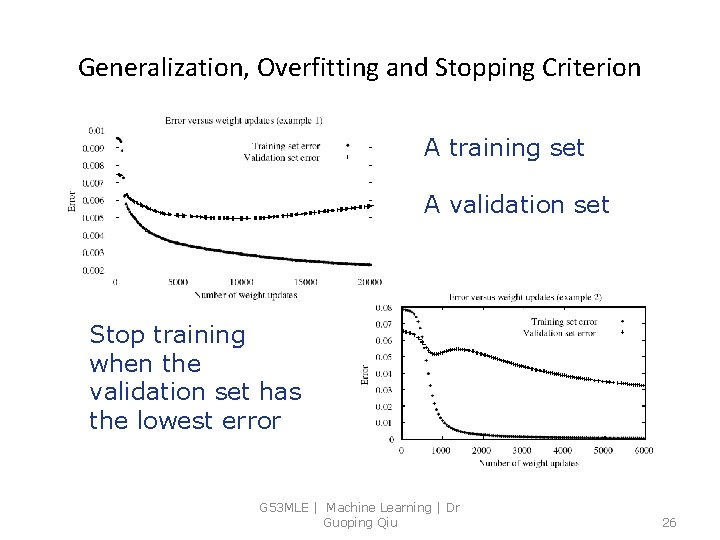
Generalization, Overfitting and Stopping Criterion • What is the appropriate condition for stopping weight update loop? – Continue until the error E falls below some predefined value • Not a very good idea – Back-propagation is susceptible to overfitting the training example at the cost of decreasing generalization accuracy over other unseen examples G 53 MLE | Machine Learning | Dr Guoping Qiu 25
Generalization, Overfitting and Stopping Criterion A training set A validation set Stop training when the validation set has the lowest error G 53 MLE | Machine Learning | Dr Guoping Qiu 26
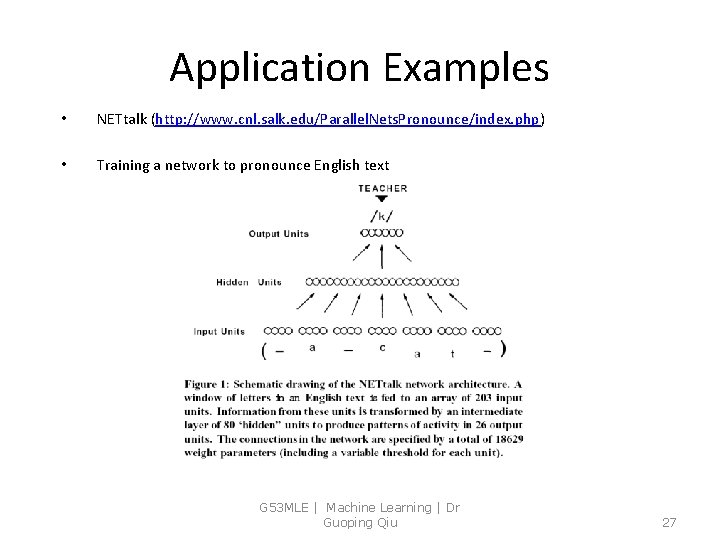
Application Examples • NETtalk (http: //www. cnl. salk. edu/Parallel. Nets. Pronounce/index. php) • Training a network to pronounce English text G 53 MLE | Machine Learning | Dr Guoping Qiu 27
Application Examples • NETtalk (http: //www. cnl. salk. edu/Parallel. Nets. Pronounce/index. php) • Training a network to pronounce English text – The input to the network: 7 consecutive characters from some written text, presented in a moving windows that gradually scanned the text – The desired output: A phoneme code which could be directed to a speech generator, given the pronunciation of the letter at the centre of the input window – The architecture: 7 x 29 inputs encoding 7 characters (including punctuation), 80 hidden units and 26 output units encoding phonemes. G 53 MLE | Machine Learning | Dr Guoping Qiu 28
Application Examples • NETtalk (http: //www. cnl. salk. edu/Parallel. Nets. Pronounce/index. php) • Training a network to pronounce English text – Training examples: 1024 words from a side-by-side English/phoneme source – – After 10 epochs, intelligible speech After 50 epochs, 95% accuracy – It first learned gross features such as the division points between words and gradually refines its discrimination, sounding rather like a child learning to talk G 53 MLE | Machine Learning | Dr Guoping Qiu 29
Application Examples • NETtalk (http: //www. cnl. salk. edu/Parallel. Nets. Pronounce/index. php) • Training a network to pronounce English text – Internal Representation: Some internal units were found to be representing meaningful properties of the input, such as the distinction between vowels and consonants. – Testing: After training, the network was tested on a continuation of the side-byside source, and achieved 78% accuracy on this generalization task, producing quite intelligible speech. – Damaging the network by adding random noise to the connection weights, or by removing some units, was found to degrade performance continuously (not catastrophically as expected for a digital computer), with a rather rapid recovery after retraining. G 53 MLE | Machine Learning | Dr Guoping Qiu 30
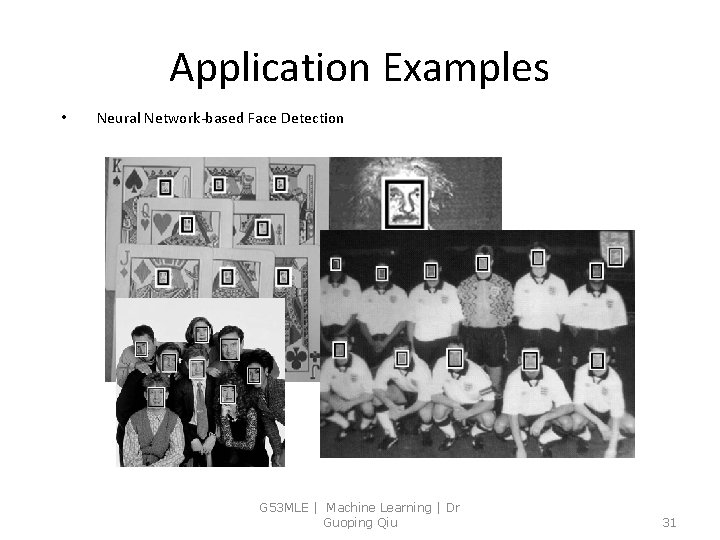
Application Examples • Neural Network-based Face Detection G 53 MLE | Machine Learning | Dr Guoping Qiu 31
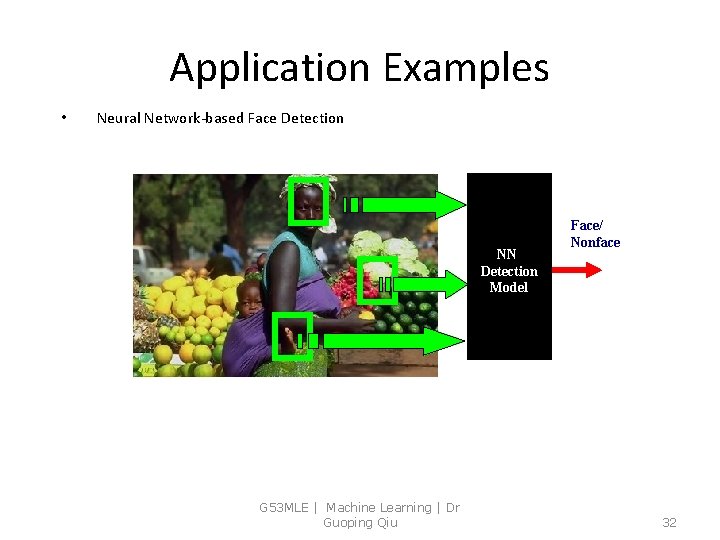
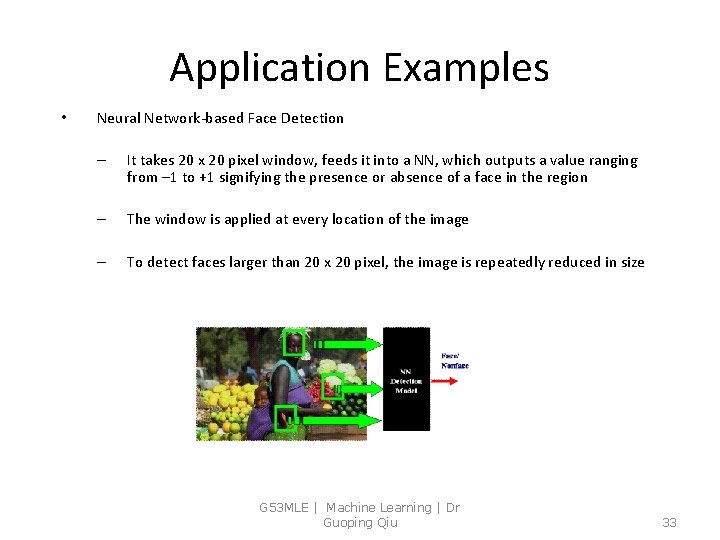
Application Examples • Neural Network-based Face Detection NN Detection Model G 53 MLE | Machine Learning | Dr Guoping Qiu Face/ Nonface 32
Application Examples • Neural Network-based Face Detection – It takes 20 x 20 pixel window, feeds it into a NN, which outputs a value ranging from – 1 to +1 signifying the presence or absence of a face in the region – The window is applied at every location of the image – To detect faces larger than 20 x 20 pixel, the image is repeatedly reduced in size G 53 MLE | Machine Learning | Dr Guoping Qiu 33
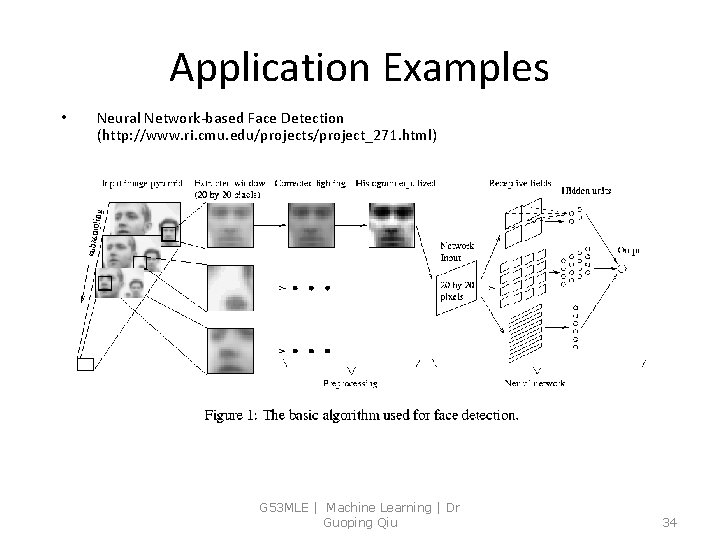
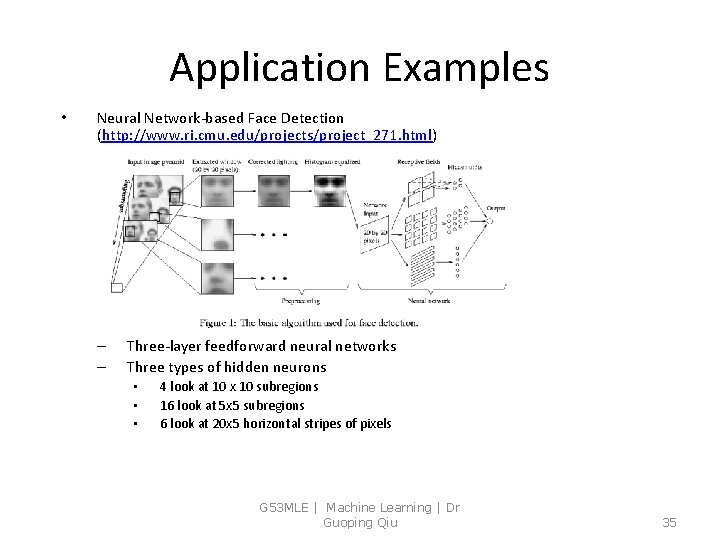
Application Examples • Neural Network-based Face Detection (http: //www. ri. cmu. edu/projects/project_271. html) G 53 MLE | Machine Learning | Dr Guoping Qiu 34
Application Examples • Neural Network-based Face Detection (http: //www. ri. cmu. edu/projects/project_271. html) – – Three-layer feedforward neural networks Three types of hidden neurons • • • 4 look at 10 x 10 subregions 16 look at 5 x 5 subregions 6 look at 20 x 5 horizontal stripes of pixels G 53 MLE | Machine Learning | Dr Guoping Qiu 35
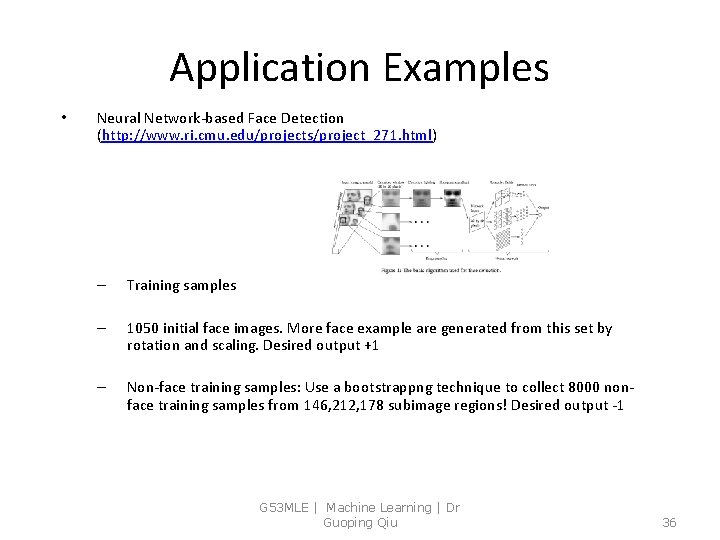
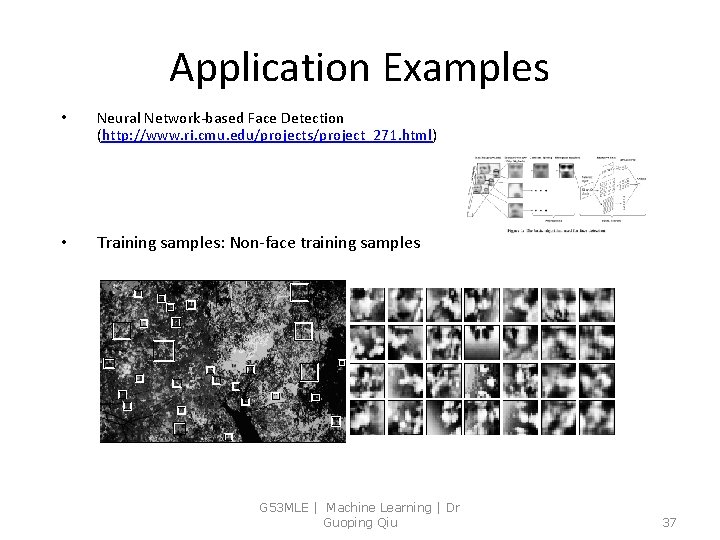
Application Examples • Neural Network-based Face Detection (http: //www. ri. cmu. edu/projects/project_271. html) – Training samples – 1050 initial face images. More face example are generated from this set by rotation and scaling. Desired output +1 – Non-face training samples: Use a bootstrappng technique to collect 8000 nonface training samples from 146, 212, 178 subimage regions! Desired output -1 G 53 MLE | Machine Learning | Dr Guoping Qiu 36
Application Examples • Neural Network-based Face Detection (http: //www. ri. cmu. edu/projects/project_271. html) • Training samples: Non-face training samples G 53 MLE | Machine Learning | Dr Guoping Qiu 37
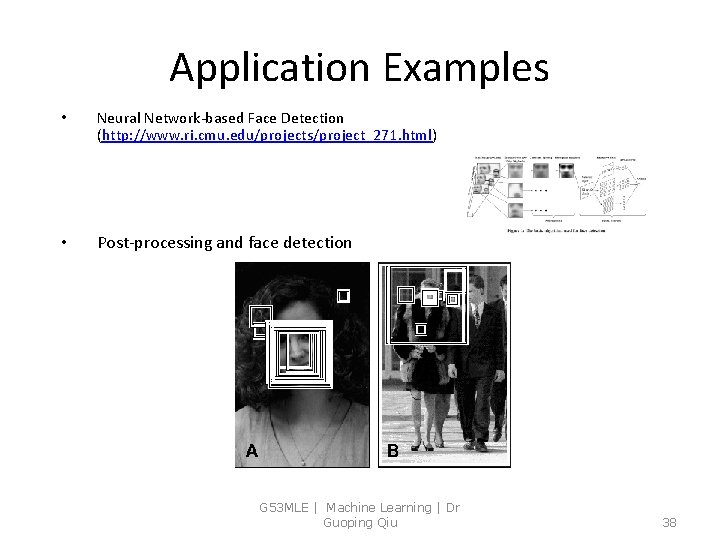
Application Examples • Neural Network-based Face Detection (http: //www. ri. cmu. edu/projects/project_271. html) • Post-processing and face detection G 53 MLE | Machine Learning | Dr Guoping Qiu 38
Application Examples • Neural Network-based Face Detection (http: //www. ri. cmu. edu/projects/project_271. html) – Results and Issues – – 77. % ~ 90. 3% detection rate (130 test images) Process 320 x 240 image in 2 – 4 seconds on a 200 MHz R 4400 SGI Indigo 2 G 53 MLE | Machine Learning | Dr Guoping Qiu 39
Further Readings 1. T. M. Mitchell, Machine Learning, Mc. Graw-Hill International Edition, 1997 Chapter 4 G 53 MLE | Machine Learning | Dr Guoping Qiu 40
Tutorial/Exercise Question 1. Assume that a system uses a three-layer perceptron neural network to recognize 10 hand-written digits: 0, 1, 2, 3, 4, 5, 6, 7, 8, 9. Each digit is represented by a 9 x 9 pixels binary image and therefore each sample is represented by an 81 -dimensional binary vector. The network uses 10 neurons in the output layer. Each of the output neurons signifies one of the digits. The network uses 120 hidden neurons. Each hidden neuron and output neuron also has a bias input. (i) (iii) (iv) How many connection weights does the network contain? For the training samples from each of the 10 digits, write down their possible corresponding desired output vectors. Describe briefly how the backprogation algorithm can be applied to train the network. Describe briefly how a trained network will be applied to recognize an unknown input. G 53 MLE | Machine Learning | Dr Guoping Qiu 41
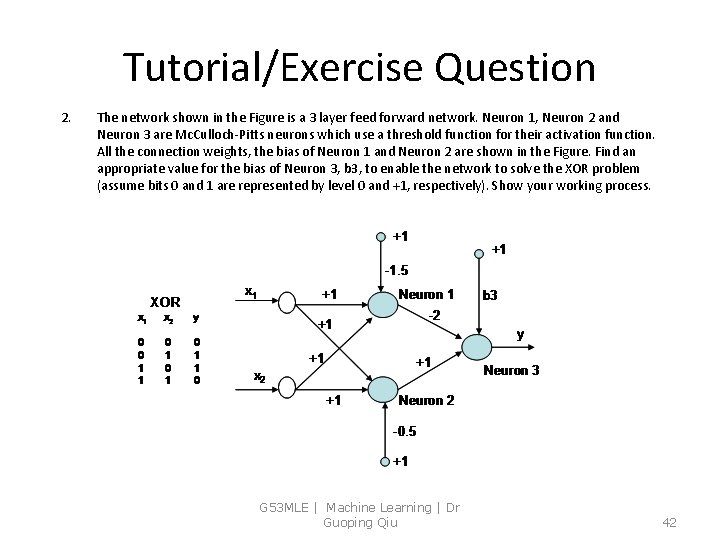
Tutorial/Exercise Question 2. The network shown in the Figure is a 3 layer feed forward network. Neuron 1, Neuron 2 and Neuron 3 are Mc. Culloch-Pitts neurons which use a threshold function for their activation function. All the connection weights, the bias of Neuron 1 and Neuron 2 are shown in the Figure. Find an appropriate value for the bias of Neuron 3, b 3, to enable the network to solve the XOR problem (assume bits 0 and 1 are represented by level 0 and +1, respectively). Show your working process. G 53 MLE | Machine Learning | Dr Guoping Qiu 42
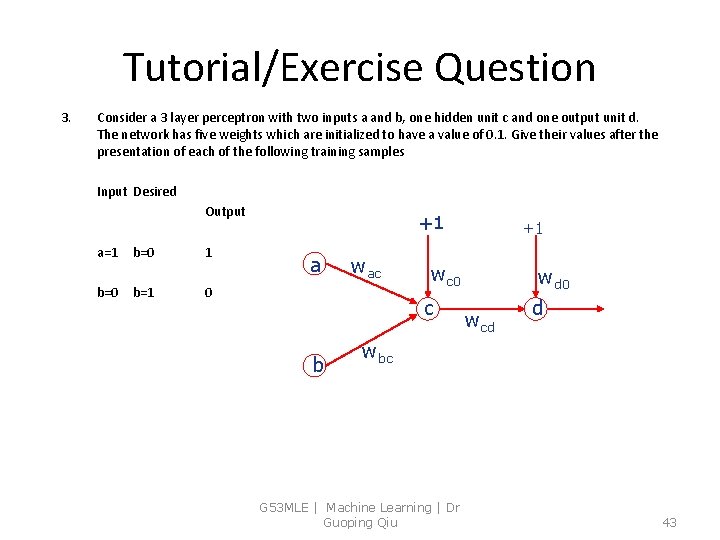
Tutorial/Exercise Question 3. Consider a 3 layer perceptron with two inputs a and b, one hidden unit c and one output unit d. The network has five weights which are initialized to have a value of 0. 1. Give their values after the presentation of each of the following training samples Input Desired Output a=1 b=0 b=1 1 +1 a wac 0 wc 0 c b +1 wd 0 wcd d wbc G 53 MLE | Machine Learning | Dr Guoping Qiu 43