
Machine Learning in SimulationBased Analysis LiC Wang Malgorzata
Machine Learning in Simulation-Based Analysis Li-C. Wang, Malgorzata Marek-Sadowska University of California, Santa Barbara 1
Synopsis Ø Simulation is a popular approach employed in many EDA applications Ø In this work, we explore the potential of using machine learning to improve simulation efficiency Ø While the work is developed based on specific simulation contexts, the concepts and ideas should be applicable to a generic simulation setting 2
Problem Setting 3
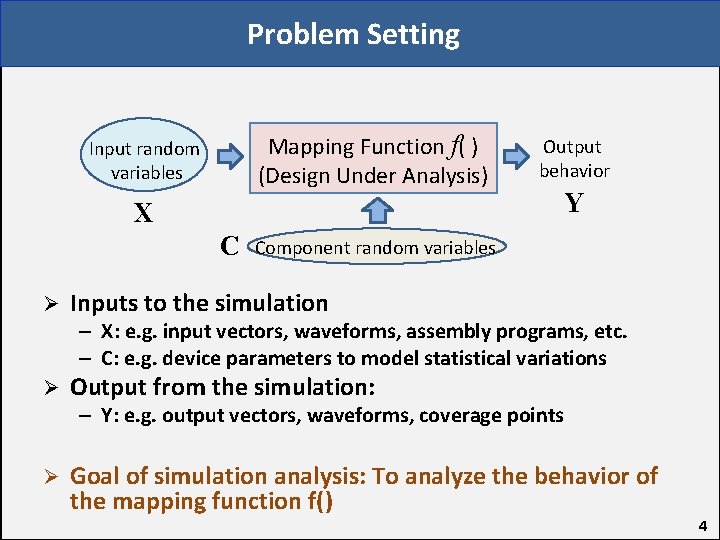
Problem Setting Mapping Function f( ) (Design Under Analysis) Input random variables Output behavior X C Ø Y Component random variables Inputs to the simulation – X: e. g. input vectors, waveforms, assembly programs, etc. – C: e. g. device parameters to model statistical variations Ø Output from the simulation: – Y: e. g. output vectors, waveforms, coverage points Ø Goal of simulation analysis: To analyze the behavior of the mapping function f() 4
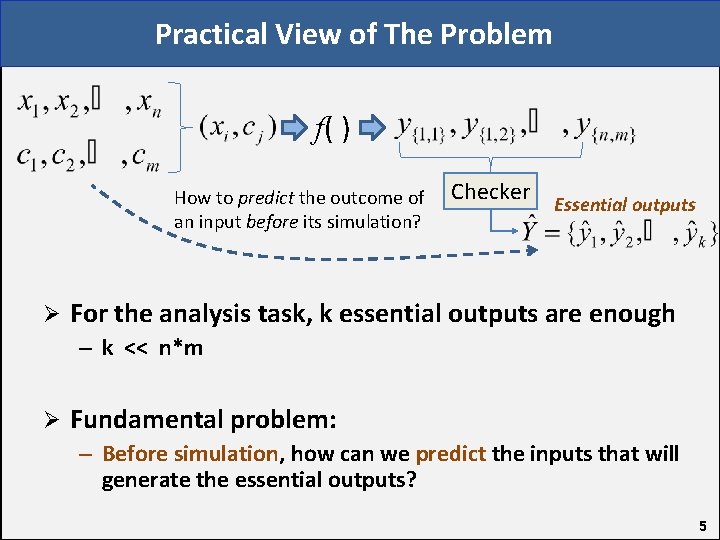
Practical View of The Problem f( ) How to predict the outcome of an input before its simulation? Ø Checker Essential outputs For the analysis task, k essential outputs are enough – k << n*m Ø Fundamental problem: – Before simulation, how can we predict the inputs that will generate the essential outputs? 5
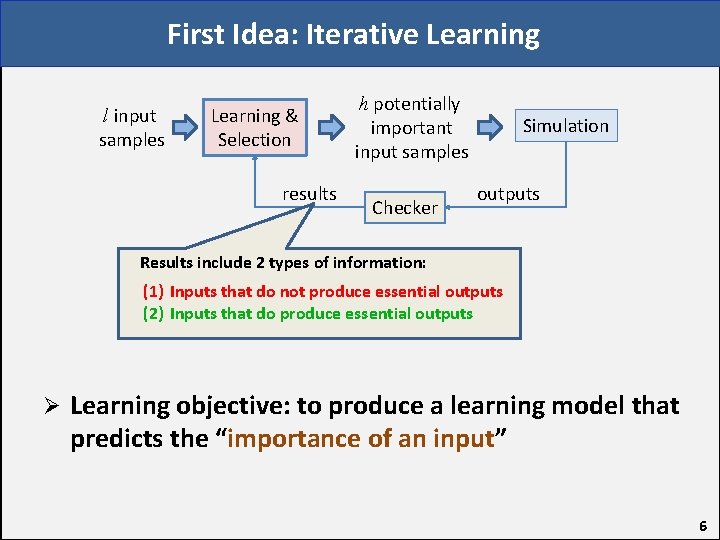
First Idea: Iterative Learning l input samples Learning & Selection results h potentially important input samples Checker Simulation outputs Results include 2 types of information: (1) Inputs that do not produce essential outputs (2) Inputs that do produce essential outputs Ø Learning objective: to produce a learning model that predicts the “importance of an input” 6
Machine Learning Concepts 7
For More Information Ø Tutorial on Data Mining in EDA & Test – IEEE CEDA Austin chapter tutorial – April 2014 – http: //mtv. ece. ucsb. edu/licwang/PDF/CEDA-Tutorial-April -2014. pdf Ø Tutorial papers – “Data Mining in EDA” – DAC 2014 • Overview and include a list of references to our prior works – “Data Mining in Functional Debug” – ICCAD 2014 – “Data Mining in Functional Test Content Optimization” – ASP DAC 2015 n. Vidia talk, Li-C. Wang at 3/27/15 8
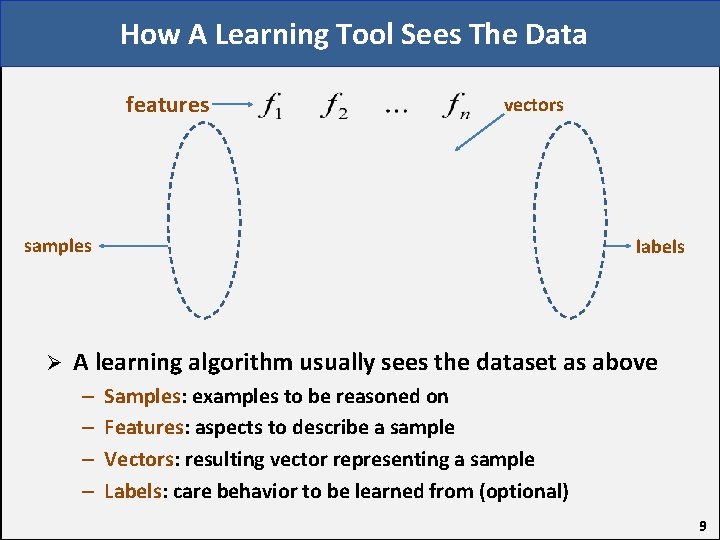
How A Learning Tool Sees The Data features vectors samples Ø labels A learning algorithm usually sees the dataset as above – – Samples: examples to be reasoned on Features: aspects to describe a sample Vectors: resulting vector representing a sample Labels: care behavior to be learned from (optional) 9

Supervised Learning (features) Labels Ø Classification – Labels represent classes (e. g. +1, -1: binary classes) Ø Regression – Labels are some numerical values (e. g. frequencies) 10
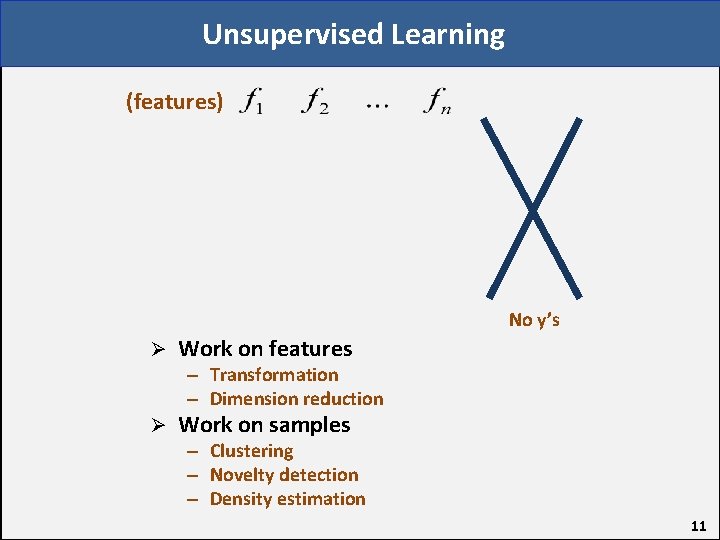
Unsupervised Learning (features) No y’s Ø Work on features – Transformation – Dimension reduction Ø Work on samples – Clustering – Novelty detection – Density estimation 11
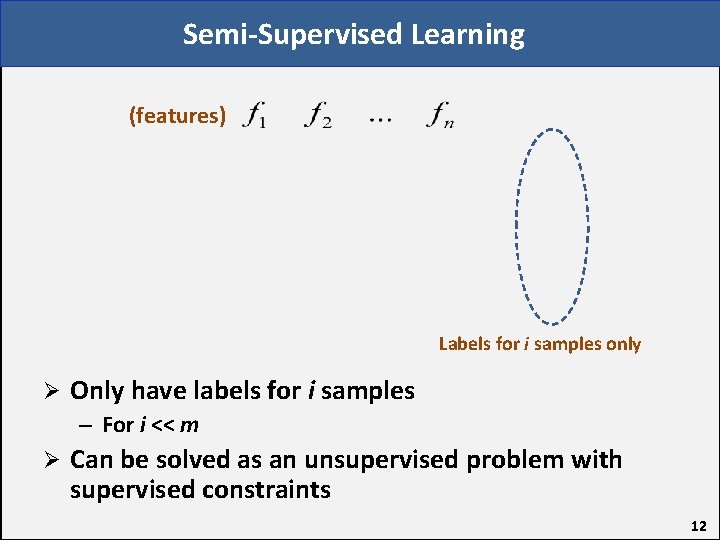
Semi-Supervised Learning (features) Labels for i samples only Ø Only have labels for i samples – For i << m Ø Can be solved as an unsupervised problem with supervised constraints 12
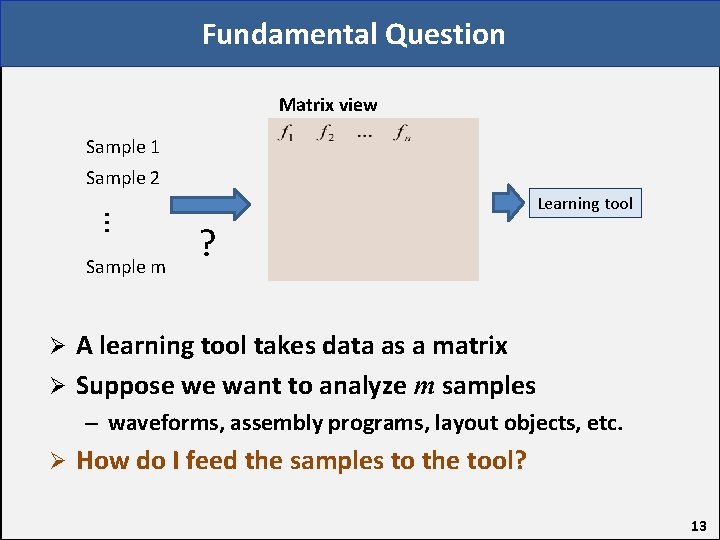
Fundamental Question Matrix view Sample 1 Sample 2 … Sample m Learning tool ? A learning tool takes data as a matrix Ø Suppose we want to analyze m samples Ø – waveforms, assembly programs, layout objects, etc. Ø How do I feed the samples to the tool? 13
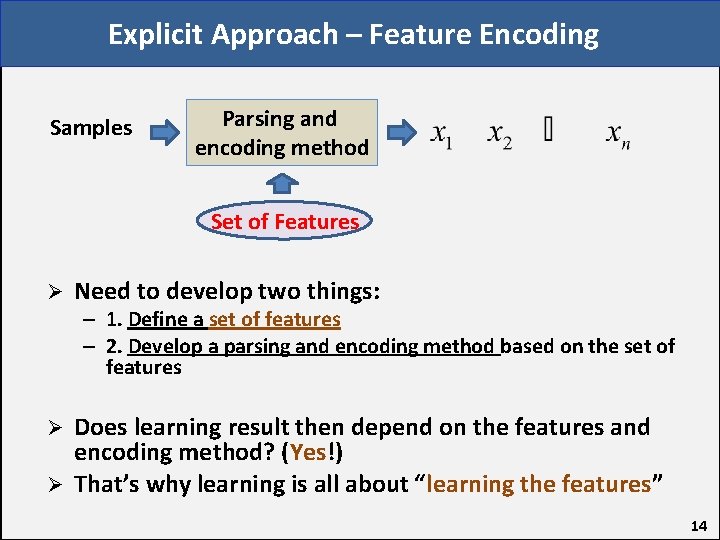
Explicit Approach – Feature Encoding Samples Parsing and encoding method Set of Features Ø Need to develop two things: – 1. Define a set of features – 2. Develop a parsing and encoding method based on the set of features Does learning result then depend on the features and encoding method? (Yes!) Ø That’s why learning is all about “learning the features” Ø 14
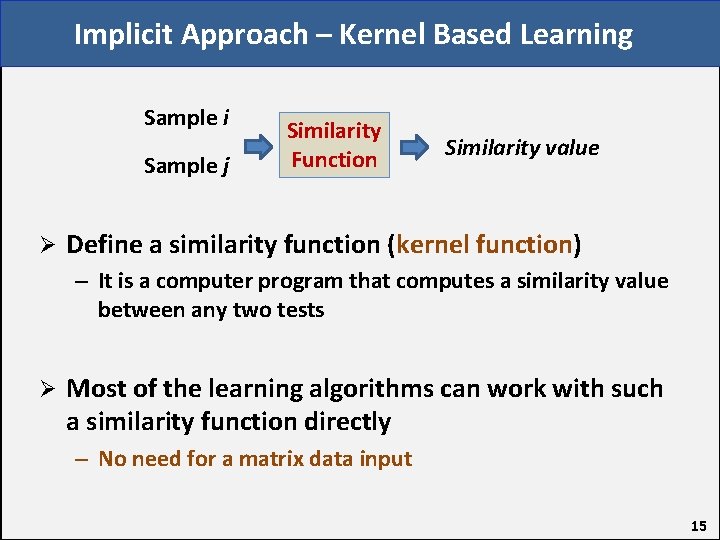
Implicit Approach – Kernel Based Learning Sample i Sample j Ø Similarity Function Similarity value Define a similarity function (kernel function) – It is a computer program that computes a similarity value between any two tests Ø Most of the learning algorithms can work with such a similarity function directly – No need for a matrix data input 15
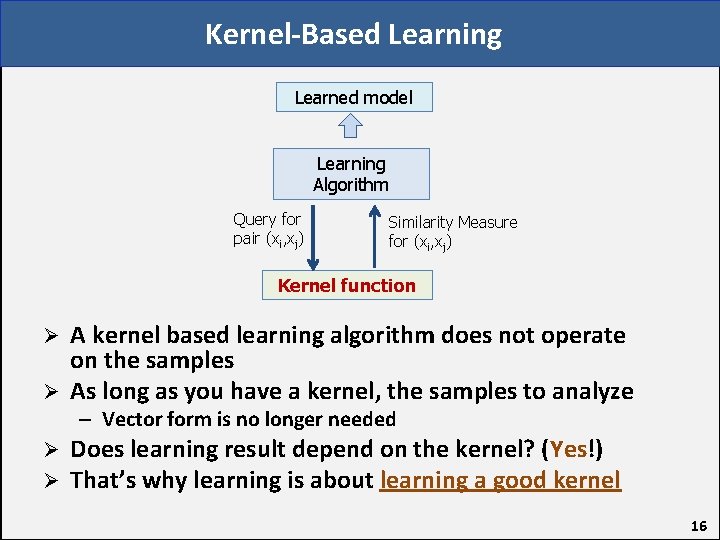
Kernel-Based Learning Learned model Learning Algorithm Query for pair (xi, xj) Similarity Measure for (xi, xj) Kernel function A kernel based learning algorithm does not operate on the samples Ø As long as you have a kernel, the samples to analyze Ø – Vector form is no longer needed Ø Ø Does learning result depend on the kernel? (Yes!) That’s why learning is about learning a good kernel 16
Example: RTL Simulation Context 17
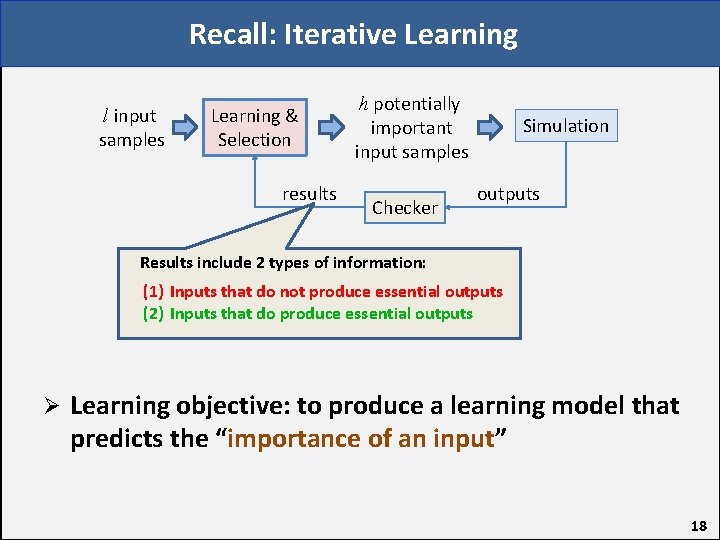
Recall: Iterative Learning l input samples Learning & Selection results h potentially important input samples Checker Simulation outputs Results include 2 types of information: (1) Inputs that do not produce essential outputs (2) Inputs that do produce essential outputs Ø Learning objective: to produce a learning model that predicts the “importance of an input” 18
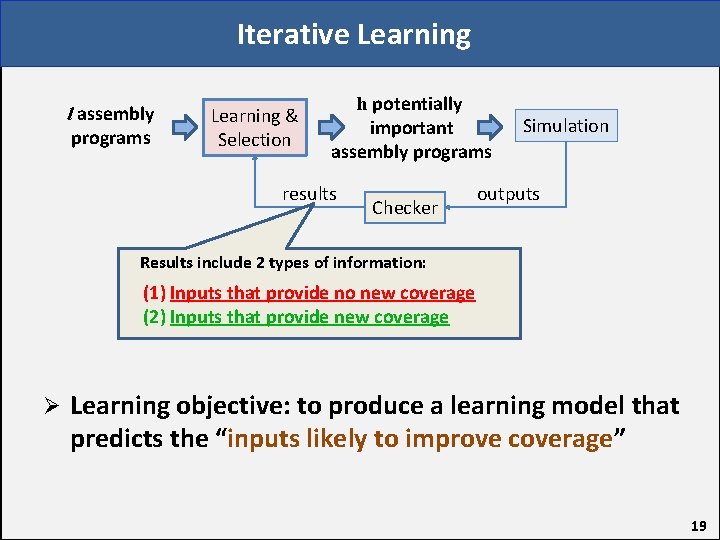
Iterative Learning l assembly programs Learning & Selection h potentially important assembly programs results Checker Simulation outputs Results include 2 types of information: (1) Inputs that provide no new coverage (2) Inputs that provide new coverage Ø Learning objective: to produce a learning model that predicts the “inputs likely to improve coverage” 19
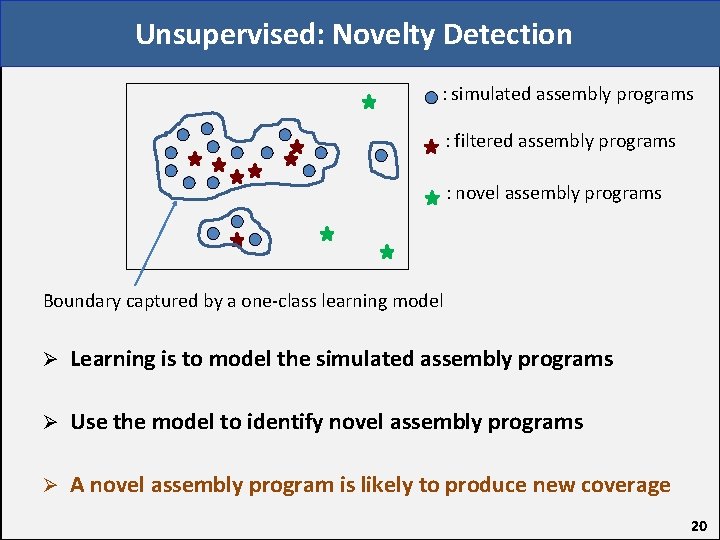
Unsupervised: Novelty Detection : simulated assembly programs : filtered assembly programs : novel assembly programs Boundary captured by a one-class learning model Ø Learning is to model the simulated assembly programs Ø Use the model to identify novel assembly programs Ø A novel assembly program is likely to produce new coverage 20
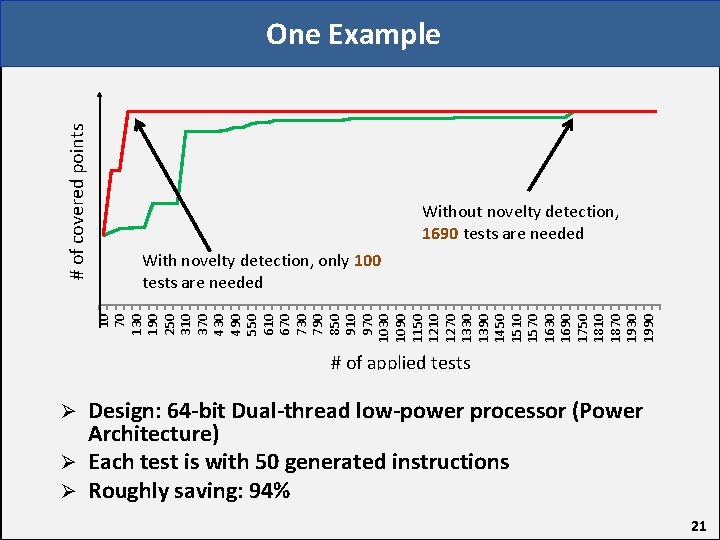
Without novelty detection, 1690 tests are needed With novelty detection, only 100 tests are needed 10 70 130 190 250 310 370 430 490 550 610 670 730 790 850 910 970 1030 1090 1150 1210 1270 1330 1390 1450 1510 1570 1630 1690 1750 1810 1870 1930 1990 # of covered points One Example # of applied tests Design: 64 -bit Dual-thread low-power processor (Power Architecture) Ø Each test is with 50 generated instructions Ø Roughly saving: 94% Ø 21
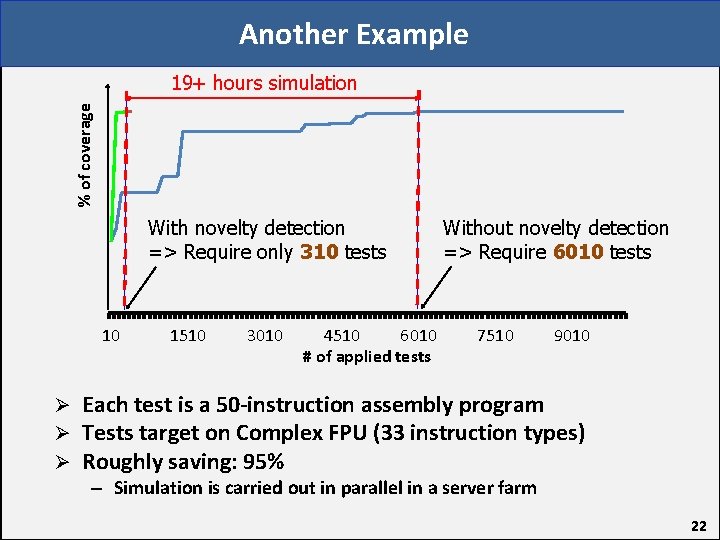
Another Example % of coverage 19+ hours simulation With novelty detection => Require only 310 tests 10 Ø Ø Ø 1510 3010 4510 6010 # of applied tests Without novelty detection => Require 6010 tests 7510 9010 Each test is a 50 -instruction assembly program Tests target on Complex FPU (33 instruction types) Roughly saving: 95% – Simulation is carried out in parallel in a server farm 22
Example: SPICE Simulation Context (Include C Variations) 23
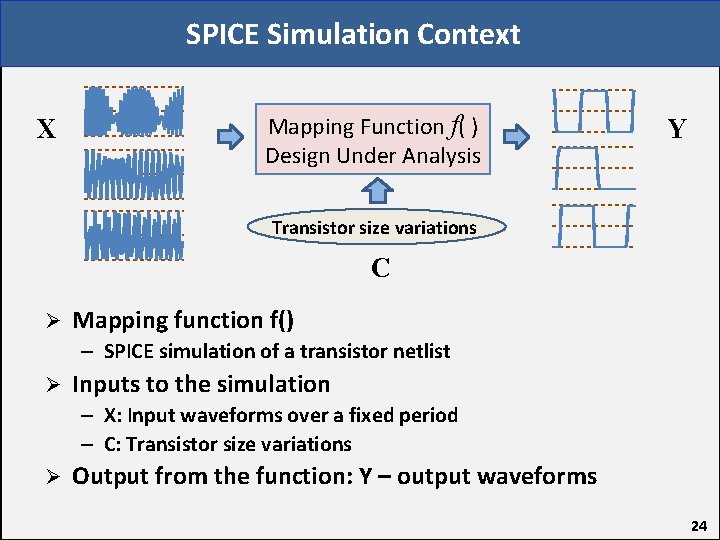
SPICE Simulation Context X Mapping Function f( ) Design Under Analysis Y Transistor size variations C Ø Mapping function f() – SPICE simulation of a transistor netlist Ø Inputs to the simulation – X: Input waveforms over a fixed period – C: Transistor size variations Ø Output from the function: Y – output waveforms 24
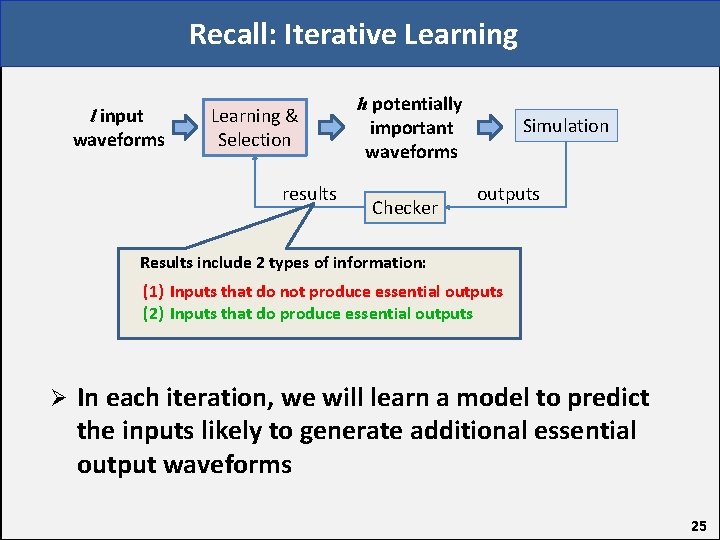
Recall: Iterative Learning l input waveforms Learning & Selection results h potentially important waveforms Checker Simulation outputs Results include 2 types of information: (1) Inputs that do not produce essential outputs (2) Inputs that do produce essential outputs Ø In each iteration, we will learn a model to predict the inputs likely to generate additional essential output waveforms 25
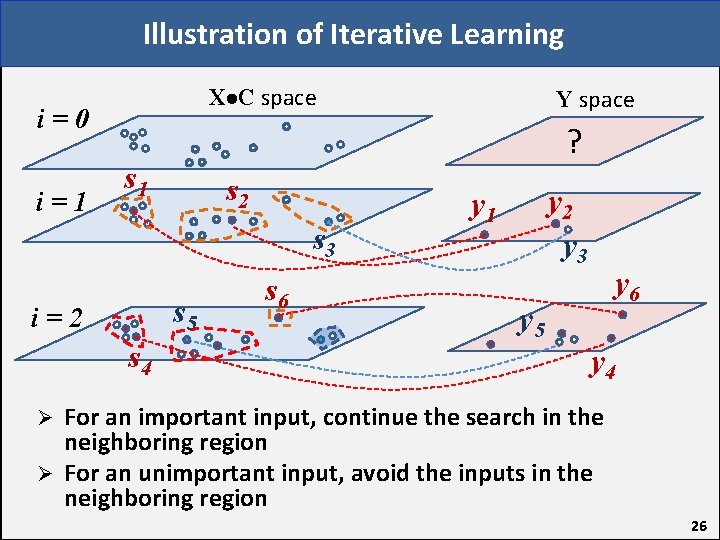
Illustration of Iterative Learning X C space i=0 i=1 ? s 1 s 2 s 3 s 5 i=2 s 4 Y space s 6 y 2 y 3 y 1 y 6 y 5 y 4 For an important input, continue the search in the neighboring region Ø For an unimportant input, avoid the inputs in the neighboring region Ø 26
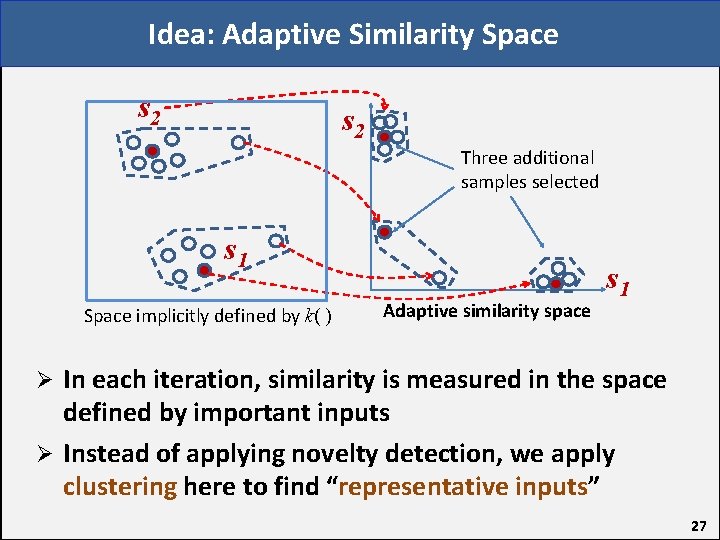
Idea: Adaptive Similarity Space s 2 Three additional samples selected s 1 Space implicitly defined by k( ) Adaptive similarity space s 1 In each iteration, similarity is measured in the space defined by important inputs Ø Instead of applying novelty detection, we apply clustering here to find “representative inputs” Ø 27
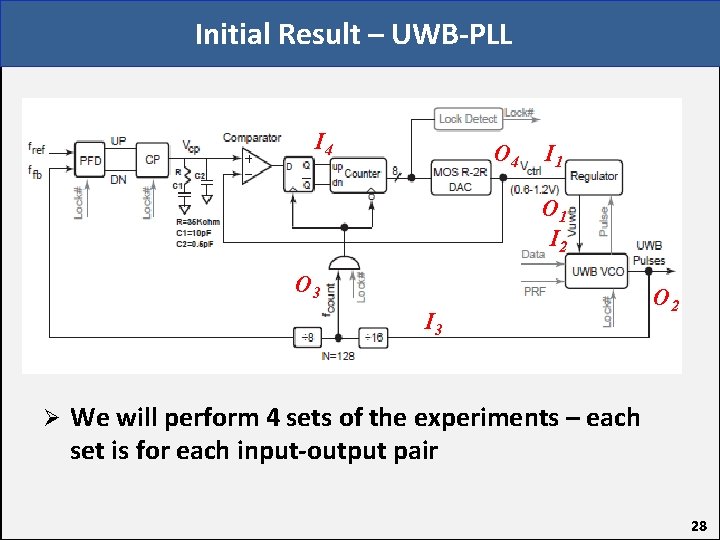
Initial Result – UWB-PLL I 4 O 4 I 1 O 1 I 2 O 3 I 3 Ø O 2 We will perform 4 sets of the experiments – each set is for each input-output pair 28
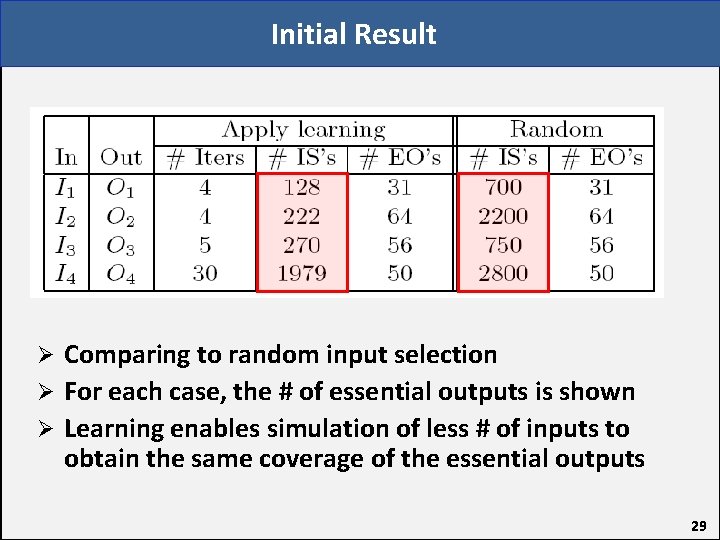
Initial Result Comparing to random input selection Ø For each case, the # of essential outputs is shown Ø Learning enables simulation of less # of inputs to obtain the same coverage of the essential outputs Ø 29
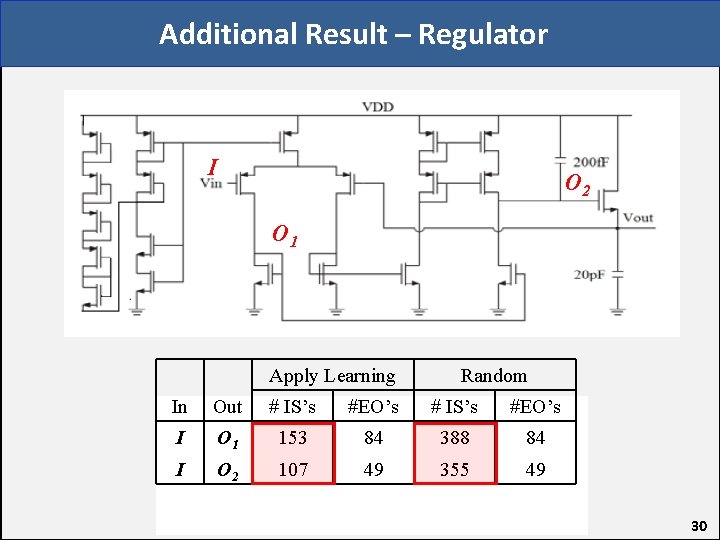
Additional Result – Regulator I O 2 O 1 Apply Learning Random In Out # IS’s #EO’s I O 1 153 84 388 84 I O 2 107 49 355 49 30
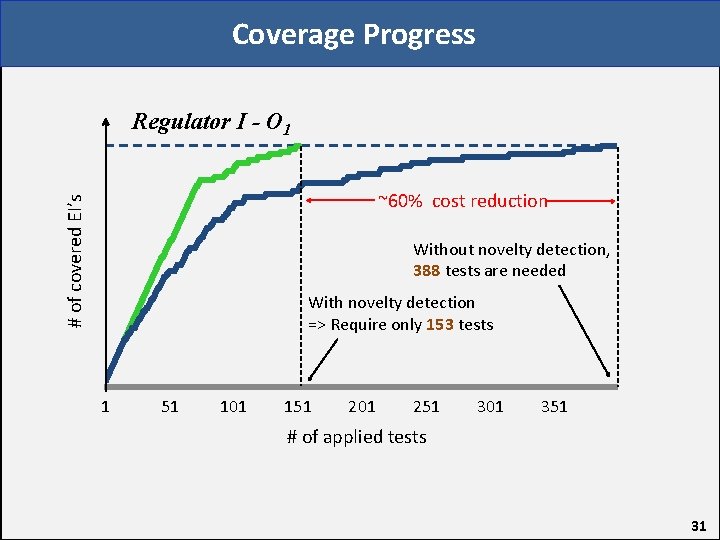
Coverage Progress Regulator I - O 1 # of covered EI’s ~60% cost reduction Without novelty detection, 388 tests are needed With novelty detection => Require only 153 tests 1 51 101 151 201 251 301 351 # of applied tests 31
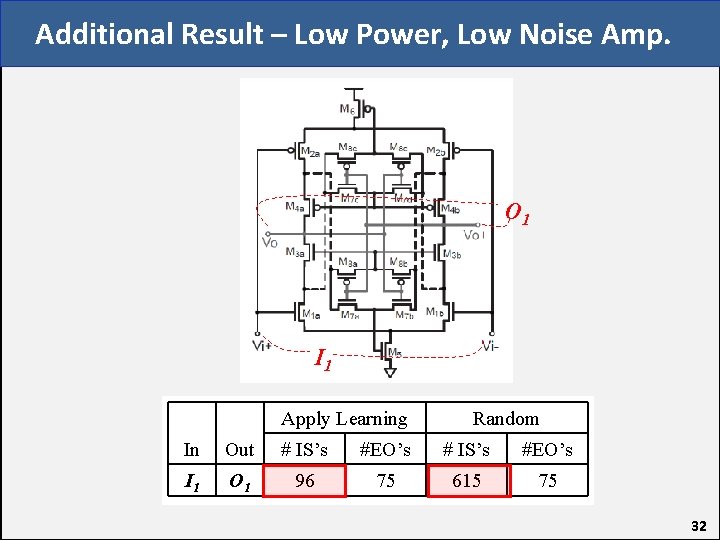
Additional Result – Low Power, Low Noise Amp. O 1 I 1 Apply Learning Random In Out # IS’s #EO’s I 1 O 1 96 75 615 75 32
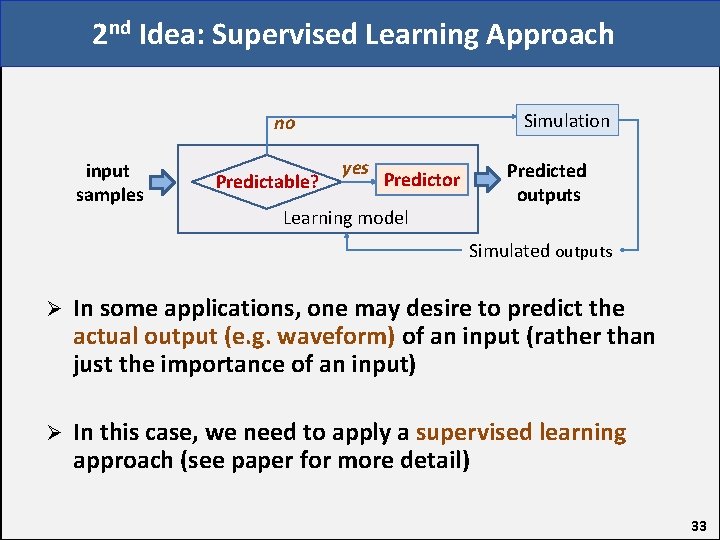
2 nd Idea: Supervised Learning Approach Simulation no input samples Predictable? yes Predictor Learning model Predicted outputs Simulated outputs Ø In some applications, one may desire to predict the actual output (e. g. waveform) of an input (rather than just the importance of an input) Ø In this case, we need to apply a supervised learning approach (see paper for more detail) 33
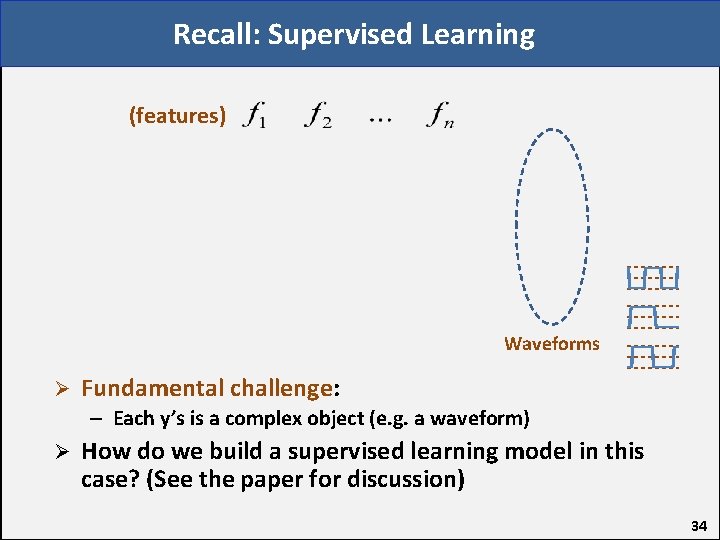
Recall: Supervised Learning (features) Waveforms Ø Fundamental challenge: – Each y’s is a complex object (e. g. a waveform) Ø How do we build a supervised learning model in this case? (See the paper for discussion) 34
Conclusion Ø Machine learning provides viable approaches for improving simulation efficiency in EDA applications Ø Keep in mind: Learning is about learning – The features, or – The kernel function Ø The proposed learning approaches are generic and can be applied to diverse simulation contexts Ø We are developing theories and concepts – (1) for learning the kernel – (2) for predicting the complex output objects 35
Thank you Questions? 36
- Slides: 36