
Machine Learning for Cyber Unit Data Sets and

Machine Learning for Cyber Unit : Data Sets and Features This document is licensed with a Creative Commons Attribution 4. 0 International License © 2017
Learning Outcomes Upon completion of this unit: • Students will have a better understanding of features for machine learning. • Students will have a better understanding of how to extract features. This document is licensed with a Creative Commons Attribution 4. 0 International License © 2017
Data sets • Data sets are central to machine learning • The algorithms are data hungry • What is better have? • The most powerful machine learning algorithm and small amounts of poor data • Or • Lots of good data even if our algorithm is not the best • Data is king! • Why have companies like Facebook, google, etc. do so well? • Because all of you that have social media feed them new data all the time and you even annotate it for them by labeling it with likes, etc. This document is licensed with a Creative Commons Attribution 4. 0 International License © 2017
Difference • What is the difference between a regular data science class and a data science class for cyber security • The data • Everything else is the same. The machine learning algorithms do not really change • What Changes is the how the data is represented or converted to features, samples, classes, etc. • In this, module we will explore data sets. This document is licensed with a Creative Commons Attribution 4. 0 International License © 2017
Characteristics of data sets • When thinking of a data set, think in terms of a matrix • Rows => samples • Columns => features Matrix_data = np. loadtxt(dataset, delimiter= “ , ” , skiprows=1) X = Matrix_data[ : , : 4] y = Matrix_data[ : , 4] This document is licensed with a Creative Commons Attribution 4. 0 International License © 2017
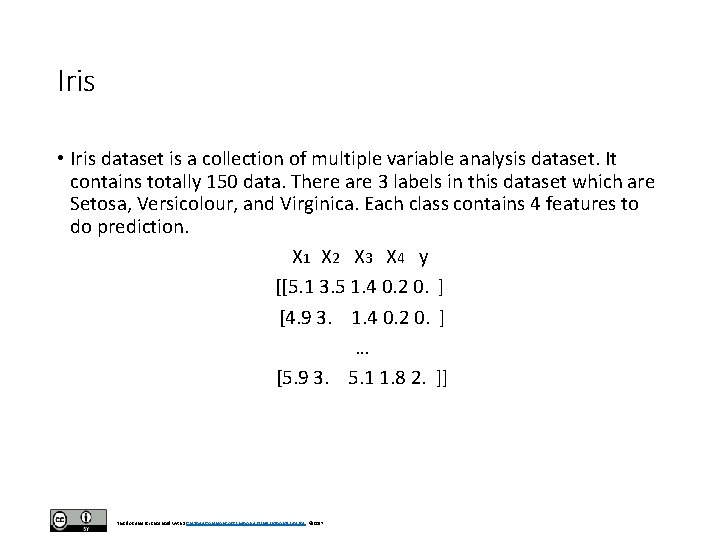
Iris • Iris dataset is a collection of multiple variable analysis dataset. It contains totally 150 data. There are 3 labels in this dataset which are Setosa, Versicolour, and Virginica. Each class contains 4 features to do prediction. X 1 X 2 X 3 X 4 y [[5. 1 3. 5 1. 4 0. 2 0. ] [4. 9 3. 1. 4 0. 2 0. ] … [5. 9 3. 5. 1 1. 8 2. ]] This document is licensed with a Creative Commons Attribution 4. 0 International License © 2017
Text Data set • Phishing Websites Data Set: • Phishing Dataset This document is licensed with a Creative Commons Attribution 4. 0 International License © 2017
Images data set This document is licensed with a Creative Commons Attribution 4. 0 International License © 2017

Speech This document is licensed with a Creative Commons Attribution 4. 0 International License © 2017
NSL-KDD • Network intrusion This document is licensed with a Creative Commons Attribution 4. 0 International License © 2017
UNSW big data • Network This document is licensed with a Creative Commons Attribution 4. 0 International License © 2017

Phishing This document is licensed with a Creative Commons Attribution 4. 0 International License © 2017
Honeypot unsupervised This document is licensed with a Creative Commons Attribution 4. 0 International License © 2017

Malware This document is licensed with a Creative Commons Attribution 4. 0 International License © 2017
Fraud Detection This document is licensed with a Creative Commons Attribution 4. 0 International License © 2017
Biometrics This document is licensed with a Creative Commons Attribution 4. 0 International License © 2017
What are features? • Ways to represent a sample • Vector space model This document is licensed with a Creative Commons Attribution 4. 0 International License © 2017
Types of features • Binary • Continuous This document is licensed with a Creative Commons Attribution 4. 0 International License © 2017
Dimensionality • Number of features determines dimensionality This document is licensed with a Creative Commons Attribution 4. 0 International License © 2017
• Machine Learning (ML) is essential for automated systems to make decisions and to infer new knowledge about the world. • Machine learning approaches can be divided into • supervised learning (such as Support Vector Machines) • unsupervised learning (such as K-means clustering). This document is licensed with a Creative Commons Attribution 4. 0 International License © 2017
Within supervised approaches • Within supervised approaches, the learning methodologies can be divided based on whether they • predict a class (into classifiers ) • or a magnitude (and regression models) This document is licensed with a Creative Commons Attribution 4. 0 International License © 2017
• An additional categorization for these methods depends on whether they use • sequential • or non-sequential data. This document is licensed with a Creative Commons Attribution 4. 0 International License © 2017
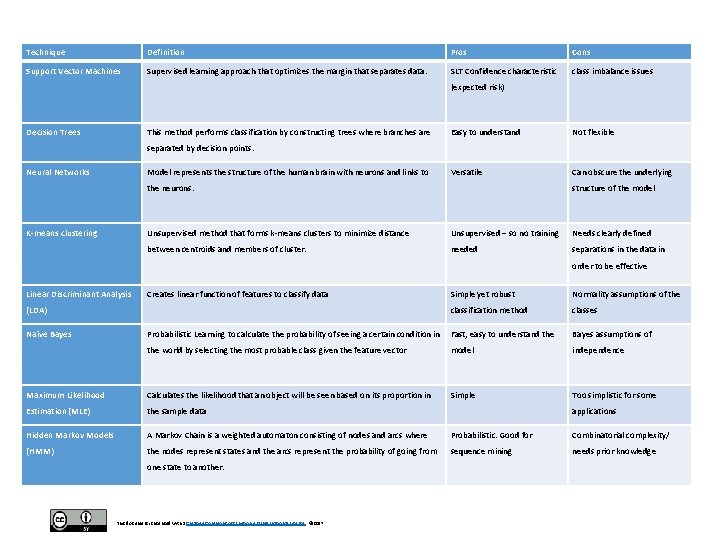
Technique Definition Pros Cons Support Vector Machines Supervised learning approach that optimizes the margin that separates data. SLT Confidence characteristic class imbalance issues (expected risk) Decision Trees This method performs classification by constructing trees where branches are Easy to understand Not flexible Versatile Can obscure the underlying separated by decision points. Neural Networks Model represents the structure of the human brain with neurons and links to the neurons. K-means clustering structure of the model Unsupervised method that forms k-means clusters to minimize distance Unsupervised – so no training Needs clearly defined between centroids and members of cluster. needed separations in the data in order to be effective Linear Discriminant Analysis Creates linear function of features to classify data Simple yet robust Normality assumptions of the classification method classes Probabilistic Learning to calculate the probability of seeing a certain condition in Fast, easy to understand the Bayes assumptions of the world by selecting the most probable class given the feature vector model independence Maximum Likelihood Calculates the likelihood that an object will be seen based on its proportion in Simple Too simplistic for some Estimation (MLE) the sample data Hidden Markov Models A Markov Chain is a weighted automaton consisting of nodes and arcs where Probabilistic. Good for Combinatorial complexity/ (HMM) the nodes represent states and the arcs represent the probability of going from sequence mining needs prior knowledge (LDA) Naïve Bayes one state to another. This document is licensed with a Creative Commons Attribution 4. 0 International License © 2017 applications
A few ML algorithms • Classifiers are machine learning approaches that produce as an output a specific class given some input features. • Important classifiers include: • Support Vector Machines (Burges 1998) commonly implemented using Lib. SVM (Chang and Lin, 2001) • Naïve Bayes • artificial neural networks • deep learning based neural networks • decision trees • random forests • k-nearest neighbor classifier This document is licensed with a Creative Commons Attribution 4. 0 International License © 2017
deep learning • deep learning based methods are simply neural nets with more layers. • Deep learning methods have made a big impact in the field of machine learning in recent years. • given enough computational power, they can automatically learn the optimal features to be used in a classification problem. This document is licensed with a Creative Commons Attribution 4. 0 International License © 2017
Feature Engineering • In the past, learning what features to use required using humans to engineer the features. • This issue has now been alleviated somewhat by deep learning. • Revolutionized the industry This document is licensed with a Creative Commons Attribution 4. 0 International License © 2017
• Additionally, artificial neural networks are classifiers that can handle non-linearly separable data. • In theory, this capability allows them to model data that may be more difficult to classify. This document is licensed with a Creative Commons Attribution 4. 0 International License © 2017
Libraries • • • • import numpy as np from sklearn import datasets from sklearn. cross_validation import train_test_split from sklearn. preprocessing import Standard. Scaler from sklearn. metrics import accuracy_score from matplotlib. colors import Listed. Colormap import matplotlib. pyplot as plt from sklearn. metrics import confusion_matrix from sklearn. metrics import precision_score from sklearn. metrics import recall_score, f 1_score import pandas as pd from sklearn. preprocessing import Label. Encoder from sklearn import decomposition This document is licensed with a Creative Commons Attribution 4. 0 International License © 2017
SKlearn library • SKlearn library is the main library which contains most of the traditional machine learning tools we will • The numpy library is essential for efficient matrix and linear algebra operations. • For those with experience with Mat. Lab, I can say that numpy is a way of performing linear algebra operations in python similar to how they are done in Mat. Lab. • This makes the code more efficient in its implementation and faster as well. • The datasets library helps to obtain standard corpora. You can use it to obtain annotated data like Fisher’s iris data set, for instance. This document is licensed with a Creative Commons Attribution 4. 0 International License © 2017
• sklearn. cross_validation we can import train_test_split which is used to create splits in a data matrix such as 70% for training purposes and 30% for testing purposes. • From sklearn. preprocessing we can import the Standard. Scaler module which helps to scale feature data. • We will use functions such as these to scale our data for the Tensorflow based classifiers. • Deep learning algorithms can improve significantly when data is properly scaled. So, it is recommended to do this. This document is licensed with a Creative Commons Attribution 4. 0 International License © 2017
• Two more very important libraries are matplotlib. pyplot and pandas. • The matplotlib. pyplot library is very useful for visualization of data and results and the pandas library is very useful for pre-processing. • The pandas library can be very useful to pre-process large data sets in very fast and very efficient ways. • There are some parameters that are sometimes useful to set in your code. • The code sample below shows the use of np. set_printoptions. • The function is used to print all values in a numpy array. • This can be useful when trying to visualize the contents of a large data set. This document is licensed with a Creative Commons Attribution 4. 0 International License © 2017
• ## set parameters • np. set_printoptions(threshold=np. inf) ## print all values in numpy array This document is licensed with a Creative Commons Attribution 4. 0 International License © 2017
Splitting the data • Let us assume that our data is stored in the matrix X. • The code segment below uses the function train_test_split. • This function is used to split a data set (in this case X) into 4 sets which are X_train, X_test, y_train, y_test. • These are the 4 sets that will be used by the traditional classifiers or the deep learning classifiers. • The sets that start with X hold the data (feature vectors) and the sets that start with y hold the labels per sample (e. g. y 1 for the first feature vector, y 2 for the second feature vector, and so on). This document is licensed with a Creative Commons Attribution 4. 0 International License © 2017
Split size • The values test_size=0. 01 and random_state=42 in the function are parameters that define the split. • The value 0. 01 makes a train set that has 99% of all samples while the test set has 1% of all samples. • In contrast test_size=0. 20 would mean that there is a 80% and 20% split. • The random_state=42 allows you to always get the same random data since the seed is defined as 42. This document is licensed with a Creative Commons Attribution 4. 0 International License © 2017
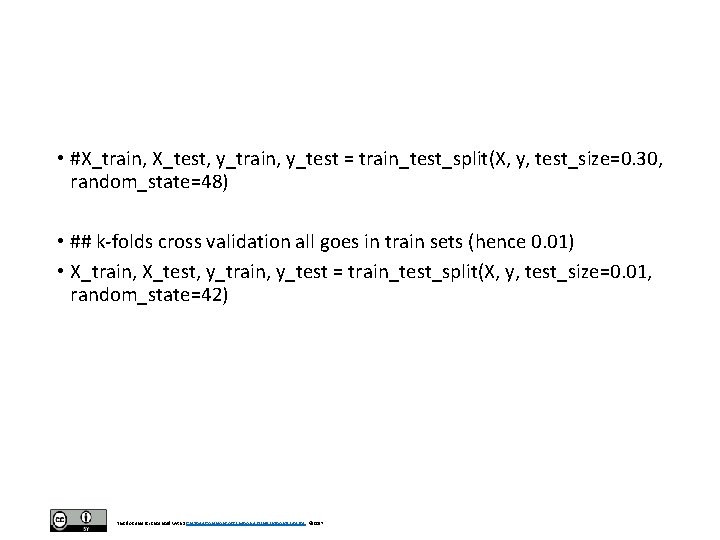
• #X_train, X_test, y_train, y_test = train_test_split(X, y, test_size=0. 30, random_state=48) • ## k-folds cross validation all goes in train sets (hence 0. 01) • X_train, X_test, y_train, y_test = train_test_split(X, y, test_size=0. 01, random_state=42) This document is licensed with a Creative Commons Attribution 4. 0 International License © 2017
• To call the functions or classifiers you can employ the following approach. • Here we have defined 5 common classifiers. • Notice that each one gets the 4 data sets obtained from the percentage split. • Notice also that the data files have a _normalized added to their name. • This is a good standard approach used by programmers to indicate that this data has been scaled. • The next chapter addresses scaling. Here you run X_train through a scaler function to obtain X_train_normalized. • The labels (y) are not scaled. This document is licensed with a Creative Commons Attribution 4. 0 International License © 2017
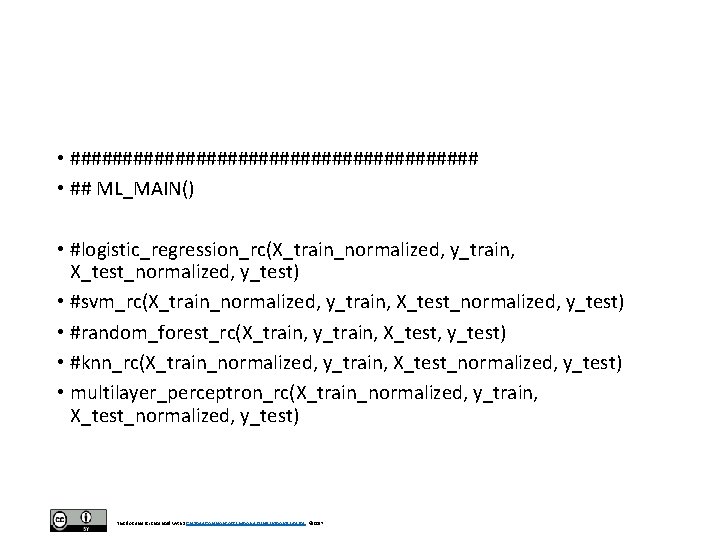
• #################### • ## ML_MAIN() • #logistic_regression_rc(X_train_normalized, y_train, X_test_normalized, y_test) • #svm_rc(X_train_normalized, y_train, X_test_normalized, y_test) • #random_forest_rc(X_train, y_train, X_test, y_test) • #knn_rc(X_train_normalized, y_train, X_test_normalized, y_test) • multilayer_perceptron_rc(X_train_normalized, y_train, X_test_normalized, y_test) This document is licensed with a Creative Commons Attribution 4. 0 International License © 2017
Optimization • Before we begin to discuss some of the machine learning algorithms, I should say something about optimization. • Optimization is a key process in machine learning. • Basically, any supervised learning algorithm needs to learn a prediction equation given a set of annotated data. • This prediction function usually has a set of parameters that must be learned. • However, the question is “how do you learn these parameters? ” • The answer is that you do so through optimization. This document is licensed with a Creative Commons Attribution 4. 0 International License © 2017
• In its simplest form, optimization consists of trying a set of parameters with your model and seeing what result they give you. • If the result is not good, the optimization algorithm needs to decide if you should decrease the values of the parameters or increase the values of the parameters. • In general, you do this in a loop (increasing and decreasing) until you find an optimal set of parameters. • But one of the questions to answer here is: do the values go up or down? • Well, as it turns out, there are methodologies based on calculus that help you to make this decision. This document is licensed with a Creative Commons Attribution 4. 0 International License © 2017
Optimization graph This document is licensed with a Creative Commons Attribution 4. 0 International License © 2017
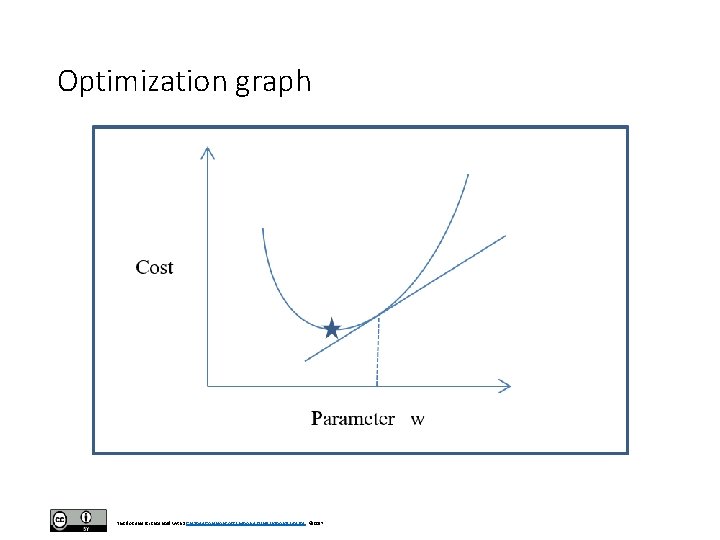
• The above graph represents an optimization problem. • The y axis represents the cost (or penalty) of using a given parameter. • The x axis represents the value of the parameter (w) being used at the given iteration. • The curve represents the behavior that the function being used to minime the cost will follow for every value of parameter w. This document is licensed with a Creative Commons Attribution 4. 0 International License © 2017
• As shown in the graph, the optimal value for the curve is found where the star is located (i. e where the value of cost is at a minimum). • So, somehow the optimization algorithm needs to travel through the function and arrive at the position indicated by the star. • At that point, the value of “w” reduces the cost and finds the best solution. • Instead of trying all values of “w” at random, the algorithm can make educated guesses about which direction to follow (up or down). • To do this, we can use calculus to calculate the derivative of the function at a given point. • This will allow us to determine the slope at that point. This document is licensed with a Creative Commons Attribution 4. 0 International License © 2017
• In the case of the graph, this represents the tangent line to the curve if we calculate the derivative at point w. • If we calculate the slope at the position of the star symbol, then the slope is zero because the tangent at that point is parallel to the x axis. • The slope at the point “w” will be positive. • Based on this result, we can tell the direction we want to take for parameter w (decrease or increase). • This type of optimization is called gradient descent and is very important in machine learning and deep learning. • There are several approaches to implement gradient descent and this is just the simplest explanation for conceptual purposes. This document is licensed with a Creative Commons Attribution 4. 0 International License © 2017
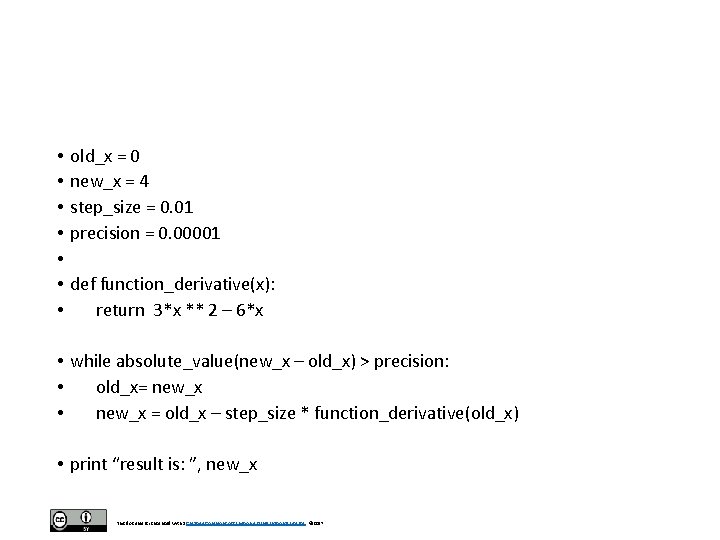
• • old_x = 0 new_x = 4 step_size = 0. 01 precision = 0. 00001 def function_derivative(x): return 3*x ** 2 – 6*x • while absolute_value(new_x – old_x) > precision: • old_x= new_x • new_x = old_x – step_size * function_derivative(old_x) • print “result is: ”, new_x This document is licensed with a Creative Commons Attribution 4. 0 International License © 2017
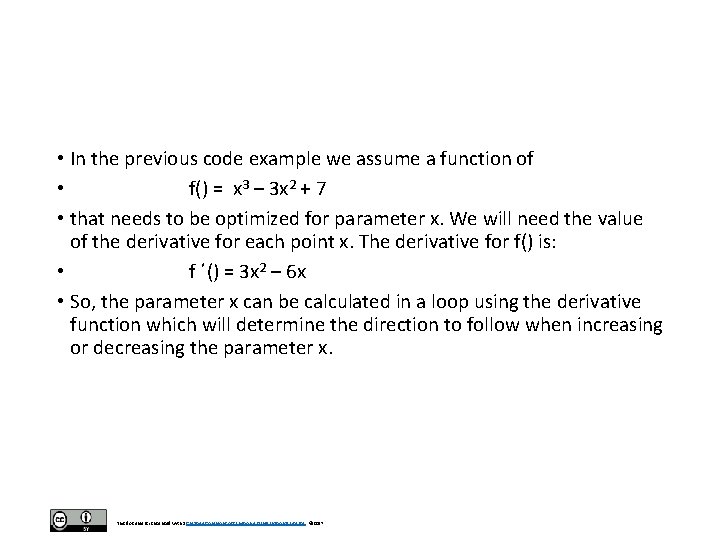
• In the previous code example we assume a function of • f() = x 3 – 3 x 2 + 7 • that needs to be optimized for parameter x. We will need the value of the derivative for each point x. The derivative for f() is: • f ´() = 3 x 2 – 6 x • So, the parameter x can be calculated in a loop using the derivative function which will determine the direction to follow when increasing or decreasing the parameter x. This document is licensed with a Creative Commons Attribution 4. 0 International License © 2017
Summary • Data sets and features This document is licensed with a Creative Commons Attribution 4. 0 International License © 2017

- Slides: 47