
Machine Learning for Computer Security What you will
- Slides: 20
Machine Learning for Computer Security What you will learn …. v. Current problems of computer security v Detection and prevention of unknown attacks v Large-scale analysis of security data, e. g. malware v Development of “intelligent” defenses v. Machine learning as a tool for tacking v Key concepts of learning theory v Unsupervised and supervised learning algorithms v Features and feature spaces
Module Contents v v v v v Introduction to probabilistic learning Learning theory Feature design Decision trees Neural networks Support Vector Machines Clustering and classification of malware Learning-based anomaly and intrusion detection methods Special topics on security
What you will need … v Knowledge in core computer science v Computer security and operating systems v Network communication and protocols v Basic knowledge of: v v Probability Statistics Linear algebra Optimization v The “Hacker Spirit” v Eagerness to understand how things work v Some endurance, if things get tricky
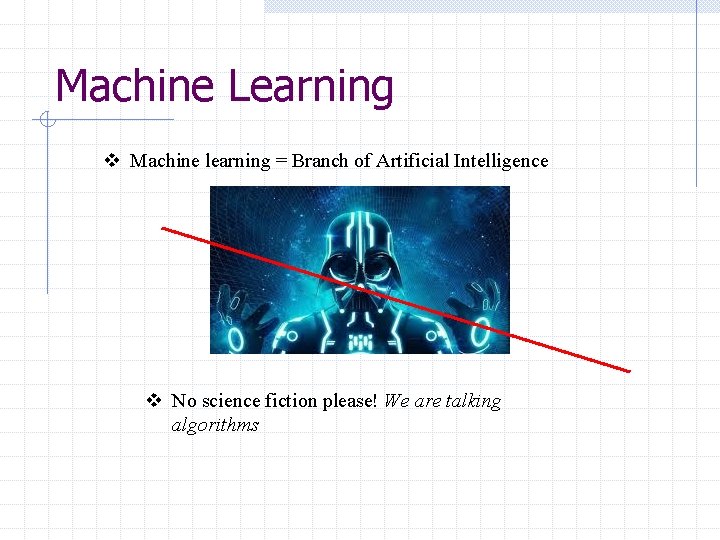
Machine Learning v Machine learning = Branch of Artificial Intelligence v No science fiction please! We are talking algorithms
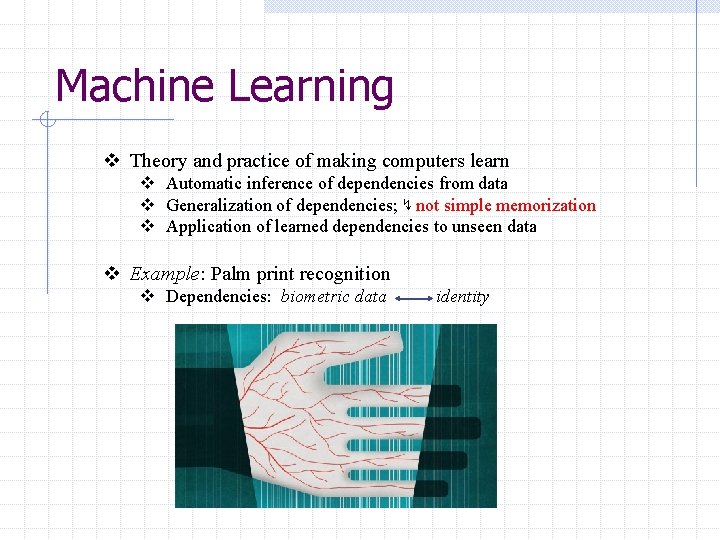
Machine Learning v Theory and practice of making computers learn v Automatic inference of dependencies from data v Generalization of dependencies; ↯ not simple memorization v Application of learned dependencies to unseen data v Example: Palm print recognition v Dependencies: biometric data identity
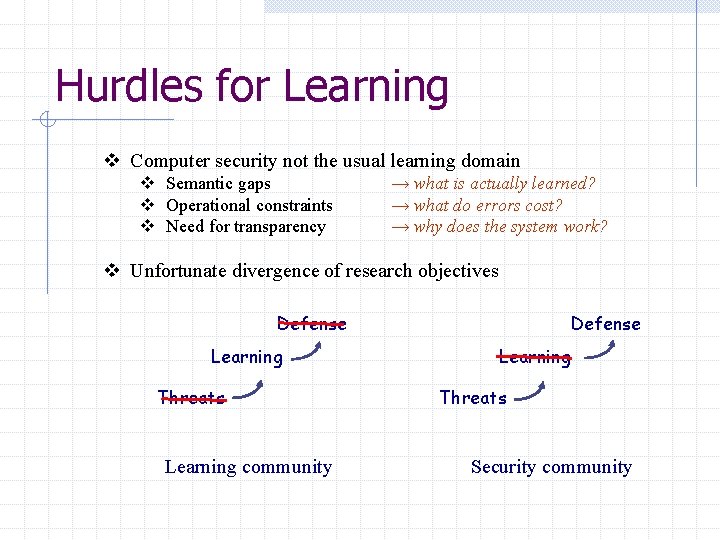
Hurdles for Learning v Computer security not the usual learning domain v Semantic gaps v Operational constraints v Need for transparency → what is actually learned? → what do errors cost? → why does the system work? v Unfortunate divergence of research objectives Defense Learning Threats Learning community Defense Learning Threats Security community
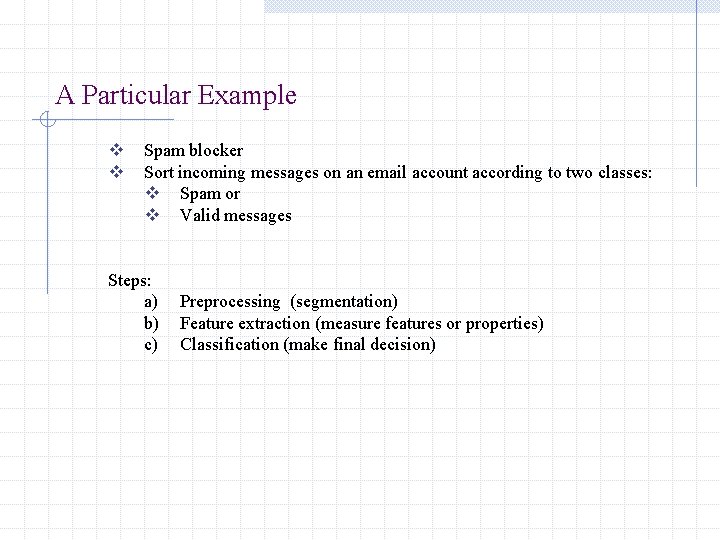
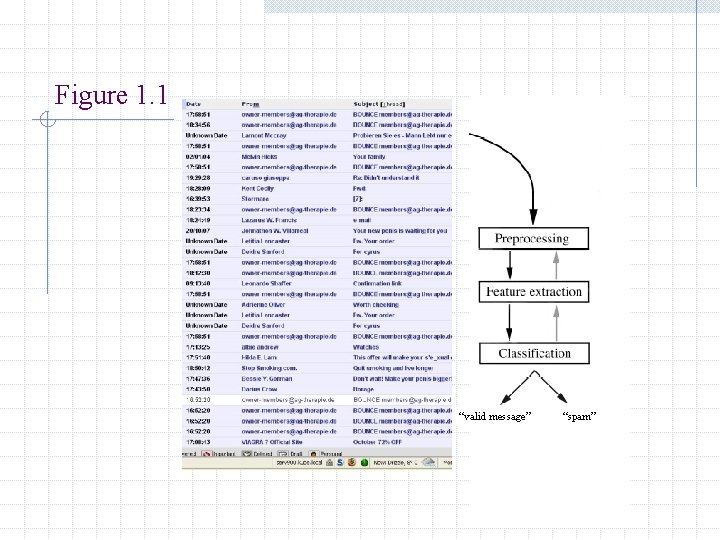
A Particular Example v v Spam blocker Sort incoming messages on an email account according to two classes: v Spam or v Valid messages Steps: a) b) c) Preprocessing (segmentation) Feature extraction (measure features or properties) Classification (make final decision)
Figure 1. 1 “valid message” “spam”
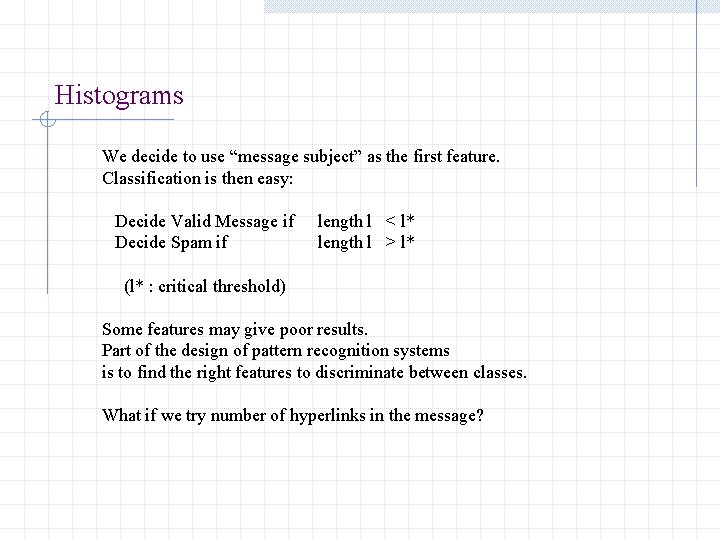
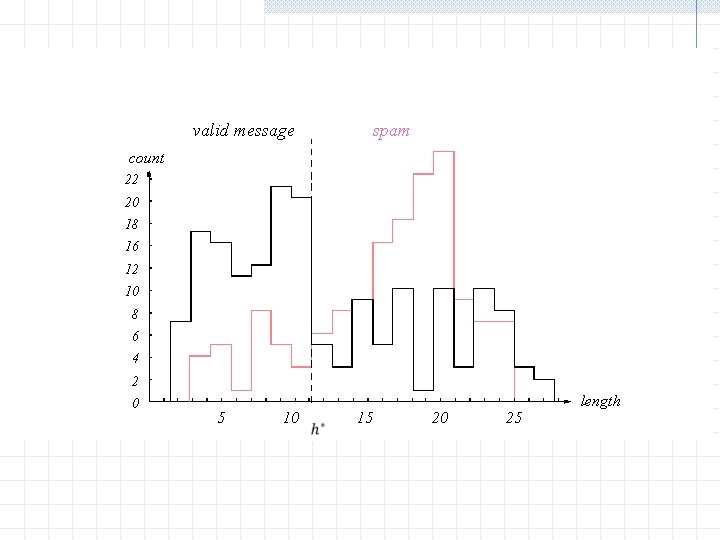
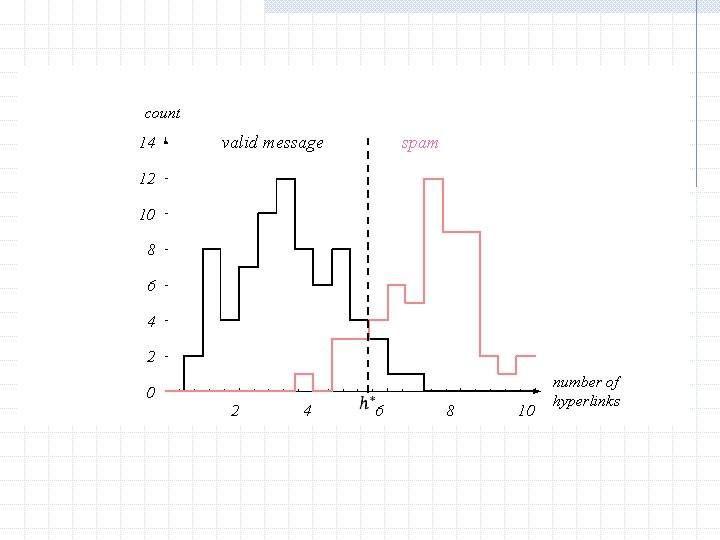
Histograms We decide to use “message subject” as the first feature. Classification is then easy: Decide Valid Message if Decide Spam if length l < l* length l > l* (l* : critical threshold) Some features may give poor results. Part of the design of pattern recognition systems is to find the right features to discriminate between classes. What if we try number of hyperlinks in the message?
Figure 1. 2 valid message spam count 22 20 18 16 12 10 8 6 4 2 0 5 10 15 20 25 length
Figure 1. 3 count 14 valid message spam 12 10 8 6 4 2 0 2 4 6 8 10 number of hyperlinks
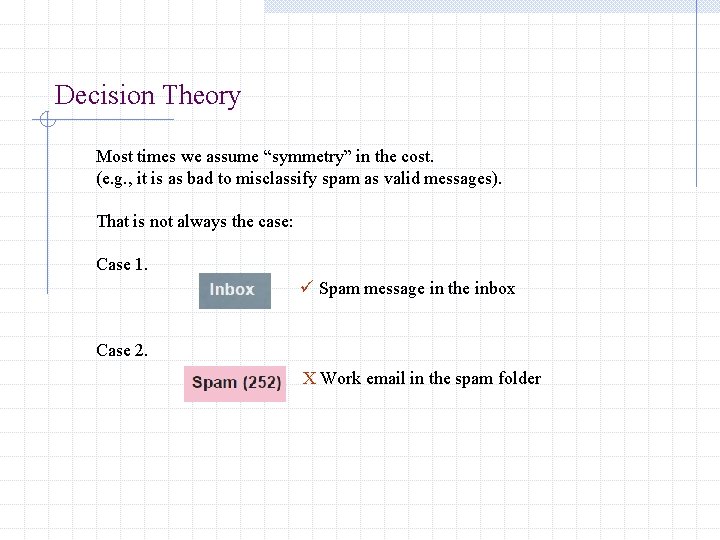
Decision Theory Most times we assume “symmetry” in the cost. (e. g. , it is as bad to misclassify spam as valid messages). That is not always the case: Case 1. ü Spam message in the inbox Case 2. X Work email in the spam folder
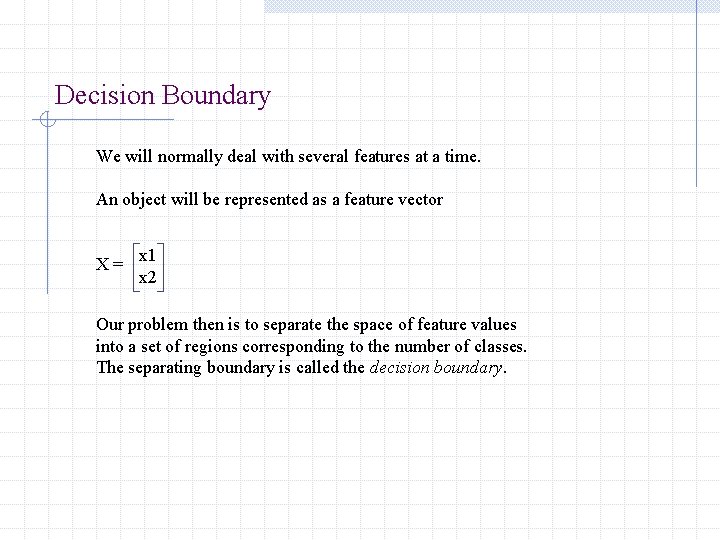
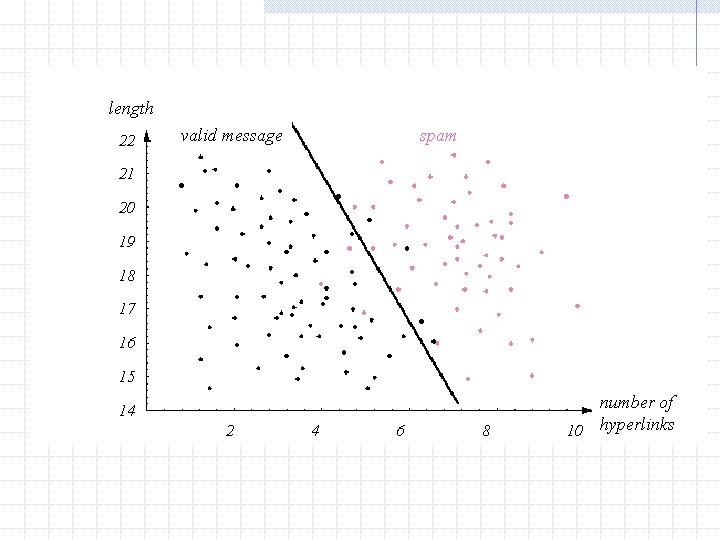
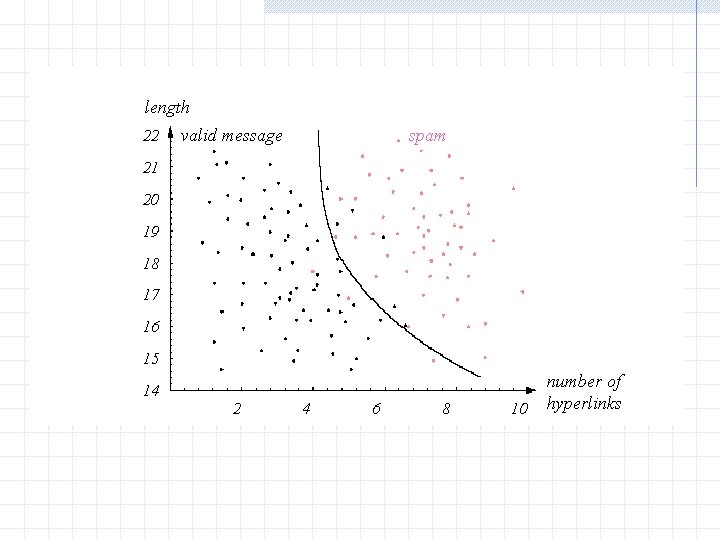
Decision Boundary We will normally deal with several features at a time. An object will be represented as a feature vector X = x 1 x 2 Our problem then is to separate the space of feature values into a set of regions corresponding to the number of classes. The separating boundary is called the decision boundary.
Figure 1. 4 length 22 valid message spam 21 20 19 18 17 16 15 14 2 4 6 8 number of 10 hyperlinks
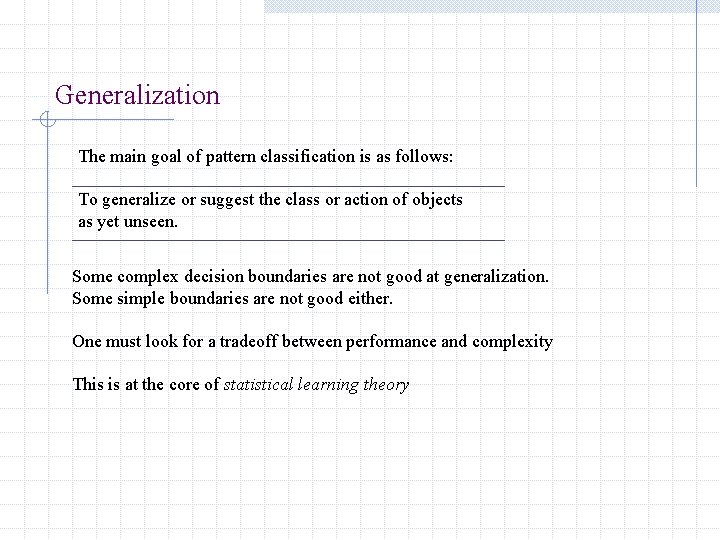
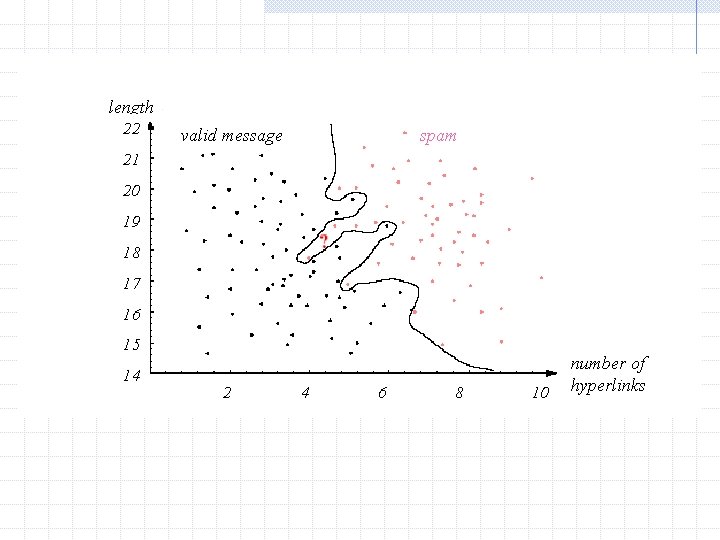
Generalization The main goal of pattern classification is as follows: To generalize or suggest the class or action of objects as yet unseen. Some complex decision boundaries are not good at generalization. Some simple boundaries are not good either. One must look for a tradeoff between performance and complexity This is at the core of statistical learning theory
Figure 1. 5 length 22 valid message spam 21 20 19 18 17 16 15 14 2 4 6 8 10 number of hyperlinks
Figure 1. 6 length 22 valid message spam 21 20 19 18 17 16 15 14 2 4 6 8 10 number of hyperlinks
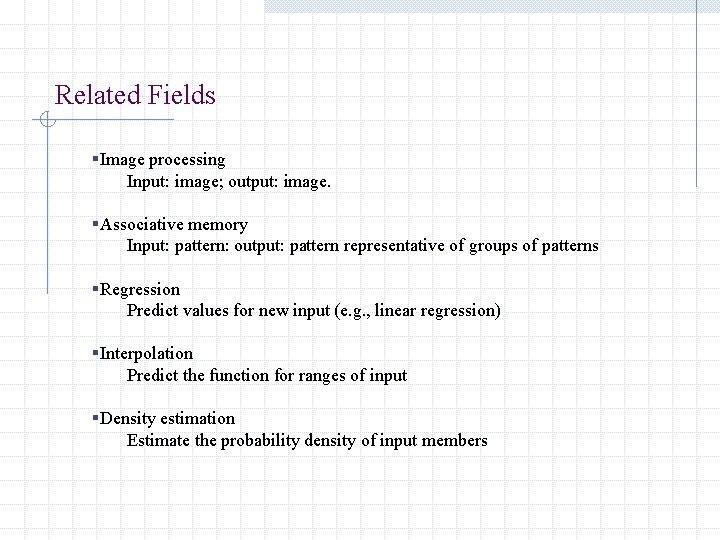
Related Fields §Image processing Input: image; output: image. §Associative memory Input: pattern: output: pattern representative of groups of patterns §Regression Predict values for new input (e. g. , linear regression) §Interpolation Predict the function for ranges of input §Density estimation Estimate the probability density of input members
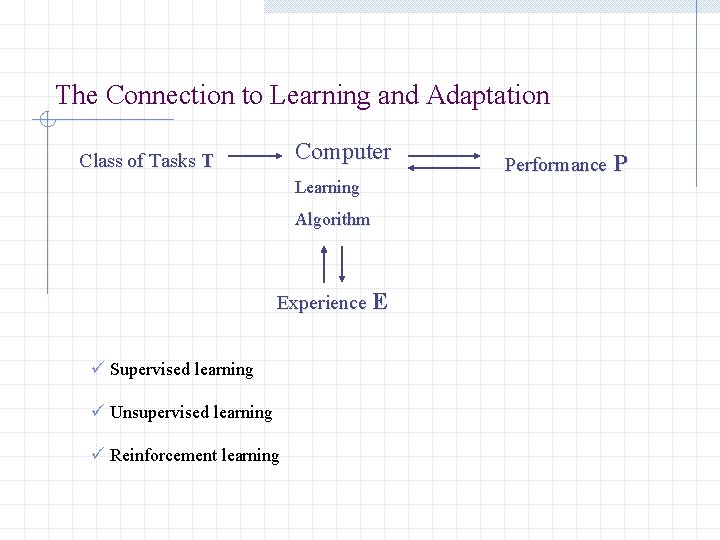
The Connection to Learning and Adaptation Computer Class of Tasks T Learning Algorithm Experience E ü Supervised learning ü Unsupervised learning ü Reinforcement learning Performance P
References Material taken from: Chapters 1 and 2: Pattern Classification by Duda, Hart and Stork, 2 nd Edition Wiley-Interscience