
Machine Learning For Biologists Workshop Fangzhou Mu Chris
Machine Learning For Biologists Workshop Fangzhou Mu, Chris Magnano, Debora Treu, Anthony Gitter University of Wisconsin-Madison, Morgridge Institute for Research
Outline ● Motivation ● Content ● Demo ● Response so far ● Challenges/Future Plans

Machine learning (ML) is becoming pervasive in biology. https: //www. nature. com/articles/d 41586 -018 -02881 -7 Nature. 2018 Mar 22; 555(7697): 469 -474. ar. Xiv: 1708. 09843 v 2 [cs. CV] https: //www. nature. com/articles/d 41586 -018 -00004 -w Cell. 2018 Apr 5; 173(2): 338 -354. e 15. J Proteome Res. 2016 Aug 5; 15(8): 2749 -59. Nucleic Acids Res. 2017 Sep 29; 45(17): e 156. Pharm Res. 2018 Jun 29; 35(9): 170.
Our goal is to create a workshop which teaches ML literacy. ● Know what machine learning does and why it can be useful in biological research. ● Be able to read papers that apply (simple) ML to biological problems. ● Understand (some of) the language used by computational biologists and be more comfortable to collaborate with them. ● Be prepared to explore opportunities of applying ML in your own projects.
Format ● 3 -4 hour workshop ● Some reading and software installation pre-workshop ● Focus on intuition, not math ● No coding element ● ~80% presentation and discussion ● ~20% activities with ML 4 Bio software
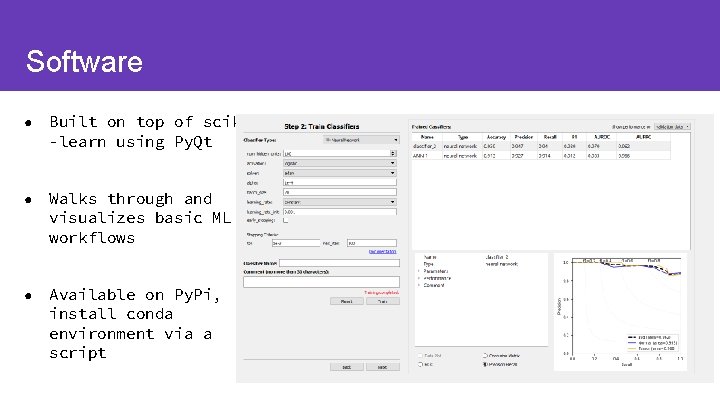
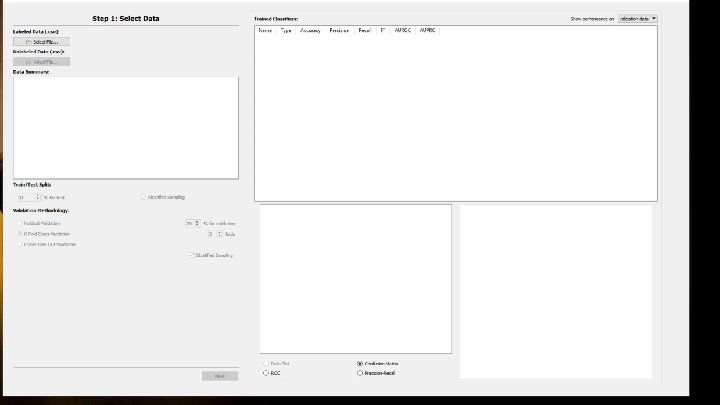
Software ● Built on top of scikit -learn using Py. Qt ● Walks through and visualizes basic ML workflows ● Available on Py. Pi, install conda environment via a script
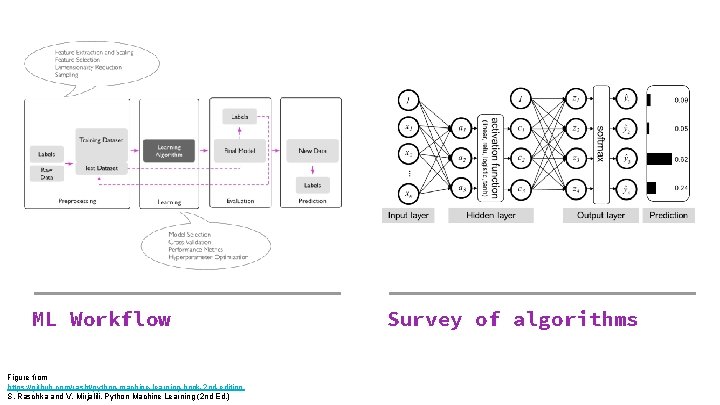
ML Workflow Figure from https: //github. com/rasbt/python-machine-learning-book-2 nd-edition S. Raschka and V. Mirjalili, Python Machine Learning (2 nd Ed. ) Survey of algorithms
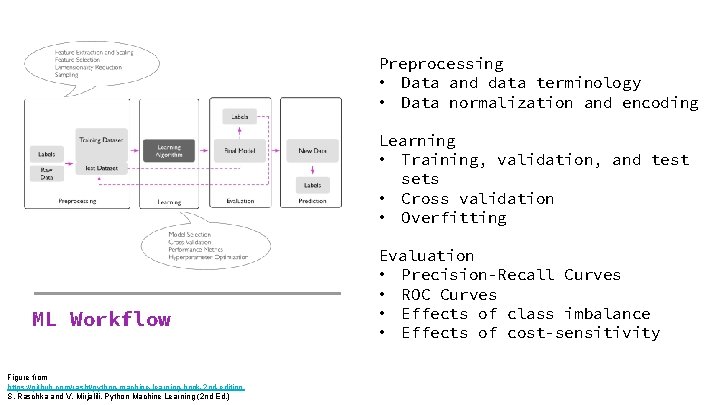
Preprocessing • Data and data terminology • Data normalization and encoding Learning • Training, validation, and test sets • Cross validation • Overfitting ML Workflow Figure from https: //github. com/rasbt/python-machine-learning-book-2 nd-edition S. Raschka and V. Mirjalili, Python Machine Learning (2 nd Ed. ) Evaluation • Precision-Recall Curves • ROC Curves • Effects of class imbalance • Effects of cost-sensitivity
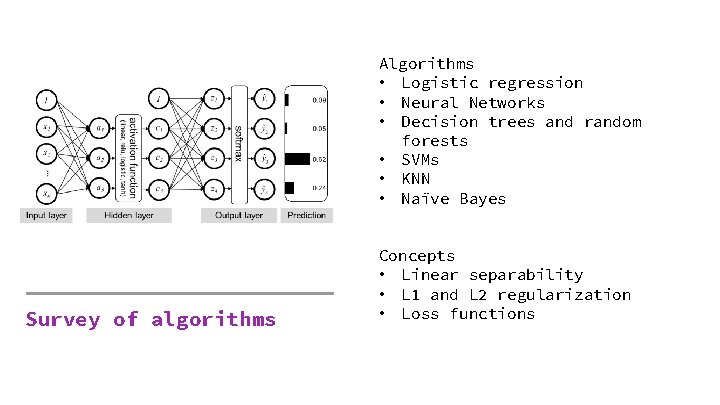
Algorithms • Logistic regression • Neural Networks • Decision trees and random forests • SVMs • KNN • Naïve Bayes Survey of algorithms Concepts • Linear separability • L 1 and L 2 regularization • Loss functions
Software Demo ML Workflow Prostate Cancer Classification
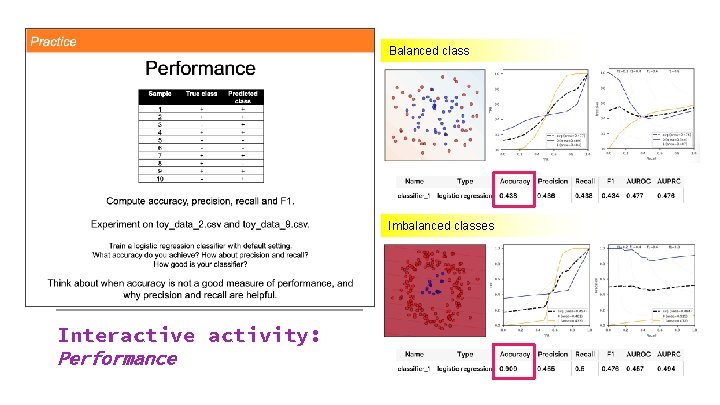
Balanced class Imbalanced classes Interactive activity: Performance
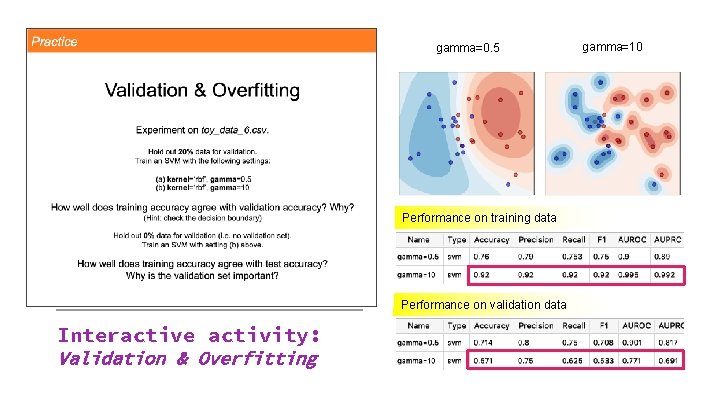
gamma=0. 5 Performance on training data Performance on validation data Interactive activity: Validation & Overfitting gamma=10
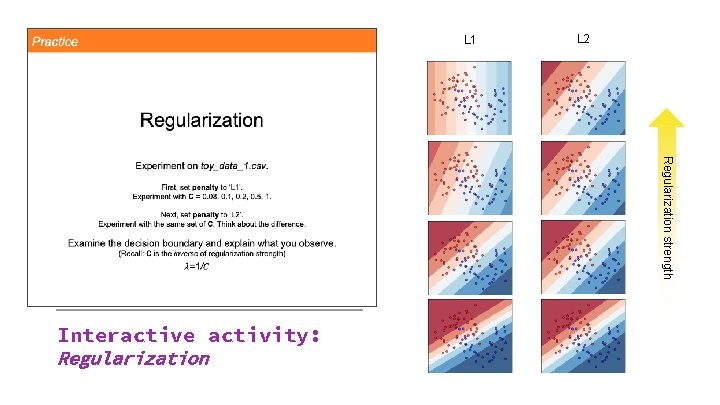
L 1 L 2 Regularization strength Interactive activity: Regularization
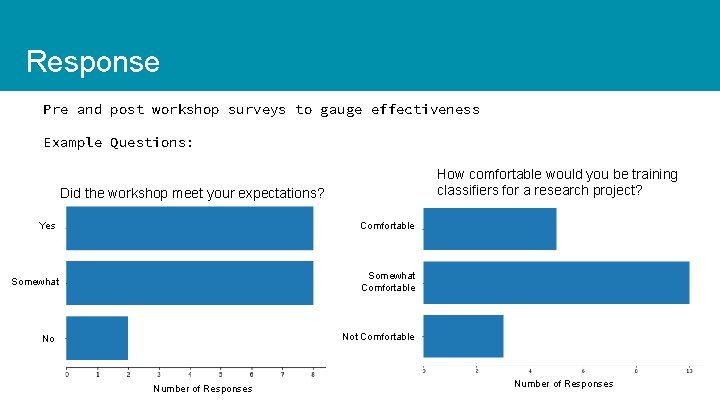
Response Pre and post workshop surveys to gauge effectiveness Example Questions: How comfortable would you be training classifiers for a research project? Did the workshop meet your expectations? Yes Comfortable Somewhat Comfortable Not Comfortable No Number of Responses
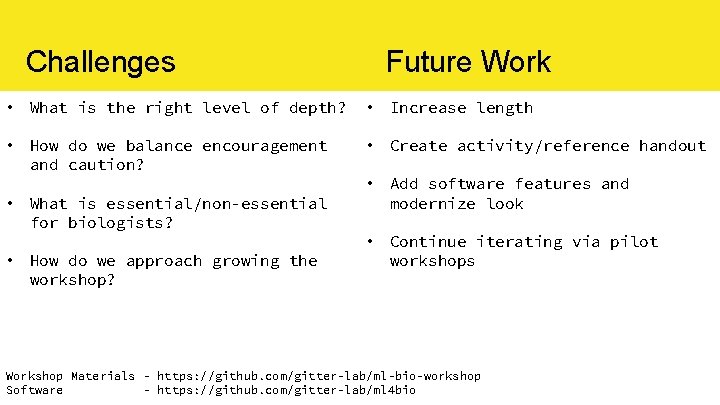
Challenges Future Work • What is the right level of depth? • Increase length • How do we balance encouragement and caution? • Create activity/reference handout • Add software features and modernize look • Continue iterating via pilot workshops • • What is essential/non-essential for biologists? How do we approach growing the workshop? Workshop Materials - https: //github. com/gitter-lab/ml-bio-workshop Software - https: //github. com/gitter-lab/ml 4 bio
Acknowledgements ● ML consultants: Ross Kleiman, Zijie (Jay) Wang ● Beth Meyerand, Megan Mc. Clean ● Python Machine Learning book authors Sebastian Raschka and Vahid Mirjalili ● NSF 1553206, Morgridge Institute for Research ● Workshop participants
- Slides: 17