
Machine Learning Chapter 9 Genetic Algorithm Tom M
![GABIL [De. Jong et al. 1993] § Learn disjunctive set of propositional rules, competitive](https://slidetodoc.com/presentation_image_h2/7f862a4cf428c78b046fa9363783faac/image-10.jpg "GABIL [De. Jong et al. 1993] § Learn disjunctive set of propositional rules, competitive")
![GP for Classifying Images [Teller and Veloso, 1997] § Fitness: based on coverage and](https://slidetodoc.com/presentation_image_h2/7f862a4cf428c78b046fa9363783faac/image-23.jpg "GP for Classifying Images [Teller and Veloso, 1997] § Fitness: based on coverage and")
![Computer Experiments on Baldwin Effect [Hinton and Nowlan, 1987] § Evolve simple neural networks:](https://slidetodoc.com/presentation_image_h2/7f862a4cf428c78b046fa9363783faac/image-27.jpg "Computer Experiments on Baldwin Effect [Hinton and Nowlan, 1987] § Evolve simple neural networks:")
- Slides: 28
Machine Learning Chapter 9. Genetic Algorithm Tom M. Mitchell
Genetic Algorithms § Evolutionary computation § Prototypical GA § An example: GABIL § Genetic Programming § Individual learning and population evolution 2
Evolutionary Computation 1. Computational procedures patterned after biological evolution 2. Search procedure that probabilistically applies search operators to set of points in the search space 3
Biological Evolution (1/3) § Lamarck and others: – Species “transmute” over time § Darwin and Wallace: – Consistent, heritable variation among individuals in population – Natural selection of the fittest § Mendel and genetics: – A mechanism for inheriting traits – genotype phenotype mapping 4
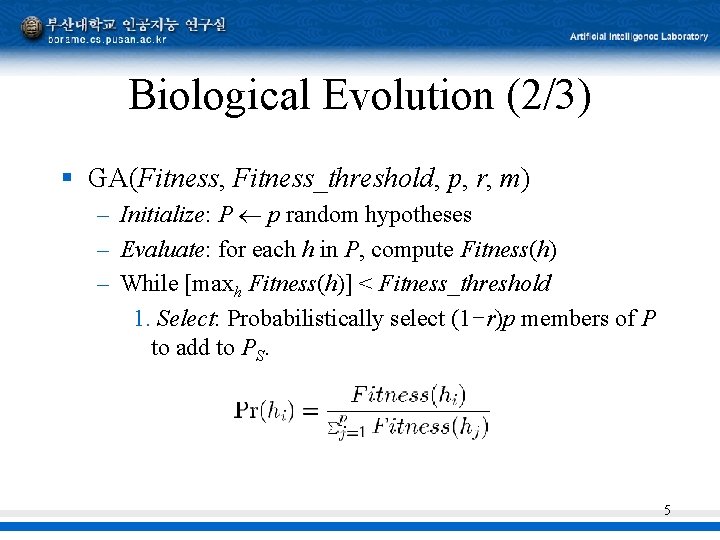
Biological Evolution (2/3) § GA(Fitness, Fitness_threshold, p, r, m) – Initialize: P p random hypotheses – Evaluate: for each h in P, compute Fitness(h) – While [maxh Fitness(h)] < Fitness_threshold 1. Select: Probabilistically select (1 -r)p members of P to add to PS. 5
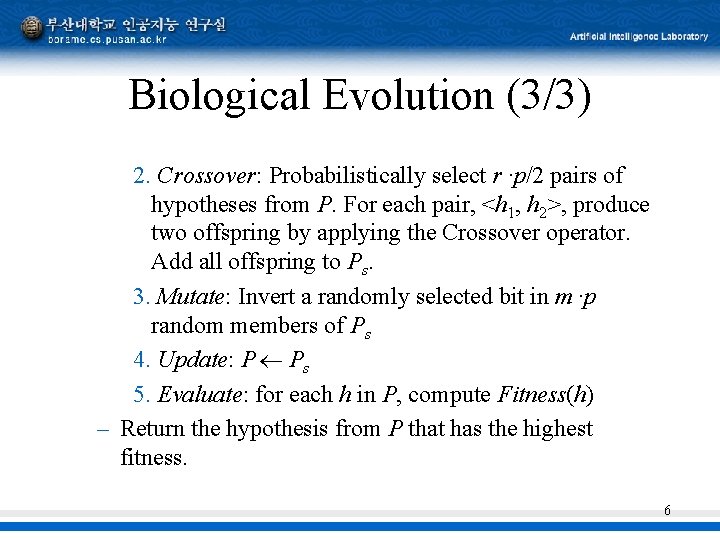
Biological Evolution (3/3) 2. Crossover: Probabilistically select r ·p/2 pairs of hypotheses from P. For each pair, <h 1, h 2>, produce two offspring by applying the Crossover operator. Add all offspring to Ps. 3. Mutate: Invert a randomly selected bit in m ·p random members of Ps 4. Update: P Ps 5. Evaluate: for each h in P, compute Fitness(h) – Return the hypothesis from P that has the highest fitness. 6
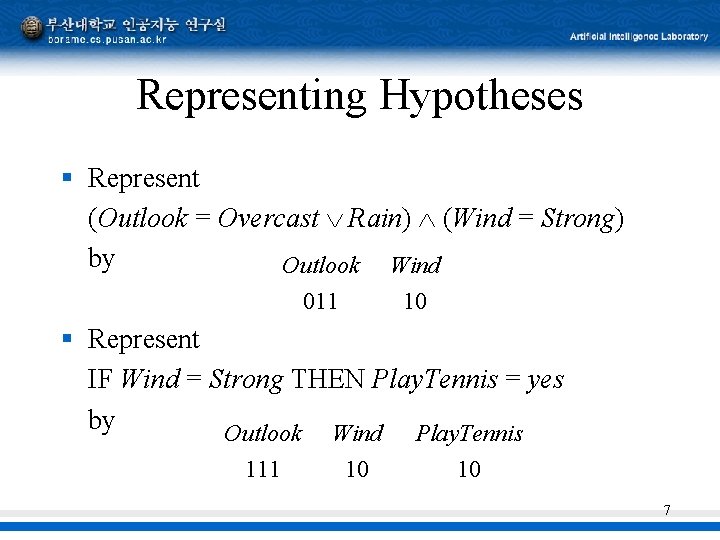
Representing Hypotheses § Represent (Outlook = Overcast Rain) (Wind = Strong) by Outlook Wind 011 10 § Represent IF Wind = Strong THEN Play. Tennis = yes by Outlook Wind Play. Tennis 111 10 10 7
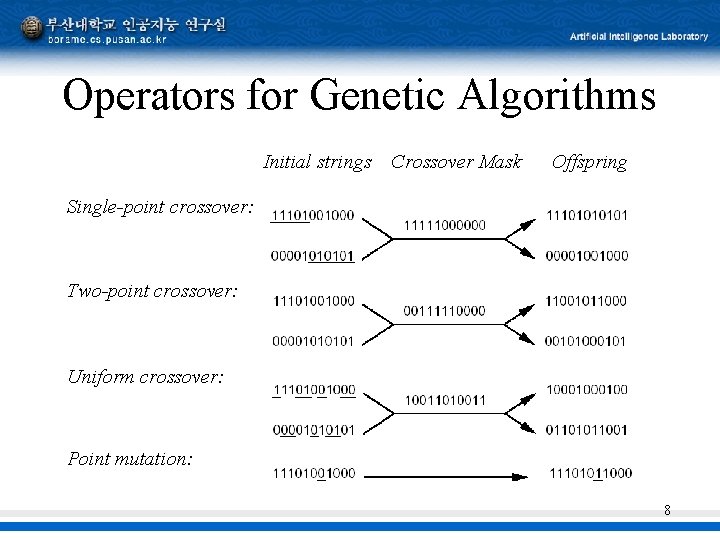
Operators for Genetic Algorithms Initial strings Crossover Mask Offspring Single-point crossover: Two-point crossover: Uniform crossover: Point mutation: 8
Selecting Most Fit Hypotheses § Fitness proportionate selection: . . . can lead to crowding § Tournament selection: – Pick h 1, h 2 at random with uniform prob. – With probability p, select the more fit. § Rank selection: – Sort all hypotheses by fitness – Prob of selection is proportional to rank 9
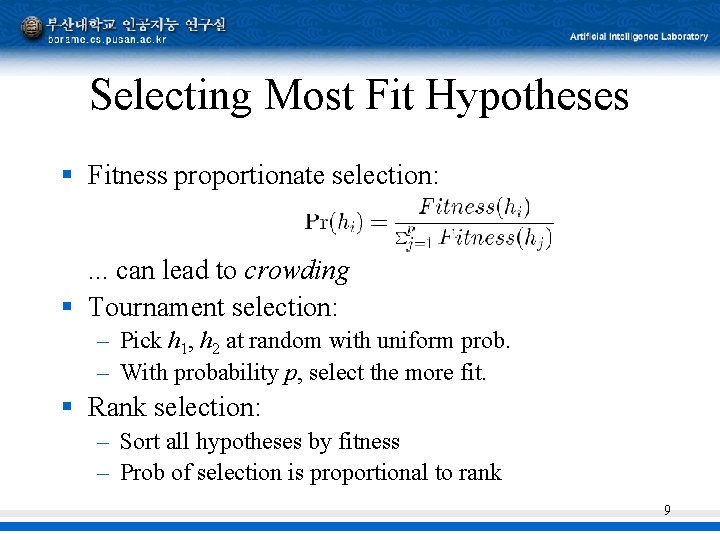
GABIL [De. Jong et al. 1993] § Learn disjunctive set of propositional rules, competitive with C 4. 5 § Fitness: Fitness(h) = (correct(h))2 § Representation: IF a 1 = T a 2 = F THEN c = T; IF a 2 = T THEN c = F represented by a 1 a 2 c 10 01 1 11 10 0 § Genetic operators: ? ? ? – want variable length rule sets – want only well-formed bitstring hypotheses 10
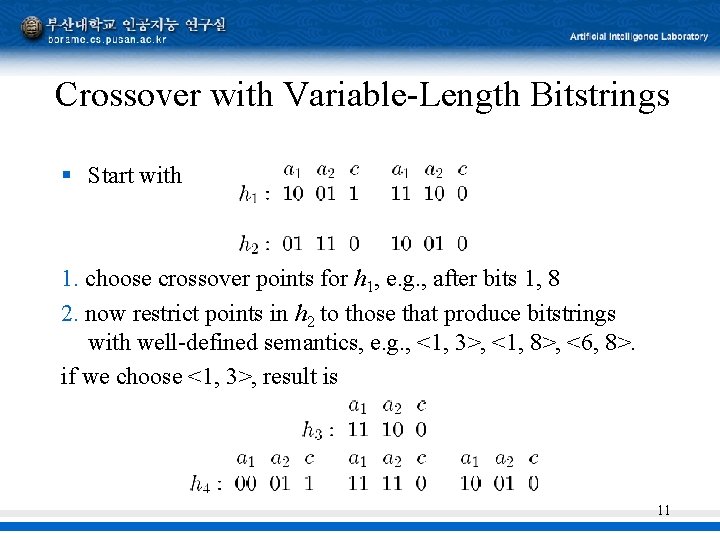
Crossover with Variable-Length Bitstrings § Start with 1. choose crossover points for h 1, e. g. , after bits 1, 8 2. now restrict points in h 2 to those that produce bitstrings with well-defined semantics, e. g. , <1, 3>, <1, 8>, <6, 8>. if we choose <1, 3>, result is 11
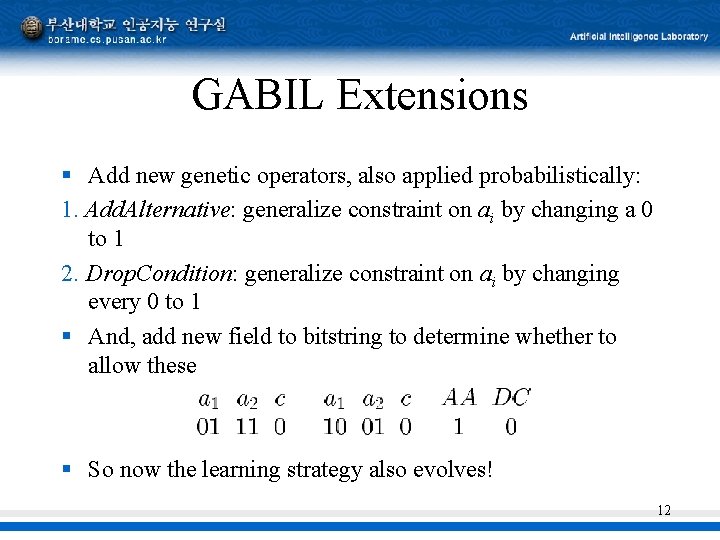
GABIL Extensions § Add new genetic operators, also applied probabilistically: 1. Add. Alternative: generalize constraint on ai by changing a 0 to 1 2. Drop. Condition: generalize constraint on ai by changing every 0 to 1 § And, add new field to bitstring to determine whether to allow these § So now the learning strategy also evolves! 12
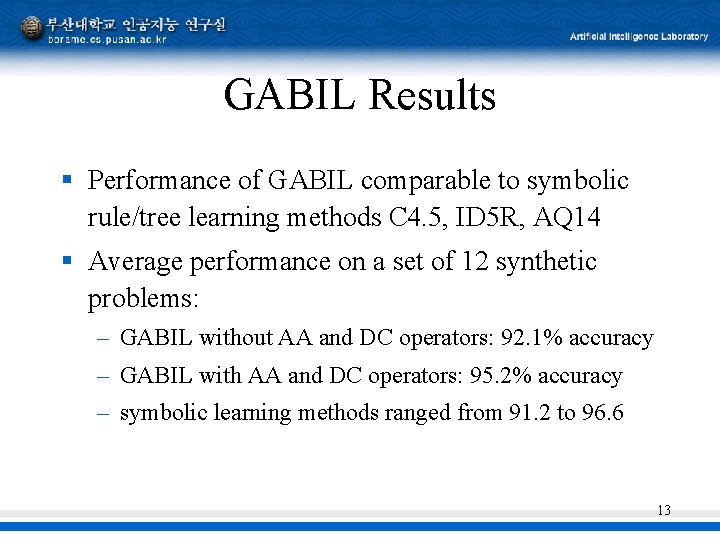
GABIL Results § Performance of GABIL comparable to symbolic rule/tree learning methods C 4. 5, ID 5 R, AQ 14 § Average performance on a set of 12 synthetic problems: – GABIL without AA and DC operators: 92. 1% accuracy – GABIL with AA and DC operators: 95. 2% accuracy – symbolic learning methods ranged from 91. 2 to 96. 6 13
Schemas § How to characterize evolution of population in GA? § Schema = string containing 0, 1, * (“don’t care”) – Typical schema: 10**0* – Instances of above schema: 101101, 100000, . . . § Characterize population by number of instances representing each possible schema – m(s, t) = number of instances of schema s in pop at time t 14
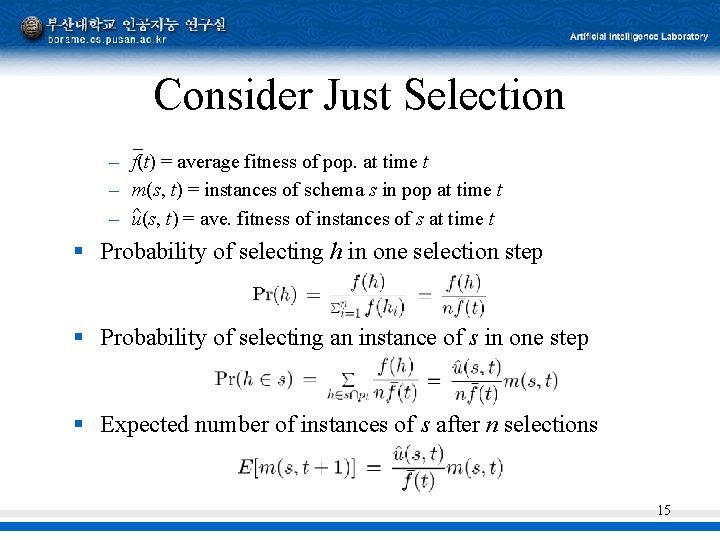
Consider Just Selection – – – f(t) = average fitness of pop. at time t m(s, t) = instances of schema s in pop at time t ^ t) = ave. fitness of instances of s at time t u(s, § Probability of selecting h in one selection step § Probability of selecting an instance of s in one step § Expected number of instances of s after n selections 15
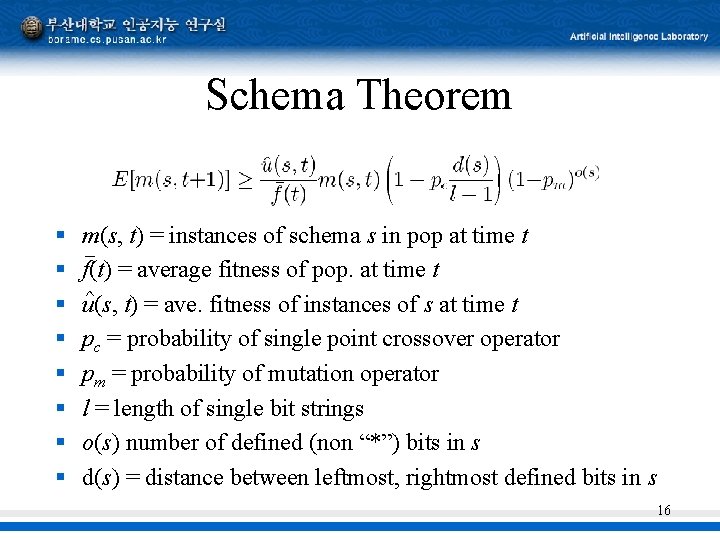
Schema Theorem § § § § m(s, t) = instances of schema s in pop at time t f(t) = average fitness of pop. at time t ^ u(s, t) = ave. fitness of instances of s at time t pc = probability of single point crossover operator pm = probability of mutation operator l = length of single bit strings o(s) number of defined (non “*”) bits in s d(s) = distance between leftmost, rightmost defined bits in s 16
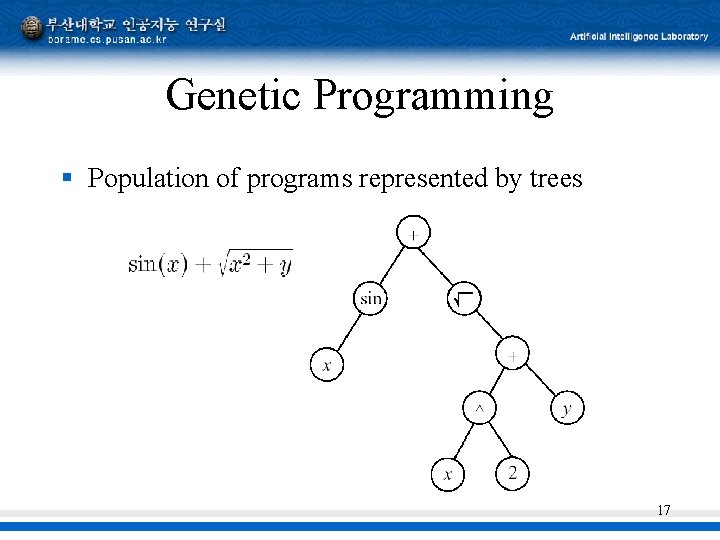
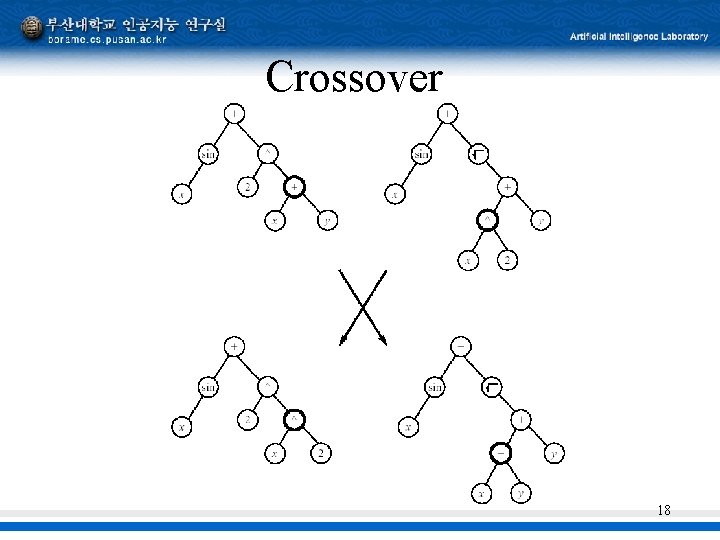
Genetic Programming § Population of programs represented by trees 17
Crossover 18
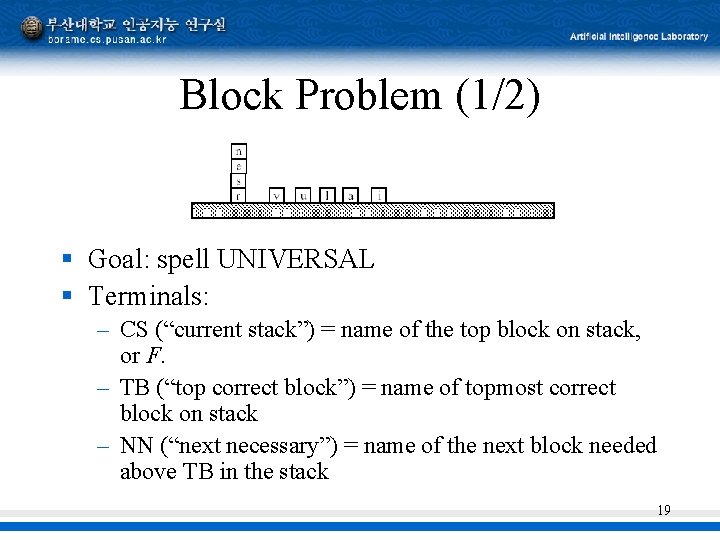
Block Problem (1/2) § Goal: spell UNIVERSAL § Terminals: – CS (“current stack”) = name of the top block on stack, or F. – TB (“top correct block”) = name of topmost correct block on stack – NN (“next necessary”) = name of the next block needed above TB in the stack 19
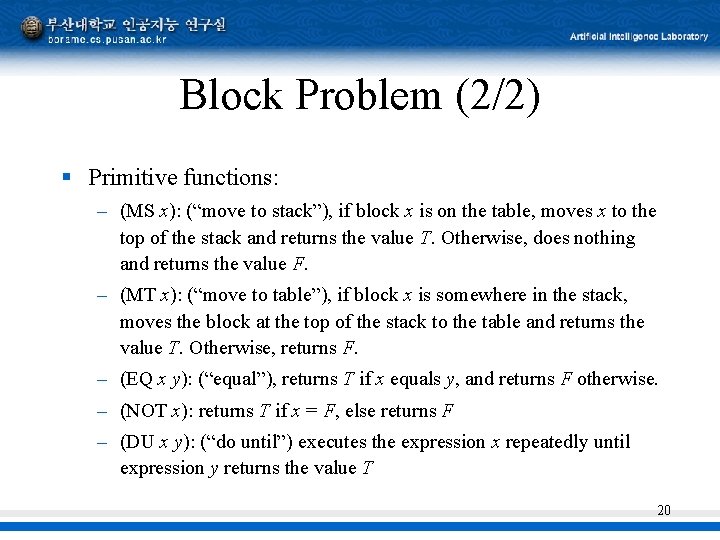
Block Problem (2/2) § Primitive functions: – (MS x): (“move to stack”), if block x is on the table, moves x to the top of the stack and returns the value T. Otherwise, does nothing and returns the value F. – (MT x): (“move to table”), if block x is somewhere in the stack, moves the block at the top of the stack to the table and returns the value T. Otherwise, returns F. – (EQ x y): (“equal”), returns T if x equals y, and returns F otherwise. – (NOT x): returns T if x = F, else returns F – (DU x y): (“do until”) executes the expression x repeatedly until expression y returns the value T 20
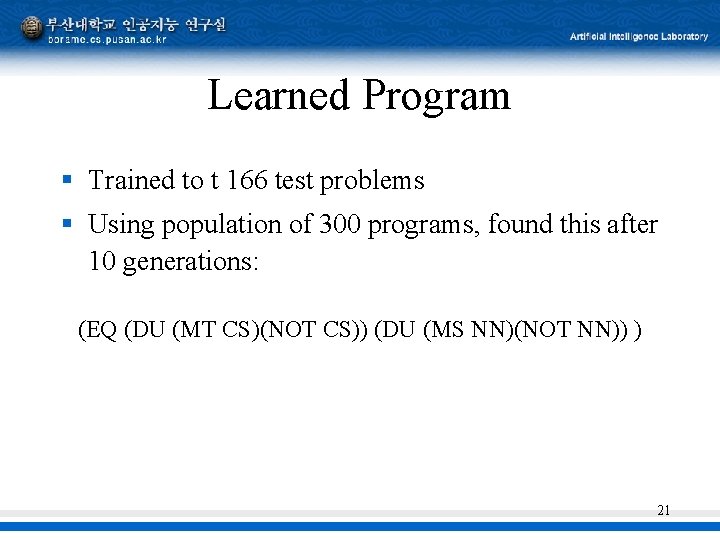
Learned Program § Trained to t 166 test problems § Using population of 300 programs, found this after 10 generations: (EQ (DU (MT CS)(NOT CS)) (DU (MS NN)(NOT NN)) ) 21
Genetic Programming § More interesting example: design electronic filter circuits – Individuals are programs that transform beginning circuit to final circuit, by adding/subtracting components and connections – Use population of 640, 000, run on 64 node parallel processor – Discovers circuits competitive with best human designs 22
GP for Classifying Images [Teller and Veloso, 1997] § Fitness: based on coverage and accuracy § Representation: – Primitives include Add, Sub, Mult, Div, Not, Max, Min, Read, Write, If-Then-Else, Either, Pixel, Least, Most, Ave, Variance, Difference, Mini, Library – Mini refers to a local subroutine that is separately co-evolved – Library refers to a global library subroutine (evolved by selecting the most useful minis) § Genetic operators: – Crossover, mutation – Create “mating pools” and use rank proportionate reproduction 23
Biological Evolution § Lamark (19 th century) – Believed individual genetic makeup was altered by lifetime experience – But current evidence contradicts this view § What is the impact of individual learning on population evolution? 24
Baldwin Effect (1/2) § Assume – Individual learning has no direct influence on individual DNA – But ability to learn reduces need to “hard wire” traits in DNA § Then – Ability of individuals to learn will support more diverse gene pool § Because learning allows individuals with various “hard wired” traits to be successful – More diverse gene pool will support faster evolution of gene pool individual learning (indirectly) increases rate of evolution 25
Baldwin Effect (2/2) § Plausible example: 1. New predator appears in environment 2. Individuals who can learn (to avoid it) will be selected 3. Increase in learning individuals will support more diverse gene pool 4. resulting in faster evolution 5. possibly resulting in new non-learned traits such as instinctive fear of predator 26
Computer Experiments on Baldwin Effect [Hinton and Nowlan, 1987] § Evolve simple neural networks: – Some network weights fixed during lifetime, others trainable – Genetic makeup determines which are fixed, and their weight values § Results: – With no individual learning, population failed to improve over time – When individual learning allowed § Early generations: population contained many individuals with many trainable weights § Later generations: higher fitness, while number of trainable weights decreased 27
Summary: Evolutionary Programming § Conduct randomized, parallel, hill-climbing search through H § Approach learning as optimization problem (optimize fitness) § Nice feature: evaluation of Fitness can be very indirect – consider learning rule set for multistep decision making – no issue of assigning credit/blame to indiv. steps 28