
Machine Learning Chapter 4 Artificial Neural Networks Tom
- Slides: 34
Machine Learning Chapter 4. Artificial Neural Networks Tom M. Mitchell
Artificial Neural Networks § § § § Threshold units Gradient descent Multilayer networks Backpropagation Hidden layer representations Example: Face Recognition Advanced topics 2
Connectionist Models (1/2) Consider humans: § Neuron switching time ~. 001 second § Number of neurons ~ 1010 § Connections per neuron ~ 104 -5 § Scene recognition time ~. 1 second § 100 inference steps doesn’t seem like enough much parallel computation 3
Connectionist Models (2/2) Properties of artificial neural nets (ANN’s): § Many neuron-like threshold switching units § Many weighted interconnections among units § Highly parallel, distributed process § Emphasis on tuning weights automatically 4
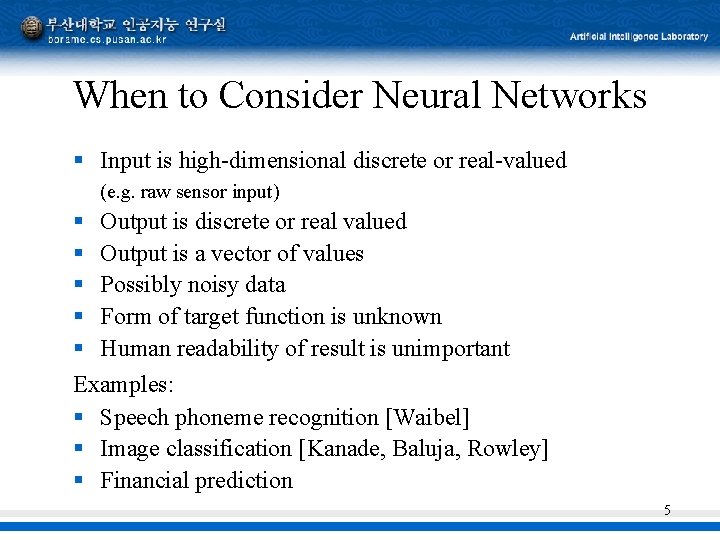
When to Consider Neural Networks § Input is high-dimensional discrete or real-valued (e. g. raw sensor input) § Output is discrete or real valued § Output is a vector of values § Possibly noisy data § Form of target function is unknown § Human readability of result is unimportant Examples: § Speech phoneme recognition [Waibel] § Image classification [Kanade, Baluja, Rowley] § Financial prediction 5
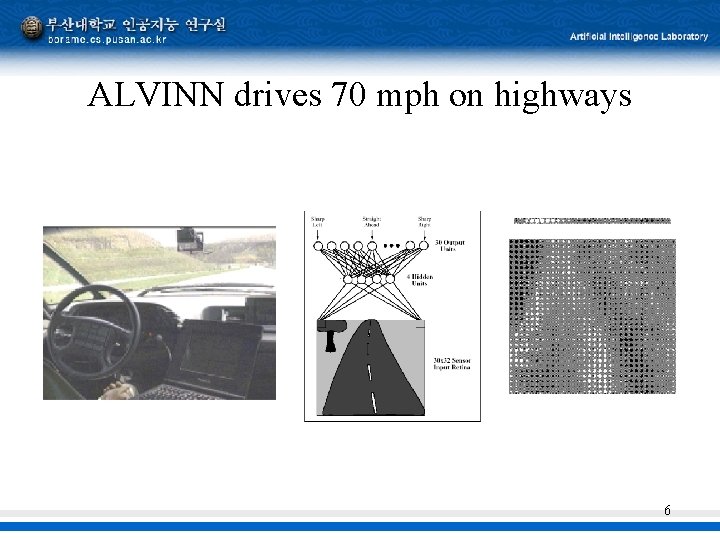
ALVINN drives 70 mph on highways 6
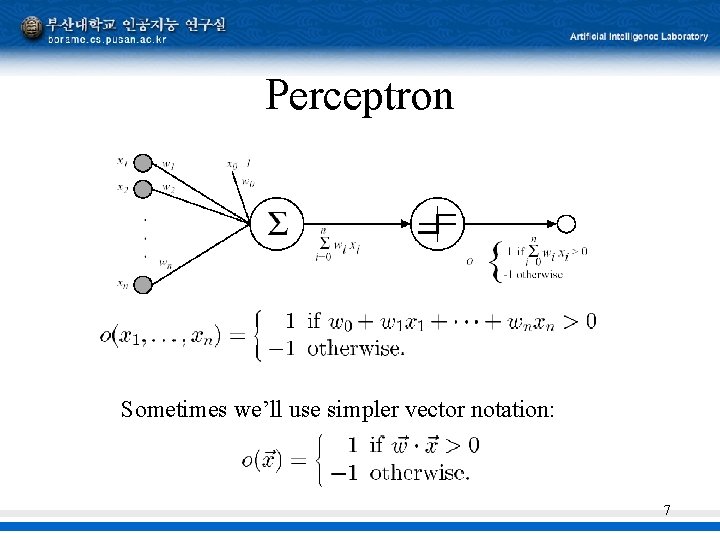
Perceptron Sometimes we’ll use simpler vector notation: 7
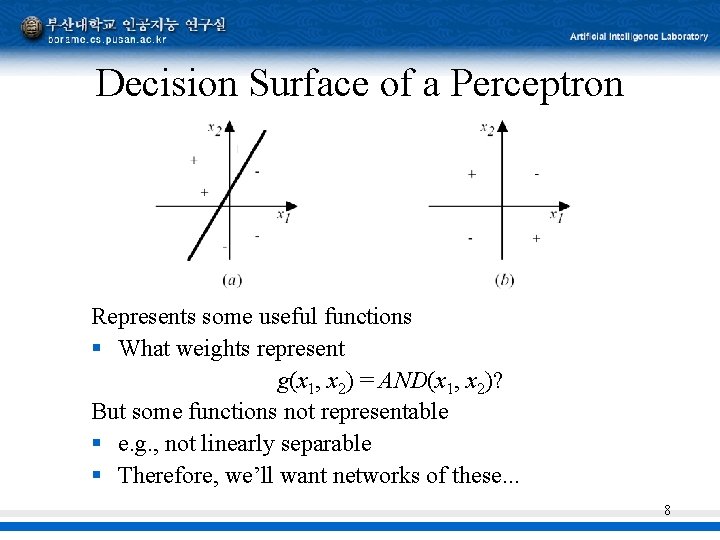
Decision Surface of a Perceptron Represents some useful functions § What weights represent g(x 1, x 2) = AND(x 1, x 2)? But some functions not representable § e. g. , not linearly separable § Therefore, we’ll want networks of these. . . 8
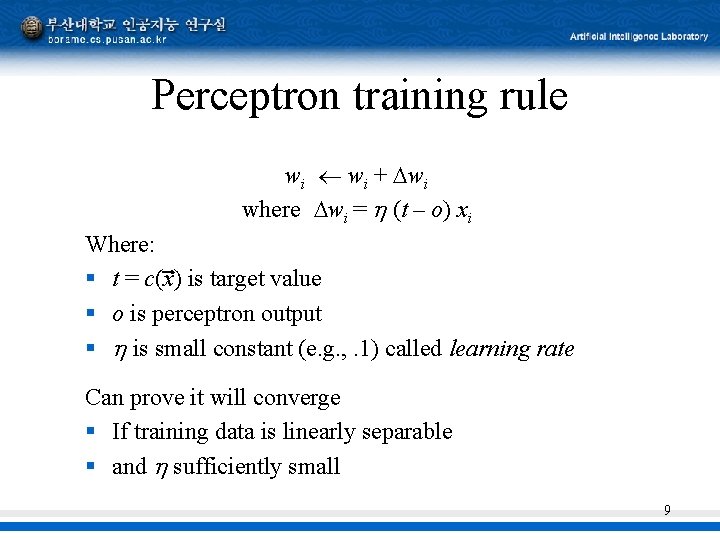
Perceptron training rule wi + wi where wi = (t – o) xi Where: § t = c(x) is target value § o is perceptron output § is small constant (e. g. , . 1) called learning rate Can prove it will converge § If training data is linearly separable § and sufficiently small 9
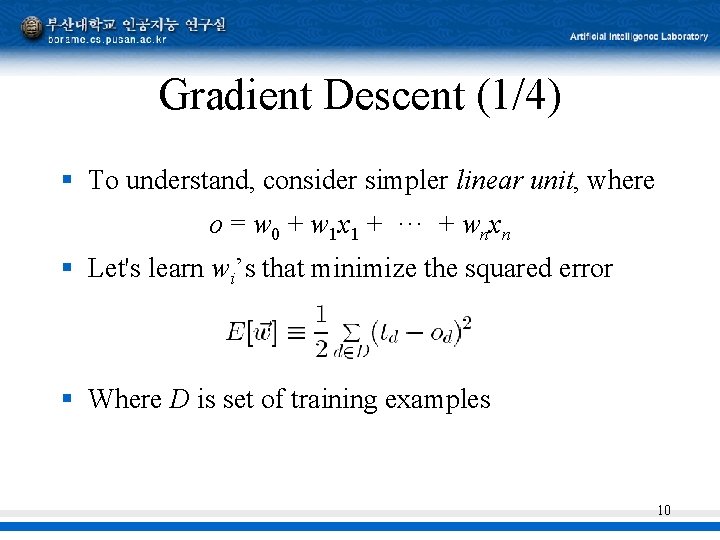
Gradient Descent (1/4) § To understand, consider simpler linear unit, where o = w 0 + w 1 x 1 + ··· + wnxn § Let's learn wi’s that minimize the squared error § Where D is set of training examples 10
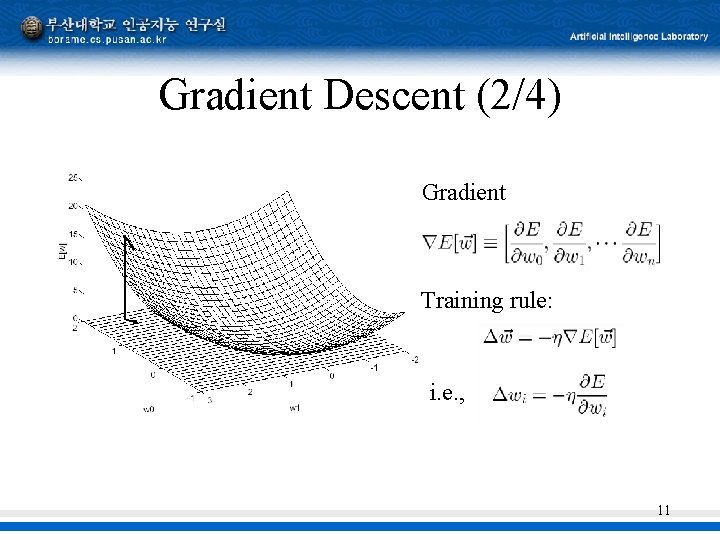
Gradient Descent (2/4) Gradient Training rule: i. e. , 11
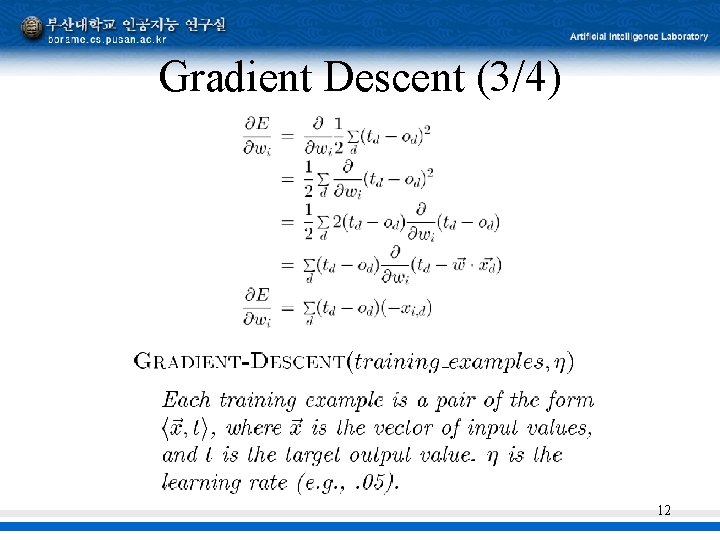
Gradient Descent (3/4) 12
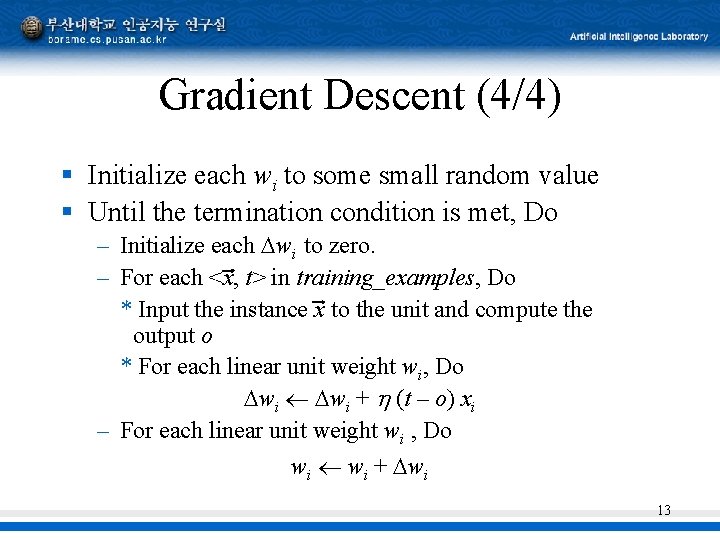
Gradient Descent (4/4) § Initialize each wi to some small random value § Until the termination condition is met, Do – Initialize each wi to zero. – For each <x, t> in training_examples, Do * Input the instance x to the unit and compute the output o * For each linear unit weight wi, Do wi + (t – o) xi – For each linear unit weight wi , Do wi + wi 13
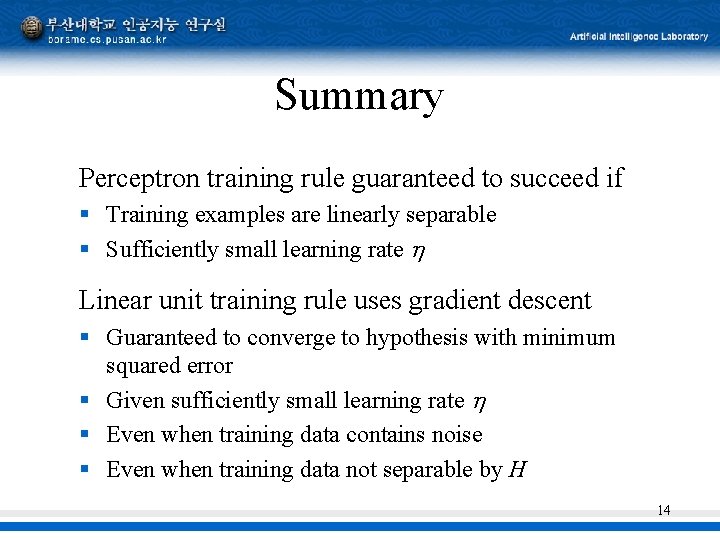
Summary Perceptron training rule guaranteed to succeed if § Training examples are linearly separable § Sufficiently small learning rate Linear unit training rule uses gradient descent § Guaranteed to converge to hypothesis with minimum squared error § Given sufficiently small learning rate § Even when training data contains noise § Even when training data not separable by H 14
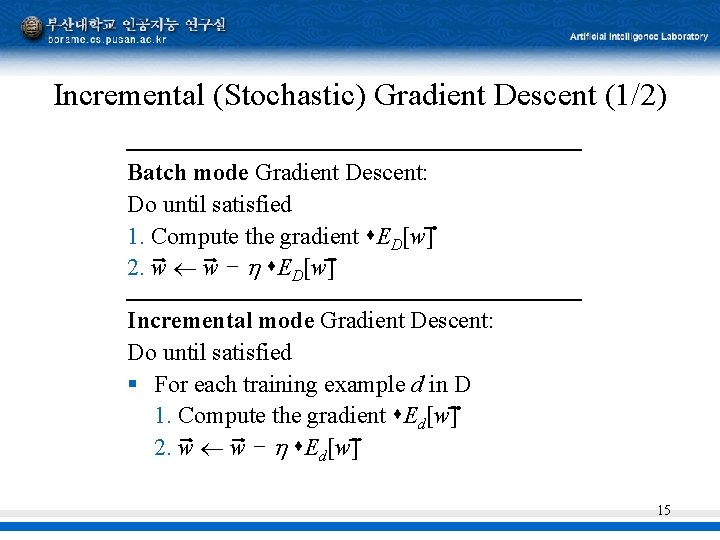
Incremental (Stochastic) Gradient Descent (1/2) Batch mode Gradient Descent: Do until satisfied 1. Compute the gradient ED[w] 2. w w - ED[w] Incremental mode Gradient Descent: Do until satisfied § For each training example d in D 1. Compute the gradient Ed[w] 2. w w - Ed[w] 15
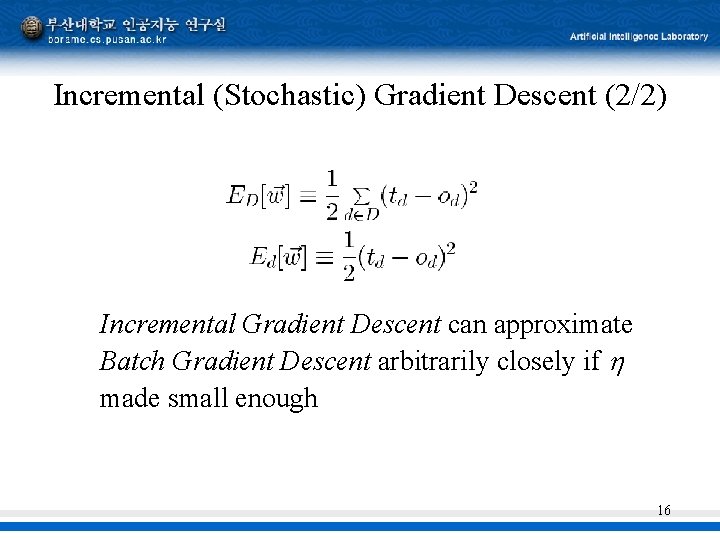
Incremental (Stochastic) Gradient Descent (2/2) Incremental Gradient Descent can approximate Batch Gradient Descent arbitrarily closely if made small enough 16
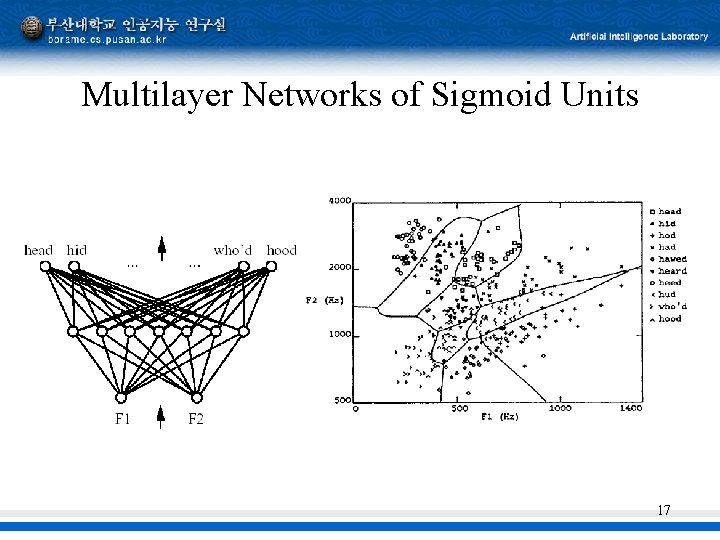
Multilayer Networks of Sigmoid Units 17
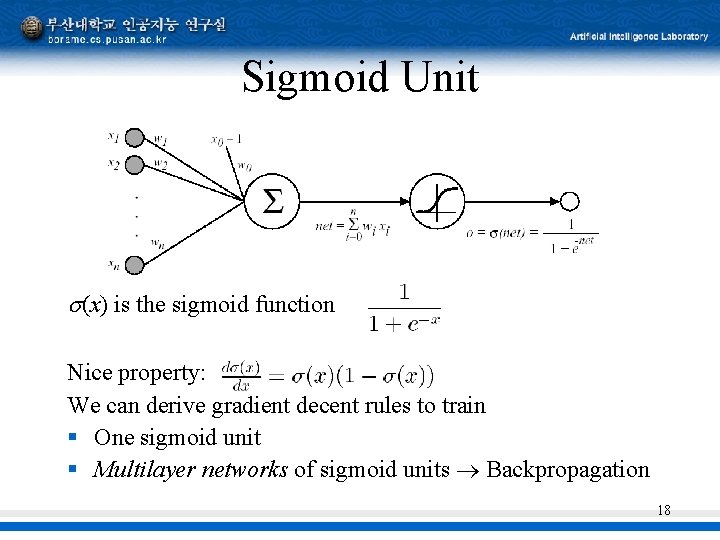
Sigmoid Unit (x) is the sigmoid function Nice property: We can derive gradient decent rules to train § One sigmoid unit § Multilayer networks of sigmoid units Backpropagation 18
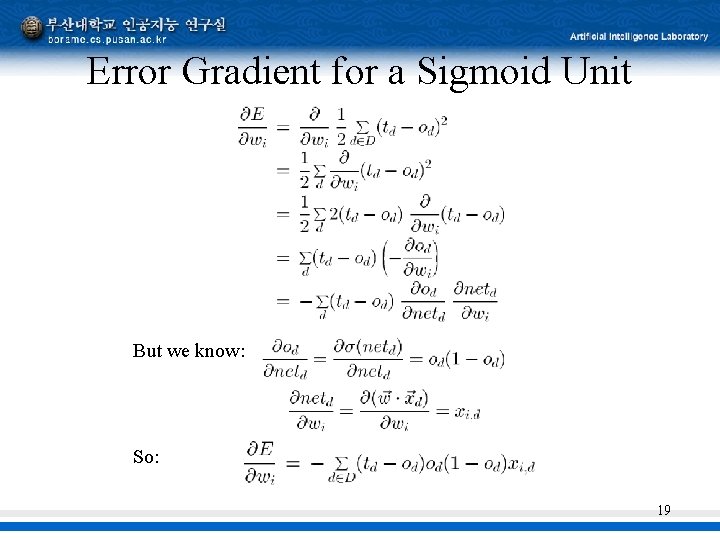
Error Gradient for a Sigmoid Unit But we know: So: 19
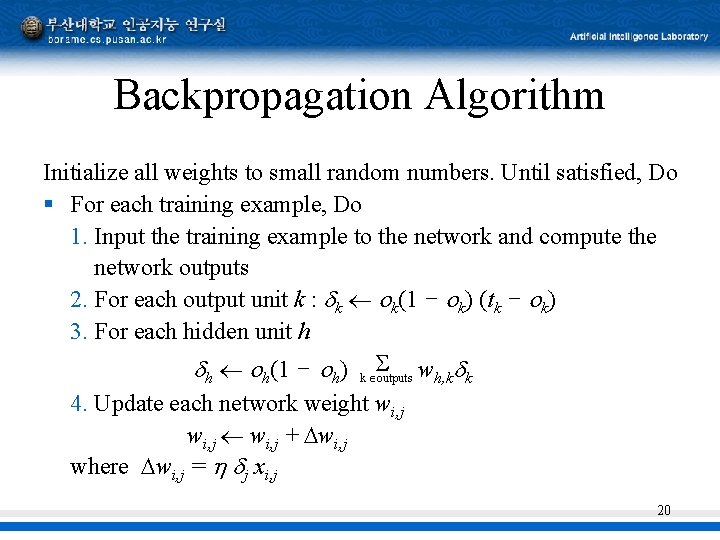
Backpropagation Algorithm Initialize all weights to small random numbers. Until satisfied, Do § For each training example, Do 1. Input the training example to the network and compute the network outputs 2. For each output unit k : k k(1 - k) (tk - k) 3. For each hidden unit h w (1 - ) k outputs h h, k k 4. Update each network weight wi, j + wi, j where wi, j = j xi, j 20
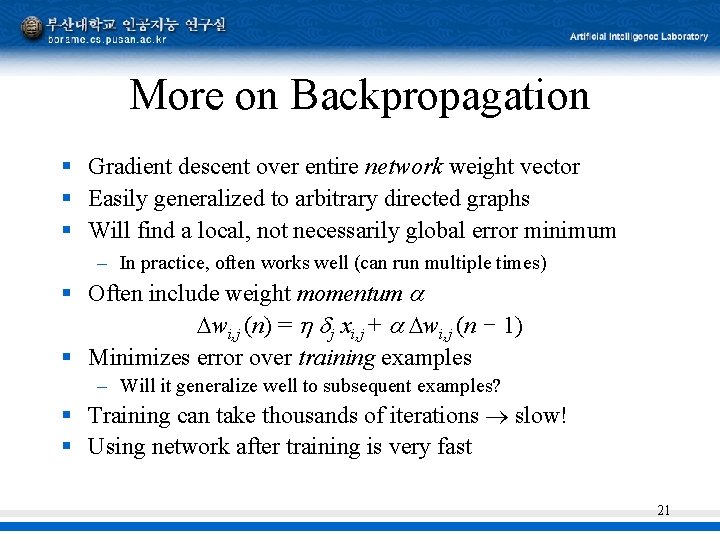
More on Backpropagation § Gradient descent over entire network weight vector § Easily generalized to arbitrary directed graphs § Will find a local, not necessarily global error minimum – In practice, often works well (can run multiple times) § Often include weight momentum wi, j (n) = j xi, j + wi, j (n - 1) § Minimizes error over training examples – Will it generalize well to subsequent examples? § Training can take thousands of iterations slow! § Using network after training is very fast 21
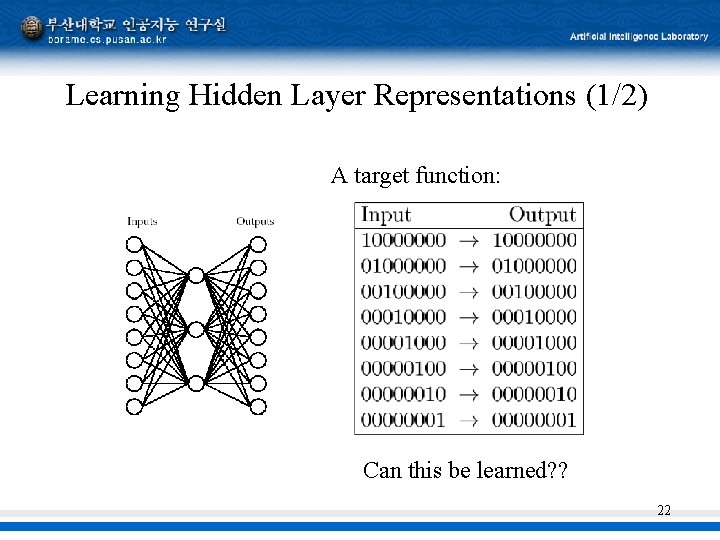
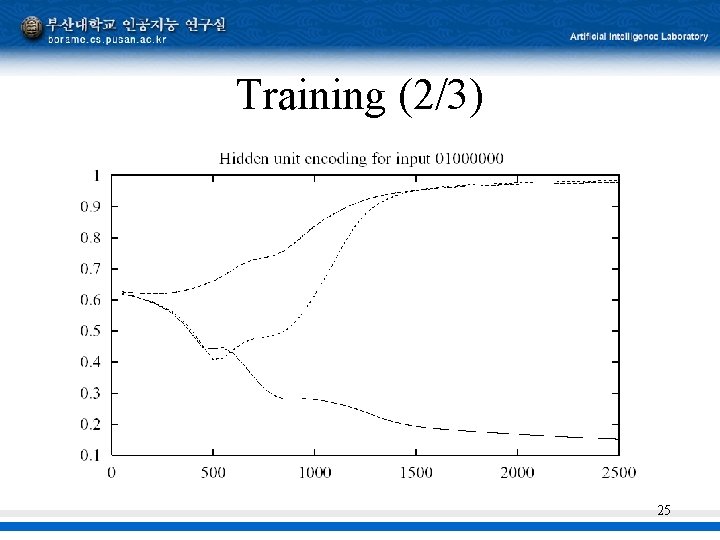
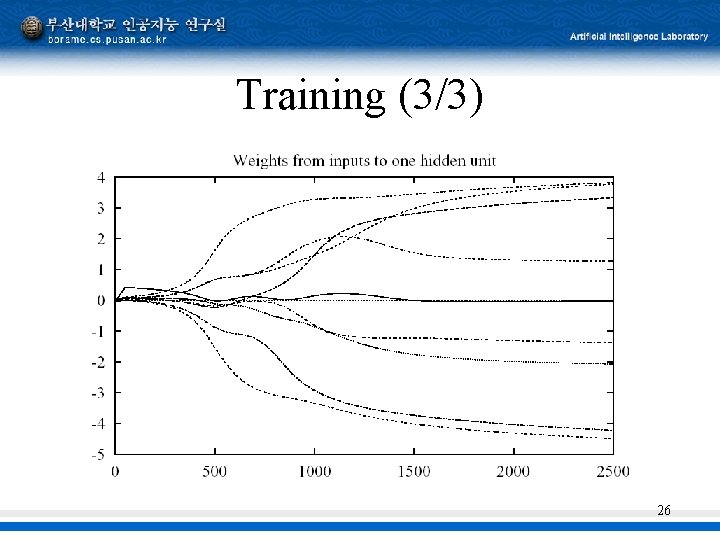
Learning Hidden Layer Representations (1/2) A target function: Can this be learned? ? 22
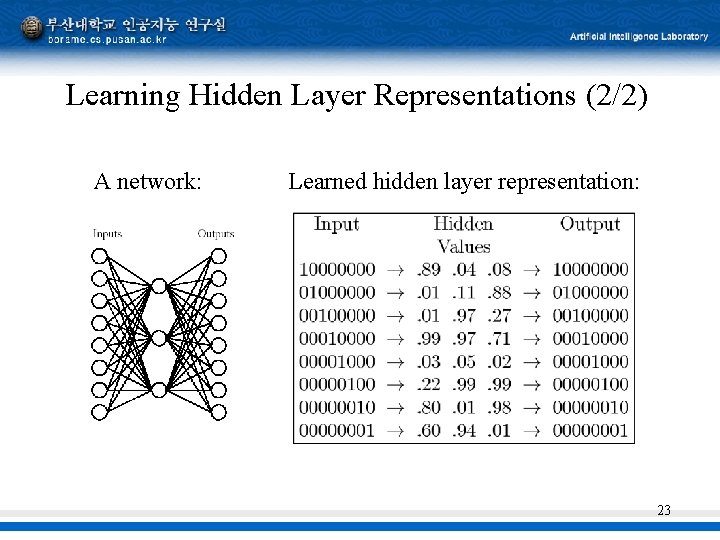
Learning Hidden Layer Representations (2/2) A network: Learned hidden layer representation: 23
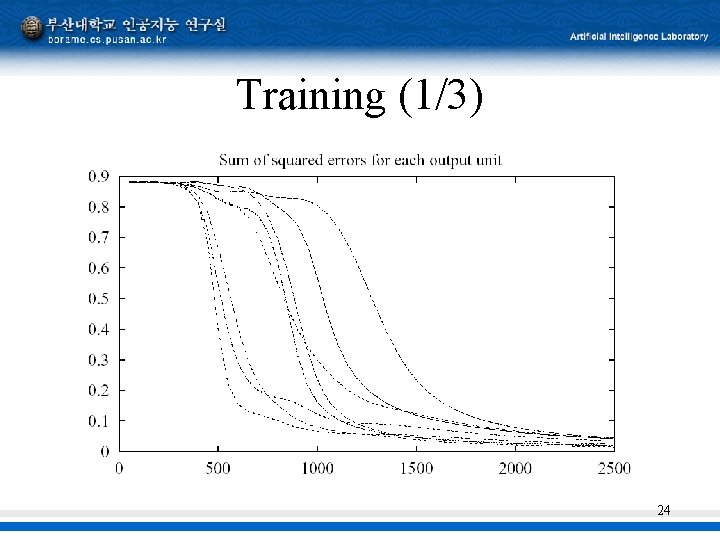
Training (1/3) 24
Training (2/3) 25
Training (3/3) 26
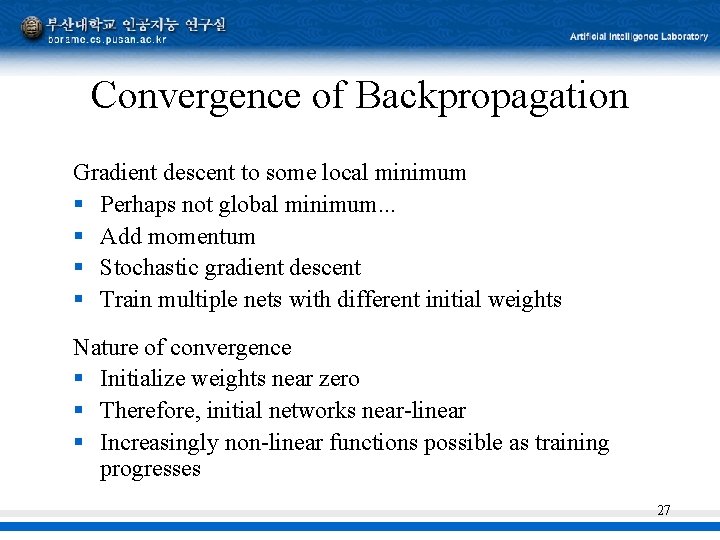
Convergence of Backpropagation Gradient descent to some local minimum § Perhaps not global minimum. . . § Add momentum § Stochastic gradient descent § Train multiple nets with different initial weights Nature of convergence § Initialize weights near zero § Therefore, initial networks near-linear § Increasingly non-linear functions possible as training progresses 27
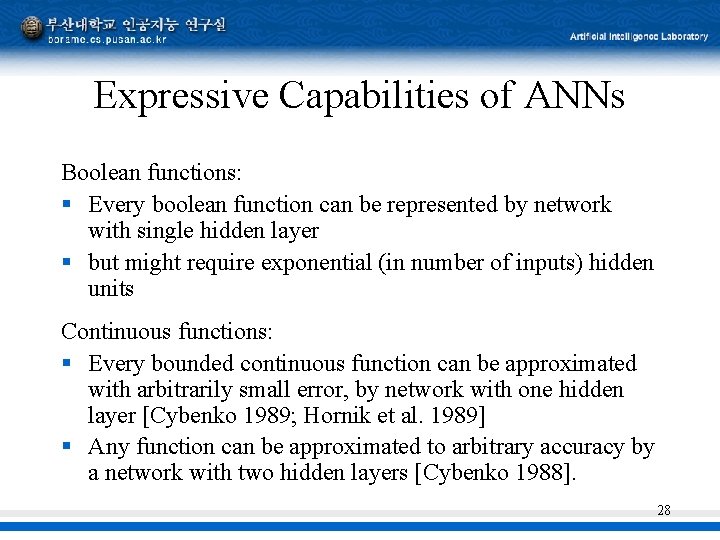
Expressive Capabilities of ANNs Boolean functions: § Every boolean function can be represented by network with single hidden layer § but might require exponential (in number of inputs) hidden units Continuous functions: § Every bounded continuous function can be approximated with arbitrarily small error, by network with one hidden layer [Cybenko 1989; Hornik et al. 1989] § Any function can be approximated to arbitrary accuracy by a network with two hidden layers [Cybenko 1988]. 28
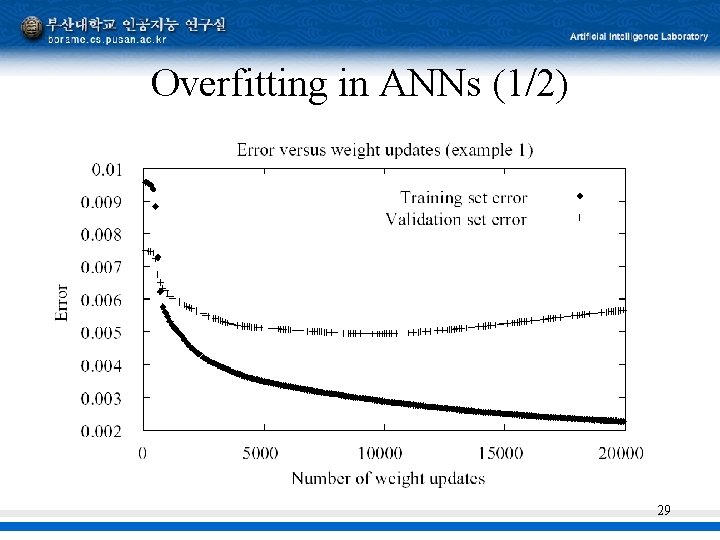
Overfitting in ANNs (1/2) 29
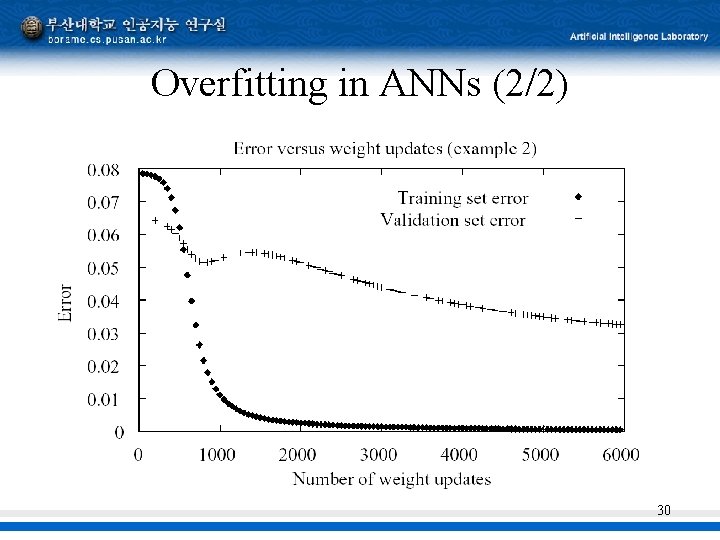
Overfitting in ANNs (2/2) 30
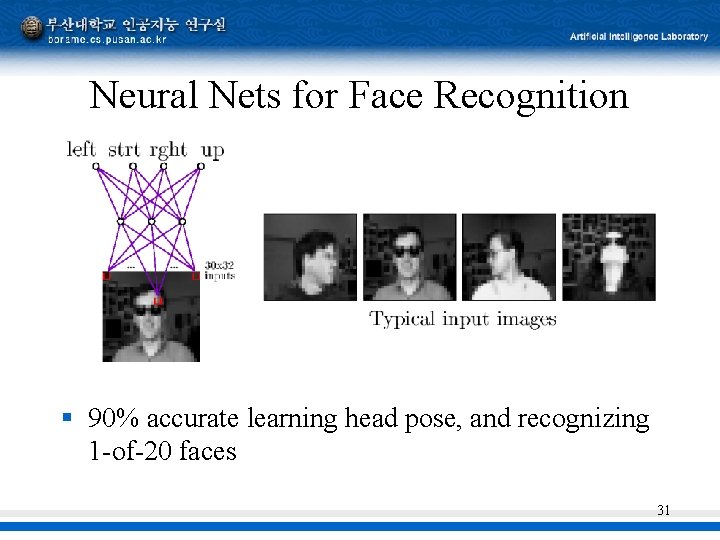
Neural Nets for Face Recognition § 90% accurate learning head pose, and recognizing 1 -of-20 faces 31
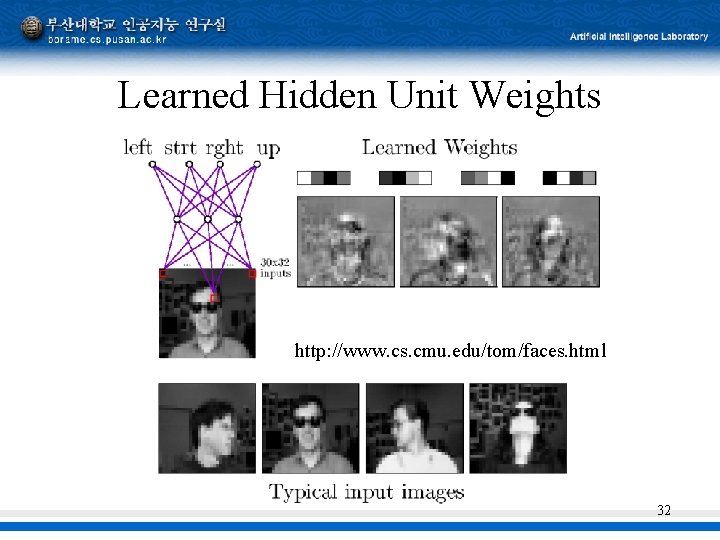
Learned Hidden Unit Weights http: //www. cs. cmu. edu/tom/faces. html 32
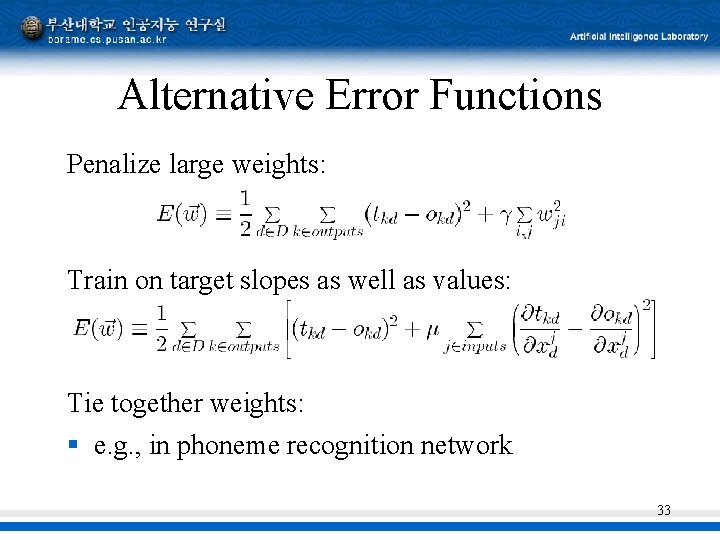
Alternative Error Functions Penalize large weights: Train on target slopes as well as values: Tie together weights: § e. g. , in phoneme recognition network 33
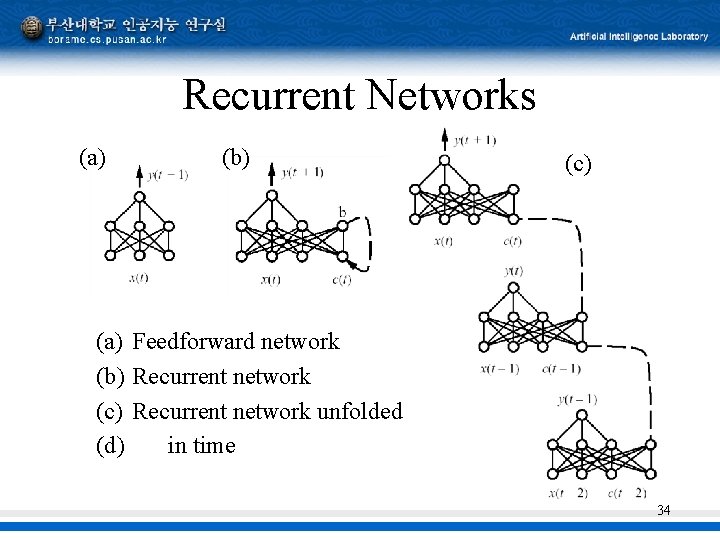
Recurrent Networks (a) (b) (c) (a) Feedforward network (b) Recurrent network (c) Recurrent network unfolded (d) in time 34