
Machine Learning Chapter 2 Concept Learning and The
- Slides: 25
Machine Learning Chapter 2. Concept Learning and The General-to-specific Ordering Tom M. Mitchell
Outline § Learning from examples § General-to-specific ordering over hypotheses § Version spaces and candidate elimination algorithm § Picking new examples § The need for inductive bias Note: simple approach assuming no noise, illustrates key concepts 2
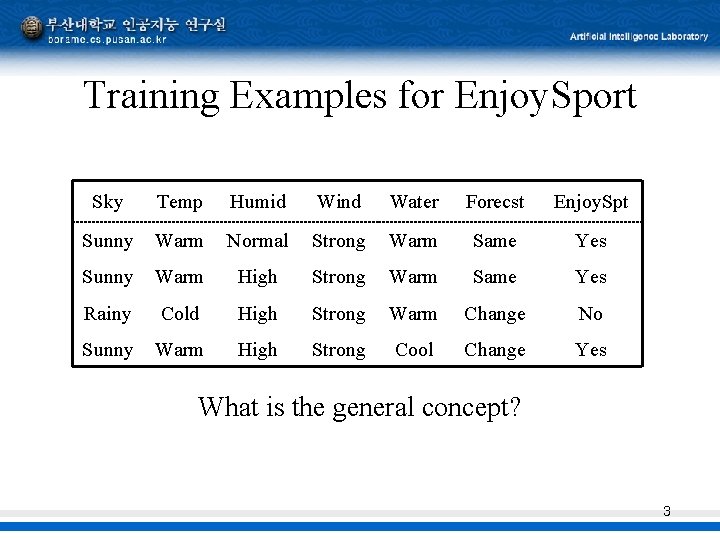
Training Examples for Enjoy. Sport Sky Temp Humid Wind Water Forecst Enjoy. Spt Sunny Warm Normal Strong Warm Same Yes Sunny Warm High Strong Warm Same Yes Rainy Cold High Strong Warm Change No Sunny Warm High Strong Cool Change Yes What is the general concept? 3
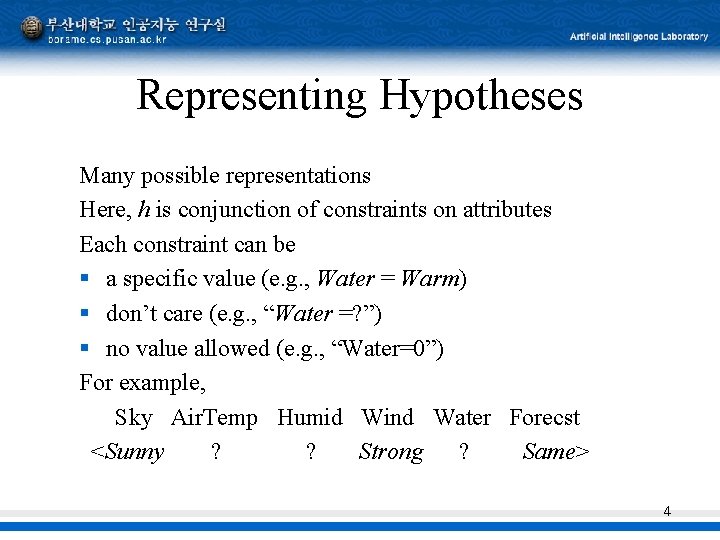
Representing Hypotheses Many possible representations Here, h is conjunction of constraints on attributes Each constraint can be § a specific value (e. g. , Water = Warm) § don’t care (e. g. , “Water =? ”) § no value allowed (e. g. , “Water=0”) For example, Sky Air. Temp Humid Wind Water Forecst <Sunny ? ? Strong ? Same> 4
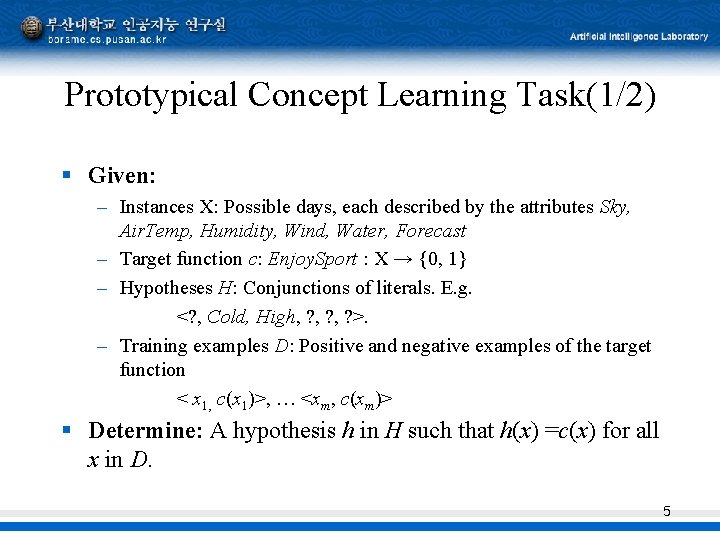
Prototypical Concept Learning Task(1/2) § Given: – Instances X: Possible days, each described by the attributes Sky, Air. Temp, Humidity, Wind, Water, Forecast – Target function c: Enjoy. Sport : X → {0, 1} – Hypotheses H: Conjunctions of literals. E. g. <? , Cold, High, ? , ? >. – Training examples D: Positive and negative examples of the target function < x 1, c(x 1)>, … <xm, c(xm)> § Determine: A hypothesis h in H such that h(x) =c(x) for all x in D. 5
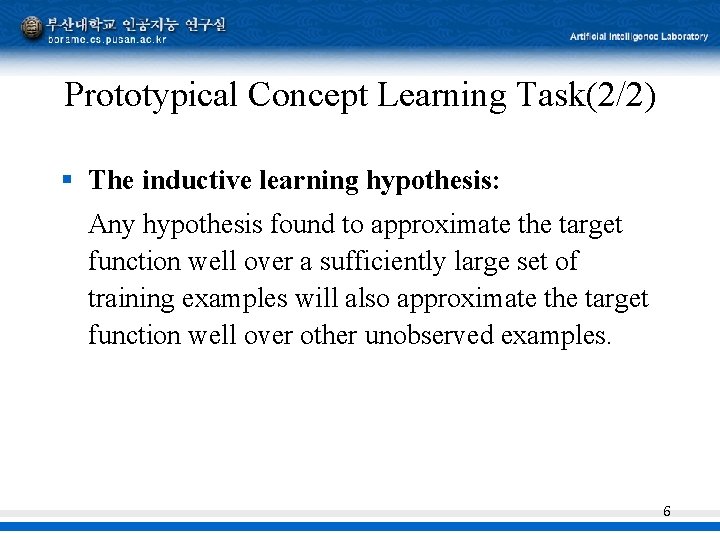
Prototypical Concept Learning Task(2/2) § The inductive learning hypothesis: Any hypothesis found to approximate the target function well over a sufficiently large set of training examples will also approximate the target function well over other unobserved examples. 6
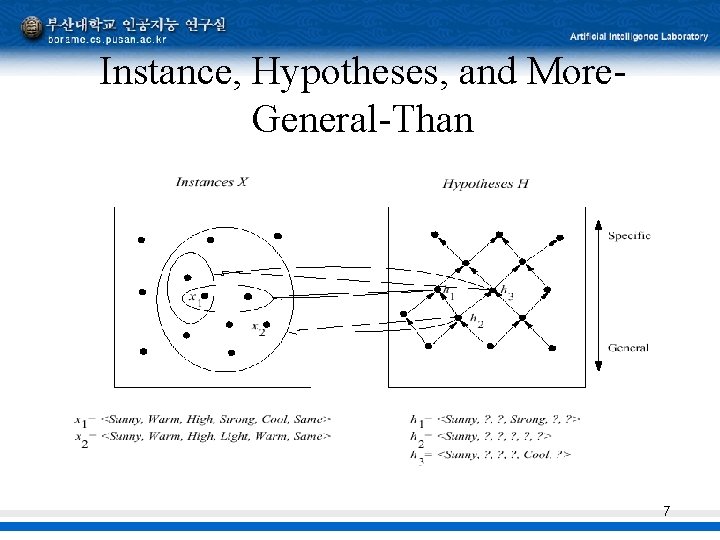
Instance, Hypotheses, and More. General-Than 7
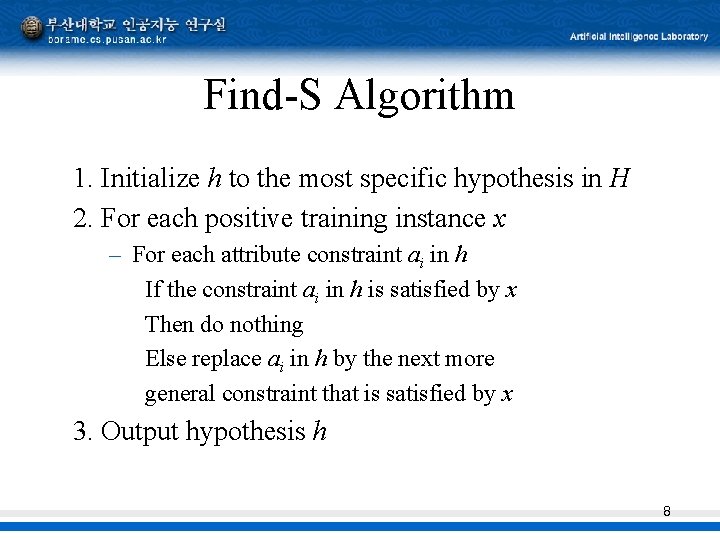
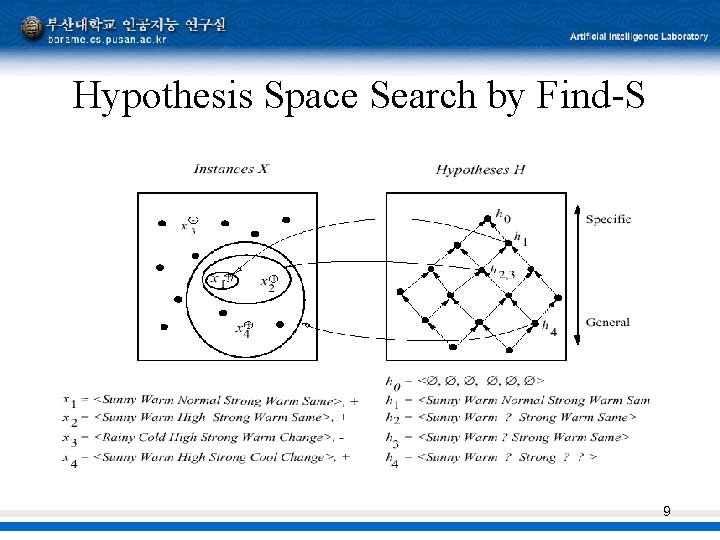
Find-S Algorithm 1. Initialize h to the most specific hypothesis in H 2. For each positive training instance x – For each attribute constraint ai in h If the constraint ai in h is satisfied by x Then do nothing Else replace ai in h by the next more general constraint that is satisfied by x 3. Output hypothesis h 8
Hypothesis Space Search by Find-S 9
Complaints about Find-S § Can’t tell whether it has learned concept § Can’t tell when training data inconsistent § Picks a maximally specific h (why? ) § Depending on H, there might be several! 10
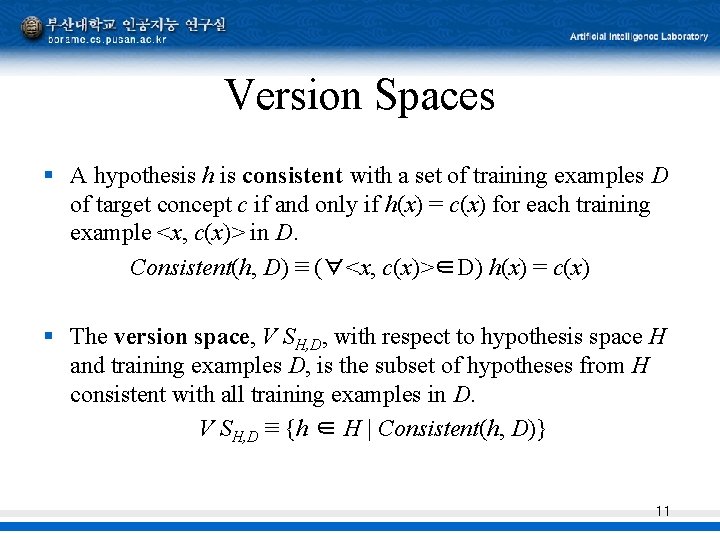
Version Spaces § A hypothesis h is consistent with a set of training examples D of target concept c if and only if h(x) = c(x) for each training example <x, c(x)> in D. Consistent(h, D) ≡ (∀<x, c(x)>∈D) h(x) = c(x) § The version space, V SH, D, with respect to hypothesis space H and training examples D, is the subset of hypotheses from H consistent with all training examples in D. V SH, D ≡ {h ∈ H | Consistent(h, D)} 11
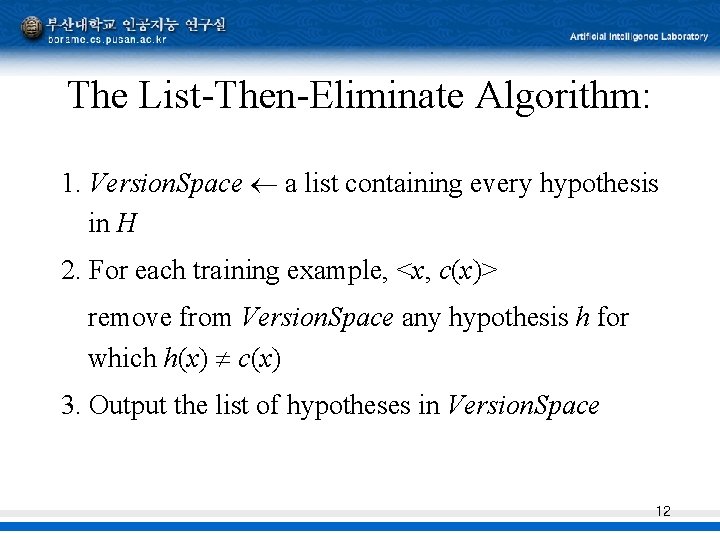
The List-Then-Eliminate Algorithm: 1. Version. Space a list containing every hypothesis in H 2. For each training example, <x, c(x)> remove from Version. Space any hypothesis h for which h(x) c(x) 3. Output the list of hypotheses in Version. Space 12
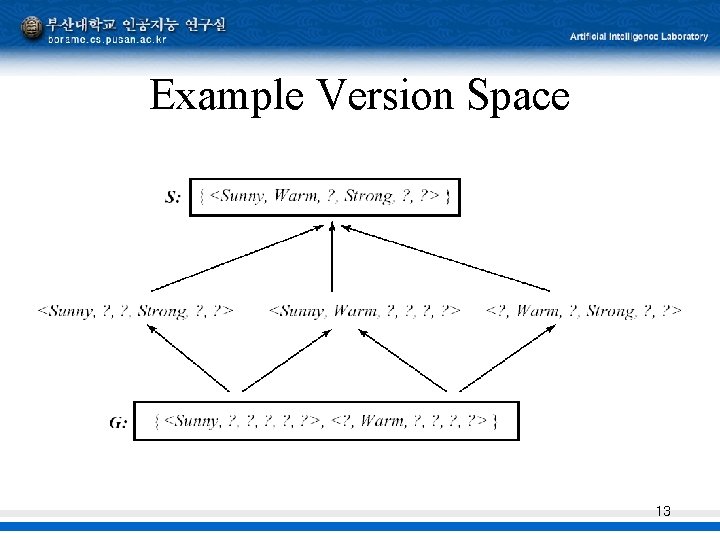
Example Version Space 13
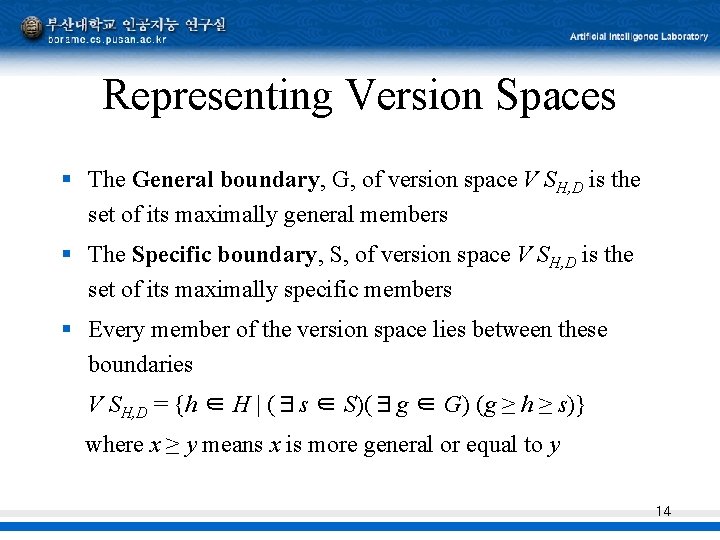
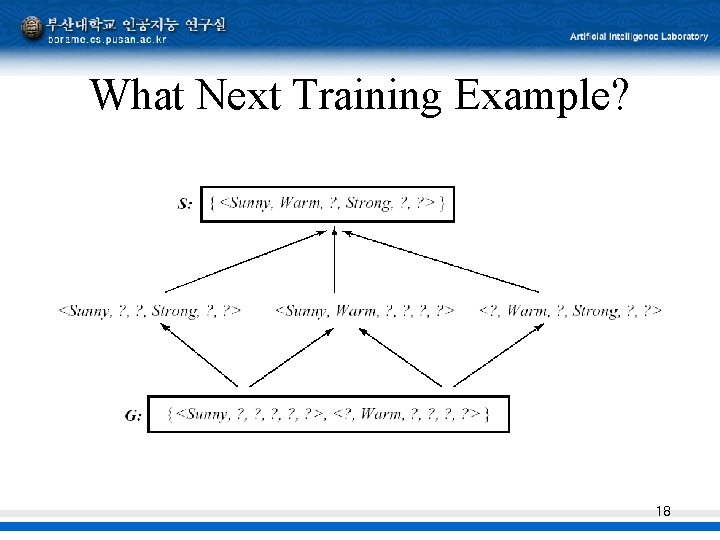
Representing Version Spaces § The General boundary, G, of version space V SH, D is the set of its maximally general members § The Specific boundary, S, of version space V SH, D is the set of its maximally specific members § Every member of the version space lies between these boundaries V SH, D = {h ∈ H | (∃s ∈ S)(∃g ∈ G) (g ≥ h ≥ s)} where x ≥ y means x is more general or equal to y 14
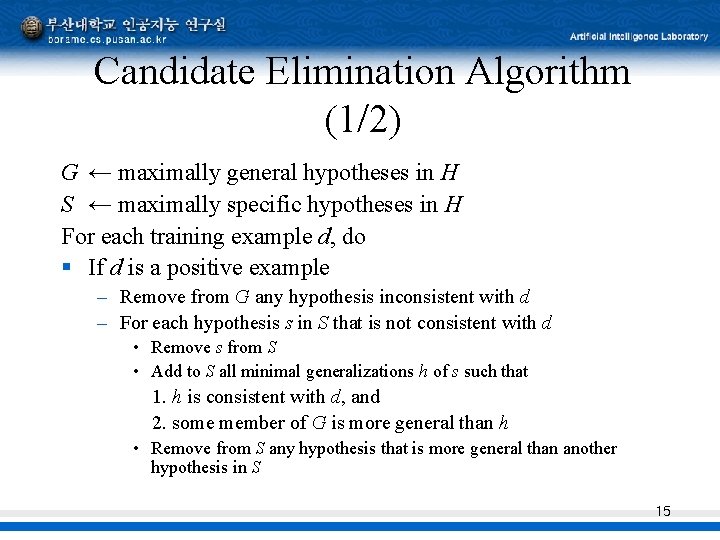
Candidate Elimination Algorithm (1/2) G ← maximally general hypotheses in H S ← maximally specific hypotheses in H For each training example d, do § If d is a positive example – Remove from G any hypothesis inconsistent with d – For each hypothesis s in S that is not consistent with d • Remove s from S • Add to S all minimal generalizations h of s such that 1. h is consistent with d, and 2. some member of G is more general than h • Remove from S any hypothesis that is more general than another hypothesis in S 15
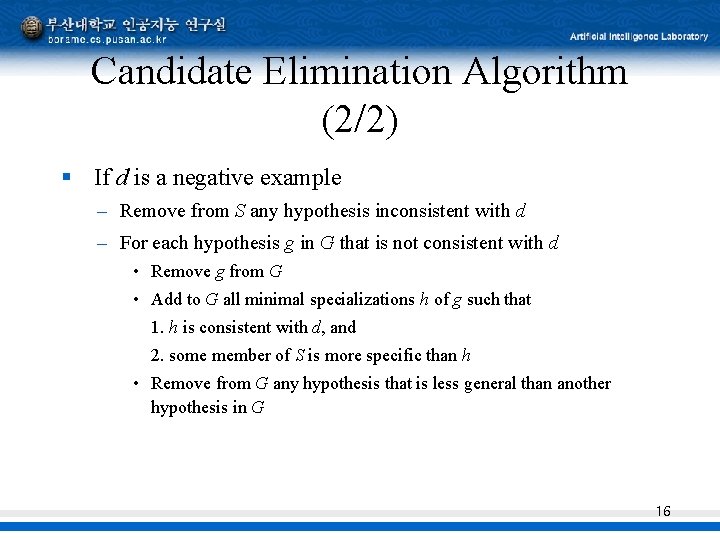
Candidate Elimination Algorithm (2/2) § If d is a negative example – Remove from S any hypothesis inconsistent with d – For each hypothesis g in G that is not consistent with d • Remove g from G • Add to G all minimal specializations h of g such that 1. h is consistent with d, and 2. some member of S is more specific than h • Remove from G any hypothesis that is less general than another hypothesis in G 16
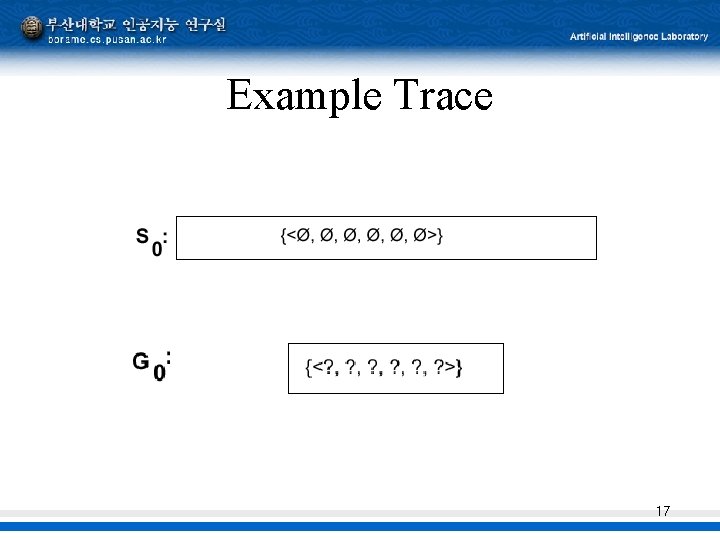
Example Trace 17
What Next Training Example? 18
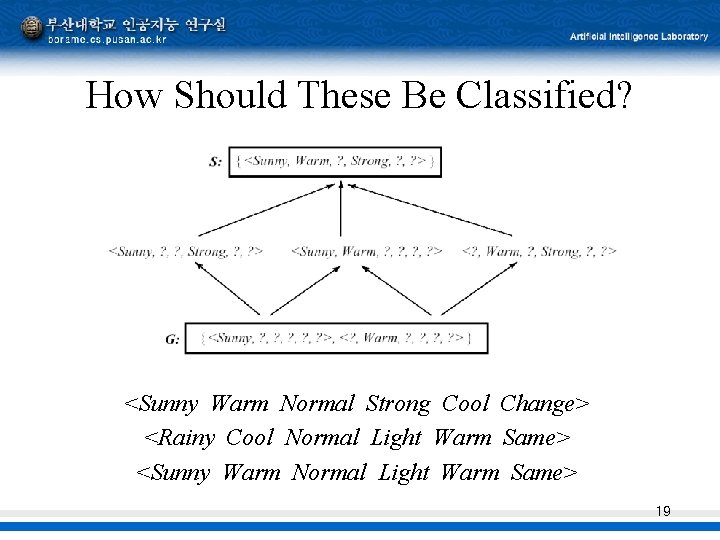
How Should These Be Classified? <Sunny Warm Normal Strong Cool Change> <Rainy Cool Normal Light Warm Same> <Sunny Warm Normal Light Warm Same> 19
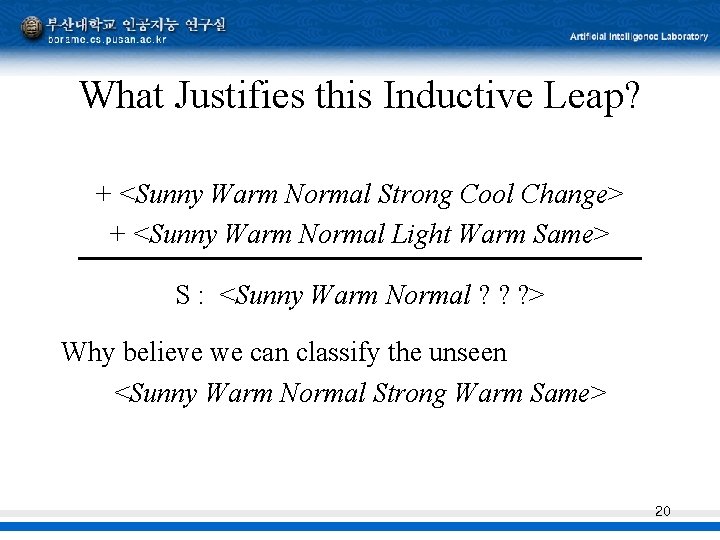
What Justifies this Inductive Leap? + <Sunny Warm Normal Strong Cool Change> + <Sunny Warm Normal Light Warm Same> S : <Sunny Warm Normal ? ? ? > Why believe we can classify the unseen <Sunny Warm Normal Strong Warm Same> 20
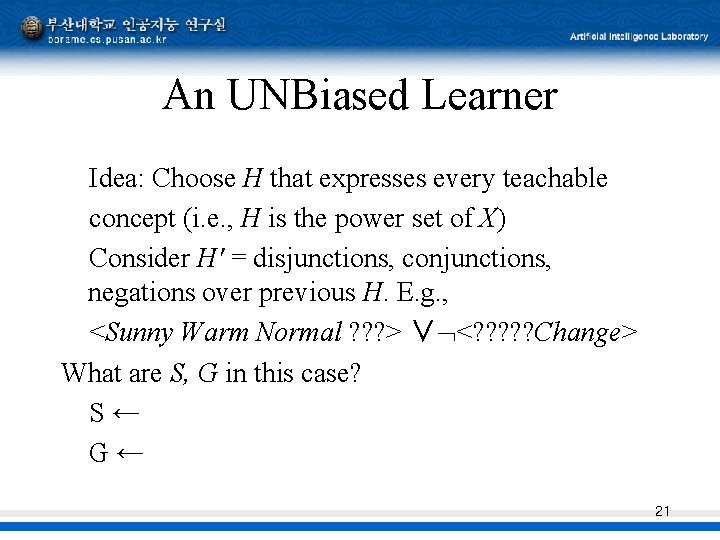
An UNBiased Learner Idea: Choose H that expresses every teachable concept (i. e. , H is the power set of X) Consider H' = disjunctions, conjunctions, negations over previous H. E. g. , <Sunny Warm Normal ? ? ? > ∨ <? ? ? Change> What are S, G in this case? S← G← 21
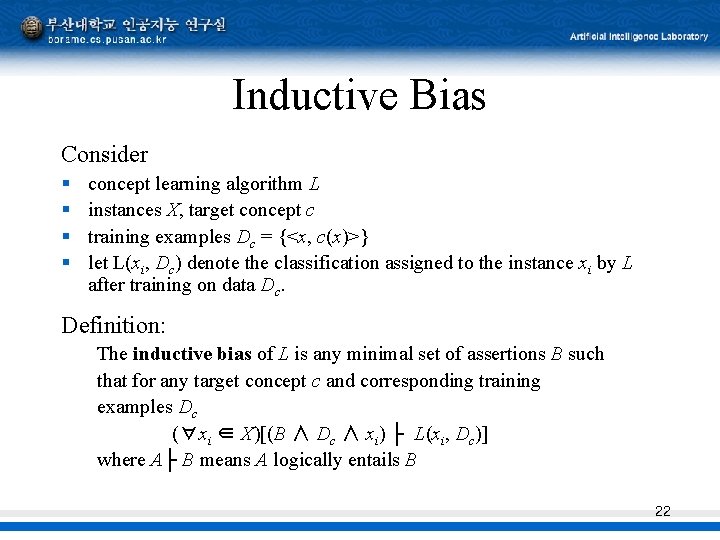
Inductive Bias Consider § § concept learning algorithm L instances X, target concept c training examples Dc = {<x, c(x)>} let L(xi, Dc) denote the classification assigned to the instance xi by L after training on data Dc. Definition: The inductive bias of L is any minimal set of assertions B such that for any target concept c and corresponding training examples Dc (∀xi ∈ X)[(B ∧ Dc ∧ xi) ├ L(xi, Dc)] where A├ B means A logically entails B 22
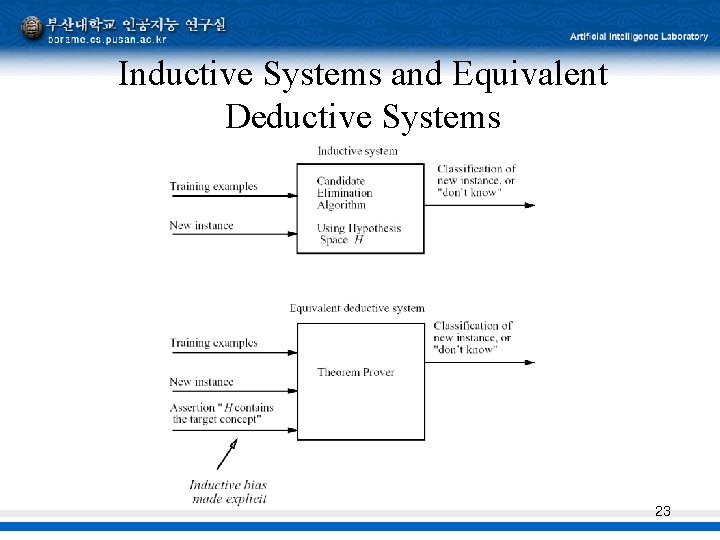
Inductive Systems and Equivalent Deductive Systems 23
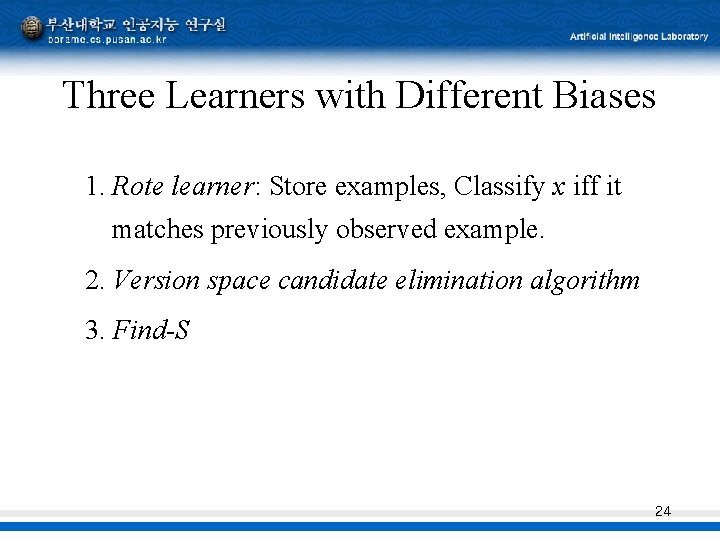
Three Learners with Different Biases 1. Rote learner: Store examples, Classify x iff it matches previously observed example. 2. Version space candidate elimination algorithm 3. Find-S 24
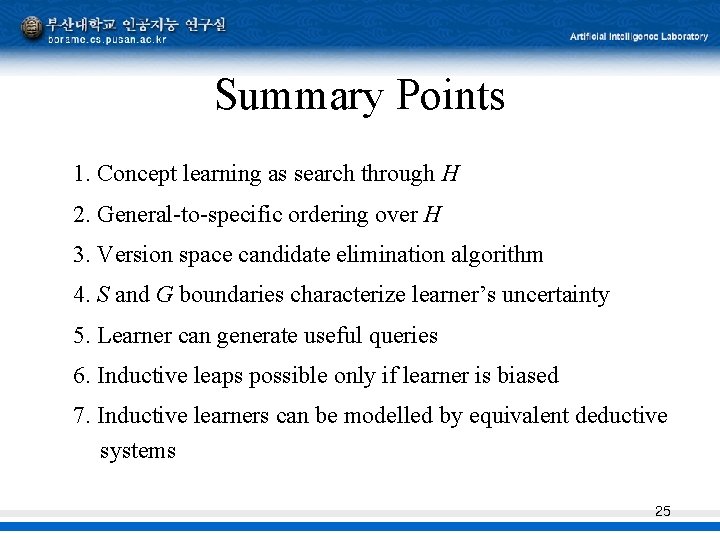
Summary Points 1. Concept learning as search through H 2. General-to-specific ordering over H 3. Version space candidate elimination algorithm 4. S and G boundaries characterize learner’s uncertainty 5. Learner can generate useful queries 6. Inductive leaps possible only if learner is biased 7. Inductive learners can be modelled by equivalent deductive systems 25