
Machine Learning basics Dimensionality reduction Visualization Neural networks
Machine Learning basics Dimensionality reduction, Visualization, Neural networks 12/7/2020 9: 39 AM ENEE 632
Overview Dimensionality reduction Principal Component Analysis (PCA) Linear Discriminant Analysis Data Visualization Multidimensional scaling (MDS) Stochastic Neighborhood Embedding (t-SNE) Artificial neural networks What are they Objective function and parameters Optimization algorithm: Gradient descent How to make them deep beasts? 12/7/2020 9: 39 AM ENEE 632
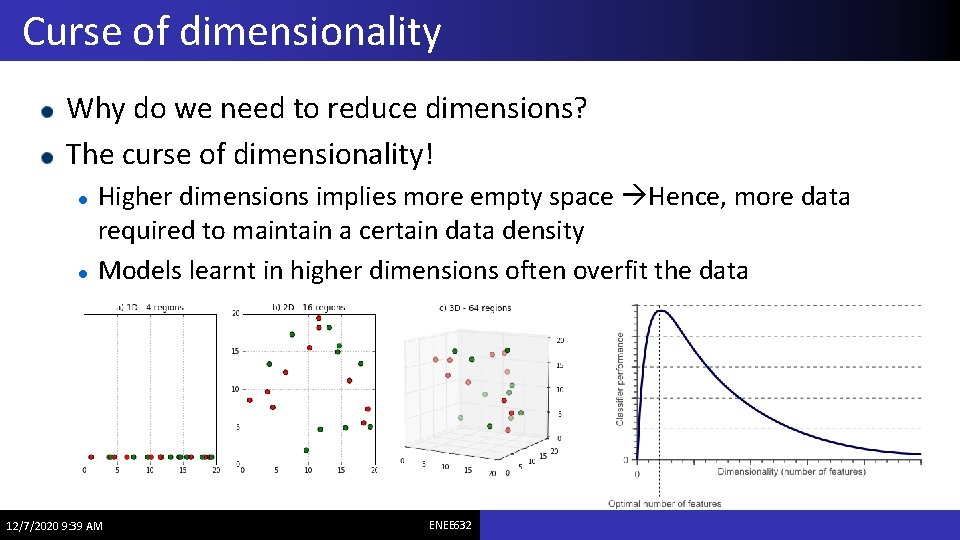
Curse of dimensionality Why do we need to reduce dimensions? The curse of dimensionality! Higher dimensions implies more empty space Hence, more data required to maintain a certain data density Models learnt in higher dimensions often overfit the data 12/7/2020 9: 39 AM ENEE 632
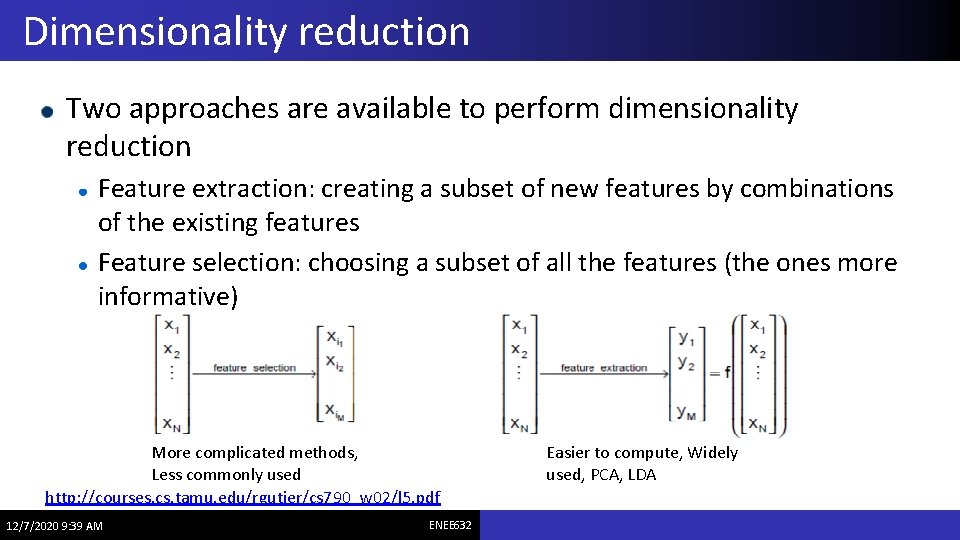
Dimensionality reduction Two approaches are available to perform dimensionality reduction Feature extraction: creating a subset of new features by combinations of the existing features Feature selection: choosing a subset of all the features (the ones more informative) More complicated methods, Less commonly used http: //courses. cs. tamu. edu/rgutier/cs 790_w 02/l 5. pdf 12/7/2020 9: 39 AM ENEE 632 Easier to compute, Widely used, PCA, LDA
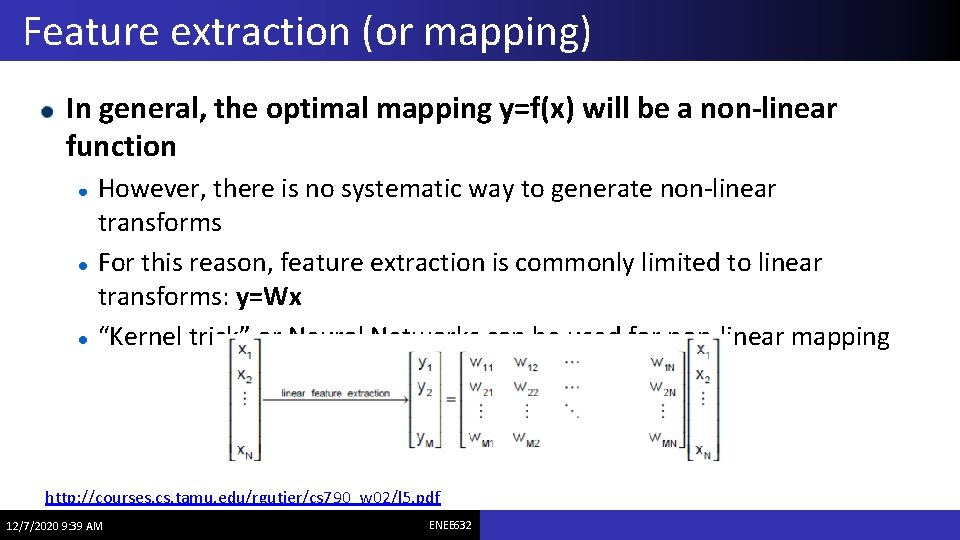
Feature extraction (or mapping) In general, the optimal mapping y=f(x) will be a non-linear function However, there is no systematic way to generate non-linear transforms For this reason, feature extraction is commonly limited to linear transforms: y=Wx “Kernel trick” or Neural Networks can be used for non-linear mapping http: //courses. cs. tamu. edu/rgutier/cs 790_w 02/l 5. pdf 12/7/2020 9: 39 AM ENEE 632

Different objectives, different mapping methods Within the realm of linear feature extraction, two techniques are commonly used Principal Components Analysis (PCA) • uses a signal representation criterion Linear Discriminant Analysis (LDA) • uses a classification criterion http: //courses. cs. tamu. edu/rgutier/cs 790_w 02/l 5. pdf 12/7/2020 9: 39 AM ENEE 632
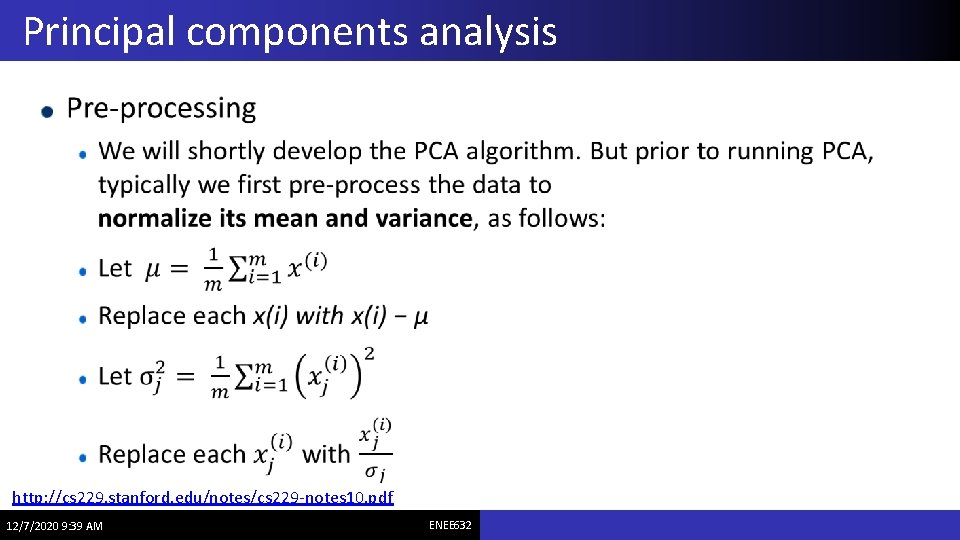
Principal components analysis http: //cs 229. stanford. edu/notes/cs 229 -notes 10. pdf 12/7/2020 9: 39 AM ENEE 632
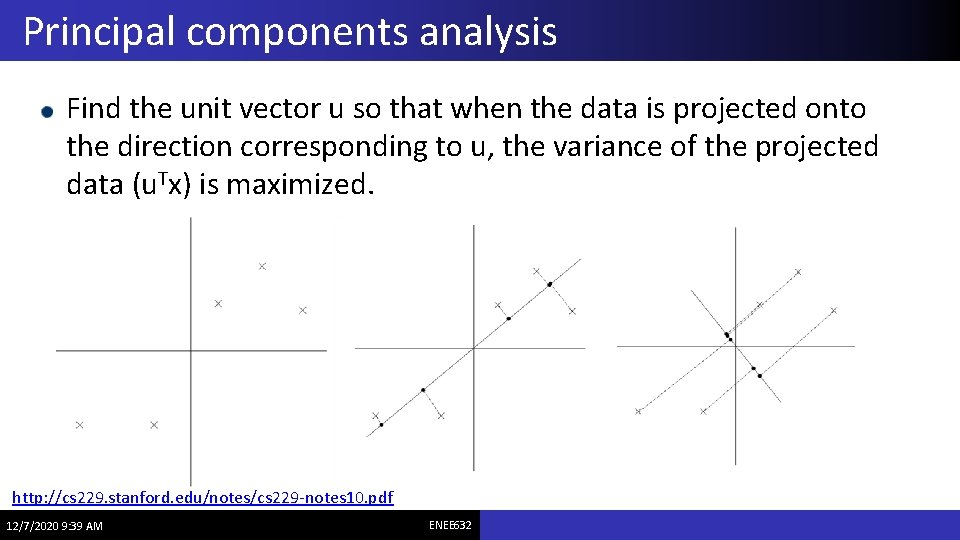
Principal components analysis Find the unit vector u so that when the data is projected onto the direction corresponding to u, the variance of the projected data (u. Tx) is maximized. http: //cs 229. stanford. edu/notes/cs 229 -notes 10. pdf 12/7/2020 9: 39 AM ENEE 632
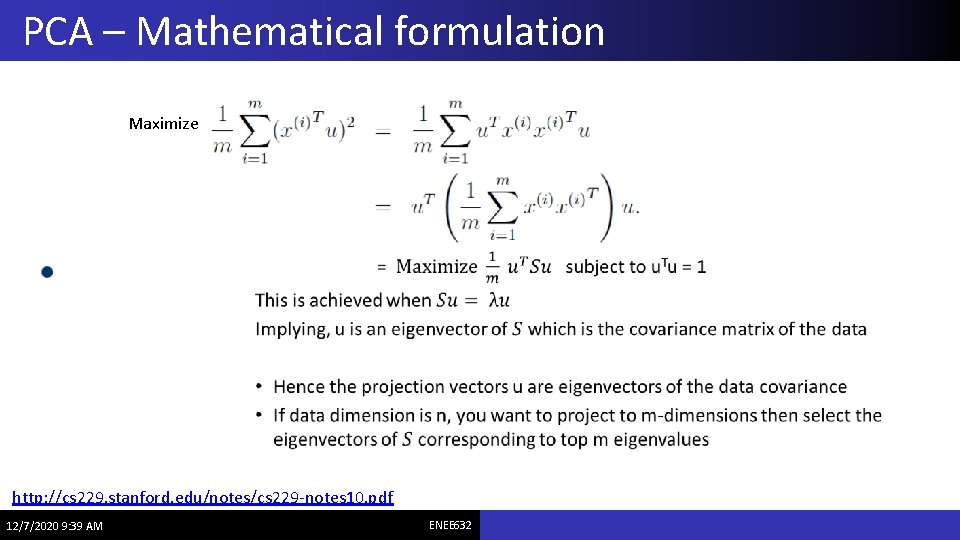
PCA – Mathematical formulation Maximize http: //cs 229. stanford. edu/notes/cs 229 -notes 10. pdf 12/7/2020 9: 39 AM ENEE 632
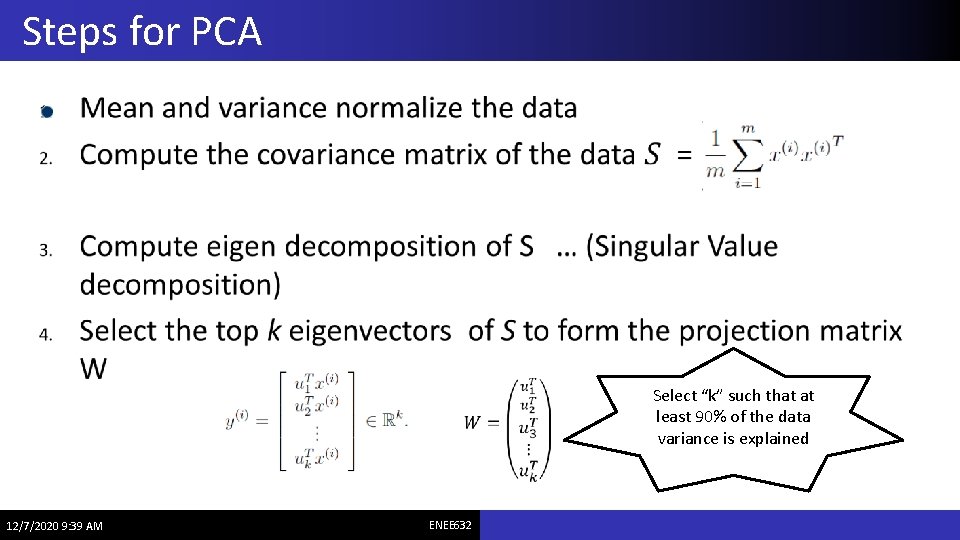
Steps for PCA 12/7/2020 9: 39 AM ENEE 632 Select “k” such that at least 90% of the data variance is explained

Linear Discriminant Analysis The objective of LDA is to perform dimensionality reduction while preserving as much of the class discriminatory information as possible Assume we have a set of D-dimensional samples {x(1), x(2), …, x(N)}, N 1 of which belong to class ω1, and N 2 to class ω2. We seek to obtain a scalar (1 -dimensional) y by projecting the samples x onto a line y = w Tx If you have c classes, LDA projects the data to (c-1) dimensions http: //courses. cs. tamu. edu/rgutier/cs 790_w 02/l 6. pdf 12/7/2020 9: 39 AM ENEE 632
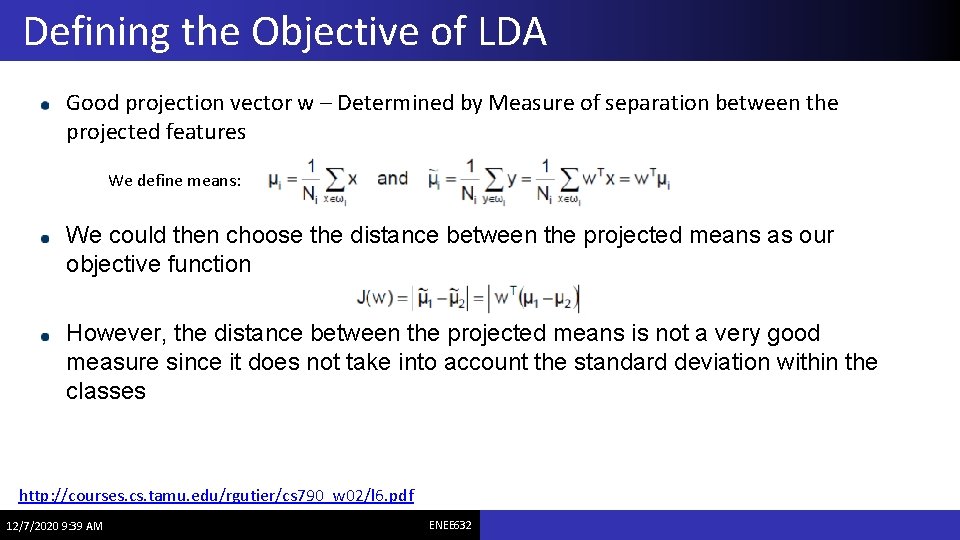
Defining the Objective of LDA Good projection vector w – Determined by Measure of separation between the projected features We define means: We could then choose the distance between the projected means as our objective function However, the distance between the projected means is not a very good measure since it does not take into account the standard deviation within the classes http: //courses. cs. tamu. edu/rgutier/cs 790_w 02/l 6. pdf 12/7/2020 9: 39 AM ENEE 632
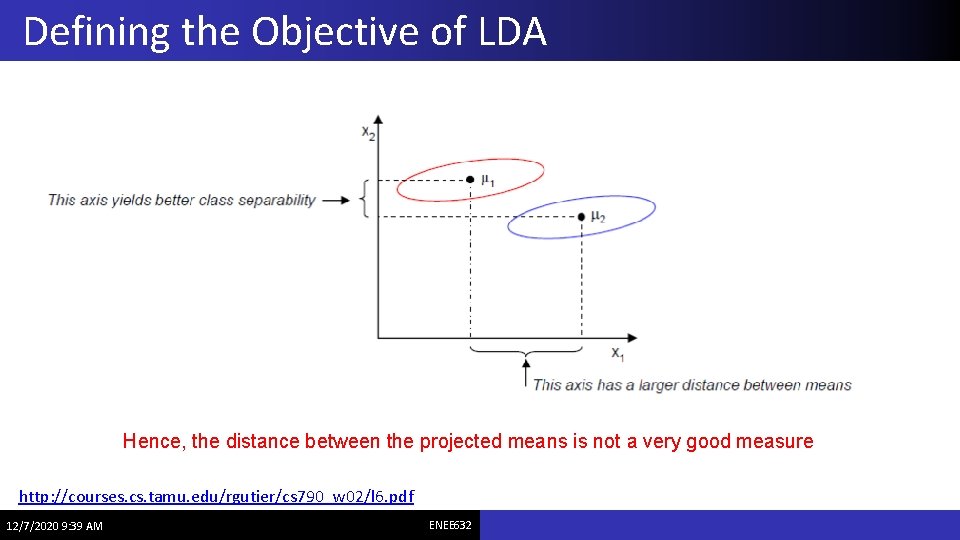
Defining the Objective of LDA Hence, the distance between the projected means is not a very good measure http: //courses. cs. tamu. edu/rgutier/cs 790_w 02/l 6. pdf 12/7/2020 9: 39 AM ENEE 632
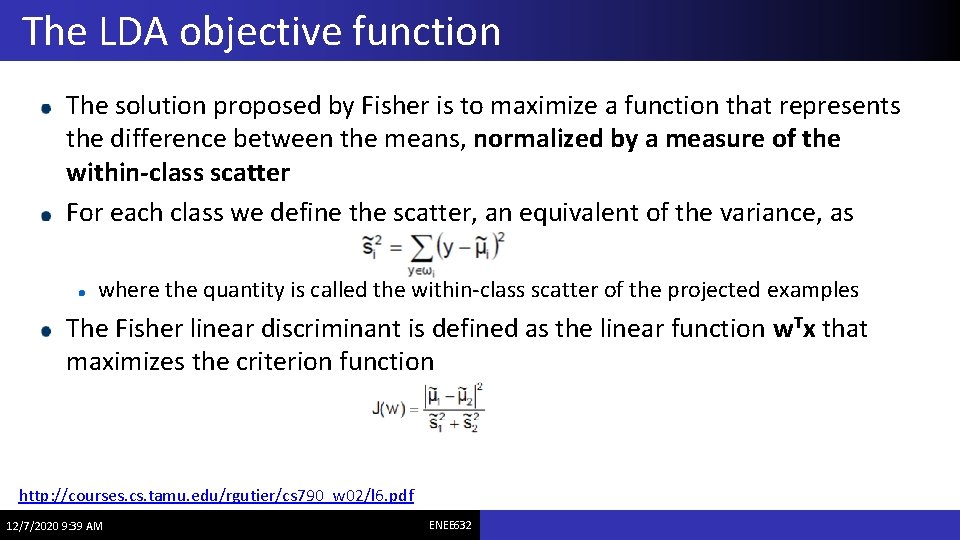
The LDA objective function The solution proposed by Fisher is to maximize a function that represents the difference between the means, normalized by a measure of the within-class scatter For each class we define the scatter, an equivalent of the variance, as where the quantity is called the within-class scatter of the projected examples The Fisher linear discriminant is defined as the linear function w. Tx that maximizes the criterion function http: //courses. cs. tamu. edu/rgutier/cs 790_w 02/l 6. pdf 12/7/2020 9: 39 AM ENEE 632
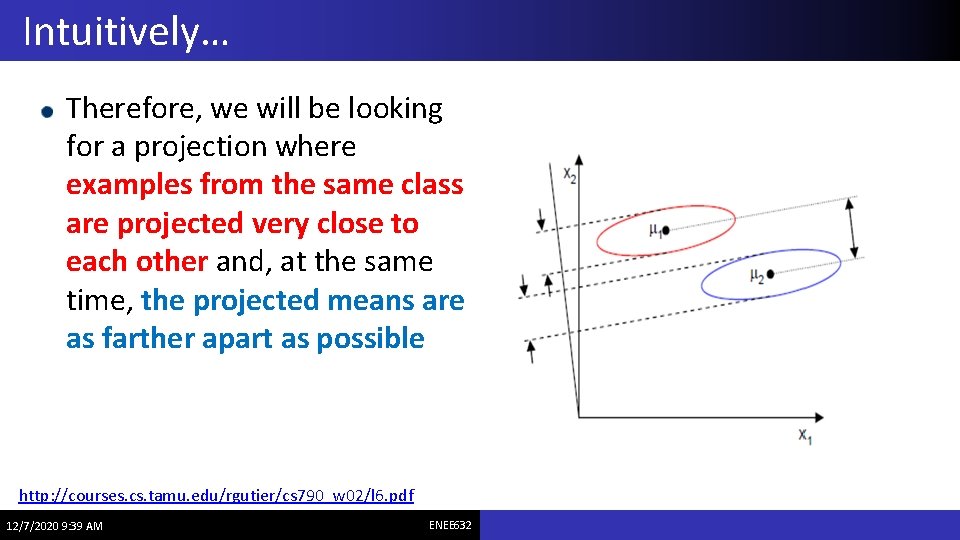
Intuitively… Therefore, we will be looking for a projection where examples from the same class are projected very close to each other and, at the same time, the projected means are as farther apart as possible http: //courses. cs. tamu. edu/rgutier/cs 790_w 02/l 6. pdf 12/7/2020 9: 39 AM ENEE 632
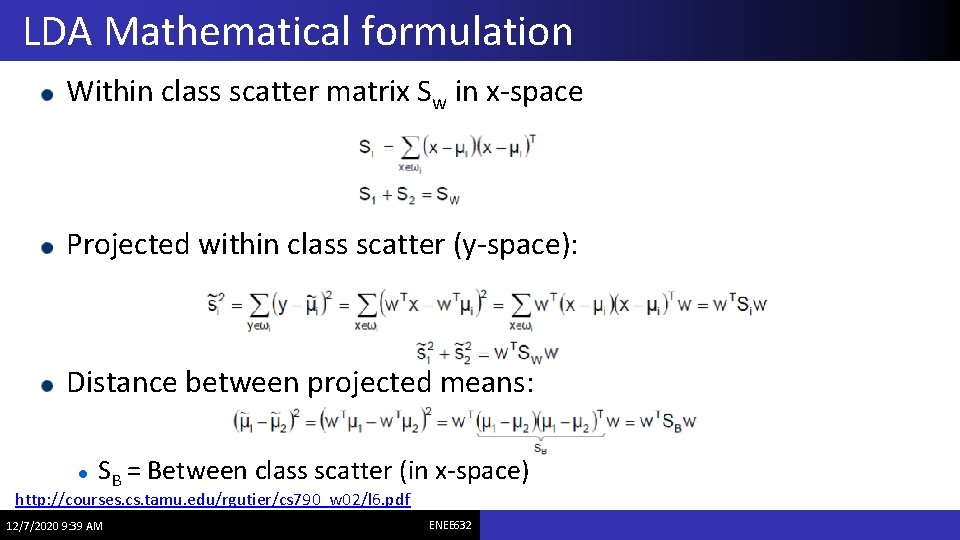
LDA Mathematical formulation Within class scatter matrix Sw in x-space Projected within class scatter (y-space): Distance between projected means: SB = Between class scatter (in x-space) http: //courses. cs. tamu. edu/rgutier/cs 790_w 02/l 6. pdf 12/7/2020 9: 39 AM ENEE 632
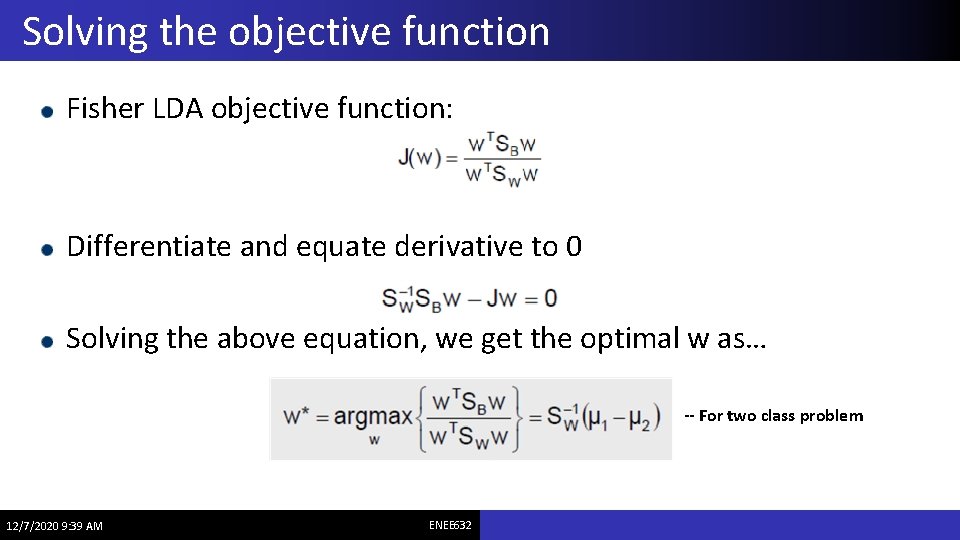
Solving the objective function Fisher LDA objective function: Differentiate and equate derivative to 0 Solving the above equation, we get the optimal w as… -- For two class problem 12/7/2020 9: 39 AM ENEE 632
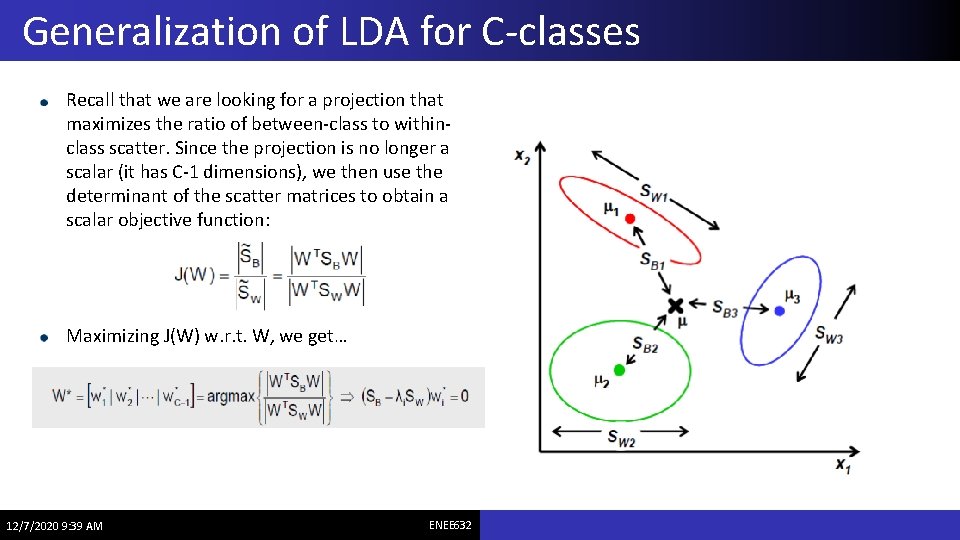
Generalization of LDA for C-classes Recall that we are looking for a projection that maximizes the ratio of between-class to withinclass scatter. Since the projection is no longer a scalar (it has C-1 dimensions), we then use the determinant of the scatter matrices to obtain a scalar objective function: Maximizing J(W) w. r. t. W, we get… 12/7/2020 9: 39 AM ENEE 632
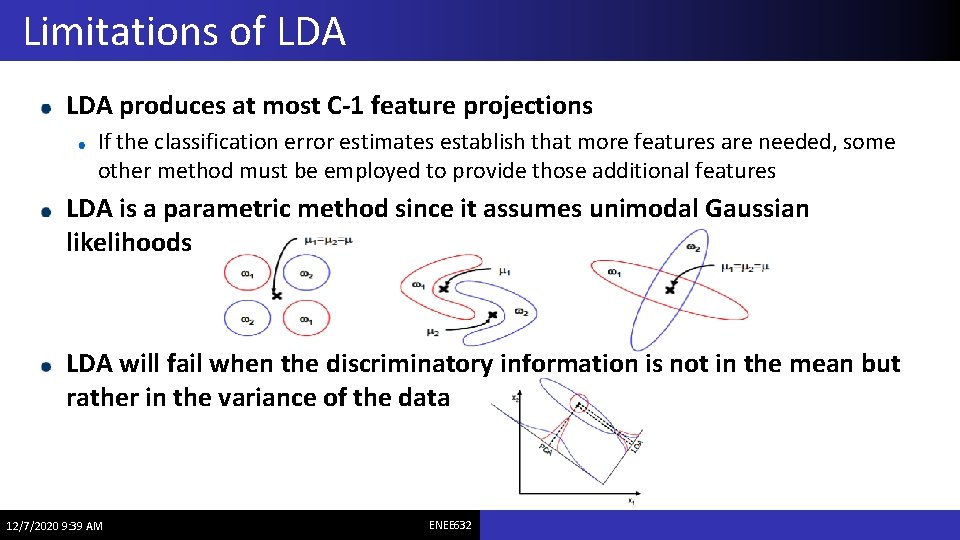
Limitations of LDA produces at most C-1 feature projections If the classification error estimates establish that more features are needed, some other method must be employed to provide those additional features LDA is a parametric method since it assumes unimodal Gaussian likelihoods LDA will fail when the discriminatory information is not in the mean but rather in the variance of the data 12/7/2020 9: 39 AM ENEE 632
Data Visualization Data of higher dimensions (>3) are hard to visualize Dimensionality reduction helps project data to lower dimensions for visualization LDA and PCA aren’t useful for reliable visualization of data Criteria for visualization: Preserves the structure of the high dimensional data Neighborhoods in projected data represent actual data neighborhoods 12/7/2020 9: 39 AM ENEE 632
Multidimensional Scaling (MDS) MDS slides from ETH-Z https: //stat. ethz. ch/education/semesters/ss 2012/ams/slides/v 4. 1. pdf 12/7/2020 9: 39 AM ENEE 632
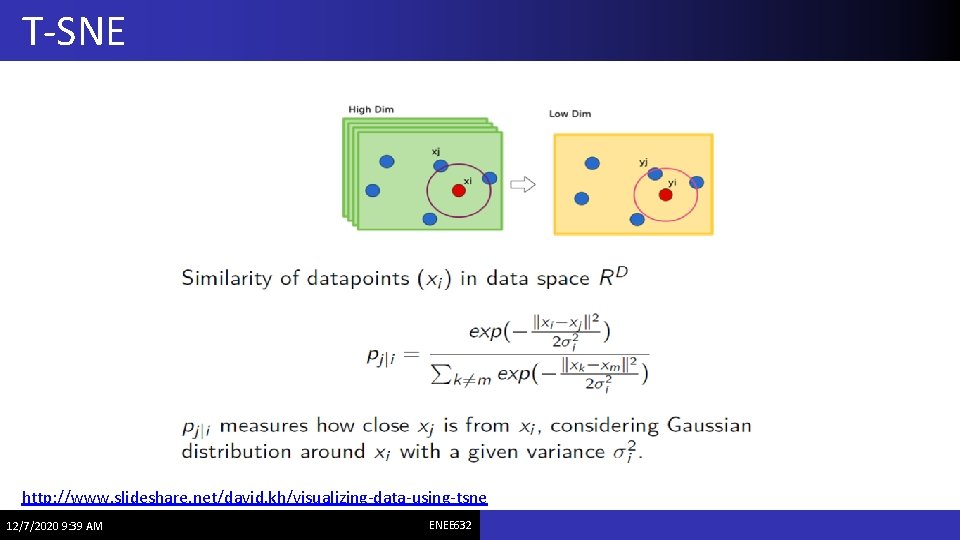
T-SNE http: //www. slideshare. net/david. kh/visualizing-data-using-tsne 12/7/2020 9: 39 AM ENEE 632
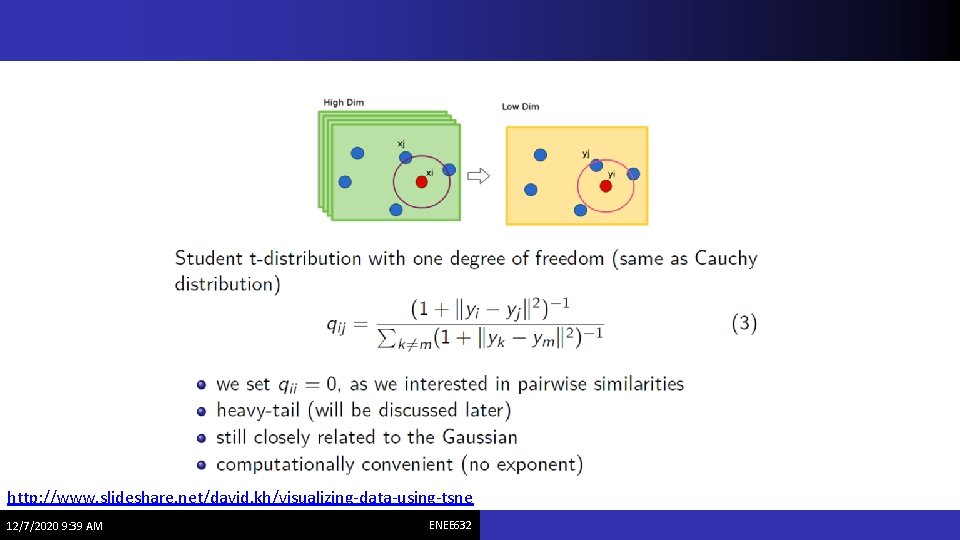
http: //www. slideshare. net/david. kh/visualizing-data-using-tsne 12/7/2020 9: 39 AM ENEE 632
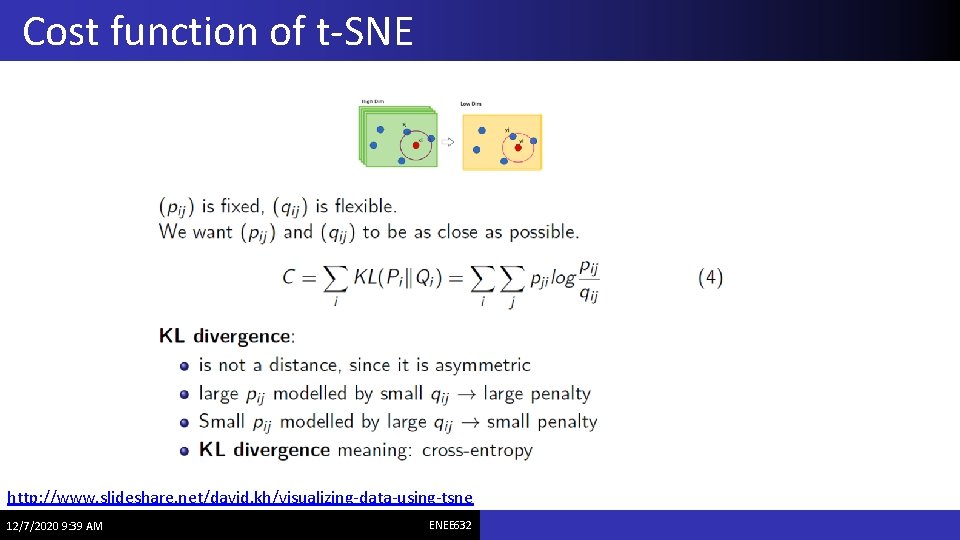
Cost function of t-SNE http: //www. slideshare. net/david. kh/visualizing-data-using-tsne 12/7/2020 9: 39 AM ENEE 632
Strengths and limitations of t-SNE Strengths: t-SNE is an effective method to visualize a complex datasets t-SNE exposes natural clusters Implemented in many languages Scalable with O(Nlog. N) version Limitations Sensitive to the curse of the intrinsic dimensionality of the data due to local nature of t-SNE Not guaranteed to converge to a global optimum of its cost function. Different initializations result in different results 12/7/2020 9: 39 AM ENEE 632
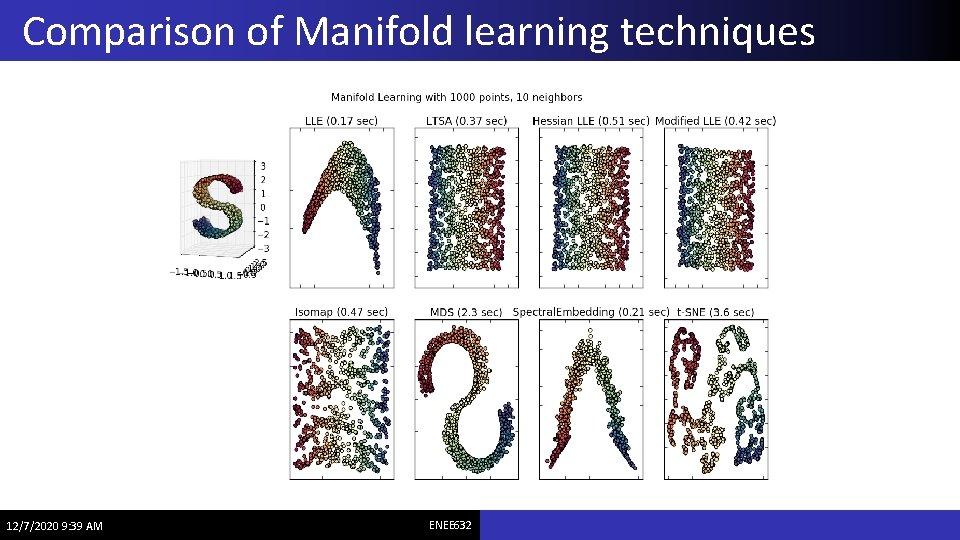
Comparison of Manifold learning techniques 12/7/2020 9: 39 AM ENEE 632

References http: //courses. cs. tamu. edu/rgutier/cs 790_w 02/l 5. pdf http: //scikitlearn. org/stable/auto_examples/manifold/plot_compare_meth ods. html T-SNE slides: http: //www. slideshare. net/david. kh/visualizingdata-using-tsne Multidimensional Scaling: https: //stat. ethz. ch/education/semesters/ss 2012/ams/slides/v 4. 1. pdf 12/7/2020 9: 39 AM ENEE 632
- Slides: 27