
Machine Learning Applied to Diagnosis of Human Diseases
- Slides: 20
“Machine Learning Applied to Diagnosis of Human Diseases: A Systematic Review” Nuria Caballé-Cervigón 1 , José L. Castillo-Sequera 2, 3 , Juan A. Gómez-Pulido 4, * , José M. Gómez-Pulido 2, 3 and María L. Polo-Luque 3 Journal of Applied Science. 31 May 2020; Accepted: 24 July 2020; Published: 26 July 2020 MOHAMAD NAZHAN B. MOHD. NIZAR ELECTRICAL ENGINEERING PROGRAMME UKM, BANGI. 21 S T OCT 2020
Objectives of Systematic Review q. Focus on modern techniques related to the development of Machine Learning which can be used in diagnosis of diseases q. Provide systematic review of the intelligent data analysis tools in the medical field. q. Provide examples of some algorithms used in medical field q. Describe advantages and disadvantages of each technique NIZAR. NAZHAN@GMAIL. COM 2
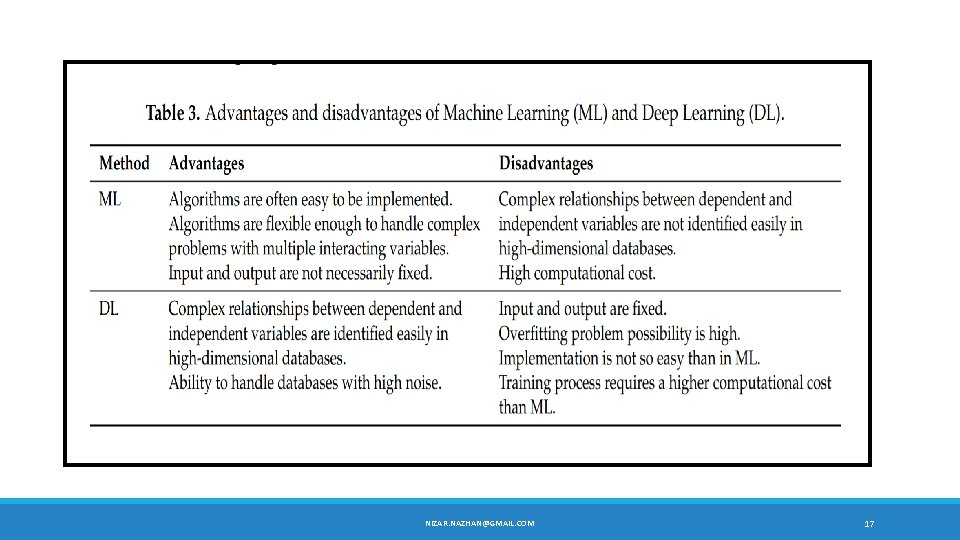
Machine Learning (ML) Within AI, Machine Learning (ML) emerged as a method of choice for developing algorithms to analyse datasets ML provides several indispensable tools for intelligent data analysis. Well suited for analysing medical data and, in particular, there is a wide range of works done in medical diagnosis in small-specialised diagnostic problems Deep Learning (DL) arose as a specific kind of ML NIZAR. NAZHAN@GMAIL. COM 3
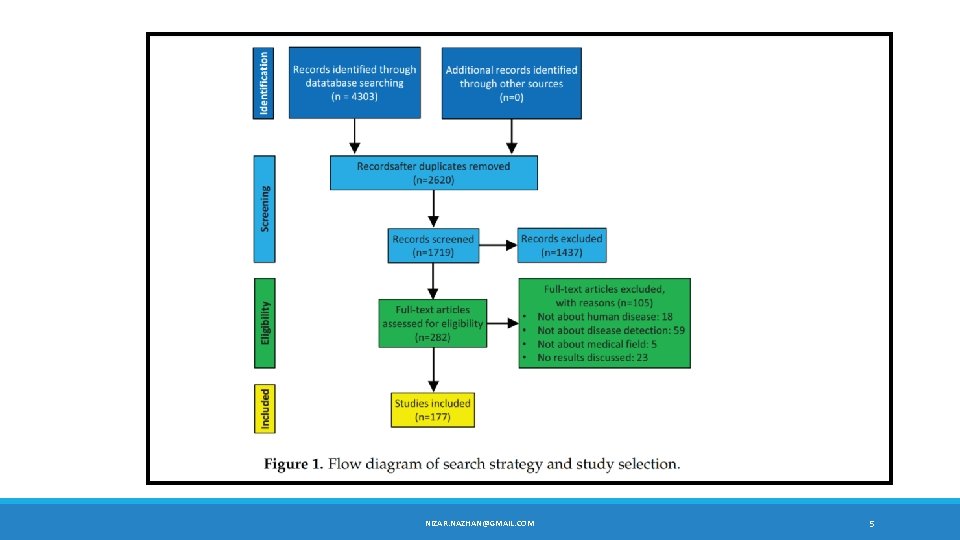
Method of Systematic Review q. Systematically searched in literature databases, such as Scopus, Journal Citation Reports (JCR), Google Scholar, and Med. Line q. English language q. Studies of AI, BD, DL, DM, and ML applied to diagnosis of human diseases in the medical field. q. Human Disease, Metabolic Disease, Cancer, Parkinson’s Disease, Alzheimer’s Disease, Heart Disease, Hepatic Disease, Infectious Disease, or Renal Disease; q. Year 2008 -2018 NIZAR. NAZHAN@GMAIL. COM 4
NIZAR. NAZHAN@GMAIL. COM 5
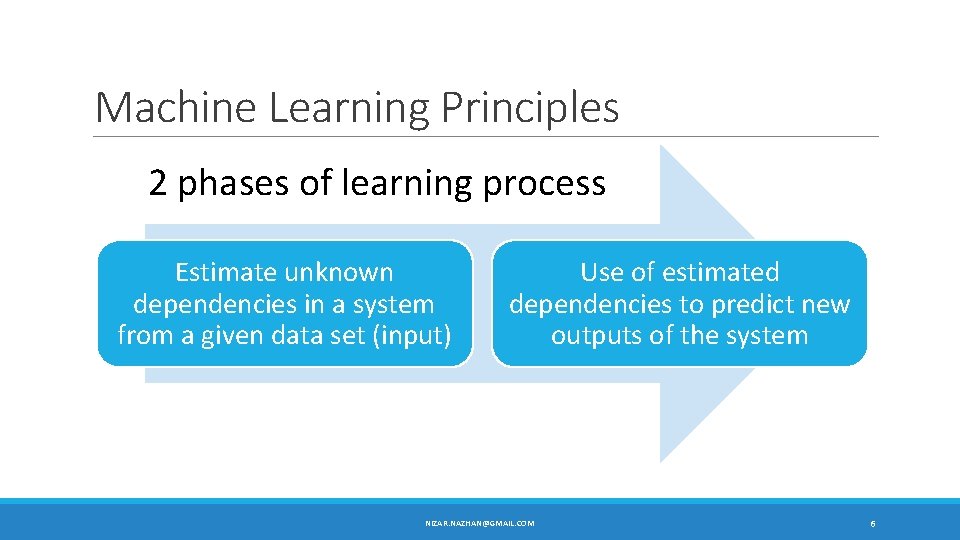
Machine Learning Principles 2 phases of learning process Estimate unknown dependencies in a system from a given data set (input) Use of estimated dependencies to predict new outputs of the system NIZAR. NAZHAN@GMAIL. COM 6
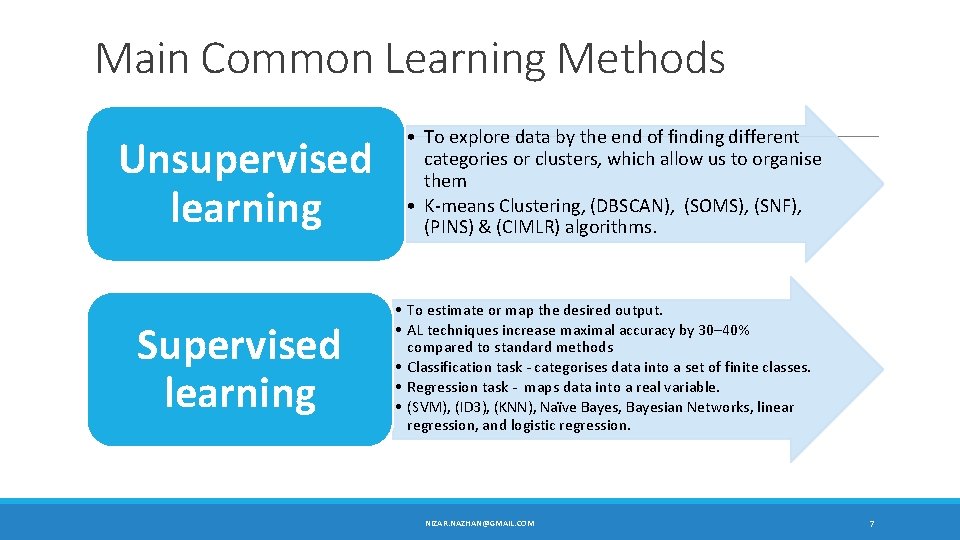
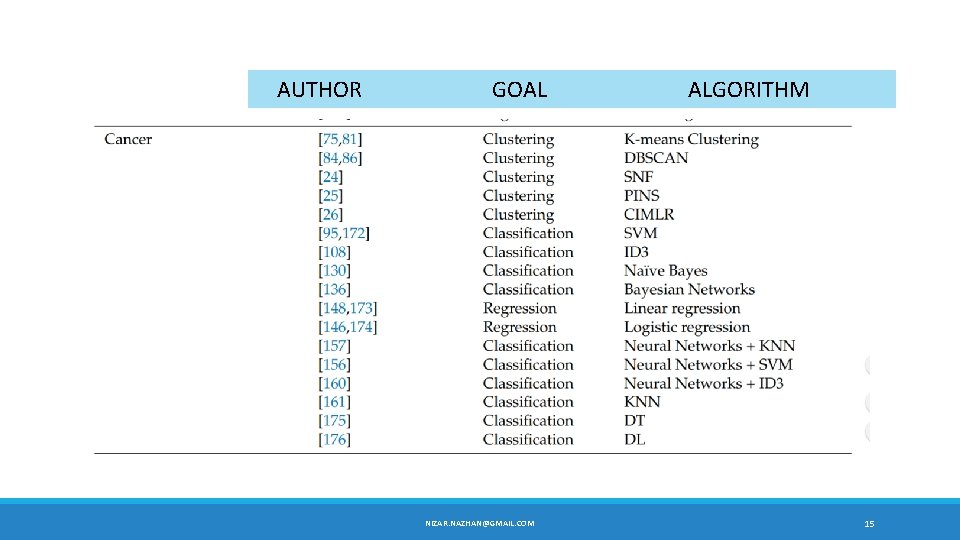
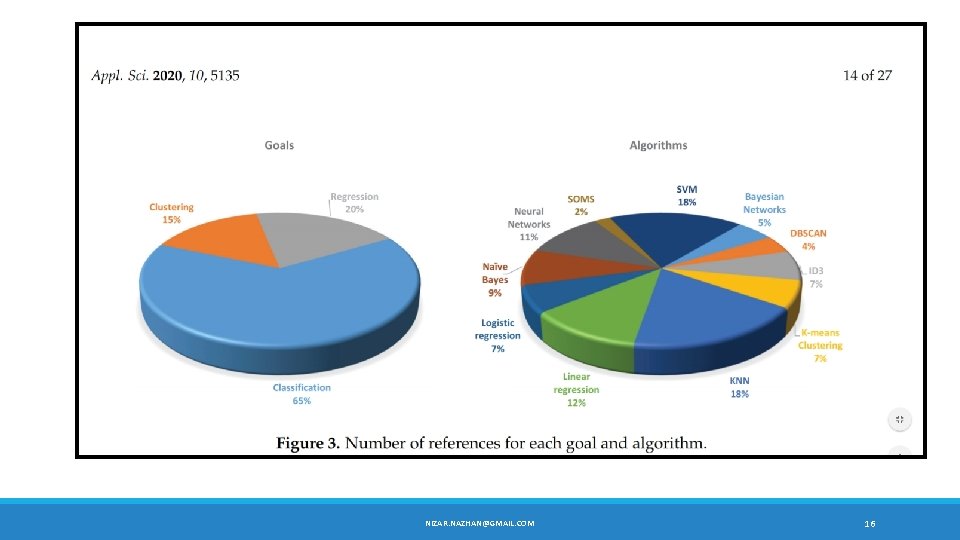
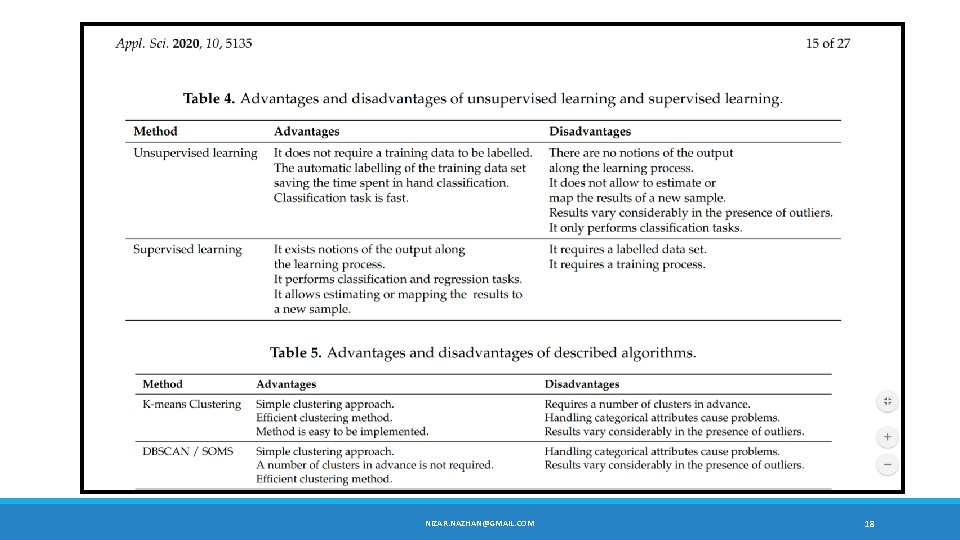
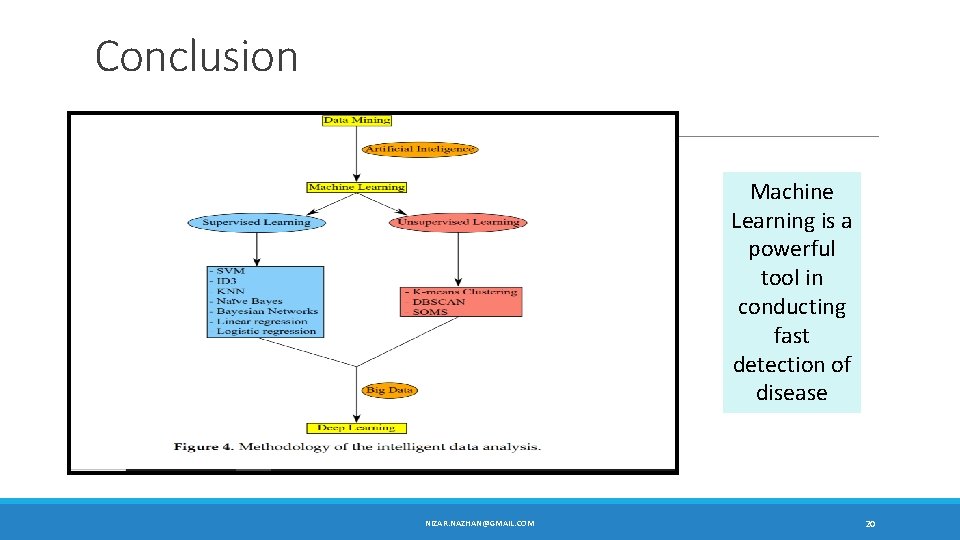
Main Common Learning Methods Unsupervised learning Supervised learning • To explore data by the end of finding different categories or clusters, which allow us to organise them • K-means Clustering, (DBSCAN), (SOMS), (SNF), (PINS) & (CIMLR) algorithms. • To estimate or map the desired output. • AL techniques increase maximal accuracy by 30– 40% compared to standard methods • Classification task - categorises data into a set of finite classes. • Regression task - maps data into a real variable. • (SVM), (ID 3), (KNN), Naïve Bayes, Bayesian Networks, linear regression, and logistic regression. NIZAR. NAZHAN@GMAIL. COM 7
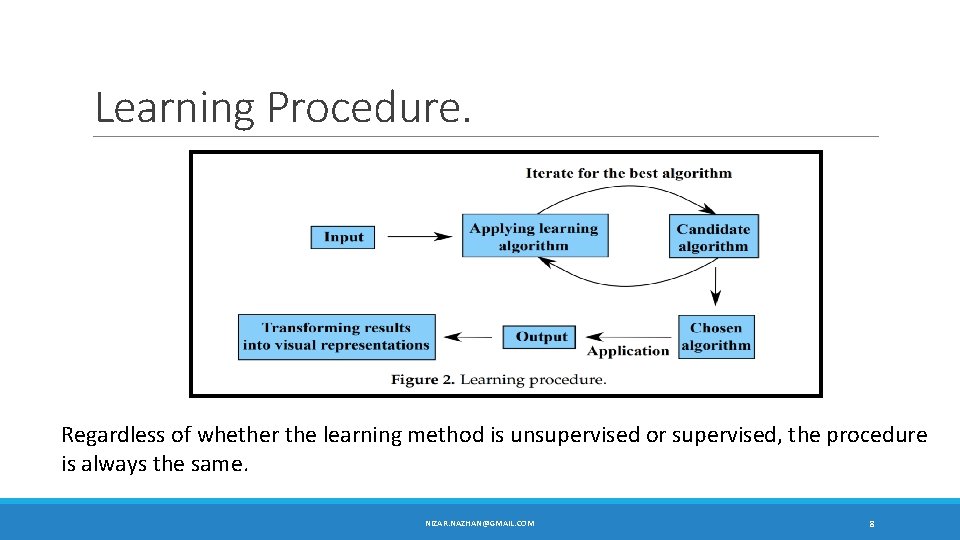
Learning Procedure. Regardless of whether the learning method is unsupervised or supervised, the procedure is always the same. NIZAR. NAZHAN@GMAIL. COM 8
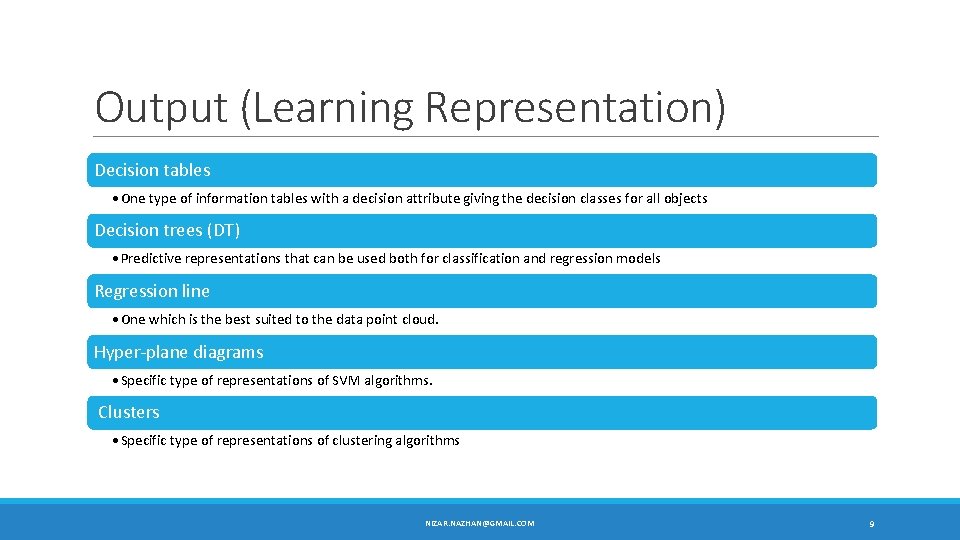
Output (Learning Representation) Decision tables • One type of information tables with a decision attribute giving the decision classes for all objects Decision trees (DT) • Predictive representations that can be used both for classification and regression models Regression line • One which is the best suited to the data point cloud. Hyper-plane diagrams • Specific type of representations of SVM algorithms. Clusters • Specific type of representations of clustering algorithms NIZAR. NAZHAN@GMAIL. COM 9
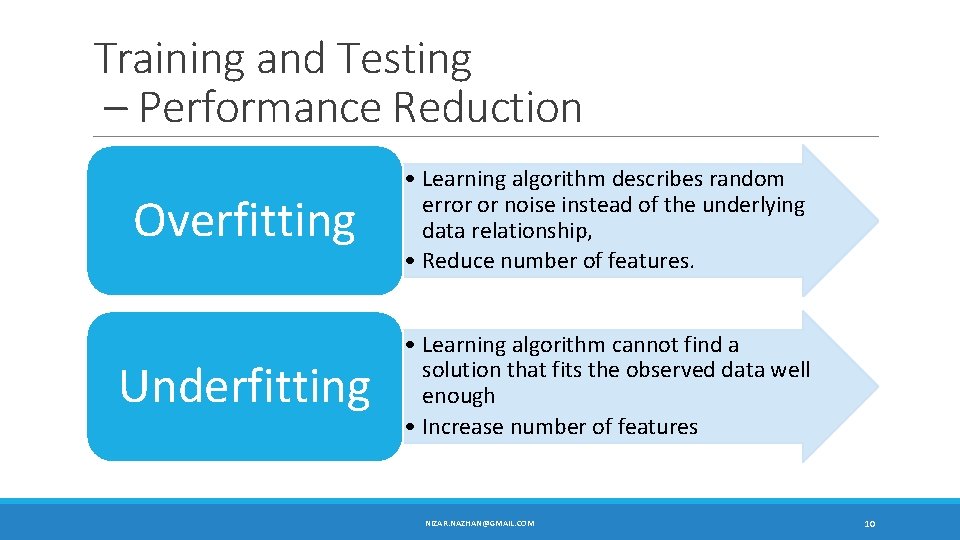
Training and Testing – Performance Reduction Overfitting • Learning algorithm describes random error or noise instead of the underlying data relationship, • Reduce number of features. Underfitting • Learning algorithm cannot find a solution that fits the observed data well enough • Increase number of features NIZAR. NAZHAN@GMAIL. COM 10
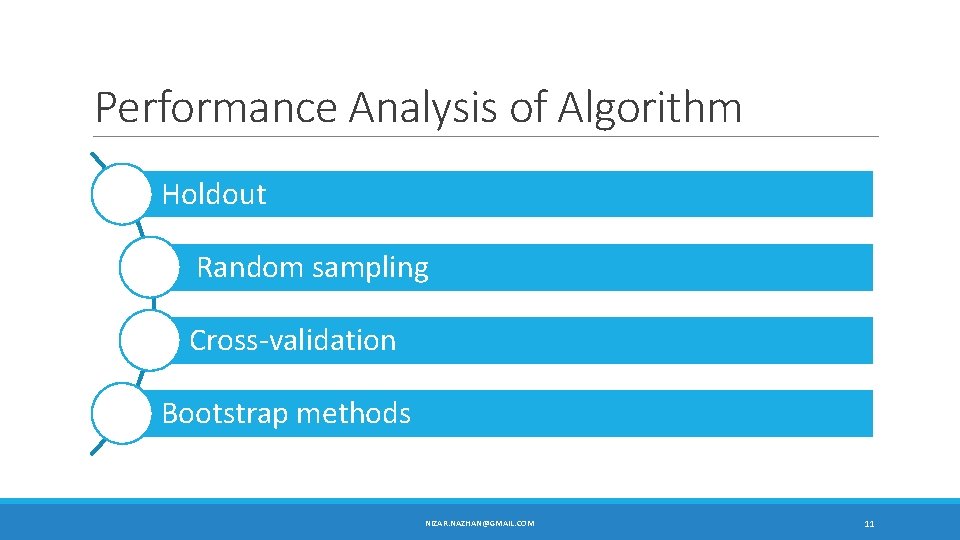
Performance Analysis of Algorithm Holdout Random sampling Cross-validation Bootstrap methods NIZAR. NAZHAN@GMAIL. COM 11
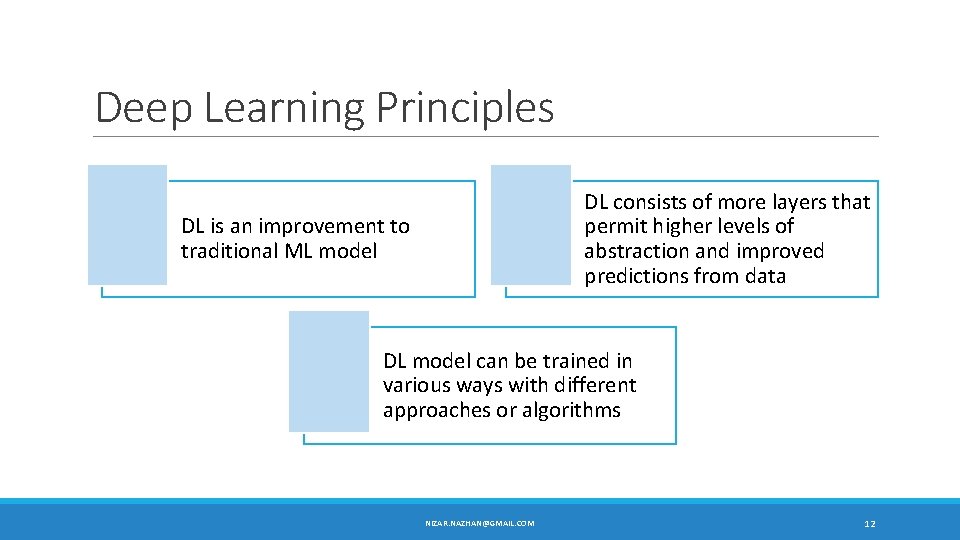
Deep Learning Principles DL consists of more layers that permit higher levels of abstraction and improved predictions from data DL is an improvement to traditional ML model DL model can be trained in various ways with different approaches or algorithms NIZAR. NAZHAN@GMAIL. COM 12
Application of ML & DL - Examples NIZAR. NAZHAN@GMAIL. COM 13
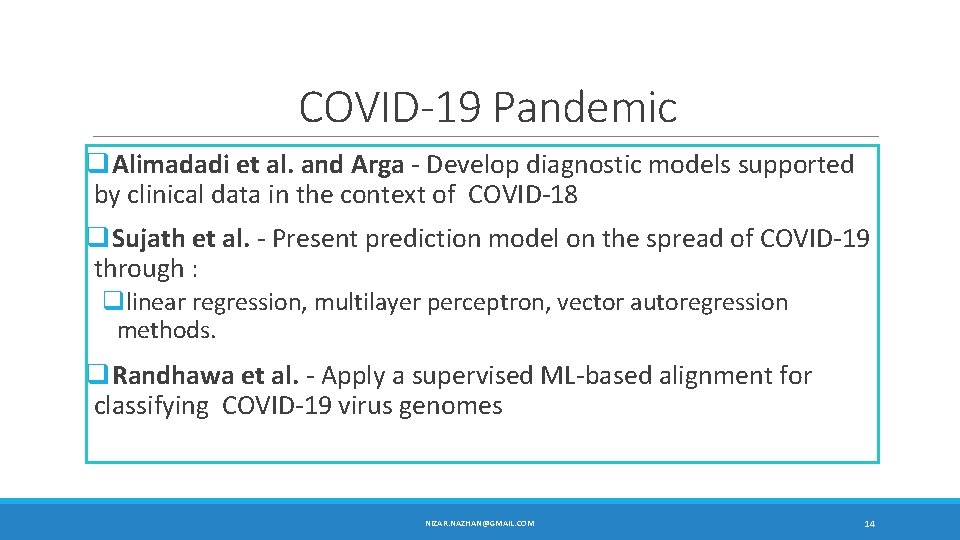
COVID-19 Pandemic q. Alimadadi et al. and Arga - Develop diagnostic models supported by clinical data in the context of COVID-18 q. Sujath et al. - Present prediction model on the spread of COVID-19 through : qlinear regression, multilayer perceptron, vector autoregression methods. q. Randhawa et al. - Apply a supervised ML-based alignment for classifying COVID-19 virus genomes NIZAR. NAZHAN@GMAIL. COM 14
AUTHOR GOAL NIZAR. NAZHAN@GMAIL. COM ALGORITHM 15
NIZAR. NAZHAN@GMAIL. COM 16
NIZAR. NAZHAN@GMAIL. COM 17
NIZAR. NAZHAN@GMAIL. COM 18
Applicability of ML to Clinical Practice Machine learning is a valuable tool for medical professionals • Prevention, diagnosis, treatment of human diseases. ML algorithm learned a new task • Instead of saying that it simply extracted a set of statistical patterns ML techniques currently applied in Medical Records to predict • Which patients are at greatest risk of readmission to hospital • Who are unlikely to follow prescribed treatments Key advantage of ML • Researchers do not need to specify which potential predictive variables to consider and in which combinations NIZAR. NAZHAN@GMAIL. COM 19
Conclusion Machine Learning is a powerful tool in conducting fast detection of disease NIZAR. NAZHAN@GMAIL. COM 20