
Machine Learning applied to CERNs Industrial Control Systems
- Slides: 14
Machine Learning applied to CERN’s Industrial Control Systems Spanish High-School Students Internship Programme 2019 Miguel Martin & Celia Lopez
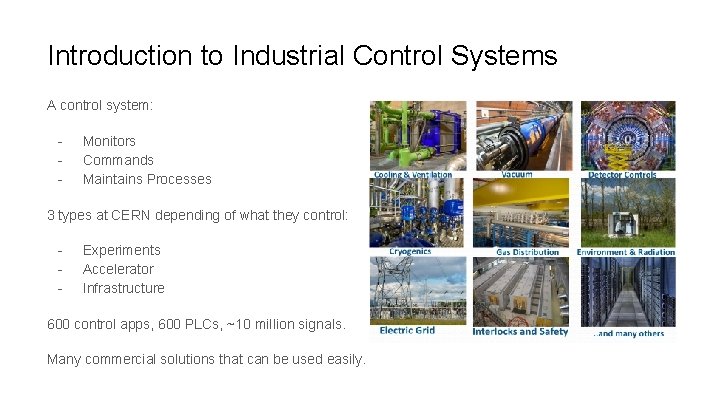
Introduction to Industrial Control Systems A control system: - Monitors Commands Maintains Processes 3 types at CERN depending of what they control: - Experiments Accelerator Infrastructure 600 control apps, 600 PLCs, ~10 million signals. Many commercial solutions that can be used easily.
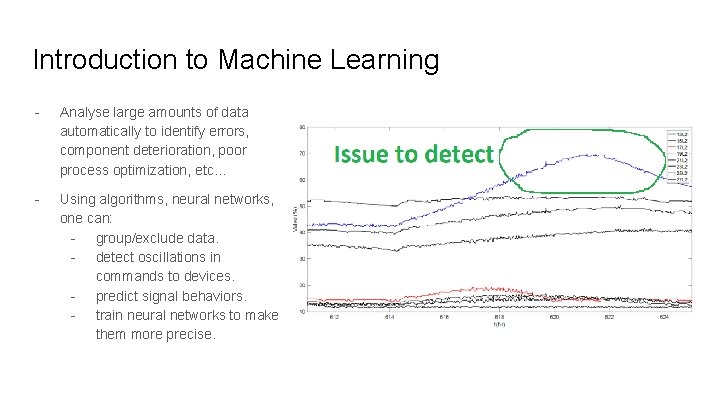
Introduction to Machine Learning - Analyse large amounts of data automatically to identify errors, component deterioration, poor process optimization, etc… - Using algorithms, neural networks, one can: - group/exclude data. - detect oscillations in commands to devices. - predict signal behaviors. - train neural networks to make them more precise.
PROJECT OBJECTIVES Why is this project interesting? - It uses the latest technologies available in this technology sector. It allows us to understand how data can be captured from signals. How signals are processed to store them. How those signals are used to: - Predict when sensors and actuators are going to stop working. - Detect deviated signals from millions of other values.
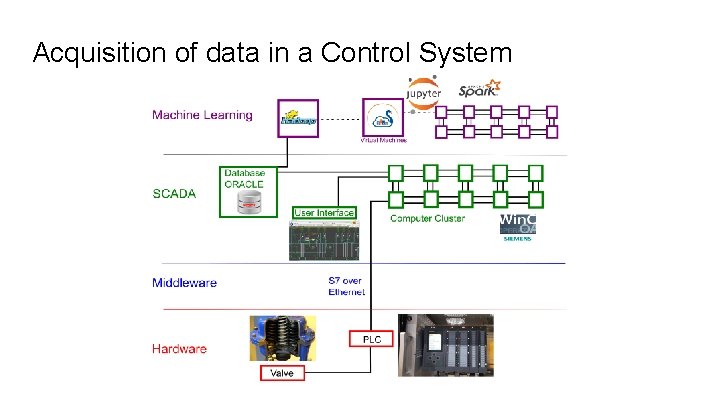
Acquisition of data in a Control System
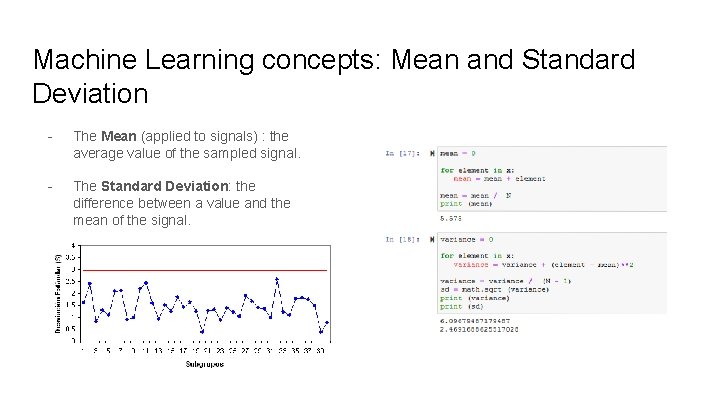
Machine Learning concepts: Mean and Standard Deviation - The Mean (applied to signals) : the average value of the sampled signal. - The Standard Deviation: the difference between a value and the mean of the signal.
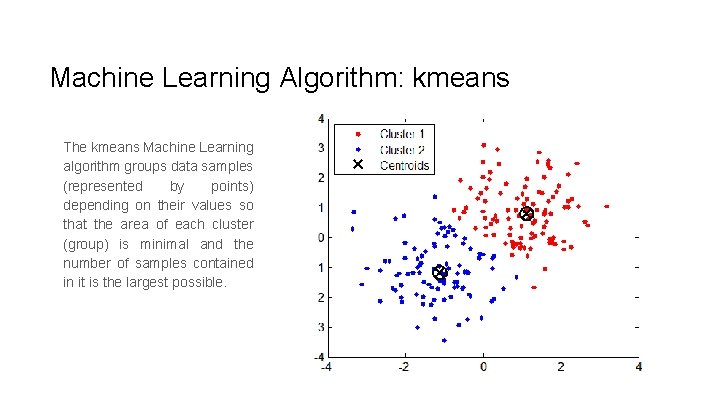
Machine Learning Algorithm: kmeans The kmeans Machine Learning algorithm groups data samples (represented by points) depending on their values so that the area of each cluster (group) is minimal and the number of samples contained in it is the largest possible.
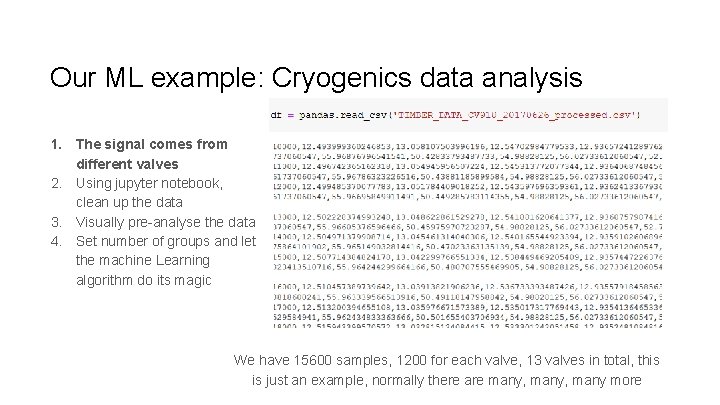
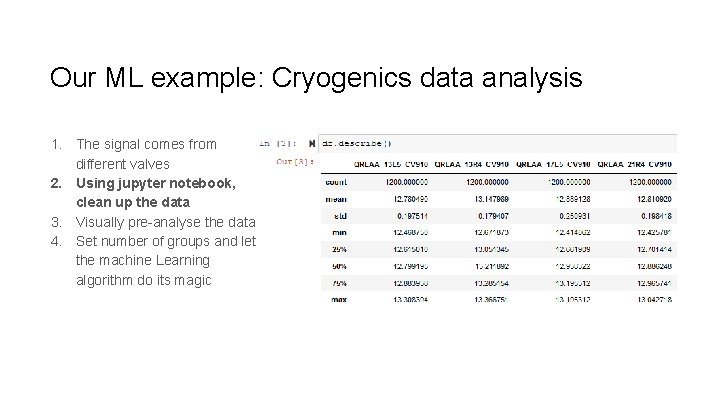
Our ML example: Cryogenics data analysis 1. The signal comes from different valves 2. Using jupyter notebook, clean up the data 3. Visually pre-analyse the data 4. Set number of groups and let the machine Learning algorithm do its magic We have 15600 samples, 1200 for each valve, 13 valves in total, this is just an example, normally there are many, many more
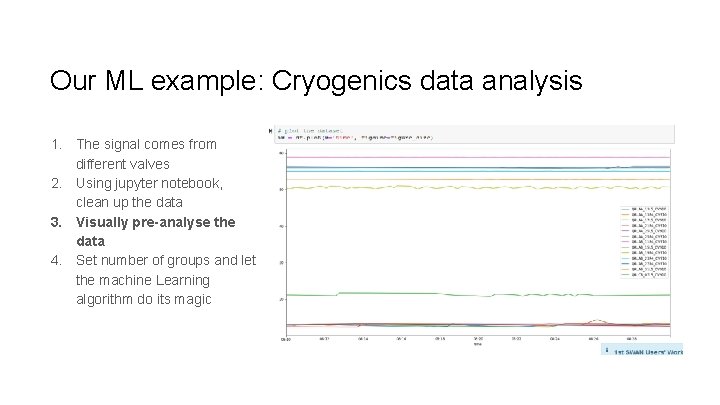
Our ML example: Cryogenics data analysis 1. The signal comes from different valves 2. Using jupyter notebook, clean up the data 3. Visually pre-analyse the data 4. Set number of groups and let the machine Learning algorithm do its magic
Our ML example: Cryogenics data analysis 1. The signal comes from different valves 2. Using jupyter notebook, clean up the data 3. Visually pre-analyse the data 4. Set number of groups and let the machine Learning algorithm do its magic
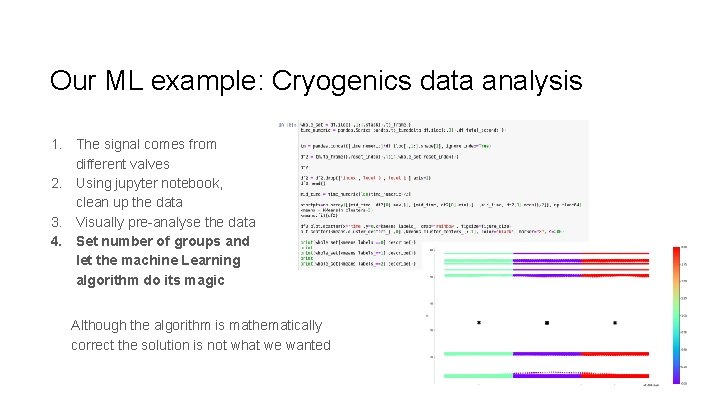
Our ML example: Cryogenics data analysis 1. The signal comes from different valves 2. Using jupyter notebook, clean up the data 3. Visually pre-analyse the data 4. Set number of groups and let the machine Learning algorithm do its magic Although the algorithm is mathematically correct the solution is not what we wanted
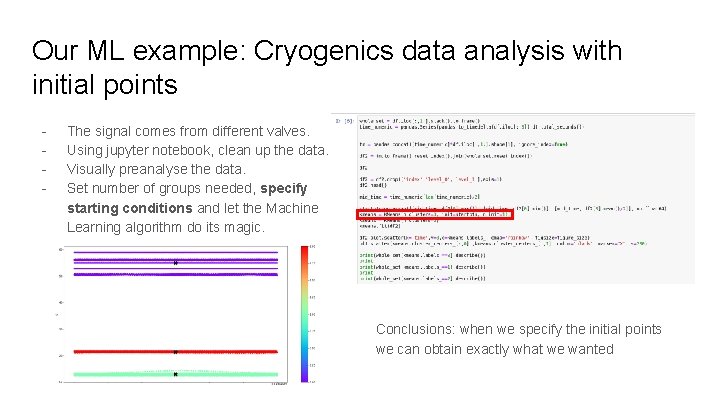
Our ML example: Cryogenics data analysis with initial points - The signal comes from different valves. Using jupyter notebook, clean up the data. Visually preanalyse the data. Set number of groups needed, specify starting conditions and let the Machine Learning algorithm do its magic. Conclusions: when we specify the initial points we can obtain exactly what we wanted
Conclusions - CERN Industrial Control Systems are really complex. - Standardisation simplifies maintenance and makes component integration easier. - Signals have to be processed many times before they can be used for Machine Learning. - Machine Learning makes maintenance more efficient and reduces costs. - Machine Learning is an emerging topic and there is much work left to do around it.
Do you have any questions?