
Machine Learning Applications in Physical Design Recent Results


![[ISQED 01] (This is “METRICS” !) • METRICS (1999; ISQED 01): “Measure to Improve”](https://slidetodoc.com/presentation_image_h/8c5ca5626bdf08311d93351addff933a/image-58.jpg "[ISQED 01] (This is “METRICS” !) • METRICS (1999; ISQED 01): “Measure to Improve”")
![[ASPDAC 16] Closing Multiphysics Analysis Loops Sim Results (Dyn. ) Activity Factor (Static) Tech](https://slidetodoc.com/presentation_image_h/8c5ca5626bdf08311d93351addff933a/image-61.jpg "[ASPDAC 16] Closing Multiphysics Analysis Loops Sim Results (Dyn. ) Activity Factor (Static) Tech")
![[ASPDAC 16] Closing Multiphysics Analysis Loops Tech files, signoff criteria, corners Sim Results Functional](https://slidetodoc.com/presentation_image_h/8c5ca5626bdf08311d93351addff933a/image-62.jpg "[ASPDAC 16] Closing Multiphysics Analysis Loops Tech files, signoff criteria, corners Sim Results Functional")
![Some References Highlighted in the talk from ABKGroup • [RISKMAP] W. -T. J. Chan,](https://slidetodoc.com/presentation_image_h/8c5ca5626bdf08311d93351addff933a/image-63.jpg "Some References Highlighted in the talk from ABKGroup • [RISKMAP] W. -T. J. Chan,")
- Slides: 63
Machine Learning Applications in Physical Design: Recent Results and Directions Andrew B. Kahng CSE and ECE Departments UC San Diego http: //vlsicad. ucsd. edu A. B. Kahng, 180327 ISPD--2018
Agenda • Crises… A. B. Kahng, 180327 ISPD--2018 2
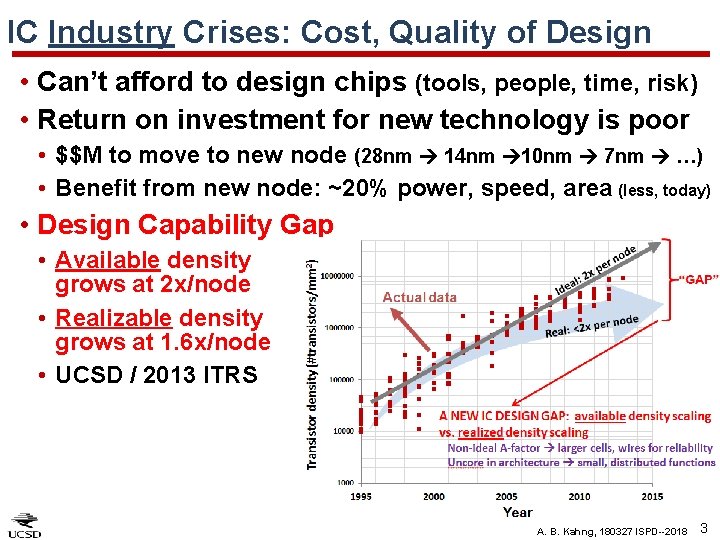
IC Industry Crises: Cost, Quality of Design • Can’t afford to design chips (tools, people, time, risk) • Return on investment for new technology is poor • $$M to move to new node (28 nm 14 nm 10 nm 7 nm …) • Benefit from new node: ~20% power, speed, area (less, today) • Design Capability Gap • Available density grows at 2 x/node • Realizable density grows at 1. 6 x/node • UCSD / 2013 ITRS A. B. Kahng, 180327 ISPD--2018 3
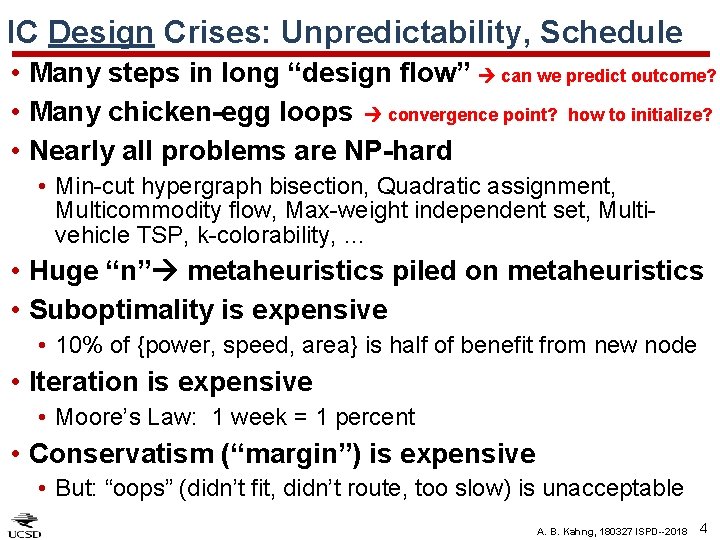
IC Design Crises: Unpredictability, Schedule • Many steps in long “design flow” can we predict outcome? • Many chicken-egg loops convergence point? how to initialize? • Nearly all problems are NP-hard • Min-cut hypergraph bisection, Quadratic assignment, Multicommodity flow, Max-weight independent set, Multivehicle TSP, k-colorability, … • Huge “n” metaheuristics piled on metaheuristics • Suboptimality is expensive • 10% of {power, speed, area} is half of benefit from new node • Iteration is expensive • Moore’s Law: 1 week = 1 percent • Conservatism (“margin”) is expensive • But: “oops” (didn’t fit, didn’t route, too slow) is unacceptable A. B. Kahng, 180327 ISPD--2018 4
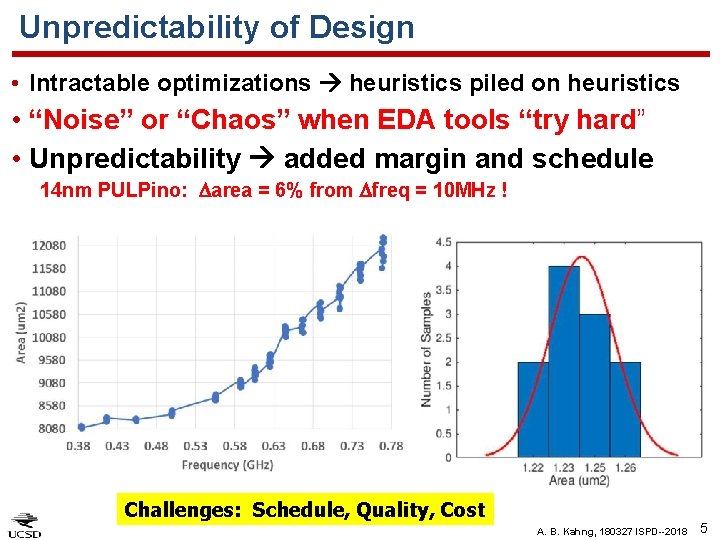
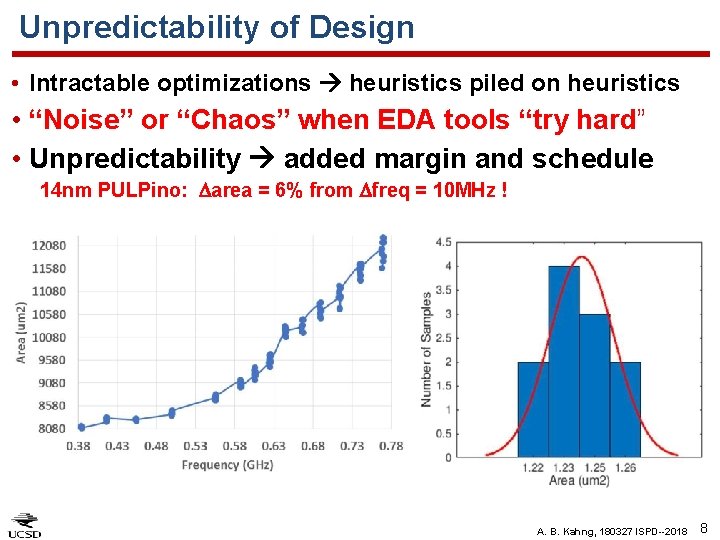
Unpredictability of Design • Intractable optimizations heuristics piled on heuristics • “Noise” or “Chaos” when EDA tools “try hard” • Unpredictability added margin and schedule 14 nm PULPino: area = 6% from freq = 10 MHz ! Challenges: Schedule, Quality, Cost A. B. Kahng, 180327 ISPD--2018 5
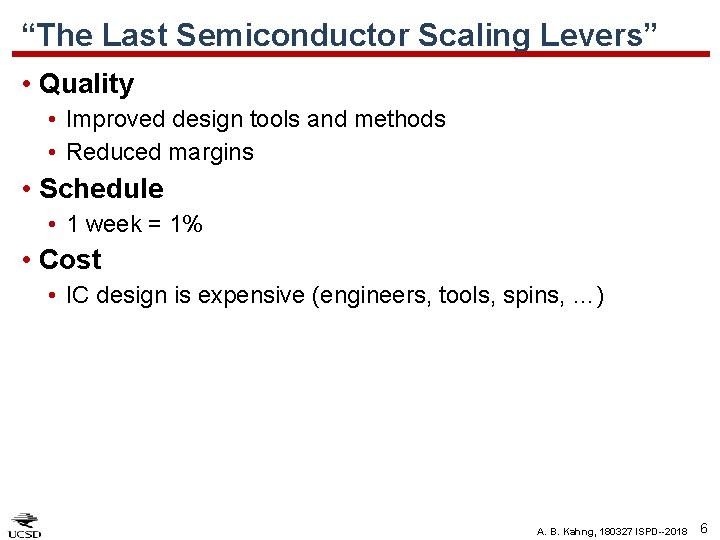
“The Last Semiconductor Scaling Levers” • Quality • Improved design tools and methods • Reduced margins • Schedule • 1 week = 1% • Cost • IC design is expensive (engineers, tools, spins, …) A. B. Kahng, 180327 ISPD--2018 6
Agenda • Crises… • … and a Vision A. B. Kahng, 180327 ISPD--2018 7
Unpredictability of Design • Intractable optimizations heuristics piled on heuristics • “Noise” or “Chaos” when EDA tools “try hard” • Unpredictability added margin and schedule 14 nm PULPino: area = 6% from freq = 10 MHz ! A. B. Kahng, 180327 ISPD--2018 8
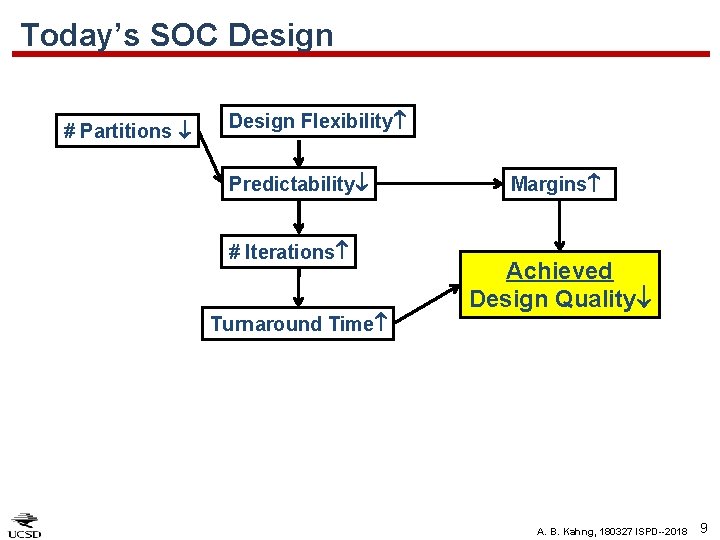
Today’s SOC Design # Partitions Design Flexibility Predictability # Iterations Turnaround Time Margins Achieved Design Quality A. B. Kahng, 180327 ISPD--2018 9
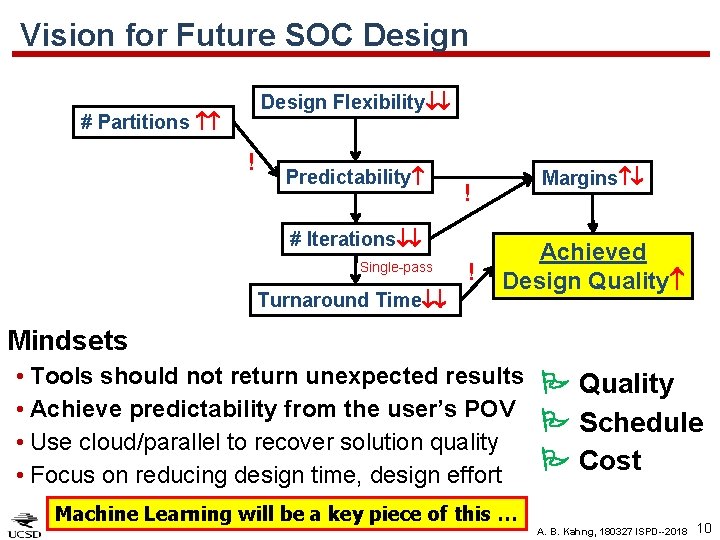
Vision for Future SOC Design Flexibility # Partitions ! Predictability ! # Iterations Single-pass Turnaround Time Margins ! Achieved Design Quality Mindsets • Tools should not return unexpected results Quality • Achieve predictability from the user’s POV Schedule • Use cloud/parallel to recover solution quality Cost • Focus on reducing design time, design effort Machine Learning will be a key piece of this … A. B. Kahng, 180327 ISPD--2018 10
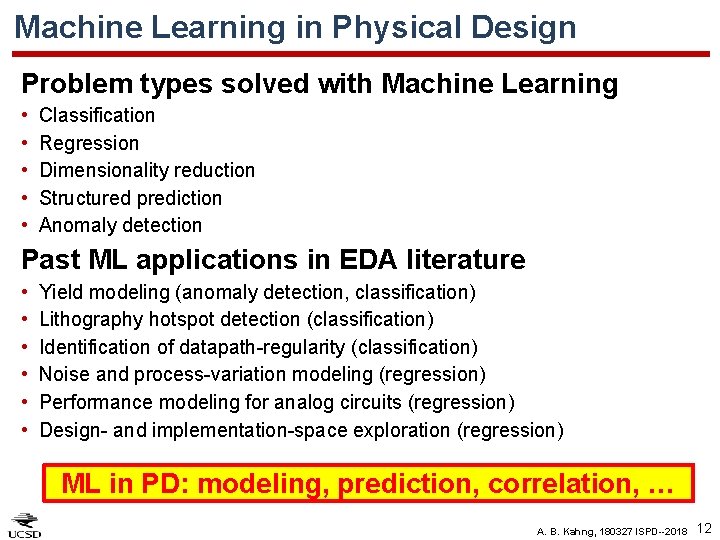
Agenda • Crises… • … and a Vision • Machine Learning in PD A. B. Kahng, 180327 ISPD--2018 11
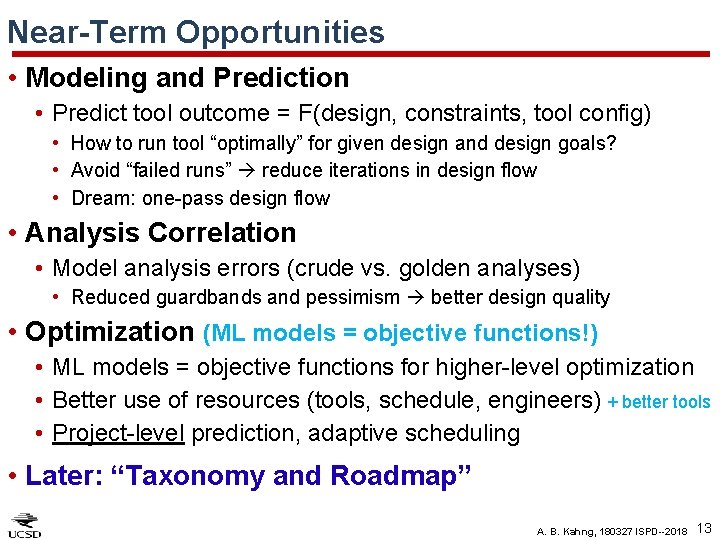
Machine Learning in Physical Design Problem types solved with Machine Learning • • • Classification Regression Dimensionality reduction Structured prediction Anomaly detection Past ML applications in EDA literature • • • Yield modeling (anomaly detection, classification) Lithography hotspot detection (classification) Identification of datapath-regularity (classification) Noise and process-variation modeling (regression) Performance modeling for analog circuits (regression) Design- and implementation-space exploration (regression) ML in PD: modeling, prediction, correlation, … A. B. Kahng, 180327 ISPD--2018 12
Near-Term Opportunities • Modeling and Prediction • Predict tool outcome = F(design, constraints, tool config) • How to run tool “optimally” for given design and design goals? • Avoid “failed runs” reduce iterations in design flow • Dream: one-pass design flow • Analysis Correlation • Model analysis errors (crude vs. golden analyses) • Reduced guardbands and pessimism better design quality • Optimization (ML models = objective functions!) • ML models = objective functions for higher-level optimization • Better use of resources (tools, schedule, engineers) + better tools • Project-level prediction, adaptive scheduling • Later: “Taxonomy and Roadmap” A. B. Kahng, 180327 ISPD--2018 13
Agenda • Crises… • … and a Vision • Machine Learning in PD • Modeling and Prediction A. B. Kahng, 180327 ISPD--2018 14
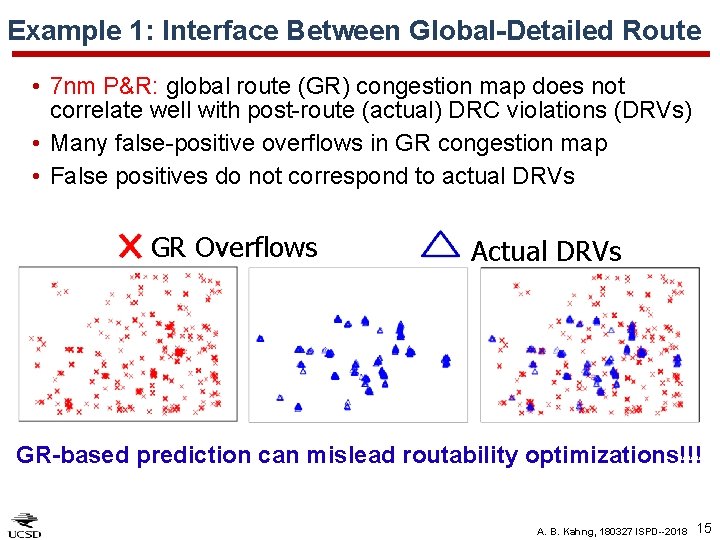
Example 1: Interface Between Global-Detailed Route • 7 nm P&R: global route (GR) congestion map does not correlate well with post-route (actual) DRC violations (DRVs) • Many false-positive overflows in GR congestion map • False positives do not correspond to actual DRVs GR Overflows Actual DRVs GR-based prediction can mislead routability optimizations!!! A. B. Kahng, 180327 ISPD--2018 15
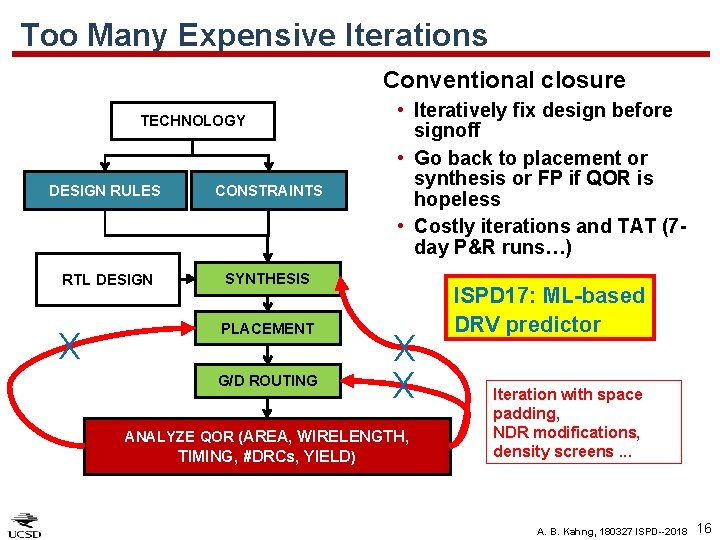
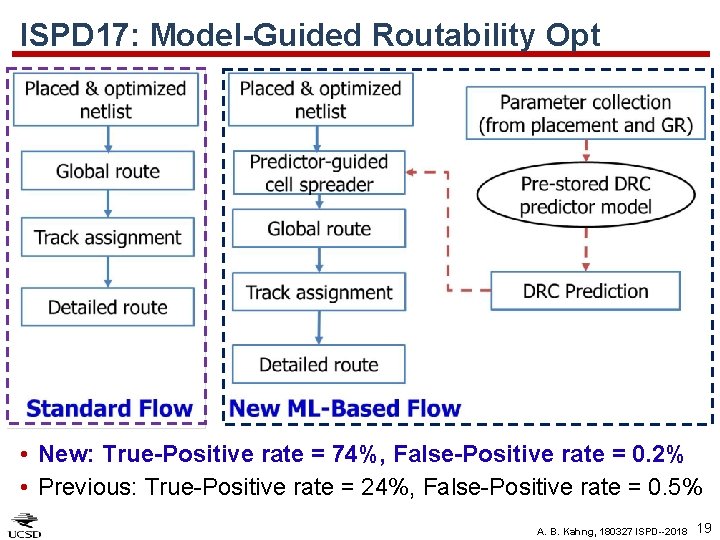
Too Many Expensive Iterations Conventional closure TECHNOLOGY DESIGN RULES CONSTRAINTS RTL DESIGN SYNTHESIS X PLACEMENT G/D ROUTING • Iteratively fix design before signoff • Go back to placement or synthesis or FP if QOR is hopeless • Costly iterations and TAT (7 day P&R runs…) X X ANALYZE QOR (AREA, WIRELENGTH, TIMING, #DRCs, YIELD) ISPD 17: ML-based DRV predictor Iteration with space padding, NDR modifications, density screens. . . A. B. Kahng, 180327 ISPD--2018 16
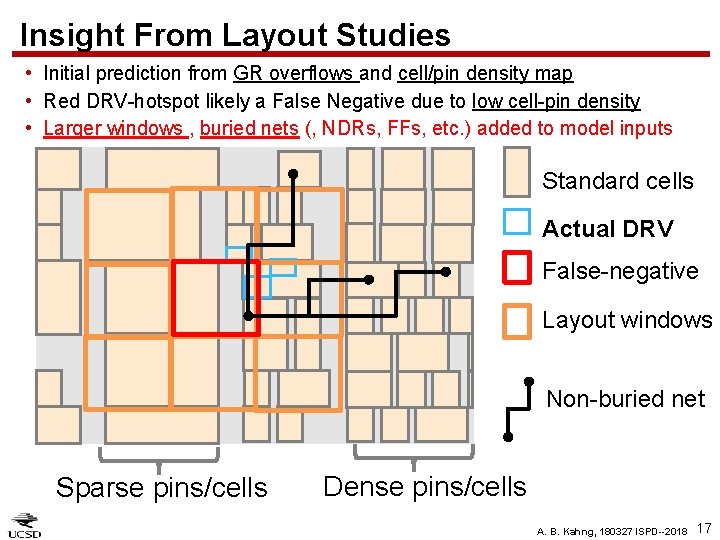
Insight From Layout Studies • Initial prediction from GR overflows and cell/pin density map • Red DRV-hotspot likely a False Negative due to low cell-pin density • Larger windows , buried nets (, NDRs, FFs, etc. ) added to model inputs Standard cells Actual DRV False-negative Layout windows Non-buried net Sparse pins/cells Dense pins/cells A. B. Kahng, 180327 ISPD--2018 17
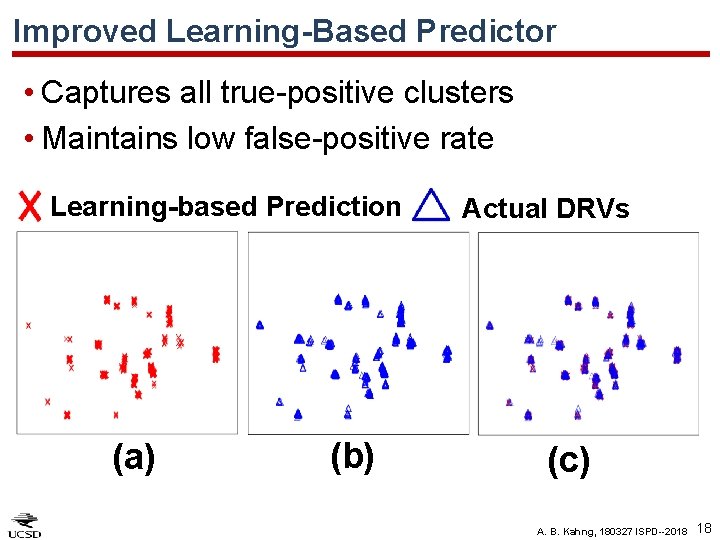
Improved Learning-Based Predictor • Captures all true-positive clusters • Maintains low false-positive rate Learning-based Prediction (a) (b) Actual DRVs (c) A. B. Kahng, 180327 ISPD--2018 18
ISPD 17: Model-Guided Routability Opt • New: True-Positive rate = 74%, False-Positive rate = 0. 2% • Previous: True-Positive rate = 24%, False-Positive rate = 0. 5% A. B. Kahng, 180327 ISPD--2018 19
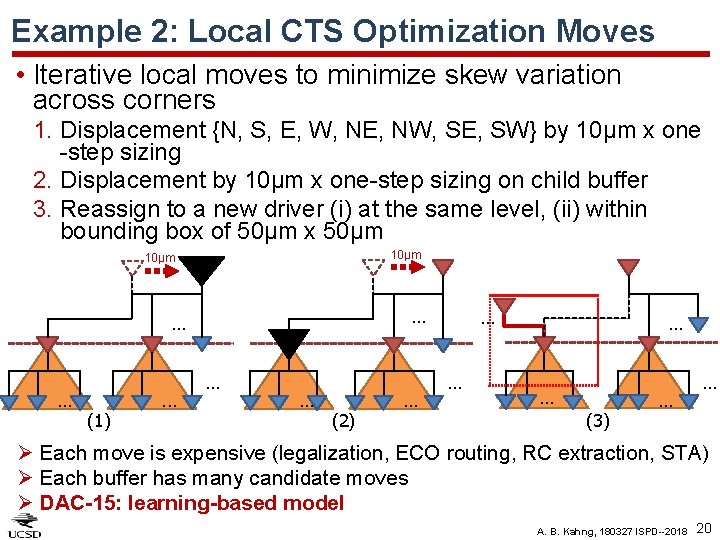
Example 2: Local CTS Optimization Moves • Iterative local moves to minimize skew variation across corners 1. Displacement {N, S, E, W, NE, NW, SE, SW} by 10μm x one -step sizing 2. Displacement by 10μm x one-step sizing on child buffer 3. Reassign to a new driver (i) at the same level, (ii) within bounding box of 50μm x 50μm 10μm . . (1) . . (2) . . . . (3) . . . Ø Each move is expensive (legalization, ECO routing, RC extraction, STA) Ø Each buffer has many candidate moves Ø DAC-15: learning-based model A. B. Kahng, 180327 ISPD--2018 20
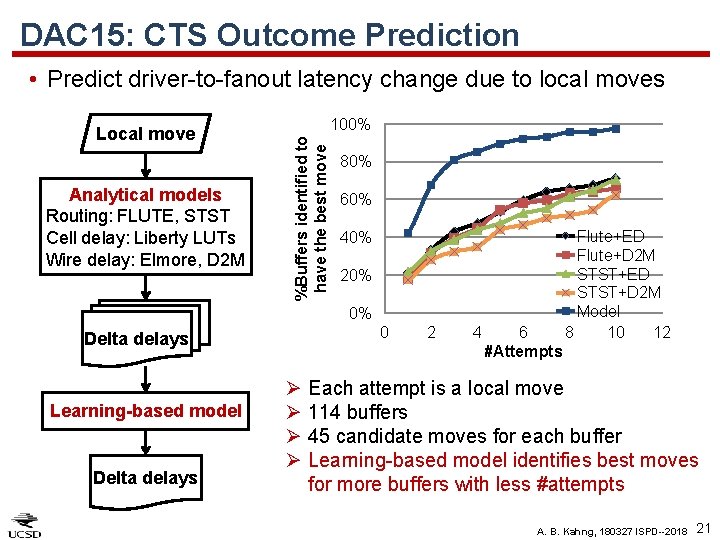
DAC 15: CTS Outcome Prediction • Predict driver-to-fanout latency change due to local moves Analytical models Routing: FLUTE, STST Cell delay: Liberty LUTs Wire delay: Elmore, D 2 M 100% %Buffers identified to have the best move Local move 80% 60% 40% 20% 0% 0 Delta delays Learning-based model Delta delays Ø Ø 2 4 6 #Attempts Flute+ED Flute+D 2 M STST+ED STST+D 2 M Model 8 10 12 Each attempt is a local move 114 buffers 45 candidate moves for each buffer Learning-based model identifies best moves for more buffers with less #attempts A. B. Kahng, 180327 ISPD--2018 21
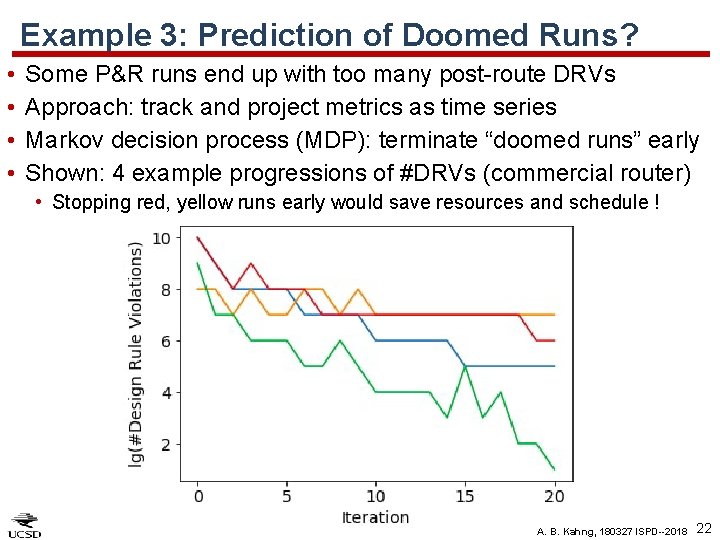
Example 3: Prediction of Doomed Runs? • • Some P&R runs end up with too many post-route DRVs Approach: track and project metrics as time series Markov decision process (MDP): terminate “doomed runs” early Shown: 4 example progressions of #DRVs (commercial router) • Stopping red, yellow runs early would save resources and schedule ! A. B. Kahng, 180327 ISPD--2018 22
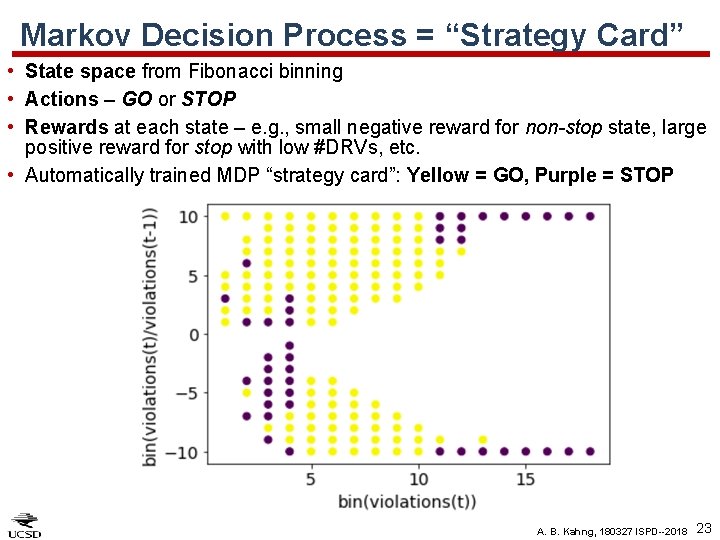
Markov Decision Process = “Strategy Card” • State space from Fibonacci binning • Actions – GO or STOP • Rewards at each state – e. g. , small negative reward for non-stop state, large positive reward for stop with low #DRVs, etc. • Automatically trained MDP “strategy card”: Yellow = GO, Purple = STOP A. B. Kahng, 180327 ISPD--2018 23
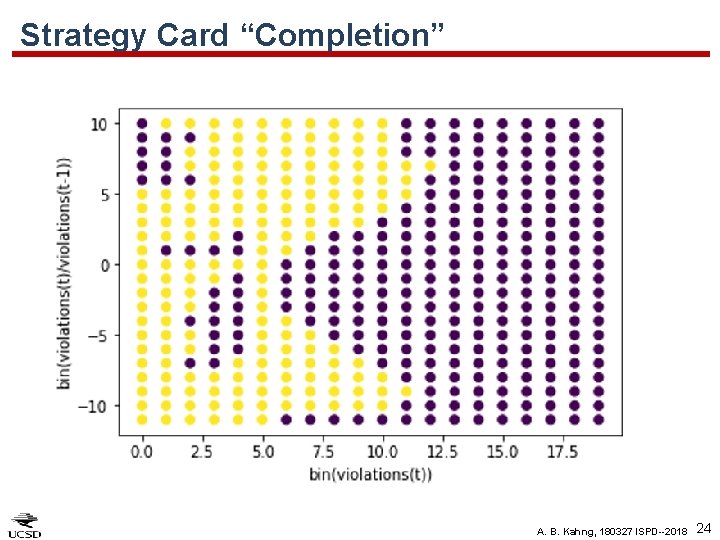
Strategy Card “Completion” A. B. Kahng, 180327 ISPD--2018 24
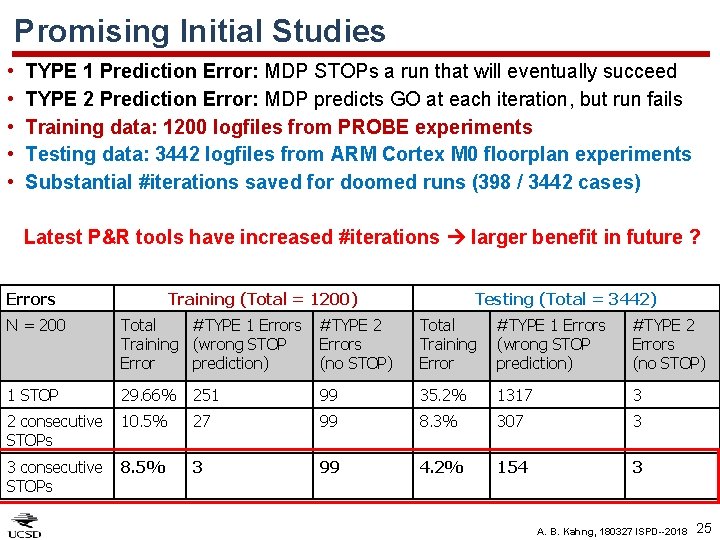
Promising Initial Studies • • • TYPE 1 Prediction Error: MDP STOPs a run that will eventually succeed TYPE 2 Prediction Error: MDP predicts GO at each iteration, but run fails Training data: 1200 logfiles from PROBE experiments Testing data: 3442 logfiles from ARM Cortex M 0 floorplan experiments Substantial #iterations saved for doomed runs (398 / 3442 cases) Latest P&R tools have increased #iterations larger benefit in future ? Errors Training (Total = 1200) Testing (Total = 3442) N = 200 Total #TYPE 1 Errors Training (wrong STOP Error prediction) #TYPE 2 Total #TYPE 1 Errors Training (wrong STOP (no STOP) Error prediction) #TYPE 2 Errors (no STOP) 1 STOP 29. 66% 251 99 35. 2% 1317 3 2 consecutive 10. 5% STOPs 27 99 8. 3% 307 3 3 consecutive 8. 5% STOPs 3 99 4. 2% 154 3 A. B. Kahng, 180327 ISPD--2018 25
Agenda • Crises… • … and a Vision • Machine Learning in PD • Modeling and Prediction • Analysis Correlation A. B. Kahng, 180327 ISPD--2018 26
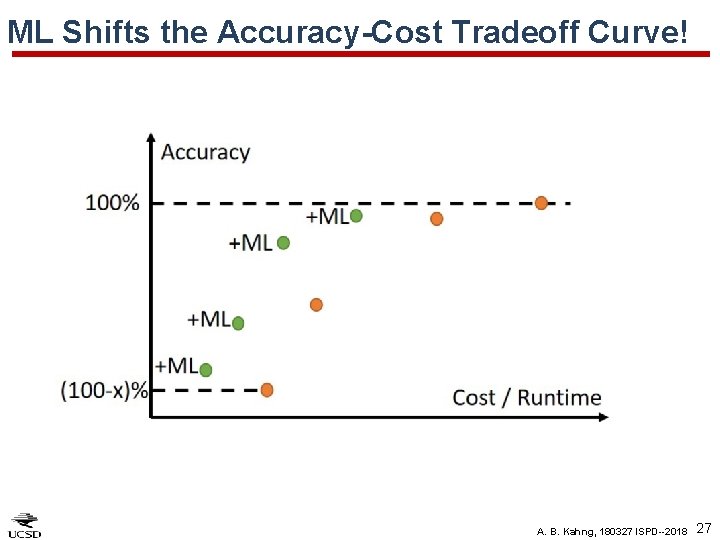
ML Shifts the Accuracy-Cost Tradeoff Curve! A. B. Kahng, 180327 ISPD--2018 27
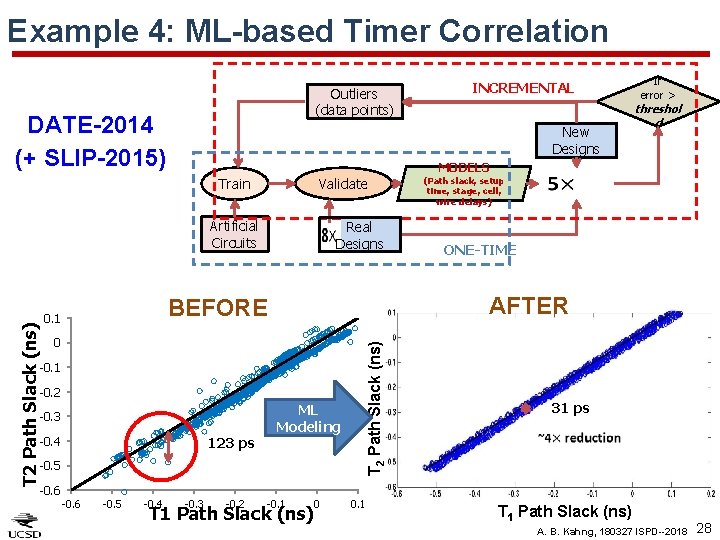
Example 4: ML-based Timer Correlation Outliers (data points) DATE-2014 (+ SLIP-2015) New Designs Validate Real Designs 0 -0. 1 -0. 2 -0. 3 -0. 4 123 ps ML Modeling -0. 5 -0. 6 -0. 5 -0. 4 threshol d -0. 3 -0. 2 (Path slack, setup time, stage, cell, wire delays) ONE-TIME AFTER BEFORE -0. 1 T 1 Path Slack (ns) 0 T 2 Path Slack (ns) Artificial Circuits -0. 6 If error > MODELS Train 0. 1 INCREMENTAL 0. 1 31 ps T 1 Path Slack (ns) A. B. Kahng, 180327 ISPD--2018 28
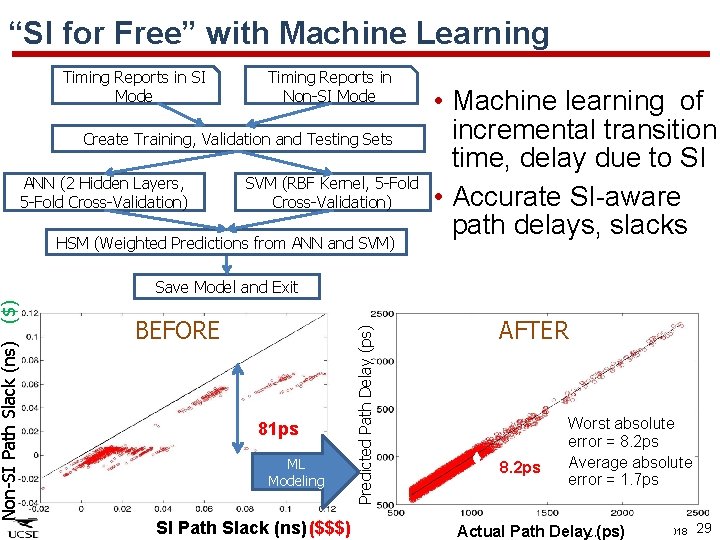
Timing Reports in SI Mode Timing Reports in Non-SI Mode Create Training, Validation and Testing Sets ANN (2 Hidden Layers, 5 -Fold Cross-Validation) SVM (RBF Kernel, 5 -Fold Cross-Validation) HSM (Weighted Predictions from ANN and SVM) • Machine learning of incremental transition time, delay due to SI • Accurate SI-aware path delays, slacks Save Model and Exit BEFORE 81 ps ML Modeling SI Path Slack (ns) ($$$) Predicted Path Delay (ps) Non-SI Path Slack (ns) ($) “SI for Free” with Machine Learning AFTER 8. 2 ps Worst absolute error = 8. 2 ps Average absolute error = 1. 7 ps B. Kahng, (ps) 180327 ISPD--2018 29 Actual Path. A. Delay
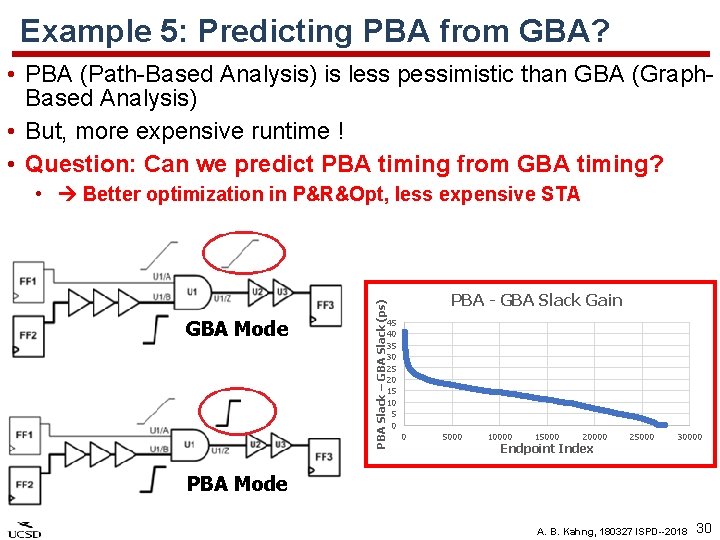
Example 5: Predicting PBA from GBA? • PBA (Path-Based Analysis) is less pessimistic than GBA (Graph. Based Analysis) • But, more expensive runtime ! • Question: Can we predict PBA timing from GBA timing? GBA Mode PBA Slack – GBA Slack (ps) • Better optimization in P&R&Opt, less expensive STA PBA - GBA Slack Gain 45 40 35 30 25 20 15 10 5 0 0 5000 10000 15000 20000 Endpoint Index 25000 30000 PBA Mode A. B. Kahng, 180327 ISPD--2018 30
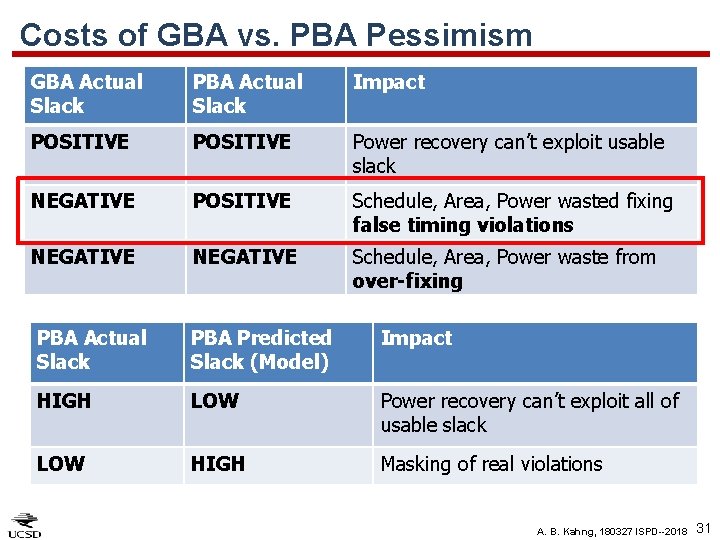
Costs of GBA vs. PBA Pessimism GBA Actual Slack PBA Actual Slack Impact POSITIVE Power recovery can’t exploit usable slack NEGATIVE POSITIVE Schedule, Area, Power wasted fixing false timing violations NEGATIVE Schedule, Area, Power waste from over-fixing PBA Actual Slack PBA Predicted Slack (Model) Impact HIGH LOW Power recovery can’t exploit all of usable slack LOW HIGH Masking of real violations A. B. Kahng, 180327 ISPD--2018 31
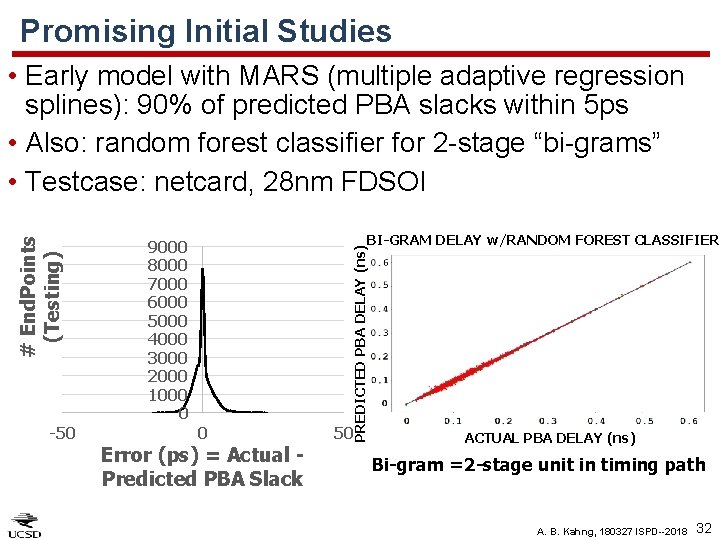
Promising Initial Studies -50 BI-GRAM DELAY w/RANDOM FOREST CLASSIFIER 9000 8000 7000 6000 5000 4000 3000 2000 1000 0 0 Error (ps) = Actual Predicted PBA Slack PREDICTED PBA DELAY (ns) # End. Points (Testing) • Early model with MARS (multiple adaptive regression splines): 90% of predicted PBA slacks within 5 ps • Also: random forest classifier for 2 -stage “bi-grams” • Testcase: netcard, 28 nm FDSOI 50 ACTUAL PBA DELAY (ns) Bi-gram =2 -stage unit in timing path A. B. Kahng, 180327 ISPD--2018 32
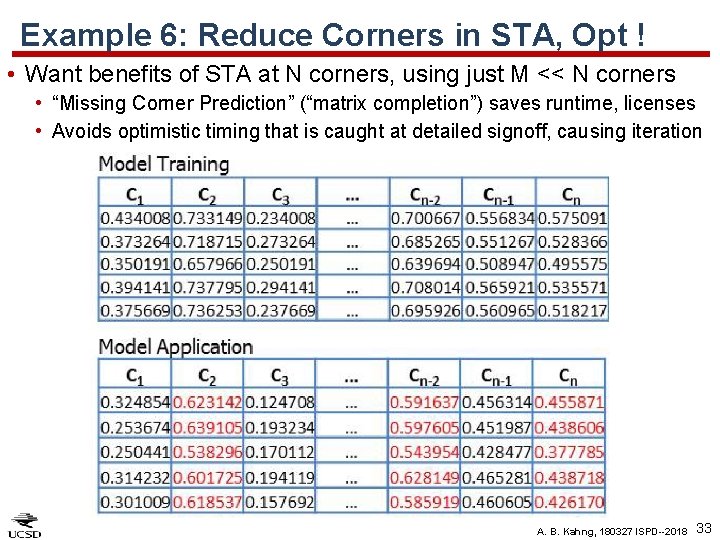
Example 6: Reduce Corners in STA, Opt ! • Want benefits of STA at N corners, using just M << N corners • “Missing Corner Prediction” (“matrix completion”) saves runtime, licenses • Avoids optimistic timing that is caught at detailed signoff, causing iteration A. B. Kahng, 180327 ISPD--2018 33
Agenda • Crises… • … and a Vision • Machine Learning in PD • Modeling and Prediction • Analysis Correlation • Optimization A. B. Kahng, 180327 ISPD--2018 34
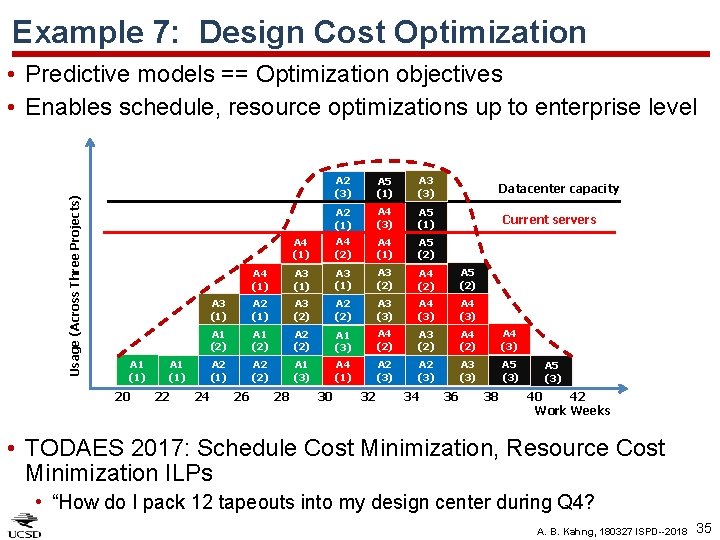
Example 7: Design Cost Optimization Usage (Across Three Projects) • Predictive models == Optimization objectives • Enables schedule, resource optimizations up to enterprise level A 1 (1) 20 A 1 (1) 22 24 A 2 (3) A 5 (1) A 3 (3) A 2 (1) A 4 (3) A 5 (1) A 4 (2) A 4 (1) A 5 (2) A 4 (1) A 3 (2) A 4 (2) A 5 (2) A 3 (1) A 2 (1) A 3 (2) A 2 (2) A 3 (3) A 4 (3) A 1 (2) A 2 (2) A 1 (3) A 4 (2) A 3 (2) A 4 (3) A 2 (1) A 2 (2) A 1 (3) A 4 (1) A 2 (3) A 3 (3) A 5 (3) 26 28 30 32 34 Datacenter capacity Current servers 36 38 A 5 (3) 40 42 Work Weeks • TODAES 2017: Schedule Cost Minimization, Resource Cost Minimization ILPs • “How do I pack 12 tapeouts into my design center during Q 4? A. B. Kahng, 180327 ISPD--2018 35
Agenda • Crises… • … and a Vision • Machine Learning in PD • Modeling and Prediction • Analysis Correlation • Optimization • A Roadmap A. B. Kahng, 180327 ISPD--2018 36
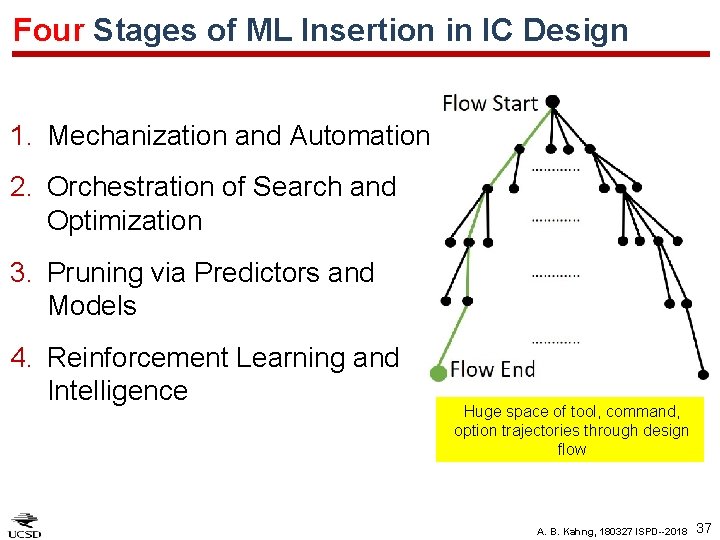
Four Stages of ML Insertion in IC Design 1. Mechanization and Automation 2. Orchestration of Search and Optimization 3. Pruning via Predictors and Models 4. Reinforcement Learning and Intelligence Huge space of tool, command, option trajectories through design flow A. B. Kahng, 180327 ISPD--2018 37
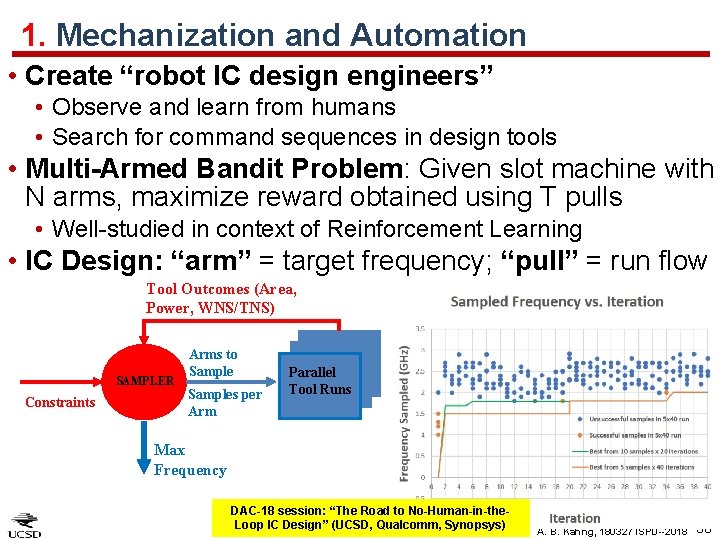
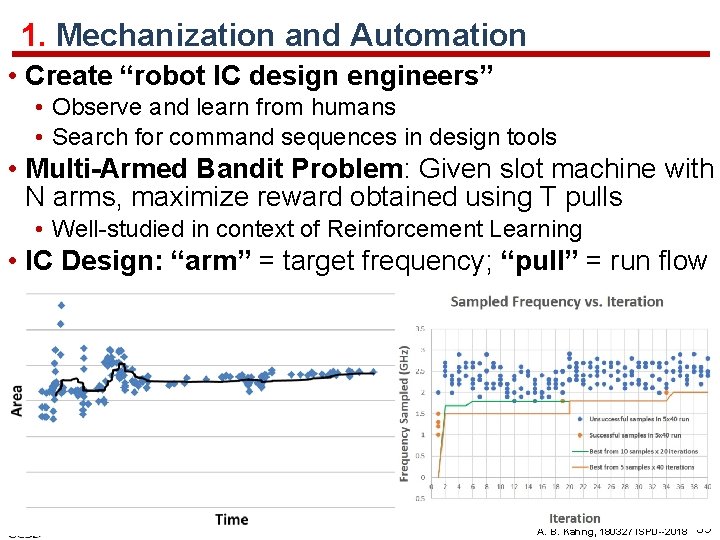
1. Mechanization and Automation • Create “robot IC design engineers” • Observe and learn from humans • Search for command sequences in design tools • Multi-Armed Bandit Problem: Given slot machine with N arms, maximize reward obtained using T pulls • Well-studied in context of Reinforcement Learning • IC Design: “arm” = target frequency; “pull” = run flow Tool Outcomes (Area, Power, WNS/TNS) SAMPLER Constraints Arms to Samples per Arm Parallel Tool Runs Max Frequency DAC-18 session: “The Road to No-Human-in-the. Loop IC Design” (UCSD, Qualcomm, Synopsys) A. B. Kahng, 180327 ISPD--2018 38
1. Mechanization and Automation • Create “robot IC design engineers” • Observe and learn from humans • Search for command sequences in design tools • Multi-Armed Bandit Problem: Given slot machine with N arms, maximize reward obtained using T pulls • Well-studied in context of Reinforcement Learning • IC Design: “arm” = target frequency; “pull” = run flow A. B. Kahng, 180327 ISPD--2018 39
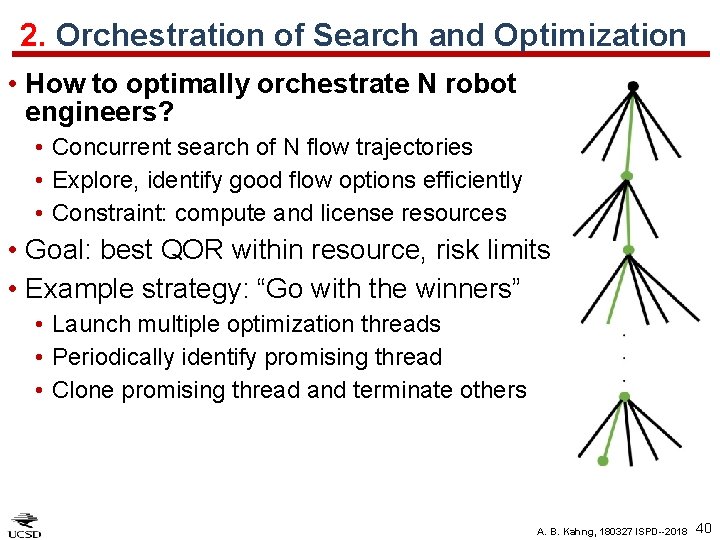
2. Orchestration of Search and Optimization • How to optimally orchestrate N robot engineers? • Concurrent search of N flow trajectories • Explore, identify good flow options efficiently • Constraint: compute and license resources • Goal: best QOR within resource, risk limits • Example strategy: “Go with the winners” • Launch multiple optimization threads • Periodically identify promising thread • Clone promising thread and terminate others A. B. Kahng, 180327 ISPD--2018 40
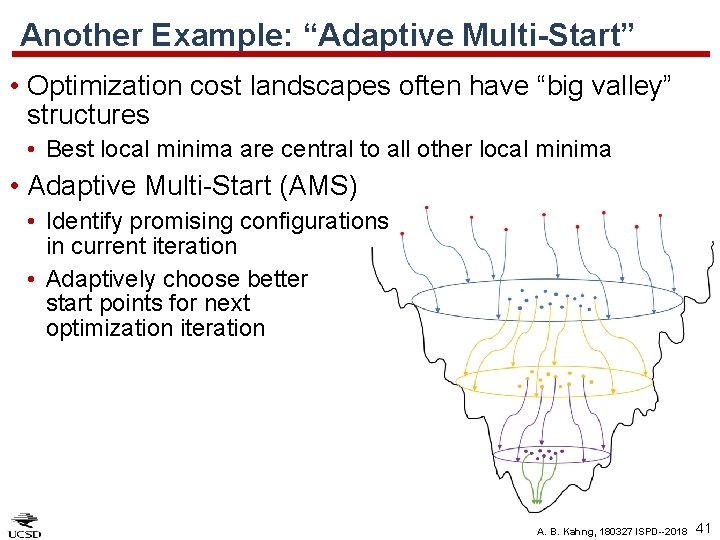
Another Example: “Adaptive Multi-Start” • Optimization cost landscapes often have “big valley” structures • Best local minima are central to all other local minima • Adaptive Multi-Start (AMS) • Identify promising configurations in current iteration • Adaptively choose better start points for next optimization iteration A. B. Kahng, 180327 ISPD--2018 41
3. Pruning via Predictors and Models • Prediction of tool- and design-specific outcomes over longer and longer subflows • Wiggling of longer and longer ropes A. B. Kahng, 180327 ISPD--2018 42
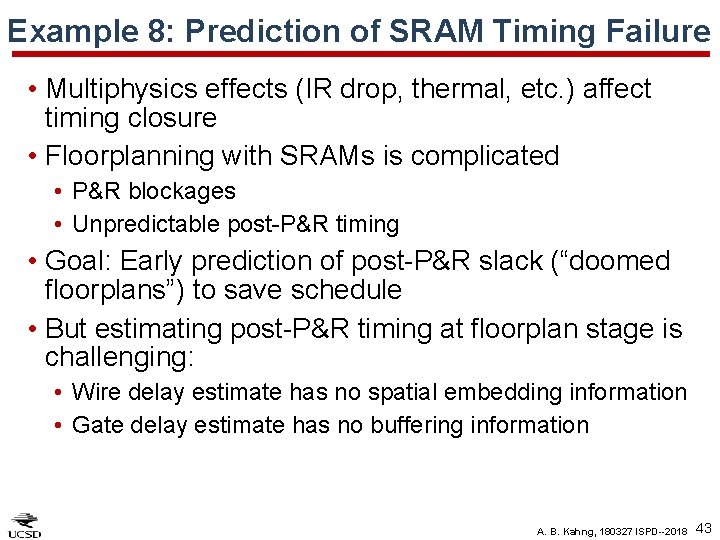
Example 8: Prediction of SRAM Timing Failure • Multiphysics effects (IR drop, thermal, etc. ) affect timing closure • Floorplanning with SRAMs is complicated • P&R blockages • Unpredictable post-P&R timing • Goal: Early prediction of post-P&R slack (“doomed floorplans”) to save schedule • But estimating post-P&R timing at floorplan stage is challenging: • Wire delay estimate has no spatial embedding information • Gate delay estimate has no buffering information A. B. Kahng, 180327 ISPD--2018 43
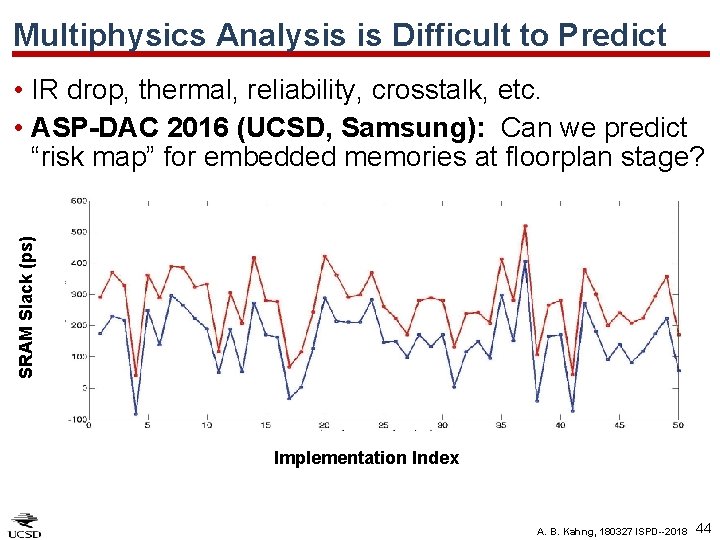
Multiphysics Analysis is Difficult to Predict SRAM Slack (ps) • IR drop, thermal, reliability, crosstalk, etc. • ASP-DAC 2016 (UCSD, Samsung): Can we predict “risk map” for embedded memories at floorplan stage? Implementation Index A. B. Kahng, 180327 ISPD--2018 44
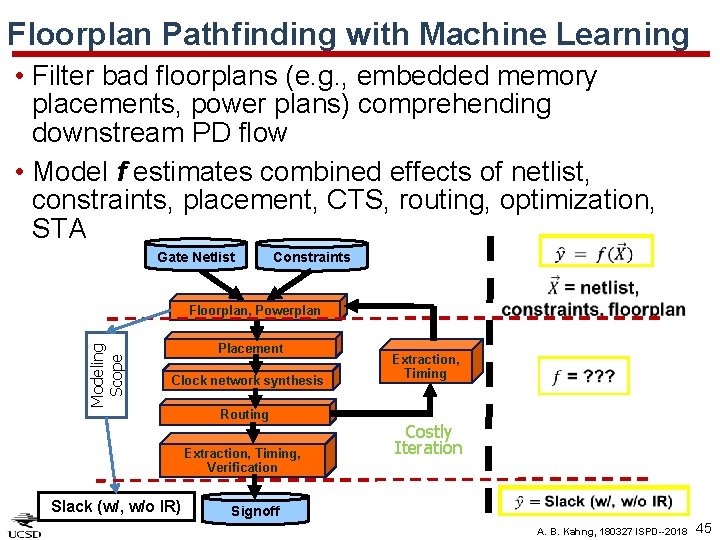
Floorplan Pathfinding with Machine Learning • Filter bad floorplans (e. g. , embedded memory placements, power plans) comprehending downstream PD flow • Model f estimates combined effects of netlist, constraints, placement, CTS, routing, optimization, STA Gate Netlist Constraints Modeling Scope Floorplan, Powerplan Placement Clock network synthesis Routing Extraction, Timing, Verification Slack (w/, w/o IR) Signoff Extraction, Timing Costly Iteration A. B. Kahng, 180327 ISPD--2018 45
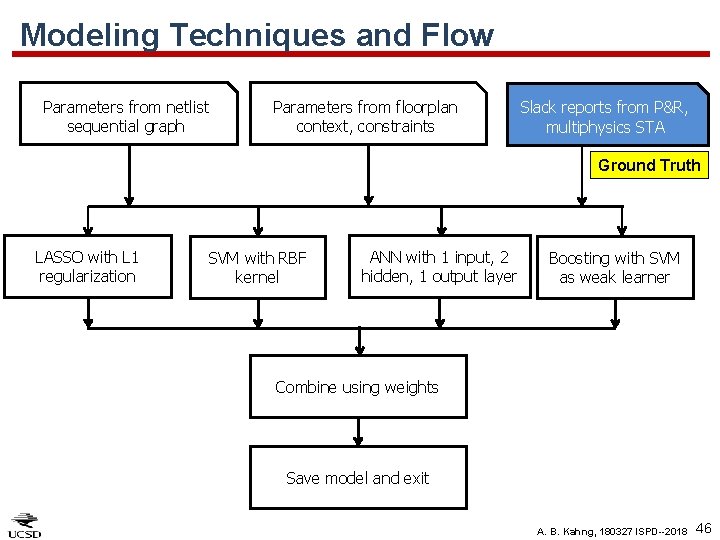
Modeling Techniques and Flow Parameters from netlist sequential graph Parameters from floorplan context, constraints Slack reports from P&R, multiphysics STA Ground Truth LASSO with L 1 regularization SVM with RBF kernel ANN with 1 input, 2 hidden, 1 output layer Boosting with SVM as weak learner Combine using weights Save model and exit A. B. Kahng, 180327 ISPD--2018 46
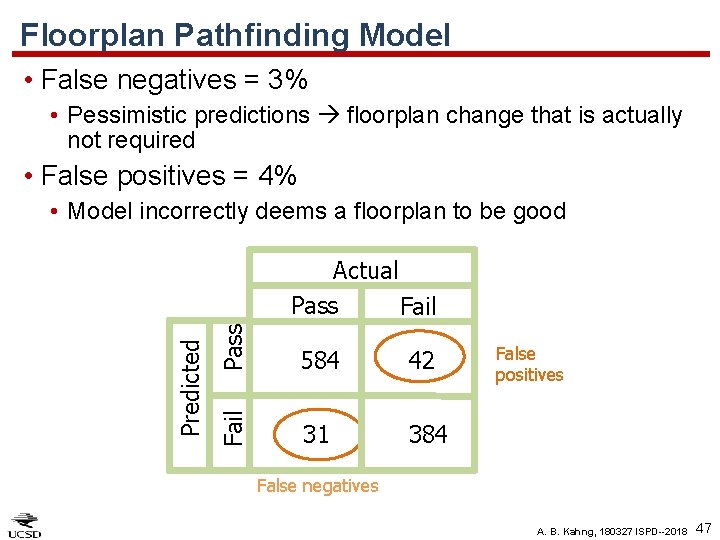
Floorplan Pathfinding Model • False negatives = 3% • Pessimistic predictions floorplan change that is actually not required • False positives = 4% • Model incorrectly deems a floorplan to be good Pass 584 42 Fail Predicted Actual Pass Fail 31 384 False positives False negatives A. B. Kahng, 180327 ISPD--2018 47
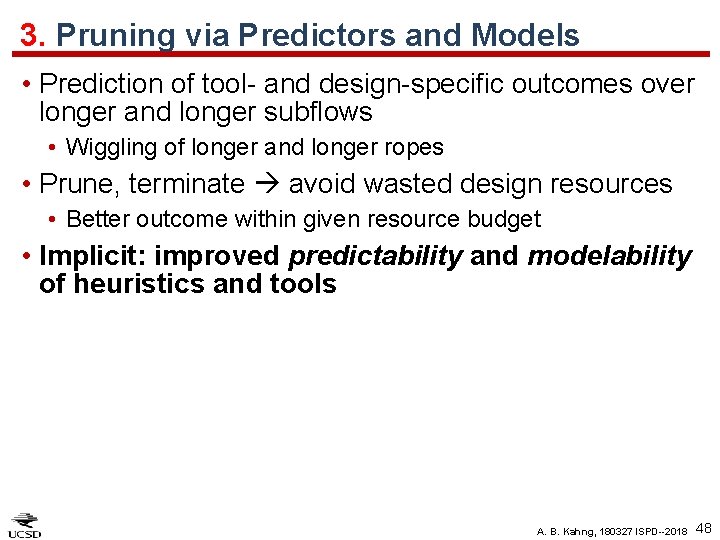
3. Pruning via Predictors and Models • Prediction of tool- and design-specific outcomes over longer and longer subflows • Wiggling of longer and longer ropes • Prune, terminate avoid wasted design resources • Better outcome within given resource budget • Implicit: improved predictability and modelability of heuristics and tools A. B. Kahng, 180327 ISPD--2018 48
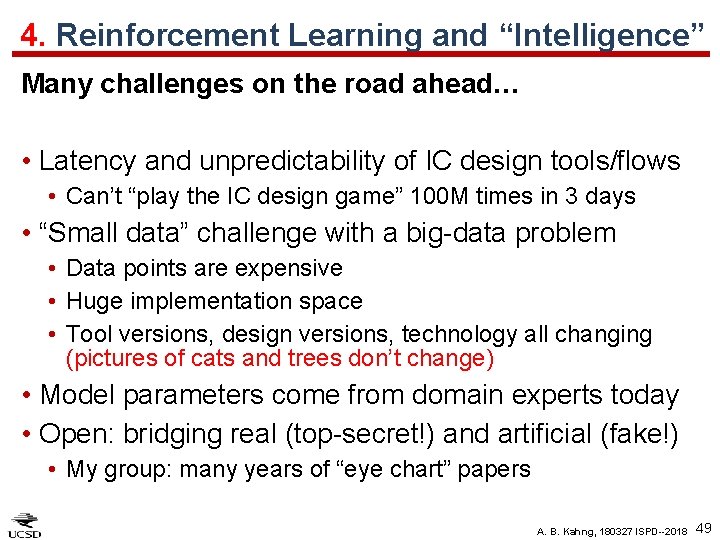
4. Reinforcement Learning and “Intelligence” Many challenges on the road ahead… • Latency and unpredictability of IC design tools/flows • Can’t “play the IC design game” 100 M times in 3 days • “Small data” challenge with a big-data problem • Data points are expensive • Huge implementation space • Tool versions, design versions, technology all changing (pictures of cats and trees don’t change) • Model parameters come from domain experts today • Open: bridging real (top-secret!) and artificial (fake!) • My group: many years of “eye chart” papers A. B. Kahng, 180327 ISPD--2018 49
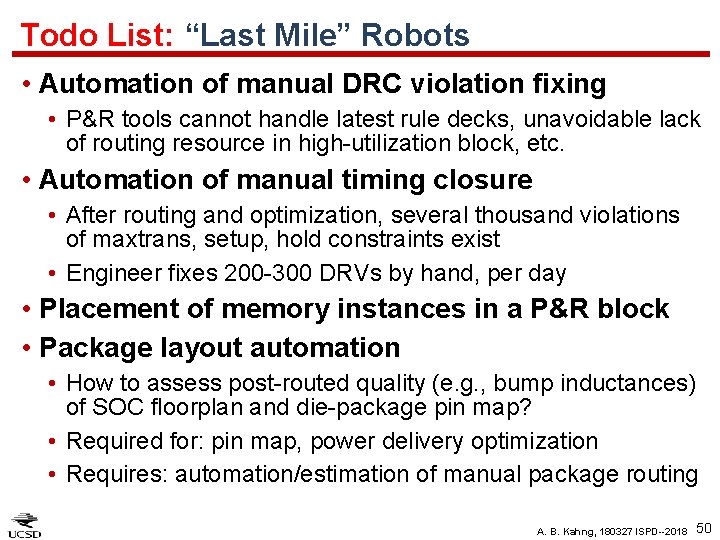
Todo List: “Last Mile” Robots • Automation of manual DRC violation fixing • P&R tools cannot handle latest rule decks, unavoidable lack of routing resource in high-utilization block, etc. • Automation of manual timing closure • After routing and optimization, several thousand violations of maxtrans, setup, hold constraints exist • Engineer fixes 200 -300 DRVs by hand, per day • Placement of memory instances in a P&R block • Package layout automation • How to assess post-routed quality (e. g. , bump inductances) of SOC floorplan and die-package pin map? • Required for: pin map, power delivery optimization • Requires: automation/estimation of manual package routing A. B. Kahng, 180327 ISPD--2018 50
Todo List: Improving Analysis Correlation • Prediction of the worst PBA path • Prediction of the worst PBA slack per endpoint, from GBA analysis • Prediction of timing at “missing corners” • Predict other impacts (e. g. , transition times, . . ) of an ECO as well • Closing of multi-physics analysis loops • Early priorities: vectorless dynamic IR drop, powertemperature loops • Continued improvement of timing correlation and estimation ! • Faster and better always helpful ! A. B. Kahng, 180327 ISPD--2018 51
Todo List: Predictive Models of Tools, Designs • Predict convergence point for P&R, non-uniform PDN • Estimate PPA response of block to floorplan context • Estimate useful skew impact on post-route WNS, TNS • “Auto-magic” determination of netlist constraints for given performance and power targets • Key opportunity: exactly ONE netlist is passed into place-and -route – how to generate this best netlist? • Predict best “target sequence” of constraints through layout optimization phases • Predict “most-optimizable” cells during design closure • Predict divergence (detouring , timing/slew violations) between trial/global route and final detailed route • Predict “doomed runs” at all steps of design flow A. B. Kahng, 180327 ISPD--2018 52
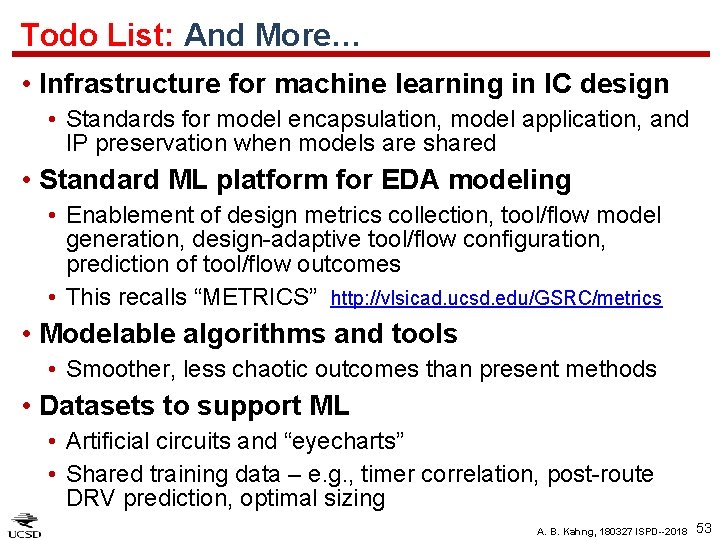
Todo List: And More… • Infrastructure for machine learning in IC design • Standards for model encapsulation, model application, and IP preservation when models are shared • Standard ML platform for EDA modeling • Enablement of design metrics collection, tool/flow model generation, design-adaptive tool/flow configuration, prediction of tool/flow outcomes • This recalls “METRICS” http: //vlsicad. ucsd. edu/GSRC/metrics • Modelable algorithms and tools • Smoother, less chaotic outcomes than present methods • Datasets to support ML • Artificial circuits and “eyecharts” • Shared training data – e. g. , timer correlation, post-route DRV prediction, optimal sizing A. B. Kahng, 180327 ISPD--2018 53
Agenda • Crises… • … and a Vision • Machine Learning in PD • Modeling and Prediction • Analysis Correlation • Optimization • A Roadmap • Conclusion A. B. Kahng, 180327 ISPD--2018 54
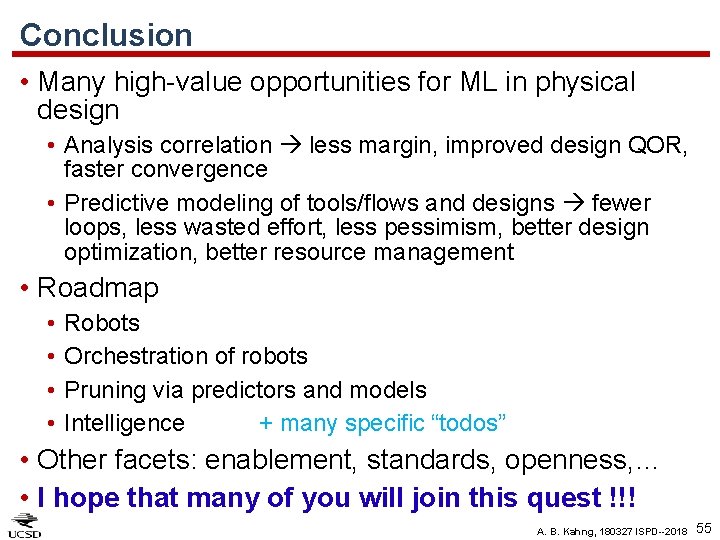
Conclusion • Many high-value opportunities for ML in physical design • Analysis correlation less margin, improved design QOR, faster convergence • Predictive modeling of tools/flows and designs fewer loops, less wasted effort, less pessimism, better design optimization, better resource management • Roadmap • • Robots Orchestration of robots Pruning via predictors and models Intelligence + many specific “todos” • Other facets: enablement, standards, openness, … • I hope that many of you will join this quest !!! A. B. Kahng, 180327 ISPD--2018 55
THANK YOU ! Support from NSF, Qualcomm, Samsung, NXP, Mentor Graphics and the C-DEN center is gratefully acknowledged. A. B. Kahng, 180327 ISPD--2018 56
BACKUP A. B. Kahng, 180327 ISPD--2018 57
[ISQED 01] (This is “METRICS” !) • METRICS (1999; ISQED 01): “Measure to Improve” • Goal #1: Predict outcome • Goal #2: Find sweet spot (field of use) of tool, flow • Goal #3: Dial in design-specific tool, flow knobs http: //vlsicad. ucsd. edu/GSRC/metrics A. B. Kahng, 180327 ISPD--2018 58
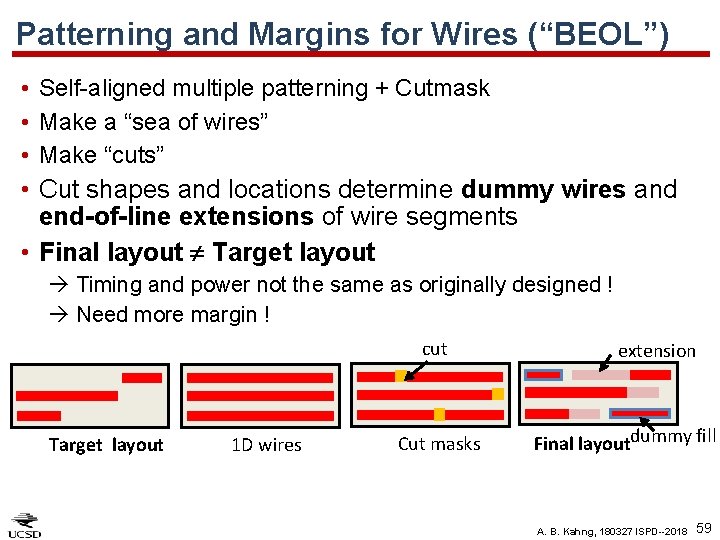
Patterning and Margins for Wires (“BEOL”) • Self-aligned multiple patterning + Cutmask • Make a “sea of wires” • Make “cuts” • Cut shapes and locations determine dummy wires and end-of-line extensions of wire segments • Final layout Target layout Timing and power not the same as originally designed ! Need more margin ! cut Target layout 1 D wires Cut masks extension Final layoutdummy fill A. B. Kahng, 180327 ISPD--2018 59
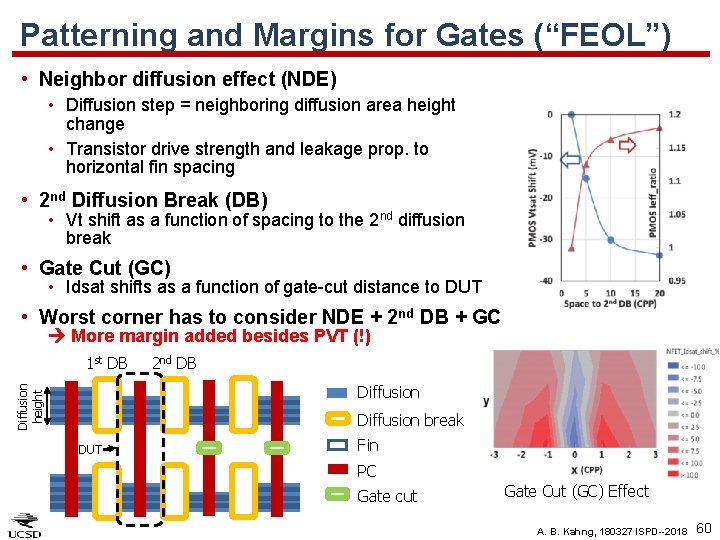
Patterning and Margins for Gates (“FEOL”) • Neighbor diffusion effect (NDE) • Diffusion step = neighboring diffusion area height change • Transistor drive strength and leakage prop. to horizontal fin spacing • 2 nd Diffusion Break (DB) • Vt shift as a function of spacing to the 2 nd diffusion break • Gate Cut (GC) • Idsat shifts as a function of gate-cut distance to DUT • Worst corner has to consider NDE + 2 nd DB + GC More margin added besides PVT (!) Diffusion height 1 st DB 2 nd DB Diffusion break DUT Fin PC Gate cut Gate Cut (GC) Effect A. B. Kahng, 180327 ISPD--2018 60
[ASPDAC 16] Closing Multiphysics Analysis Loops Sim Results (Dyn. ) Activity Factor (Static) Tech files, signoff criteria, corners IR Drop Map AVS Timing / Glitches Slack P&R + Optimization Timing/ Noise Functional Sim Power Trace Thermal Analysis Power Analysis Reliability Report Sim vectors Benchmark RTL Temp Map Task Mapping/ Migration/ (DVFS) MTTF & Aging A. B. Kahng, 180327 ISPD--2018 61
[ASPDAC 16] Closing Multiphysics Analysis Loops Tech files, signoff criteria, corners Sim Results Functional Workload-Thermal (Dyn. ) Activity Sim Factor (Static) STA-IR loop IR Drop Map AVS Timing / Glitches Slack P&R + Optimization loop Sim vectors Timing/ Noise Power Trace Thermal Analysis Power Analysis. STA-Thermal loop Reliability Report STA-Reliability loop Benchmark RTL Temp Map Task Mapping/ Migration/ (DVFS) MTTF & Aging A. B. Kahng, 180327 ISPD--2018 62
Some References Highlighted in the talk from ABKGroup • [RISKMAP] W. -T. J. Chan, K. Y. Chung, A. B. Kahng, N. D. Mac. Donald and S. Nath, "Learning-Based Prediction of Embedded Memory Timing Failures During Initial Floorplan Design", (. pdf), Proc. ASPDAC, 2016. • [GT 1 GT 2] ] S. S. Han, A. B. Kahng, S. Nath and A. Vydyanathan, "A Deep Learning Methodology to Proliferate Golden Signoff Timing", (. pdf), Proc. DATE, 2014. • [GT 1 GT 2] A. B. Kahng, M. Luo and S. Nath, "SI for Free: Machine Learning of Interconnect Coupling Delay and Transition Effects", (. pdf), Proc. SLIP, 2015. • [#ML/ROPT] W. -T. J. Chan, Y. Du, A. B. Kahng, S. Nath and K. Samadi, "BEOL Stack-Aware Routability Prediction from Placement Using Data Mining Techniques", (. pdf), Proc. ICCD, 2016. • [#ML/ROPT] W. -T. J. Chan, P. -H. Ho, A. B. Kahng and P. Saxena, "Routability Optimization for Industrial Designs at Sub-14 nm Process Nodes Using Machine Learning", (. pdf), Proc. ISPD, 2017. • [CTS] K. Han, A. B. Kahng, J. Lee, J. Li and S. Nath, "A Global-Local Optimization Framework for Simultaneous Multi -Mode Multi-Corner Skew Variation Reduction", (. pdf), Proc. DAC, 2015. Some other machine learning / data mining papers from ABKGroup • [3 DPE] W. -T. J. Chan, Y. Du, A. B. Kahng, S. Nath and K. Samadi, "3 D-IC Benefit Estimation and Implementation Guidance from 2 D-IC Implementation", (. pdf), Proc. DAC, 2015. • [HS] A. B. Kahng, C. -H. Park and X. Xu, "Fast Dual-Graph Based Hotspot Detection” (. pdf), Proc. BACUS, 2006. • [INT] A. B. Kahng, S. Kang, H. Lee, S. Nath and J. Wadhwani, "Learning-Based Approximation of Interconnect Delay and Slew in Signoff Timing Tools", (. pdf), Proc. SLIP, 2013. • [METRICS] S. Fenstermaker, D. George, A. B. Kahng, S. Mantik and B. Thielges, "METRICS: A System Architecture for Design Process Optimization", (. pdf), Proc. DAC, 2000. • [METRICS] A. B. Kahng and S. Mantik, "A System for Automatic Recording and Prediction of Design Quality Metrics", (. pdf), Proc. ISQED, 2001. • [HSM] A. B. Kahng, B. Lin and S. Nath, "Enhanced Metamodeling Techniques for High-Dimensional IC Design Estimation Problems", (. pdf), Proc. Design, Automation and Test in Europe, 2013, pp. 1861 -1866. • [HHSM] A. B. Kahng, B. Lin and S. Nath, "High-Dimensional Metamodeling for Prediction of Clock Tree Synthesis Outcomes", (. pdf), Proc. ACM/IEEE International Workshop on System-Level Interconnect Prediction, 2013. • [METRICS] GSRC/METRICS: http: //vlsicad. ucsd. edu/GSRC/metrics/ See also: Center for Design-Enabled Nanofabrication, http: //cden. ucsd. edu A. B. Kahng, 180327 ISPD--2018 63