
Machine Learning a Hands on Session Raman Sankaran




- Slides: 42
Machine Learning – a Hands on Session Raman Sankaran Saneem Ahmed Chandrahas Dewangan Sachin Nagargoje
Disclaimer Most of the images in this presentation are shamelessly downloaded from Google images
Why is this pic included here ?
Popular Applications of Machine Learning
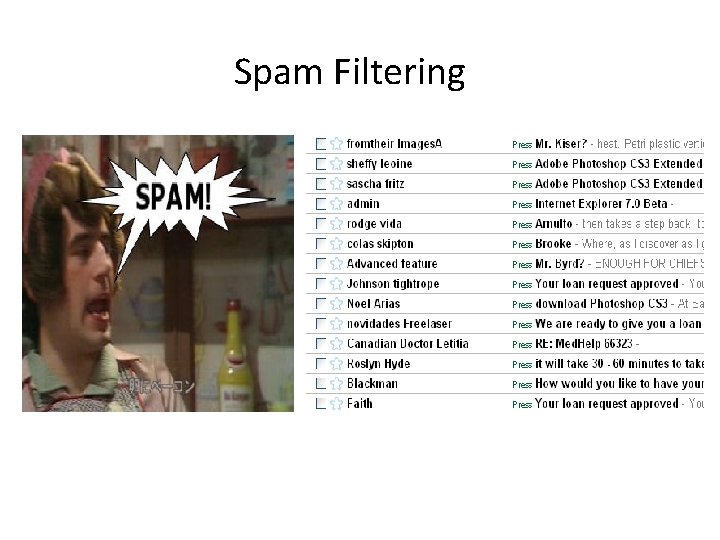
Spam Filtering
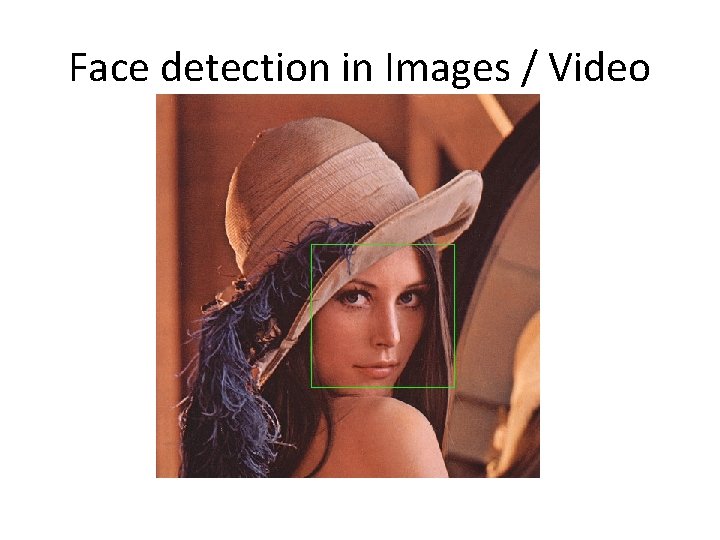
Face detection in Images / Video
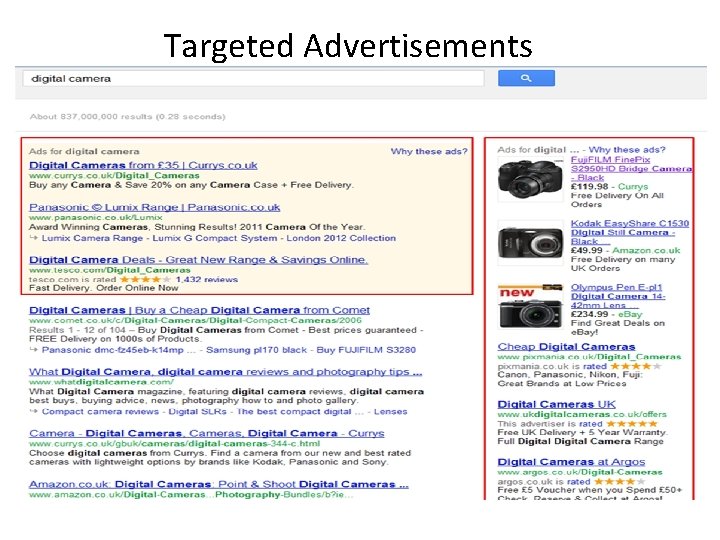
Targeted Advertisements
Why Machine Learning?
Why Machine Learning • Data size • Ability to develop algorithms which are independent of the data domain • Inability of humans to completely specify the rules for the tasks – How would you describe verbally to the computer about how a person looks like ?
What is Machine Learning?
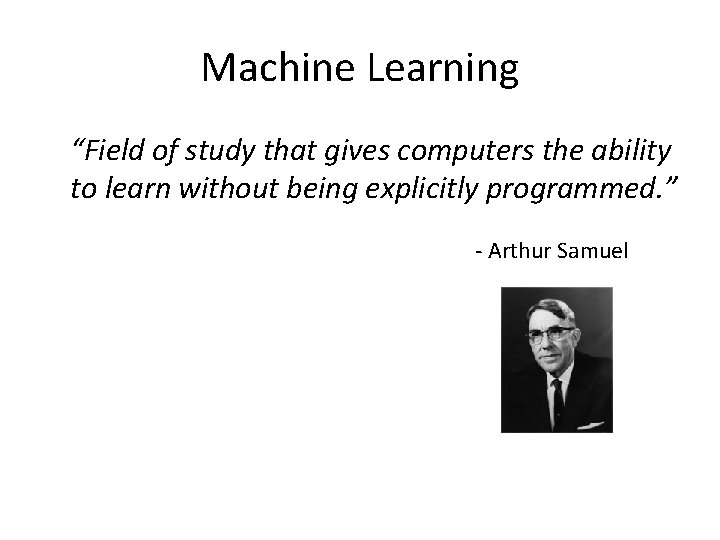
Machine Learning “Field of study that gives computers the ability to learn without being explicitly programmed. ” - Arthur Samuel
How to train a model – a toy example
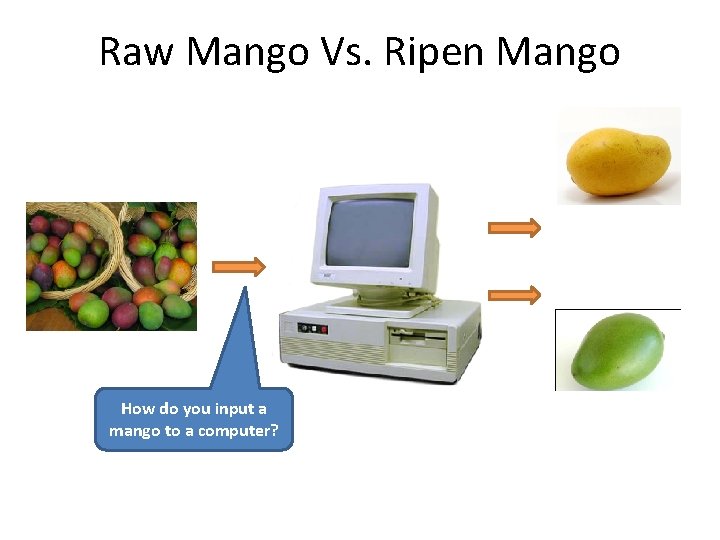
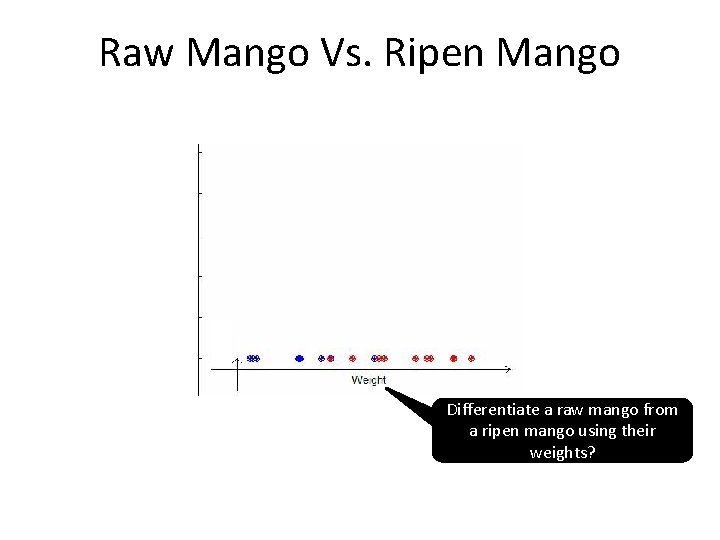
Raw Mango Vs. Ripen Mango How do you input a mango to a computer?
Raw Mango Vs. Ripen Mango Differentiate a raw mango from a ripen mango using their weights?
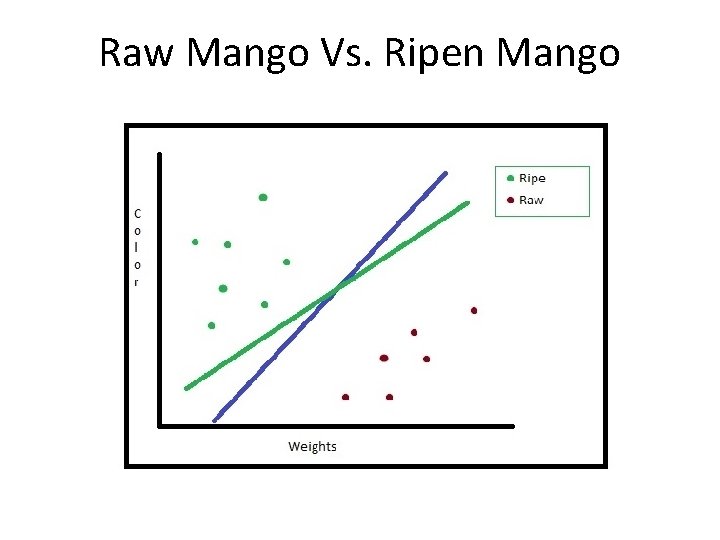
Raw Mango Vs. Ripen Mango
Feature Engineering • How would you encode a raw or a ripen mango to the computer ? • The idea is to represent them in an array of real number values. • Use a mathematical model to learn the separator using the real number values • Need a domain expert in designing efficient features. – Eg – Images (Signal Transformations), Genes (sequence analysis), Documents (regular expressions)
Classification Steps • Pick mangoes of both category to train • Identify the quantities that you want to measure • Identify a GOOD separator between the classes • Pick a new mango and find which side of the separator it falls under.
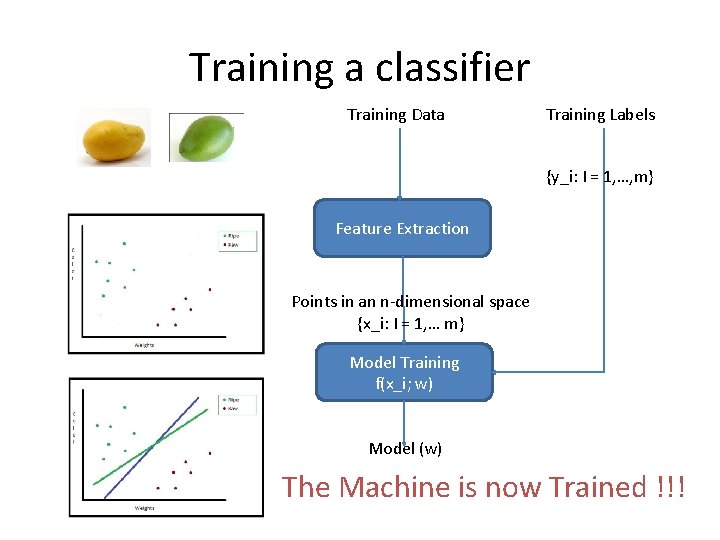
Training a classifier Training Data Training Labels {y_i: I = 1, …, m} Feature Extraction Points in an n-dimensional space {x_i: I = 1, … m} Model Training f(x_i; w) Model (w) The Machine is now Trained !!!
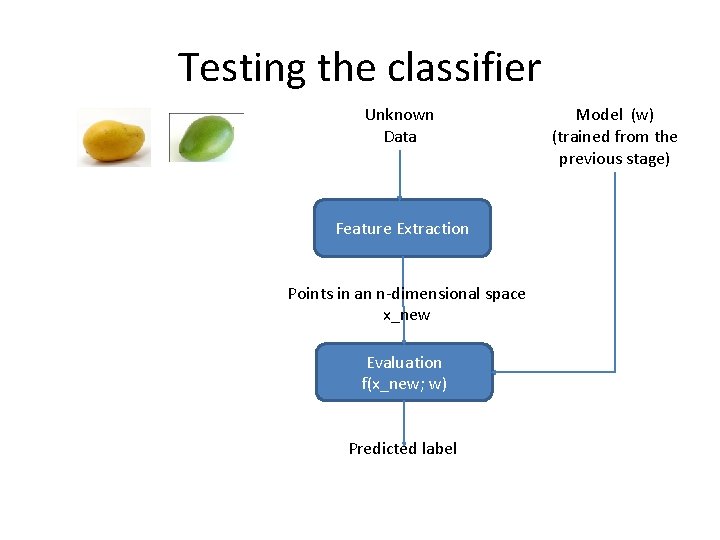
Testing the classifier Unknown Data Feature Extraction Points in an n-dimensional space x_new Evaluation f(x_new; w) Predicted label Model (w) (trained from the previous stage)
Tips • Avoid overfitting the training data. Why ? • Generalize. Do not memorize. • Find a simple enough model which fits the data, discarding the outliers. – Optimize !!!
Types of Learning
Types of Learning • Supervised Learning – Classification – Given examples along with their corresponding classes as the label (spam filtering) – Regression – Given examples along with a Real valued label (Rain forcast) • Unsupervised Learning – Clustering – Examples are given without any labels. One has to find groups within the data • Reinforcement Learning – Learning through feedback (How to cycle !, Robot training itself to go through a Maze)
Examples revisited
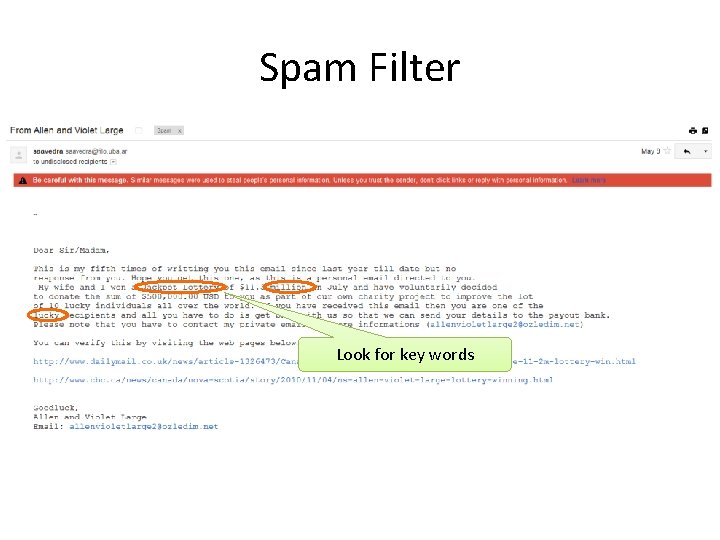
Spam Filter Look for key words
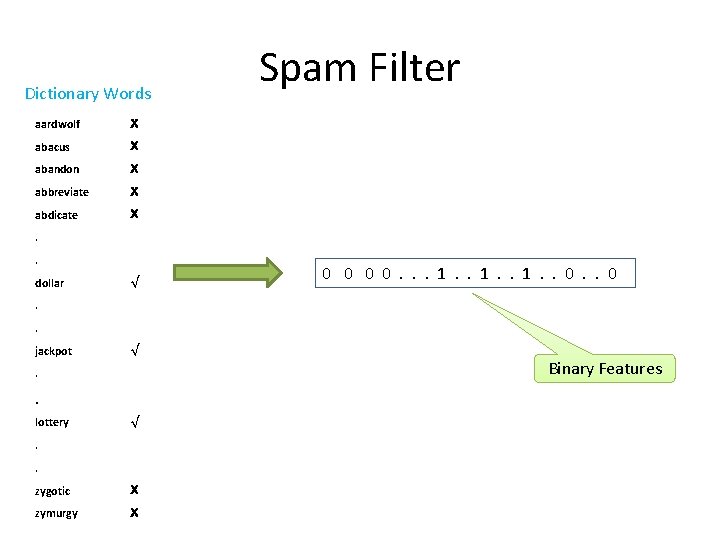
Dictionary Words aardwolf X abacus X abandon X abbreviate X abdicate X Spam Filter . . dollar √ 0 0. . . 1. . 0 . . jackpot √ Binary Features . . lottery √ . . zygotic X zymurgy X
Score Prediction • How much is Sachin expected to score against SA today ? – Current form – Past performance against this opposition – Past performance at this venue – His overall average – Is Steyn playing for SA ?
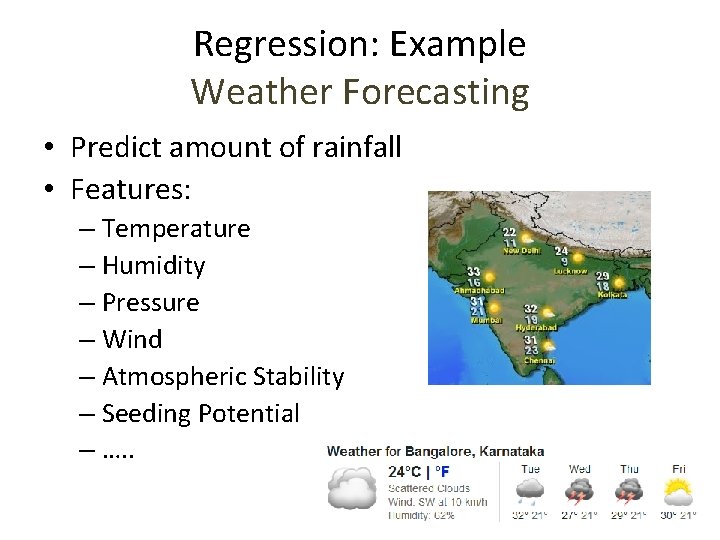
Regression: Example Weather Forecasting • Predict amount of rainfall • Features: – Temperature – Humidity – Pressure – Wind – Atmospheric Stability – Seeding Potential – …. .
Documents Clustering • Given the set of documents, group them according to categories like Sports, Politics, etc. • No explicit label provided
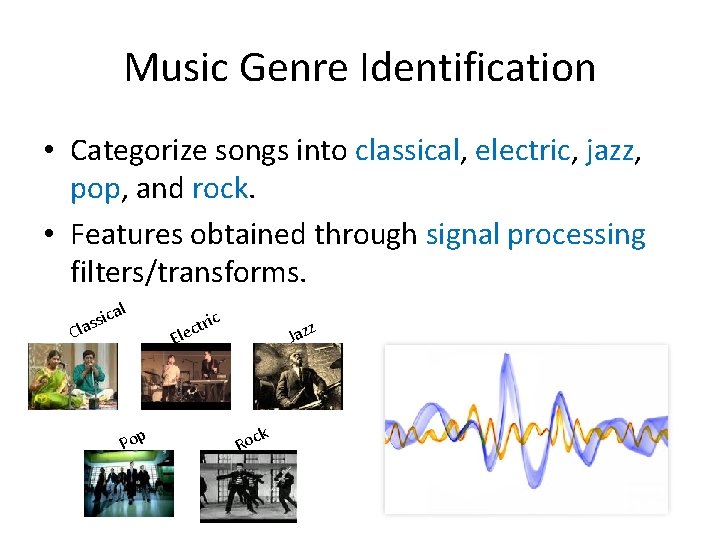
Music Genre Identification • Categorize songs into classical, electric, jazz, pop, and rock. • Features obtained through signal processing filters/transforms. ica s s la l C Pop tric c e El z Jaz k Roc
Exercise Can you guess the Type of Learning in the given Applications?
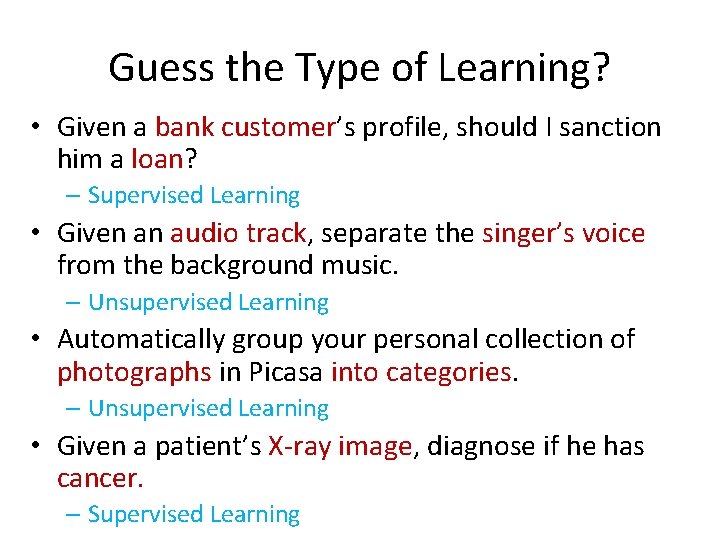
Guess the Type of Learning? • Given a bank customer’s profile, should I sanction him a loan? – Supervised Learning • Given an audio track, separate the singer’s voice from the background music. – Unsupervised Learning • Automatically group your personal collection of photographs in Picasa into categories. – Unsupervised Learning • Given a patient’s X-ray image, diagnose if he has cancer. – Supervised Learning
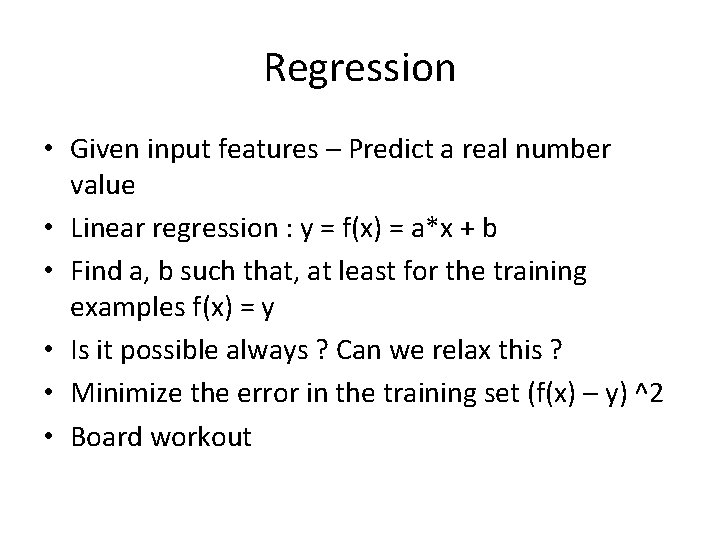
Regression • Given input features – Predict a real number value • Linear regression : y = f(x) = a*x + b • Find a, b such that, at least for the training examples f(x) = y • Is it possible always ? Can we relax this ? • Minimize the error in the training set (f(x) – y) ^2 • Board workout
Regression • Closed form for computing the least squares solution • Iterative method – using the gradients to compute the same solution
Hands on Session Regression
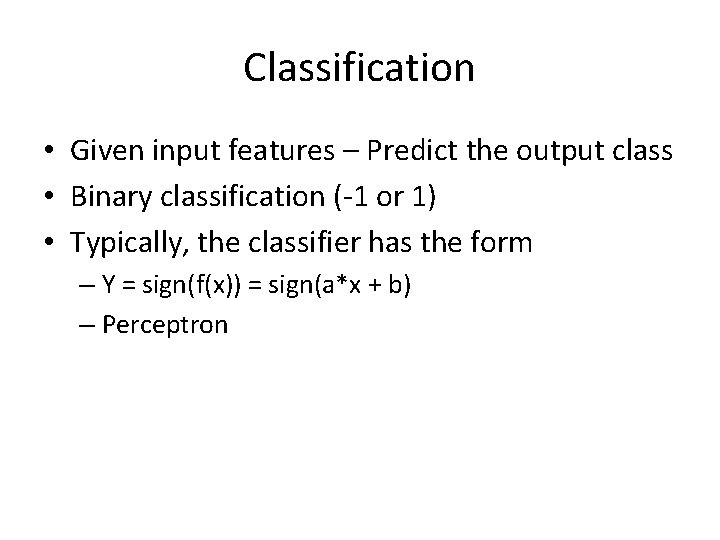
Classification • Given input features – Predict the output class • Binary classification (-1 or 1) • Typically, the classifier has the form – Y = sign(f(x)) = sign(a*x + b) – Perceptron
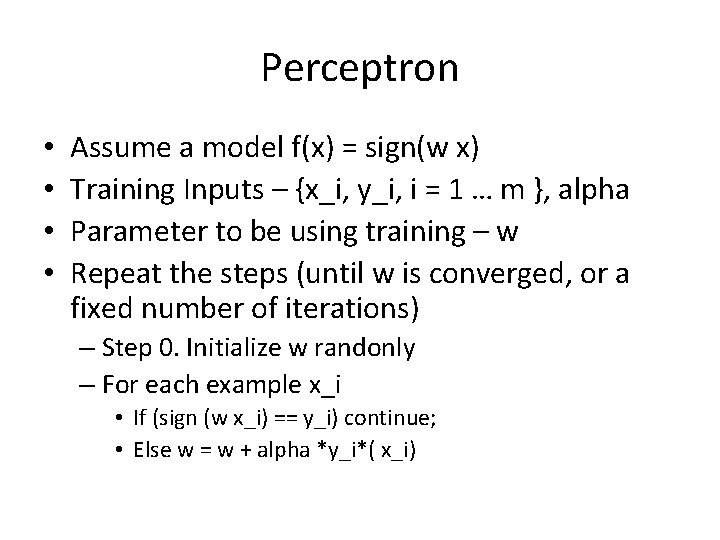
Perceptron • • Assume a model f(x) = sign(w x) Training Inputs – {x_i, y_i, i = 1 … m }, alpha Parameter to be using training – w Repeat the steps (until w is converged, or a fixed number of iterations) – Step 0. Initialize w randonly – For each example x_i • If (sign (w x_i) == y_i) continue; • Else w = w + alpha *y_i*( x_i)
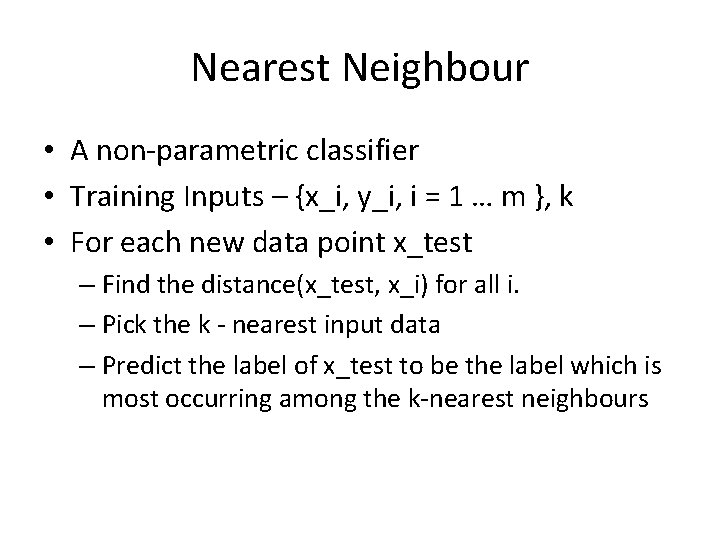
Nearest Neighbour • A non-parametric classifier • Training Inputs – {x_i, y_i, i = 1 … m }, k • For each new data point x_test – Find the distance(x_test, x_i) for all i. – Pick the k - nearest input data – Predict the label of x_test to be the label which is most occurring among the k-nearest neighbours
Classification Criteria • How good is the model – Number of training points which are correctly classified – What if the training data is very skewed ? – What if the training data has some outliers
Hands on Session Classification
Questions?