
Machine Guarding OSHA Office of Training and Education

- Slides: 28
Machine Guarding OSHA Office of Training and Education
Introduction Crushed hands and arms, severed fingers, blindness the list of possible machinery-related injuries is as long as it is horrifying. Safeguards are essential for protecting workers from needless and preventable injuries. A good rule to remember is: Any machine part, function, or process which may cause injury must be safeguarded. Where the operation of a machine can injure the operator or other workers, the hazard must be controlled or eliminated. OSHA Office of Training and Education
Causes of Machine Accidents o Reaching in to “clear” equipment o Not using Lockout/Tagout o Unauthorized persons doing maintenance or using the machines o Missing or loose machine guards OSHA Office of Training and Education
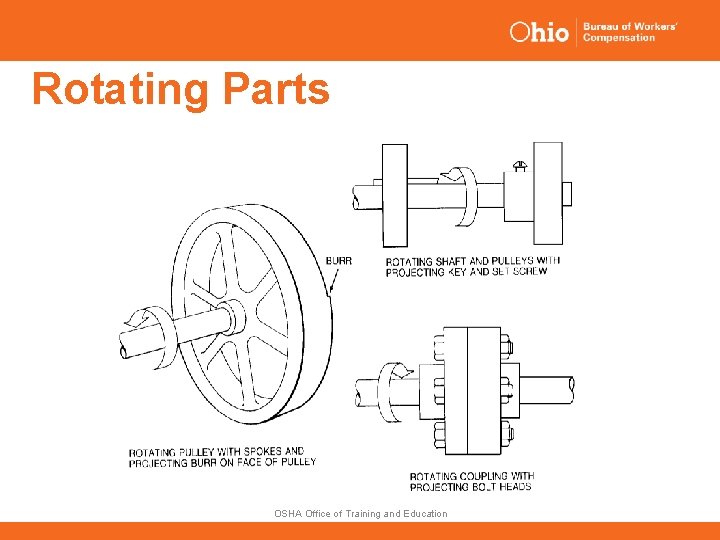
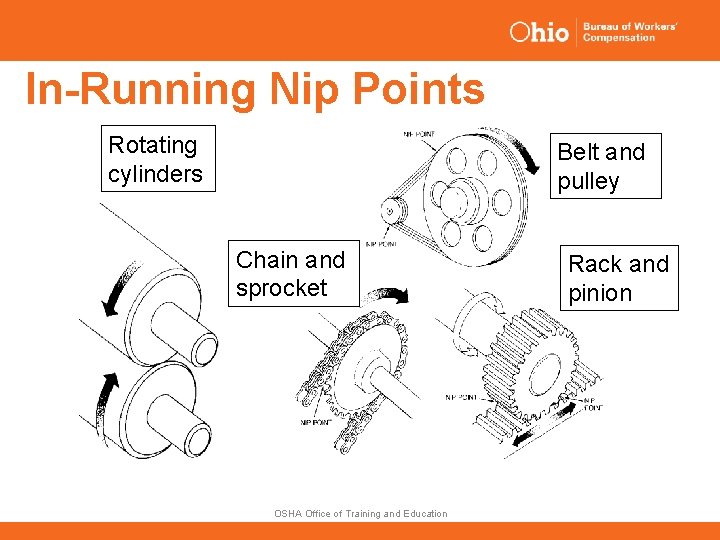
Where Mechanical Hazards Occur o Point of operation o All parts of the machine which move, such as: • flywheels, pulleys, belts, couplings, chains, cranks, gears, etc. • feed mechanisms and auxiliary parts of the machine o In-running nip points OSHA Office of Training and Education
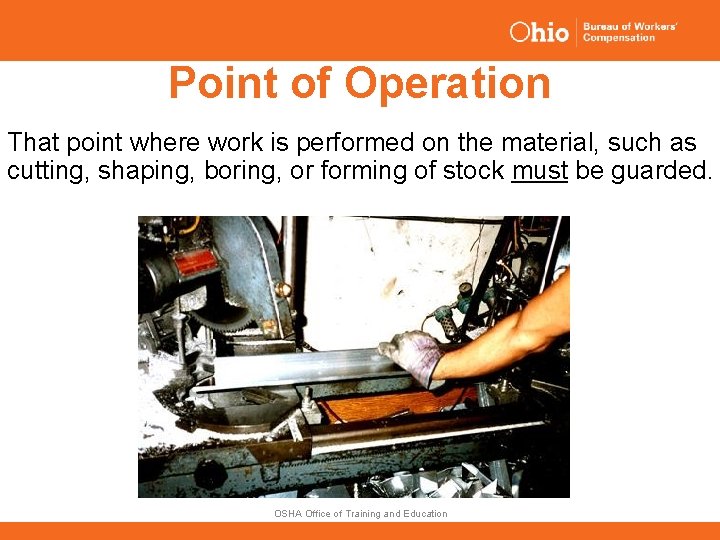
Point of Operation That point where work is performed on the material, such as cutting, shaping, boring, or forming of stock must be guarded. OSHA Office of Training and Education
Rotating Parts OSHA Office of Training and Education
In-Running Nip Points Rotating cylinders Belt and pulley Chain and sprocket OSHA Office of Training and Education Rack and pinion
Requirements for Safeguards o Prevent contact - prevent worker’s body or clothing from contacting hazardous moving parts o Secured - firmly secured to machine and not easily removed o Protect from falling objects - ensure that no objects can fall into moving parts OSHA Office of Training and Education
Requirements for Safeguards o Create no new hazards - must not have shear points, jagged edges or unfinished surfaces o Create no interference - must not prevent worker from performing the job quickly and comfortably o Allow safe lubrication - if possible, be able to lubricate the machine without removing the safeguards OSHA Office of Training and Education
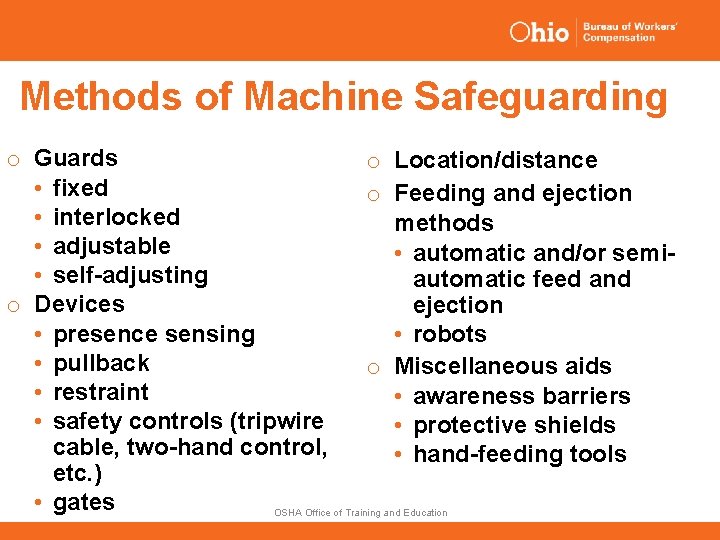
Methods of Machine Safeguarding o Guards o Location/distance • fixed o Feeding and ejection • interlocked methods • adjustable • automatic and/or semi • self-adjusting automatic feed and o Devices ejection • presence sensing • robots • pullback o Miscellaneous aids • restraint • awareness barriers • safety controls (tripwire • protective shields cable, two-hand control, • hand-feeding tools etc. ) • gates OSHA Office of Training and Education
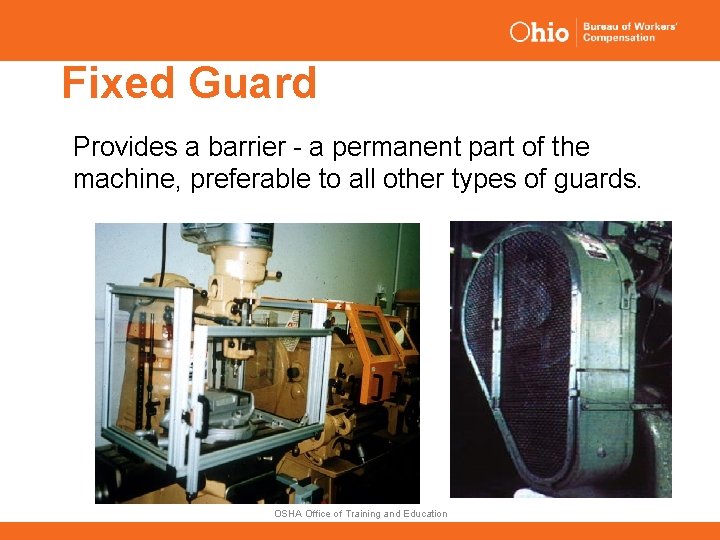
Fixed Guard Provides a barrier - a permanent part of the machine, preferable to all other types of guards. OSHA Office of Training and Education
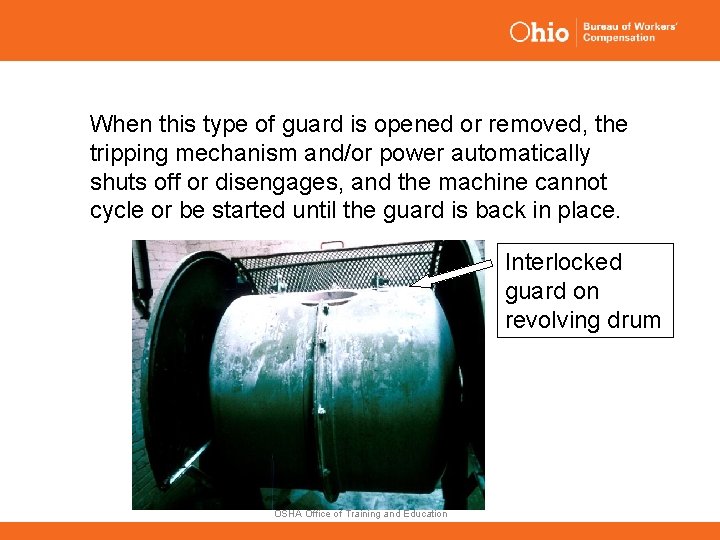
Interlocked Guard When this type of guard is opened or removed, the tripping mechanism and/or power automatically shuts off or disengages, and the machine cannot cycle or be started until the guard is back in place. Interlocked guard on revolving drum OSHA Office of Training and Education
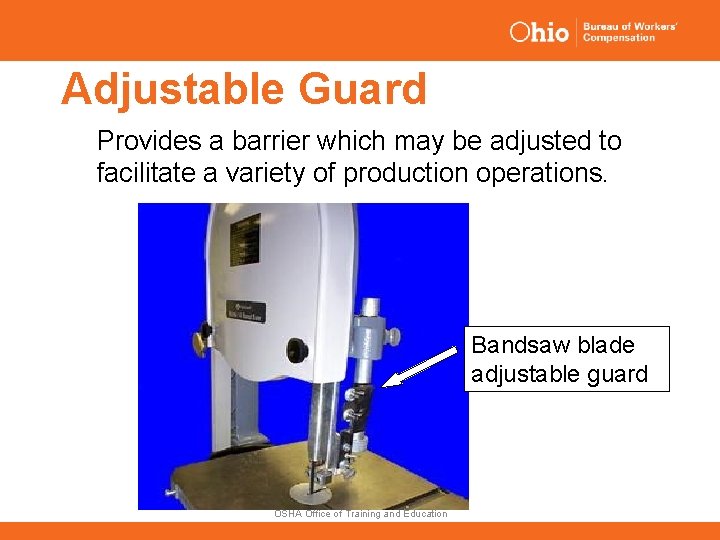
Adjustable Guard Provides a barrier which may be adjusted to facilitate a variety of production operations. Bandsaw blade adjustable guard OSHA Office of Training and Education
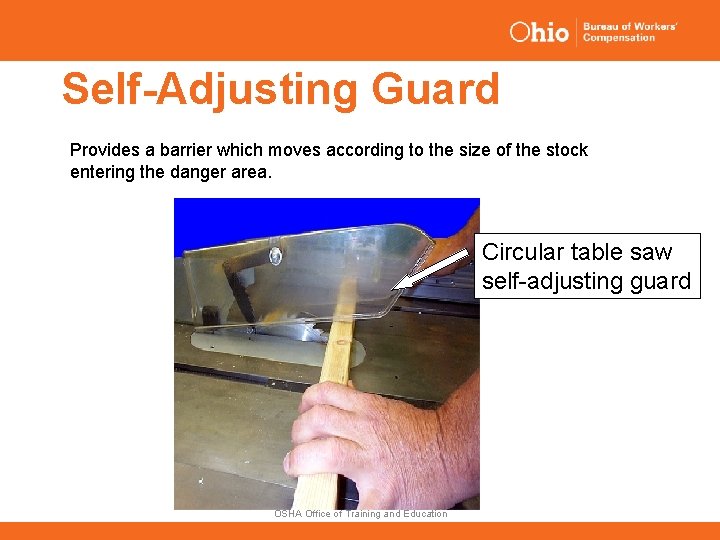
Self-Adjusting Guard Provides a barrier which moves according to the size of the stock entering the danger area. Circular table saw self-adjusting guard OSHA Office of Training and Education
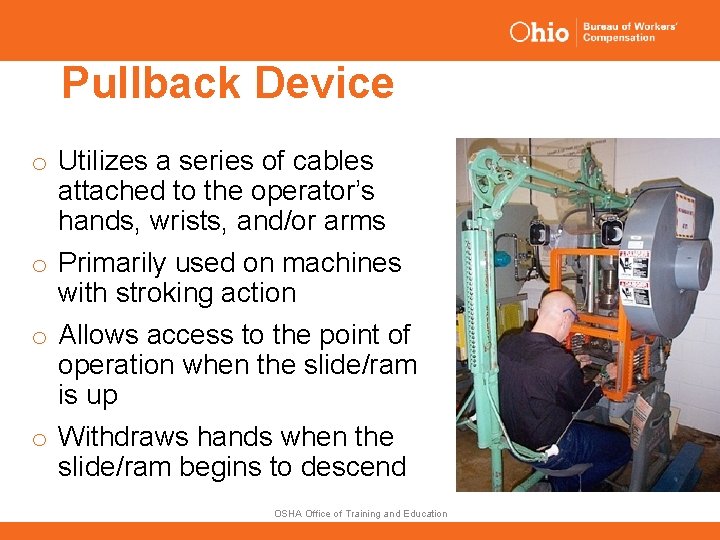
Pullback Device o Utilizes a series of cables attached to the operator’s hands, wrists, and/or arms o Primarily used on machines with stroking action o Allows access to the point of operation when the slide/ram is up o Withdraws hands when the slide/ram begins to descend OSHA Office of Training and Education
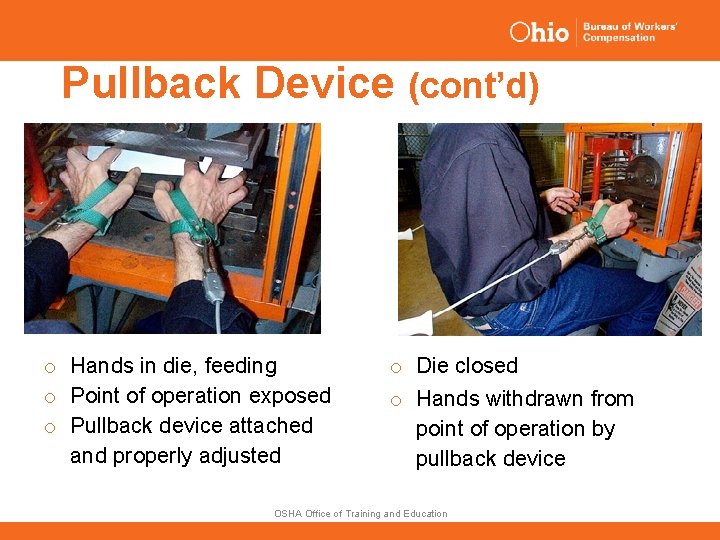
Pullback Device (cont’d) o Hands in die, feeding o Point of operation exposed o Pullback device attached and properly adjusted o Die closed o Hands withdrawn from point of operation by pullback device OSHA Office of Training and Education
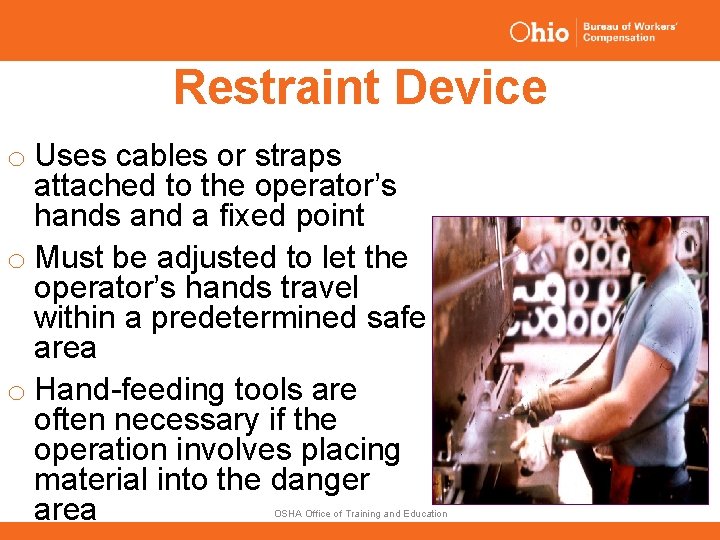
Restraint Device o Uses cables or straps attached to the operator’s hands and a fixed point o Must be adjusted to let the operator’s hands travel within a predetermined safe area o Hand-feeding tools are often necessary if the operation involves placing material into the danger area OSHA Office of Training and Education
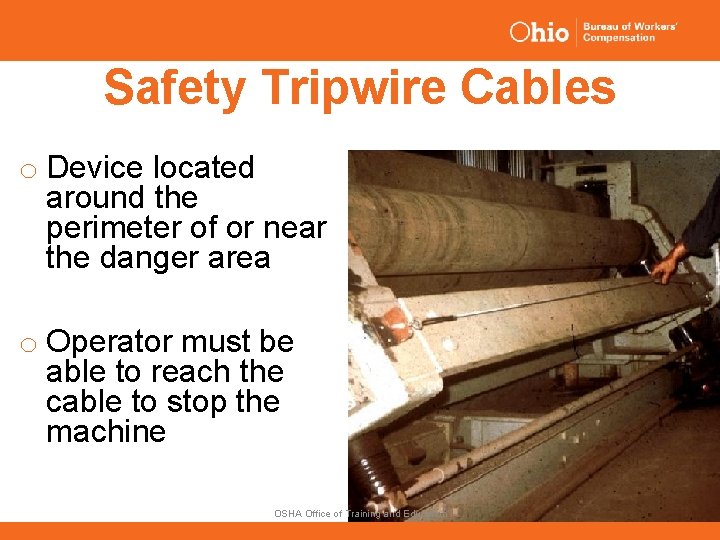
Safety Tripwire Cables o Device located around the perimeter of or near the danger area o Operator must be able to reach the cable to stop the machine OSHA Office of Training and Education
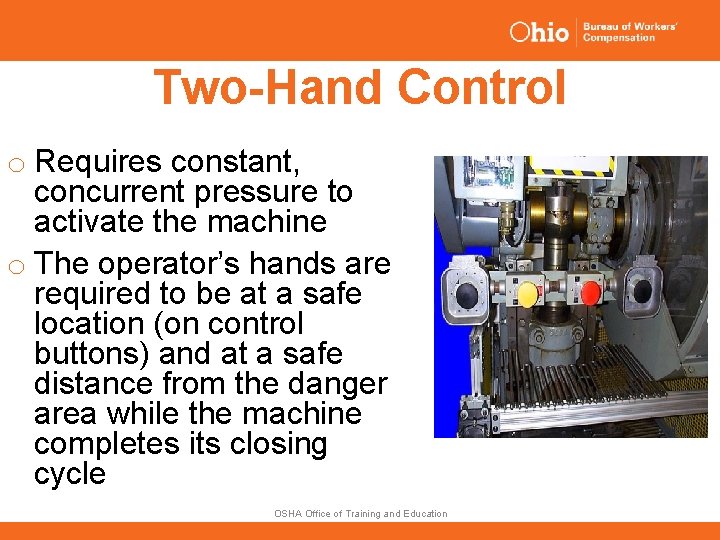
Two-Hand Control o Requires constant, concurrent pressure to activate the machine o The operator’s hands are required to be at a safe location (on control buttons) and at a safe distance from the danger area while the machine completes its closing cycle OSHA Office of Training and Education
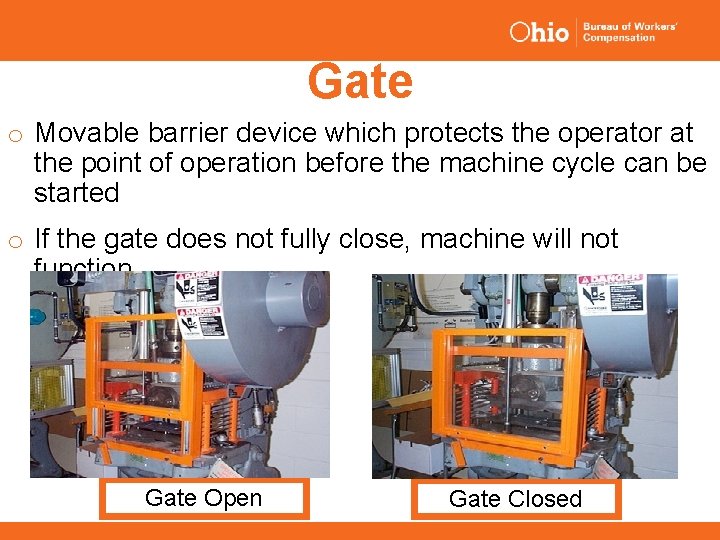
Gate o Movable barrier device which protects the operator at the point of operation before the machine cycle can be started o If the gate does not fully close, machine will not function Gate Open Gate Closed
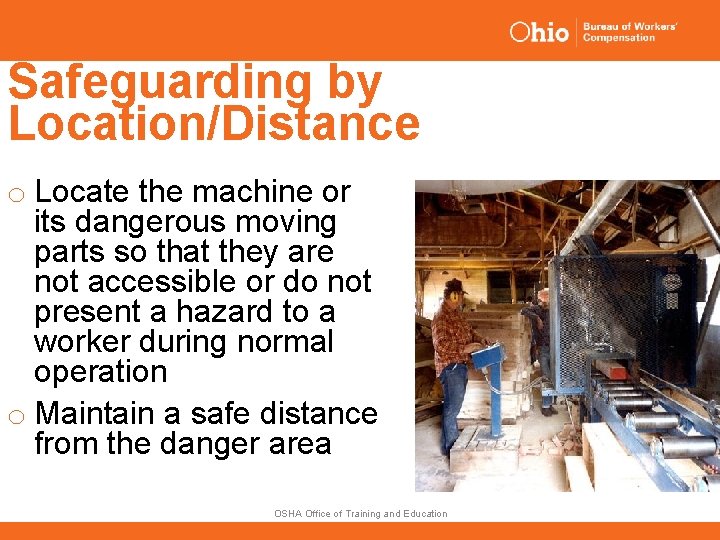
Safeguarding by Location/Distance o Locate the machine or its dangerous moving parts so that they are not accessible or do not present a hazard to a worker during normal operation o Maintain a safe distance from the danger area OSHA Office of Training and Education
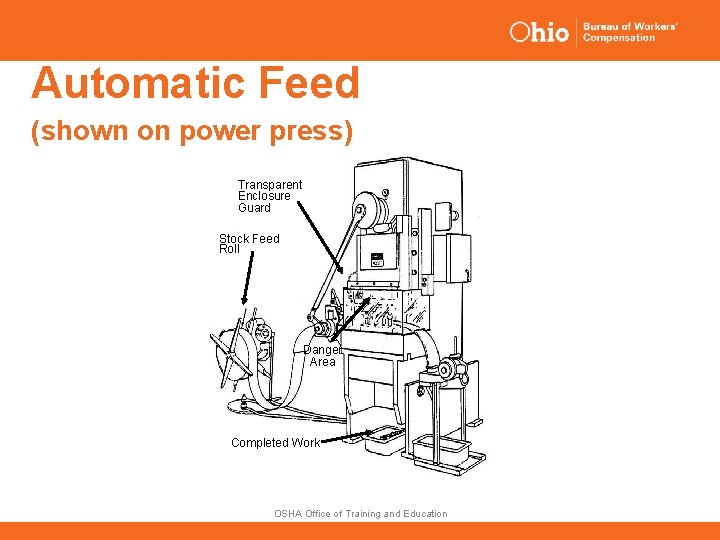
Automatic Feed (shown on power press) Transparent Enclosure Guard Stock Feed Roll Danger Area Completed Work OSHA Office of Training and Education
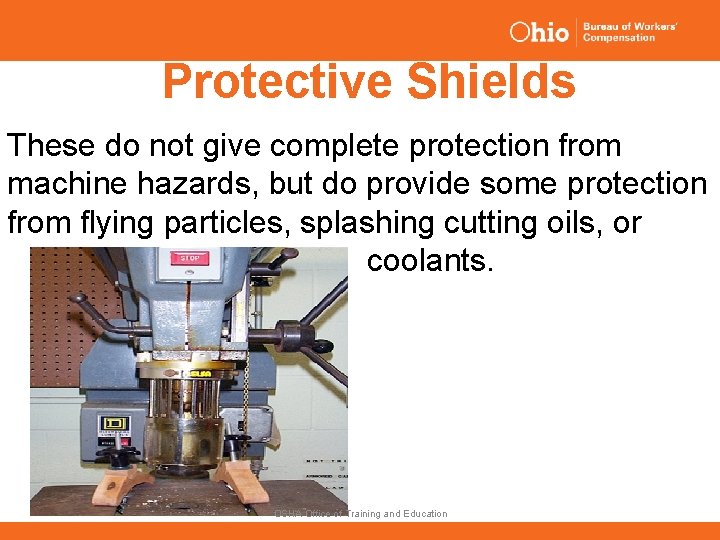
Protective Shields These do not give complete protection from machine hazards, but do provide some protection from flying particles, splashing cutting oils, or coolants. OSHA Office of Training and Education
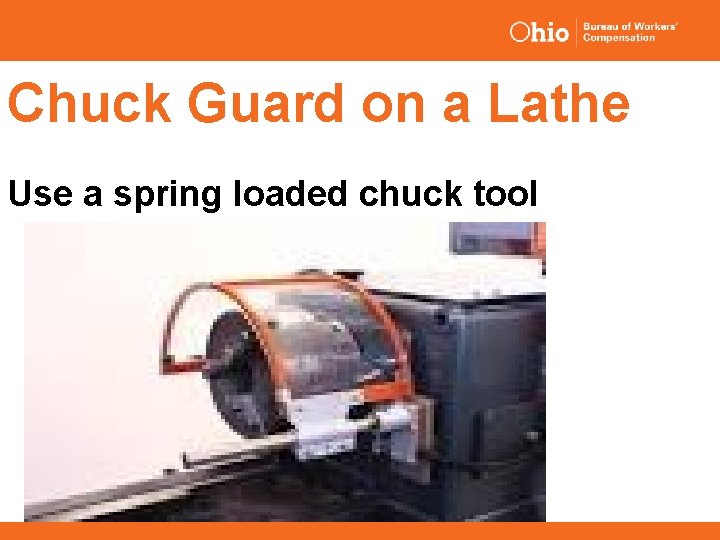
Chuck Guard on a Lathe Use a spring loaded chuck tool
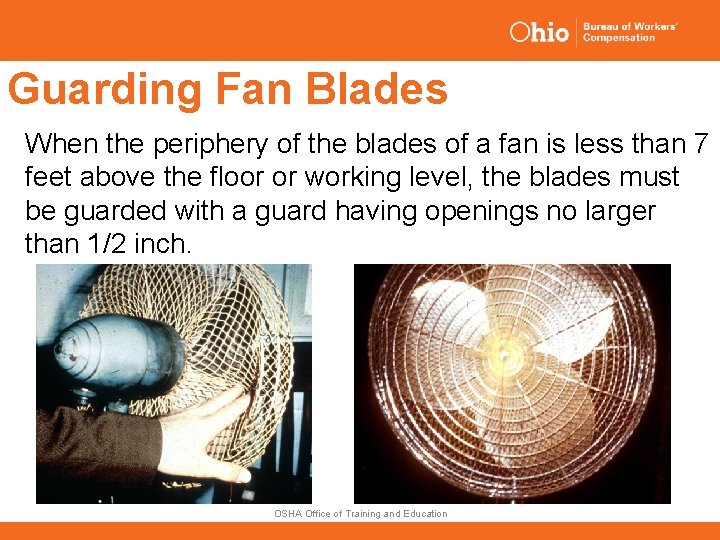
Guarding Fan Blades When the periphery of the blades of a fan is less than 7 feet above the floor or working level, the blades must be guarded with a guard having openings no larger than 1/2 inch. OSHA Office of Training and Education
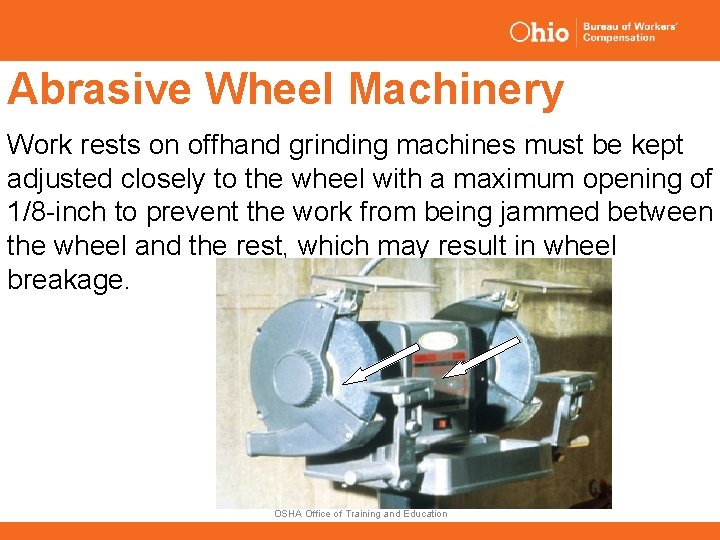
Abrasive Wheel Machinery Work rests on offhand grinding machines must be kept adjusted closely to the wheel with a maximum opening of 1/8 -inch to prevent the work from being jammed between the wheel and the rest, which may result in wheel breakage. OSHA Office of Training and Education
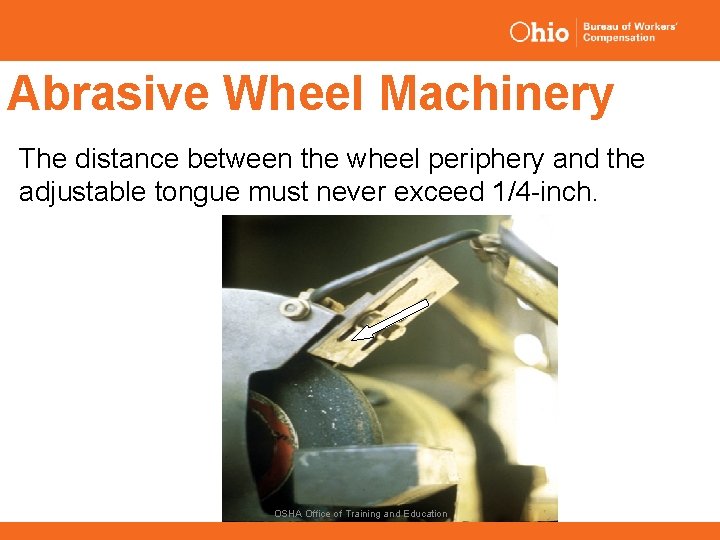
Abrasive Wheel Machinery The distance between the wheel periphery and the adjustable tongue must never exceed 1/4 -inch. OSHA Office of Training and Education
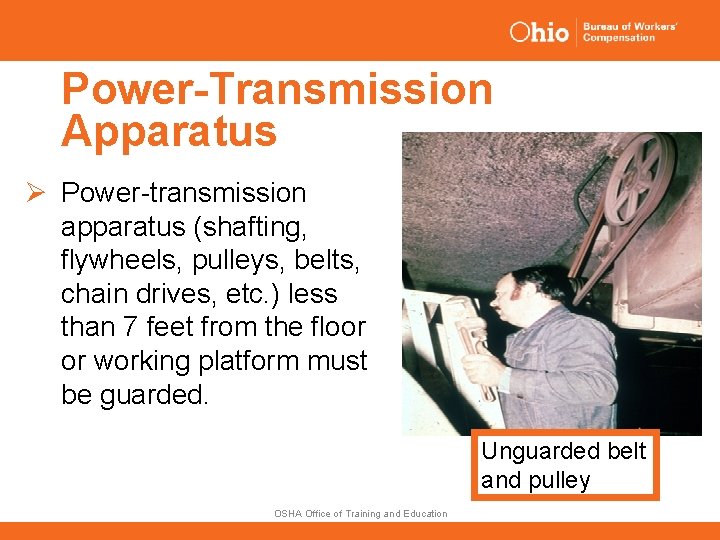
Power-Transmission Apparatus Ø Power-transmission apparatus (shafting, flywheels, pulleys, belts, chain drives, etc. ) less than 7 feet from the floor or working platform must be guarded. Unguarded belt and pulley OSHA Office of Training and Education