
Machine Elements in Mechanical Design FIFTH EDITION CHAPTER
- Slides: 20
Machine Elements in Mechanical Design FIFTH EDITION CHAPTER 17 Linear Motion Elements Machine Elements in Mechanical Design , Fifth Edition Robert L. Mott Copyright © 2014 by Pearson Education, Inc. All Rights Reserved
Power Screws • Three types of power screw threads: square thread, Acme thread, buttress thread § Square and buttress threads most efficient § Acme thread not greatly less efficient; easier to machine Machine Elements in Mechanical Design , Fifth Edition Robert L. Mott Copyright © 2014 by Pearson Education, Inc. All Rights Reserved
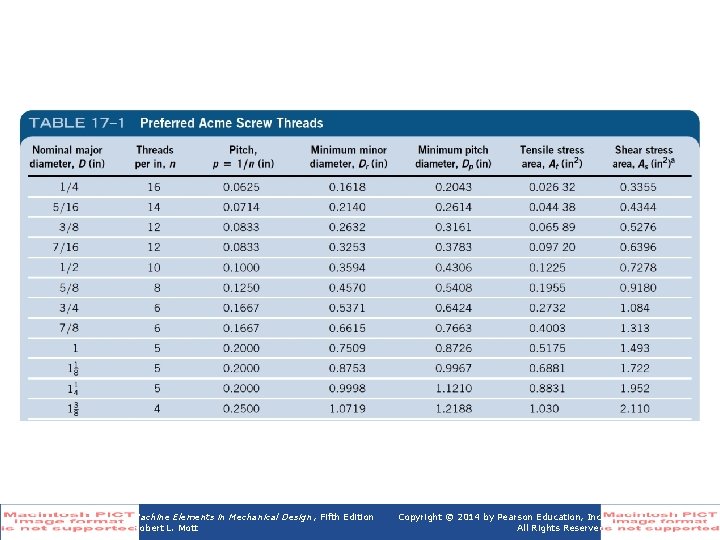
Table 17 -1 Preferred Acme Screw Threads Machine Elements in Mechanical Design , Fifth Edition Robert L. Mott Copyright © 2014 by Pearson Education, Inc. All Rights Reserved
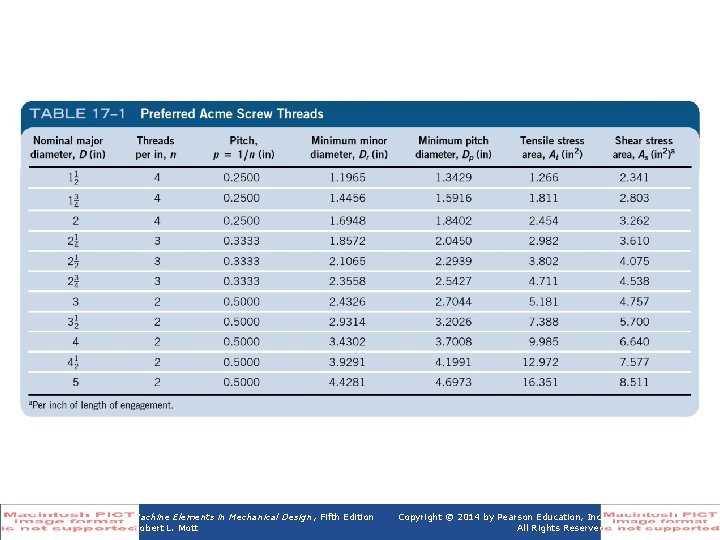
Table 17 -1 (continued) Threads Preferred Acme Screw Machine Elements in Mechanical Design , Fifth Edition Robert L. Mott Copyright © 2014 by Pearson Education, Inc. All Rights Reserved
Power Screws • Metric Power Screws § Use a trapezoidal thread system similar to Acme thread; slightly different thread form and made to metric dimensions Machine Elements in Mechanical Design , Fifth Edition Robert L. Mott Copyright © 2014 by Pearson Education, Inc. All Rights Reserved
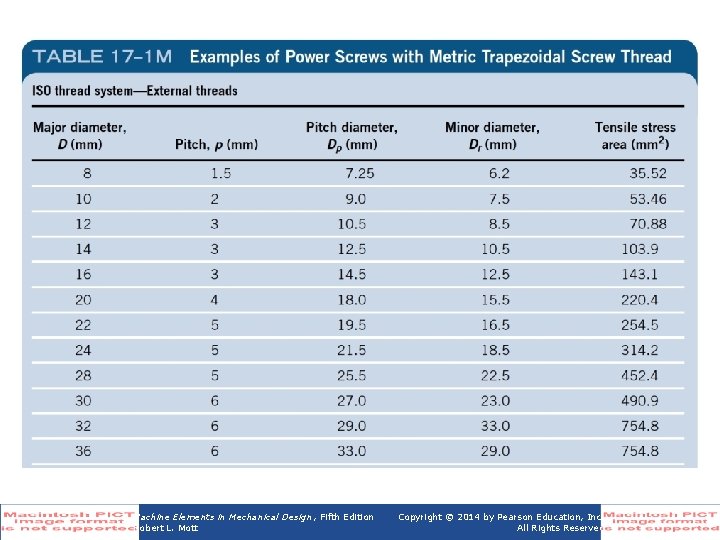
Table 17 -1 M Examples of Power Screws with Metric Trapezoidal Screw Thread Machine Elements in Mechanical Design , Fifth Edition Robert L. Mott Copyright © 2014 by Pearson Education, Inc. All Rights Reserved
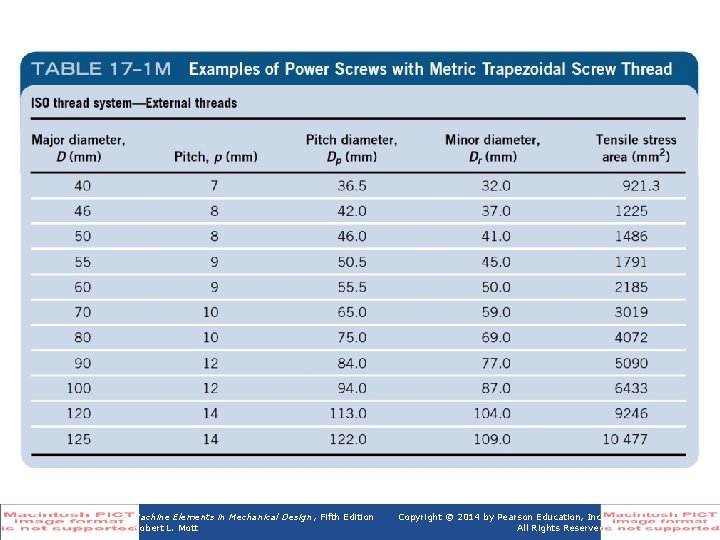
Table 17 -1 M (continued) Examples of Power Screws with Metric Trapezoidal Screw Thread Machine Elements in Mechanical Design , Fifth Edition Robert L. Mott Copyright © 2014 by Pearson Education, Inc. All Rights Reserved
Power Screws • Torque Required to Move a Load § Need to know how much torque must be applied to the nut of the screw to move the load. Machine Elements in Mechanical Design , Fifth Edition Robert L. Mott Copyright © 2014 by Pearson Education, Inc. All Rights Reserved
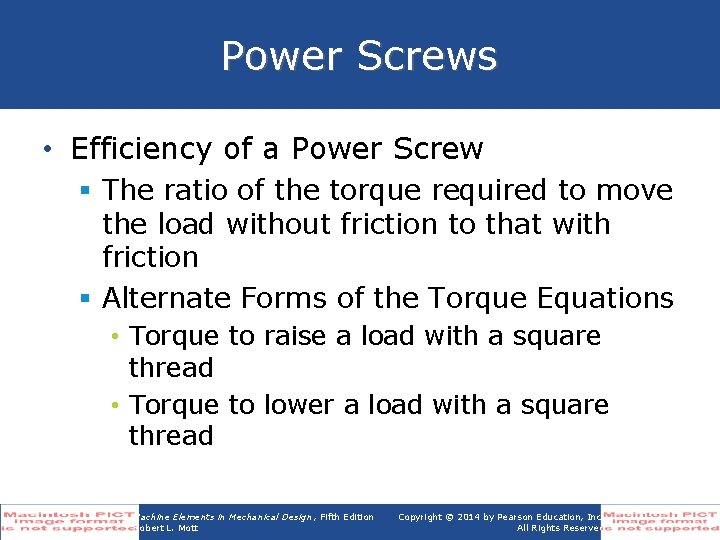
Power Screws • Efficiency of a Power Screw § The ratio of the torque required to move the load without friction to that with friction § Alternate Forms of the Torque Equations • Torque to raise a load with a square thread • Torque to lower a load with a square thread Machine Elements in Mechanical Design , Fifth Edition Robert L. Mott Copyright © 2014 by Pearson Education, Inc. All Rights Reserved
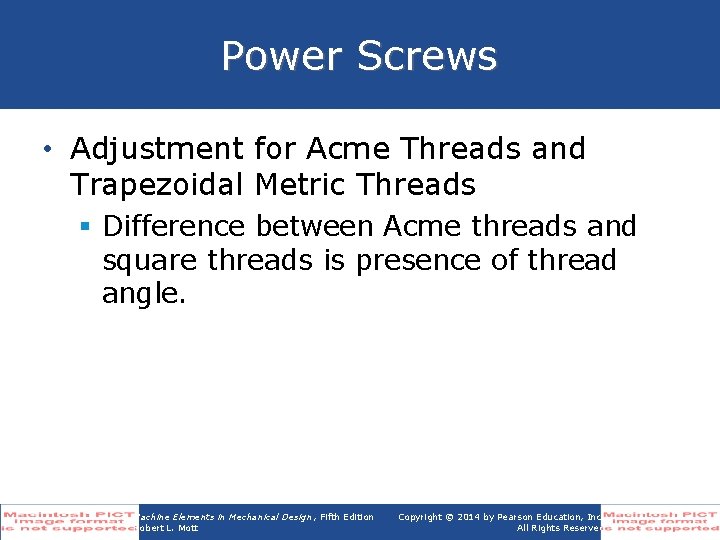
Power Screws • Adjustment for Acme Threads and Trapezoidal Metric Threads § Difference between Acme threads and square threads is presence of thread angle. Machine Elements in Mechanical Design , Fifth Edition Robert L. Mott Copyright © 2014 by Pearson Education, Inc. All Rights Reserved
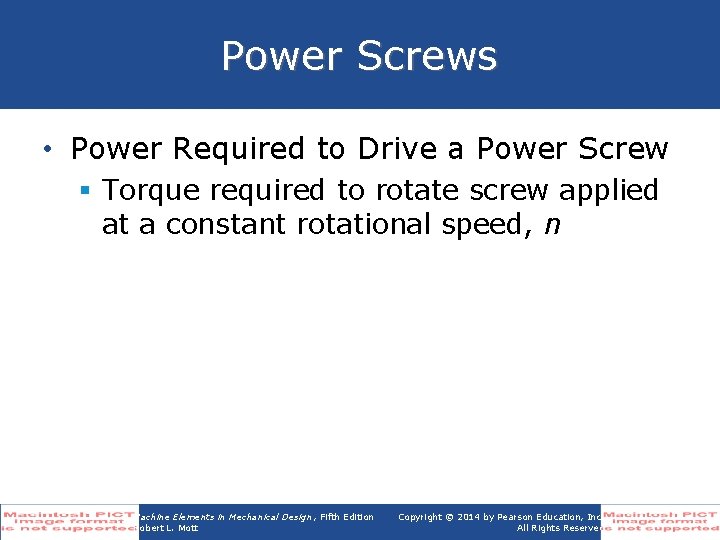
Power Screws • Power Required to Drive a Power Screw § Torque required to rotate screw applied at a constant rotational speed, n Machine Elements in Mechanical Design , Fifth Edition Robert L. Mott Copyright © 2014 by Pearson Education, Inc. All Rights Reserved
Power Screws • Multiple Start Thread Forms for Power Screws § Low efficiency of standard single-thread Acme screws (30% or less) strong disadvantage § Higher efficiencies achieved using high lead, multiple thread designs § Higher lead angle produces efficiencies in 30% to 70% range. Machine Elements in Mechanical Design , Fifth Edition Robert L. Mott Copyright © 2014 by Pearson Education, Inc. All Rights Reserved
Ball Screws • Minimizes friction between screw threads and mating nut • Applications of ball screws: § § § Automotive steering systems Machine tool tables Linear actuators Jacking and positioning mechanisms Aircraft controls Machine Elements in Mechanical Design , Fifth Edition Robert L. Mott Copyright © 2014 by Pearson Education, Inc. All Rights Reserved
Ball Screws • Application parameters in selecting ball screw: § Axial load to be exerted by screw during rotation § Rotational speed of screw § Maximum static load on screw § Direction of load Machine Elements in Mechanical Design , Fifth Edition Robert L. Mott Copyright © 2014 by Pearson Education, Inc. All Rights Reserved
Ball Screws • Application parameters in selecting ball screw: § § Manner of supporting the ends of screw Length of screw Expected life Environmental conditions Machine Elements in Mechanical Design , Fifth Edition Robert L. Mott Copyright © 2014 by Pearson Education, Inc. All Rights Reserved
Ball Screws • Load-Life Relationship § When transmitting a load, ball screw experiences stresses similar to those on a ball bearing. § Load is transferred from screw to the balls, from balls to the nut, from nut to the driven device. § Contact stress between balls and races in which they roll causes fatigue failure, indicated by pitting of balls or races. Machine Elements in Mechanical Design , Fifth Edition Robert L. Mott Copyright © 2014 by Pearson Education, Inc. All Rights Reserved
Ball Screws • Torque and Efficiency § Efficiency of ball bearing screw typically 90% § Far exceeds efficiency for power screws without rolling contact that range 20% to 30% § Far less torque required to exert given load with a given size of screw § Power correspondingly reduced Machine Elements in Mechanical Design , Fifth Edition Robert L. Mott Copyright © 2014 by Pearson Education, Inc. All Rights Reserved
Application Considerations for Power Screws and Ball Screws • Critical Speed § Proper application of ball screws must take into account their vibration tendencies, particularly when operating at relatively high speeds. § Screws tend to vibrate or whirl about axis, possibly reaching dangerous amplitudes. Machine Elements in Mechanical Design , Fifth Edition Robert L. Mott Copyright © 2014 by Pearson Education, Inc. All Rights Reserved
Application Considerations for Power Screws and Ball Screws • Column Buckling § Ball screws that carry axial compressive loads must be checked for column buckling. § Parameters: material screw is made, end fixity, diameter, length Machine Elements in Mechanical Design , Fifth Edition Robert L. Mott Copyright © 2014 by Pearson Education, Inc. All Rights Reserved
Application Considerations for Power Screws and Ball Screws • Material for Screws § Ball screws: made from carbon or alloy steels using thread-rolling technology § Power screws: made from carbon or alloy steels § Power screw nuts: made from steels for moderate loads and when operating at relatively low speeds • Grease lubrication recommended Machine Elements in Mechanical Design , Fifth Edition Robert L. Mott Copyright © 2014 by Pearson Education, Inc. All Rights Reserved