
Machine Detector Interface what is new since the
![Collimation Requirements l* [m] smask [m] Nx Ny TDR 3 2 13 81 New](https://slidetodoc.com/presentation_image_h2/a54a0ea06c1da21b7139411e9e12e685/image-13.jpg "Collimation Requirements l* [m] smask [m] Nx Ny TDR 3 2 13 81 New")
- Slides: 26
Machine – Detector Interface : what is new since the TDR ? O. Napoly CEA/Saclay O. Napoly ECFA-DESY Amsterdam, April 2003 1
Outline Ø New final focus with l* = 5 m Ø BDSIM Background Simulation Code Ø "Realistic beams" Ø Open problem of the extraction line O. Napoly ECFA-DESY Amsterdam, April 2003 2
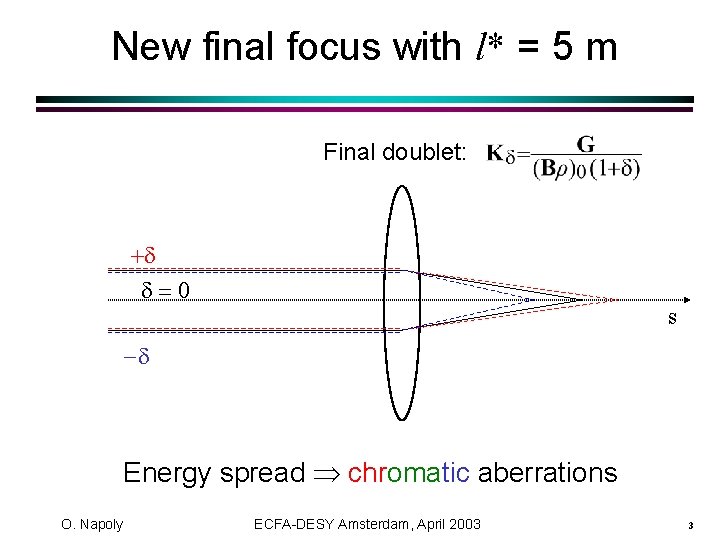
New final focus with l* = 5 m Final doublet: +d d=0 s -d Energy spread chromatic aberrations O. Napoly ECFA-DESY Amsterdam, April 2003 3
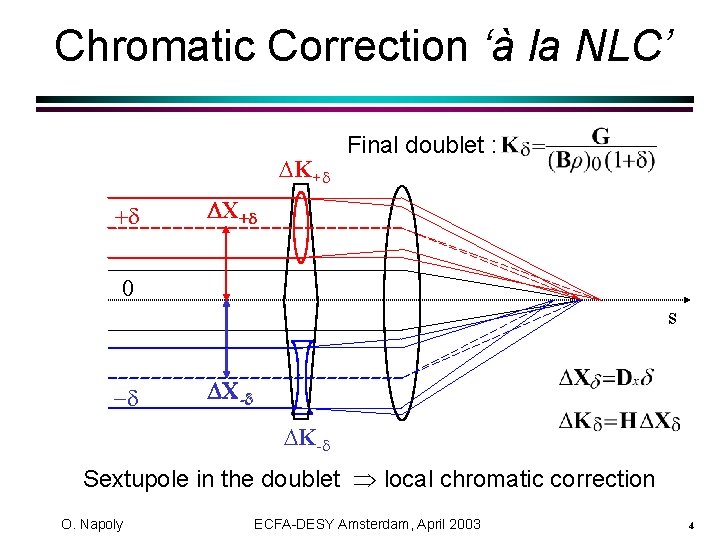
Chromatic Correction ‘à la NLC’ DK+d +d Final doublet : DX+d 0 s -d DX-d DK-d Sextupole in the doublet local chromatic correction O. Napoly ECFA-DESY Amsterdam, April 2003 4
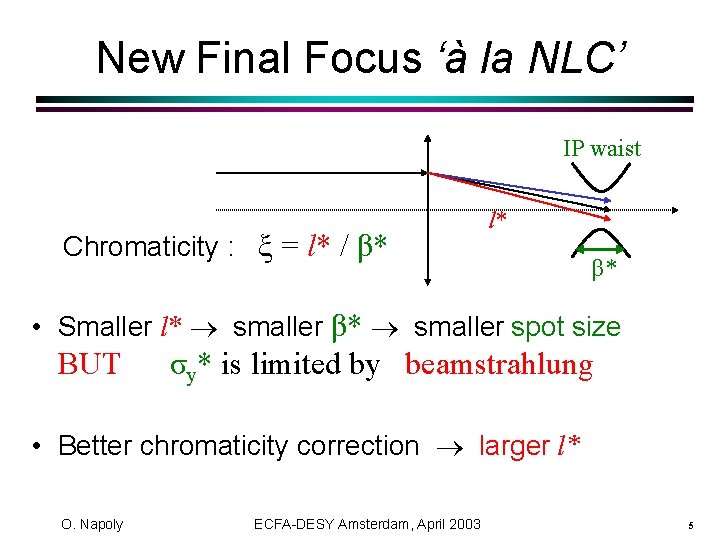
New Final Focus ‘à la NLC’ IP waist Chromaticity : ξ = l* / β* l* β* • Smaller l* smaller β* smaller spot size BUT σy* is limited by beamstrahlung • Better chromaticity correction larger l* O. Napoly ECFA-DESY Amsterdam, April 2003 5
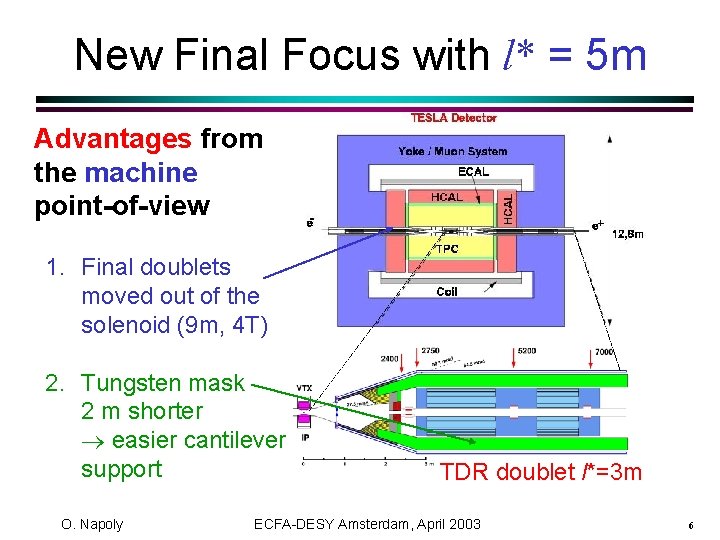
New Final Focus with l* = 5 m Advantages from the machine point-of-view 1. Final doublets moved out of the solenoid (9 m, 4 T) 2. Tungsten mask 2 m shorter easier cantilever support O. Napoly TDR doublet l*=3 m ECFA-DESY Amsterdam, April 2003 6
New Final Focus with l* = 5 m Advantages from the detector point-of-view (see A. Stahl) Ø Larger forward acceptance at low angles Ø Final doublets moved out of the calorimeters less e. m. showers in the detector O. Napoly ECFA-DESY Amsterdam, April 2003 7
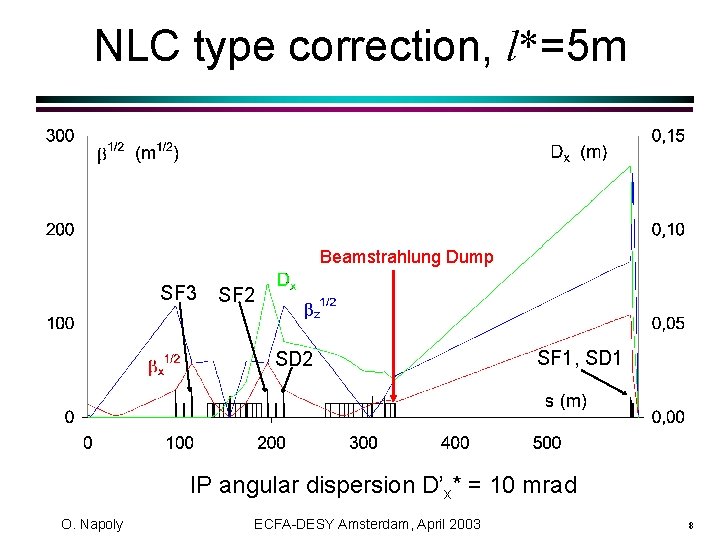
NLC type correction, l*=5 m Beamstrahlung Dump SF 3 SF 2 SD 2 SF 1, SD 1 IP angular dispersion D’x* = 10 mrad O. Napoly ECFA-DESY Amsterdam, April 2003 8
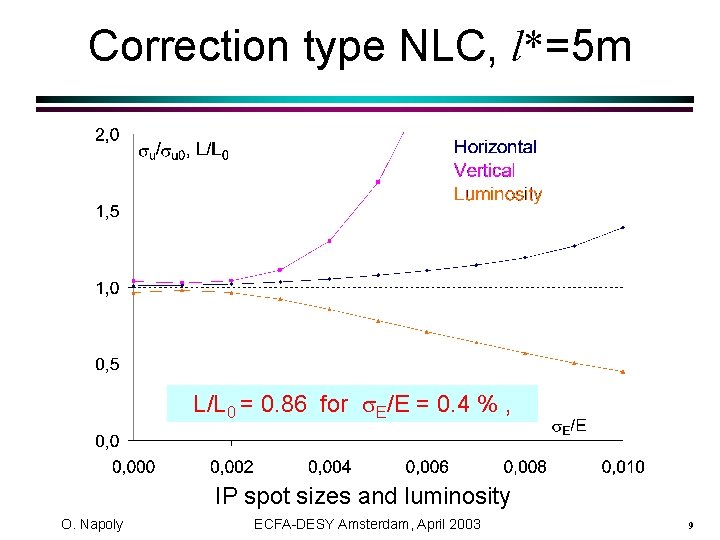
Correction type NLC, l*=5 m L/L 0 = 0. 86 for s. E/E = 0. 4 % , IP spot sizes and luminosity O. Napoly ECFA-DESY Amsterdam, April 2003 9
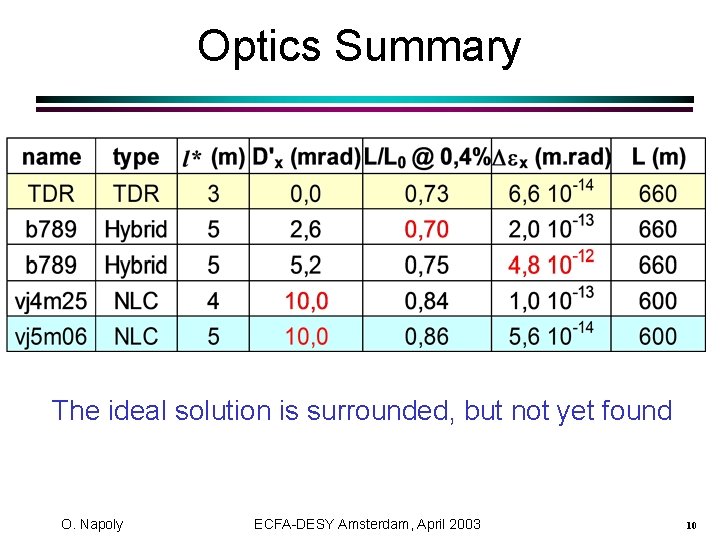
Optics Summary The ideal solution is surrounded, but not yet found O. Napoly ECFA-DESY Amsterdam, April 2003 10
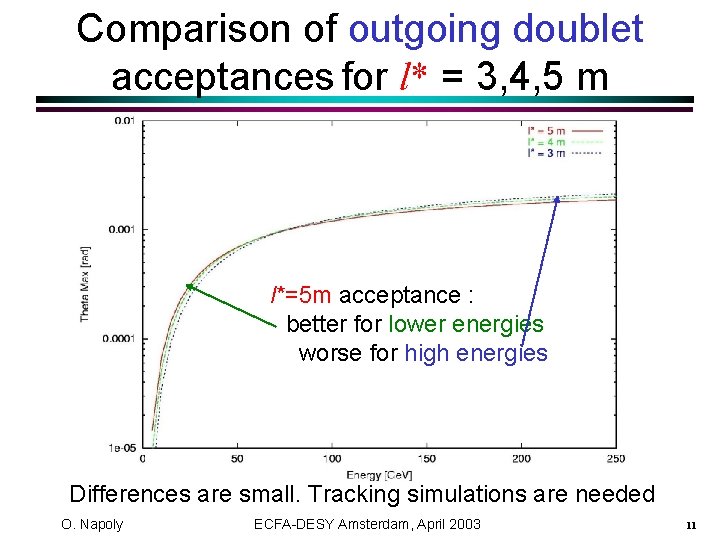
Comparison of outgoing doublet acceptances for l* = 3, 4, 5 m l*=5 m acceptance : better for lower energies worse for high energies Differences are small. Tracking simulations are needed O. Napoly ECFA-DESY Amsterdam, April 2003 11
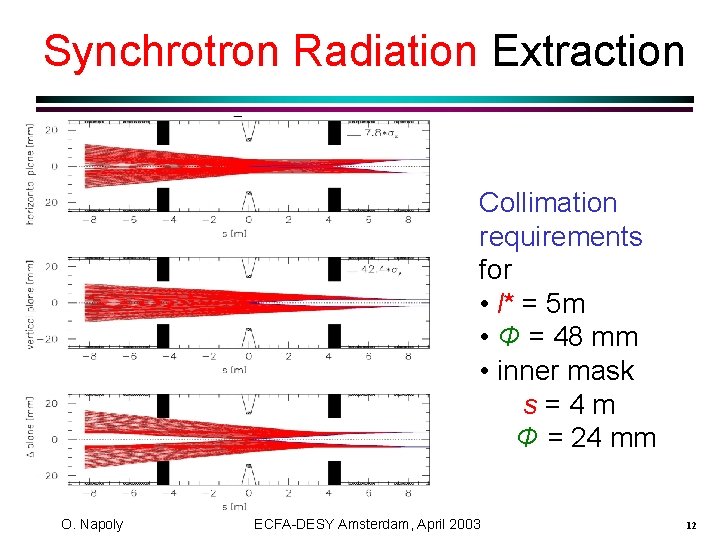
Synchrotron Radiation Extraction Collimation requirements for • l* = 5 m • Φ = 48 mm • inner mask s=4 m Φ = 24 mm O. Napoly ECFA-DESY Amsterdam, April 2003 12
Collimation Requirements l* [m] smask [m] Nx Ny TDR 3 2 13 81 New FF 5 2 10 48 New FF 5 4 7. 8 42 new collimation section required with tail folding by octupoles O. Napoly ECFA-DESY Amsterdam, April 2003 13
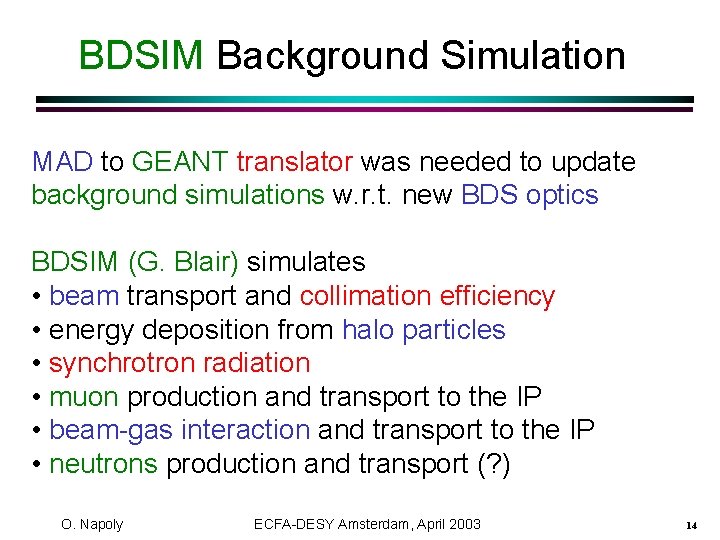
BDSIM Background Simulation MAD to GEANT translator was needed to update background simulations w. r. t. new BDS optics BDSIM (G. Blair) simulates • beam transport and collimation efficiency • energy deposition from halo particles • synchrotron radiation • muon production and transport to the IP • beam-gas interaction and transport to the IP • neutrons production and transport (? ) O. Napoly ECFA-DESY Amsterdam, April 2003 14
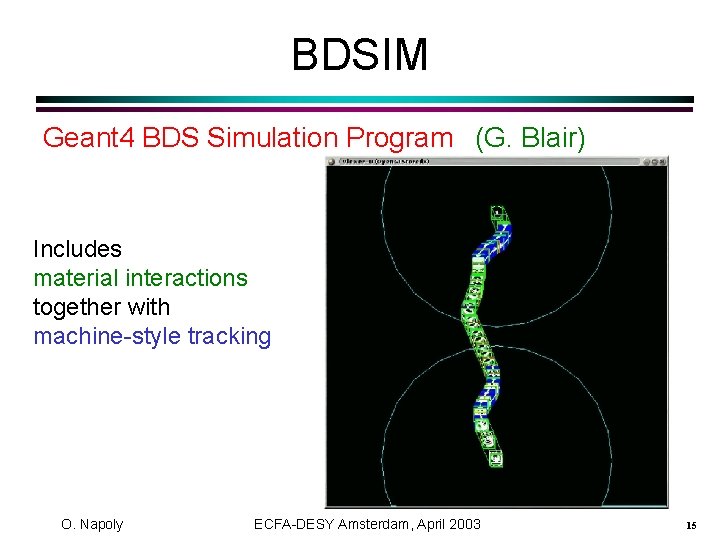
BDSIM Geant 4 BDS Simulation Program (G. Blair) Includes material interactions together with machine-style tracking O. Napoly ECFA-DESY Amsterdam, April 2003 15
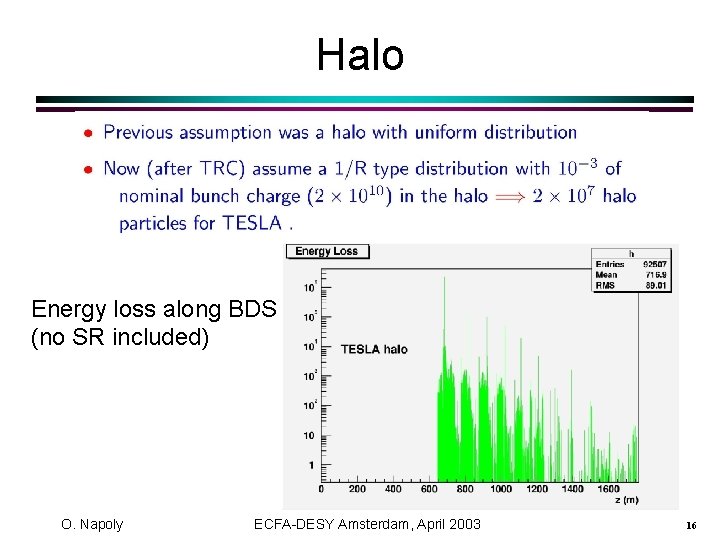
Halo Energy loss along BDS (no SR included) O. Napoly ECFA-DESY Amsterdam, April 2003 16
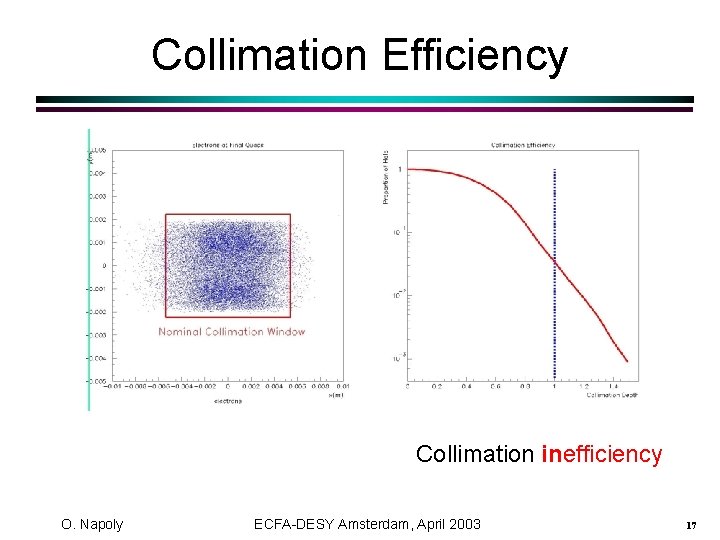
Collimation Efficiency Collimation inefficiency O. Napoly ECFA-DESY Amsterdam, April 2003 17
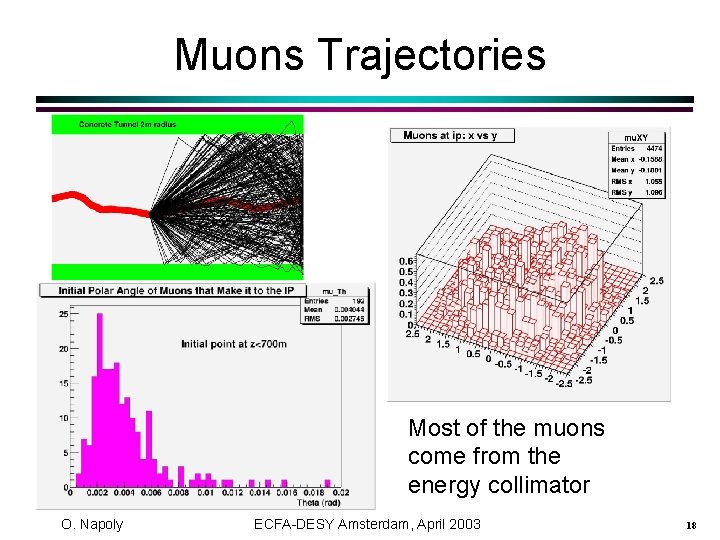
Muons Trajectories Most of the muons come from the energy collimator O. Napoly ECFA-DESY Amsterdam, April 2003 18
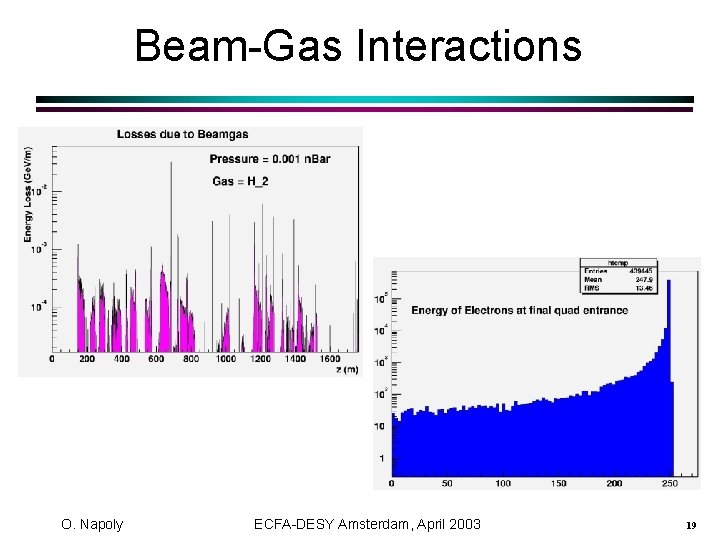
Beam-Gas Interactions O. Napoly ECFA-DESY Amsterdam, April 2003 19
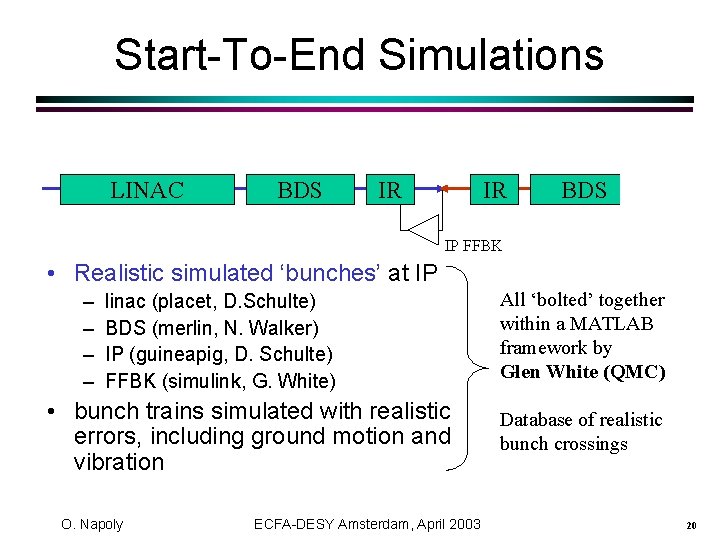
Start-To-End Simulations LINAC BDS IR IR BDS IP FFBK • Realistic simulated ‘bunches’ at IP – – linac (placet, D. Schulte) BDS (merlin, N. Walker) IP (guineapig, D. Schulte) FFBK (simulink, G. White) • bunch trains simulated with realistic errors, including ground motion and vibration O. Napoly ECFA-DESY Amsterdam, April 2003 All ‘bolted’ together within a MATLAB framework by Glen White (QMC) Database of realistic bunch crossings 20
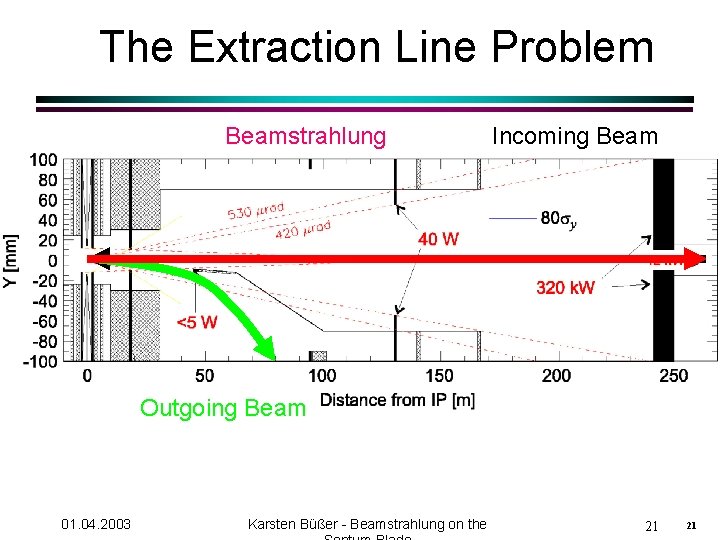
The Extraction Line Problem Beamstrahlung Incoming Beam Outgoing Beam 01. 04. 2003 Karsten Büßer - Beamstrahlung on the 21 21
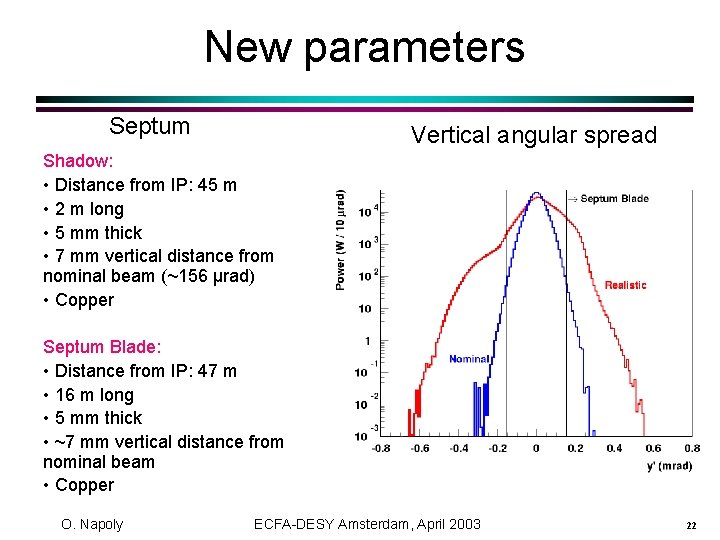
New parameters Septum Vertical angular spread Shadow: • Distance from IP: 45 m • 2 m long • 5 mm thick • 7 mm vertical distance from nominal beam (~156 µrad) • Copper Septum Blade: • Distance from IP: 47 m • 16 m long • 5 mm thick • ~7 mm vertical distance from nominal beam • Copper O. Napoly ECFA-DESY Amsterdam, April 2003 22
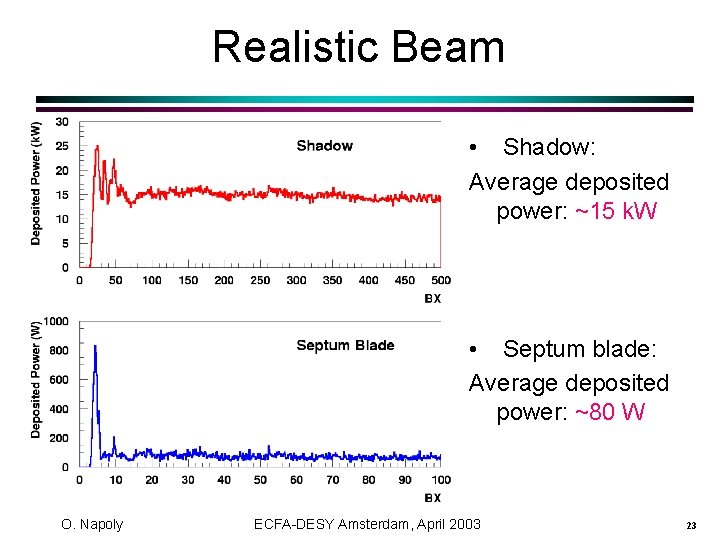
Realistic Beam • Shadow: Average deposited power: ~15 k. W • Septum blade: Average deposited power: ~80 W O. Napoly ECFA-DESY Amsterdam, April 2003 23
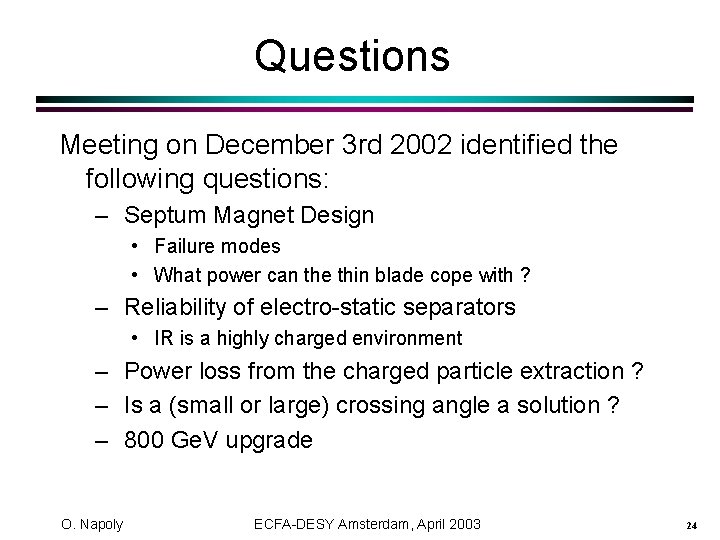
Questions Meeting on December 3 rd 2002 identified the following questions: – Septum Magnet Design • Failure modes • What power can the thin blade cope with ? – Reliability of electro-static separators • IR is a highly charged environment – Power loss from the charged particle extraction ? – Is a (small or large) crossing angle a solution ? – 800 Ge. V upgrade O. Napoly ECFA-DESY Amsterdam, April 2003 24
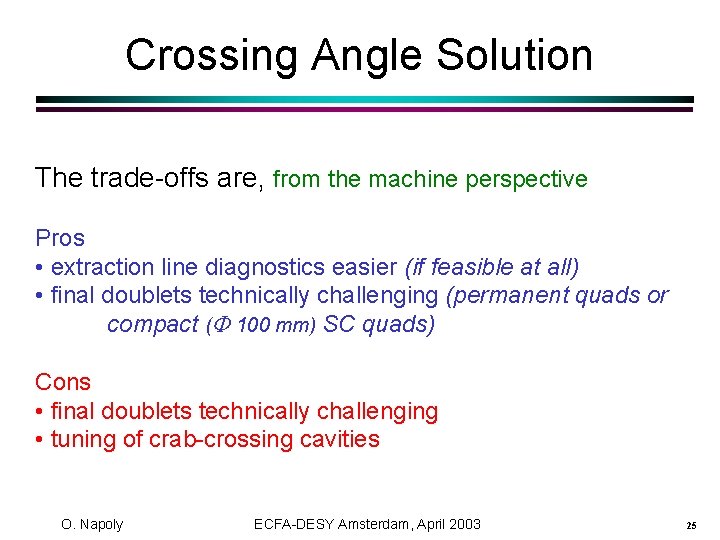
Crossing Angle Solution The trade-offs are, from the machine perspective Pros • extraction line diagnostics easier (if feasible at all) • final doublets technically challenging (permanent quads or compact ( 100 mm) SC quads) Cons • final doublets technically challenging • tuning of crab-crossing cavities O. Napoly ECFA-DESY Amsterdam, April 2003 25
Conclusions • BDS (collimation + final focus+ extractions) needs a major redesign, partly under way. • Definite progress in the simulation tools and networking. • IR issues (beam-beam backgrounds + diagnostics) are being adressed. • The accelerator physics group are undercritical : help is needed for progress. O. Napoly ECFA-DESY Amsterdam, April 2003 26