
Machine arithmetic and associated errors Introduction to error
- Slides: 12
Machine arithmetic and associated errors Introduction to error analysis (cont. ) Class III
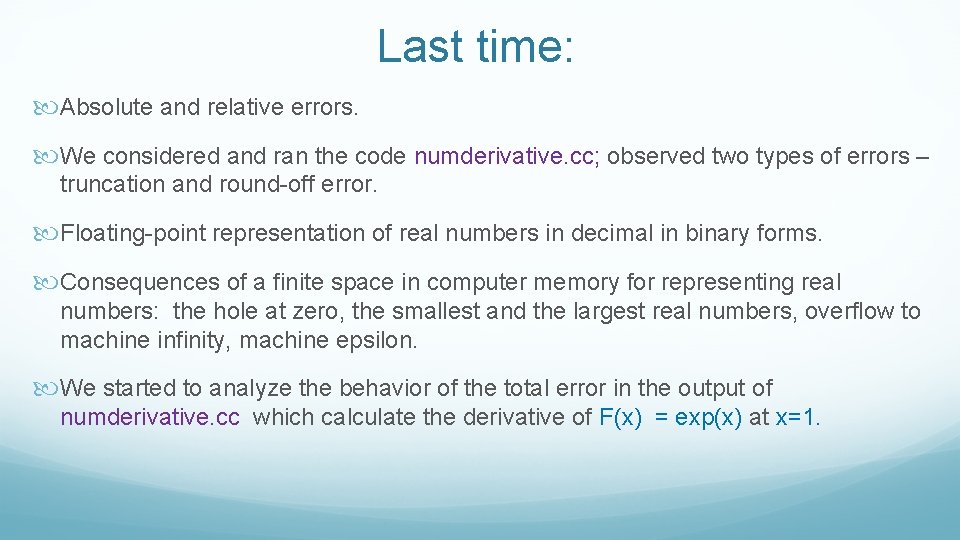
Last time: Absolute and relative errors. We considered and ran the code numderivative. cc; observed two types of errors – truncation and round-off error. Floating-point representation of real numbers in decimal in binary forms. Consequences of a finite space in computer memory for representing real numbers: the hole at zero, the smallest and the largest real numbers, overflow to machine infinity, machine epsilon. We started to analyze the behavior of the total error in the output of numderivative. cc which calculate the derivative of F(x) = exp(x) at x=1.
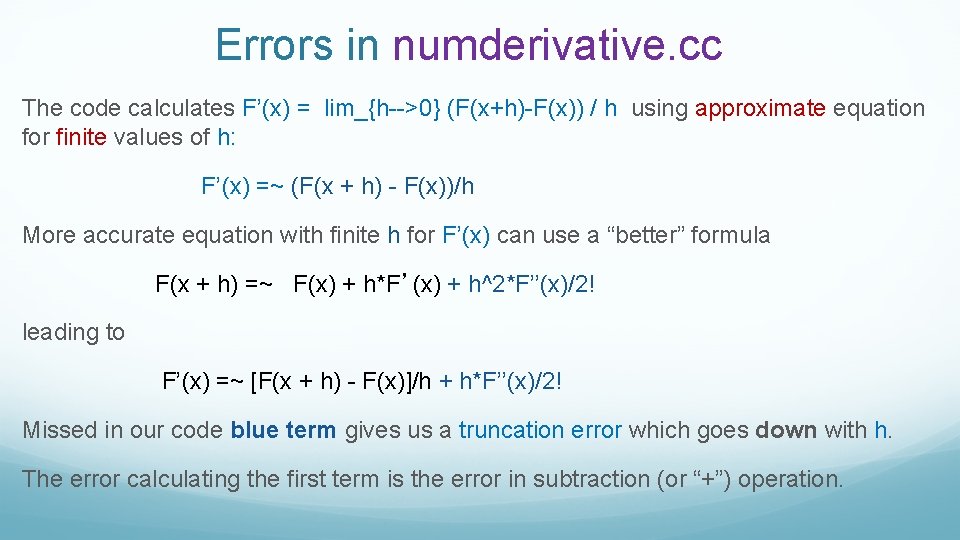
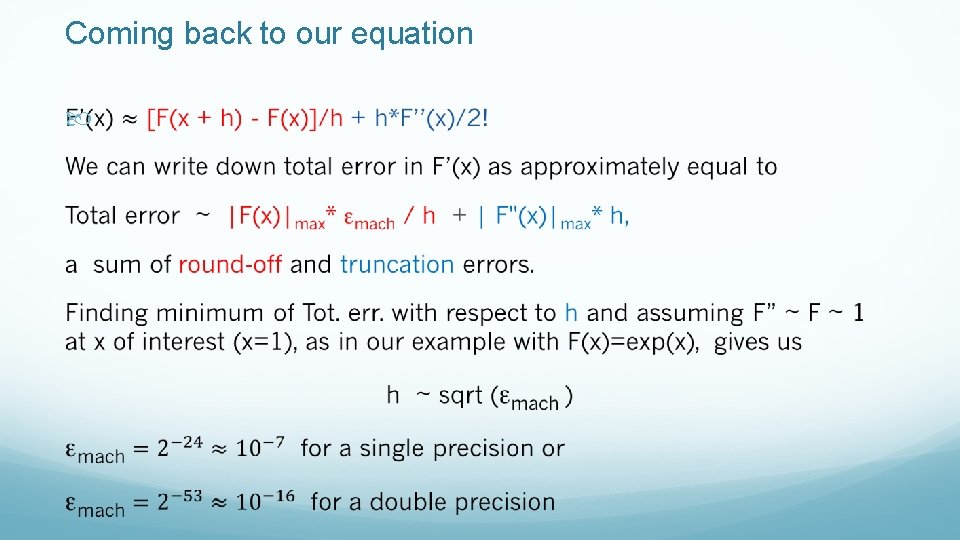
Errors in numderivative. cc The code calculates F’(x) = lim_{h-->0} (F(x+h)-F(x)) / h using approximate equation for finite values of h: F’(x) =~ (F(x + h) - F(x))/h More accurate equation with finite h for F’(x) can use a “better” formula F(x + h) =~ F(x) + h*F’(x) + h^2*F’’(x)/2! leading to F’(x) =~ [F(x + h) - F(x)]/h + h*F’’(x)/2! Missed in our code blue term gives us a truncation error which goes down with h. The error calculating the first term is the error in subtraction (or “+”) operation.
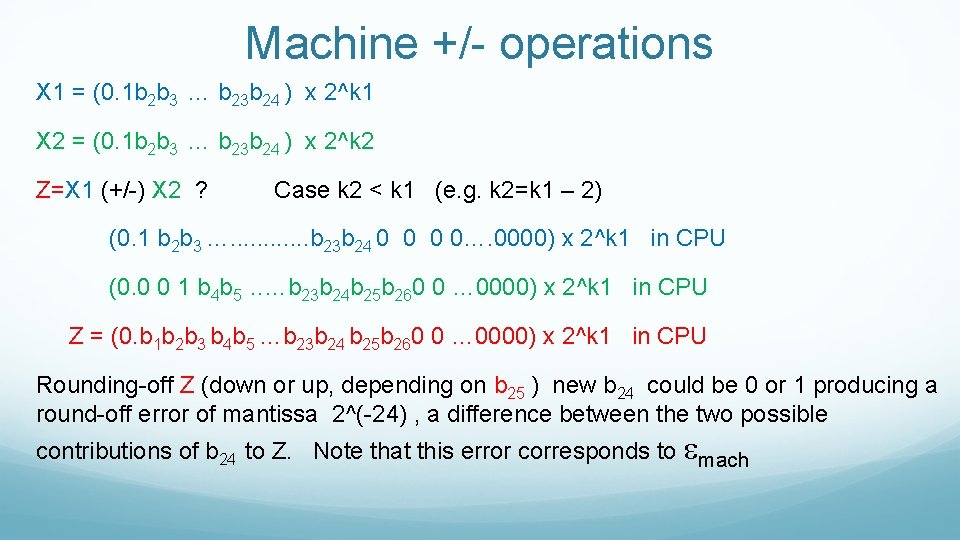
Machine +/- operations X 1 = (0. 1 b 2 b 3 … b 23 b 24 ) x 2^k 1 X 2 = (0. 1 b 2 b 3 … b 23 b 24 ) x 2^k 2 Z=X 1 (+/-) X 2 ? Case k 2 < k 1 (e. g. k 2=k 1 – 2) (0. 1 b 2 b 3 …. . . b 23 b 24 0 0…. 0000) x 2^k 1 in CPU (0. 0 0 1 b 4 b 5 . . …b 23 b 24 b 25 b 260 0 … 0000) x 2^k 1 in CPU Z = (0. b 1 b 2 b 3 b 4 b 5 …b 23 b 24 b 25 b 260 0 … 0000) x 2^k 1 in CPU Rounding-off Z (down or up, depending on b 25 ) new b 24 could be 0 or 1 producing a round-off error of mantissa 2^(-24) , a difference between the two possible contributions of b 24 to Z. Note that this error corresponds to emach
Coming back to our equation
Significant digits Suppose we measure a length of a desk with a ruler with metric scale and the smallest distance between ruler marks is 1 mm. Suppose the result of our measurement is 1 m 21 cm 4 mm or L=1. 214 m What is wrong if we write down this number as L=1. 214238 m ?
Significant digits Suppose we measure a length of a desk with a ruler with metric scale and the smallest distance between ruler marks is 1 mm. Suppose the result of our measurement is 1 m 21 cm 4 mm or L=1. 214 m What is wrong if we write down this number as L=1. 214238 m ? It’s misleading. Why? Because the precision of our measurement is only 1 mm or 0. 001 m and we have only 4 significant digits in the value of L. Definition: significant digits are digits beginning with the leftmost nonzero digit and ending with the rightmost correct digit. The quantity L=0. 1214238 x 10^1 m is accurate to 4 significant digits. We can trust a total of 4 digits as being meaningful.
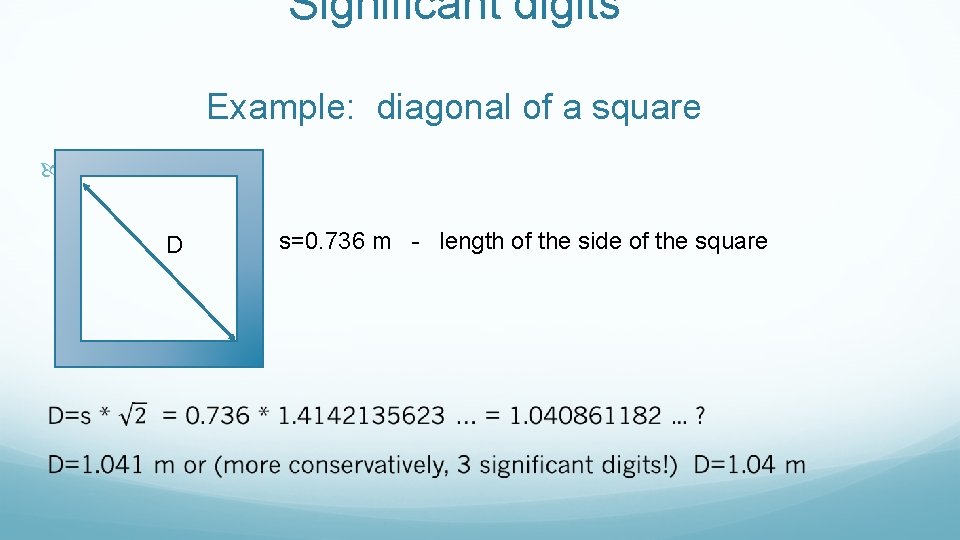
Significant digits Example: diagonal of a square D s=0. 736 m - length of the side of the square
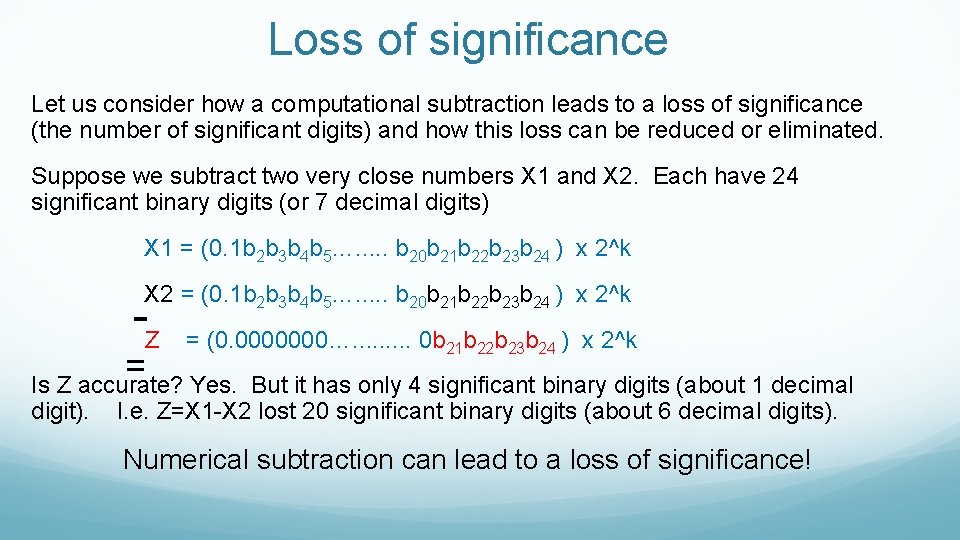
Loss of significance Let us consider how a computational subtraction leads to a loss of significance (the number of significant digits) and how this loss can be reduced or eliminated. Suppose we subtract two very close numbers X 1 and X 2. Each have 24 significant binary digits (or 7 decimal digits) X 1 = (0. 1 b 2 b 3 b 4 b 5…. . . b 20 b 21 b 22 b 23 b 24 ) x 2^k X 2 = (0. 1 b 2 b 3 b 4 b 5…. . . b 20 b 21 b 22 b 23 b 24 ) x 2^k Z = (0. 0000000…. . 0 b 21 b 22 b 23 b 24 ) x 2^k = Is Z accurate? Yes. But it has only 4 significant binary digits (about 1 decimal digit). I. e. Z=X 1 -X 2 lost 20 significant binary digits (about 6 decimal digits). Numerical subtraction can lead to a loss of significance!
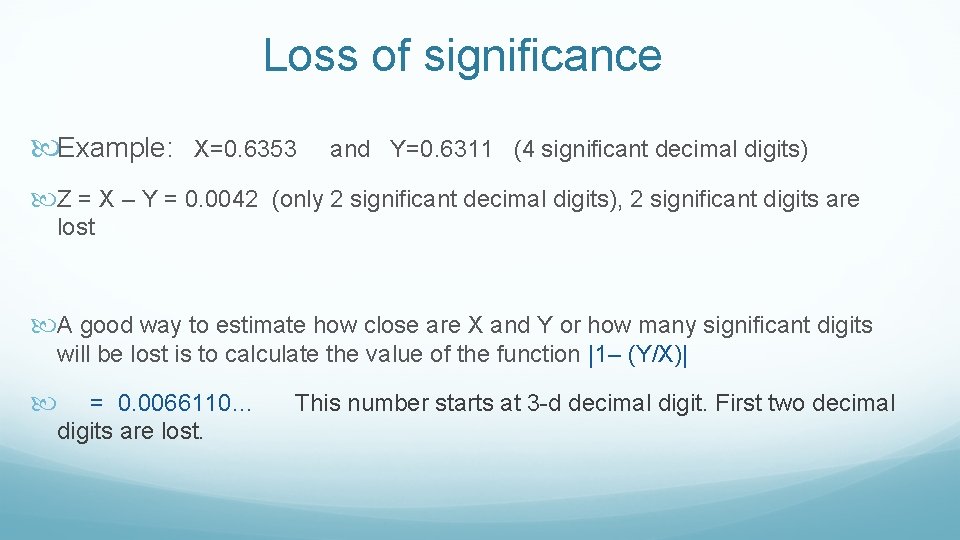
Loss of significance Example: X=0. 6353 and Y=0. 6311 (4 significant decimal digits) Z = X – Y = 0. 0042 (only 2 significant decimal digits), 2 significant digits are lost A good way to estimate how close are X and Y or how many significant digits will be lost is to calculate the value of the function |1– (Y/X)| = 0. 0066110… This number starts at 3 -d decimal digit. First two decimal digits are lost.
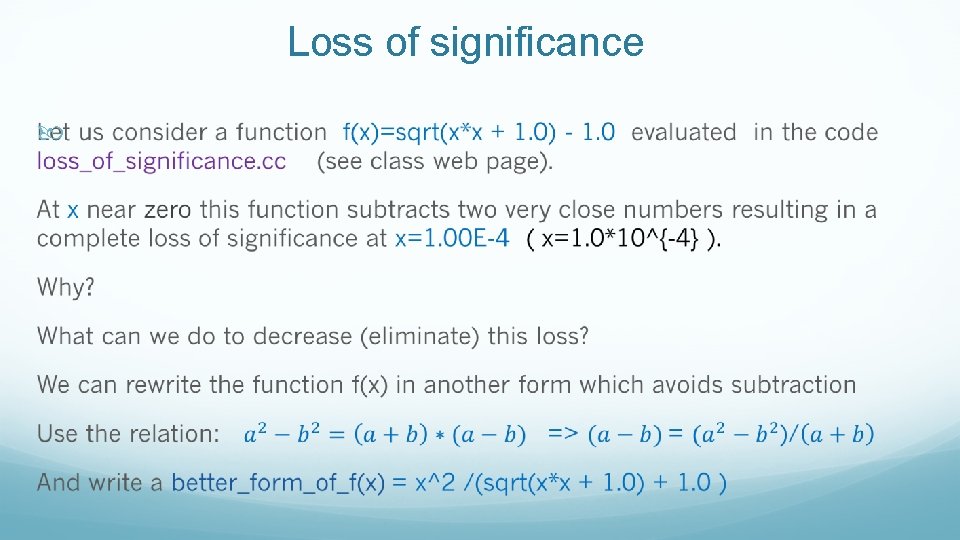
Loss of significance
Summary of today Class We recalled round-off and truncation errors in computer operations related to the real number representation in computers We considered a concept of significant digits in a real numbers Loss of significance at subtraction operation and how it can be avoided