
Macbeth Terminology Terminology As we read various scenes

Macbeth Terminology
Terminology �As we read various scenes and sections of the play, you will need to look out for examples of the following terms. �While it is important to look at Shakespeare’s work from a literary perspective (that is written), it is also important to consider the dramatic elements of the play, as that is what it was created as – a play.

1. Pathetic Fallacy Human emotions and feelings represented in nature. Giving nature human emotions. For example: “A cruel lonesome wind is howling through the trees”
2. Subversion Challenging, upsetting or overthrowing an accepted idea. In literary terms, texts can subvert ideas when they “rebel” against accepted social ideas or structure For example: The character of Christopher Boone subverts what is considered typical for the narrator of a story.
3. Foreshadowing Warning or indication of a future event. For example: Romeo and Juliet “Life were better ended by their hate, Than death prorogued, wanting of thy love” Romeo says, in the above lines, that he would rather have her love and die sooner than not obtain her love and die later. Eventually, he gets her love and dies for her love, too.
4. Dramatic Irony When readers/viewers/audience have knowledge about something the characters do not. For example: Viewers know that Juliet is not actually dead, but rather she has taken a sleeping potion, when Romeo kills himself.
5. Pun A pun is a play on words, often humorous, that uses words that have similar or identical sounds but very different meanings. For example: My friend's bakery burned down last night. Now his business is toast. My dog has a lot of potential, you just have to unleash it.
6. Innuendo A subtle or indirect observation about a person or thing, usually of a cruel or malicious nature; an insinuation. Can have sexual innuendo.
7. Double Entendre Words or phrases with more than one meaning. Double meanings. Unlike innuendo, a double entendre is not usually planned or intended to be sly.
8. Iambic Pentameter A line that has 10 syllables but only the second is stressed (5 stressed syllables). In Shakespearean plays, most verses are written using IP, except the lower class characters who write in prose. For example: If mu- / -sic be / the food / of love, / play on Is this / a dag- / -ger I / see be- / fore me?
9. Rhymed Couplet As the words suggests, rhyming couplets are two lines that rhyme. In Macbeth rhyming couplets are always used for the witches. For example: Double, double, toil and trouble. Fire burn and cauldron bubble.
10. Figurative Language Metaphors, Similes, Personification, Imagery
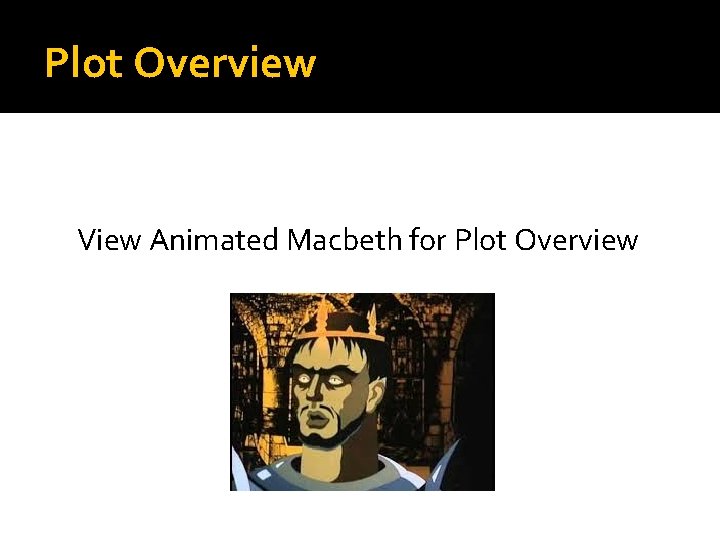
Plot Overview View Animated Macbeth for Plot Overview
Shakespeare’s Macbeth Act 1
Do Now Activity: Act 1, Scene 1 1. What happens in this scene? 2. What tone/mood does this scene set? 3. What does this scene tell you about what may happen in the play? 4. What symbolism can you identify in this scene? What does it symbolise? (P. F)
Act 1, Scene 1 “FAIR IS FOUL AND FOUL IS FAIR” �Foreshadows the chaos and foul-play that will ensue the witches prophecy. �Sets theme for the play that nothing is as it seems - there is always two sides to every story and two sides to every person. �Juxtaposition of the two ideas - contrasted directly
Act 1, Scene 1 Interpretations For each clip (1971, 2006, 2010) write a couple of words to describe it. After watching all three clips: � What do the clips have in common? � What has been changed about the clips? � Which clip do you deem to be most effective?
Act 1, Scene 1 What do we learn about each of these ideas and motifs from this scene? �Fate / Destiny �The Supernatural �Chaos / Disorder
Act 1, Scene 5 �Read Act 1, Scene 5 �Discussion of meaning
Act 1, Scene 7 �Read Act 1, Scene 7 �Discussion of meaning
DNA: Recap of Act 1 1. 2. 3. 4. 5. What did the witches predict about Macbeth? Why was King Duncan coming to Macbeth’s castle? What example of pathetic fallacy has been used in the play so far? What is the plan for killing Duncan? What word does Macbeth use when talking about murdering Duncan?
Who’s to Blame? Who do you think is ultimately responsible for the murder of Duncan? You can only choose one character, you cannot sit on the fence, you must be able to support your choice.
Recap Techniques Technique Foreshadowing Juxtaposition Simile Double Entendre Elision Dramatic Irony What is it?
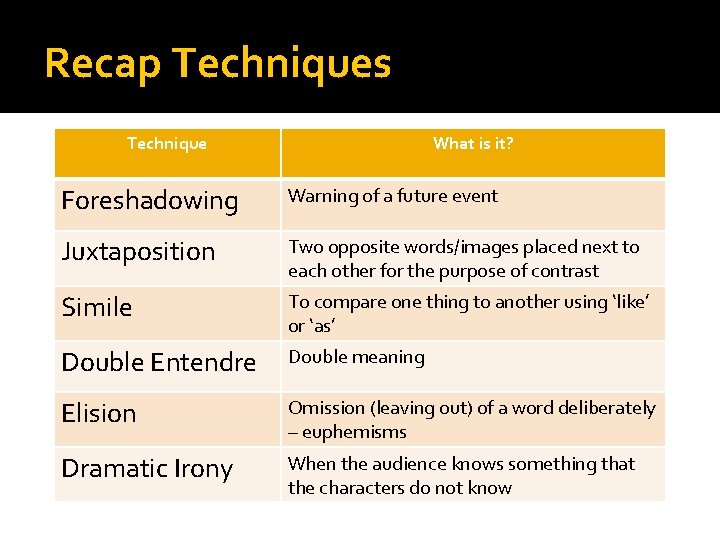
Recap Techniques Technique What is it? Foreshadowing Warning of a future event Juxtaposition Two opposite words/images placed next to each other for the purpose of contrast Simile To compare one thing to another using ‘like’ or ‘as’ Double Entendre Double meaning Elision Omission (leaving out) of a word deliberately – euphemisms Dramatic Irony When the audience knows something that the characters do not know
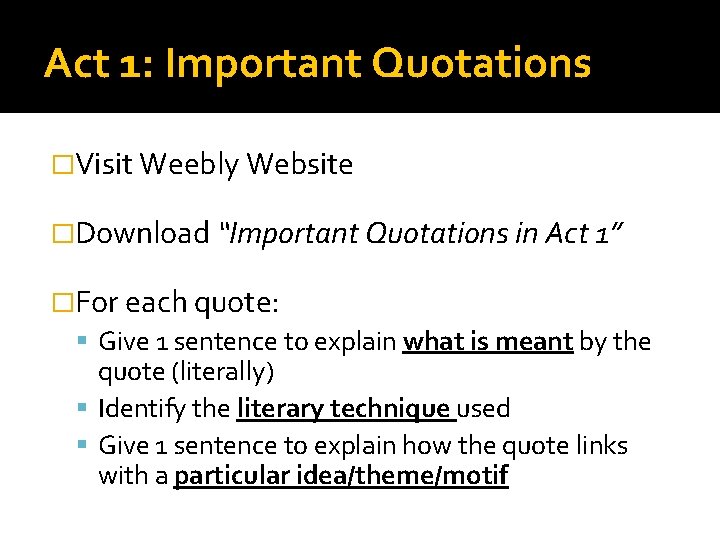
Act 1: Important Quotations �Visit Weebly Website �Download “Important Quotations in Act 1” �For each quote: Give 1 sentence to explain what is meant by the quote (literally) Identify the literary technique used Give 1 sentence to explain how the quote links with a particular idea/theme/motif
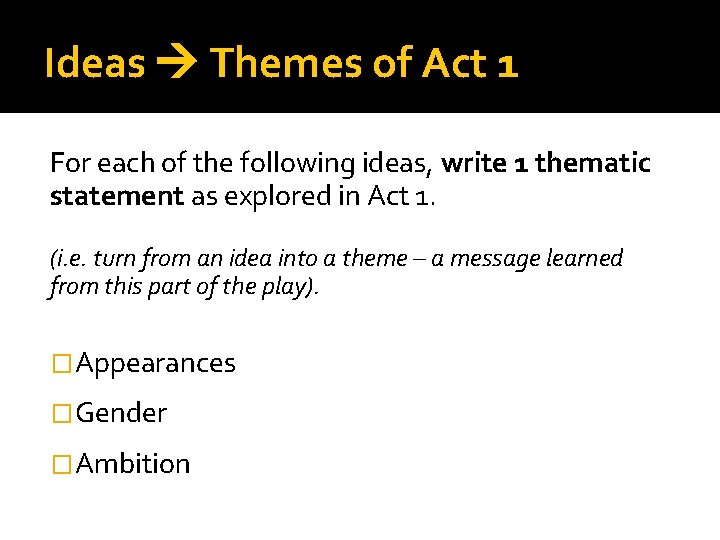
Ideas Themes of Act 1 For each of the following ideas, write 1 thematic statement as explored in Act 1. (i. e. turn from an idea into a theme – a message learned from this part of the play). �Appearances �Gender �Ambition
Representation of Themes For each of themes you have written, choose and draw/find a symbol to represent this theme. Complete a reflection/justification for the symbol chosen: �What is the symbol chosen? �How does this symbol represent theme?
Macbeth Rap Take the Crown – Macbeth Rap
Shakespeare’s Macbeth Act 2
Act 2, Scene 1 1. What is Macbeth doing in this soliloquy? 2. What is the meaning of the following quote? “Art thou not, fatal vision, sensible/to feeling as to sight? ” 3. How is theme of the supernatural included in this scene? 4. What does the bell symbolise? 5. Macbeth ends with “that summons thee to heaven or to hell” – how does this line foreshadow remorse/madness later in the play?
Adaptations of Act 2, Scene 1 Version 2 1. What choices in director make in these adaptations? 2. How do these choices effectively portray Macbeth’s state of mind at this point?
Macbeth’s State of Mind Create a graph to represent the change in Macbeth state of mind as the play progresses. Think about what his frame of mind was at the beginning and how it has evolved. We will add to it as we read more On your graph include the causes of his change of mind.
Act 2, Scene 2 What does Macbeth mean as he says: Methought I heard a voice cry 'Sleep no more! Macbeth does murder sleep', the innocent sleep, Sleep that knits up the ravell'd sleeve of care, The death of each day's life, sore labour's bath, Balm of hurt minds, great nature's second course, Chief nourisher in life's feast, -- Still it cried 'Sleep no more!' to all the house: 'Glamis hath murder'd sleep, and therefore Cawdor Shall sleep no more; Macbeth shall sleep no more. '
Act 2, Scene 2 “…Macbeth shall sleep no more. ” �Sleep is a symbol of rejuvenation and refreshment, a chance to recover. �‘Sleep’ has also been used as a double entendre for a sense of ‘peace of mind’ �Macbeth is foreshadowing that he will no longer be able to sleep in the future due to his impending guilt. He will not have ‘peace of mind’ or sanity because of what he has done.
Imagery in Act 2, Scenes 1 and 2 �Download the worksheet – ‘Imagery in Act 2’. �Find and write examples of references made to: animals, weapons, sleep, blood, darkness and nature. �What is the effect of this imagery?
Themes of Macbeth so far… Turn these ideas into thematic statements, that could be applied to the play. �Power �Ambition �Madness
Themes of Macbeth so far… Choose one of theme statements you have just written (regarding power, ambition, madness). Create a TEEL paragraph to explain how this theme is shown in the play Macbeth. (see next slide) Upload your TEEL paragraph to Edmodo.
Theme TEEL Paragraph �Topic Sentence: Outline theme shown in Macbeth (1 sentence). �Explanation: Give further detail about this theme and how it is shown in the play (2 – 3 sentences). �Example: Give a quote, literary/dramatic technique, how does this connect with theme? (2 – 3 sentences) �Link: Connect all ideas together and link back to theme (1 sentence).
Act 2, Scene 3 �Read Act 2, Scene 3 �What choices have been made with characterisation for this scene? �What examples of double entendre can you find?

Scenes Examined… � Act 1, Scene 1: Fair is Foul and Foul is Fair � Act 1, Scene 5: Unsex me here � Act 1, Scene 7: I dare do all that may become a man/…innocent flower, serpent under’t � Act 2, Scene 1: Is this a dagger which I see before me? � Act 2, Scene 2: Macbeth doth murder sleep � Act 2, Scene 3: If a man were porter of hell-gate
Review of Key Ideas The key ideas examined in the play so far: �Ambition �Power/Greed �Fate �Supernatural �Gender �Deceiving Appearances �Madness These are the basis for themes of the play.
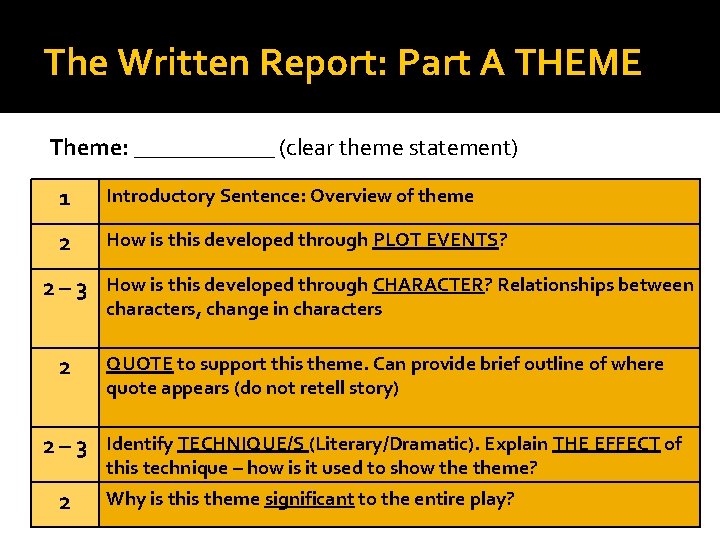
The Written Report: Part A THEME Theme: ______ (clear theme statement) 1 Introductory Sentence: Overview of theme 2 How is this developed through PLOT EVENTS? 2 – 3 How is this developed through CHARACTER? Relationships between characters, change in characters 2 QUOTE to support this theme. Can provide brief outline of where quote appears (do not retell story) 2 – 3 Identify TECHNIQUE/S (Literary/Dramatic). Explain THE EFFECT of this technique – how is it used to show theme? 2 Why is theme significant to the entire play?
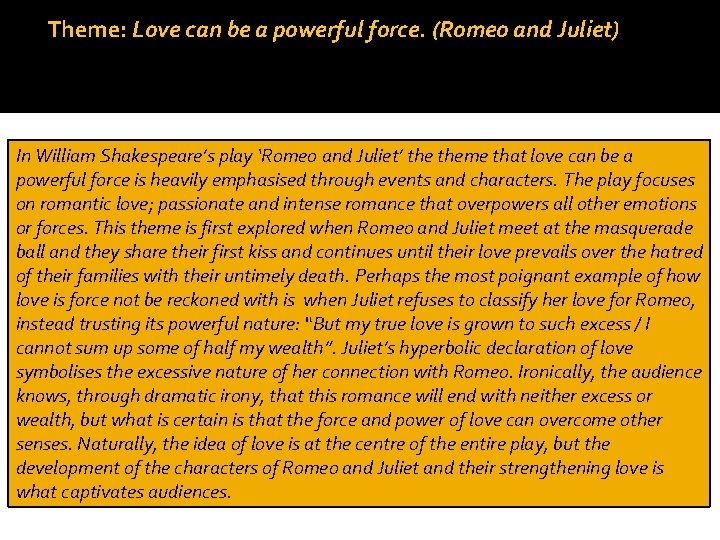
Theme: Love can be a powerful force. (Romeo and Juliet) In William Shakespeare’s play ‘Romeo and Juliet’ theme that love can be a powerful force is heavily emphasised through events and characters. The play focuses on romantic love; passionate and intense romance that overpowers all other emotions or forces. This theme is first explored when Romeo and Juliet meet at the masquerade ball and they share their first kiss and continues until their love prevails over the hatred of their families with their untimely death. Perhaps the most poignant example of how love is force not be reckoned with is when Juliet refuses to classify her love for Romeo, instead trusting its powerful nature: “But my true love is grown to such excess / I cannot sum up some of half my wealth”. Juliet’s hyperbolic declaration of love symbolises the excessive nature of her connection with Romeo. Ironically, the audience knows, through dramatic irony, that this romance will end with neither excess or wealth, but what is certain is that the force and power of love can overcome other senses. Naturally, the idea of love is at the centre of the entire play, but the development of the characters of Romeo and Juliet and their strengthening love is what captivates audiences.
The Written Report: PART B VISUAL LITERACY There a number ways you may choose to set out your report: � Headings may be for the pictures/elements of your poster – e. g. Rose, Mask, Text. Underneath these headings you will then provide information about the visual literacy choices of each e. g. colour, vectors, salience � Headings may be for visual literacy elements of your poster – e. g. salient image, colour scheme, reading path. Within each heading you will then provide information about how this element is developed in your poster.
The Written Report: PART B VISUAL LITERACY � For EACH AND EVERY visual element you identify in your poster you must: Identify where/how the element was used = The salient image of the dagger … Give a specific example = The colours of red, black and grey used for the background … Provide a justification for the visual choice linking to theme you discussed in Part 1 = The large size of the crown, acting as the salient image, has been chosen to emphasise the significance of this object for Macbeth in his quest for power. By increasing the size of the crown the viewer understands the importance of this object for Macbeth and know that he will do anything to obtain the crown, including murder.
Act 2, Scene 4 �Read Act 2, Scene 4 �What do the Old Man and Ross discuss? �How are these events symbolic?
Act 3, Scene 1 & Scene 4 �Read Act 3, Scene 1 & 4 �Discuss Macbeth’s state of mind as this Act progresses.
Act 4, Scene 1 �Read Act 4, Scene 1 �What choices have directors made in presenting the witches of this scene?
Act 5, Scene 1: Sleep Walking �Read Act 5, Scene 1 �Discuss Lady Macbeth’s state of mind in this scene. �What themes/messages are represented in this scene?
Act 5, Scene 1: Sleep Walking �View these four versions of this scene: https: //www. youtube. com/watch? v=VS_Z 4 z. BDItw �For each version, make notes on the particular choices of the directors. �Which of these versions do you feel is most effective? Why?
Act 5, Scene 5 �Macbeth: “Life’s but a walking shadow, a poor player. That struts and frets his hour upon the stage, And then is heard no more. It is a tale told by an idiot, full of sound and fury, Signifying nothing. ”
Act 5 – Final Scenes �Final Fight Scene: https: //www. youtube. com/watch? v=tr 6 Vrm. OQY 1 M � By the end of the play, how do you know order has been restored? � Was justice served?
Who Did It? �Earlier in the term, you were asked to consider who was ultimately responsible for the murder of Macbeth. �Has your opinion changed? Do you still think the same person was responsible? What changed/confirmed your opinion?
Application to Modern Society �Brainstorm with a partner a film, book, event or situation you have been exposed to that has some element of the ideas learned from Macbeth. �What does this say about the universality of Shakespeare’s work?
- Slides: 54