
Macbeth Revision Themes Ambition Evil The Supernatural Death
Macbeth Revision
Themes Ambition Evil The Supernatural Death Appearance v. Reality Violence & Tyranny Guilt & Conscience Equivocation
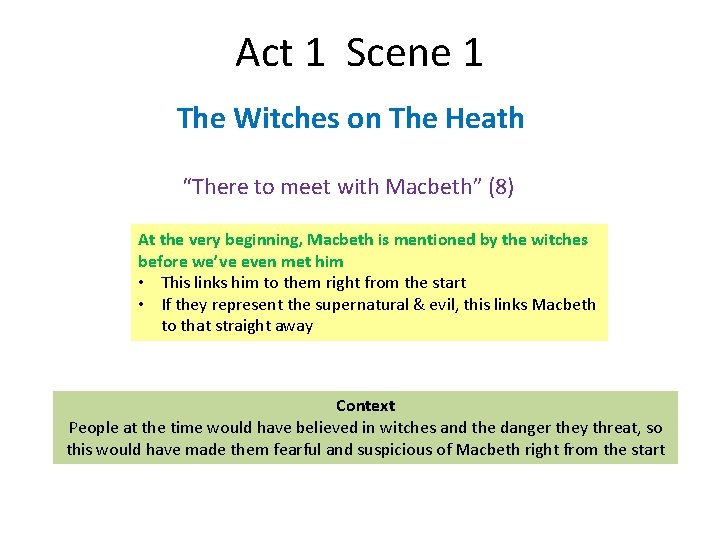
Act 1 Scene 1 The Witches on The Heath “There to meet with Macbeth” (8) At the very beginning, Macbeth is mentioned by the witches before we’ve even met him • This links him to them right from the start • If they represent the supernatural & evil, this links Macbeth to that straight away Context People at the time would have believed in witches and the danger they threat, so this would have made them fearful and suspicious of Macbeth right from the start
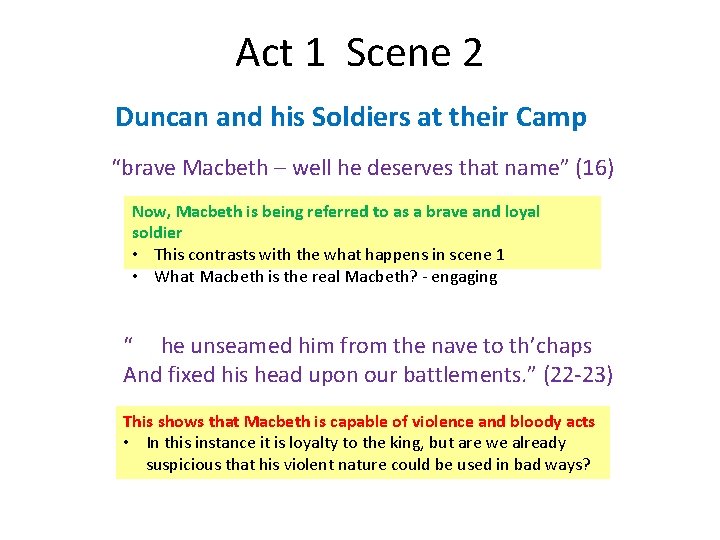
Act 1 Scene 2 Duncan and his Soldiers at their Camp “brave Macbeth – well he deserves that name” (16) Now, Macbeth is being referred to as a brave and loyal soldier • This contrasts with the what happens in scene 1 • What Macbeth is the real Macbeth? - engaging “ he unseamed him from the nave to th’chaps And fixed his head upon our battlements. ” (22 -23) This shows that Macbeth is capable of violence and bloody acts • In this instance it is loyalty to the king, but are we already suspicious that his violent nature could be used in bad ways?
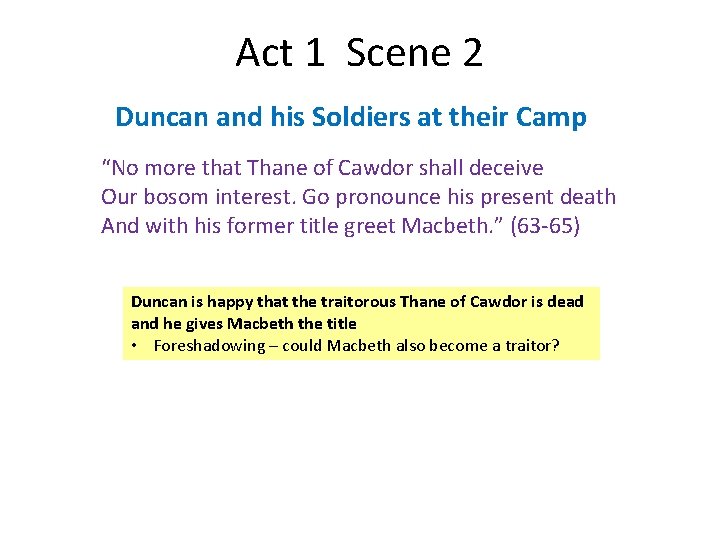
Act 1 Scene 2 Duncan and his Soldiers at their Camp “No more that Thane of Cawdor shall deceive Our bosom interest. Go pronounce his present death And with his former title greet Macbeth. ” (63 -65) Duncan is happy that the traitorous Thane of Cawdor is dead and he gives Macbeth the title • Foreshadowing – could Macbeth also become a traitor?
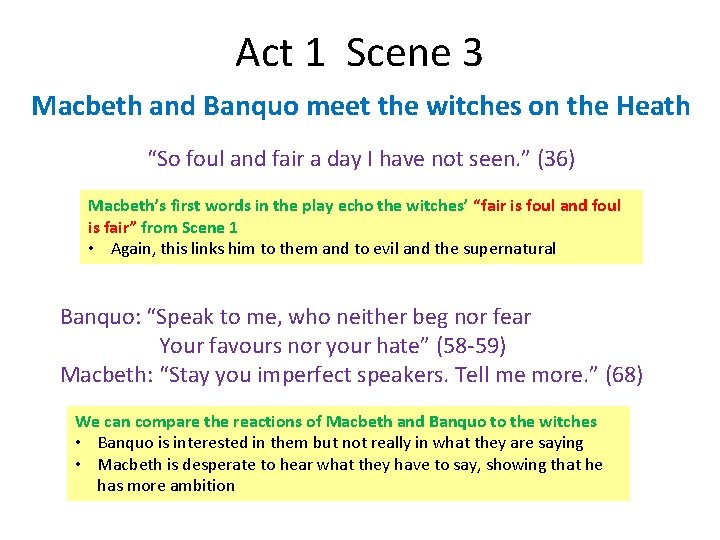
Act 1 Scene 3 Macbeth and Banquo meet the witches on the Heath “So foul and fair a day I have not seen. ” (36) Macbeth’s first words in the play echo the witches’ “fair is foul and foul is fair” from Scene 1 • Again, this links him to them and to evil and the supernatural Banquo: “Speak to me, who neither beg nor fear Your favours nor your hate” (58 -59) Macbeth: “Stay you imperfect speakers. Tell me more. ” (68) We can compare the reactions of Macbeth and Banquo to the witches • Banquo is interested in them but not really in what they are saying • Macbeth is desperate to hear what they have to say, showing that he has more ambition
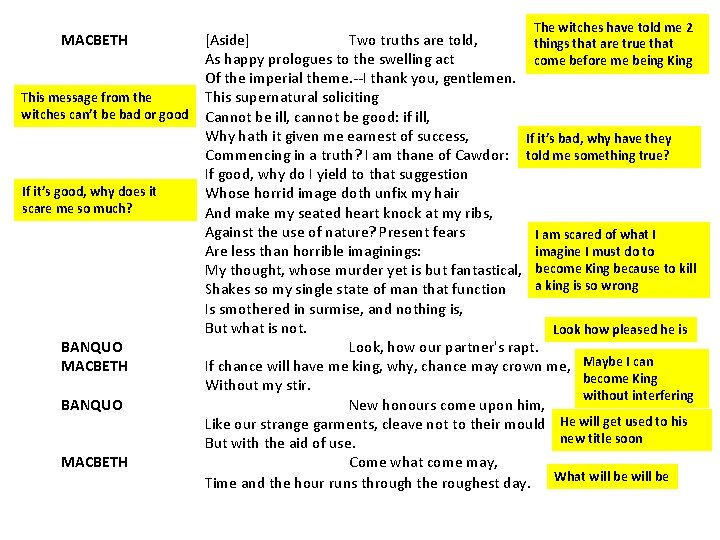
MACBETH This message from the witches can’t be bad or good If it’s good, why does it scare me so much? BANQUO MACBETH The witches have told me 2 things that are true that come before me being King [Aside] Two truths are told, As happy prologues to the swelling act Of the imperial theme. --I thank you, gentlemen. This supernatural soliciting Cannot be ill, cannot be good: if ill, Why hath it given me earnest of success, If it’s bad, why have they Commencing in a truth? I am thane of Cawdor: told me something true? If good, why do I yield to that suggestion Whose horrid image doth unfix my hair And make my seated heart knock at my ribs, Against the use of nature? Present fears I am scared of what I Are less than horrible imaginings: imagine I must do to My thought, whose murder yet is but fantastical, become King because to kill a king is so wrong Shakes so my single state of man that function Is smothered in surmise, and nothing is, But what is not. Look how pleased he is Look, how our partner's rapt. If chance will have me king, why, chance may crown me, Maybe I can become King Without my stir. without interfering New honours come upon him, Like our strange garments, cleave not to their mould He will get used to his new title soon But with the aid of use. Come what come may, Time and the hour runs through the roughest day. What will be

MACBETH Repetition of ‘cannot’ shows he is divided between the horror of the thought of killing the king and accepting whatever has to be done. His first thought is murder. What does this tell us about his personality? Appearance v. Reality BANQUO MACBETH [Aside] Two truths are told, As happy prologues to the swelling act Of the imperial theme. --I thank you, gentlemen. This supernatural soliciting Regicide was considered a Cannot be ill, cannot be good: if ill, particularly terrible crime Why hath it given me earnest of success, as the King was believed to Commencing in a truth? I am thane of Cawdor: be ordained by God and the If good, why do I yield to that suggestion closest person to God on Whose horrid image doth unfix my hair Earth, so it was like killing And make my seated heart knock at my ribs, God. Against the use of nature? Present fears Appearance v. Are less than horrible imaginings: Reality: they think My thought, whose murder yet is but fantastical, he’s pleased about Shakes so my single state of man that function being Thane of Is smothered in surmise, and nothing is, cawdor but he’s But what is not. actually thinking Look, how our partner's rapt. about killing the If chance will have me king, why, chance may crown me, King! Without my stir. New honours come upon him Clothes imagery: he will get used to his new title Like our strange garments, cleave not to their mould just like you get used to But with the aid of use. new clothes that don’t fit Come what come may, properly straight away. Time and the hour runs through the roughest day. Links to Av. R because it is covering up what he’s really thinking about.
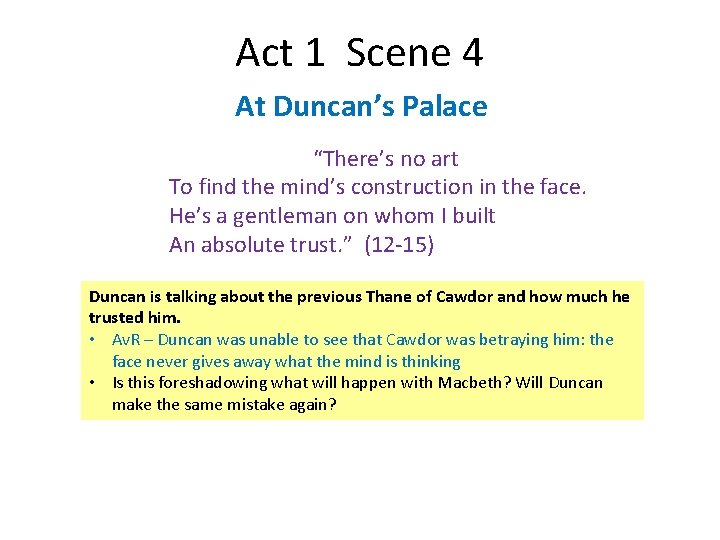
Act 1 Scene 4 At Duncan’s Palace “There’s no art To find the mind’s construction in the face. He’s a gentleman on whom I built An absolute trust. ” (12 -15) Duncan is talking about the previous Thane of Cawdor and how much he trusted him. • Av. R – Duncan was unable to see that Cawdor was betraying him: the face never gives away what the mind is thinking • Is this foreshadowing what will happen with Macbeth? Will Duncan make the same mistake again?
![Act 1 Scene 4 At Duncan’s Palace “[Aside] The Prince of Cumberland: that is](http://slidetodoc.com/presentation_image_h/334d34ec81f0f70b0674647410e477ee/image-10.jpg "Act 1 Scene 4 At Duncan’s Palace “[Aside] The Prince of Cumberland: that is")
Act 1 Scene 4 At Duncan’s Palace “[Aside] The Prince of Cumberland: that is a step On which I must fall down, or else o’erleap, For in my way it lies. Stars, hide your fires, Let not light see my black and deep desires, The eye wink at the hand” (49 -52) Macbeth responds to Malcolm being named as Duncan’s heir • Thus makes him think of murder again • Av. R – He asks for the darkness to cover up the truth of what he is thinking so that the eye of his victim may not recognise the hand that comes to kill him.
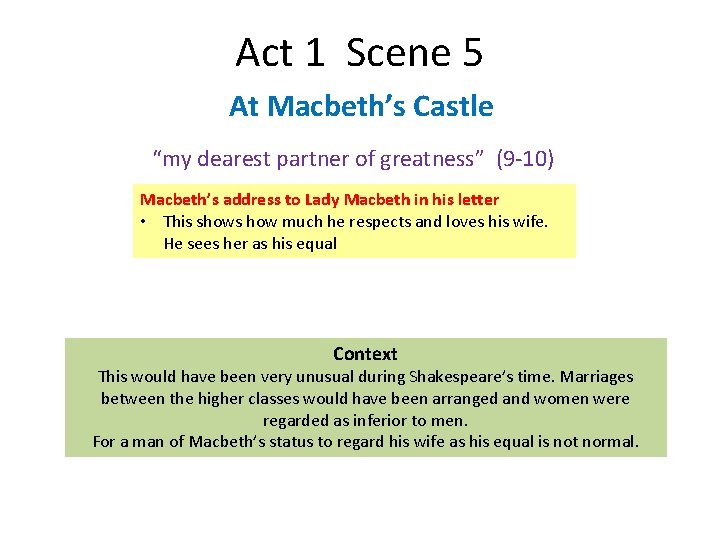
Act 1 Scene 5 At Macbeth’s Castle “my dearest partner of greatness” (9 -10) Macbeth’s address to Lady Macbeth in his letter • This shows how much he respects and loves his wife. He sees her as his equal Context This would have been very unusual during Shakespeare’s time. Marriages between the higher classes would have been arranged and women were regarded as inferior to men. For a man of Macbeth’s status to regard his wife as his equal is not normal.
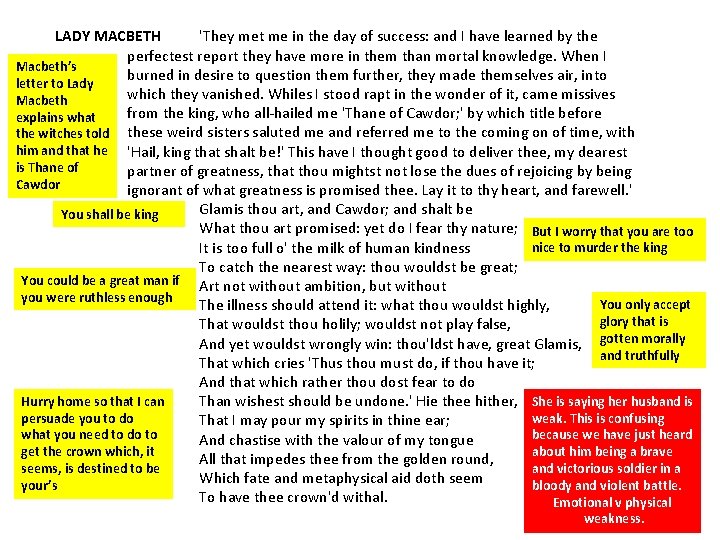
LADY MACBETH 'They met me in the day of success: and I have learned by the perfectest report they have more in them than mortal knowledge. When I Macbeth’s burned in desire to question them further, they made themselves air, into letter to Lady which they vanished. Whiles I stood rapt in the wonder of it, came missives Macbeth from the king, who all-hailed me 'Thane of Cawdor; ' by which title before explains what the witches told these weird sisters saluted me and referred me to the coming on of time, with him and that he 'Hail, king that shalt be!' This have I thought good to deliver thee, my dearest is Thane of partner of greatness, that thou mightst not lose the dues of rejoicing by being Cawdor ignorant of what greatness is promised thee. Lay it to thy heart, and farewell. ' Glamis thou art, and Cawdor; and shalt be You shall be king What thou art promised: yet do I fear thy nature; But I worry that you are too nice to murder the king It is too full o' the milk of human kindness To catch the nearest way: thou wouldst be great; You could be a great man if Art not without ambition, but without you were ruthless enough You only accept The illness should attend it: what thou wouldst highly, glory that is That wouldst thou holily; wouldst not play false, And yet wouldst wrongly win: thou'ldst have, great Glamis, gotten morally and truthfully That which cries 'Thus thou must do, if thou have it; And that which rather thou dost fear to do Hurry home so that I can Than wishest should be undone. ' Hie thee hither, She is saying her husband is persuade you to do weak. This is confusing That I may pour my spirits in thine ear; what you need to do to because we have just heard And chastise with the valour of my tongue get the crown which, it about him being a brave All that impedes thee from the golden round, seems, is destined to be and victorious soldier in a Which fate and metaphysical aid doth seem your’s bloody and violent battle. To have thee crown'd withal. Emotional v physical weakness.
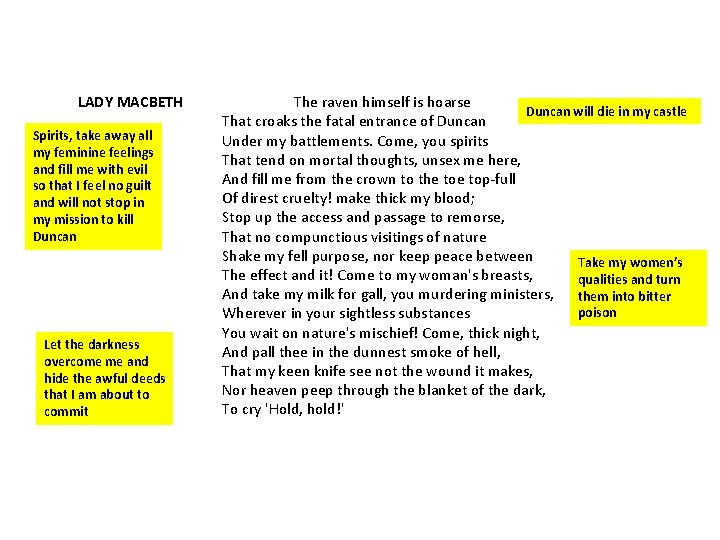
LADY MACBETH Spirits, take away all my feminine feelings and fill me with evil so that I feel no guilt and will not stop in my mission to kill Duncan Let the darkness overcome me and hide the awful deeds that I am about to commit The raven himself is hoarse Duncan will die in my castle That croaks the fatal entrance of Duncan Under my battlements. Come, you spirits That tend on mortal thoughts, unsex me here, And fill me from the crown to the top-full Of direst cruelty! make thick my blood; Stop up the access and passage to remorse, That no compunctious visitings of nature Shake my fell purpose, nor keep peace between Take my women’s The effect and it! Come to my woman's breasts, qualities and turn And take my milk for gall, you murdering ministers, them into bitter poison Wherever in your sightless substances You wait on nature's mischief! Come, thick night, And pall thee in the dunnest smoke of hell, That my keen knife see not the wound it makes, Nor heaven peep through the blanket of the dark, To cry 'Hold, hold!'
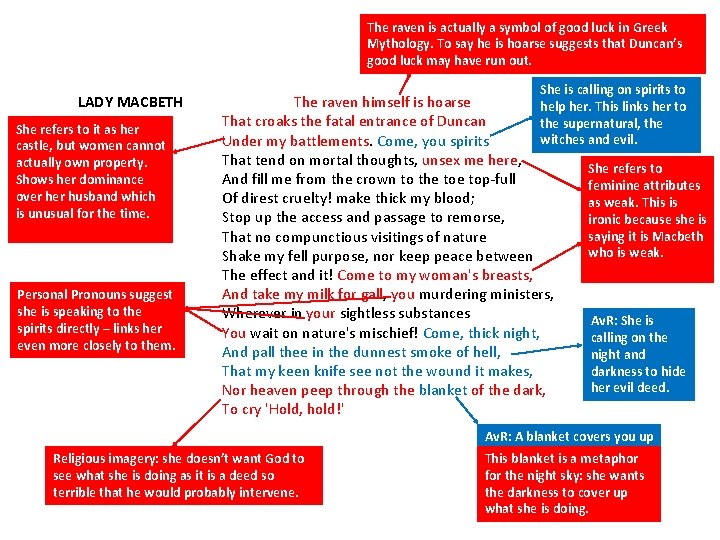
The raven is actually a symbol of good luck in Greek Mythology. To say he is hoarse suggests that Duncan’s good luck may have run out. LADY MACBETH She refers to it as her castle, but women cannot actually own property. Shows her dominance over husband which is unusual for the time. Personal Pronouns suggest she is speaking to the spirits directly – links her even more closely to them. She is calling on spirits to The raven himself is hoarse help her. This links her to That croaks the fatal entrance of Duncan the supernatural, the witches and evil. Under my battlements. Come, you spirits That tend on mortal thoughts, unsex me here, She refers to And fill me from the crown to the top-full feminine attributes Of direst cruelty! make thick my blood; as weak. This is Stop up the access and passage to remorse, ironic because she is saying it is Macbeth That no compunctious visitings of nature who is weak. Shake my fell purpose, nor keep peace between The effect and it! Come to my woman's breasts, And take my milk for gall, you murdering ministers, Wherever in your sightless substances Av. R: She is You wait on nature's mischief! Come, thick night, calling on the And pall thee in the dunnest smoke of hell, night and darkness to hide That my keen knife see not the wound it makes, her evil deed. Nor heaven peep through the blanket of the dark, To cry 'Hold, hold!' Av. R: A blanket covers you up Religious imagery: she doesn’t want God to see what she is doing as it is a deed so terrible that he would probably intervene. This blanket is a metaphor for the night sky: she wants the darkness to cover up what she is doing.
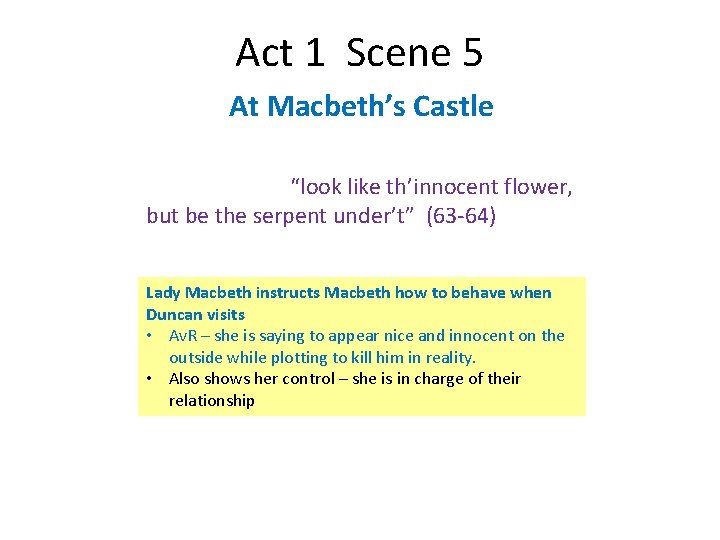
Act 1 Scene 5 At Macbeth’s Castle “look like th’innocent flower, but be the serpent under’t” (63 -64) Lady Macbeth instructs Macbeth how to behave when Duncan visits • Av. R – she is saying to appear nice and innocent on the outside while plotting to kill him in reality. • Also shows her control – she is in charge of their relationship
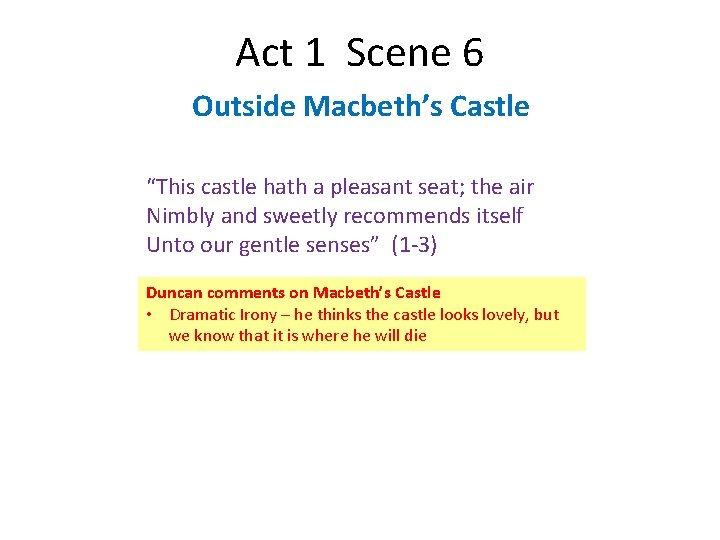
Act 1 Scene 6 Outside Macbeth’s Castle “This castle hath a pleasant seat; the air Nimbly and sweetly recommends itself Unto our gentle senses” (1 -3) Duncan comments on Macbeth’s Castle • Dramatic Irony – he thinks the castle looks lovely, but we know that it is where he will die
Act 1 Scene 7 Inside Macbeth’s Castle, near the Main Hall
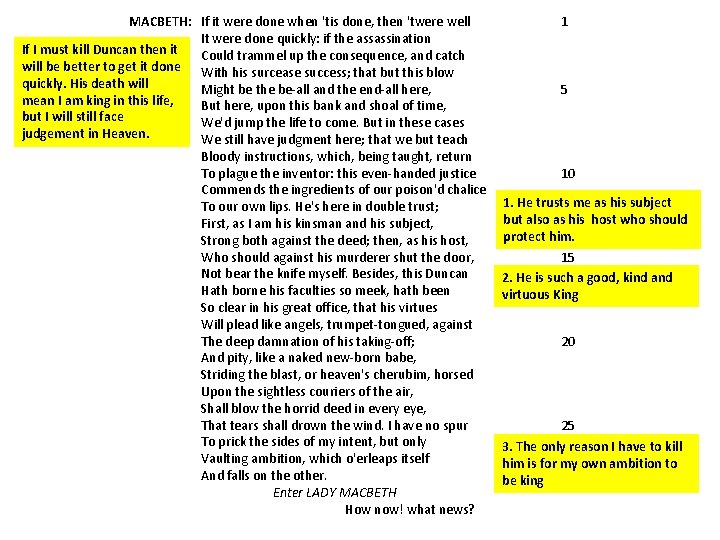
MACBETH: If it were done when 'tis done, then 'twere well It were done quickly: if the assassination If I must kill Duncan then it Could trammel up the consequence, and catch will be better to get it done With his surcease success; that but this blow quickly. His death will Might be the be-all and the end-all here, mean I am king in this life, But here, upon this bank and shoal of time, but I will still face We'd jump the life to come. But in these cases judgement in Heaven. We still have judgment here; that we but teach Bloody instructions, which, being taught, return To plague the inventor: this even-handed justice Commends the ingredients of our poison'd chalice To our own lips. He's here in double trust; First, as I am his kinsman and his subject, Strong both against the deed; then, as his host, Who should against his murderer shut the door, Not bear the knife myself. Besides, this Duncan Hath borne his faculties so meek, hath been So clear in his great office, that his virtues Will plead like angels, trumpet-tongued, against The deep damnation of his taking-off; And pity, like a naked new-born babe, Striding the blast, or heaven's cherubim, horsed Upon the sightless couriers of the air, Shall blow the horrid deed in every eye, That tears shall drown the wind. I have no spur To prick the sides of my intent, but only Vaulting ambition, which o'erleaps itself And falls on the other. Enter LADY MACBETH How now! what news? 1 5 10 1. He trusts me as his subject but also as his host who should protect him. 15 2. He is such a good, kind and virtuous King 20 25 3. The only reason I have to kill him is for my own ambition to be king
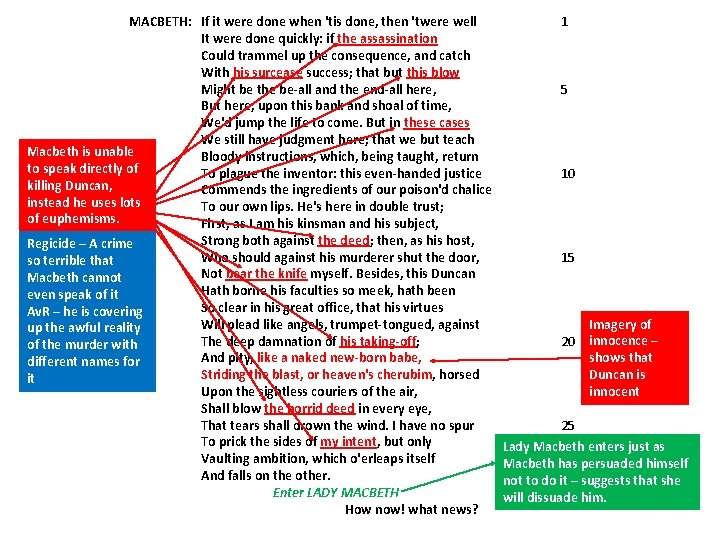
MACBETH: If it were done when 'tis done, then 'twere well It were done quickly: if the assassination Could trammel up the consequence, and catch With his surcease success; that but this blow Might be the be-all and the end-all here, But here, upon this bank and shoal of time, We'd jump the life to come. But in these cases We still have judgment here; that we but teach Macbeth is unable Bloody instructions, which, being taught, return to speak directly of To plague the inventor: this even-handed justice killing Duncan, Commends the ingredients of our poison'd chalice instead he uses lots To our own lips. He's here in double trust; of euphemisms. First, as I am his kinsman and his subject, Strong both against the deed; then, as his host, Regicide – A crime Who should against his murderer shut the door, so terrible that Not bear the knife myself. Besides, this Duncan Macbeth cannot Hath borne his faculties so meek, hath been even speak of it So clear in his great office, that his virtues Av. R – he is covering Will plead like angels, trumpet-tongued, against up the awful reality The deep damnation of his taking-off; of the murder with And pity, like a naked new-born babe, different names for Striding the blast, or heaven's cherubim, horsed it Upon the sightless couriers of the air, Shall blow the horrid deed in every eye, That tears shall drown the wind. I have no spur To prick the sides of my intent, but only Vaulting ambition, which o'erleaps itself And falls on the other. Enter LADY MACBETH How now! what news? 1 5 10 15 Imagery of 20 innocence – shows that Duncan is innocent 25 Lady Macbeth enters just as Macbeth has persuaded himself not to do it – suggests that she will dissuade him.
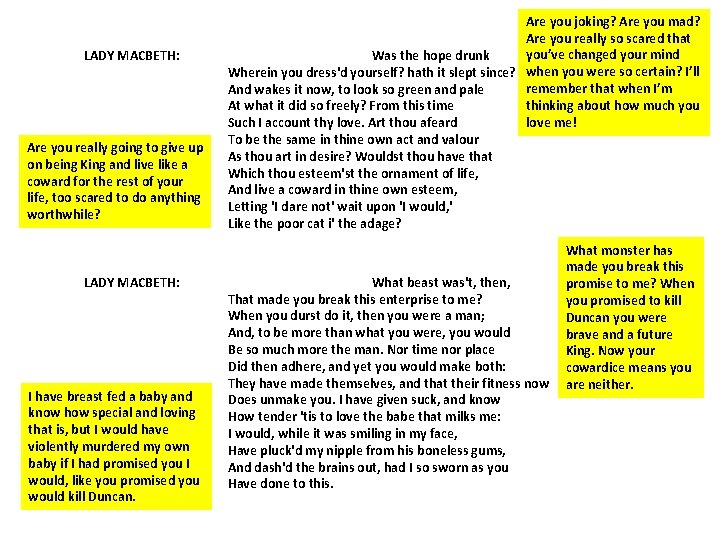
LADY MACBETH: Are you really going to give up on being King and live like a coward for the rest of your life, too scared to do anything worthwhile? LADY MACBETH: I have breast fed a baby and know how special and loving that is, but I would have violently murdered my own baby if I had promised you I would, like you promised you would kill Duncan. Are you joking? Are you mad? Are you really so scared that you’ve changed your mind Was the hope drunk Wherein you dress'd yourself? hath it slept since? when you were so certain? I’ll remember that when I’m And wakes it now, to look so green and pale thinking about how much you At what it did so freely? From this time love me! Such I account thy love. Art thou afeard To be the same in thine own act and valour As thou art in desire? Wouldst thou have that Which thou esteem'st the ornament of life, And live a coward in thine own esteem, Letting 'I dare not' wait upon 'I would, ' Like the poor cat i' the adage? What beast was't, then, That made you break this enterprise to me? When you durst do it, then you were a man; And, to be more than what you were, you would Be so much more the man. Nor time nor place Did then adhere, and yet you would make both: They have made themselves, and that their fitness now Does unmake you. I have given suck, and know How tender 'tis to love the babe that milks me: I would, while it was smiling in my face, Have pluck'd my nipple from his boneless gums, And dash'd the brains out, had I so sworn as you Have done to this. What monster has made you break this promise to me? When you promised to kill Duncan you were brave and a future King. Now your cowardice means you are neither.

LADY MACBETH: Refers to a proverb about a cat who wants to fish but is afraid of water – she is taunting Macbeth and saying he is too much of a coward to do it. LADY MACBETH: Was the hope drunk Wherein you dress'd yourself? hath it slept since? And wakes it now, to look so green and pale At what it did so freely? From this time Such I account thy love. Art thou afeard To be the same in thine own act and valour As thou art in desire? Wouldst thou have that Which thou esteem'st the ornament of life, And live a coward in thine own esteem, Letting 'I dare not' wait upon 'I would, ' Like the poor cat i' the adage? Metaphor for him being scared. She is calling him a coward for not wanting to kill Duncan. What beast was't, then, That made you break this enterprise to me? When you durst do it, then you were a man; And, to be more than what you were, you would Be so much more the man. Nor time nor place Did then adhere, and yet you would make both: They have made themselves, and that their fitness now Does unmake you. I have given suck, and know How tender 'tis to love the babe that milks me: I would, while it was smiling in my face, Have pluck'd my nipple from his boneless gums, And dash'd the brains out, had I so sworn as you Have done to this. Rhetorical question – it’s almost as though she is begging him. Makes the emotional blackmail more effective. Very violent imagery. Contrasts with the image of the suckling baby, making it more shocking and disturbing.
- Slides: 21