
Macbeth Interactive Notebook What is it A place
Macbeth Interactive Notebook
What is it? A place for you to organize new information in creative ways, express your opinions and feelings, explore new ideas, as well as give you a place to keep class discussion notes, handouts, and reading notes. What All goes in it? work related to our study of Macbeth. You will given a table of contents with specific activities that will be on the inside cover of the notebook.
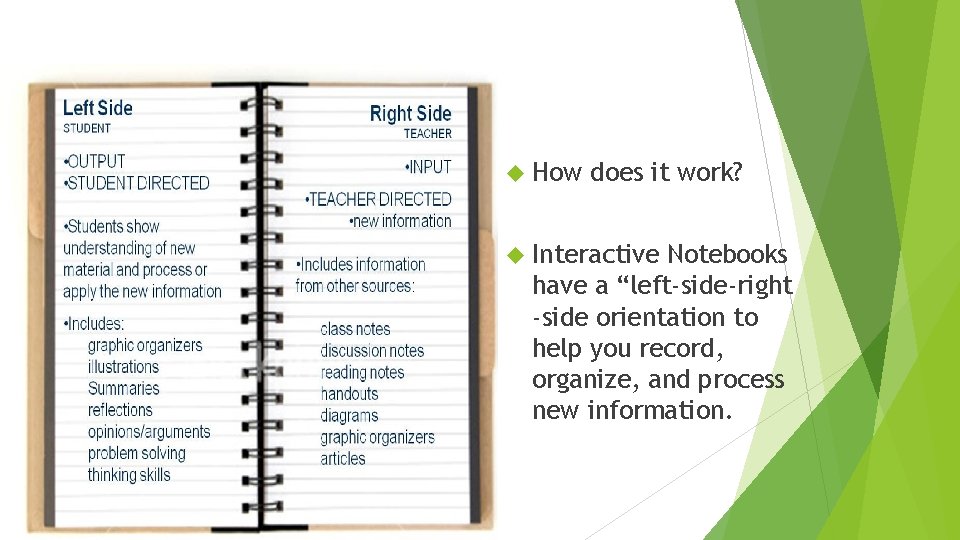
How does it work? Interactive Notebooks have a “left-side-right -side orientation to help you record, organize, and process new information.
Left Side/Right Side Left Side This is the creative side, you will be drawing pictures, writing personal responses, answering questions and doing activates. Color matters!!! It helps you interact with information It helps you remember important details. Right Side Graphic organizers, handouts, charts Always title the assignment Be sure you a thorough with facts and information The better quality right-side info, the easier it will be to complete the left side.
Guidelines Take excellent care of your interactive-Macbeth notebook. DO NOT use your notebook for any other classes and do not rip out pages for any other classes. You must have your notebook in class every day! Handouts and other provided pages must be glued or stapled. No loose handouts. Notebooks need to follow the Table of Contents that I will provide you with. Keep notebooks organized and up-to-date. All pages my be numbered in the bottom right and left corners of each page.
Number those pages Starting with the first page (not the inside cover) start number pages all the way from 1 to 30. Even numbers will always be on the left, odd numbers will always be on the right. Make sure you put the number on the left in the left-hand corner and the number on the right in the right-hand corner at the bottom of the page. 2 3
Let’s Get Organized! Inside Cover Page 1 Tape or staple the Table of Contents on the inside cover of the journal. Cover Page Include: Title Author Your name Class period Pictures/Quotes/Drawings /Color As you complete each assignment check mark the box next to it.
Pg. 2 and Pg. 3 Left-side Page 2 Right-side Page 3 On the top half of the page, glue or tape in the Why Read Shakespeare Response I gave back to you. Glue or tape in your Shakespeare Guided Notes. Make sure you can still read all of the notes. Bottom of page currently leave blank
Page 4 -Written Response-2 paragraphs How are Macbeth and Lady Macbeth different? Use their major speeches in Scene 7 to contrast their characters. Macbeth-lines Lady 1 -28 Macbeth-lines 47 -59
Pg. 5 -Shakespeare’s Language Top half of page: Prose: Ordinary speech that doesn’t have a specific rhyme or pattern. Blank Verse: Unrhymed Iambic Pentameter-which is a line of ten syllables that has a rhythm like a heartbeat. The first syllable/ beat is unstressed and the second is stressed. Example from Macbeth (Act 1, scene 7) Here’s how you would read it aloud: False face must hide what the false heart doth know. Soliloquy: a speech delivered to the audience rather than to other characters, in which the speaker explores their thoughts and feelings. Bottom Half of page: Staple or Glue in Shakespeare Language Reference Sheet

Pg. 6 -Digging into the Dagger Soliloquy Response 1. What is happening in the speech? (2 -3 sentences. ) 2. What has happened in the previous Act that influences this speech? In the previous scene? (4 sentences. ) 3. What is Macbeth trying to work out in the speech? What does he decide? What discoveries does he make? (4 sentences. ) 4. Is the dagger real or a projection of Macbeth's mind? Support your answer. (2 -3 sentences. ) 5. What is the mood or tone of the speech? (2 -3 sentences. )
Page 7 -Digging into the Dagger Soliloquy Copy this excerpt from Act II, Scene : Is this a dagger which I see before me, The handle toward my hand? Come, let me clutch thee. I have thee not, and yet I see thee still. Art thou not, fatal vision, sensible To feeling as to sight? or art thou but A dagger of the mind, a false creation, Proceeding from the heat-oppressed brain? Using different colors, circle or underline examples of imagery, foreshadowing and metaphors.

Pg. 8 Setting Notes-Left side Inverness: is where Macbeth's castle is before he becomes king. This is where Macbeth and Lady Macbeth kill Duncan. Fife: is where Macduff and his family live. Birnam Woods: is a forest near Dusinane Hill. Dusinane Woods: is a hill on which Macbeth has a castle. This is where he stays to await Malcolm's troops. Saint Colme's Inch: is an island where the king of Norway had to bring $10, 000 for Scotland as a term of peace for their defeat. Scone: is Macbeth's and Malcom's coronation place. Colmekill: is Duncan's Burial Place. Dusinane: is where Macbeth sets up his camp to fight Macduff's forces. Forres: is a castle in Scotland where Duncan lives.
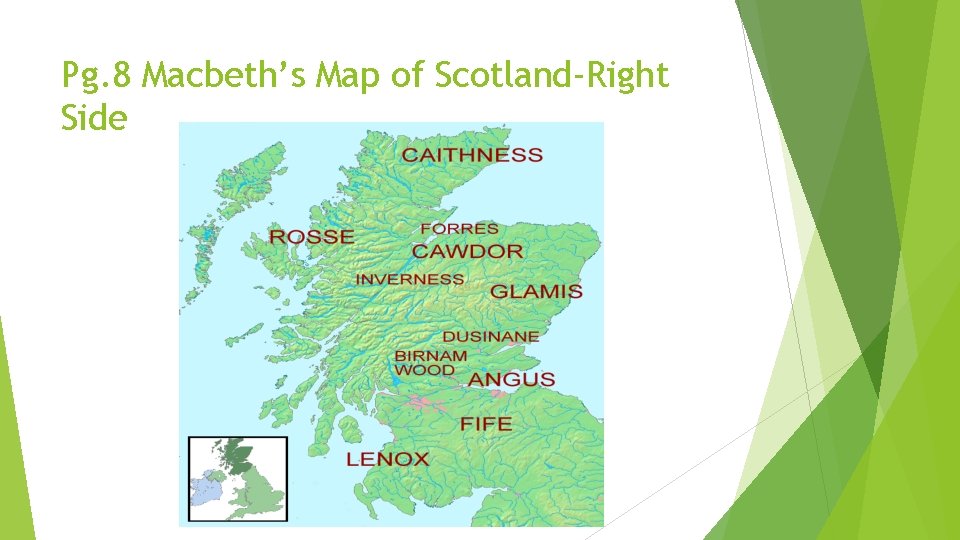
Pg. 8 Macbeth’s Map of Scotland-Right Side
Pg. 9 1. People will do whatever is necessary to achieve their goals. 2. Ambition is good (a positive, desirable trait). 3. All leaders are ambitious. 4. It is impossible to be ambitious and maintain your integrity. 5. Ambition, lust, greed, and desire all mean the same thing. 6. Everyone is capable of lying, killing, and betrayal; in other words, of being evil. 7. The world is just: if you do something wrong you will be punished for it. 8. Our nature (our character) is fixed; try as we might we cannot change who or what we are. 9. Our fate is predetermined; we cannot alter our own destiny. 10. If someone kills someone because someone else coerced them into doing it, the person who did the killing is not responsible for the murder. Write down each statement and next to it write either: Strongly Disagree, Depends, Agree, Strongly Agree At the bottom of the page, pick one statement, that you either STRONGLY AGREE with or one that you STRONGLY DISAGREE with and write a paragraph on why you feel that way.
Page 10 -Magic Chart and Response Create the chart that is on the board and fill in the “We think” section, you may discuss this with the people around you. We will fill in the “Shakespeare Thought” section together.
Pg. 11 -Elizabethan Magic Notes (Top Half of Page) In Elizabethan times, the use of magic was their science. They believed in “sympathetic magic, ” which is the idea that if two things or ideas held similarities with each other, then a certain cause and effect was directly assumed. Example: it was thought that because a walnut resembles a human brain, eating a walnut would help relieve headaches. This gave way to making wizardry and sorcery a form of magic that people believed in and was very real to the people of Shakespeare’s time. It is important to note that also in Shakespeare’s time there was a distinct difference between the occult or dark magic, and a rational kind of magic that explored the supernatural from a scientific viewpoint.
Pg. 11 Bottom Half of Page: One Paragraph Take a popular and easily explainable scientific or medical phenomenon such an earthquake, an eclipse, a feeling of vertigo, going bald, etc. It’s easy enough to look up why these things happen, for reasons that have been scientifically explained to the last detail. Use your imaginative power to write about why this phenomenon happens, using no modern scientific explanation at all, instead find a magical explanation.
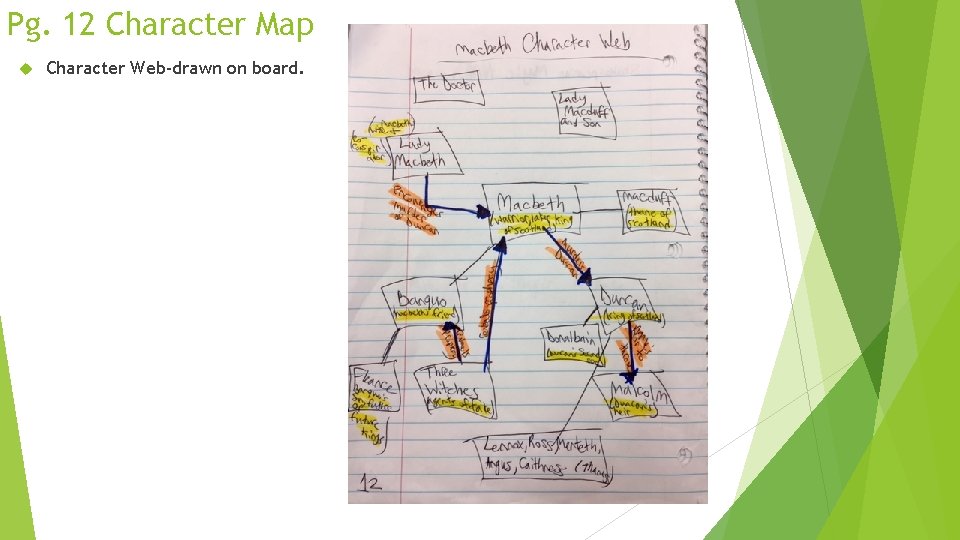
Pg. 12 Character Map Character Web-drawn on board.
Pg. 13 -Knock, Knock Joke Explained Handout given in class.
Pg. 14 -Joke Response (Top of Page) 1. Why does Shakespeare add the Porter scene in the play? What purpose does it serve? 2. What symbolism does the “gate of hell” have for what else is going on in Act 2? 3. How does the Porter scene show the reader how Shakespeare feels about Macbeth? (2 -3 sentences each. )
Pg. 14 Bottom of the Page Make up your own Macbeth related Knock, Knock Joke! Here are some examples: Knock, Knock. Who’s there? The Porter from Macbeth who? The Porter from Macbeth, who wants to know how you like it! Knock, Knock. Who’s there? Ferris who? Ferris foul and foul is fair.
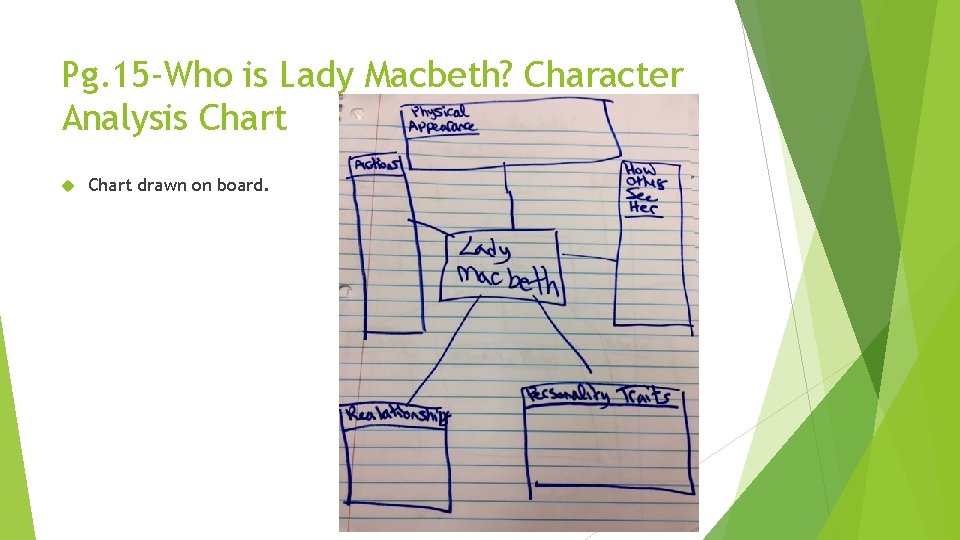
Pg. 15 -Who is Lady Macbeth? Character Analysis Chart drawn on board.
Pg. 16 -Lady Macbeth’s Diary Entry Pick one of the following important Lady Macbeth scenes and write a diary entry about that scene from her perspective. Must be at least two paragraphs long. Can be in modern language but must stay true to the personality and actions of the character. Scenes to choose from: 1. Lady Macbeth receives Macbeth’s letter and decides they’re going to kill Duncan so they can rule. (Act 1, Scene 5, pgs. 224 -225) 2. Lady Macbeth has to re-convince her husband to kill Duncan when he has doubts. (Act 1, Scene 7, pgs. 228 -230) 3. Lady Macbeth has to bring the daggers back to Duncan’s room and frame the guards because Macbeth refuses to do it. (Act 2, Scene 2, pgs. 235 -236) 4. Lady Macbeth finds Macbeth alone, unhappy because Banquo is still alive and threatens his rules. She tries to cheer him up, but he is plotting a murder. (Act 3, Scene 2, pgs. 250 -251)
Pg. 17 Macbeth Images Chart Handout given in class.
Pg. 18 -Top of the page Why do you think that Shakespeare uses such vivid (and dark) imagery in this play? What does this imagery say about themes and the tone of the play? Bottom of the Page: Choose one image from your chart to illustrate.
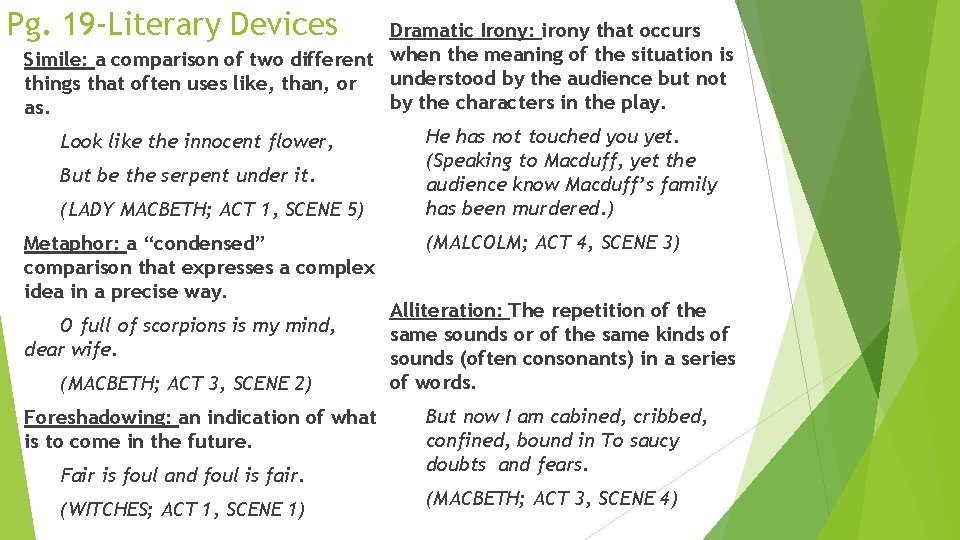
Pg. 19 -Literary Devices Dramatic Irony: irony that occurs Simile: a comparison of two different when the meaning of the situation is understood by the audience but not things that often uses like, than, or by the characters in the play. as. Look like the innocent flower, But be the serpent under it. (LADY MACBETH; ACT 1, SCENE 5) Metaphor: a “condensed” comparison that expresses a complex idea in a precise way. O full of scorpions is my mind, dear wife. (MACBETH; ACT 3, SCENE 2) Foreshadowing: an indication of what is to come in the future. Fair is foul and foul is fair. (WITCHES; ACT 1, SCENE 1) He has not touched you yet. (Speaking to Macduff, yet the audience know Macduff’s family has been murdered. ) (MALCOLM; ACT 4, SCENE 3) Alliteration: The repetition of the same sounds or of the same kinds of sounds (often consonants) in a series of words. But now I am cabined, cribbed, confined, bound in To saucy doubts and fears. (MACBETH; ACT 3, SCENE 4)
Pg. 20 -Figurative Language Hunt Go back into the play and find two examples of each literary device that we took notes for on page 19. No, you may not use the examples I gave you in the notes. 1. Simile 2. Metaphor 3. Foreshadowing 4. Dramatic Irony 5. Alliteration
Pg. 21 -Love in Macbeth Analyze Macbeth and Lady Macbeth’s relationship. Are they in love during the course of the play or are they just coconspirators? Use at least three examples from the play to support your opinion. Must be two paragraphs.
Pg. 22 -Musical Interlude Top of Page: Staple in Macbeth Inspired Music handout given in class. Bottom of Page: You find and copy down the Title, Artist and Lyrics of a song that reflects a theme in Macbeth. It should not literally mention Macbeth (like the songs above), but should be a modern interpretation of a theme we have discussed. Write a sentence to explain why you chose this song and why it connects to themes of the play. Some themes: Death, Murder, Love, Evil, Losing a Child, Greed, Ambition, The Supernatural, Seeing the Future, Going Insane, Hallucinating, etc. Example: Highway to Hell-A. C. D. C. This songs shows theme of the evil when Lady Macbeth is asking spirits to fill her with evil so she can commit murder. Or: I just can’t wait to be King-Disney’s The Lion King. This song shows themes of ambition and greed when Macbeth is determined to kill Duncan that he can be king. MUST BE SCHOOL APPROPRIATE!!!!!!
Pg. 23 -Theories of the Third Murderer-Who is it? Summarize these notes and copy into page 23 A Servant (possibly Seyton): Macbeth sent him because he wanted to check up on the men he hired. He asks the kinds of questions a servant would ask. Another argument for the servant is that Shakespeare needed another person on the stage to help get Banquo's body off the stage, so he just wrote in a third murderer on the spur of the moment. Macbeth Himself: Banquo's skill as a warrior nearly paralleled Macbeth's (they were both generals in Duncan's army), so two commoners would not really be a match for Banquo's skill as a fighter. It was imperative that Macbeth follow up and make sure the job was done right. Further, look at the words of the Banquo as he is dying, ". . . O Slave!. . . “ Perhaps Banquo has recognized Macbeth in the darkness and calls him a "slave" to his ambition and to the prophecies of the witches.
Pg. 23 Continued Continue to summarize these note and copy into page 23 Lady Macbeth: She too thought about Banquo and the threat he was to their rule. Later in the same scene, she wanted to know her role in the murder when she asked, "What's to be done? " Also, she too thought about the necessity of killing the pair (Banquo and Fleance) when she said, "But in them nature's copy's not eterne. " Another interpretation that holds Lady Macbeth is the third murderer has her going out to STOP the murder if she can. During the murder scene, Lady Macbeth might well be the one to extinguish the torch so that she can help the innocent Fleance escape. Lennox: Lennox is a political power-seeker, and we saw him on stage every time we saw Duncan on stage Once Macbeth is king, then Lennox is around him all the time, too. He could also be a spy in Macbeth’s castle for Malcolm. Although he does not want to blow his cover, he cannot let Banquo die. However, the light is extinguished, the two murderers set upon Banquo immediately, killing him before Lennox can stop them, so he does the best that he can by helping Fleance to escape.
Pg. 24 -Third Murderer Response Who do YOU think is the Third Murderer? Some arguments are better than others, but none of them are foolproof. The best answer to this question is YOUR answer. . . supported with YOUR reasons as to why the murderer is who you claim. Be sure to use lots of references to the play in order to support your reasons for your choice. I have given you only some basic arguments both for and against each possibility. Must be at least two paragraphs, must use quotes from play to support your opinion.
Pg. 25 -Modern Macbeth Quote and Response 1. Copy the following quote on the top half of the page: "It is a troubling thought that Macbeth, of all Shakespeare's characters, should seem the most 'modern, ' the only one you could transpose into contemporary battle dress or a sport shirt and slacks” -Mary Mc. Carthy On the bottom of the page, answer the following response questions: 1. Why is the idea that Macbeth is Shakespeare's most modern character “troubling” to Ms. Mc. Carthy? 2. What character traits make Macbeth seem modern? (At least 3). 3. Why would it be trickier to modernize some of Shakespeare’s other characters (like Romeo and Juliet)?
Pg. 26 -Write a Modern Macbeth Write your own modern version of Macbeth, set in the twenty-first century. At least three paragraphs. All characters must dress, talk and act like they are people you might see today. It cannot be a fictional world and you cannot change the basic plot. Examples: Macbeth is an athlete/actor/musician who is “killing” the competition-maybe for real, maybe by getting them fired or arrested, his wife is a mean manager and the witches are TV fortune-tellers. Macbeth is a high school student who wants to be class president or homecoming king, so he is giving the other competitors acne and the flu, Lady Macbeth is his ambitious girlfriend and the witches are wise old seniors who have seen it all.
Pg. 27 -Media Battle-Play or Movie? Consider which format you enjoyed the story of Macbeth in more, the movie or the play. Don’t just pick the movie because it’s easier, really think about which version of the story appeals to you more. Consider what elements from the play are taken out of the movie and what elements are added. Think about the visuals the movie uses versus what the play makes you imagine. Consider the sets, the costumes, and the music (soundtrack in movie, singing in play). Write at least two paragraph explain which media you preferred and use examples from the play/movie to explain why. Total of 10 sentences and three example from the play/movie required.
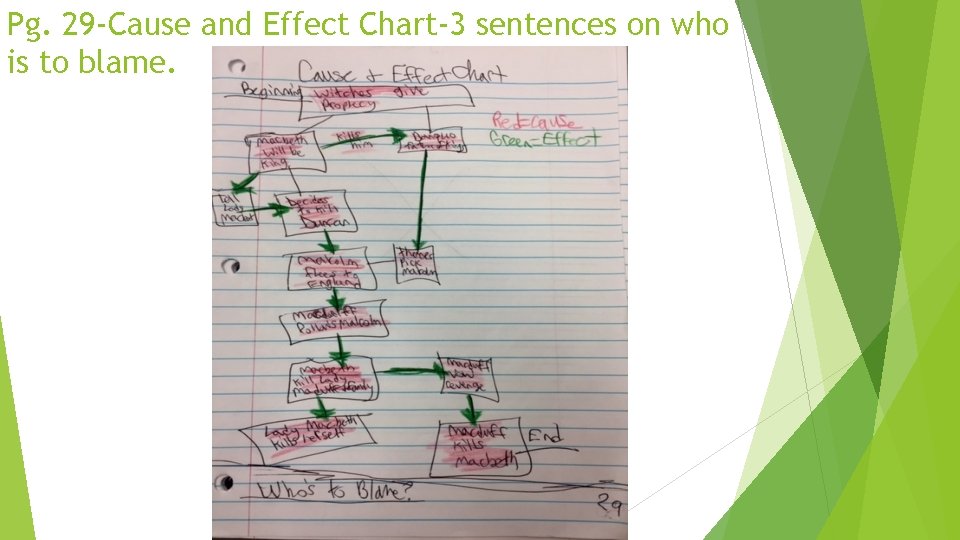
Pg. 29 -Cause and Effect Chart-3 sentences on who is to blame.
- Slides: 37