
Macbeth Act II Scenes IIV Act Annotations Guide
Macbeth Act II, Scenes I-IV
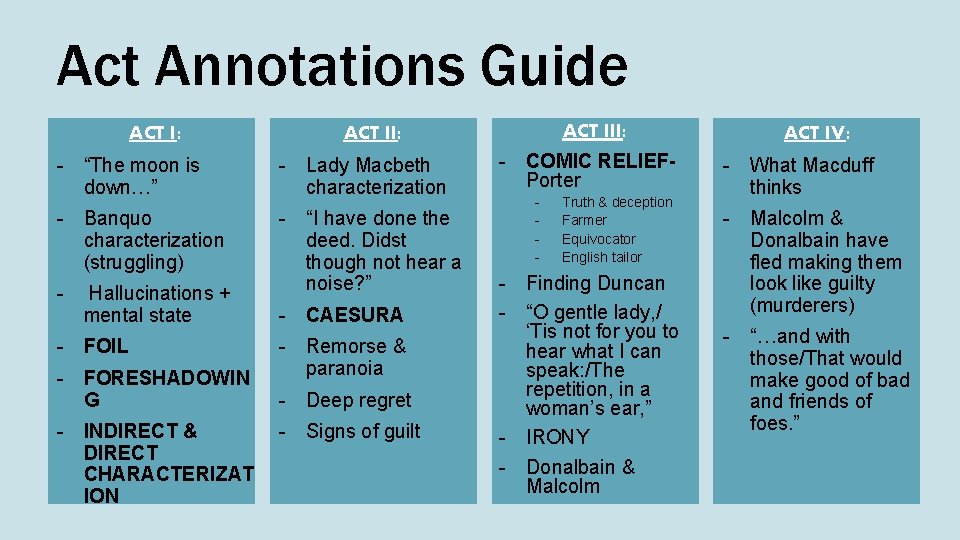
Act Annotations Guide ACT I: - “The moon is down…” - Lady Macbeth characterization - Banquo characterization (struggling) - “I have done the deed. Didst though not hear a noise? ” - Hallucinations + mental state - FOIL - FORESHADOWIN G - INDIRECT & DIRECT CHARACTERIZAT ION ACT III: ACT II: - CAESURA - Remorse & paranoia - Deep regret - Signs of guilt - COMIC RELIEFPorter - Truth & deception Farmer Equivocator English tailor - Finding Duncan - “O gentle lady, / ‘Tis not for you to hear what I can speak: /The repetition, in a woman’s ear, ” - IRONY - Donalbain & Malcolm ACT IV: - What Macduff thinks - Malcolm & Donalbain have fled making them look like guilty (murderers) - “…and with those/That would make good of bad and friends of foes. ”
1. What is the significance of the dagger in scene one? 2. Why does Lady Macbeth faint? 3. Why does Shakespeare begin scene one with Banquo and Fleance? Decide what purpose this scene serves dramatically. 4. Lady Macbeth says, “The attempt and not the deed” itself will ruin her and Macbeth. What do you think would happen if the attempt to kill Duncan or the cover-up failed? 5. What goes wrong with Lady Macbeth’s plan, and how does she fix the situation? What does this tell us about her character? What does this tell us about Macbeth’s character? 6. The killing of Duncan does not occur onstage. Why do you think Shakespeare chooses not to show his death? 7. Do you think Macbeth would have gone ahead with the murder of Duncan if his wife had not encouraged him to do so? Explain your answer. 8. Do you think Macduff believe that Malcolm and Donalbain were responsible for the death of their father? Discuss using the text to justify your answer. Reading Comprehension Questions:
Literary Elements Questions: 1. Give some reasons why COMIC RELIEF such as the Porter scene can be found in a tragedy. 3. Double entendres can also be used for darker purposes. What two interpretations can you give to the line, “Macbeth does murder sleep” (act II, scene ii, line 45)? 2. A DOUBLE ENTENDRE is a statement that has two different meanings, one of which is often sexual. Find an example of double entendre in the Porter’s speech. 4. Good drama has CONFLICT: struggle between opposing forces. EXTERNAL CONFLICT refers to a struggle between individuals and outside forces or other individuals. INTERNAL CONFLICT refers to a mental or emotional struggle within the individual. Find examples of both
- Slides: 4