
Macbeth Act 1 ANALYSIS AND EVALUATION Act 1
“Macbeth” Act 1 ANALYSIS AND EVALUATION

Act 1 Scene 1
Summary Thunder and lightning crash above a Scottish moor. Three haggard old women, the witches, appear out of the storm. In eerie, chanting tones, they make plans to meet again upon the heath, after the battle, to confront Macbeth. As quickly as they arrive, they disappear.
Things to focus on The mood and atmosphere created in the scene The impression we are given about the witches The language used by the witches and why it is important
Quote from the text 1 2 Techniques used Detailed analysis and evaluation
-“When the battle’s lost and won” (3) -“Fair is foul and foul is fair” (11) A dark and sinister mood is created from the very beginning of the play by the presence of the witches and by the bleak, miserable and harsh weather. The wasteland on which they appear is depicted as a world of darkness, unhealthiness and foulness isolated and separate from the world of men. The stage directions indicate that the play begins with a storm, and malignant supernatural forces immediately appear in the form of witches. In Shakespeare’s time period, witches were regarded as being frightening, cruel and malevolent creatures who were abnormal and upset the natural order.
The way that they speak emphasises their unnaturalness. Their rhyming incantations stand out eerily in contrast to the blank verse spoken by the other characters in the play and creates a sense of magic by imitating the casting of a spell. They speak in riddles, paradoxes and contradictions which helps to establish a sense mystery and confusion and adds to the sense that nothing is quite what it seems. This, in turn, establishes the witches as being characters that cannot be trusted. They are depicted as being characters who can not only predict the future but intend to interfere in the lives of men and women in a cruel and malicious way. Their mention of Macbeth makes the audience wonder about the nature of their interest in him and how he fits into their evil plans. Techniques Setting; Stage directions; Characterisation; Dialogue

Act 1 Scene 2
Summary At a military camp near his palace at Forres, King Duncan of Scotland asks a wounded captain for news about the Scots’ battle with the Irish invaders, who are led by the rebel Macdonald. The captain, who was wounded helping Duncan’s son Malcolm escape capture by the Irish, replies that the Scottish generals Macbeth and Banquo fought with great courage and violence. The captain then describes for Duncan how Macbeth slew the traitorous Macdonald. As the captain is carried off to have his wounds attended to, the thane of Ross, a Scottish nobleman, enters and tells the king that the traitorous thane of Cawdor has been defeated and the army of Norway repelled. Duncan decrees that the thane of Cawdor be put to death and that Macbeth, the hero of the victorious army, be given Cawdor’s title. Ross leaves to deliver the news to Macbeth.
Things to focus on The impression that we gain of Macbeth from what other characters say about him
Quote from the text 1 2 Techniques used Detailed analysis and evaluation
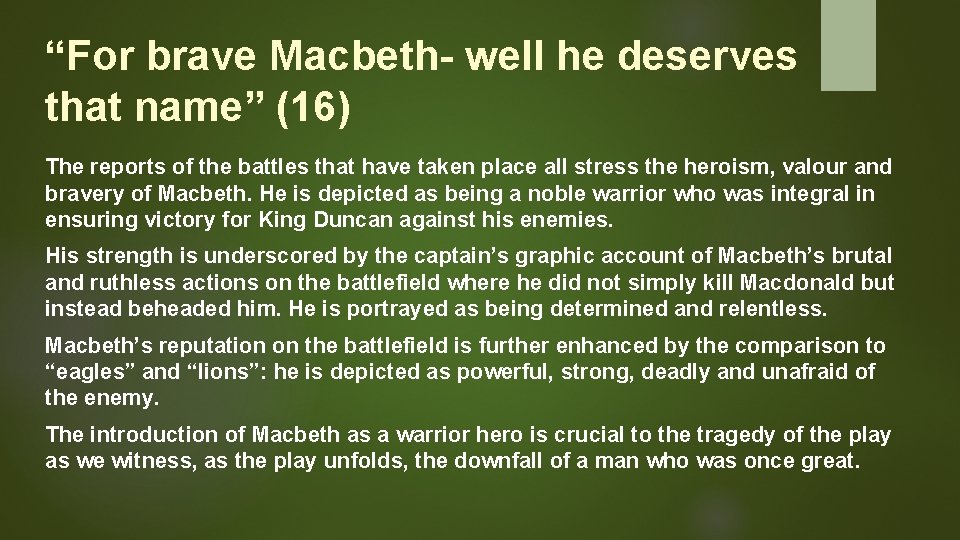
“For brave Macbeth- well he deserves that name” (16) The reports of the battles that have taken place all stress the heroism, valour and bravery of Macbeth. He is depicted as being a noble warrior who was integral in ensuring victory for King Duncan against his enemies. His strength is underscored by the captain’s graphic account of Macbeth’s brutal and ruthless actions on the battlefield where he did not simply kill Macdonald but instead beheaded him. He is portrayed as being determined and relentless. Macbeth’s reputation on the battlefield is further enhanced by the comparison to “eagles” and “lions”: he is depicted as powerful, strong, deadly and unafraid of the enemy. The introduction of Macbeth as a warrior hero is crucial to the tragedy of the play as we witness, as the play unfolds, the downfall of a man who was once great.

Techniques Dialogue Characterisation
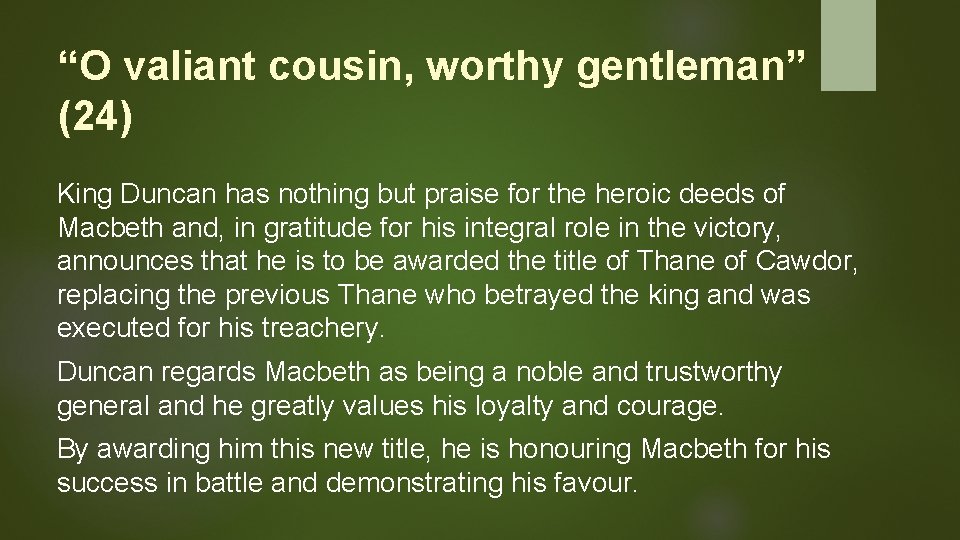
“O valiant cousin, worthy gentleman” (24) King Duncan has nothing but praise for the heroic deeds of Macbeth and, in gratitude for his integral role in the victory, announces that he is to be awarded the title of Thane of Cawdor, replacing the previous Thane who betrayed the king and was executed for his treachery. Duncan regards Macbeth as being a noble and trustworthy general and he greatly values his loyalty and courage. By awarding him this new title, he is honouring Macbeth for his success in battle and demonstrating his favour.

Techniques Dialogue Characterisation

Act 1 Scene 3
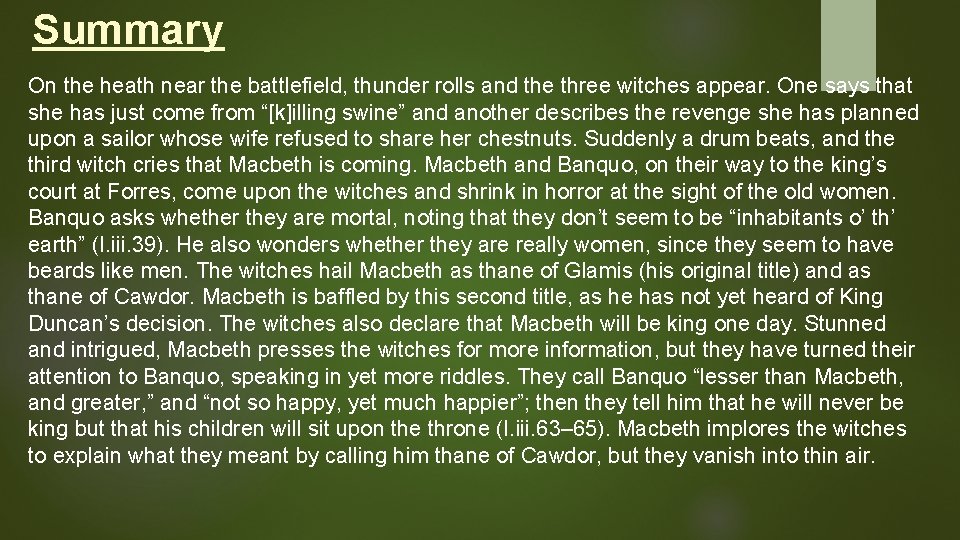
Summary On the heath near the battlefield, thunder rolls and the three witches appear. One says that she has just come from “[k]illing swine” and another describes the revenge she has planned upon a sailor whose wife refused to share her chestnuts. Suddenly a drum beats, and the third witch cries that Macbeth is coming. Macbeth and Banquo, on their way to the king’s court at Forres, come upon the witches and shrink in horror at the sight of the old women. Banquo asks whether they are mortal, noting that they don’t seem to be “inhabitants o’ th’ earth” (I. iii. 39). He also wonders whether they are really women, since they seem to have beards like men. The witches hail Macbeth as thane of Glamis (his original title) and as thane of Cawdor. Macbeth is baffled by this second title, as he has not yet heard of King Duncan’s decision. The witches also declare that Macbeth will be king one day. Stunned and intrigued, Macbeth presses the witches for more information, but they have turned their attention to Banquo, speaking in yet more riddles. They call Banquo “lesser than Macbeth, and greater, ” and “not so happy, yet much happier”; then they tell him that he will never be king but that his children will sit upon the throne (I. iii. 63– 65). Macbeth implores the witches to explain what they meant by calling him thane of Cawdor, but they vanish into thin air.
…continued In disbelief, Macbeth and Banquo discuss the strange encounter. Macbeth fixates on the details of the prophecy. “Your children shall be kings, ” he says to his friend, to which Banquo responds: “You shall be king” (I. iii. 84). Their conversation is interrupted by the arrival of Ross and Angus, who have come to convey them to the king. Ross tells Macbeth that the king has made him thane of Cawdor, as the former thane is to be executed for treason. Macbeth, amazed that the witches’ prophecy has come true, asks Banquo if he hopes his children will be kings. Banquo replies that devils often tell half-truths in order to “win us to our harm” (I. iii. 121). Macbeth ignores his companions and speaks to himself, ruminating upon the possibility that he might one day be king. He wonders whether the reign will simply fall to him or whether he will have to perform a dark deed in order to gain the crown. At last he shakes himself from his reverie and the group departs for Forres. As they leave, Macbeth whispers to Banquo that, at a later time, he would like to speak to him privately about what has transpired.
Things to focus on What we learn about the witches and their true nature. Their intentions with Macbeth. The witches’ prophecies How Macbeth reacts to the prophecies How Banquo reacts to the prophecies
Quote from the text 1 2 Techniques used Detailed analysis and evaluation
“I’ll do, I’ll do and I’ll do” (11) The First Witch is angry with a sailor’s wife who would not give her some chestnuts. As a result, she places a curse on the sailor causing him much suffering and torment while at sea, making his life a misery. The witches’ evil and vindictive actions towards the sailor, punishing him for the behaviour of his wife, gives us a clear indication of their malevolent and malicious nature and the dreadful things that they are capable of. It also suggests that their interest in Macbeth will be harmful to him and that they intend to bring him misery and torment, too.

Techniques Dialogue Characterisation Foreshadowing
“So foul and fair a day I have not seen” (38) Macbeth’s first line in the play (when he refers to the brutal battle that he has just won) is full of significance as it echoes the riddles and rhyming speech of the witches in Act 1 Scene 1 and suggests that there is a supernatural connection that has been established. The audience is left to consider the nature of this connection: are the witches beginning to take control of Macbeth’s speech and actions? To what extent is Macbeth still in control of his own fate and destiny? Techniques Dialogue characterisation
“All hail, Macbeth! Hail to thee!” (49) The witches greet Macbeth with his previous title (Thane of Glamis), his newly awarded title (Thane of Cawdor) and his future title (King of Scotland) and then vanish into thin air. The witches offer Macbeth prophecies about his future and suggest to him that he will soon gain a huge amount of power and prestige by ascending to the throne. The supernatural nature of the witches is further demonstrated as they seem to be omniscient: they have knowledge of all events that have taken place in the past and will occur in the future.
This clearly demonstrates the dishonest and sinister nature of the witches as they use flattery and promises of power to manipulate Macbeth. They skilfully exploit Macbeth's ambitious nature to encourage him to consider betraying his king in order to take his throne. This emphasises the witches' power as they somehow know exactly what to use against Macbeth which suggests that they have long observed him. The witches clearly sense the darkness and ambition in Macbeth's character which he has managed to suppress until now and this encourages them to use him in their mischievous, manipulative games as they enjoy deceiving people into destroying their own lives and find amusement in this. This skilful manipulation of Macbeth demonstrates their experience in ruining people's lives as they are able, through their prophecies, to make Macbeth consider betraying his king which leads to his ultimate demise.

Techniques Dialogue Characterisation Key scene
"Stay you imperfect speakers! Tell me more" (71) Macbeth is hugely captivated and intrigued by the three witches’ prophecies and commands them to tell him more about his own future. Macbeth’s ambitious nature is demonstrated as he is incredibly hungry for more knowledge about his glorious and prosperous future, possibly so he can act upon it. The witches exploit his ambitious nature to manipulate him with promises of kingship and power to pique his interest. His ambition and curiosity drive him forward as he finds the prophecies too valuable to resist. Unlike Banquo, Macbeth falls for their manipulation due to his own drive to become king which ultimately leads to his downfall. It also suggests Macbeth had already possessed a power-hungry and ambitious nature and that the witches merely awakened this within him, leading him down the path of tyranny, destruction and death.

Techniques Dialogue Characterisation Key scene
“Say, from whence you owe this strange intelligence? ” (76 -77) Upon hearing the prophecies, Macbeth appears to be startled and afraid. He seems sceptical and confused. However, he is greatly intrigued by them and commands them to speak more. He wants to know the reasons why the witches have addressed him as thane of Cawdor when, as far as she knows, the thane of Cawdor is still alive. He demands to know where the witches learned this information and how they can predict such a glorious future for him. His immediate reaction emphasises that he has a great desire for power and prestige.
This effectively portrays the witches' clever tactic of telling Macbeth prophecies about his future in order to entice him and gain his trust. Clearly, Macbeth becomes incredibly curious about their claims of his promising future as he is too intrigued by their words to dismiss or ignore them. This demonstrates the witches skilful manipulation of Macbeth through their words as they capture his attention and curiosity from their very first meeting. Although, initially, the witches startle and frighten Macbeth they expertly draw him in with their prophecies and his interest in their knowledge makes him command them to continue to speak. The witches illustrate their detailed, impossible awareness of Macbeth's life and future which suggests that the witches have supernatural sources of intelligence that Macbeth does not know of but wishes to.

Techniques Dialogue Characterisation Key scene
“This supernatural soliciting cannot be ill, cannot be good” (129 -130) When Ross and Angus appear to inform Macbeth that Duncan has awarded him the title of Thane of Cawdor, he begins to believe that there may be some truth behind the witches’ prophecies. It is clear that the witches have managed to awaken the ambition within Macbeth and he begins to imagine the prospect of becoming king. Shakespeare uses a number of asides to allow the audience an insight into Macbeth’s frame of mind. He recognises that there is both goodness and evil behind the prophecies. He believes that the prophecy was good as he was promised a promotion and this turned out to be true. However, he also thinks that there is some evil behind it as he is now thinking about killing the king, an idea that fills him with horror and makes him unable to recognise himself. He wonders whether fate wants him to become king and, if so, he won’t have to perform any dark deed to gain the throne.
However, Macbeth then realises that the fulfilment of the prophecies may require conspiracy and murder on his part and he clearly allows himself to consider taking such actions in order to achieve his goals. However, at this point in the play, he is by no means resolved to do so. He feels horrified at the prospect of betraying his king and would much rather take power without having to actually do anything as dramatic as murder. His reaction to the prophecies shows that he is filled with confusion and inner-conflict. He talks himself into a daze or stupor as his mind becomes filled with fantasies and speculations and he tries to work out the situation for himself. His speech is full of questioning, doubting and weighing up as he attempts to make sense of the information he has heard about his future.

Techniques Characterisation Aside
“the instruments of darkness tell us truths; win us with honest trifles, to betray us in deepest consequence” (123 -125) There is a contrast between the reactions of Banquo and Macbeth to the witches’ prophecies. Unlike Macbeth, Banquo is much more sceptical, cautious and wary of the witches and he feels that they might be dangerous. He is aware of the possibility that the prophecies may be the work of supernatural dark and evil forces. He warns Macbeth that the agents of evil, such as witches, often tell half-truths in order to harm others and lead them to their destruction. He explains that they earn the trust of their victims by telling them some truth but then betray them when it damages them the most. He expresses concern about men being tempted into sin by the “instruments of darkness”.
Interestingly, as the play unfolds the audience begins to see that Banquo was completely correct to be cautious of the witches as they manipulate Macbeth in this exact manner, thus destroying him. Techniques Characterisation Dialogue Foreshadowing

Techniques Characterisation Dialogue

Act 1 Scene 4
Summary At the king’s palace, Duncan hears reports of Cawdor’s execution from his son Malcolm, who says that Cawdor died nobly, confessing freely and repenting of his crimes. Macbeth and Banquo enter with Ross and Angus. Duncan thanks the two generals profusely for their heroism in the battle, and they profess their loyalty and gratitude toward Duncan announces his intention to name Malcolm the heir to his throne. Macbeth declares his joy but notes to himself that Malcolm now stands between him and the crown. Plans are made for Duncan to dine at Macbeth’s castle that evening, and Macbeth goes on ahead of the royal party to inform his wife of the king’s impending arrival.
Things to focus on Duncan’s opinion of Macbeth (and why it is ironic) How Macbeth is duplicitous when speaking to Duncan
Quote from the text 1 2 Techniques used Detailed analysis and evaluation
“More is thy due than more than all can pay” (21) Duncan thanks Macbeth profusely for his heroism and valour in battle and for the role that he played in ensuring victory over the invading armies that threatened Scotland. Duncan states that he feels guilty for not having thanked Macbeth enough and that there is no reward that he can give him that can adequately express his gratitude for his loyalty and bravery. He states that he owes him more than he can ever repay for his service and devotion to king and country. Duncan trusts Macbeth completely and believes that he is a man without equal yet, ironically, Macbeth has began to consider the possibility of betraying him and taking his throne (due to the witches’ prophecy).
Techniques Dramatic irony Characterisation Dialogue
“The service and the loyalty I owe in doing it pays itself” (23 -24) Macbeth humbly professes his loyalty to Duncan and his gratitude for being awarded the thane of Cawdor. He states that the opportunity to serve Duncan is its own reward and that he is motivated to serve the king not for titles but of love, loyalty and devotion to him. Macbeth tells Duncan that his duty to the king is as natural as the duty of children to their father, or servants to their master. He states that by serving Duncan and protecting him from his enemies he is only doing his duty as a subject.

Techniques Characterisation Dialogue
“Stars, hide your fires, let not light see my black and deep desires” (5051) When Duncan announces that Malcolm, his son, is to be heir to the throne, Macbeth publicly declares his joy but privately thinks to himself that Malcolm now stands between him and the crown. He realises that he will either have to give up on his quest to become king or take steps to remove the obstacle that has been placed in his path (Duncan and Malcolm). He asks the stars to hide their light so that no-one is able to sense thoughts of murder that are occupying his mind. Macbeth now seems to accept that in order to become king he will have to commit treacherous, violent and murderous acts that fill him with dread and horror.

Techniques Characterisation Aside
- Slides: 47