
MACAW A Media Access Protocol for Wireless LANs
- Slides: 21
MACAW: A Media Access Protocol for Wireless LANs Jennifer Ogunlowo Sarah El-Helw 1
Macaw topology http: //en. wikipedia. org/wiki/Macaw 2
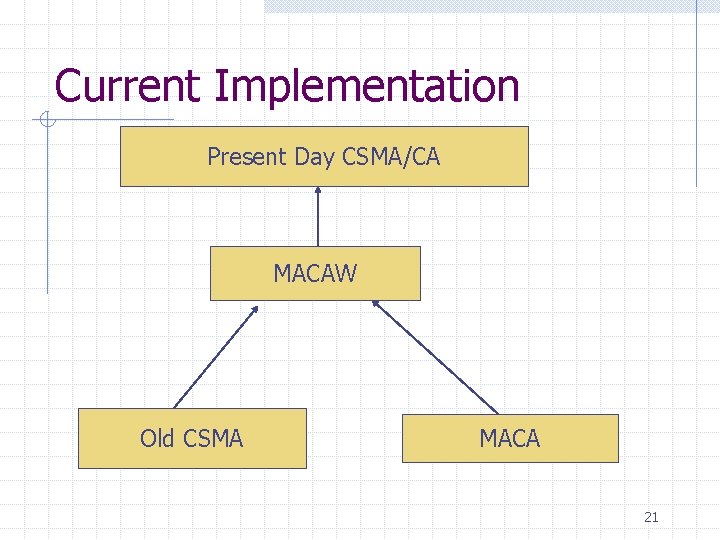
Introduction Media access protocols n n n CSMA/CA MACAW Current CSMA/CA inspired by MACAW is inspired by MACAW caused the development of the new present day CSMA/CA 3
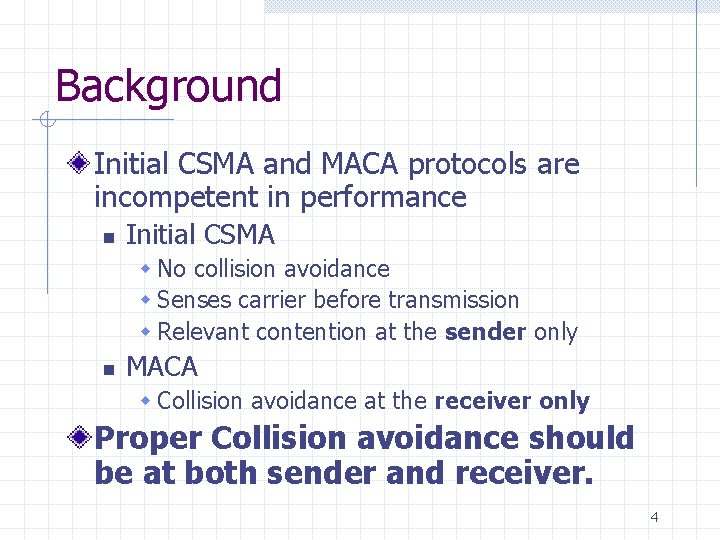
Background Initial CSMA and MACA protocols are incompetent in performance n Initial CSMA w No collision avoidance w Senses carrier before transmission w Relevant contention at the sender only n MACA w Collision avoidance at the receiver only Proper Collision avoidance should be at both sender and receiver. 4
Problem and Motivation To Develop a wireless infrastructure that supports hosts: n n n With fairness regardless to location Avoids collisions Media Access Fairness At the time MACAW was being produced, MACA and CSMA weren’t sufficient to meet these goals. 5
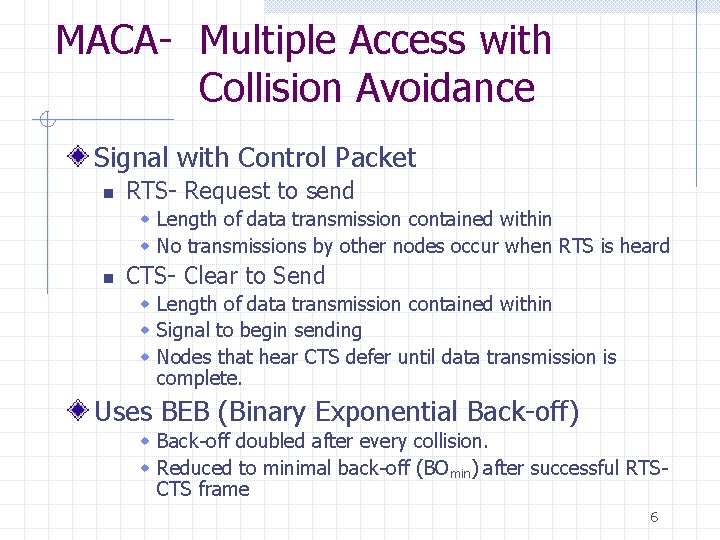
MACA- Multiple Access with Collision Avoidance Signal with Control Packet n RTS- Request to send w Length of data transmission contained within w No transmissions by other nodes occur when RTS is heard n CTS- Clear to Send w Length of data transmission contained within w Signal to begin sending w Nodes that hear CTS defer until data transmission is complete. Uses BEB (Binary Exponential Back-off) w Back-off doubled after every collision. w Reduced to minimal back-off (BOmin) after successful RTSCTS frame 6
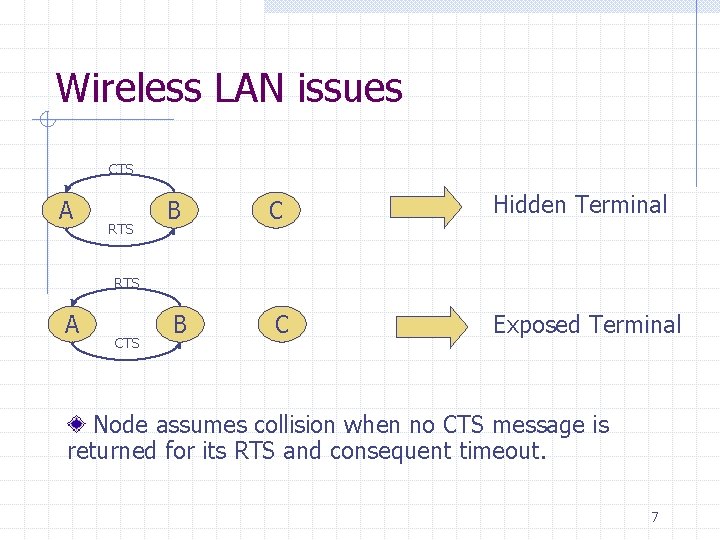
Wireless LAN issues CTS A RTS B C Hidden Terminal B C Exposed Terminal RTS A CTS Node assumes collision when no CTS message is returned for its RTS and consequent timeout. 7
Four Issues in Media Access Protocols that motivated MACAW: 1. In MACA relevant contention is at the receiver not at the sender 2. Congestion is location dependent in wireless 3. Media Access should be fair 4. Media access protocol should provide information about contention periods 8
MACAW- Multiple Access with Collision Avoidance for Wireless MACAW uses different back-off algorithm, BEB copy and MILD (Multiplicative Increase, Linear Decrease) MACAW uses RTS-CTS-DS-DATA-ACK frame sequence. Problem n With MACA, very likely that the least-backed-off station will ‘win’ the bandwidth during contention. n Problem is no sharing of collision avoidance with nodes 9
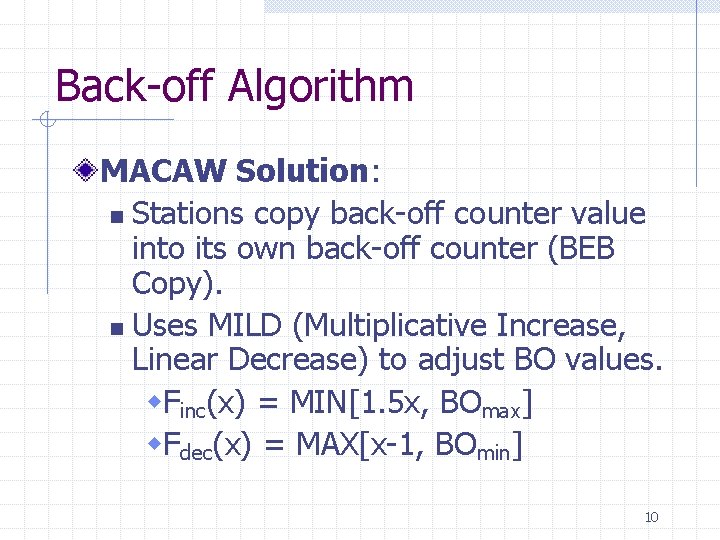
Back-off Algorithm MACAW Solution: n Stations copy back-off counter value into its own back-off counter (BEB Copy). n Uses MILD (Multiplicative Increase, Linear Decrease) to adjust BO values. w. Finc(x) = MIN[1. 5 x, BOmax] w. Fdec(x) = MAX[x-1, BOmin] 10
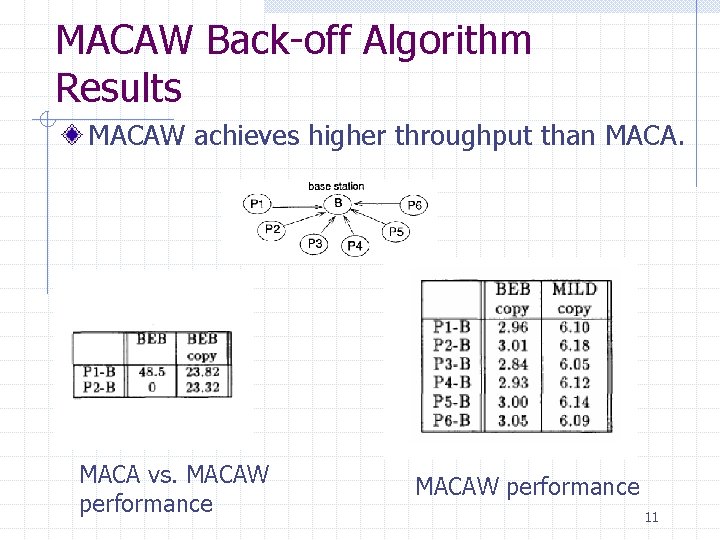
MACAW Back-off Algorithm Results MACAW achieves higher throughput than MACA vs. MACAW performance 11
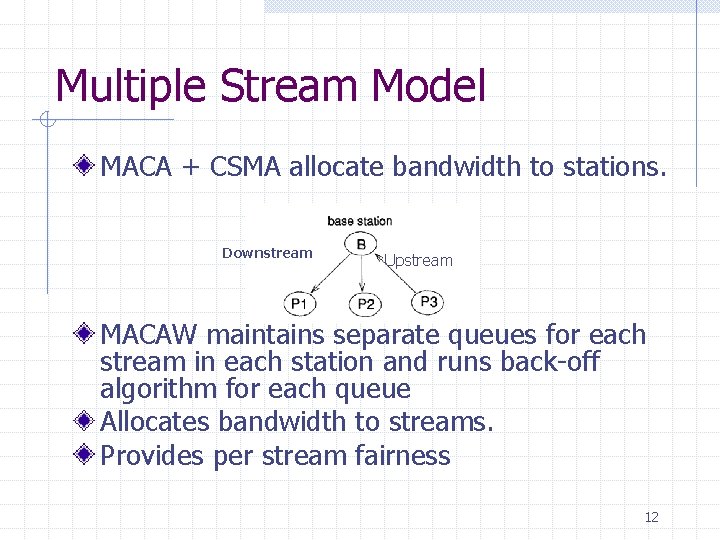
Multiple Stream Model MACA + CSMA allocate bandwidth to stations. Downstream Upstream MACAW maintains separate queues for each stream in each station and runs back-off algorithm for each queue Allocates bandwidth to streams. Provides per stream fairness 12
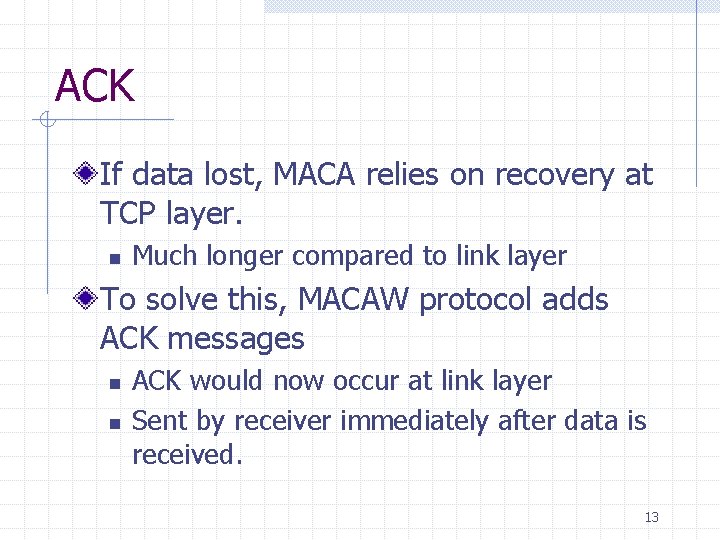
ACK If data lost, MACA relies on recovery at TCP layer. n Much longer compared to link layer To solve this, MACAW protocol adds ACK messages n n ACK would now occur at link layer Sent by receiver immediately after data is received. 13
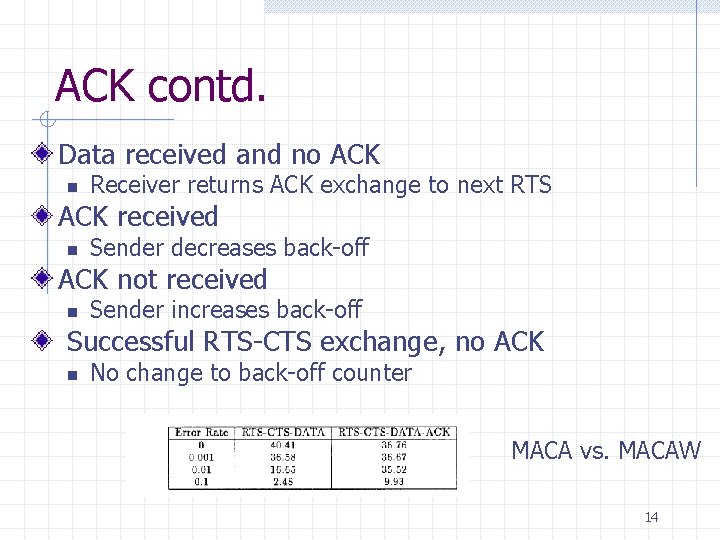
ACK contd. Data received and no ACK n Receiver returns ACK exchange to next RTS ACK received n Sender decreases back-off ACK not received n Sender increases back-off Successful RTS-CTS exchange, no ACK n No change to back-off counter MACA vs. MACAW 14
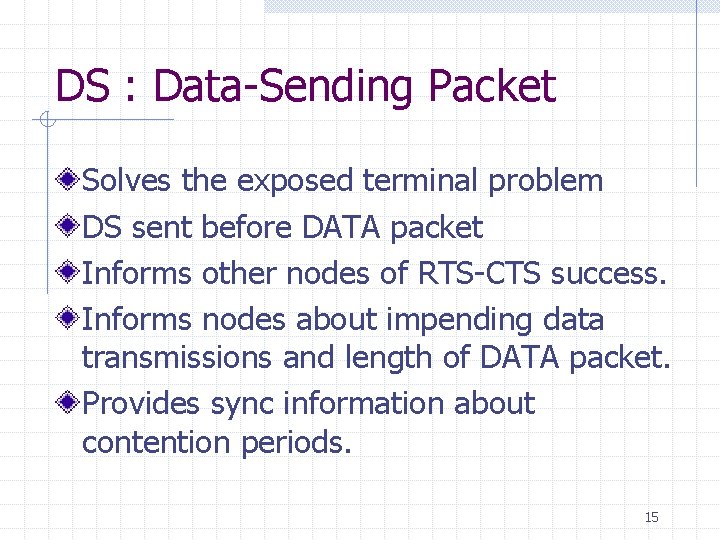
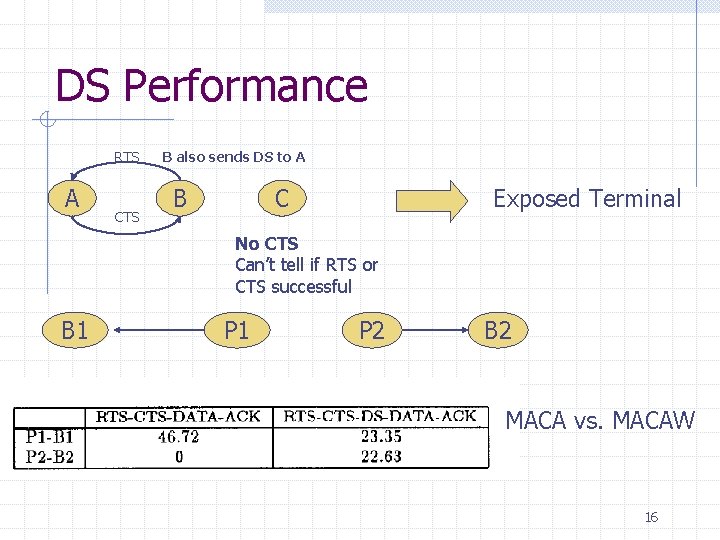
DS : Data-Sending Packet Solves the exposed terminal problem DS sent before DATA packet Informs other nodes of RTS-CTS success. Informs nodes about impending data transmissions and length of DATA packet. Provides sync information about contention periods. 15
DS Performance RTS A CTS B also sends DS to A B C Exposed Terminal No CTS Can’t tell if RTS or CTS successful B 1 P 2 B 2 MACA vs. MACAW 16
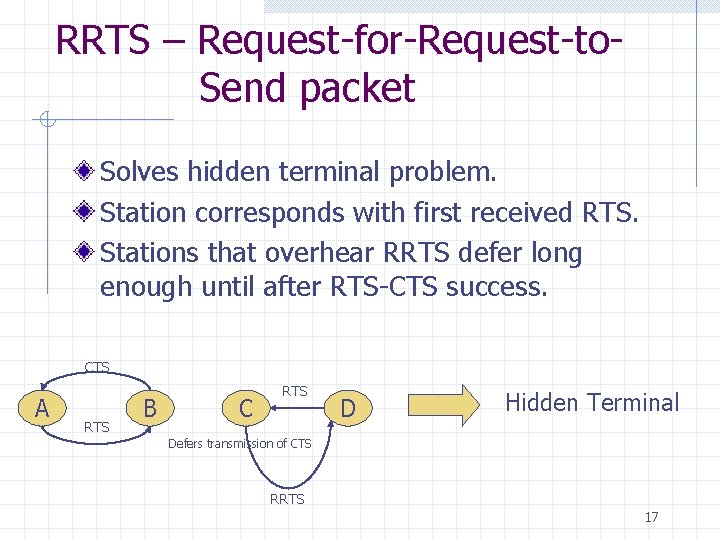
RRTS – Request-for-Request-to. Send packet Solves hidden terminal problem. Station corresponds with first received RTS. Stations that overhear RRTS defer long enough until after RTS-CTS success. CTS A RTS B C RTS D Hidden Terminal Defers transmission of CTS RRTS 17
Back-off Algorithm Revisited Three cases where BEB copy might have problems: n Presence of noise source to sender or receiver. n Leakages of high BO between two adjacent cells. n Unresponsive offline pad. Per-destination back-off algorithm suggested as solution. n Multiple Stream Model n Stations communicating with same receiving station use the same BO value. n BO value of both ends inserted into a packet header. 18
Performance Evaluation Model During low loads, MACAW performs worse than MACA. During high congestion levels, MACAW performs better with 37% overall throughput and more fair. 19
Critique Definition of fairness in wireless networks No justification for noise levels presented. Complex Implementation of MACAW BEB definitions not included with MACA. 20
Current Implementation Present Day CSMA/CA MACAW Old CSMA MACA 21