
Mac Addressing Ethernet and Interconnections 5 Data Link
- Slides: 33
Mac Addressing, Ethernet, and Interconnections 5: Data. Link Layer 1
MAC Addresses and ARP r 32 -bit IP address: m network-layer address m used to get datagram to destination IP subnet r MAC (or LAN or physical or Ethernet) address: m used to get datagram from one interface to another physically-connected interface (same network) m 48 bit MAC address (for most LANs) burned in the adapter ROM 5: Data. Link Layer 2
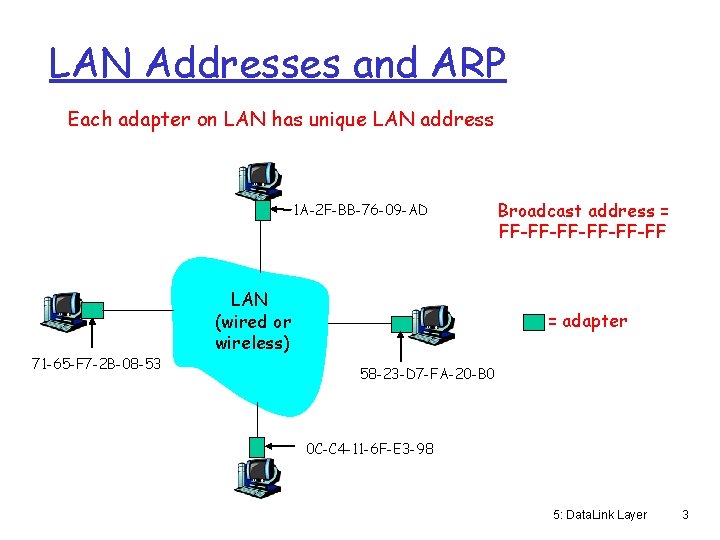
LAN Addresses and ARP Each adapter on LAN has unique LAN address 1 A-2 F-BB-76 -09 -AD 71 -65 -F 7 -2 B-08 -53 LAN (wired or wireless) Broadcast address = FF-FF-FF-FF = adapter 58 -23 -D 7 -FA-20 -B 0 0 C-C 4 -11 -6 F-E 3 -98 5: Data. Link Layer 3
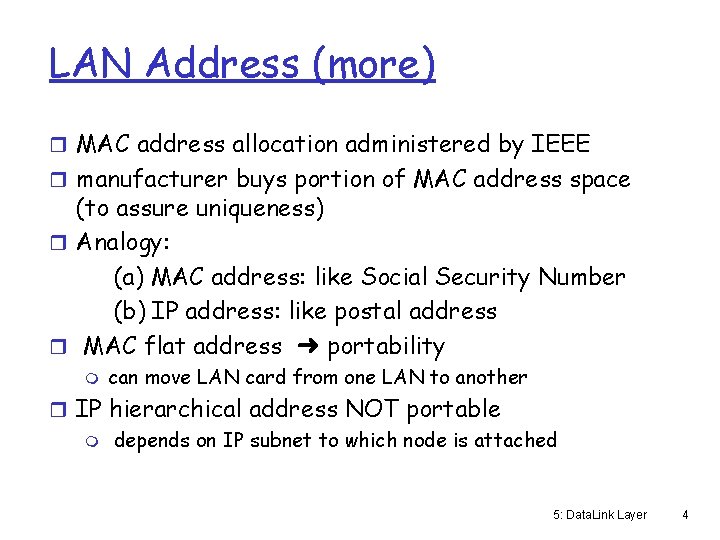
LAN Address (more) r MAC address allocation administered by IEEE r manufacturer buys portion of MAC address space (to assure uniqueness) r Analogy: (a) MAC address: like Social Security Number (b) IP address: like postal address r MAC flat address ➜ portability m can move LAN card from one LAN to another r IP hierarchical address NOT portable m depends on IP subnet to which node is attached 5: Data. Link Layer 4
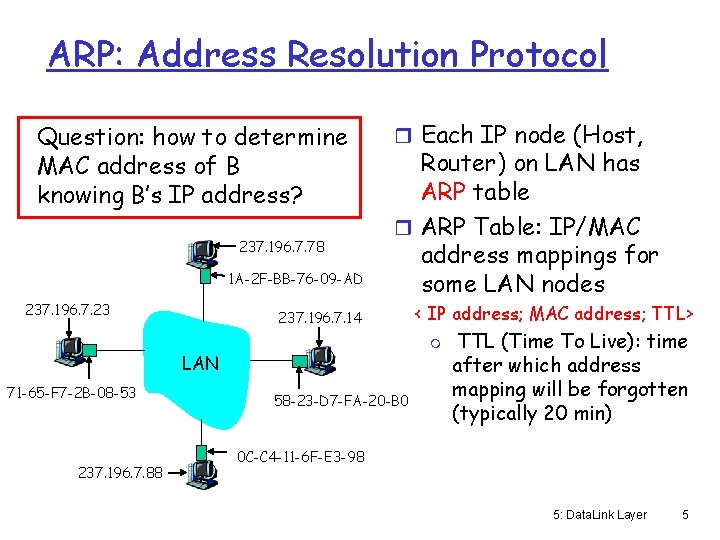
ARP: Address Resolution Protocol Question: how to determine MAC address of B knowing B’s IP address? 237. 196. 7. 78 1 A-2 F-BB-76 -09 -AD 237. 196. 7. 23 r Each IP node (Host, Router) on LAN has ARP table r ARP Table: IP/MAC address mappings for some LAN nodes 237. 196. 7. 14 m LAN 71 -65 -F 7 -2 B-08 -53 237. 196. 7. 88 < IP address; MAC address; TTL> 58 -23 -D 7 -FA-20 -B 0 TTL (Time To Live): time after which address mapping will be forgotten (typically 20 min) 0 C-C 4 -11 -6 F-E 3 -98 5: Data. Link Layer 5
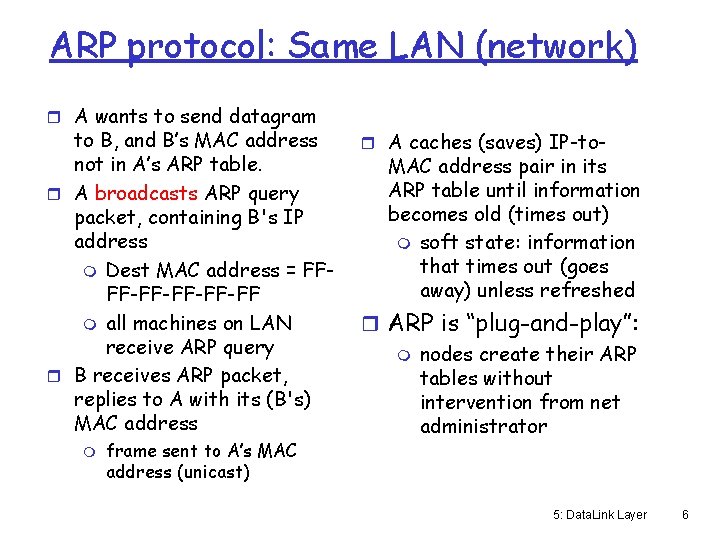
ARP protocol: Same LAN (network) r A wants to send datagram to B, and B’s MAC address not in A’s ARP table. r A broadcasts ARP query packet, containing B's IP address m Dest MAC address = FFFF-FF-FF m all machines on LAN receive ARP query r B receives ARP packet, replies to A with its (B's) MAC address m frame sent to A’s MAC address (unicast) r A caches (saves) IP-to- MAC address pair in its ARP table until information becomes old (times out) m soft state: information that times out (goes away) unless refreshed r ARP is “plug-and-play”: m nodes create their ARP tables without intervention from net administrator 5: Data. Link Layer 6
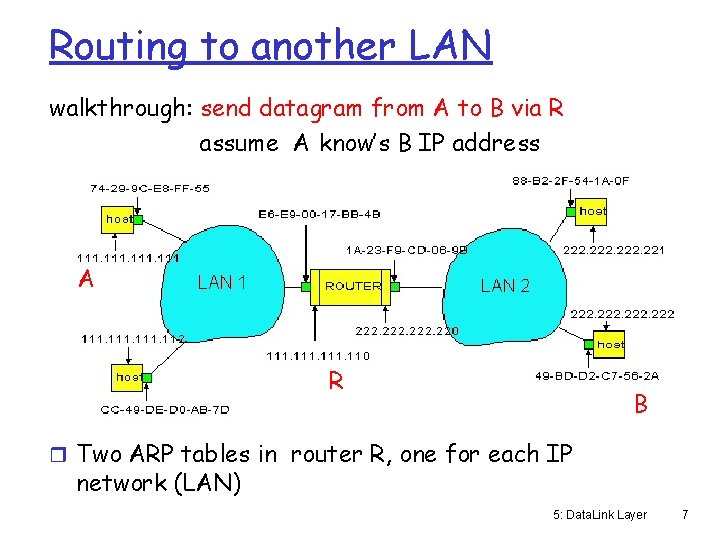
Routing to another LAN walkthrough: send datagram from A to B via R assume A know’s B IP address A R B r Two ARP tables in router R, one for each IP network (LAN) 5: Data. Link Layer 7
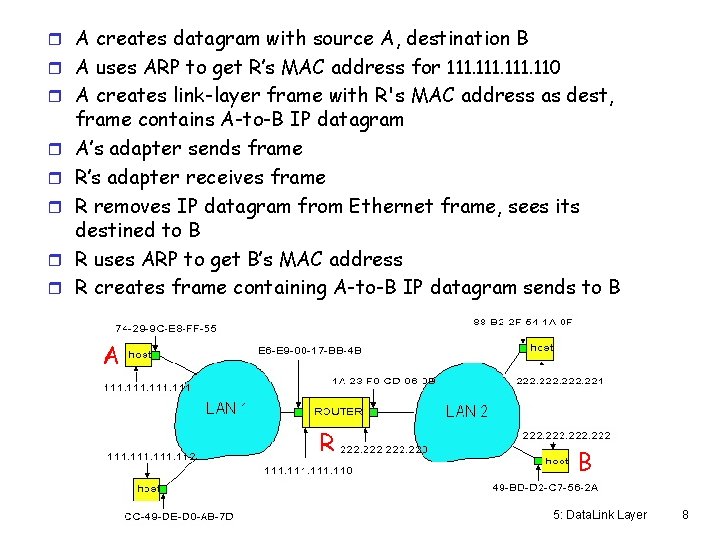
r A creates datagram with source A, destination B r A uses ARP to get R’s MAC address for 111. 110 r A creates link-layer frame with R's MAC address as dest, r r r frame contains A-to-B IP datagram A’s adapter sends frame R’s adapter receives frame R removes IP datagram from Ethernet frame, sees its destined to B R uses ARP to get B’s MAC address R creates frame containing A-to-B IP datagram sends to B A R B 5: Data. Link Layer 8
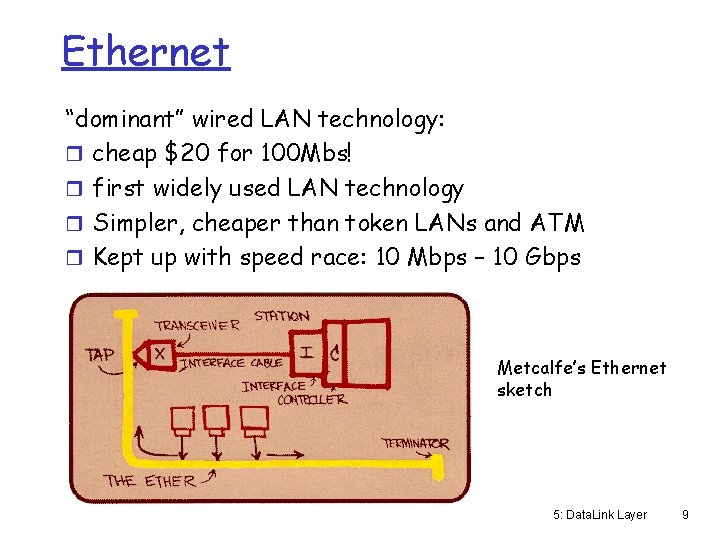
Ethernet “dominant” wired LAN technology: r cheap $20 for 100 Mbs! r first widely used LAN technology r Simpler, cheaper than token LANs and ATM r Kept up with speed race: 10 Mbps – 10 Gbps Metcalfe’s Ethernet sketch 5: Data. Link Layer 9
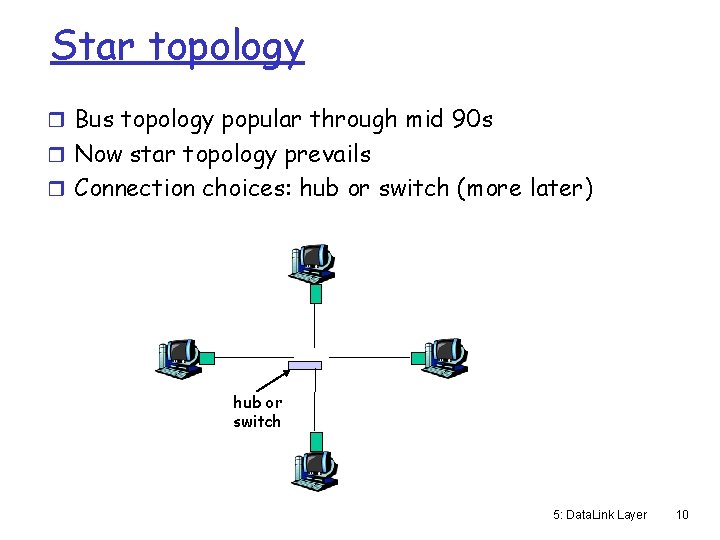
Star topology r Bus topology popular through mid 90 s r Now star topology prevails r Connection choices: hub or switch (more later) hub or switch 5: Data. Link Layer 10
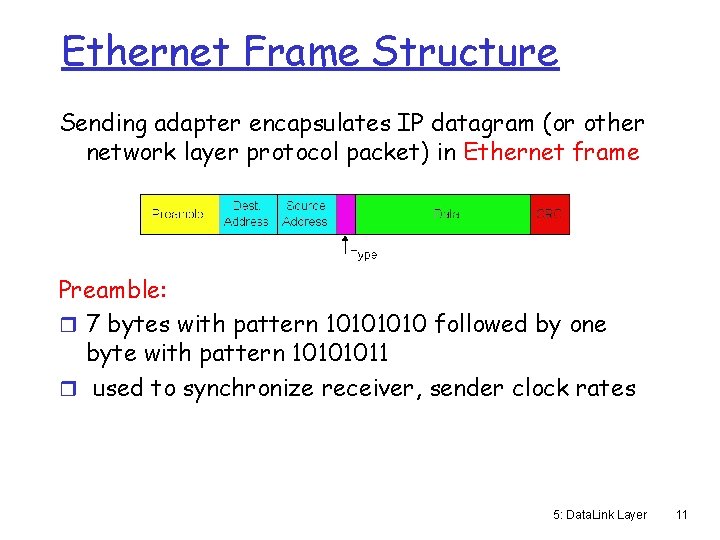
Ethernet Frame Structure Sending adapter encapsulates IP datagram (or other network layer protocol packet) in Ethernet frame Preamble: r 7 bytes with pattern 1010 followed by one byte with pattern 10101011 r used to synchronize receiver, sender clock rates 5: Data. Link Layer 11
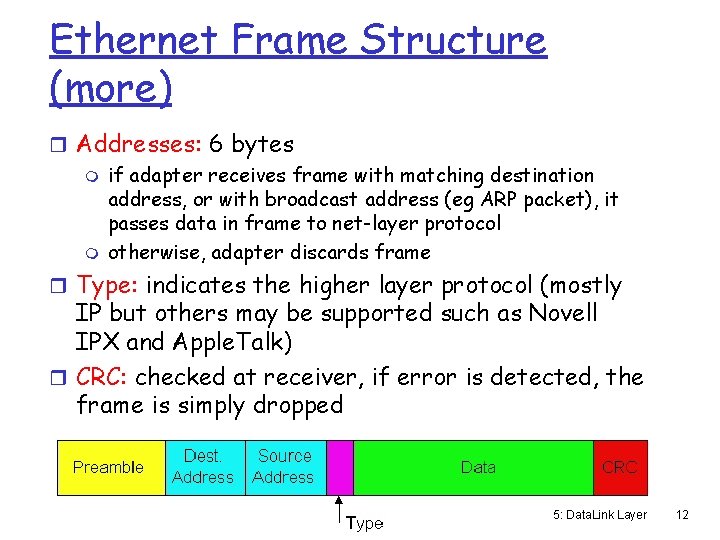
Ethernet Frame Structure (more) r Addresses: 6 bytes m if adapter receives frame with matching destination address, or with broadcast address (eg ARP packet), it passes data in frame to net-layer protocol m otherwise, adapter discards frame r Type: indicates the higher layer protocol (mostly IP but others may be supported such as Novell IPX and Apple. Talk) r CRC: checked at receiver, if error is detected, the frame is simply dropped 5: Data. Link Layer 12
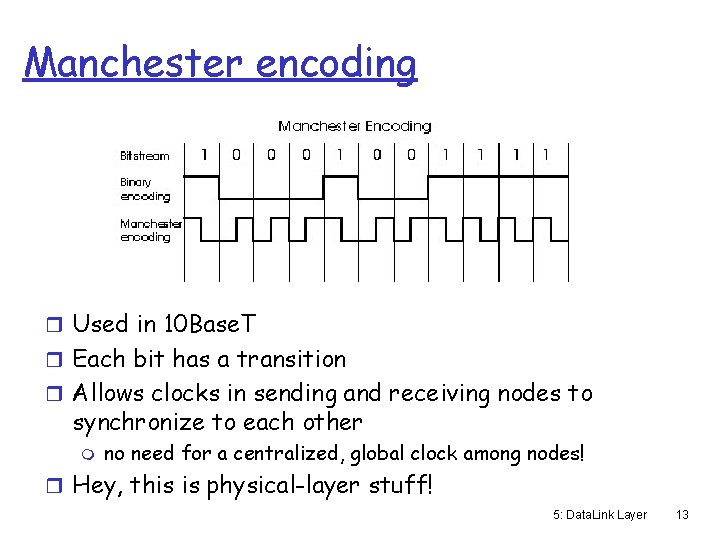
Manchester encoding r Used in 10 Base. T r Each bit has a transition r Allows clocks in sending and receiving nodes to synchronize to each other m no need for a centralized, global clock among nodes! r Hey, this is physical-layer stuff! 5: Data. Link Layer 13
Unreliable, connectionless service r Connectionless: No handshaking between sending and receiving adapter. r Unreliable: receiving adapter doesn’t send acks or nacks to sending adapter m m m stream of datagrams passed to network layer can have gaps will be filled if app is using TCP otherwise, app will see the gaps 5: Data. Link Layer 14
Ethernet uses CSMA/CD r No slots r adapter doesn’t transmit if it senses that some other adapter is transmitting, that is, carrier sense r transmitting adapter aborts when it senses that another adapter is transmitting, that is, collision detection r Before attempting a retransmission, adapter waits a random time, that is, random access 5: Data. Link Layer 15
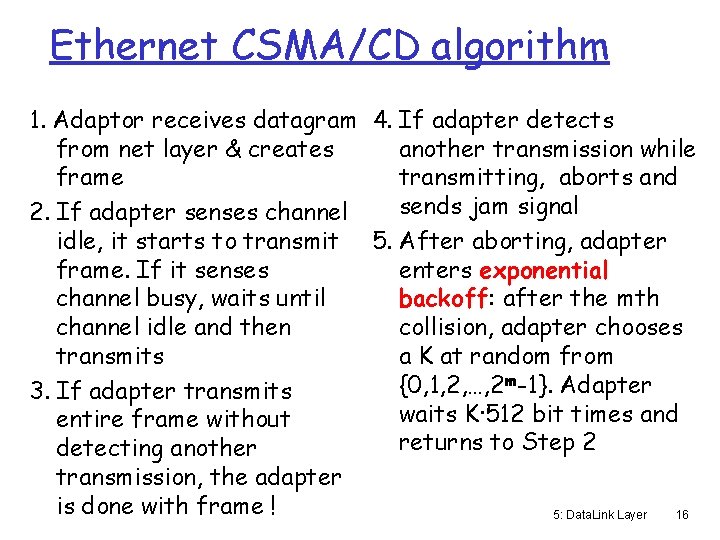
Ethernet CSMA/CD algorithm 1. Adaptor receives datagram 4. If adapter detects from net layer & creates another transmission while frame transmitting, aborts and sends jam signal 2. If adapter senses channel idle, it starts to transmit 5. After aborting, adapter frame. If it senses enters exponential channel busy, waits until backoff: after the mth channel idle and then collision, adapter chooses transmits a K at random from {0, 1, 2, …, 2 m-1}. Adapter 3. If adapter transmits waits K·512 bit times and entire frame without returns to Step 2 detecting another transmission, the adapter is done with frame ! 5: Data. Link Layer 16
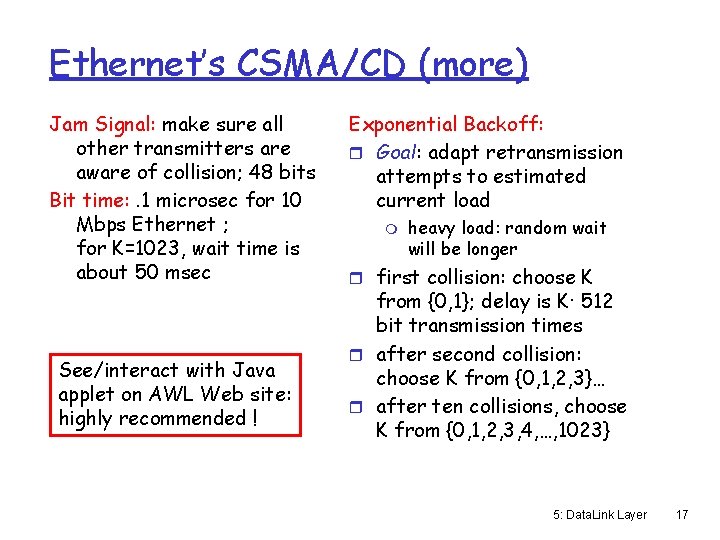
Ethernet’s CSMA/CD (more) Jam Signal: make sure all other transmitters are aware of collision; 48 bits Bit time: . 1 microsec for 10 Mbps Ethernet ; for K=1023, wait time is about 50 msec See/interact with Java applet on AWL Web site: highly recommended ! Exponential Backoff: r Goal: adapt retransmission attempts to estimated current load m heavy load: random wait will be longer r first collision: choose K from {0, 1}; delay is K· 512 bit transmission times r after second collision: choose K from {0, 1, 2, 3}… r after ten collisions, choose K from {0, 1, 2, 3, 4, …, 1023} 5: Data. Link Layer 17
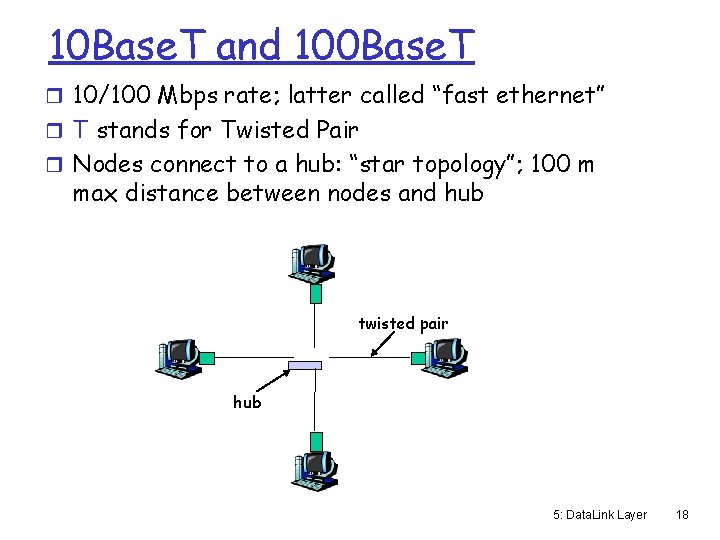
10 Base. T and 100 Base. T r 10/100 Mbps rate; latter called “fast ethernet” r T stands for Twisted Pair r Nodes connect to a hub: “star topology”; 100 m max distance between nodes and hub twisted pair hub 5: Data. Link Layer 18
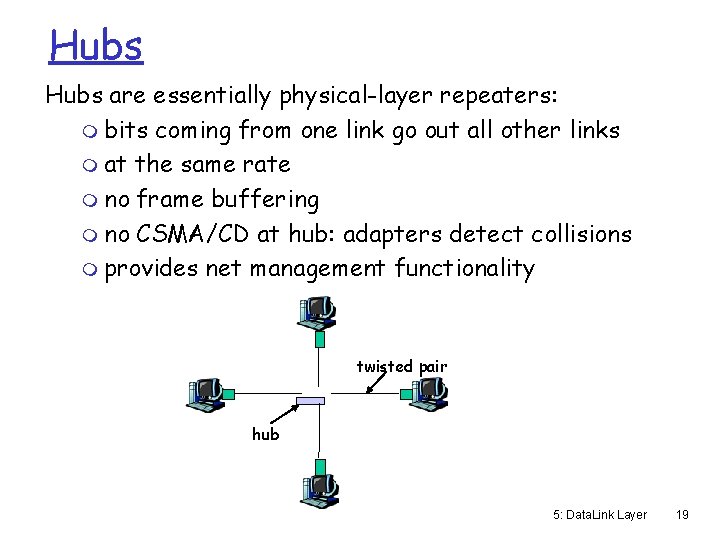
Hubs are essentially physical-layer repeaters: m bits coming from one link go out all other links m at the same rate m no frame buffering m no CSMA/CD at hub: adapters detect collisions m provides net management functionality twisted pair hub 5: Data. Link Layer 19
Gbit Ethernet r uses standard Ethernet frame format r allows for point-to-point links and shared r r broadcast channels in shared mode, CSMA/CD is used; short distances between nodes required for efficiency uses hubs, called here “Buffered Distributors” Full-Duplex at 1 Gbps for point-to-point links 10 Gbps now ! 5: Data. Link Layer 20
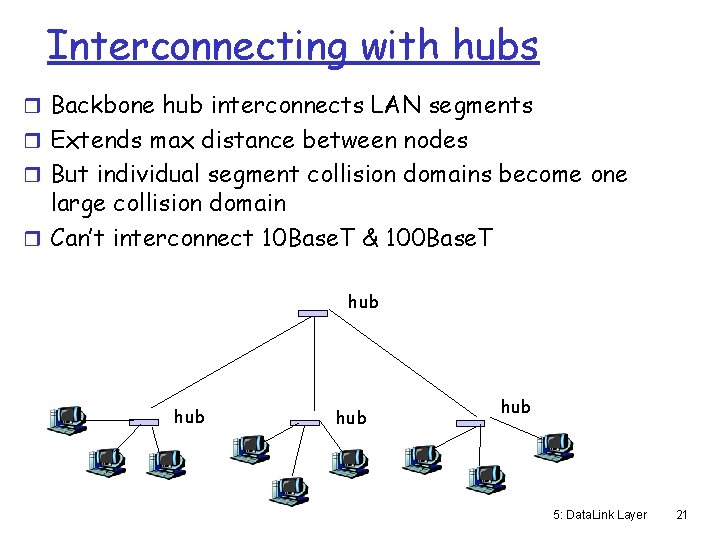
Interconnecting with hubs r Backbone hub interconnects LAN segments r Extends max distance between nodes r But individual segment collision domains become one large collision domain r Can’t interconnect 10 Base. T & 100 Base. T hub hub 5: Data. Link Layer 21
Switch r Link layer device m stores and forwards Ethernet frames m examines frame header and selectively forwards frame based on MAC dest address m when frame is to be forwarded on segment, uses CSMA/CD to access segment r transparent m hosts are unaware of presence of switches r plug-and-play, self-learning m switches do not need to be configured 5: Data. Link Layer 22
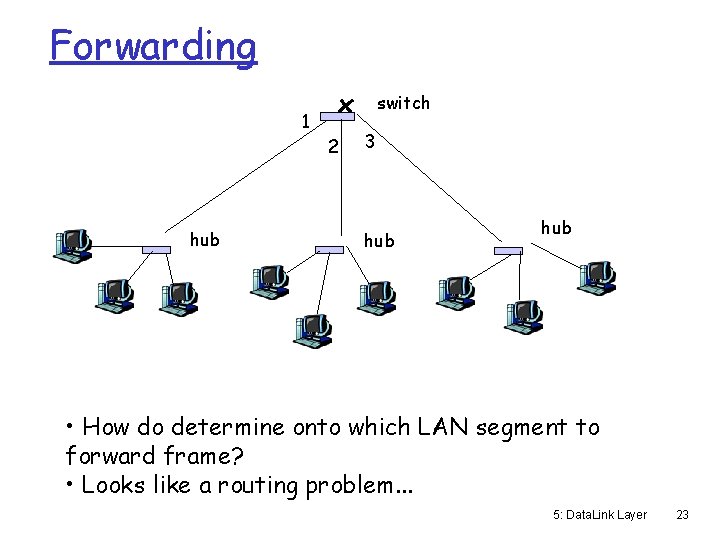
Forwarding switch 1 2 hub 3 hub • How do determine onto which LAN segment to forward frame? • Looks like a routing problem. . . 5: Data. Link Layer 23
Self learning r A switch has a switch table r entry in switch table: m (MAC Address, Interface, Time Stamp) m stale entries in table dropped (TTL can be 60 min) r switch learns which hosts can be reached through which interfaces m when frame received, switch “learns” location of sender: incoming LAN segment m records sender/location pair in switch table 5: Data. Link Layer 24
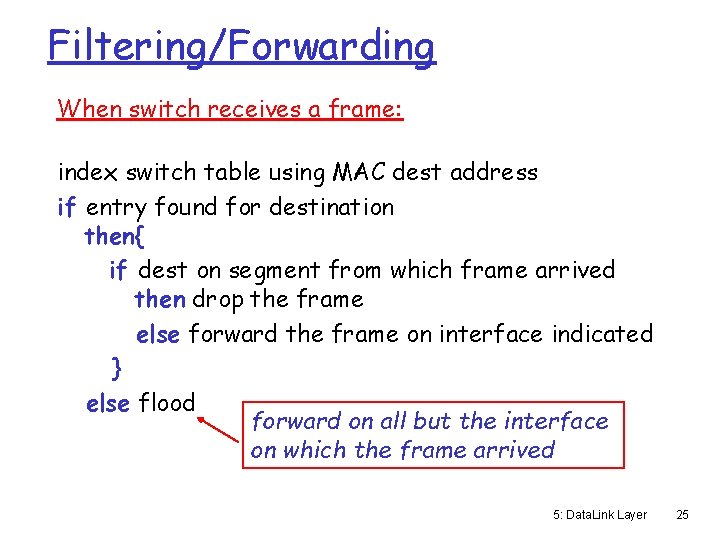
Filtering/Forwarding When switch receives a frame: index switch table using MAC dest address if entry found for destination then{ if dest on segment from which frame arrived then drop the frame else forward the frame on interface indicated } else flood forward on all but the interface on which the frame arrived 5: Data. Link Layer 25
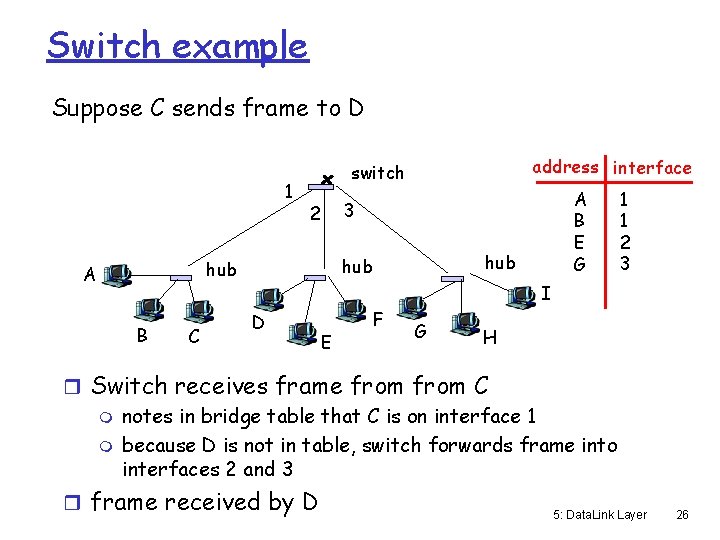
Switch example Suppose C sends frame to D 1 B C A B E G 3 2 hub hub A address interface switch 1 1 2 3 I D E F G H r Switch receives frame from C m notes in bridge table that C is on interface 1 m because D is not in table, switch forwards frame into interfaces 2 and 3 r frame received by D 5: Data. Link Layer 26
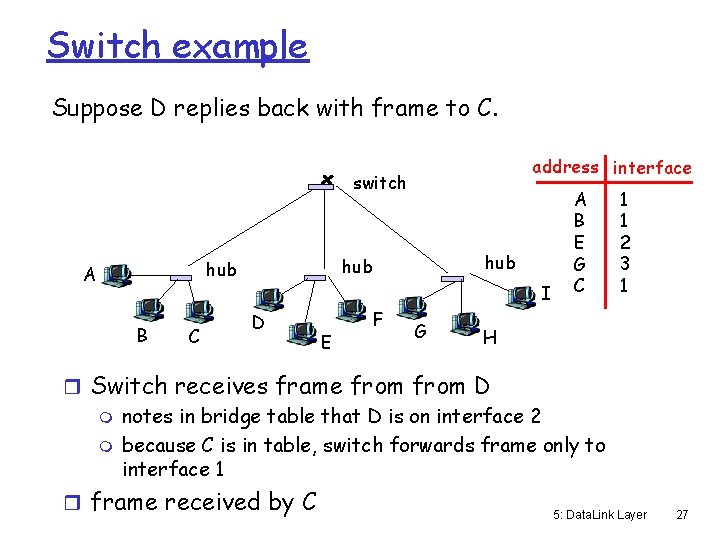
Switch example Suppose D replies back with frame to C. address interface switch B C hub hub A I D E F G A B E G C 1 1 2 3 1 H r Switch receives frame from D m notes in bridge table that D is on interface 2 m because C is in table, switch forwards frame only to interface 1 r frame received by C 5: Data. Link Layer 27
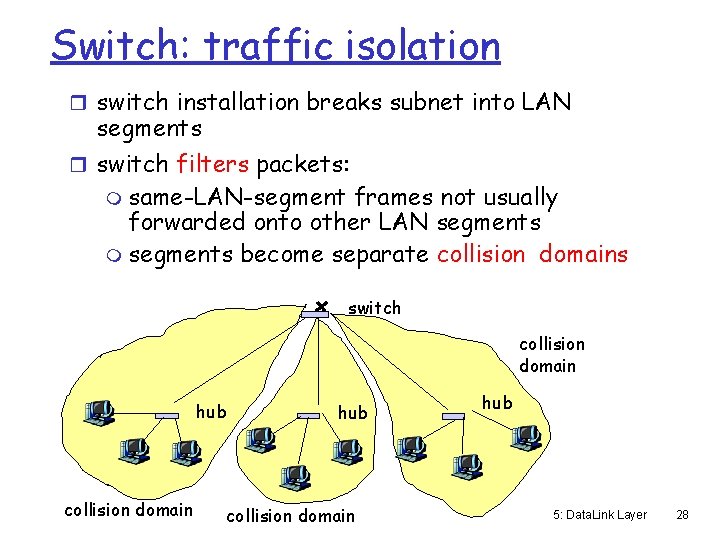
Switch: traffic isolation r switch installation breaks subnet into LAN segments r switch filters packets: m same-LAN-segment frames not usually forwarded onto other LAN segments m segments become separate collision domains switch collision domain hub 5: Data. Link Layer 28
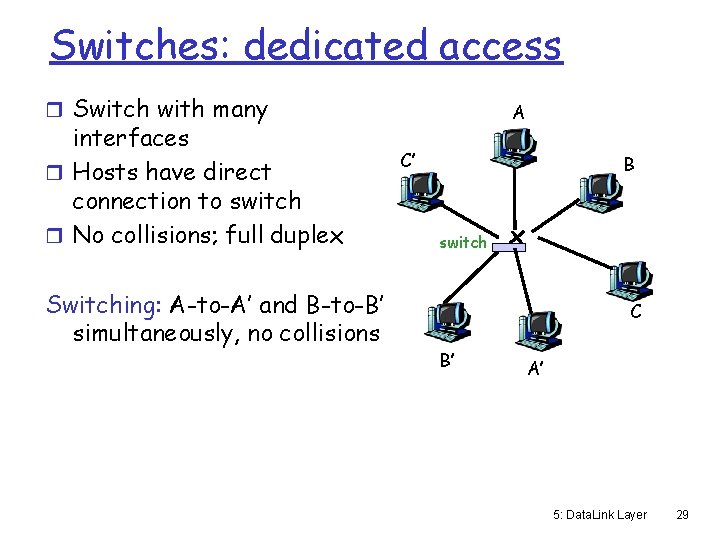
Switches: dedicated access r Switch with many interfaces r Hosts have direct connection to switch r No collisions; full duplex Switching: A-to-A’ and B-to-B’ simultaneously, no collisions A C’ B switch C B’ A’ 5: Data. Link Layer 29
More on Switches r cut-through switching: frame forwarded from input to output port without first collecting entire frame m slight reduction in latency r combinations of shared/dedicated, 10/1000 Mbps interfaces 5: Data. Link Layer 30
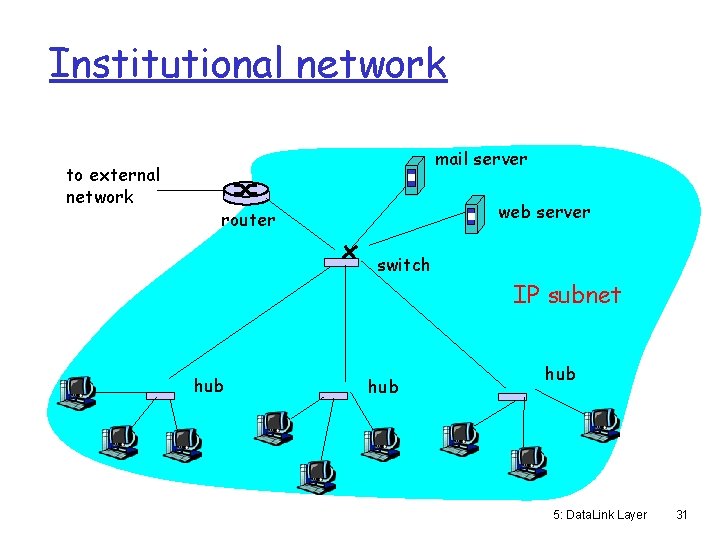
Institutional network to external network mail server web server router switch IP subnet hub hub 5: Data. Link Layer 31
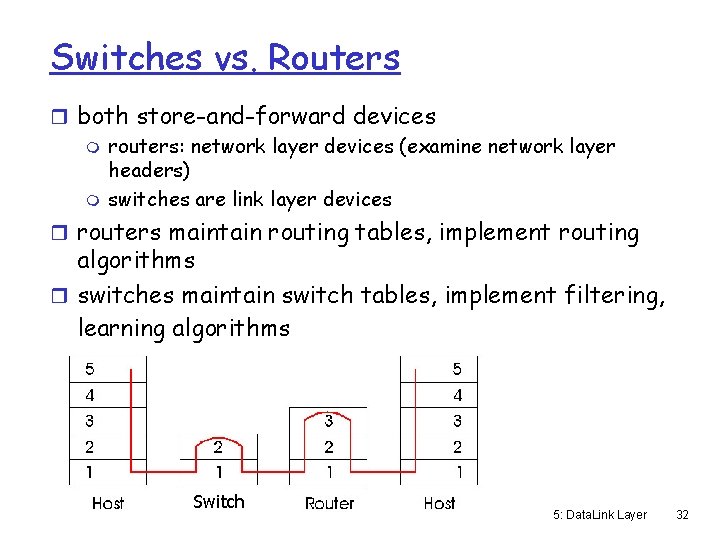
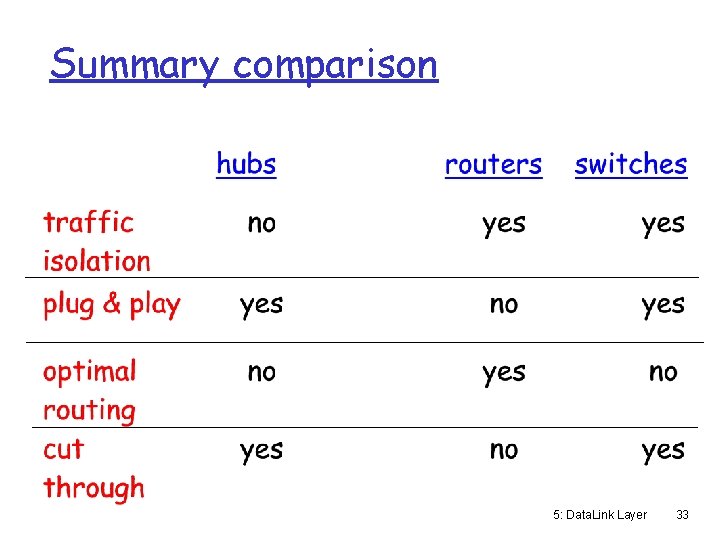
Switches vs. Routers r both store-and-forward devices m routers: network layer devices (examine network layer headers) m switches are link layer devices r routers maintain routing tables, implement routing algorithms r switches maintain switch tables, implement filtering, learning algorithms Switch 5: Data. Link Layer 32
Summary comparison 5: Data. Link Layer 33