
MAAR Chart Live Webinar Will Start Shortly NHS
MAAR Chart Live Webinar Will Start Shortly NHS England NHS Improvement
If you have a question please enter into the Q&A box. NHS England NHS Improvement
Pan-London Symptom Control Medication Authorisation and Administration Record (MAAR) chart Caroline Stirling Clinical Director, EOLC Clinical Network NHS England NHS Improvement
Outline • Rationale for and development process of Pan-London Symptom Control MAAR chart • Indications for sc medications / syringe driver • Principles of clinical care when using a syringe driver • Outline of resources provided • Chart structure NHS England NHS Improvement 4
Rationale and development of chart Rationale: • Standardised record in all community settings in London • Reduce clinical risk, build staff confidence • Support transfer of care between settings, and of all care professionals • Build on / develop charts already in use / being developed Development Process – May 2019 onwards: • Led by NHSE/I London EOLC Clinical Network • Pan-London, multi-professional steering group and working groups • Multiple iterations and reviews, with expert advice as needed • Ratification and publication by London Clinical Advisory Group – May 2020 • Version 2 – developed in response to early feedback – June 2020 • Version 3 – correction of ‘glitch’ on chart NHS England NHS Improvement 5
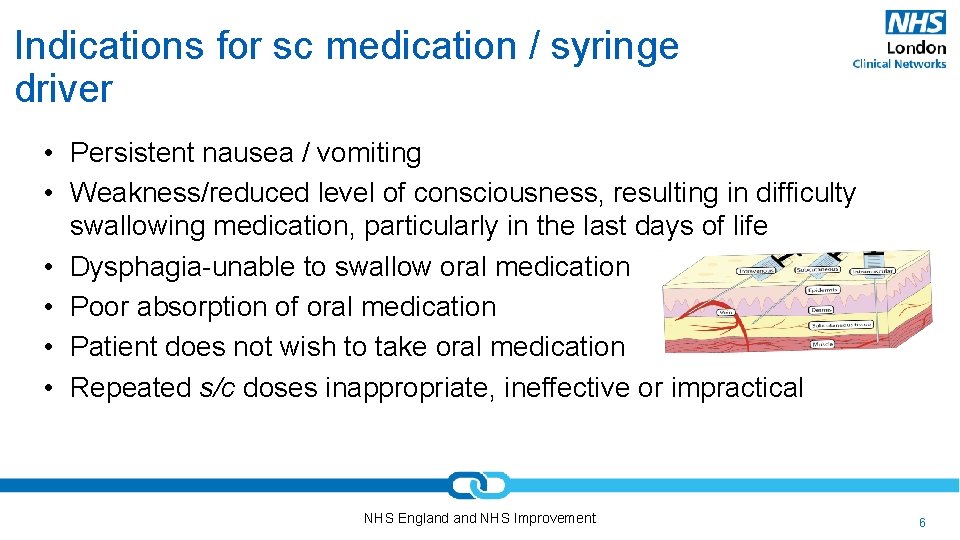
Indications for sc medication / syringe driver • Persistent nausea / vomiting • Weakness/reduced level of consciousness, resulting in difficulty swallowing medication, particularly in the last days of life • Dysphagia-unable to swallow oral medication • Poor absorption of oral medication • Patient does not wish to take oral medication • Repeated s/c doses inappropriate, ineffective or impractical NHS England NHS Improvement 6
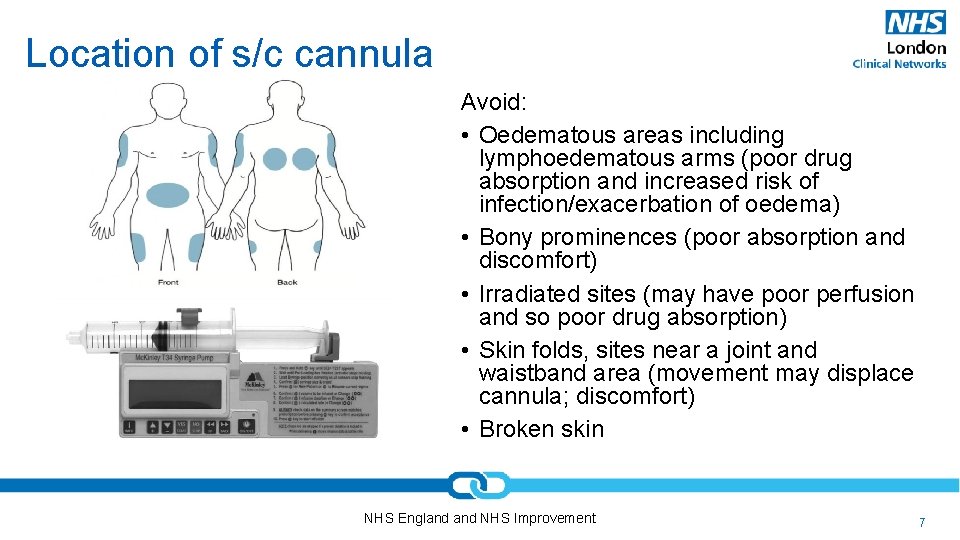
Location of s/c cannula Avoid: • Oedematous areas including lymphoedematous arms (poor drug absorption and increased risk of infection/exacerbation of oedema) • Bony prominences (poor absorption and discomfort) • Irradiated sites (may have poor perfusion and so poor drug absorption) • Skin folds, sites near a joint and waistband area (movement may displace cannula; discomfort) • Broken skin NHS England NHS Improvement 7
Initial steps • Patient / carer assessment • History and examination (including, if appropriate, assessment of prognosis) • Understanding / desire for information? • Explanation – patient and family • Prescribe • Select and prescribe medications and correct doses – use FP 10 / TTA • Use local guidelines, check previous opioid doses etc • Seek advice if needed – palliative care • Source medications - ? liaise with hospital / community pharmacy if urgent • Authorise medications using MAAR chart • Coordinate administration with community nursing staff • Document – including updating CMC NHS England NHS Improvement 8
Discussion with patient/family • Rationale for use of SC medications – control of symptoms, guaranteed absorption etc • Key elements of pump – medications, cannula rather than needle, how pump works (flashing light) etc – and medications to be used • Check • Past experience with syringe driver? • Fears and anxiety of using syringe driver? • If relevant, reassure that using syringe driver does not necessarily indicate that death is imminent, and that it does not speed up dying process • Ongoing care and assessment – what will happen / when • Emergency contact numbers including DN numbers – in and out of hours • Use patient / carer information leaflet (within Policy) NHS England NHS Improvement 9
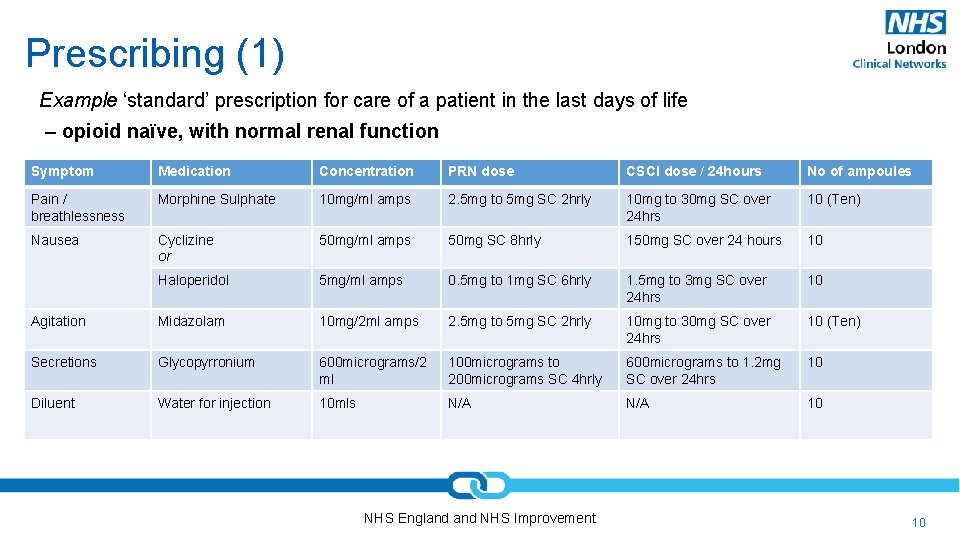
Prescribing (1) Example ‘standard’ prescription for care of a patient in the last days of life – opioid naïve, with normal renal function Symptom Medication Concentration PRN dose CSCI dose / 24 hours No of ampoules Pain / breathlessness Morphine Sulphate 10 mg/ml amps 2. 5 mg to 5 mg SC 2 hrly 10 mg to 30 mg SC over 24 hrs 10 (Ten) Nausea Cyclizine or 50 mg/ml amps 50 mg SC 8 hrly 150 mg SC over 24 hours 10 Haloperidol 5 mg/ml amps 0. 5 mg to 1 mg SC 6 hrly 1. 5 mg to 3 mg SC over 24 hrs 10 Agitation Midazolam 10 mg/2 ml amps 2. 5 mg to 5 mg SC 2 hrly 10 mg to 30 mg SC over 24 hrs 10 (Ten) Secretions Glycopyrronium 600 micrograms/2 ml 100 micrograms to 200 micrograms SC 4 hrly 600 micrograms to 1. 2 mg SC over 24 hrs 10 Diluent Water for injection 10 mls N/A 10 NHS England NHS Improvement 10
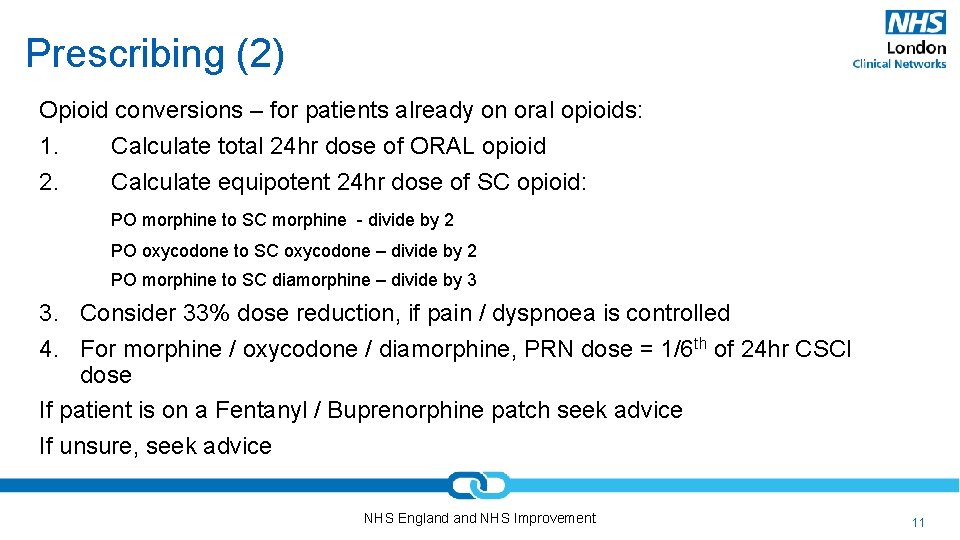
Prescribing (2) Opioid conversions – for patients already on oral opioids: 1. Calculate total 24 hr dose of ORAL opioid 2. Calculate equipotent 24 hr dose of SC opioid: PO morphine to SC morphine - divide by 2 PO oxycodone to SC oxycodone – divide by 2 PO morphine to SC diamorphine – divide by 3 3. Consider 33% dose reduction, if pain / dyspnoea is controlled 4. For morphine / oxycodone / diamorphine, PRN dose = 1/6 th of 24 hr CSCI dose If patient is on a Fentanyl / Buprenorphine patch seek advice If unsure, seek advice NHS England NHS Improvement 11
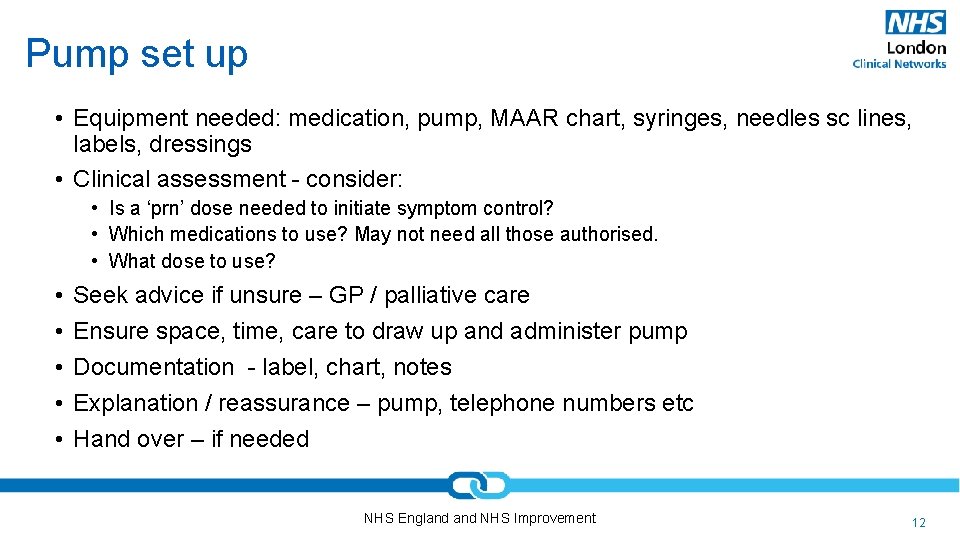
Pump set up • Equipment needed: medication, pump, MAAR chart, syringes, needles sc lines, labels, dressings • Clinical assessment - consider: • Is a ‘prn’ dose needed to initiate symptom control? • Which medications to use? May not need all those authorised. • What dose to use? • • • Seek advice if unsure – GP / palliative care Ensure space, time, care to draw up and administer pump Documentation - label, chart, notes Explanation / reassurance – pump, telephone numbers etc Hand over – if needed NHS England NHS Improvement 12
Ongoing Care • Daily clinical review and assessment • Review symptom control, number of PRN doses required • Consider whether doses should be increased or decreased • Consider whether other medications authorised should be added e. g glycopyrronium for secretions • Seek medical / palliative care review as needed • Daily explanation and reassurance • Forward planning • Equipment, medication, new MAAR chart (if doses increasing / new chart needed) • Particularly for weekends / out of hours • Allow for time to obtain medications NHS England NHS Improvement 13
Resources A: Symptom control MAAR chart: 1. 24 hrs CSCI authorisation form 2. PRN medication authorisation and administration form 3. Crisis / emergency and regular medication authorisation and administration form 4. Controlled Drug (CD) stock balance chart 5. Non-CD stock balance chart 6. 24 hrs CSCI administration record NHS England NHS Improvement 14
Resources B: Policy – Key points: • Outlines essential elements of Procedure in clinical practice • Outlines elements of risk management: • • use local processes for incident / near miss reporting and management report specific issues with MAAR chart and documents to EOLC Clinical Network use Yellow card system for adverse drug reactions be aware of relevant NPSA alerts • Advises use of PANG / local prescribing guidelines for medication choice and doses • Advises use of local policy / procedure for carer administration of medication / transcribing NHS England NHS Improvement 15
Resources B: Policy – Key points cont’d: • Outlines roles and responsibilities of members of organisations • Emphasises need for consent • Outlines need for implementation process and training within organisations / systems • Outlines responsibilities of staff caring for patient within different settings • Contains patient / carer information leaflet • Contains proformas for: • equality Impact assessment • approval / monitoring • audit NHS England NHS Improvement 16
Resources C: Patient information leaflet (within policy): covers • What are ‘anticipatory medications? • Who will give medications? • Benefits? • Side effects? • How are they administered? • What to do about other medications? • Storage? NHS England NHS Improvement 17
Resources D: Procedure: For prescribers (1) • Reminder – chart is not a prescription • Prescribing must be clear and unambiguous • Covers children and adults • Use PANG / local guidelines for dose calculations • Seek specialist advice if needed (including on compatibility) • Complete three charts - 24 hr CSCI, as required, and crisis/regular charts (1 -3) • Wet sign where possible • Use ‘to’ rather than ‘-’ when writing dose ranges • Doses <1 mg must be written as ‘micrograms’ • Review before initiating medication, and regularly thereafter – joint responsibility with administering clinicians • Re-write charts as needed NHS England NHS Improvement 18
Resources D: Procedure: for prescribers (2) • Wet signature = signature of choice for an independent nurse, Dr or Pharmacy prescriber • • Print off completed MAAR chart Wet sign Scan completed authorisation chart Email / give to community nursing team / patient or family • Electronic signature – only in exceptional circumstances: • Type name & GMC/NMC/GPh. C number on top right of Pages 1, 2 & 3 • Type name in the box beside each authorised medication • Email completed MAAR charts to & from nhs. net accounts only NHS England NHS Improvement 19
Resources D: Procedure: For staff administering medication • Check signatures and clarity of authorisation • Careful assessment, selection of medications and preparation of syringe • Seek review / advice / support if unsure or unclear • Careful completion of all documentation • Clear documentation of syringe contents on label attached to syringe • Confirm contents of syringe when in use / when being transferred (from two sources - chart / label / discharge summary) • Planning • Ensure adequate supplies of all medicines are available for next period and next syringe • Check whether chart needs re-writing • Strike through, sign, date and store old MAAR charts • Use standard MAR chart for other regular medications • Disposal of medications – must be by carers / using local policy NHS England NHS Improvement 20
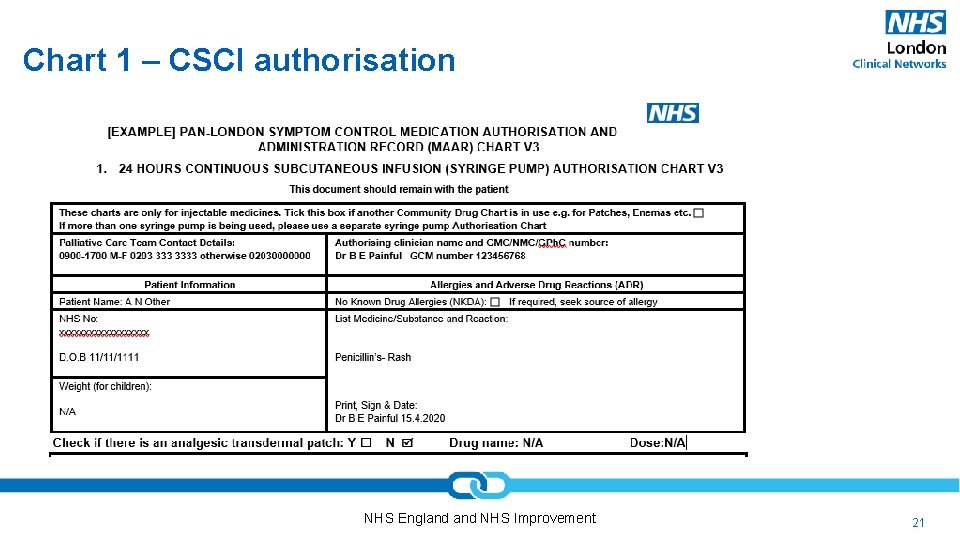
Chart 1 – CSCI authorisation NHS England NHS Improvement 21
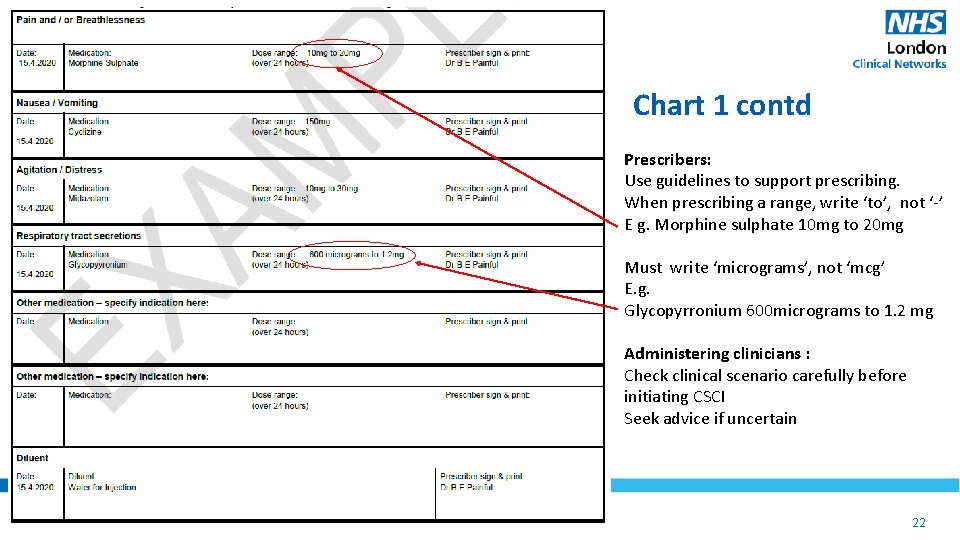
Chart 1 contd Prescribers: Use guidelines to support prescribing. When prescribing a range, write ‘to’, not ‘-’ E g. Morphine sulphate 10 mg to 20 mg Must write ‘micrograms’, not ‘mcg’ E. g. Glycopyrronium 600 micrograms to 1. 2 mg Administering clinicians : Check clinical scenario carefully before initiating CSCI Seek advice if uncertain NHS England NHS Improvement 22
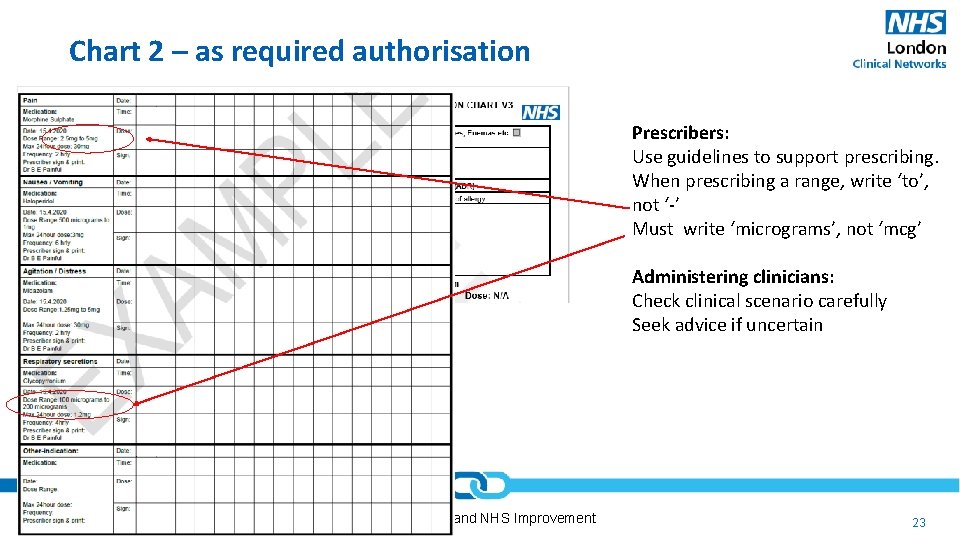
Chart 2 – as required authorisation Prescribers: Use guidelines to support prescribing. When prescribing a range, write ‘to’, not ‘-’ Must write ‘micrograms’, not ‘mcg’ Administering clinicians: Check clinical scenario carefully Seek advice if uncertain NHS England NHS Improvement 23
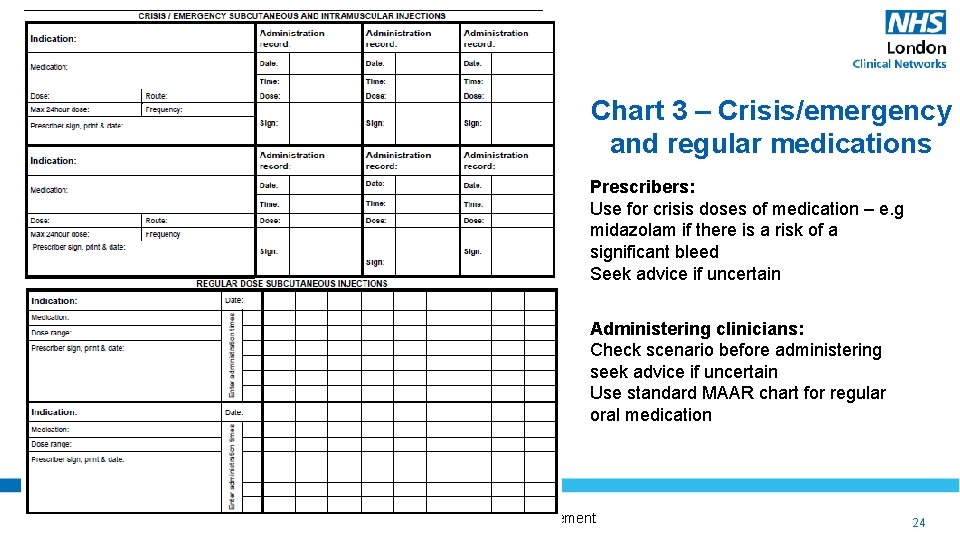
Chart 3 – Crisis/emergency and regular medications Prescribers: Use for crisis doses of medication – e. g midazolam if there is a risk of a significant bleed Seek advice if uncertain Administering clinicians: Check scenario before administering seek advice if uncertain Use standard MAAR chart for regular oral medication NHS England NHS Improvement 24
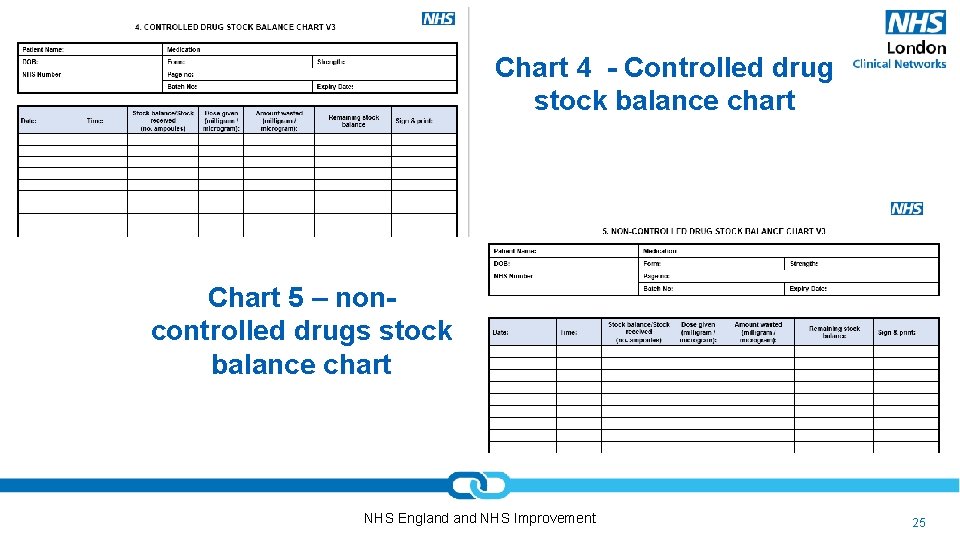
Chart 4 - Controlled drug stock balance chart Chart 5 – noncontrolled drugs stock balance chart NHS England NHS Improvement 25
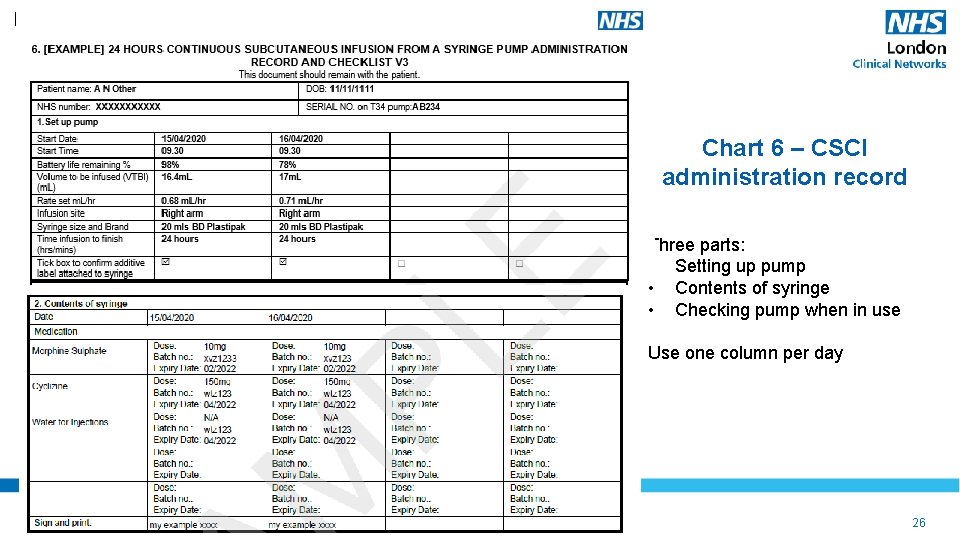
Chart 6 – CSCI administration record Three parts: • Setting up pump • Contents of syringe • Checking pump when in use Use one column per day NHS England NHS Improvement 26
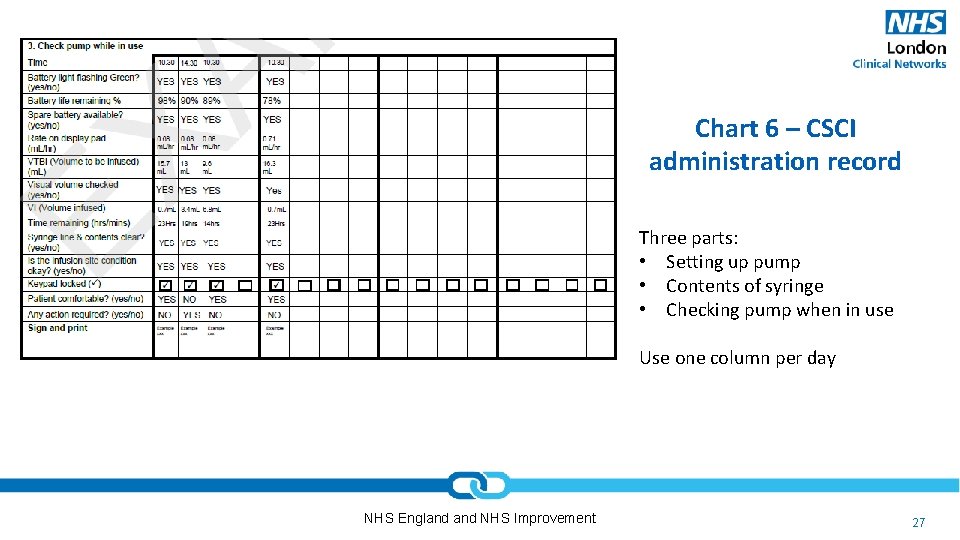
Chart 6 – CSCI administration record Three parts: • Setting up pump • Contents of syringe • Checking pump when in use Use one column per day NHS England NHS Improvement 27
Questions NHS England NHS Improvement 28
- Slides: 28