
MA and Investment Banking Accretion Dilution Analysis 1
M&A and Investment Banking Accretion / Dilution Analysis 1
Definition Simple tool to determine whether the acquisition creates or destroys value for shareholders Answers the question: “Does the proposed deal increase or decrease the post-transaction Earnings Per Share (EPS)? ” Accretion: When combined (pro forma) EPS > Acquirer’s standalone EPS Dilution: When combined (pro forma) EPS < Acquirer’s standalone EPS Breakeven: No impact on Acquirer’s EPS 2
Methodology Typically two-year projection period 4 -step methodology: ① ② ③ ④ 3 Estimate the Net Income of the Combined Firm (including expected synergies) Calculate the New Share Count Divide the Estimated Net Income of the Combined Firm by the New Share Count Compare this new pro forma EPS to the buyer’s original standalone EPS to determine whether the transaction is accretive or dilutive
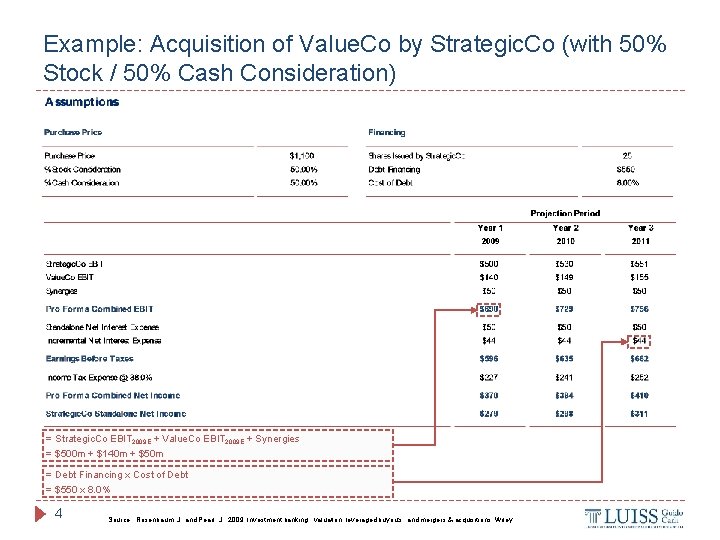
Example: Acquisition of Value. Co by Strategic. Co (with 50% Stock / 50% Cash Consideration) = Strategic. Co EBIT 2009 E + Value. Co EBIT 2009 E + Synergies = $500 m + $140 m + $50 m = Debt Financing x Cost of Debt = $550 x 8. 0% 4 Source: Rosenbaum, J. and Pearl, J. , 2009. Investment banking : valuation, leveraged buyouts, and mergers & acquisitions. Wiley :

Example: Acquisition of Value. Co by Strategic. Co (with 50% Stock / 50% Cash Consideration) (Cont’d) = Pro Forma Net Income 2009 E/Pro Forma Fully Diluted Shares 2009 E = $370 m / 125 m = Pro Forma Combined Diluted EPS 2009 E - Strategic. Co Standalone Diluted EPS 2009 E =$2. 96 - $2. 79 = Strategic. Co Standalone Net Income 2010 E / Standalone Fully Diluted Shares = $298 m / 100 m = Pro Forma Combined Diluted EPS 2010 E / Strategic. Co Standalone Diluted EPS 2010 E – 1 = $3. 15/$2. 98 - 1 = - (EPS Accretion/(Dilution)2011 E x Pro Forma Fully Diluted Shares) / (1 - Tax Rate) = - ($0. 18 x 125 m / (1 - 38. 0%) 5 Source: Rosenbaum, J. and Pearl, J. , 2009. Investment banking : valuation, leveraged buyouts, and mergers & acquisitions. Wiley :
Potential Factors Leading to EPS Dilution Target has negative Net Income Target’s P/E ratio > Acquiror’s P/E ratio Too many intangibles assets to be amortized going forward Increased interest expense due to new debt used to finance the transaction Decreased interest income due to less cash in the BS if cash is used to finance the transaction Low or negative synergies 6

Warnings There are significant limitations to this analysis: Analysis is looking at the transaction over a fixed period of time (typically a two-year horizon) but strategic buyers generally intend to own an acquired business indefinitely EPS is impacted by numerous accounting decisions and does not necessarily reflect the combined company’s ability to generate cash flow While accretion/dilution may be a factor for some potential strategic buyers, there are many other issues which will influence their decision (i. e. synergies and integration capabilities) 7
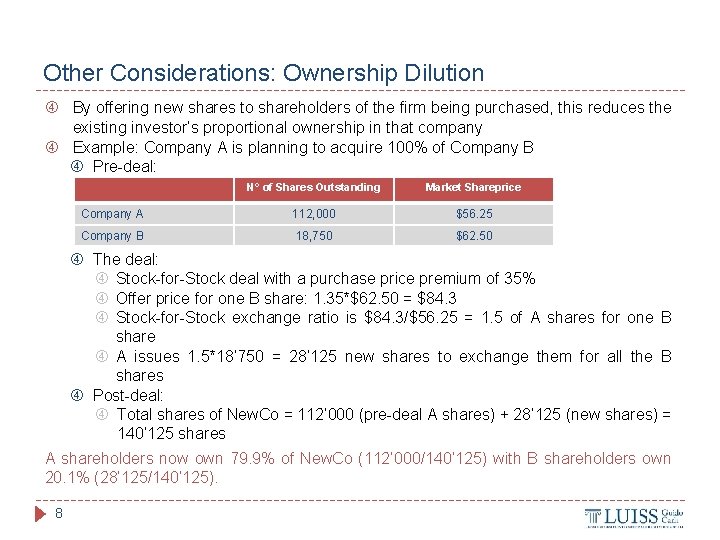
Other Considerations: Ownership Dilution By offering new shares to shareholders of the firm being purchased, this reduces the existing investor’s proportional ownership in that company Example: Company A is planning to acquire 100% of Company B Pre-deal: N° of Shares Outstanding Market Shareprice Company A 112, 000 $56. 25 Company B 18, 750 $62. 50 The deal: Stock-for-Stock deal with a purchase price premium of 35% Offer price for one B share: 1. 35*$62. 50 = $84. 3 Stock-for-Stock exchange ratio is $84. 3/$56. 25 = 1. 5 of A shares for one B share A issues 1. 5*18’ 750 = 28’ 125 new shares to exchange them for all the B shares Post-deal: Total shares of New. Co = 112’ 000 (pre-deal A shares) + 28’ 125 (new shares) = 140’ 125 shares A shareholders now own 79. 9% of New. Co (112’ 000/140’ 125) with B shareholders own 20. 1% (28’ 125/140’ 125). 8
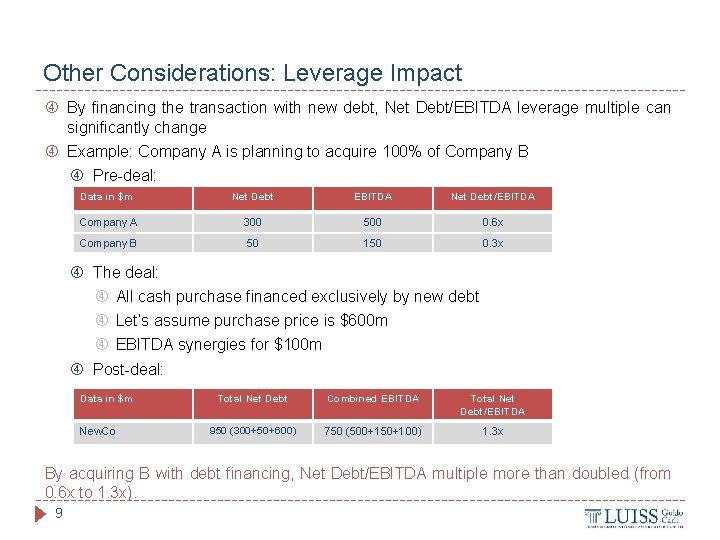
Other Considerations: Leverage Impact By financing the transaction with new debt, Net Debt/EBITDA leverage multiple can significantly change Example: Company A is planning to acquire 100% of Company B Pre-deal: Data in $m Net Debt EBITDA Net Debt/EBITDA Company A 300 500 0. 6 x Company B 50 150 0. 3 x The deal: All cash purchase financed exclusively by new debt Let’s assume purchase price is $600 m EBITDA synergies for $100 m Post-deal: Data in $m New. Co Total Net Debt Combined EBITDA Total Net Debt/EBITDA 950 (300+50+600) 750 (500+150+100) 1. 3 x By acquiring B with debt financing, Net Debt/EBITDA multiple more than doubled (from 0. 6 x to 1. 3 x). 9
- Slides: 9