
M Vitacca Divisione di Pneumologia Fondazione S Maugeri




- Slides: 60
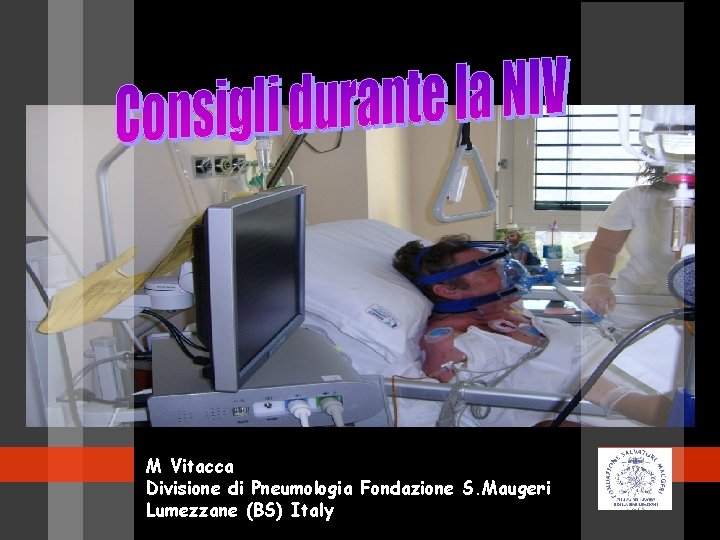
M Vitacca Divisione di Pneumologia Fondazione S. Maugeri Lumezzane (BS) Italy
Il momento e il paziente giusto
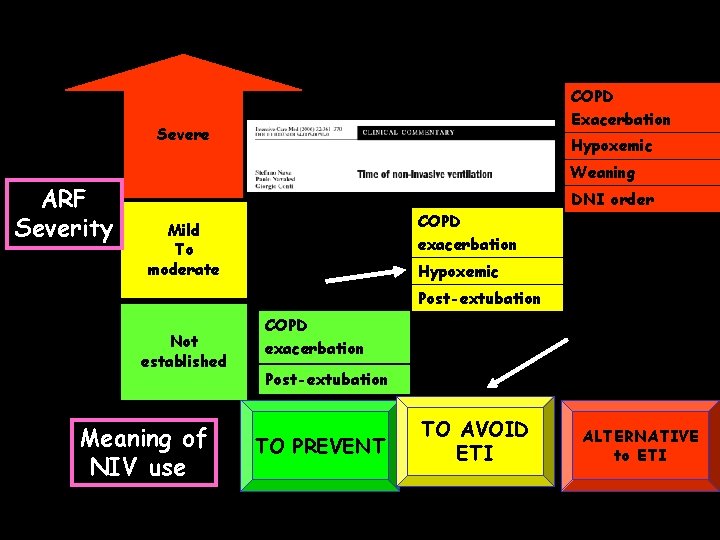
COPD Exacerbation Severe ARF Severity Hypoxemic Weaning COPD exacerbation Mild To moderate DNI order Hypoxemic Post-extubation Not established Meaning of NIV use COPD exacerbation Post-extubation TO PREVENT TO AVOID ETI ALTERNATIVE to ETI
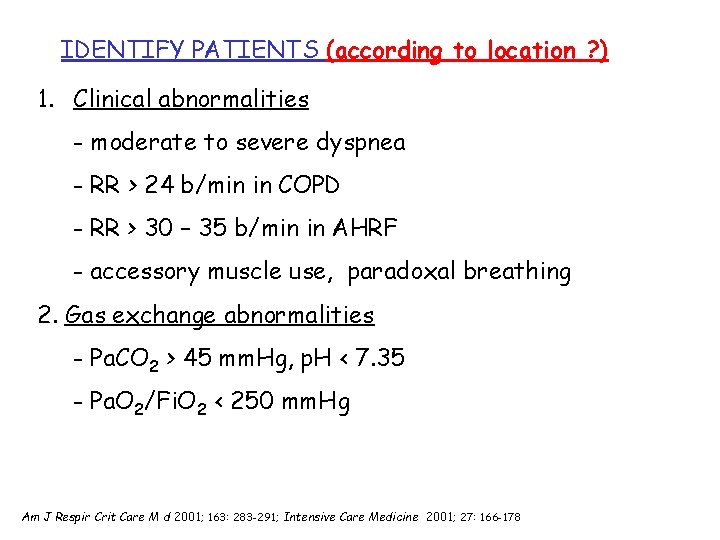
IDENTIFY PATIENTS (according to location ? ) 1. Clinical abnormalities - moderate to severe dyspnea - RR > 24 b/min in COPD - RR > 30 – 35 b/min in AHRF - accessory muscle use, paradoxal breathing 2. Gas exchange abnormalities - Pa. CO 2 > 45 mm. Hg, p. H < 7. 35 - Pa. O 2/Fi. O 2 < 250 mm. Hg Am J Respir Crit Care M d 2001; 163: 283 -291; Intensive Care Medicine 2001; 27: 166 -178
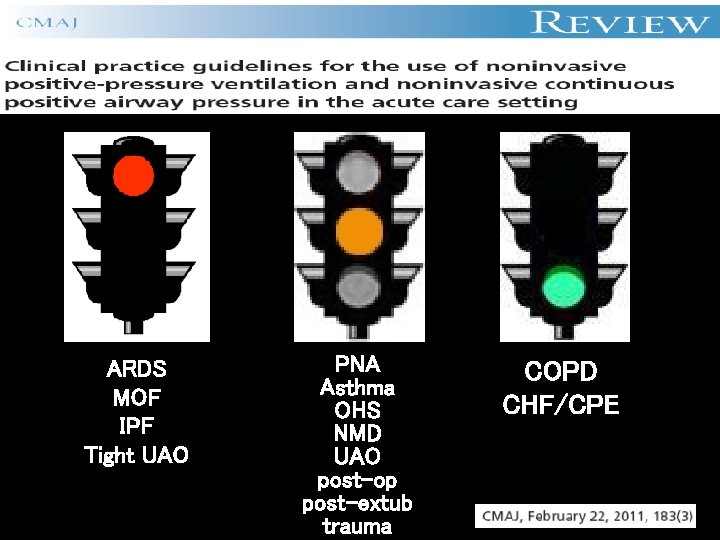
ARDS MOF IPF Tight UAO PNA Asthma OHS NMD UAO post-op post-extub trauma COPD CHF/CPE
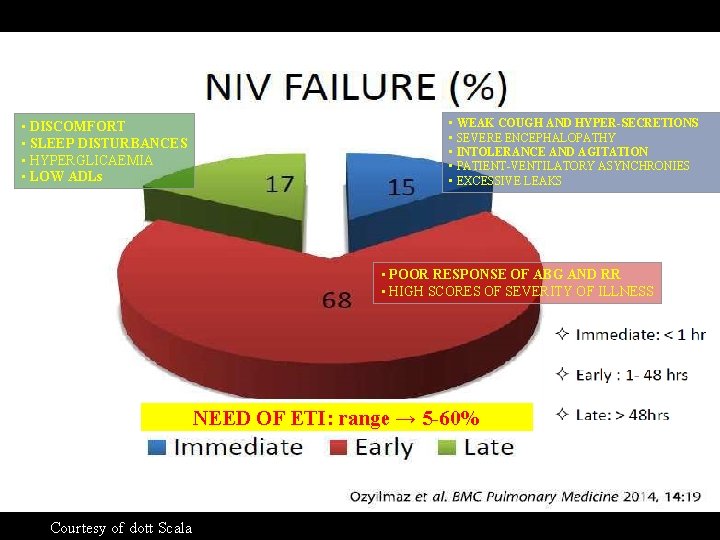
• DISCOMFORT • SLEEP DISTURBANCES • HYPERGLICAEMIA • LOW ADLs • WEAK COUGH AND HYPER-SECRETIONS • SEVERE ENCEPHALOPATHY • INTOLERANCE AND AGITATION • PATIENT-VENTILATORY ASYNCHRONIES • EXCESSIVE LEAKS • POOR RESPONSE OF ABG AND RR • HIGH SCORES OF SEVERITY OF ILLNESS NEED OF ETI: range → 5 -60% Courtesy of dott Scala
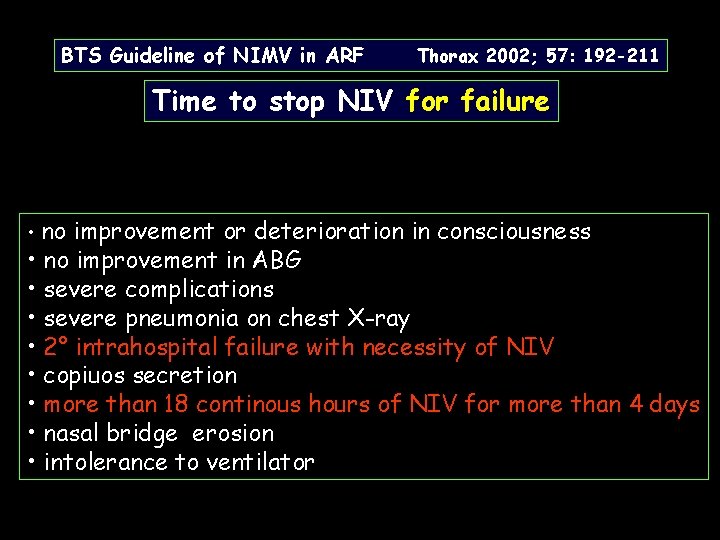
BTS Guideline of NIMV in ARF Thorax 2002; 57: 192 -211 Time to stop NIV for failure • no improvement or deterioration in consciousness • no improvement in ABG • severe complications • severe pneumonia on chest X-ray • 2° intrahospital failure with necessity of NIV • copiuos secretion • more than 18 continous hours of NIV for more than 4 days • nasal bridge erosion • intolerance to ventilator
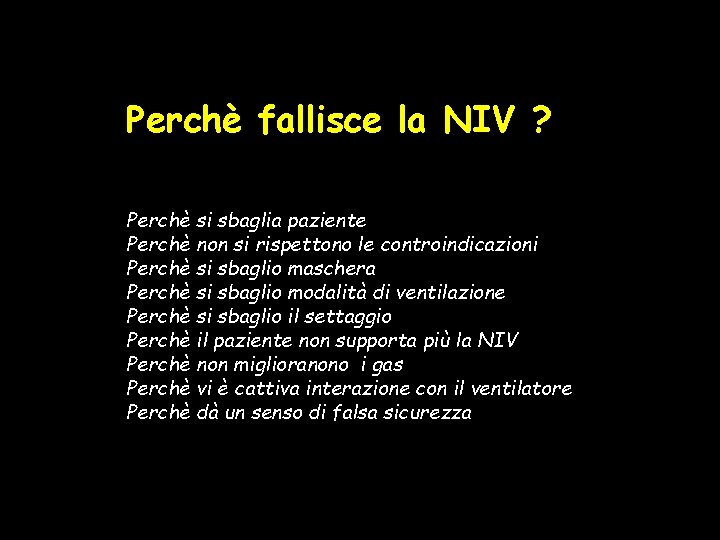
Perchè fallisce la NIV ? Perchè si sbaglia paziente Perchè non si rispettono le controindicazioni Perchè si sbaglio maschera Perchè si sbaglio modalità di ventilazione Perchè si sbaglio il settaggio Perchè il paziente non supporta più la NIV Perchè non miglioranono i gas Perchè vi è cattiva interazione con il ventilatore Perchè dà un senso di falsa sicurezza
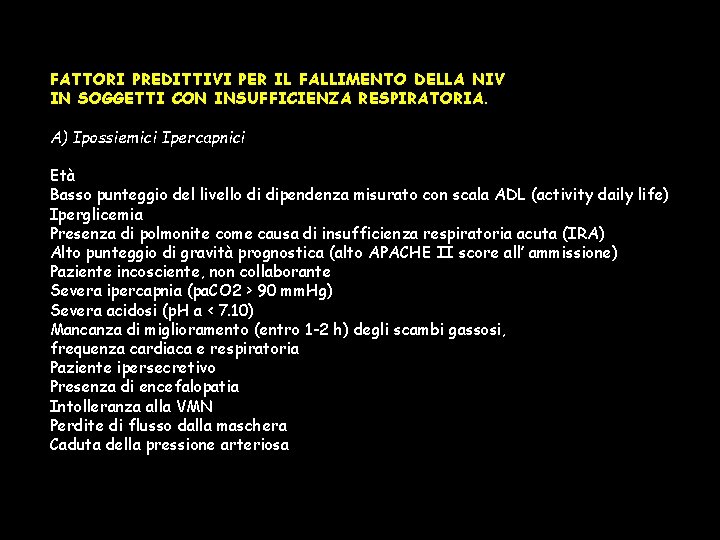
FATTORI PREDITTIVI PER IL FALLIMENTO DELLA NIV IN SOGGETTI CON INSUFFICIENZA RESPIRATORIA. A) Ipossiemici Ipercapnici Età Basso punteggio del livello di dipendenza misurato con scala ADL (activity daily life) Iperglicemia Presenza di polmonite come causa di insufficienza respiratoria acuta (IRA) Alto punteggio di gravità prognostica (alto APACHE II score all’ ammissione) Paziente incosciente, non collaborante Severa ipercapnia (pa. CO 2 > 90 mm. Hg) Severa acidosi (p. H a < 7. 10) Mancanza di miglioramento (entro 1 -2 h) degli scambi gassosi, frequenza cardiaca e respiratoria Paziente ipersecretivo Presenza di encefalopatia Intolleranza alla VMN Perdite di flusso dalla maschera Caduta della pressione arteriosa
FATTORI PREDITTIVI PER IL FALLIMENTO DELLA NIV IN SOGGETTI CON INSUFFICIENZA RESPIRATORIA. B) Ipossiemici Normocapnici Età Alto punteggio di gravità prognostica (alto SAPS II score all’ ammissione) ARDS e polmonite come causa del ricovero Edema polmonare cardiogeno senza risposta alla terapia medica Mancato miglioramento della ossigenazione dopo VMN (1 -2 h) Paziente ipersecretivo Presenza di encefalopatia Intolleranza alla VMN
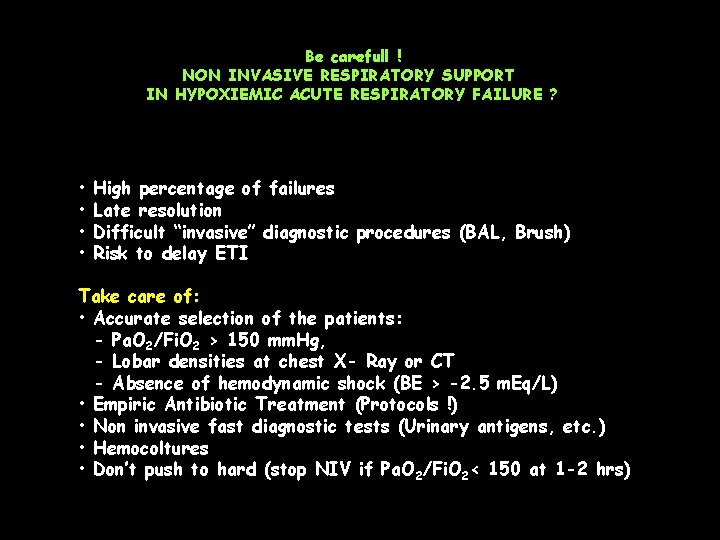
Be carefull ! NON INVASIVE RESPIRATORY SUPPORT IN HYPOXIEMIC ACUTE RESPIRATORY FAILURE ? • • High percentage of failures Late resolution Difficult “invasive” diagnostic procedures (BAL, Brush) Risk to delay ETI Take care of: • Accurate selection of the patients: - Pa. O 2/Fi. O 2 > 150 mm. Hg, - Lobar densities at chest X- Ray or CT - Absence of hemodynamic shock (BE > -2. 5 m. Eq/L) • Empiric Antibiotic Treatment (Protocols !) • Non invasive fast diagnostic tests (Urinary antigens, etc. ) • Hemocoltures • Don’t push to hard (stop NIV if Pa. O 2/Fi. O 2< 150 at 1 -2 hrs)
La giusta location
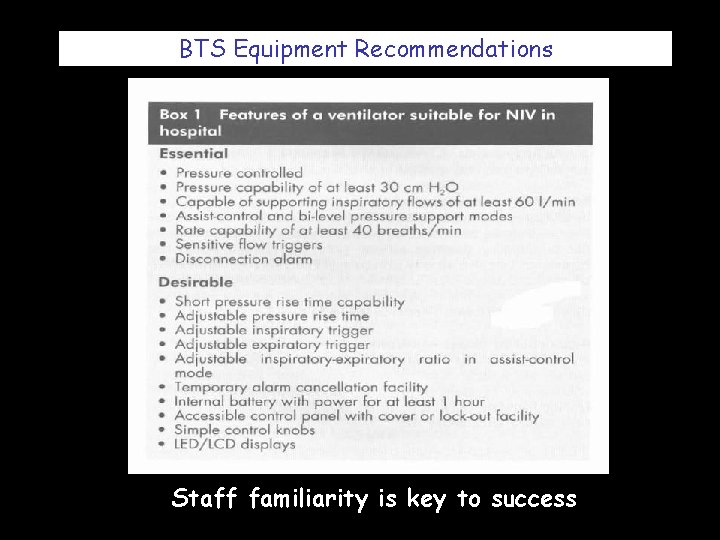
BTS Equipment Recommendations Staff familiarity is key to success
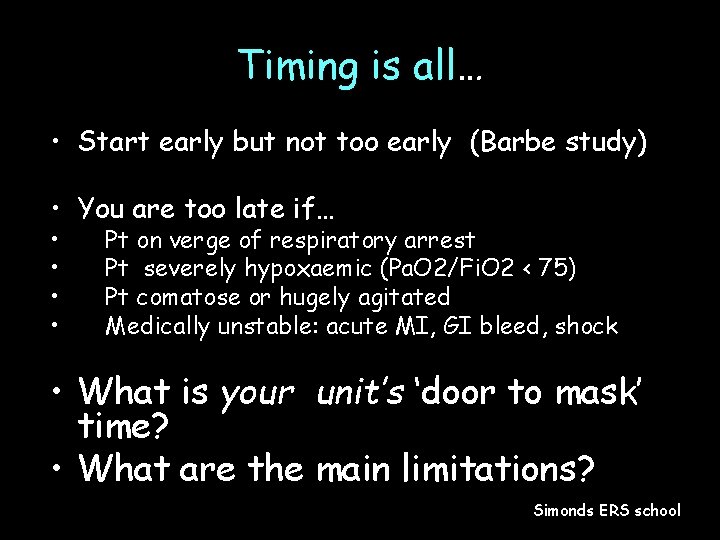
Timing is all… • Start early but not too early (Barbe study) • You are too late if… • • Pt on verge of respiratory arrest Pt severely hypoxaemic (Pa. O 2/Fi. O 2 < 75) Pt comatose or hugely agitated Medically unstable: acute MI, GI bleed, shock • What is your unit’s ‘door to mask’ time? • What are the main limitations? Simonds ERS school
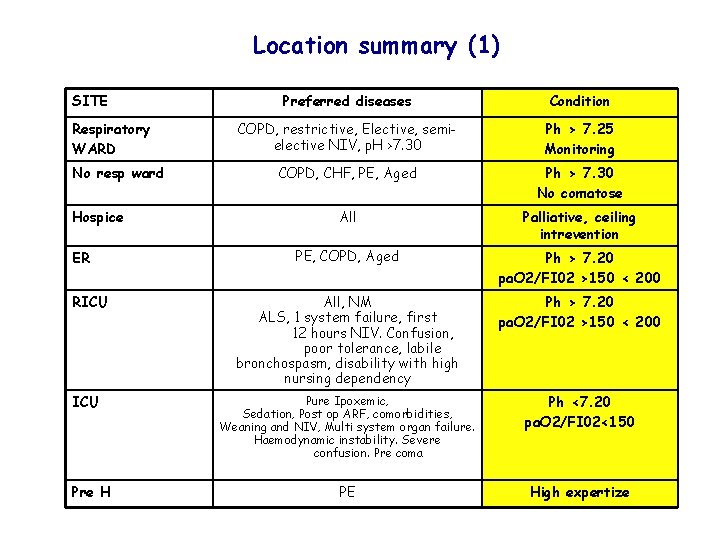
Location summary (1) SITE Respiratory WARD No resp ward Hospice ER RICU Pre H Preferred diseases Condition COPD, restrictive, Elective, semielective NIV, p. H >7. 30 Ph > 7. 25 Monitoring COPD, CHF, PE, Aged Ph > 7. 30 No comatose All Palliative, ceiling intrevention PE, COPD, Aged Ph > 7. 20 pa. O 2/FI 02 >150 < 200 All, NM ALS, 1 system failure, first 12 hours NIV. Confusion, poor tolerance, labile bronchospasm, disability with high nursing dependency Ph > 7. 20 pa. O 2/FI 02 >150 < 200 Pure Ipoxemic, Sedation, Post op ARF, comorbidities, Weaning and NIV, Multi system organ failure. Haemodynamic instability. Severe confusion. Pre coma Ph <7. 20 pa. O 2/FI 02<150 PE High expertize
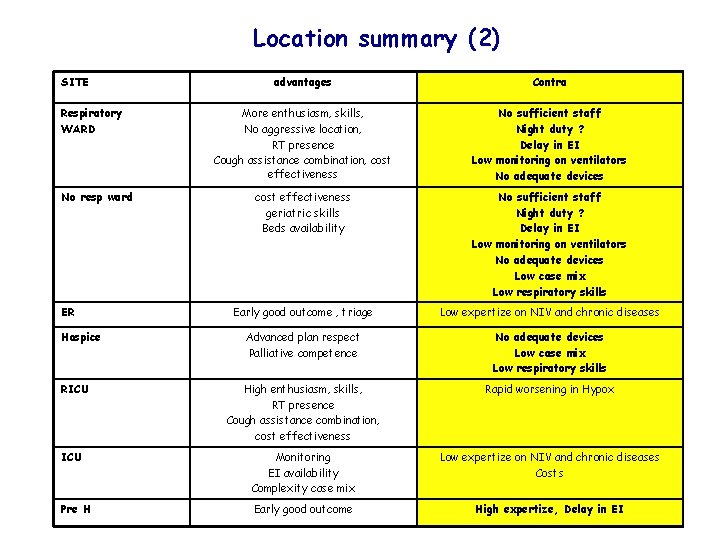
Location summary (2) SITE advantages Contra More enthusiasm, skills, No aggressive location, RT presence Cough assistance combination, cost effectiveness No sufficient staff Night duty ? Delay in EI Low monitoring on ventilators No adequate devices cost effectiveness geriatric skills Beds availability No sufficient staff Night duty ? Delay in EI Low monitoring on ventilators No adequate devices Low case mix Low respiratory skills Early good outcome , triage Low expertize on NIV and chronic diseases Advanced plan respect Palliative competence No adequate devices Low case mix Low respiratory skills High enthusiasm, skills, RT presence Cough assistance combination, cost effectiveness Rapid worsening in Hypox ICU Monitoring EI availability Complexity case mix Low expertize on NIV and chronic diseases Costs Pre H Early good outcome High expertize, Delay in EI Respiratory WARD No resp ward ER Hospice RICU
Il training adeguato
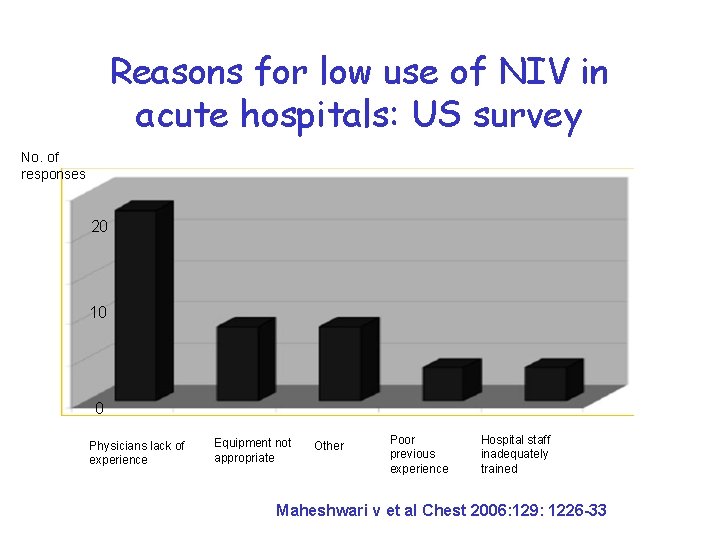
Reasons for low use of NIV in acute hospitals: US survey No. of responses 20 10 0 Physicians lack of experience Equipment not appropriate Other Poor previous experience Hospital staff inadequately trained Maheshwari v et al Chest 2006: 129: 1226 -33
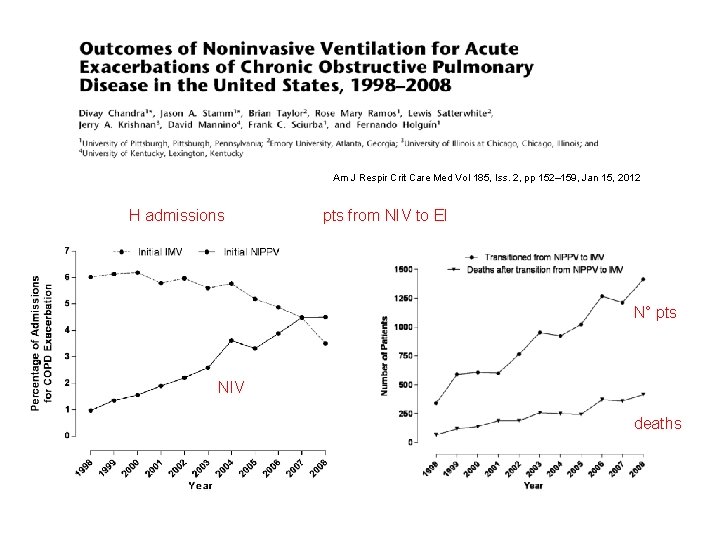
Am J Respir Crit Care Med Vol 185, Iss. 2, pp 152– 159, Jan 15, 2012 H admissions pts from NIV to EI N° pts NIV deaths
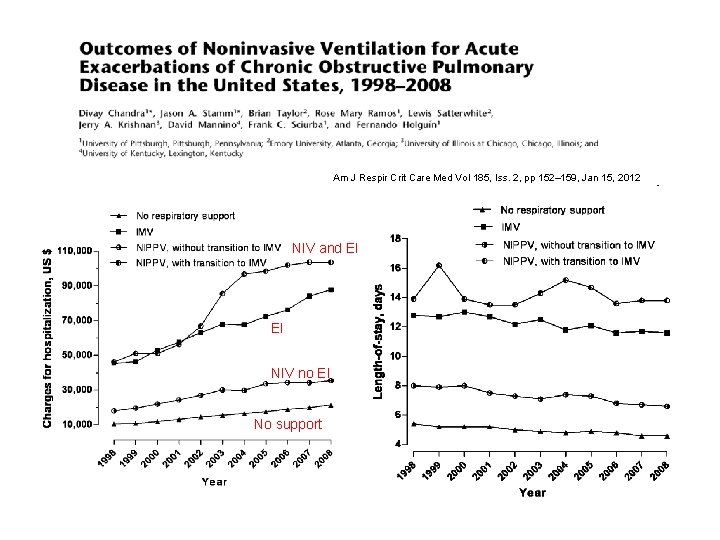
Am J Respir Crit Care Med Vol 185, Iss. 2, pp 152– 159, Jan 15, 2012 NIV and EI EI NIV no EI No support
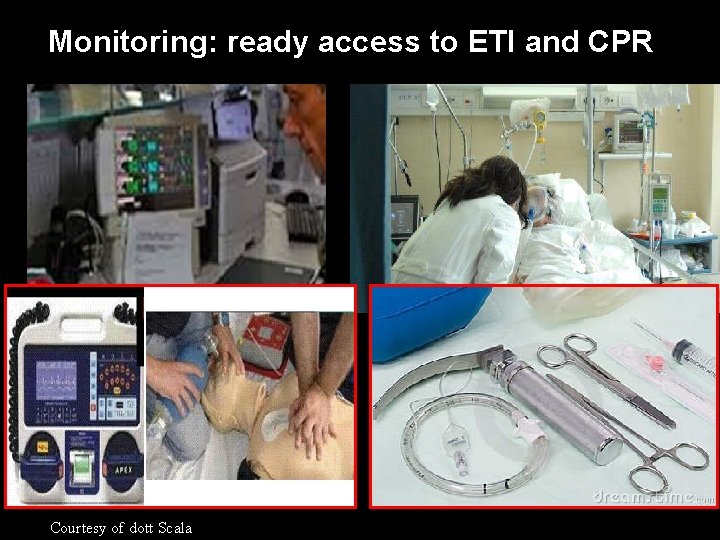
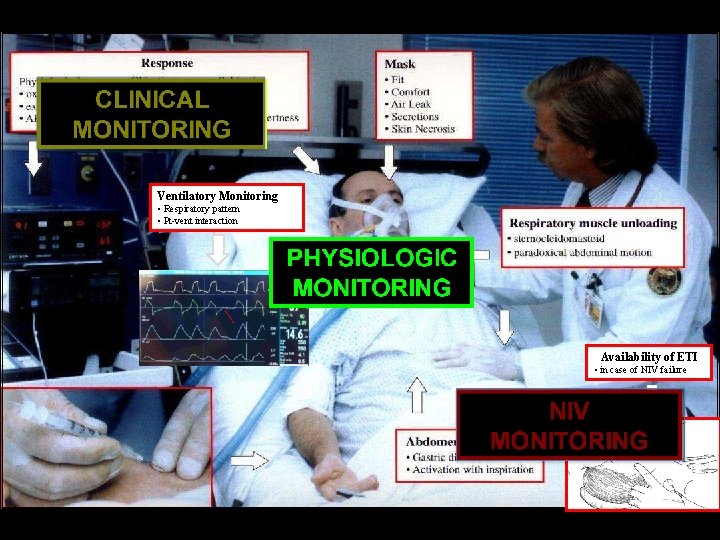
Monitoring: ready access to ETI and CPR Courtesy of dott Scala
Monitoraggio
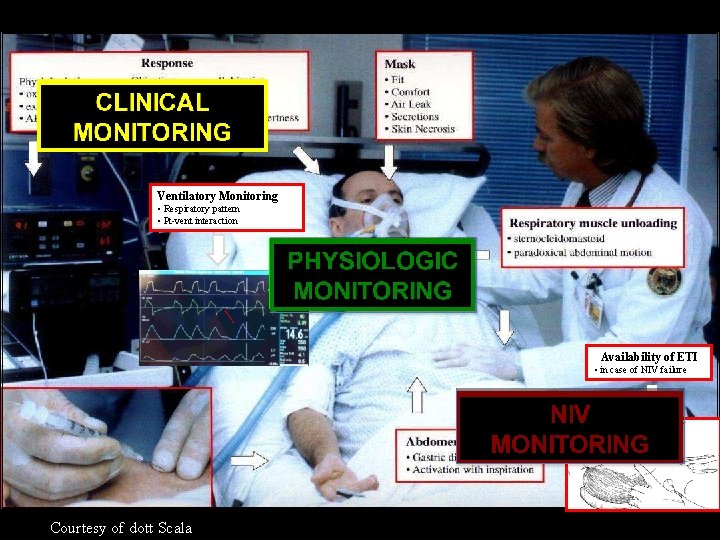
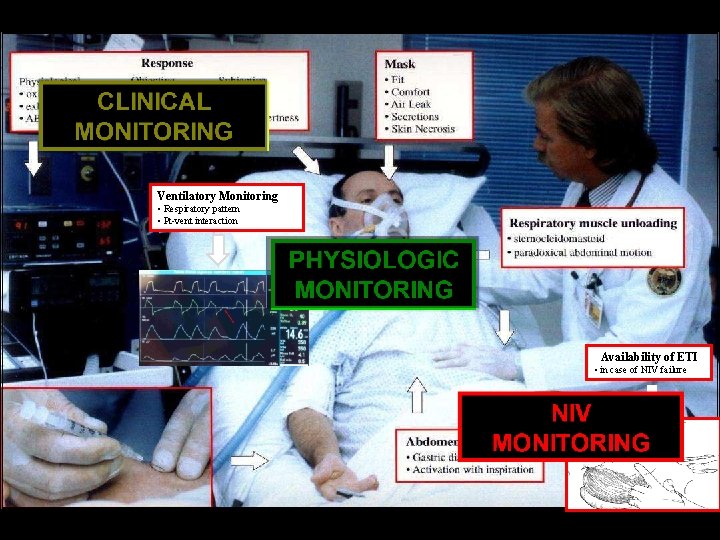
Ventilatory Monitoring • Respiratory pattern • Pt-vent interaction Availability of ETI • in case of NIV failure Courtesy of dott Scala
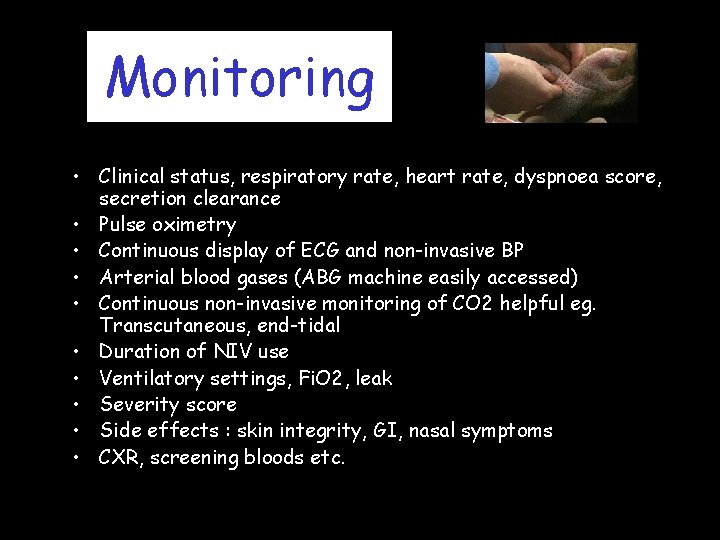
Monitoring • Clinical status, respiratory rate, heart rate, dyspnoea score, secretion clearance • Pulse oximetry • Continuous display of ECG and non-invasive BP • Arterial blood gases (ABG machine easily accessed) • Continuous non-invasive monitoring of CO 2 helpful eg. Transcutaneous, end-tidal • Duration of NIV use • Ventilatory settings, Fi. O 2, leak • Severity score • Side effects : skin integrity, GI, nasal symptoms • CXR, screening bloods etc. Simonds ERS school
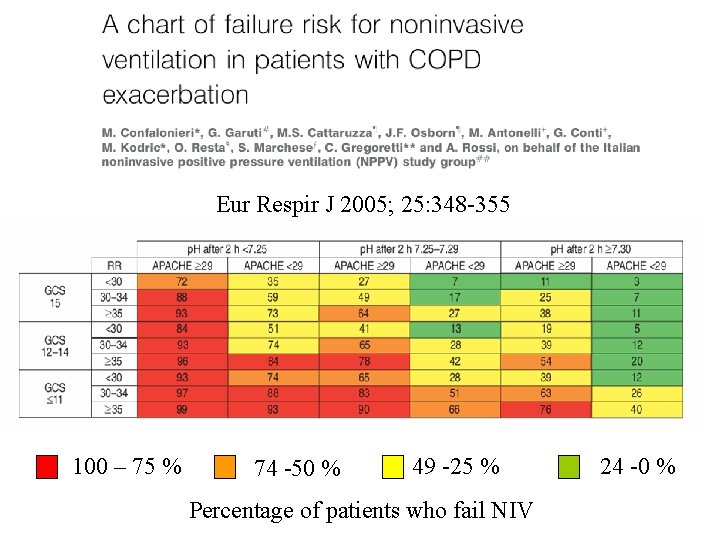
Eur Respir J 2005; 25: 348 -355 100 – 75 % 74 -50 % 49 -25 % Percentage of patients who fail NIV 24 -0 %
Ventilatory Monitoring • Respiratory pattern • Pt-vent interaction Availability of ETI • in case of NIV failure
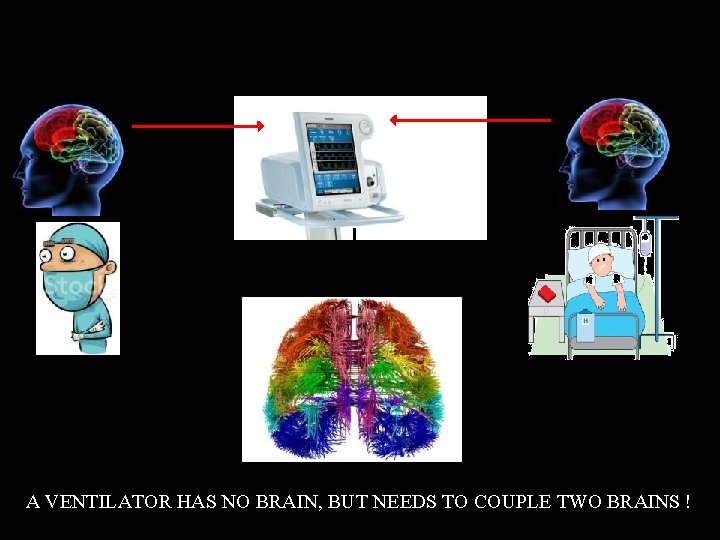
YOU HAVE……. A VENTILATOR HAS NO BRAIN, BUT NEEDS TO COUPLE TWO BRAINS !
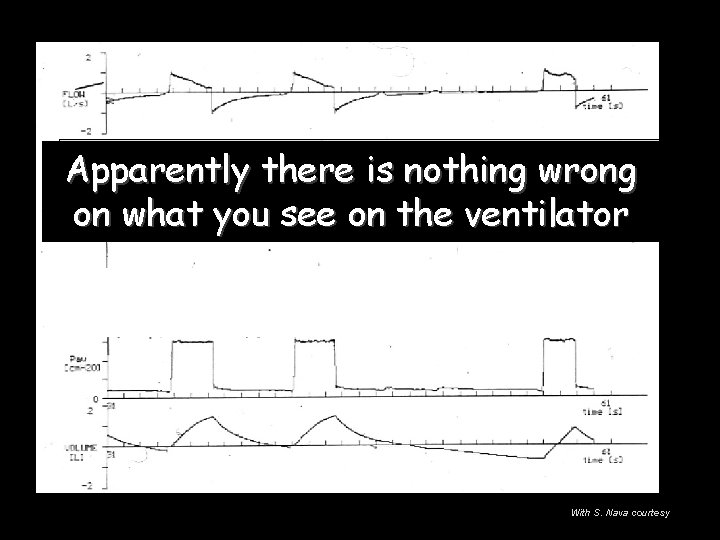
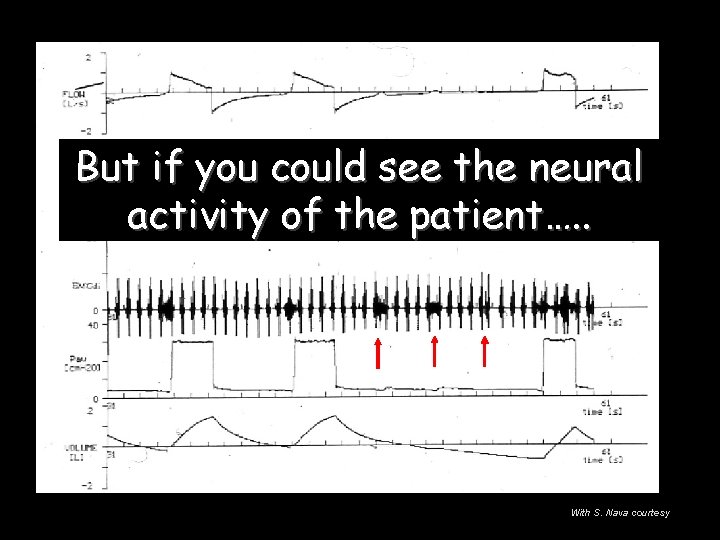
Apparently there is nothing wrong on what you see on the ventilator With S. Nava courtesy
But if you could see the neural activity of the patient…. . With S. Nava courtesy
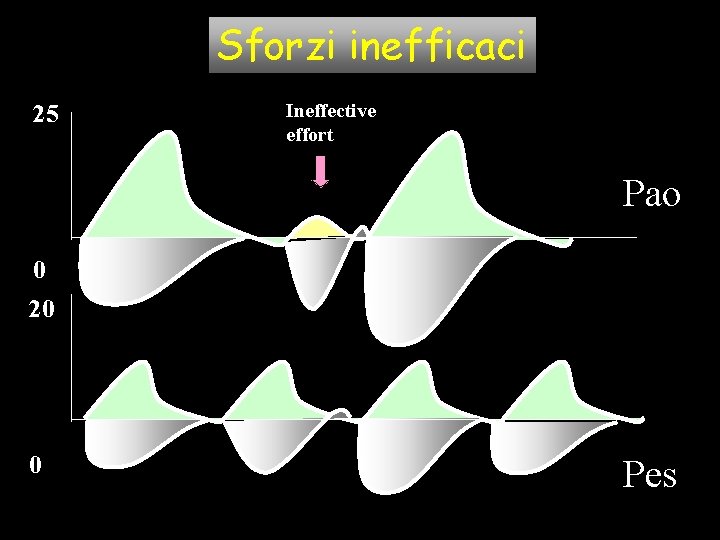
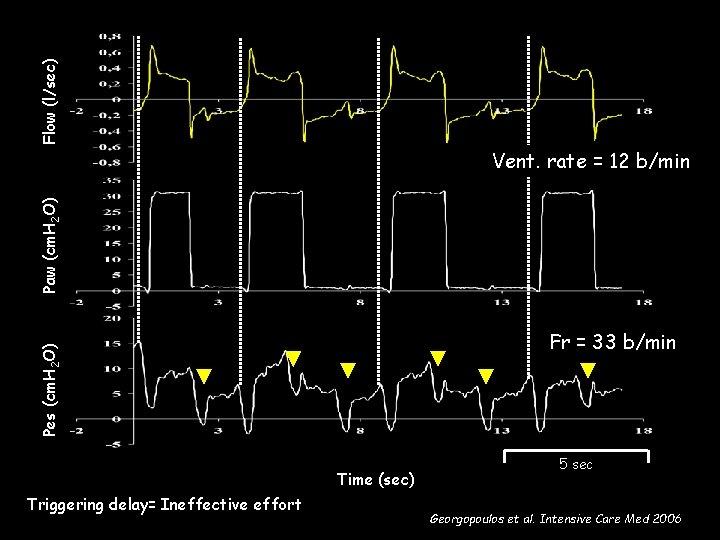
Sforzi inefficaci 25 Ineffective effort Pao 0 20 0 Pes
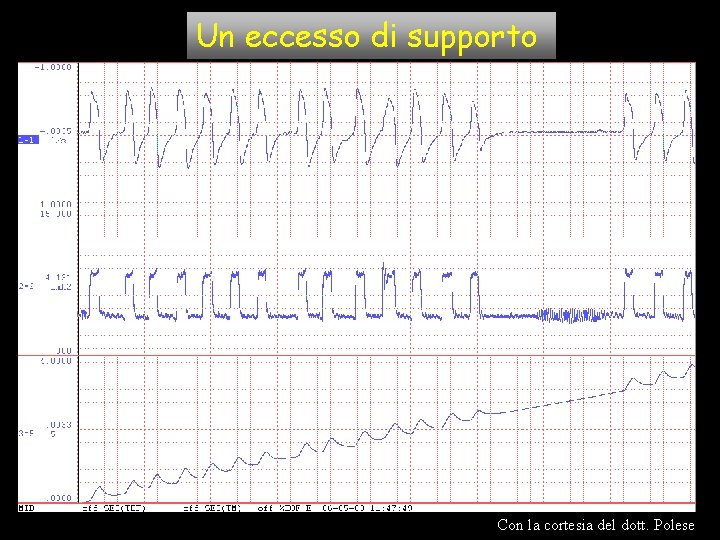
Un eccesso di supporto Con la cortesia del dott. Polese
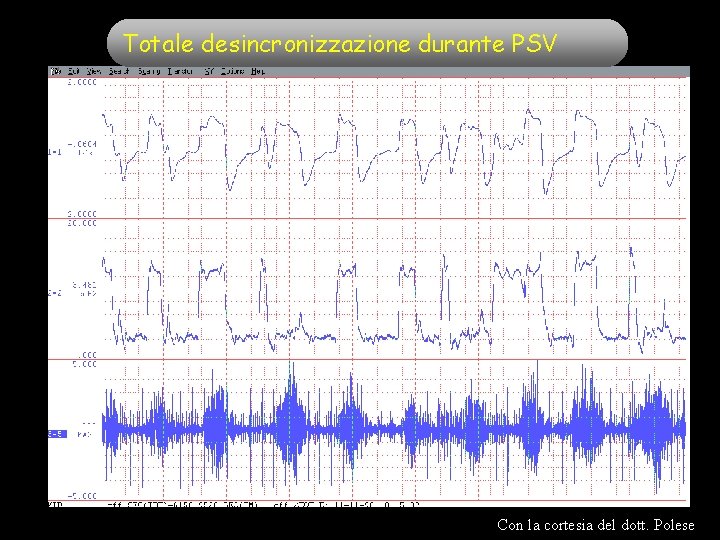
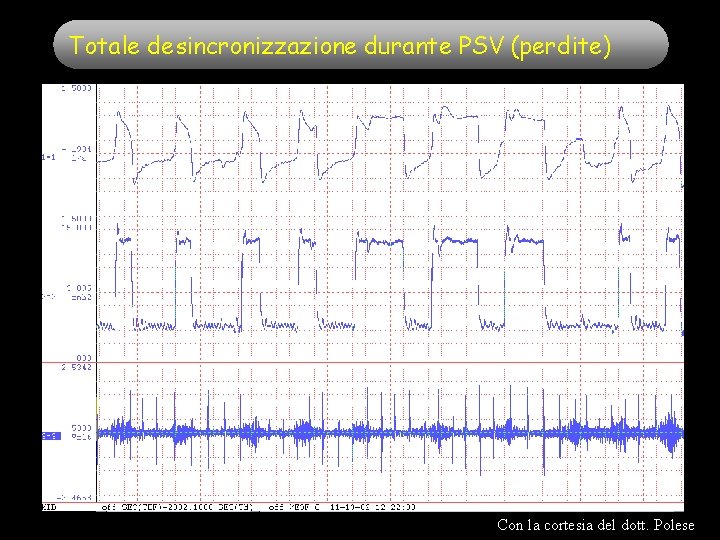
Totale desincronizzazione durante PSV Con la cortesia del dott. Polese
Totale desincronizzazione durante PSV (perdite) Con la cortesia del dott. Polese
Flow (l/sec) Paw (cm. H 2 O) Vent. rate = 12 b/min Pes (cm. H 2 O) Fr = 33 b/min Time (sec) Triggering delay= Ineffective effort 5 sec Georgopoulos et al. Intensive Care Med 2006
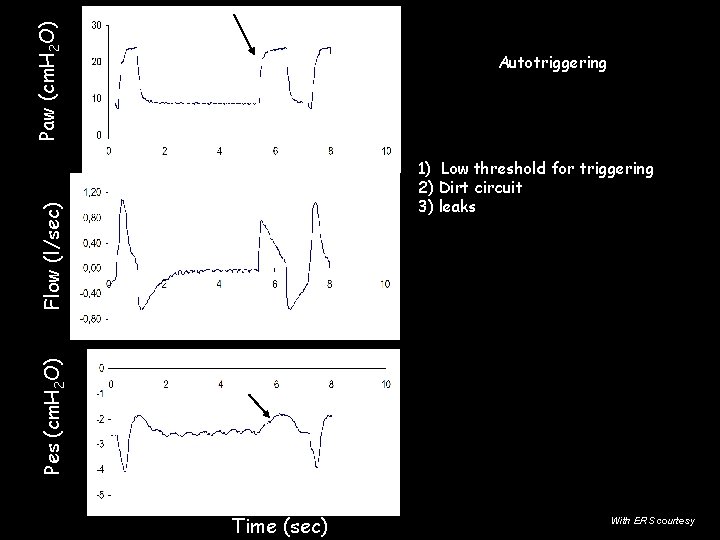
Paw (cm. H 2 O) Autotriggering Pes (cm. H 2 O) Flow (l/sec) 1) Low threshold for triggering 2) Dirt circuit 3) leaks Time (sec) With ERS courtesy
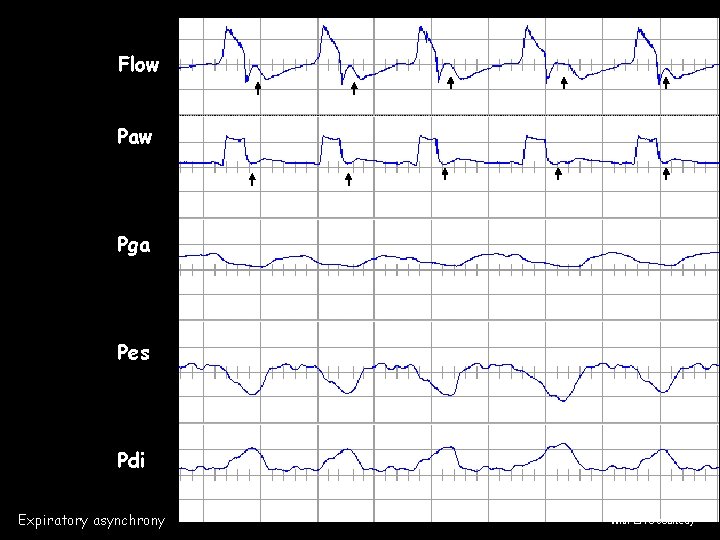
Flow Paw Pga Pes Pdi Expiratory asynchrony With ERS courtesy
Controlla il setting diurno e notturno
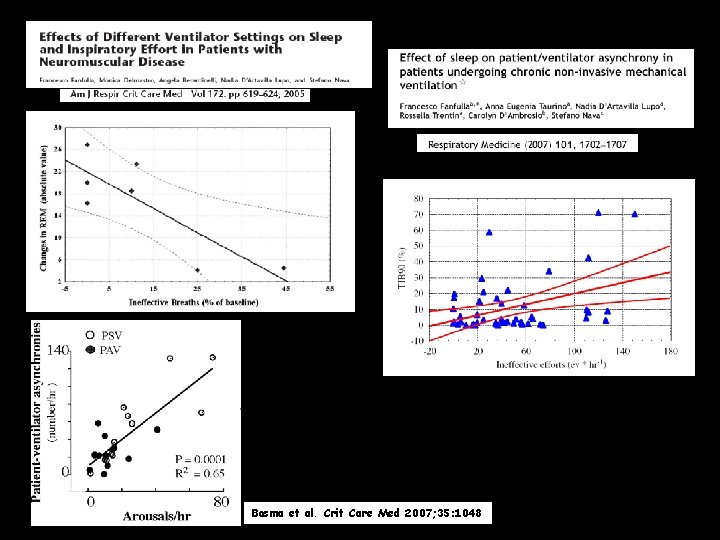
Bosma et al. Crit Care Med 2007; 35: 1048
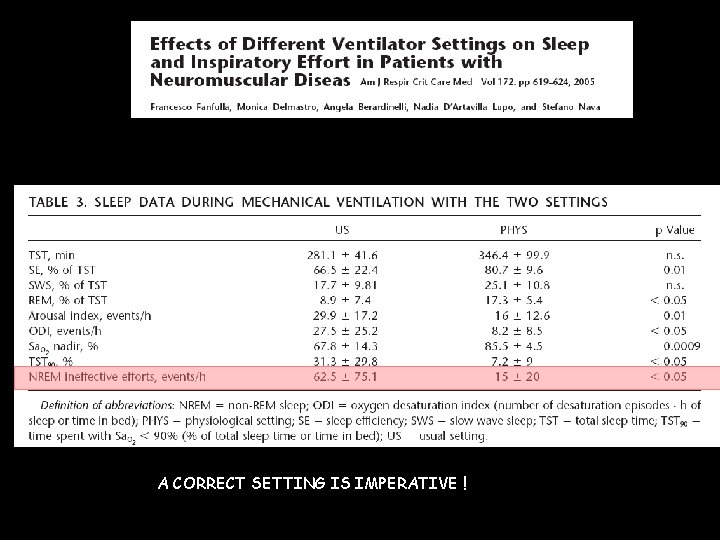
A CORRECT SETTING IS IMPERATIVE !
Ventilatory Monitoring • Respiratory pattern • Pt-vent interaction Availability of ETI • in case of NIV failure
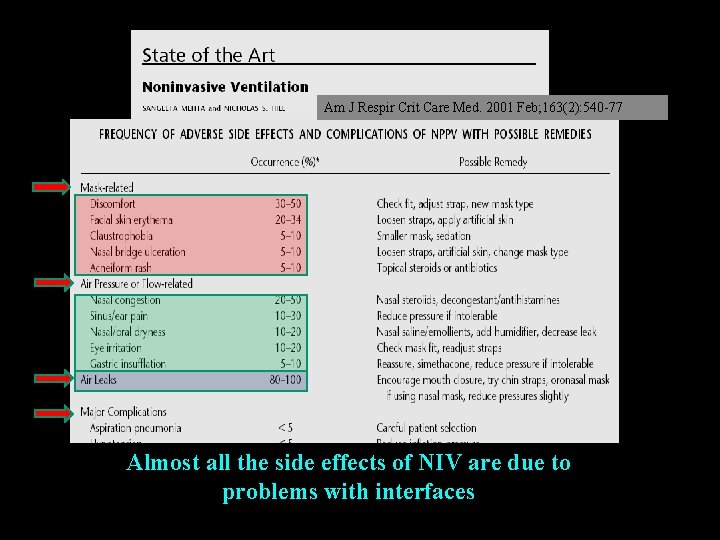
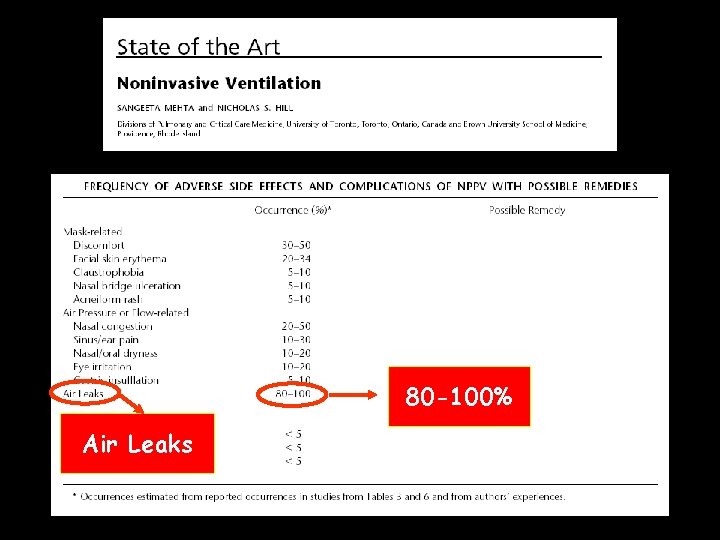
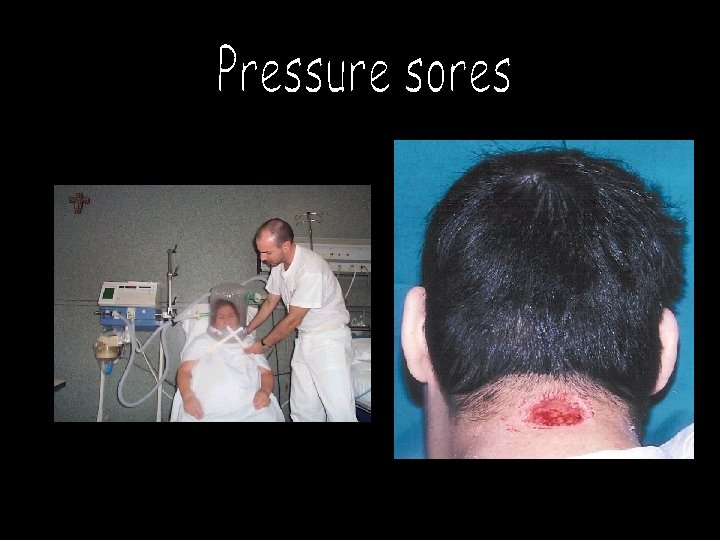
Am J Respir Crit Care Med. 2001 Feb; 163(2): 540 -77 Almost all the side effects of NIV are due to problems with interfaces
80 -100% Air Leaks
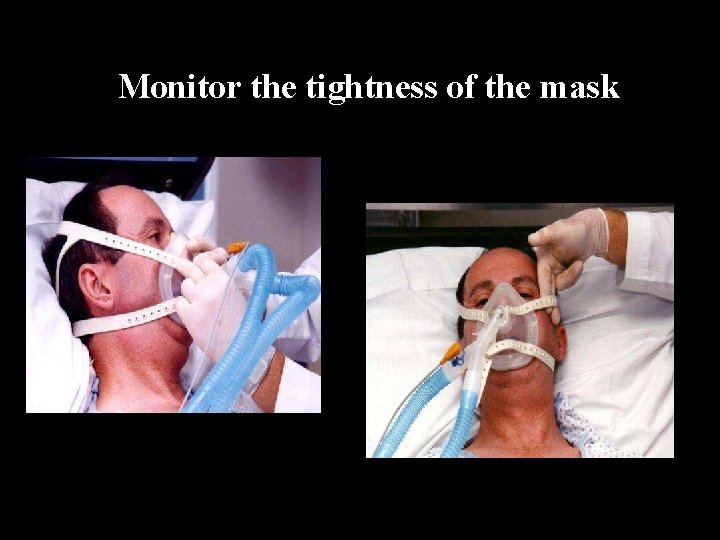
Monitor the tightness of the mask
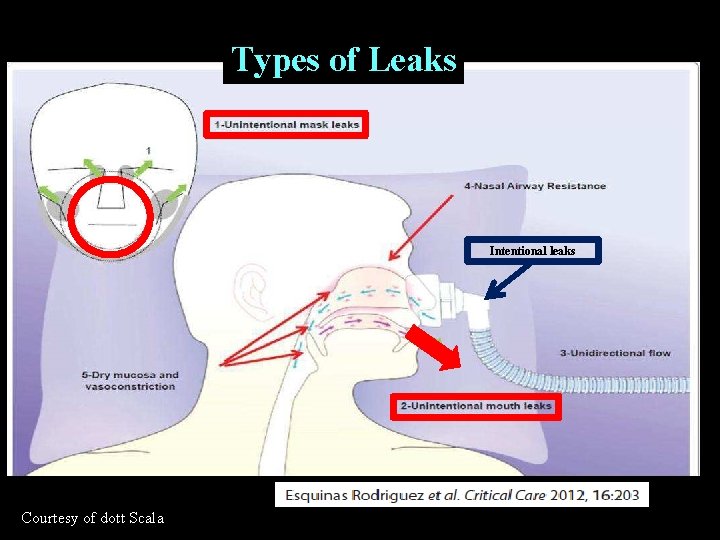
Types of Leaks Intentional leaks Courtesy of dott Scala
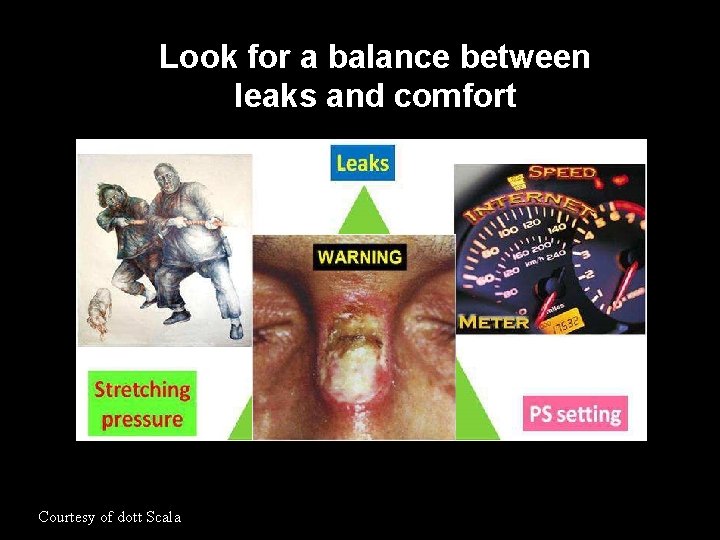
Look for a balance between leaks and comfort Courtesy of dott Scala
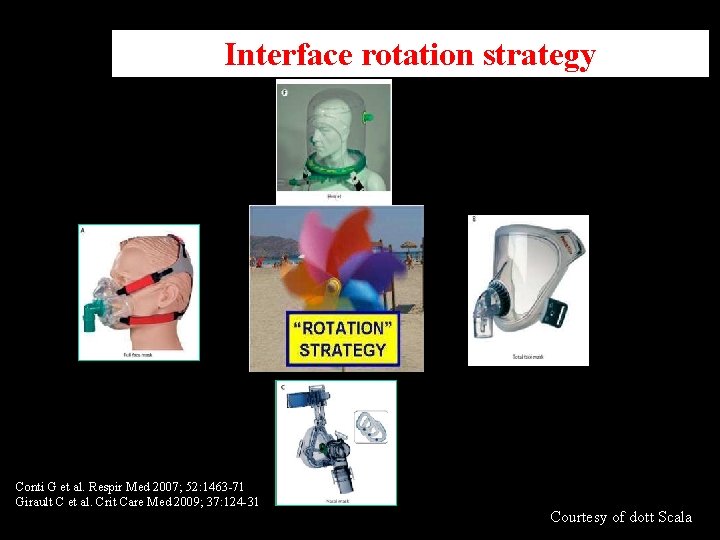
Interface rotation strategy Conti G et al. Respir Med 2007; 52: 1463 -71 Girault C et al. Crit Care Med 2009; 37: 124 -31 Courtesy of dott Scala
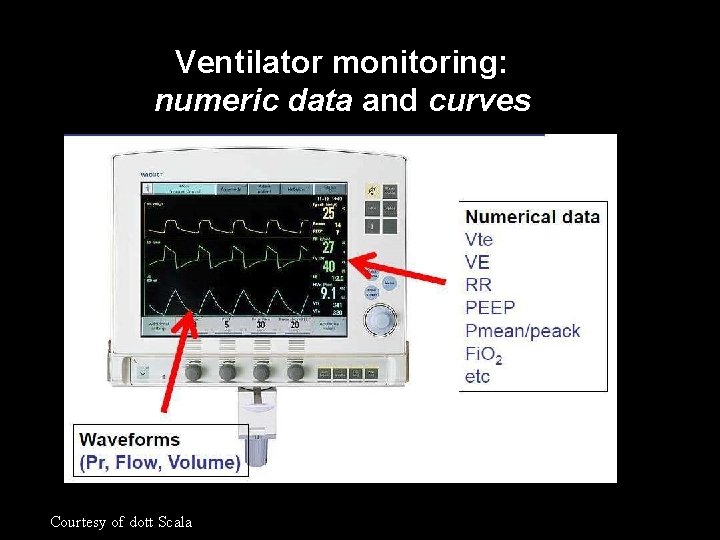
Ventilator monitoring: numeric data and curves Courtesy of dott Scala
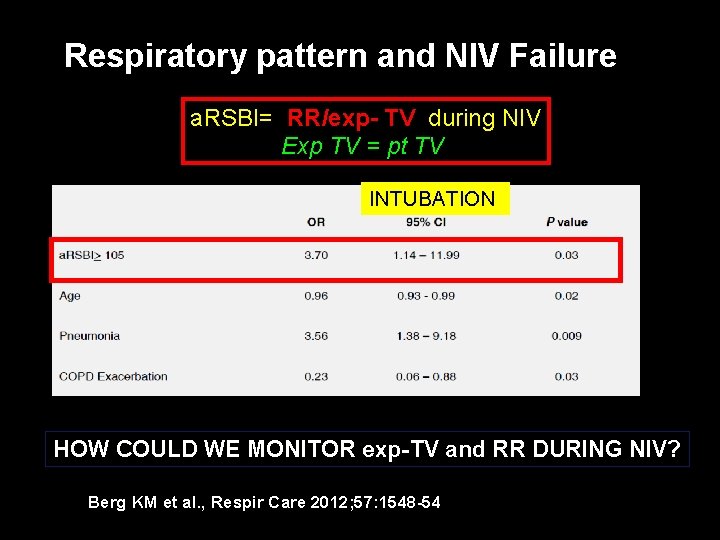
Respiratory pattern and NIV Failure a. RSBI= RR/exp- TV during NIV Exp TV = pt TV INTUBATION HOW COULD WE MONITOR exp-TV and RR DURING NIV? Berg KM et al. , Respir Care 2012; 57: 1548 -54
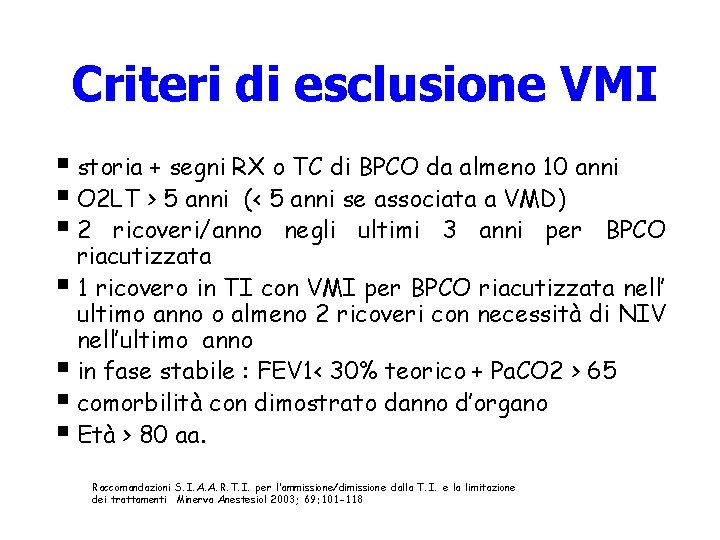
Criteri di esclusione VMI § storia + segni RX o TC di BPCO da almeno 10 anni § O 2 LT > 5 anni (< 5 anni se associata a VMD) § 2 ricoveri/anno negli ultimi 3 anni per BPCO riacutizzata § 1 ricovero in TI con VMI per BPCO riacutizzata nell’ ultimo anno o almeno 2 ricoveri con necessità di NIV nell’ultimo anno § in fase stabile : FEV 1< 30% teorico + Pa. CO 2 > 65 § comorbilità con dimostrato danno d’organo § Età > 80 aa. Raccomandazioni S. I. A. A. R. T. I. per l’ammissione/dimissione dalla T. I. e la limitazione dei trattamenti Minerva Anestesiol 2003; 69: 101 -118
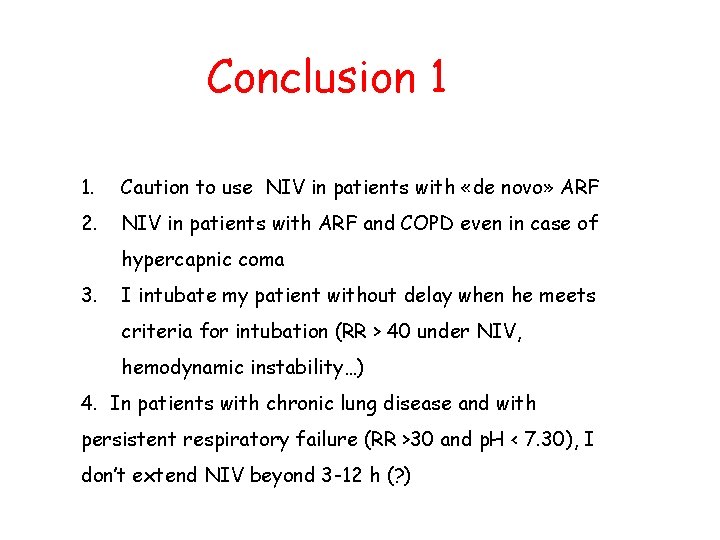
Conclusion 1 1. Caution to use NIV in patients with «de novo» ARF 2. NIV in patients with ARF and COPD even in case of hypercapnic coma 3. I intubate my patient without delay when he meets criteria for intubation (RR > 40 under NIV, hemodynamic instability…) 4. In patients with chronic lung disease and with persistent respiratory failure (RR >30 and p. H < 7. 30), I don’t extend NIV beyond 3 -12 h (? )
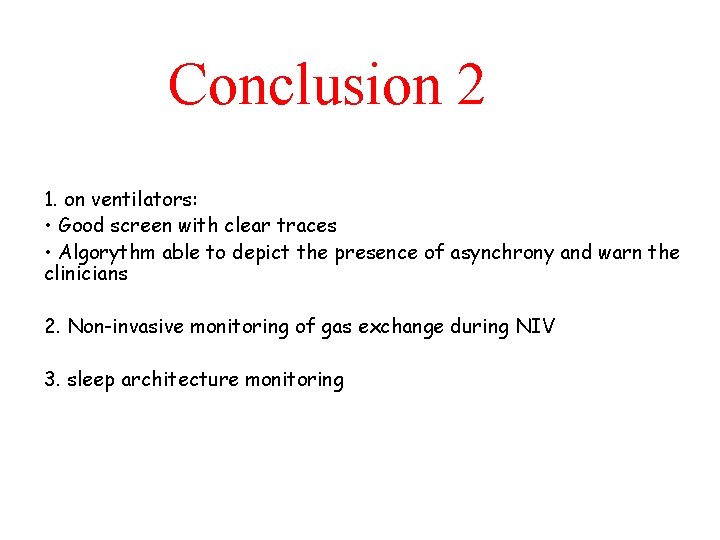
Conclusion 2 1. on ventilators: • Good screen with clear traces • Algorythm able to depict the presence of asynchrony and warn the clinicians 2. Non-invasive monitoring of gas exchange during NIV 3. sleep architecture monitoring
Conclusion 3 • Knowledge, skills, technical competence and experience in NIV is important • Training must be multidisciplinary and on going: train the team and “measure the treasure” • Provide opportunity for deliberate practice: consider the use of simulation-based education • Teach about patients, not diseases
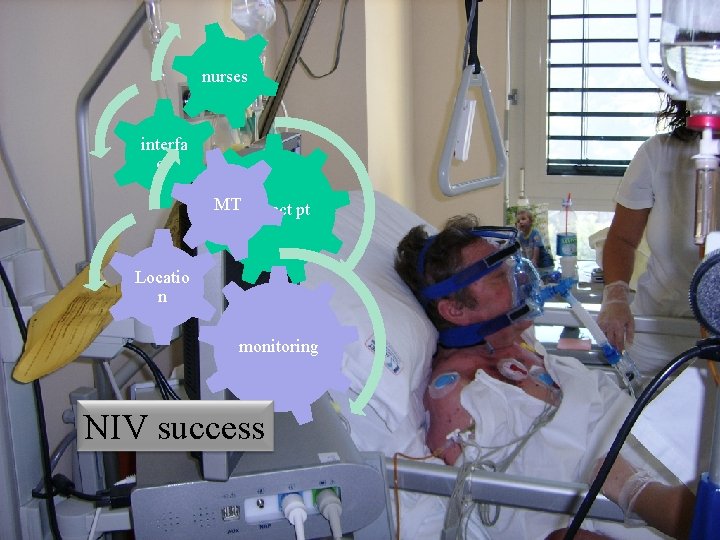
nurses interfa ce MTCorrect pt Locatio n monitoring NIV success