
m v MOL p Chemistry Unit 6 The




- Slides: 30
m v MOL p Chemistry Unit 6: The Mathematics of Chemical Formulas SO 3 C a 2 N . O 3 1 H 0 O 2 Cu(OH)2
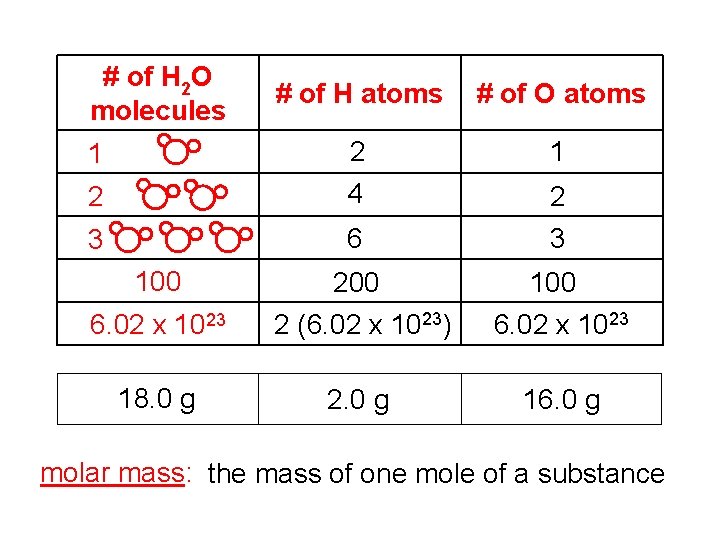
# of H 2 O molecules # of H atoms # of O atoms 1 2 4 2 3 6 3 100 200 100 6. 02 x 1023 2 (6. 02 x 1023) 6. 02 x 1023 18. 0 g 2. 0 g 16. 0 g molar mass: the mass of one mole of a substance
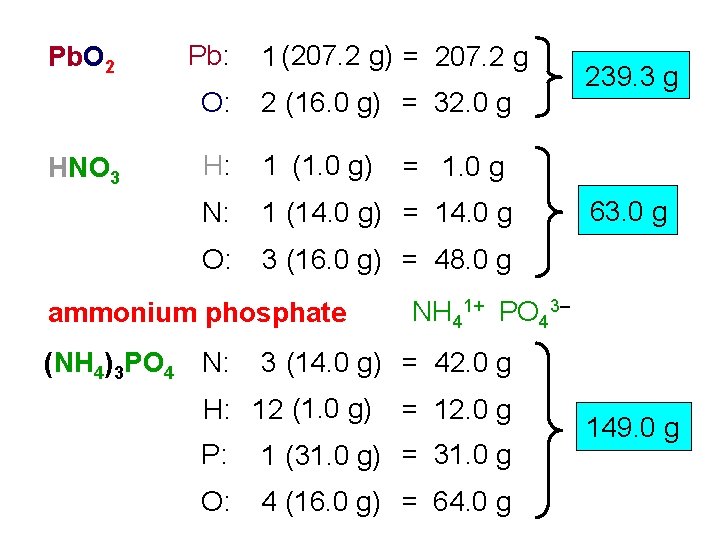
Pb. O 2 HNO 3 Pb: 1 (207. 2 g) = 207. 2 g O: 2 (16. 0 g) = 32. 0 g H: 1 (1. 0 g) N: 1 (14. 0 g) = 14. 0 g O: 3 (16. 0 g) = 48. 0 g ammonium phosphate (NH 4)3 PO 4 N: 239. 3 g = 1. 0 g 63. 0 g NH 41+ PO 43– 3 (14. 0 g) = 42. 0 g H: 12 (1. 0 g) = 12. 0 g P: 1 (31. 0 g) = 31. 0 g O: 4 (16. 0 g) = 64. 0 g 149. 0 g
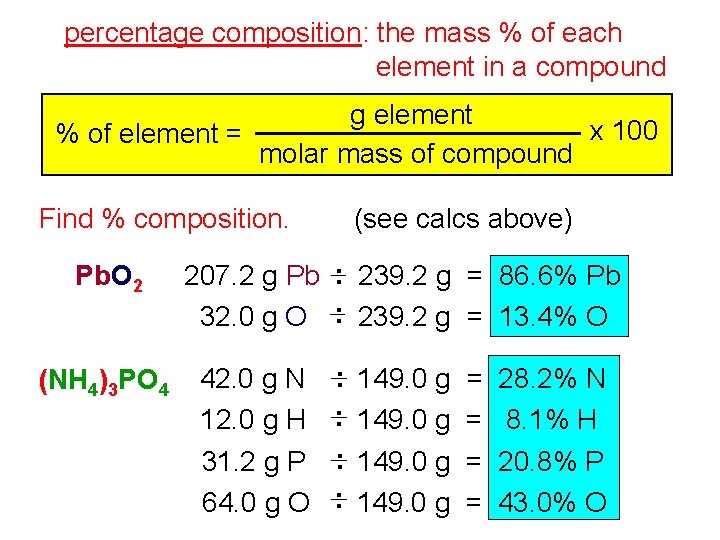
percentage composition: the mass % of each element in a compound g element x 100 % of element = molar mass of compound Find % composition. Pb. O 2 (NH 4)3 PO 4 (see calcs above) 207. 2 g Pb : 239. 2 g = 86. 6% Pb 32. 0 g O : 239. 2 g = 13. 4% O 42. 0 g N 12. 0 g H 31. 2 g P 64. 0 g O : 149. 0 g = = 28. 2% N 8. 1% H 20. 8% P 43. 0% O
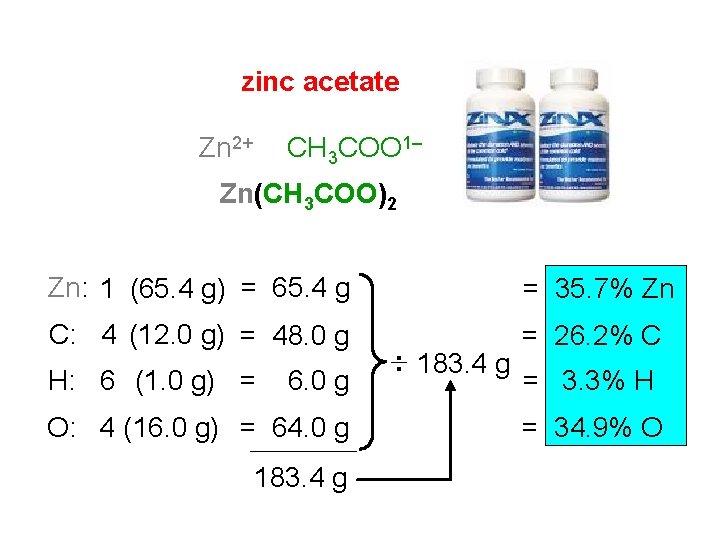
zinc acetate Zn 2+ CH 3 COO 1– Zn(CH 3 COO)2 Zn: 1 (65. 4 g) = 65. 4 g = 35. 7% Zn C: 4 (12. 0 g) = 48. 0 g = 26. 2% C H: 6 (1. 0 g) = 6. 0 g O: 4 (16. 0 g) = 64. 0 g 183. 4 g : 183. 4 g = 3. 3% H = 34. 9% O
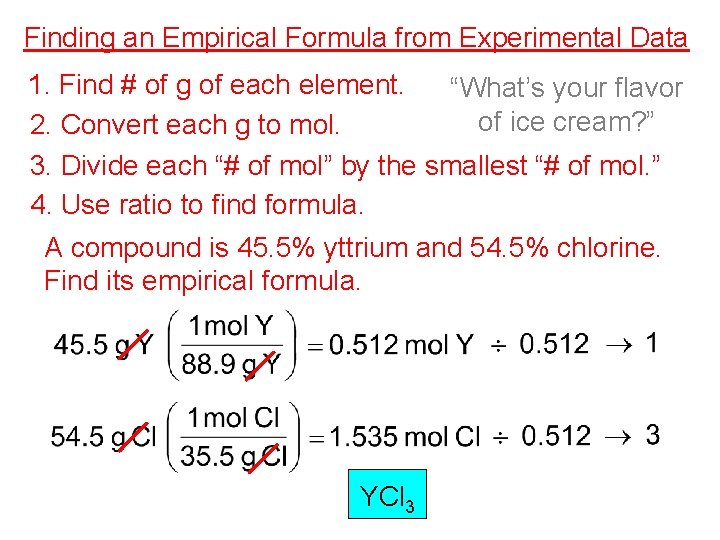
Finding an Empirical Formula from Experimental Data 1. Find # of g of each element. “What’s your flavor of ice cream? ” 2. Convert each g to mol. 3. Divide each “# of mol” by the smallest “# of mol. ” 4. Use ratio to find formula. A compound is 45. 5% yttrium and 54. 5% chlorine. Find its empirical formula. YCl 3
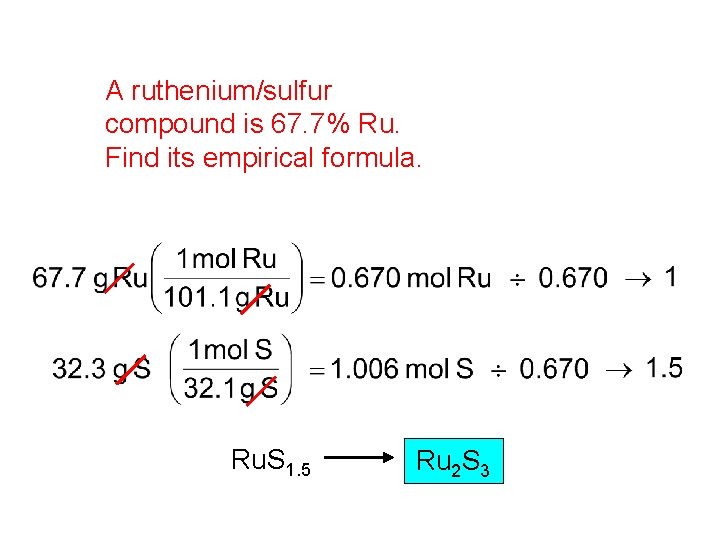
A ruthenium/sulfur compound is 67. 7% Ru. Find its empirical formula. Ru. S 1. 5 Ru 2 S 3
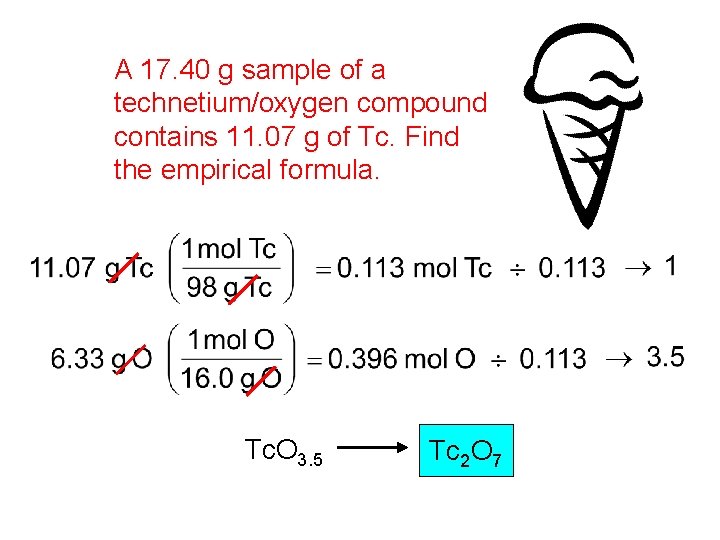
A 17. 40 g sample of a technetium/oxygen compound contains 11. 07 g of Tc. Find the empirical formula. Tc. O 3. 5 Tc 2 O 7
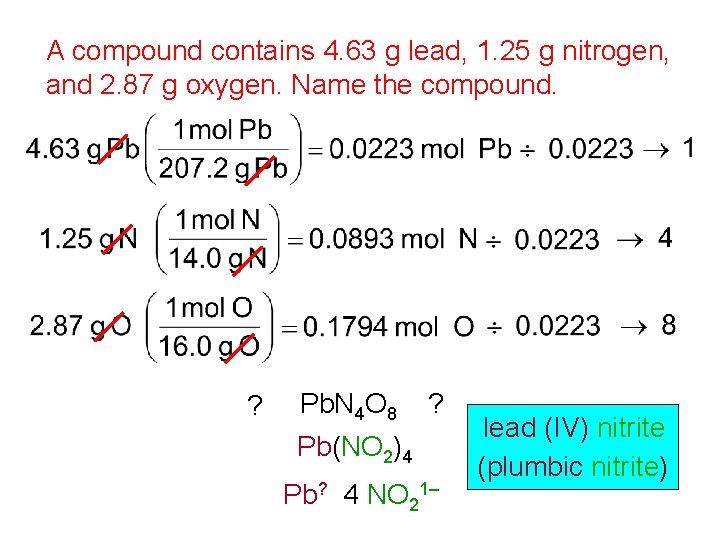
A compound contains 4. 63 g lead, 1. 25 g nitrogen, and 2. 87 g oxygen. Name the compound. ? Pb. N 4 O 8 ? Pb(NO 2)4 Pb? 4 NO 21– lead (IV) nitrite (plumbic nitrite)
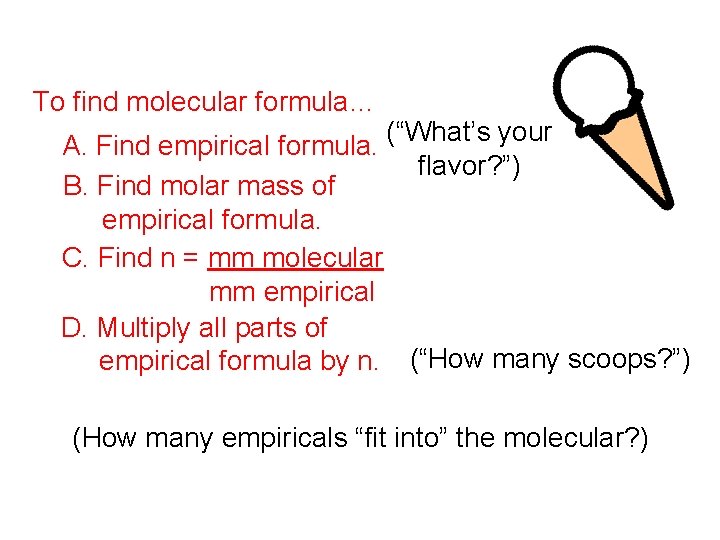
To find molecular formula… (“What’s your A. Find empirical formula. flavor? ”) B. Find molar mass of empirical formula. C. Find n = mm molecular mm empirical D. Multiply all parts of empirical formula by n. (“How many scoops? ”) (How many empiricals “fit into” the molecular? )
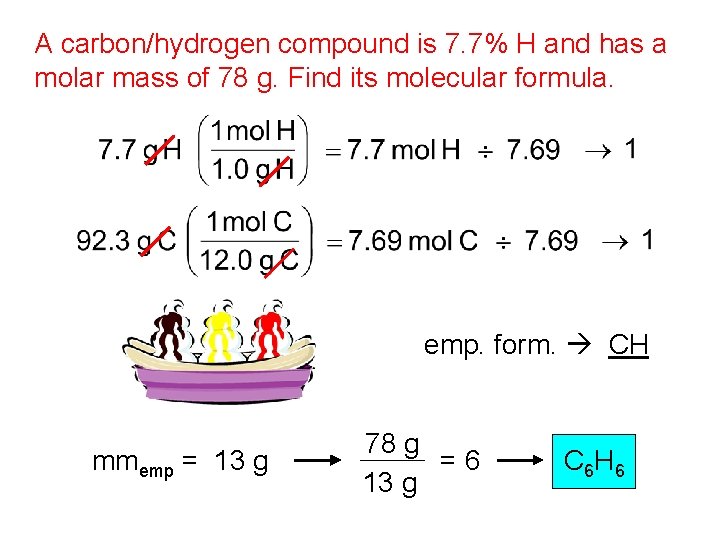
A carbon/hydrogen compound is 7. 7% H and has a molar mass of 78 g. Find its molecular formula. emp. form. CH mmemp = 13 g 78 g =6 13 g C 6 H 6
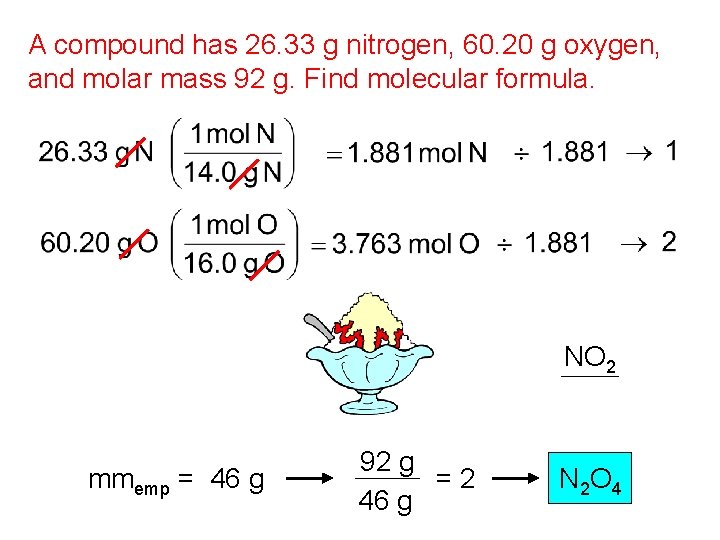
A compound has 26. 33 g nitrogen, 60. 20 g oxygen, and molar mass 92 g. Find molecular formula. NO 2 mmemp = 46 g 92 g =2 46 g N 2 O 4
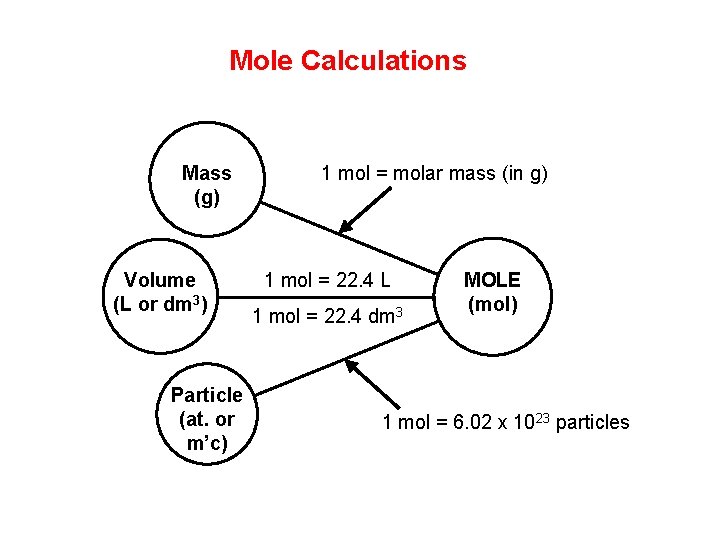
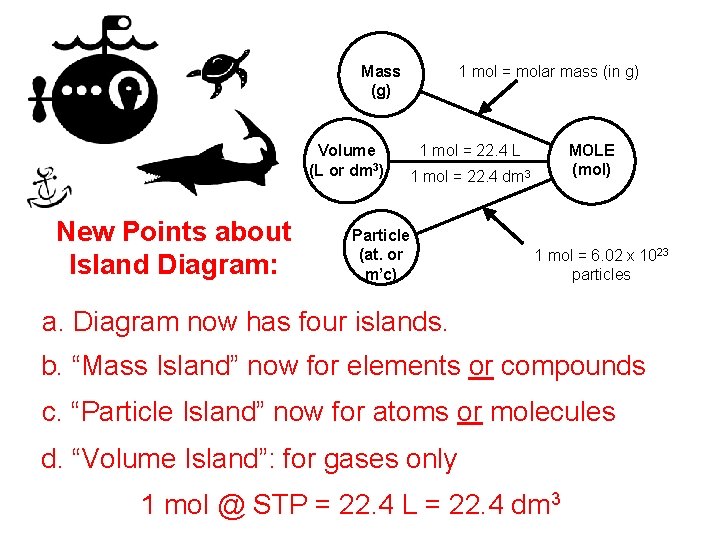
Mole Calculations Mass (g) Volume (L or dm 3) Particle (at. or m’c) 1 mol = molar mass (in g) 1 mol = 22. 4 L 1 mol = 22. 4 dm 3 MOLE (mol) 1 mol = 6. 02 x 1023 particles
1 mol = molar mass (in g) Mass (g) Volume (L or dm 3) New Points about Island Diagram: 1 mol = 22. 4 L MOLE (mol) 1 mol = 22. 4 dm 3 Particle (at. or m’c) 1 mol = 6. 02 x 1023 particles a. Diagram now has four islands. b. “Mass Island” now for elements or compounds c. “Particle Island” now for atoms or molecules d. “Volume Island”: for gases only 1 mol @ STP = 22. 4 L = 22. 4 dm 3
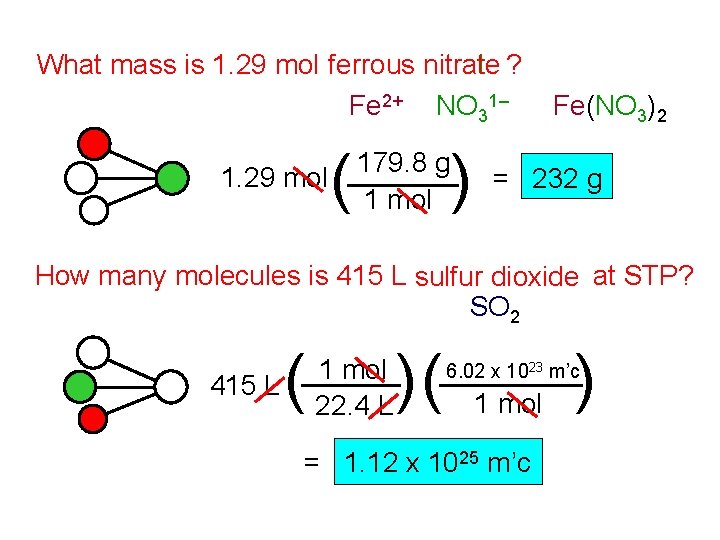
What mass is 1. 29 mol ferrous nitrate ? Fe 2+ NO 31– 1. 29 mol ( ) 179. 8 g 1 mol Fe(NO 3)2 = 232 g How many molecules is 415 L sulfur dioxide at STP? SO 2 415 L ( 1 mol 22. 4 L )( ) 6. 02 x 1023 m’c 1 mol = 1. 12 x 1025 m’c
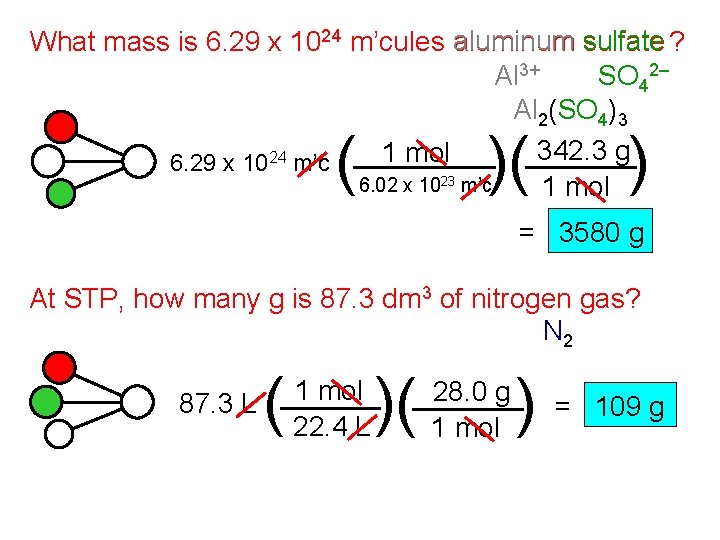
What mass is 6. 29 x 1024 m’cules aluminum sulfate ? Al 3+ SO 42– Al 2(SO 4)3 342. 3 g 1 mol 6. 29 x 1024 m’c 6. 02 x 1023 m’c 1 mol ( )( ) = 3580 g At STP, how many g is 87. 3 dm 3 of nitrogen gas? N 2 87. 3 L ( 1 mol 22. 4 L )( 28. 0 g 1 mol )= 109 g
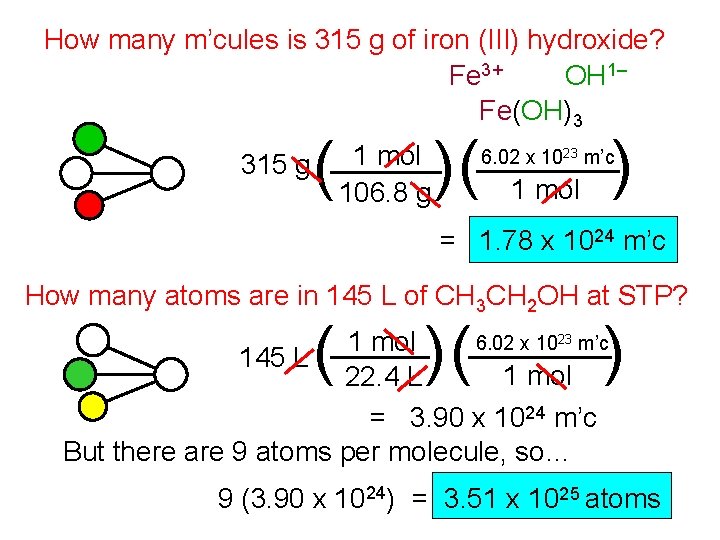
How many m’cules is 315 g of iron (III) hydroxide? Fe 3+ OH 1– Fe(OH)3 ( 1 mol 315 g 106. 8 g )( ) 6. 02 x 1023 m’c 1 mol = 1. 78 x 1024 m’c How many atoms are in 145 L of CH 3 CH 2 OH at STP? ( )( ) 6. 02 x 1023 m’c 1 mol 145 L 1 mol 22. 4 L = 3. 90 x 1024 m’c But there are 9 atoms per molecule, so… 9 (3. 90 x 1024) = 3. 51 x 1025 atoms
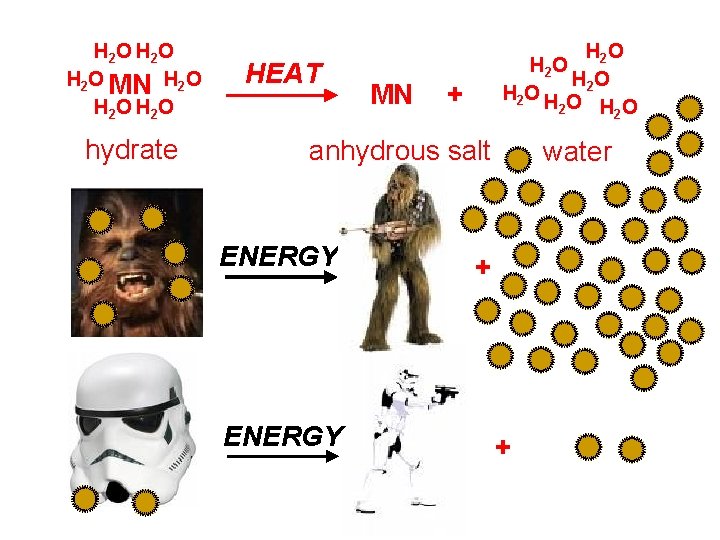
Hydrates and Anhydrous Salts anhydrous salt: an ionic compound (i. e. , a salt) that attracts water molecules and forms loose chemical bonds with them; symbolized by MN “anhydrous” = “without water” Uses: “desiccants” in leather goods, electronics, vitamins hydrate: an anhydrous salt with the water attached -- symbolized by MN. ? H 2 O Examples: Cu. SO 4. 5 H 2 O Na 2 CO 3. 10 H 2 O Ba. Cl 2. 2 H 2 O Fe. Cl 3. 6 H 2 O
H 2 O H 2 O MN H 2 O H 2 O hydrate HEAT MN H 2 O HO H 2 O H O 2 H 2 O 2 + anhydrous salt ENERGY water + +
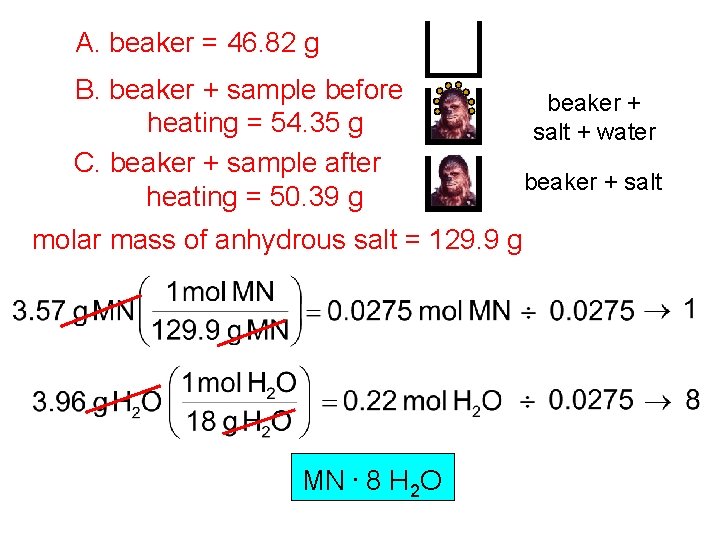
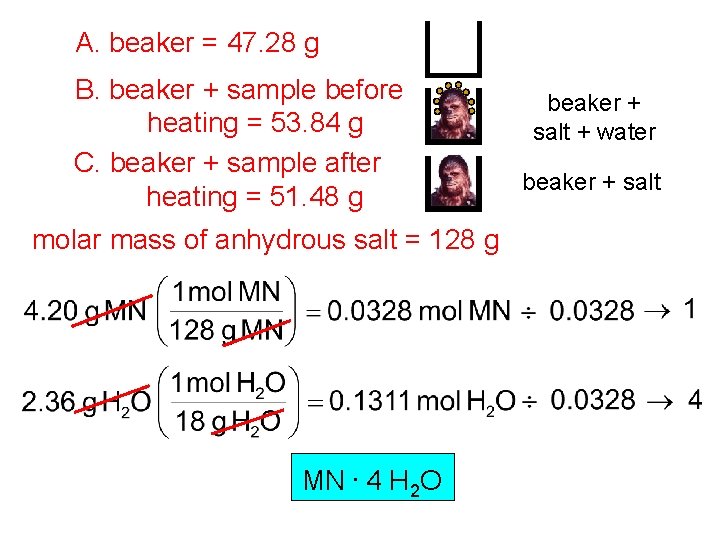
Finding the Formula of a Hydrate 1. Find the # of g of MN and # of g of H 2 O. 2. Convert g to mol. 3. Divide each “# of mol” by the smallest “# of mol. ” 4. Use the ratio to find the hydrate’s formula.
Find formula of hydrate for each problem. sample’s mass before heating = 4. 38 g MN. ? H 2 O (hydrate) sample’s mass after MN heating = 1. 93 g (anhydrous salt) molar mass of anhydrous salt = 85 g MN. 6 H 2 O
A. beaker = 46. 82 g B. beaker + sample before heating = 54. 35 g C. beaker + sample after heating = 50. 39 g molar mass of anhydrous salt = 129. 9 g MN. 8 H 2 O beaker + salt + water beaker + salt
A. beaker = 47. 28 g B. beaker + sample before heating = 53. 84 g C. beaker + sample after heating = 51. 48 g molar mass of anhydrous salt = 128 g MN. 4 H 2 O beaker + salt + water beaker + salt
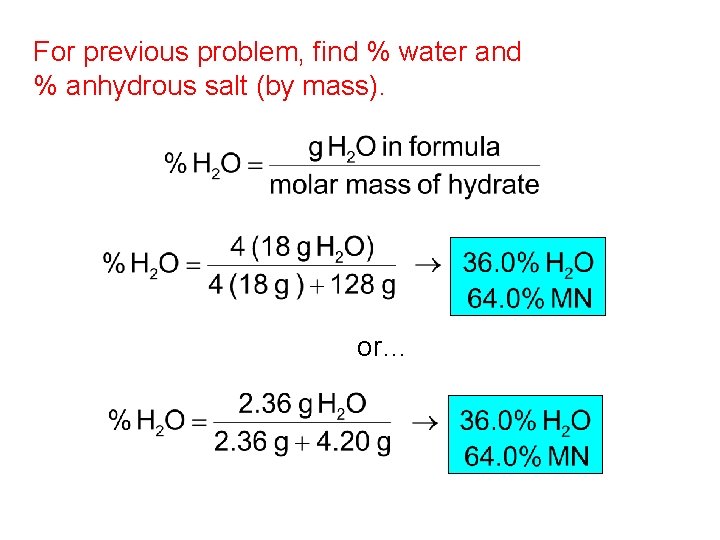
For previous problem, find % water and % anhydrous salt (by mass). or…
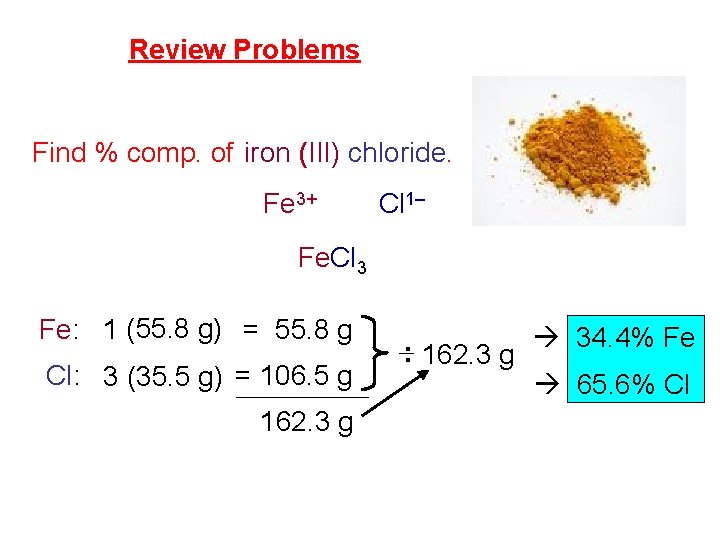
Review Problems Find % comp. of iron (III) chloride. Fe 3+ Cl 1– Fe. Cl 3 Fe: 1 (55. 8 g) = 55. 8 g Cl: 3 (35. 5 g) = 106. 5 g 162. 3 g : 162. 3 g 34. 4% Fe 65. 6% Cl
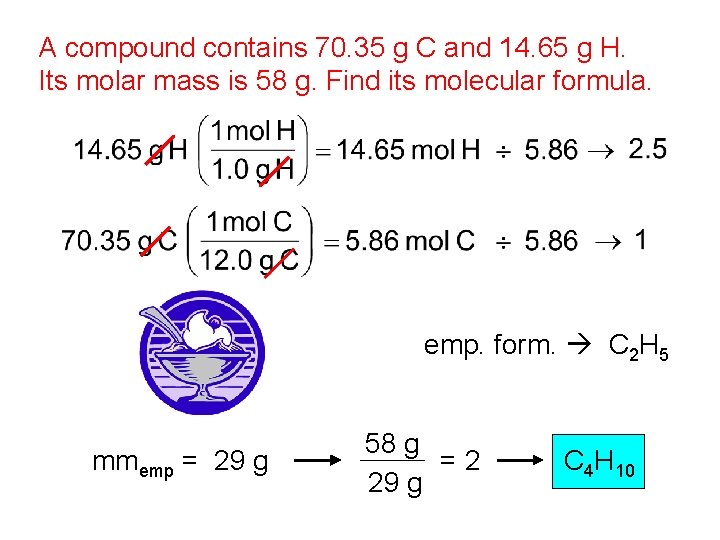
A compound contains 70. 35 g C and 14. 65 g H. Its molar mass is 58 g. Find its molecular formula. emp. form. C 2 H 5 mmemp = 29 g 58 g =2 29 g C 4 H 10
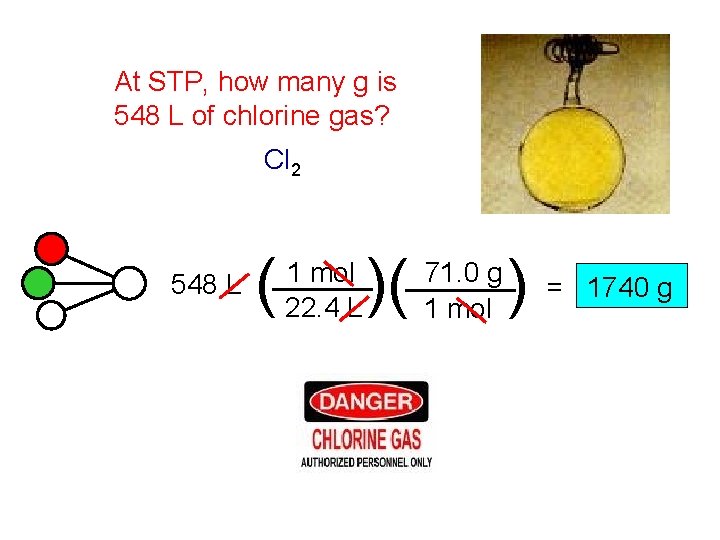
At STP, how many g is 548 L of chlorine gas? Cl 2 548 L ( 1 mol 22. 4 L )( 71. 0 g 1 mol )= 1740 g
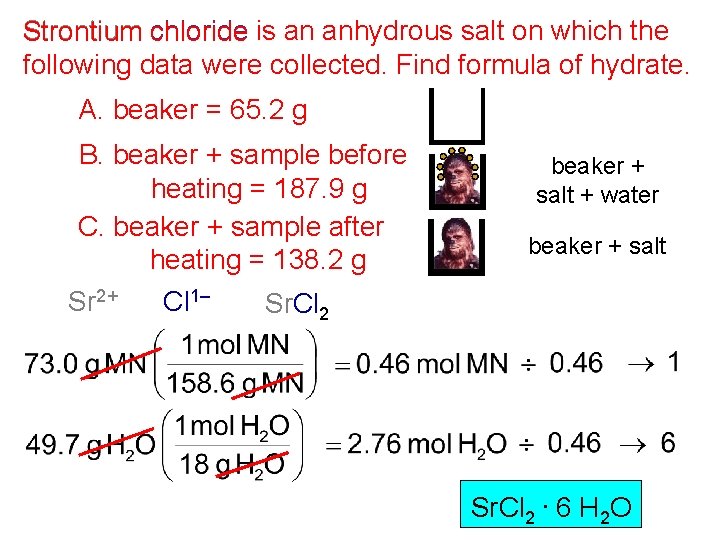
Strontium chloride is an anhydrous salt on which the following data were collected. Find formula of hydrate. A. beaker = 65. 2 g B. beaker + sample before heating = 187. 9 g C. beaker + sample after heating = 138. 2 g Sr 2+ Cl 1– Sr. Cl 2 beaker + salt + water beaker + salt Sr. Cl 2. 6 H 2 O
0 0
0 0