
m Track HighPrecision Passive Tracking Using Millimeter Wave


- Slides: 19
m. Track: High-Precision Passive Tracking Using Millimeter Wave Radios Teng Wei and Xinyu Zhang University of Wisconsin – Madison
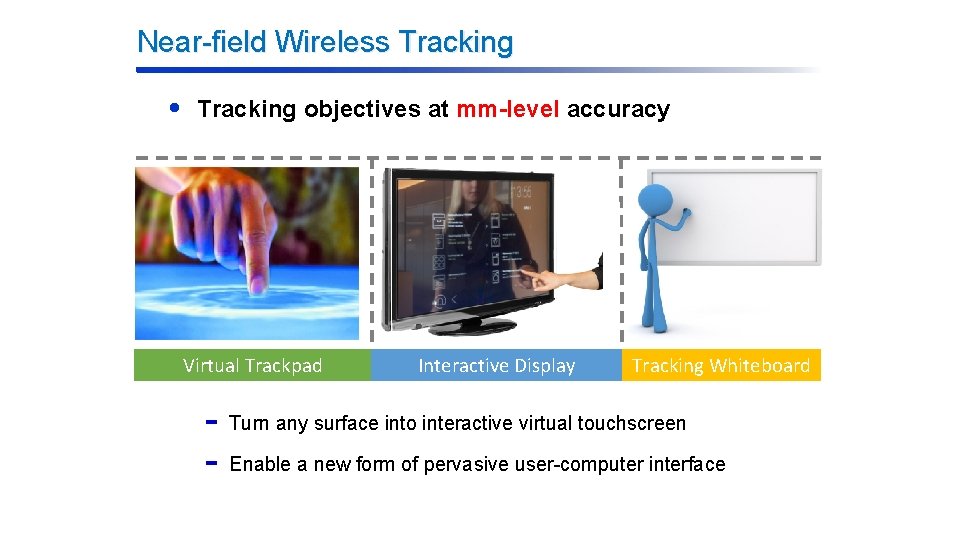
Near-field Wireless Tracking objectives at mm-level accuracy Virtual Trackpad Interactive Display Tracking Whiteboard Turn any surface into interactive virtual touchscreen Enable a new form of pervasive user-computer interface
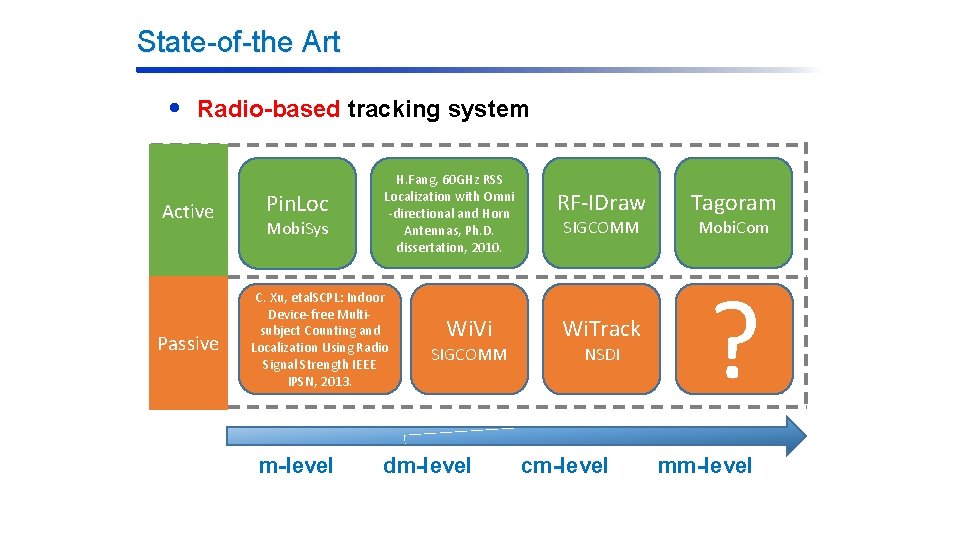
State-of-the Art Radio-based tracking system Active Passive Pin. Loc Mobi. Sys H. Fang, 60 GHz RSS Localization with Omni -directional and Horn Antennas, Ph. D. dissertation, 2010. C. Xu, etal. SCPL: Indoor Device-free Multisubject Counting and Localization Using Radio Signal Strength IEEE IPSN, 2013. m-level Wi. Vi SIGCOMM dm-level RF-IDraw Tagoram Wi. Track ? SIGCOMM NSDI cm-level Mobi. Com mm-level
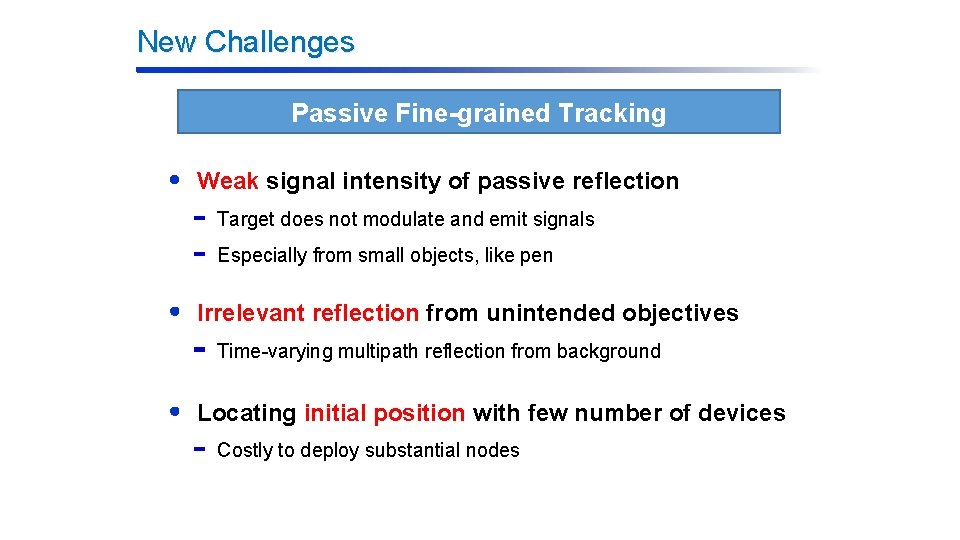
New Challenges Passive Fine-grained Tracking Weak signal intensity of passive reflection Target does not modulate and emit signals Especially from small objects, like pen Irrelevant reflection from unintended objectives Time-varying multipath reflection from background Locating initial position with few number of devices Costly to deploy substantial nodes
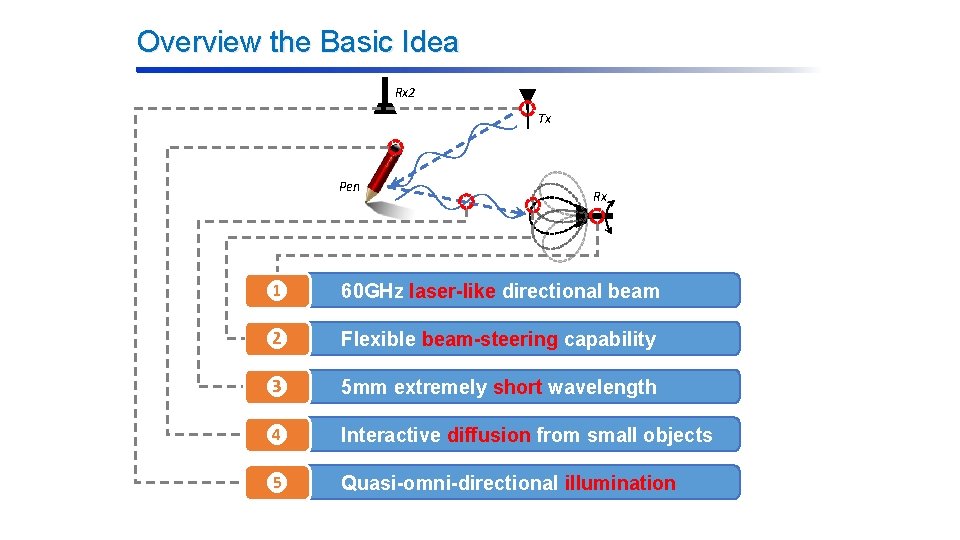
Overview the Basic Idea Rx 2 Tx Pen Rx ❶ 60 GHz laser-like directional beam ❷ Flexible beam-steering capability ❸ 5 mm extremely short wavelength ❹ Interactive diffusion from small objects ❺ Quasi-omni-directional illumination
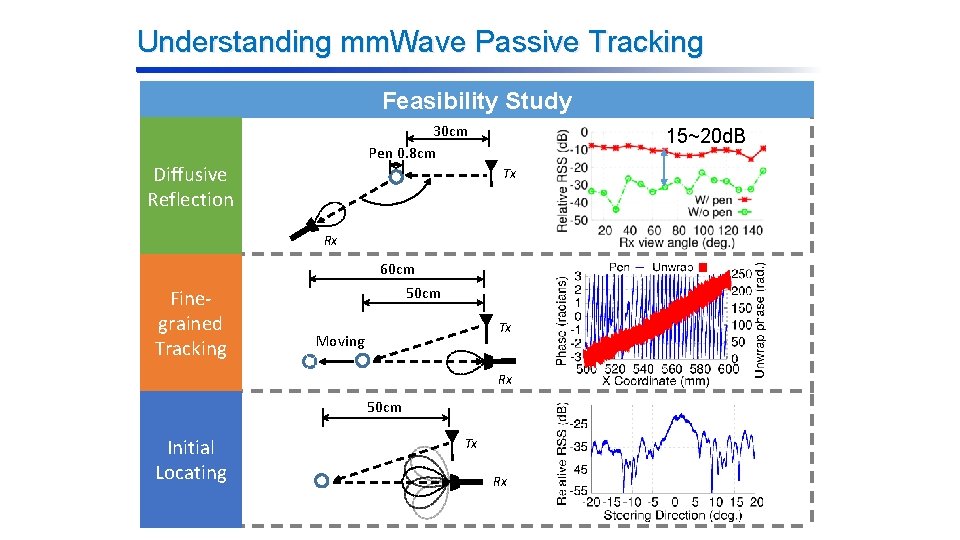
Understanding mm. Wave Passive Tracking Feasibility Study 30 cm Pen 0. 8 cm Diffusive Reflection 15~20 d. B Tx Rx Finegrained Tracking 60 cm 50 cm Tx Moving Rx 50 cm Initial Locating Tx Rx
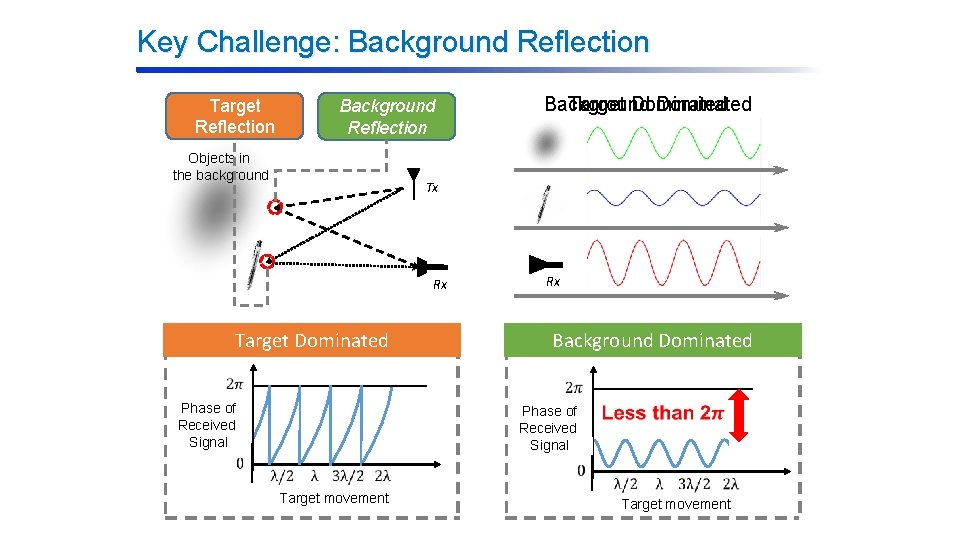
Key Challenge: Background Reflection Target Reflection Background Reflection Objects in the background Target Dominated Background Dominated Tx Rx Target Dominated Rx Background Dominated Phase of Received Signal Target movement
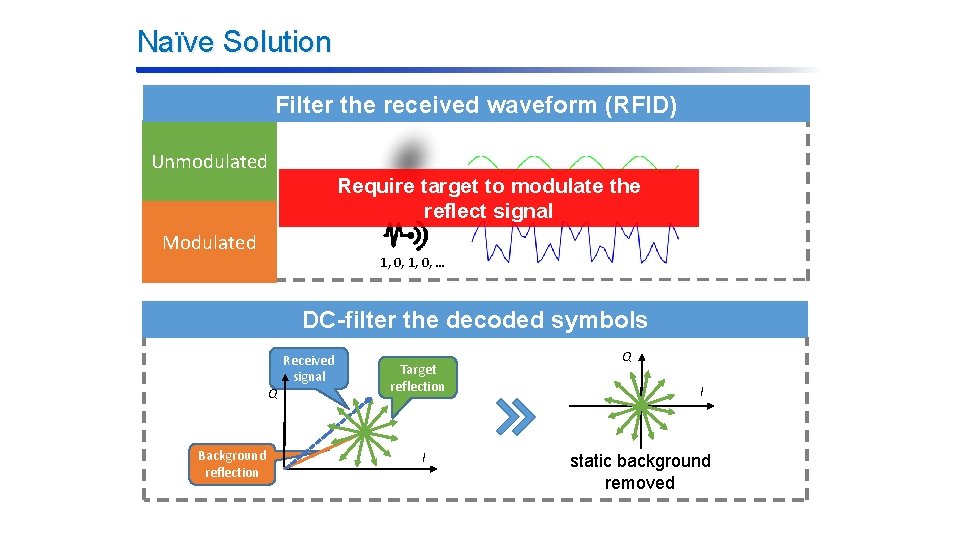
Naïve Solution Filter the received waveform (RFID) Unmodulated Require target to modulate the reflect signal Modulated 1, 0, … DC-filter the decoded symbols Q Background reflection Received signal Target reflection I Q I static background removed
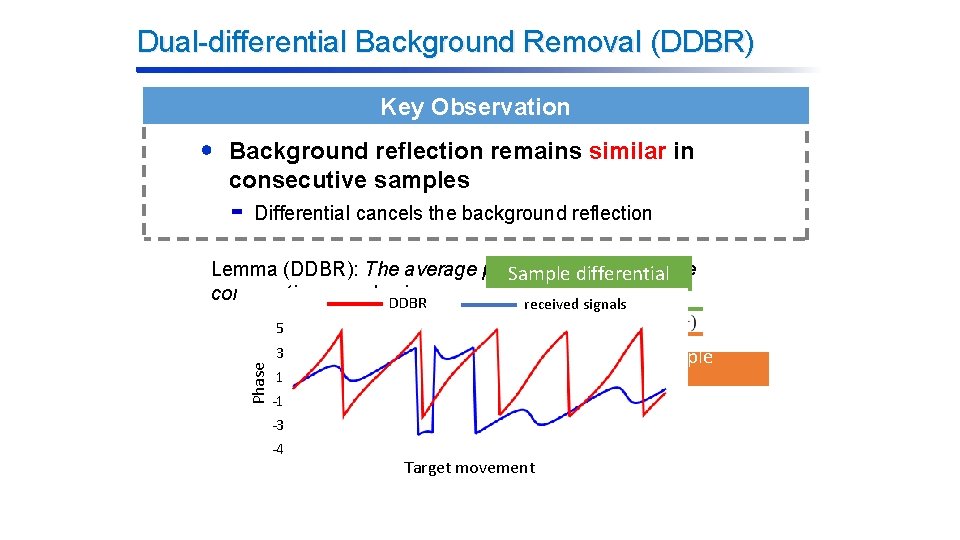
Dual-differential Background Removal (DDBR) Key Observation Background reflection remains similar in consecutive samples Differential cancels the background reflection Lemma (DDBR): The average phase shift among three Sample differential consecutive samples. DDBR is received signals 5 Phase 3 1 Average phase shift -1 Diff. phase of sample differential -3 -4 Target movement
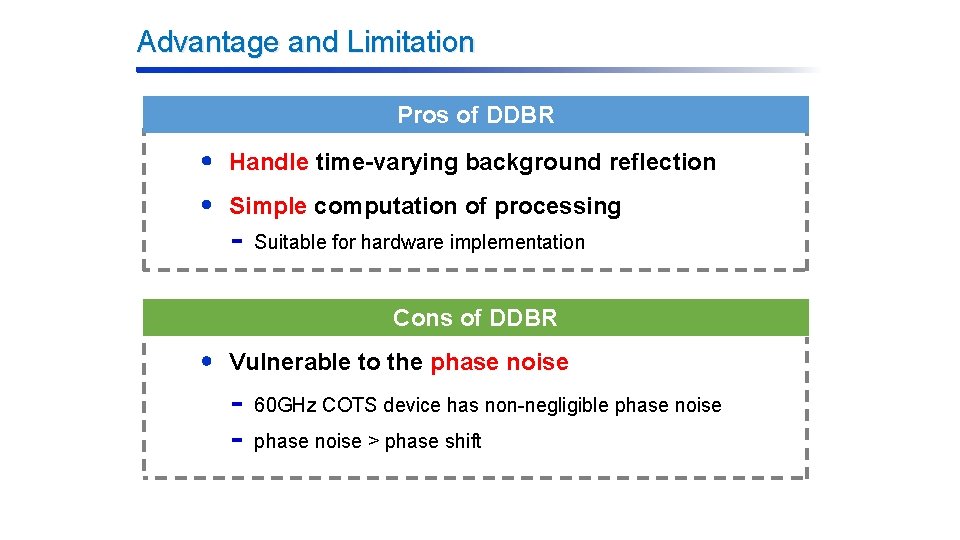
Advantage and Limitation Pros of DDBR Handle time-varying background reflection Simple computation of processing Suitable for hardware implementation Cons of DDBR Vulnerable to the phase noise 60 GHz COTS device has non-negligible phase noise > phase shift
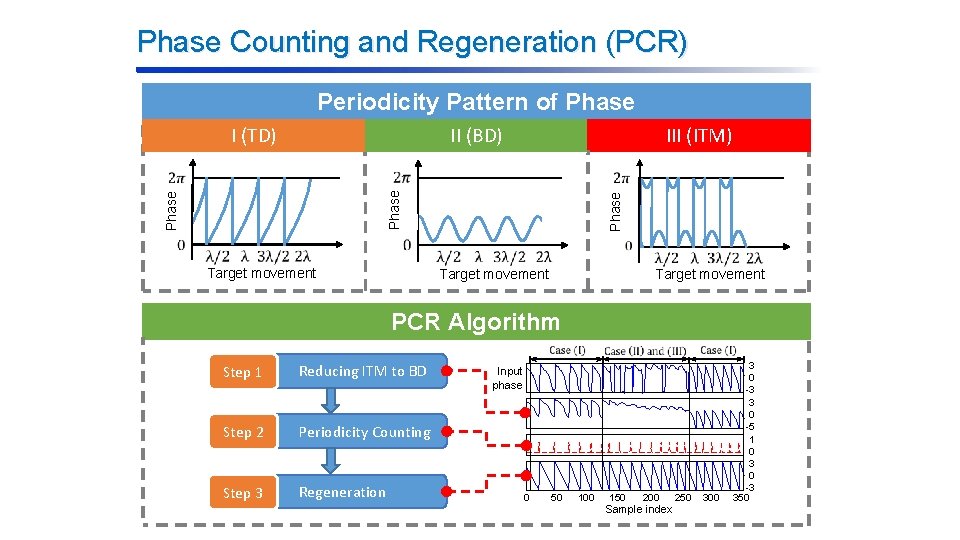
Phase Counting and Regeneration (PCR) Periodicity Pattern of Phase I (TD) II (BD) III (ITM) Target movement Phase Target movement PCR Algorithm Step 1 Reducing ITM to BD Input phase Step 2 Periodicity Counting Step 3 Regeneration 0 50 100 150 200 Sample index 250 300 3 0 -3 3 0 -5 1 0 3 0 -3 350
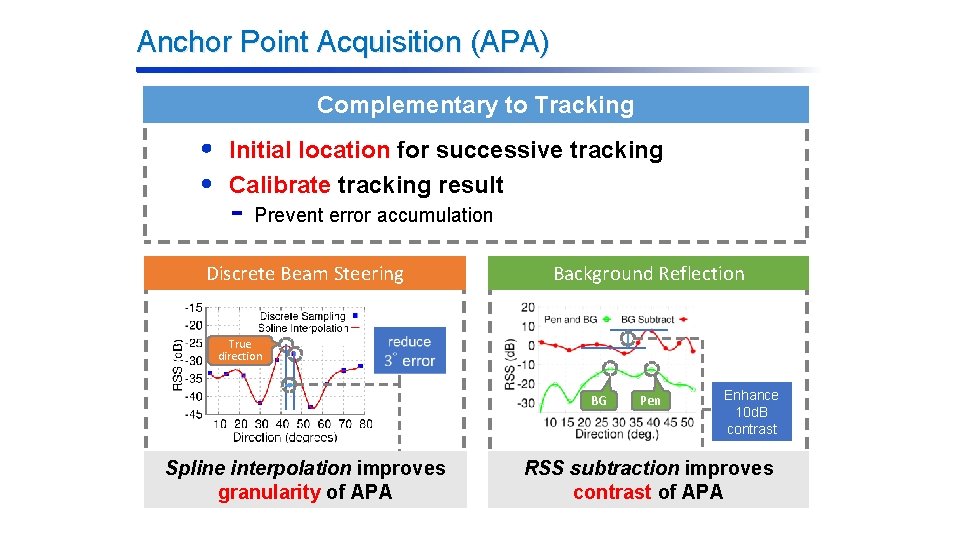
Anchor Point Acquisition (APA) Complementary to Tracking Initial location for successive tracking Calibrate tracking result Prevent error accumulation Discrete Beam Steering True direction Background Reflection BG Spline interpolation improves granularity of APA Pen Enhance 10 d. B contrast RSS subtraction improves contrast of APA
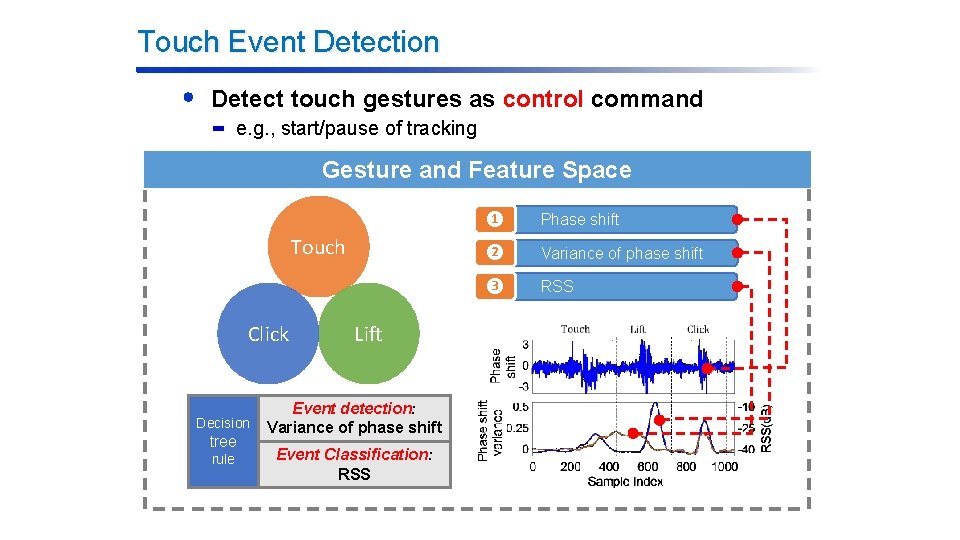
Touch Event Detection Detect touch gestures as control command e. g. , start/pause of tracking Gesture and Feature Space Touch Click Decision tree rule Lift Event detection: Variance of phase shift Event Classification: RSS ❶ Phase shift ❷ Variance of phase shift ❸ RSS
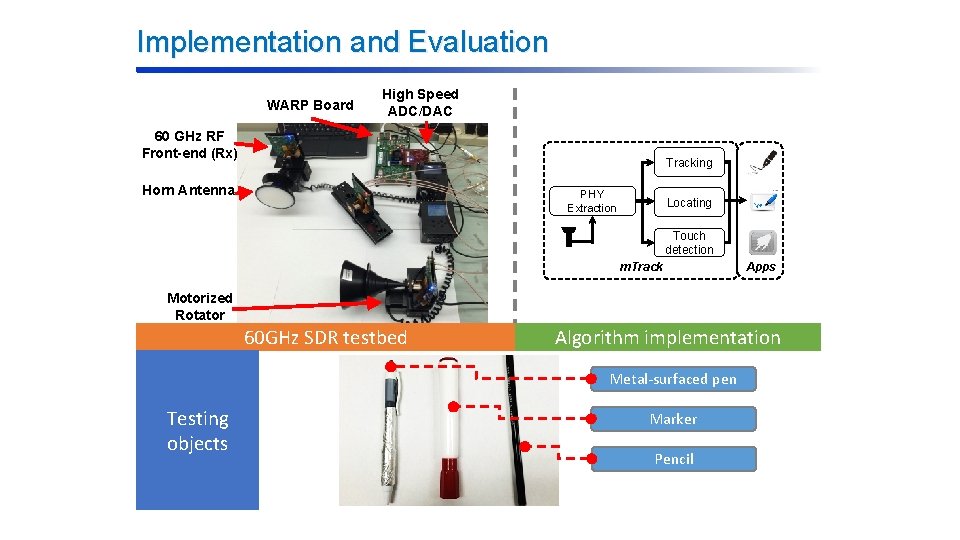
Implementation and Evaluation WARP Board High Speed ADC/DAC 60 GHz RF Front-end (Rx) Tracking Horn Antenna PHY Extraction Locating Touch detection m. Track Apps Motorized Rotator 60 GHz SDR testbed Algorithm implementation Metal-surfaced pen Testing objects Marker Pencil
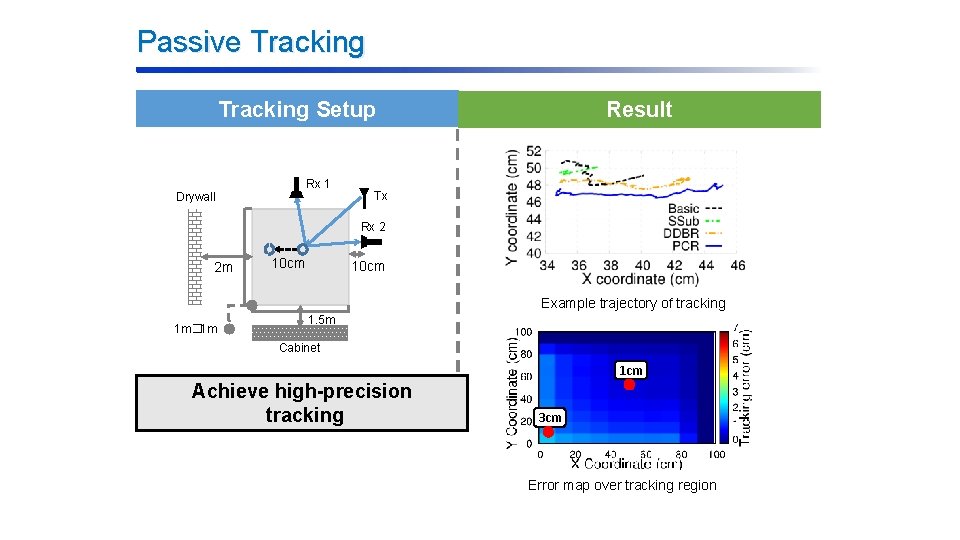
Passive Tracking Setup Rx 1 Drywall Result Tx Rx 2 2 m 10 cm Example trajectory of tracking 1 m� 1 m 1. 5 m Cabinet 1 cm Achieve high-precision tracking 3 cm Error map over tracking region
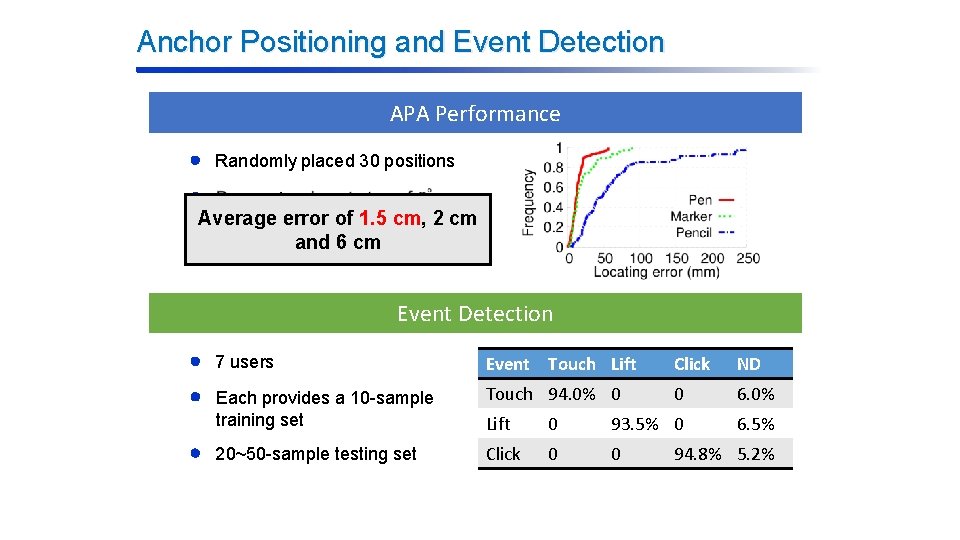
Anchor Positioning and Event Detection APA Performance Randomly placed 30 positions Average error of 1. 5 cm, 2 cm RSS: 12. 3 d. B, and 10. 1 d. B 6 cm and 4. 7 d. B Event Detection 7 users Event Touch Lift Click ND Each provides a 10 -sample training set Touch 94. 0% 0 0 6. 0% Lift 0 93. 5% 0 6. 5% 20~50 -sample testing set Click 0 0 94. 8% 5. 2%
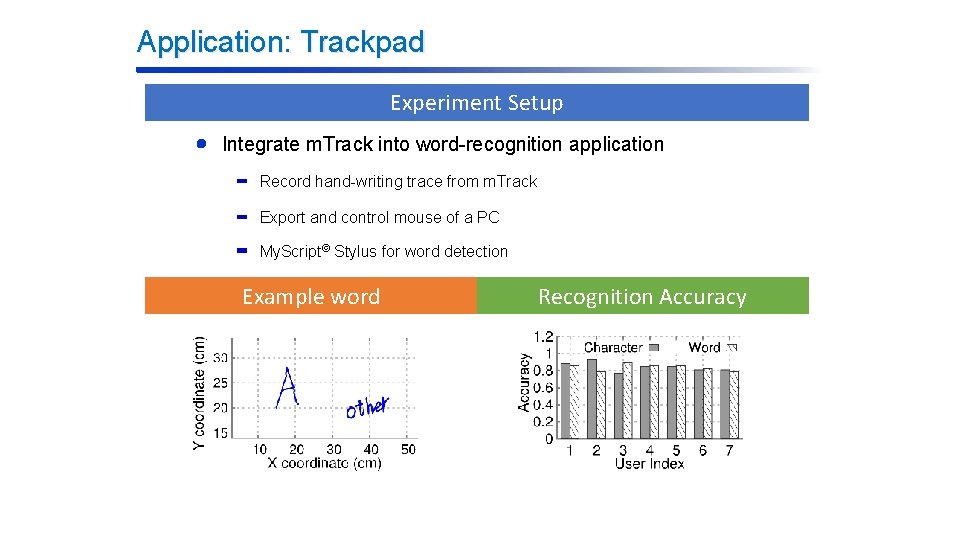
Application: Trackpad Experiment Setup Integrate m. Track into word-recognition application Record hand-writing trace from m. Track Export and control mouse of a PC My. Script© Stylus for word detection Example word Recognition Accuracy
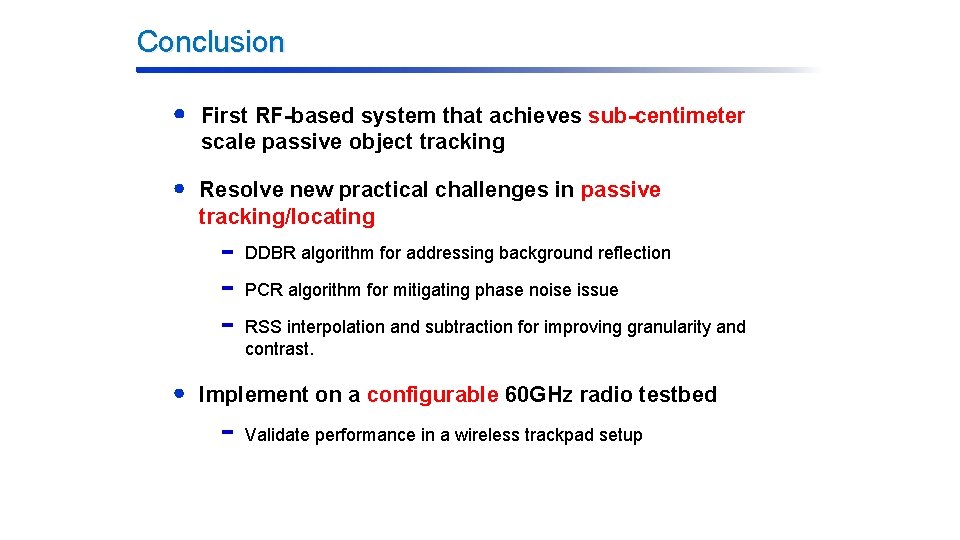
Conclusion First RF-based system that achieves sub-centimeter scale passive object tracking Resolve new practical challenges in passive tracking/locating DDBR algorithm for addressing background reflection PCR algorithm for mitigating phase noise issue RSS interpolation and subtraction for improving granularity and contrast. Implement on a configurable 60 GHz radio testbed Validate performance in a wireless trackpad setup
Questions? Thank you