
M o b i l i t y
M o b i l i t y Jo 99 INF-5261 26 January 2005, 14: 15 – 16: 00 jo. herstad@ifi. uio. no 1
Overview • Perspectives • Past – present – future • Mobility – terminology - concepts • Conditions for the possibility of mobility Jo 99 • Projects 2
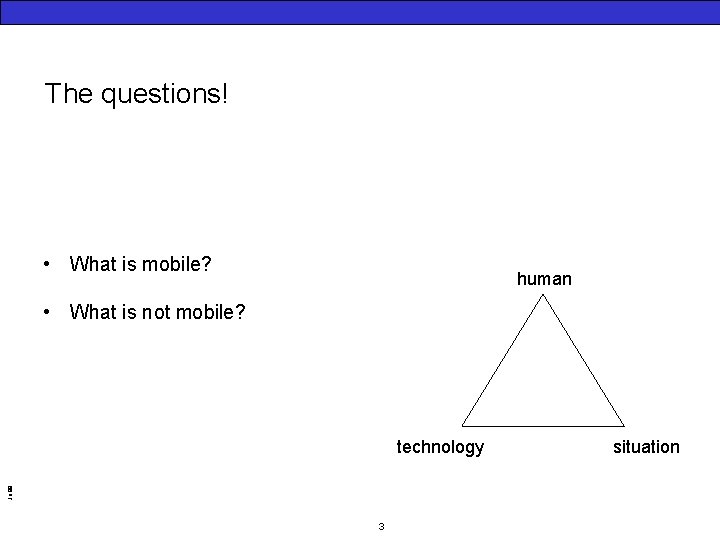
The questions! • What is mobile? human • What is not mobile? Jo 99 technology 3 situation
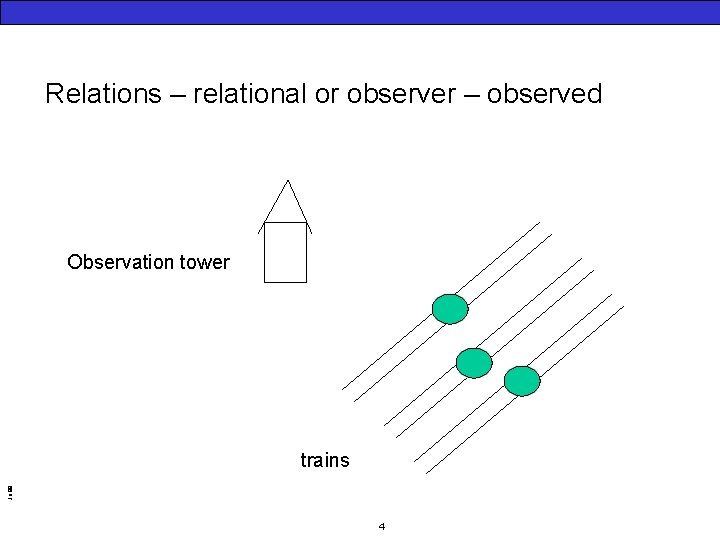
Relations – relational or observer – observed Observation tower Jo 99 trains 4
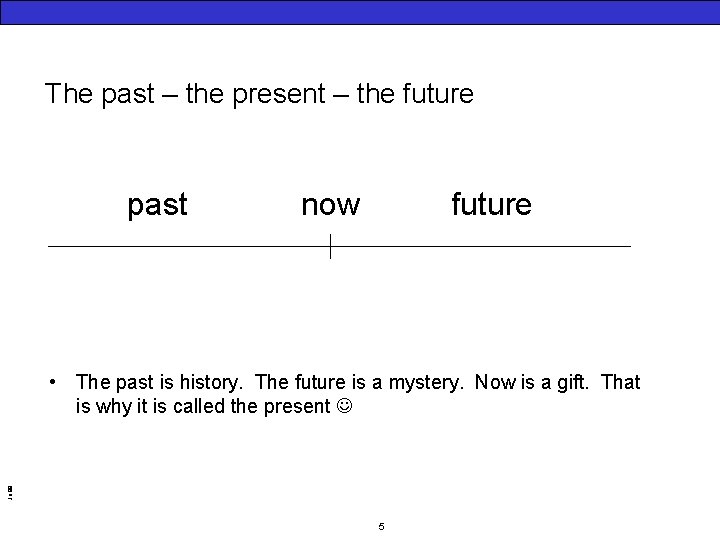
The past – the present – the future past now future Jo 99 • The past is history. The future is a mystery. Now is a gift. That is why it is called the present 5
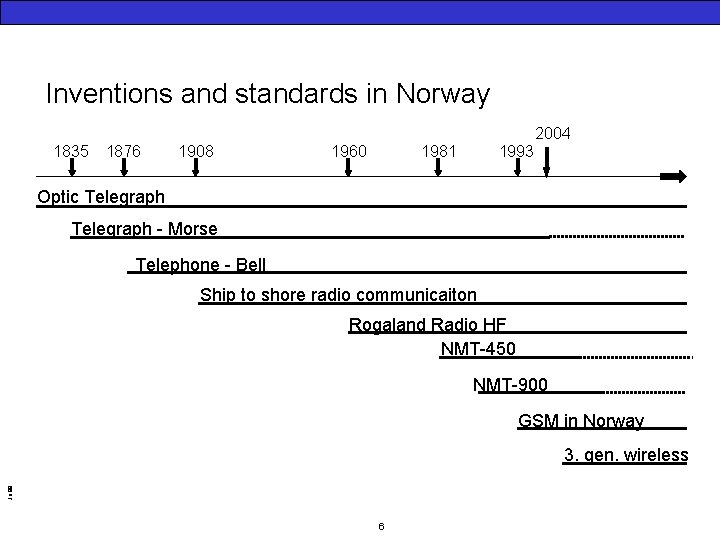
Inventions and standards in Norway 2004 1835 1876 1908 1960 1993 1981 Optic Telegraph - Morse Telephone - Bell Ship to shore radio communicaiton Rogaland Radio HF NMT-450 NMT-900 GSM in Norway Jo 99 3. gen. wireless 6
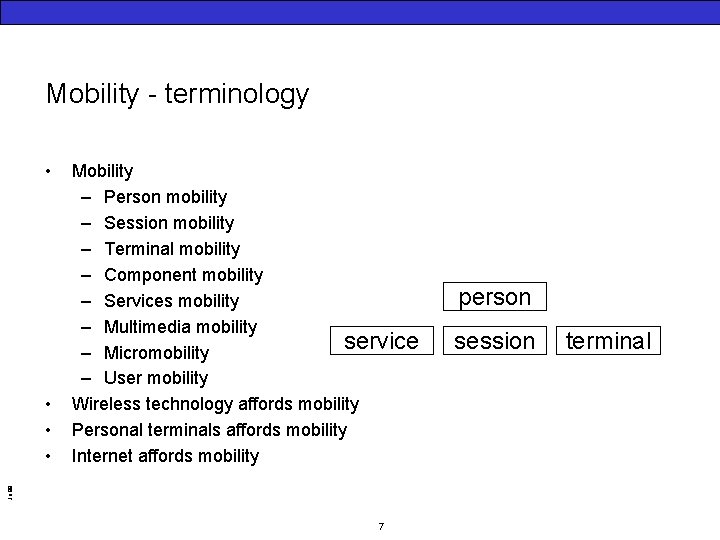
Mobility - terminology • Jo 99 • • • Mobility – Person mobility – Session mobility – Terminal mobility – Component mobility – Services mobility – Multimedia mobility service – Micromobility – User mobility Wireless technology affords mobility Personal terminals affords mobility Internet affords mobility 7 person session terminal
Personal mobility Jo 99 • The ability of a user to access services from any terminal and any location, (including invitations to join sessions). This ability may be restricted due to contract agreements between the Consumer and Retailer, and due to user system capabilities. 8
Terminal mobility Jo 99 • The ability of a terminal to change physical location. This includes terminals which can continue to support services while moving, and those that cannot. 9
Session mobility Jo 99 • The capability to suspend a session and resume it on a different location and or terminal. 10
Viewpoints – point of view Jo 99 • Micro mobility • Discrete mobility (for example DECT, Hotspots) • Continous mobility (for example GSM) • Local mobilty • Global mobility • Component mobility • And. . what concepts are needed? 11
Modes of mobility • Wandering, visiting, traveling – Ref: Ljungberg and Kristoffersen • Vagabond – Ref: Øystein Olsen, hovedfagsoppgave 1999. Jo 99 • By means of ”transportation” technology footwear, bicycles, automobiles, buses, ++ • John Urry – societies 12
The vagabond Jo 99 Wherever I may roam (Metallica). . . and the road becomes my bride I have stripped of all but pride so in her I do confide and she keeps me satisfied gives me all I need. . . and with dust in throat I crave only knowledge will I save to the game you stay a slave rover wanderer nomad vagabond call me what you will but I'll take my time anywhere free to speak my mind anywhere and I'll redefine anywhere I may roam where I lay my head is home. . . and the earth becomes my throne I adapt to the unknown under wandering stars I've grown by myself but not alone I ask no one. . . and my ties are severed clean the less I have the more I gain off the beaten path I reign rover wanderer nomad vagabond call me what you will but I'll take my time anywhere I'm free to speak my mind anywhere and I'll never mind anywhere I may roam where I lay my head is home but i'll take my time anywhere free to speak my mind and I'll take my find anywhere I may roam where I lay my head is home carved upon my stone my body lie, but still I roam wherever I may roam 13
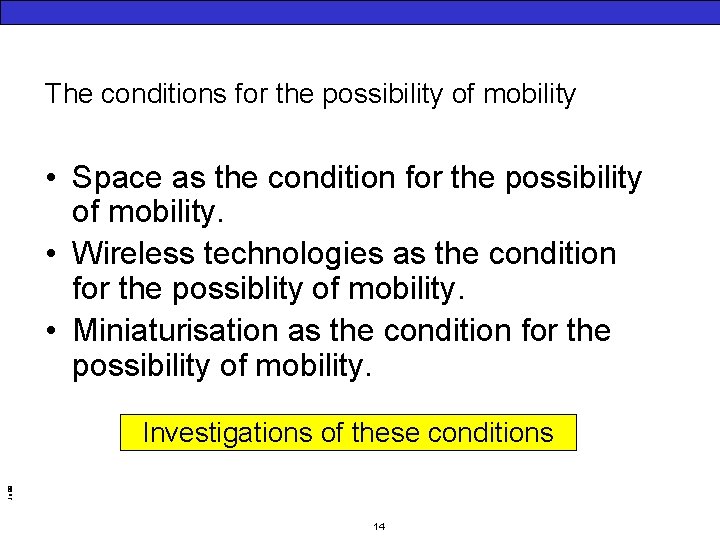
The conditions for the possibility of mobility • Space as the condition for the possibility of mobility. • Wireless technologies as the condition for the possiblity of mobility. • Miniaturisation as the condition for the possibility of mobility. Jo 99 Investigations of these conditions 14
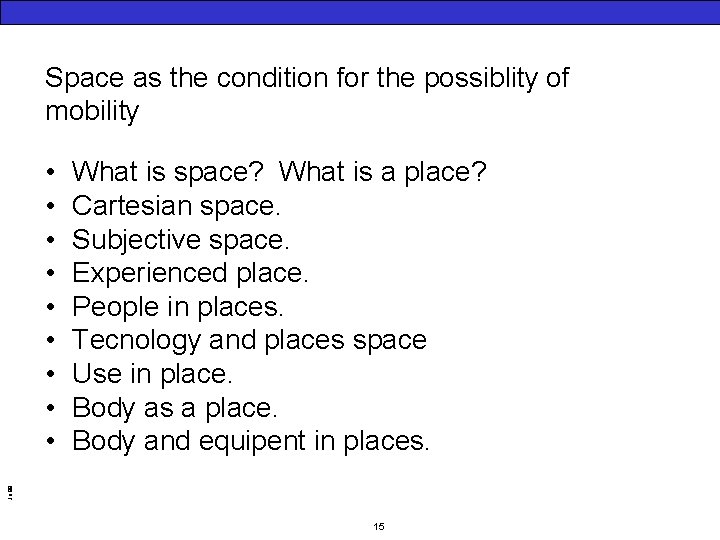
Space as the condition for the possiblity of mobility What is space? What is a place? Cartesian space. Subjective space. Experienced place. People in places. Tecnology and places space Use in place. Body as a place. Body and equipent in places. Jo 99 • • • 15
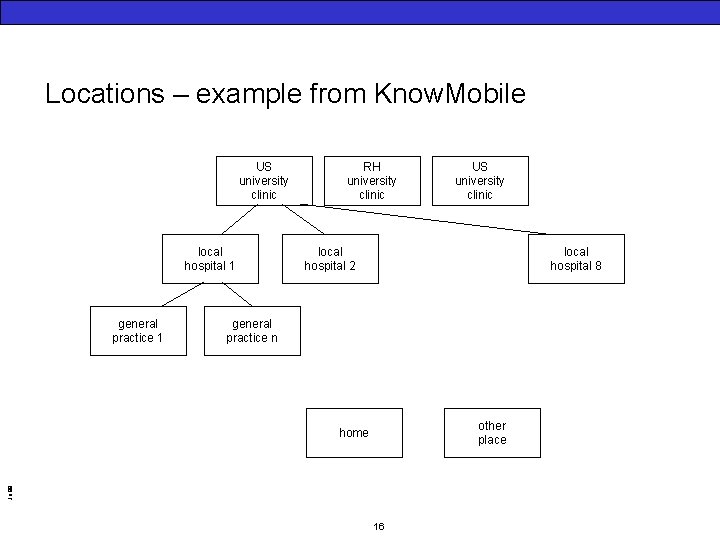
Locations – example from Know. Mobile US university clinic local hospital 1 general practice 1 RH university clinic US university clinic local hospital 2 local hospital 8 general practice n other place Jo 99 home 16
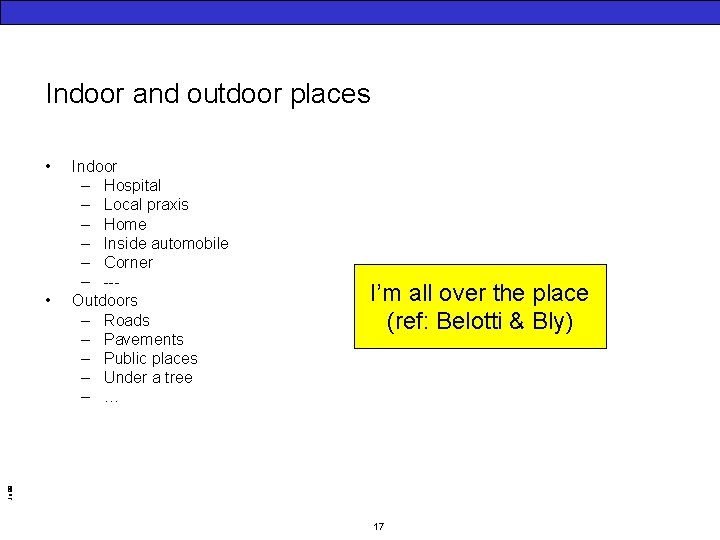
Indoor and outdoor places • I’m all over the place (ref: Belotti & Bly) Jo 99 • Indoor – Hospital – Local praxis – Home – Inside automobile – Corner – --Outdoors – Roads – Pavements – Public places – Under a tree – … 17
Jo 99 Personal sense regions in places 18
Jo 99 Use in context 19
Wireless technology as the condition for the possibility of mobility • What is wire-less? – Snorløs – Trådløs Jo 99 • What is the wire? • Relational technology. 20
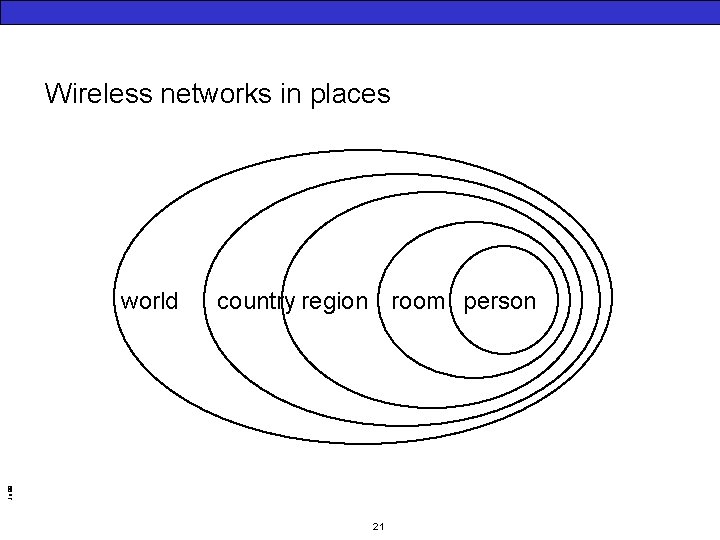
Wireless networks in places country region room person Jo 99 world 21
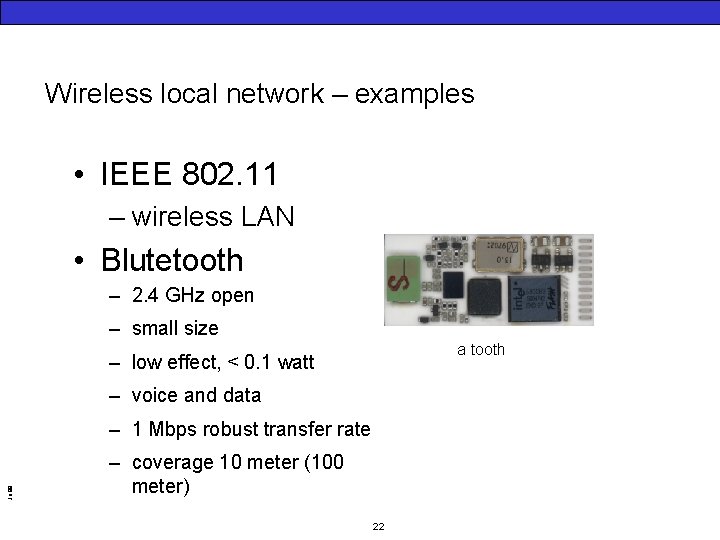
Wireless local network – examples • IEEE 802. 11 – wireless LAN • Blutetooth – 2. 4 GHz open – small size a tooth – low effect, < 0. 1 watt – voice and data Jo 99 – 1 Mbps robust transfer rate – coverage 10 meter (100 meter) 22
Miniaturisation as the contition for the possibilty The computer. The radio. The telephone. The stereo. The camera. . . are all getting smaller. Jo 99 • • • 23
Inside the terminal Miniaturization • Processor • Memory • Battery • Input output units, nuts and bolts Radio technology • Coverage • Utilization of specter • New specter • Compression Jo 99 HCI - Human Computer Interaction for mobile and wearable devices 24
Terminal Jo 99 • A physical equipment which a user operates to interact with a network or other users. This terminal may have signaling capability (or capability to handle messages related to an objectoriented interface) to perform service procedures. This terminal may have capability of control bearers to connect/disconnect bearer connections. 25
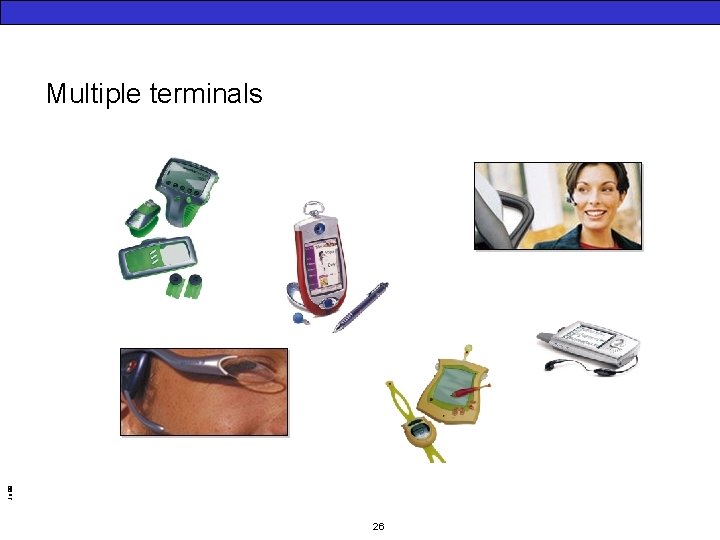
Jo 99 Multiple terminals 26
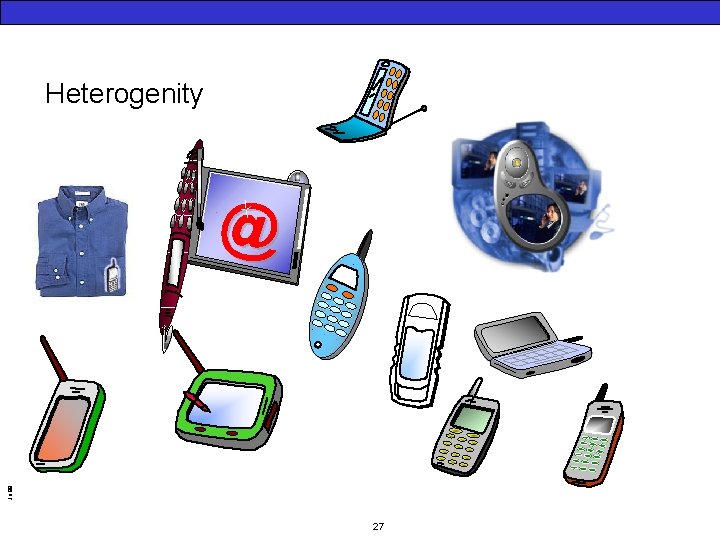
Heterogenity Jo 99 @ 27
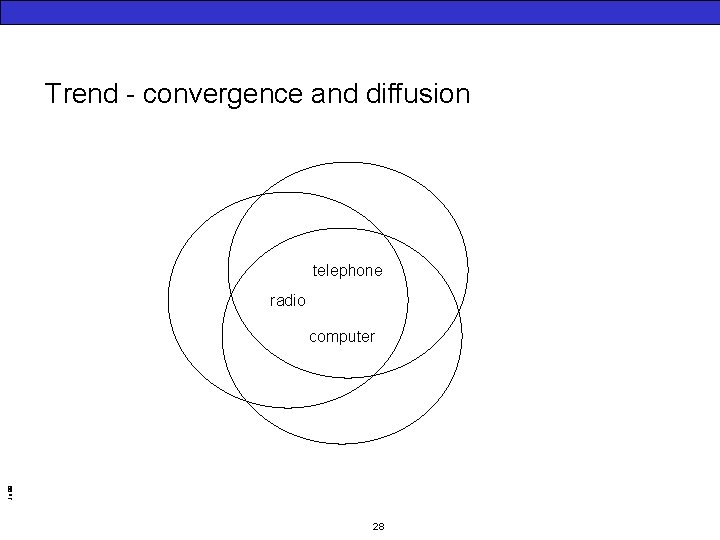
Trend - convergence and diffusion telephone radio Jo 99 computer 28
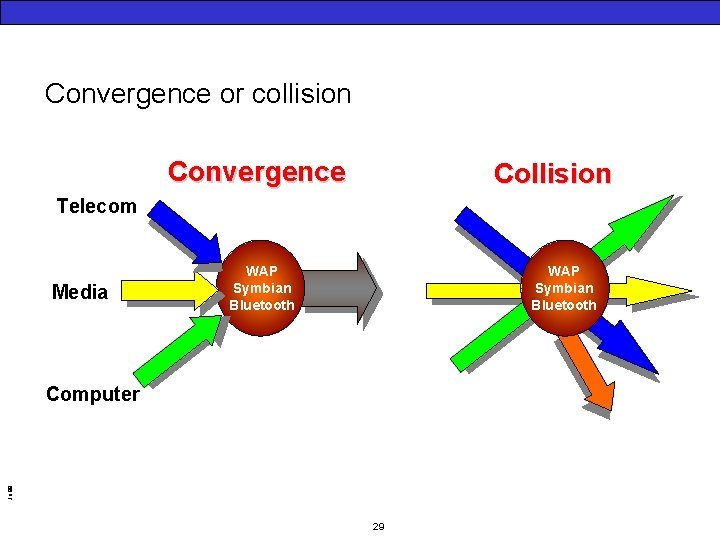
Convergence or collision Convergence Collision Telecom Media WAP Symbian Bluetooth Jo 99 Computer 29
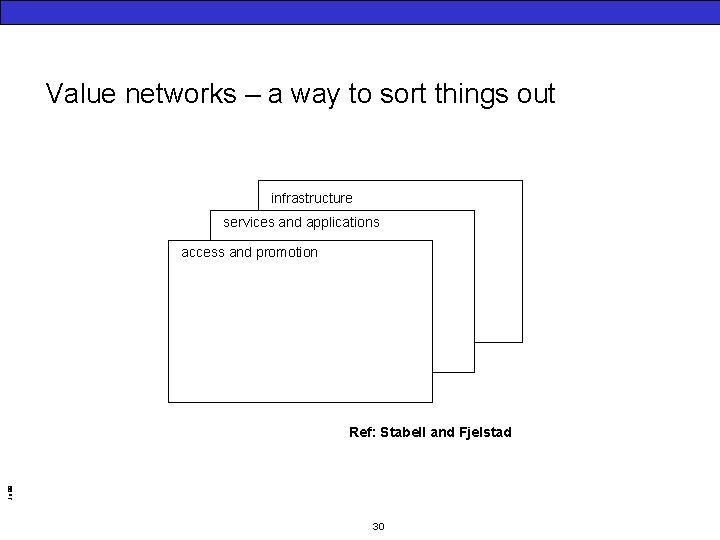
Value networks – a way to sort things out infrastructure services and applications access and promotion Jo 99 Ref: Stabell and Fjelstad 30
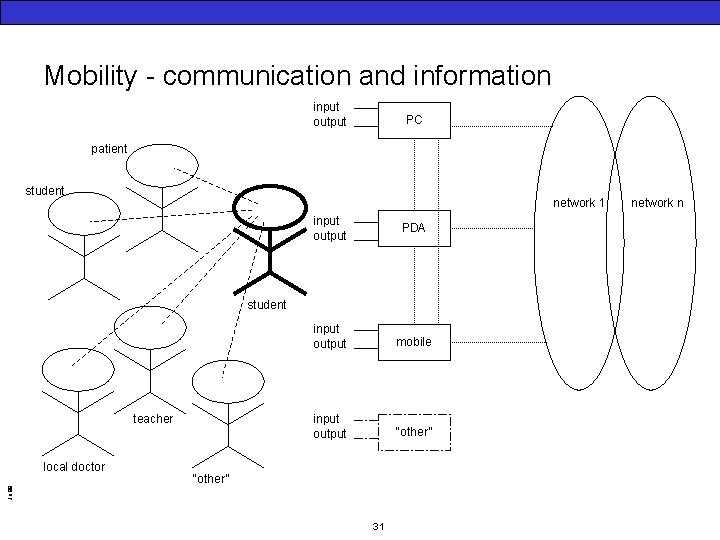
Mobility - communication and information input output PC patient student network 1 input output PDA input output mobile input output “other” student teacher Jo 99 local doctor “other” 31 network n
Summing up Jo 99 • Mobility as a ”relational science”. • Mobility – ”past, present, future”. • Space as the condition for the possiblity of mobility. • Wireless technology as the condition for the possiblity of mobility. • Miniaturisation as the condition for the possiblity of mobility. 32
Projects Two conditions are to be met in order to succeed. 1. First start. 2. Then continue. Jo 99 Deliverables: a. Project plan, Wonder. Doc date: : b. Status report, date: : c. Final report, date: : 33
Projects Jo 99 Group size: 3 – 7 Project plan – requirements: The “what, when, who, how, which, where” of the project. (1 - 2 pages) Status report – describe the status of the project (5 -15 pages) Final report – report basis for presentation (10 – 30 pages) 34
Projects Jo 99 The phenomena to be investigated and described: - Mobile people, users. - Mobile technologies. - Situations, contexts, environements. Combination of: - Theoretical description and analysis - Empirical description and analysis - Synthesis or construction - Writing, dissemination 35
According to Nygaard science is about… Jo 99 • Observation. The empirical study of phenomena: their identification, observed properties and behavior. • Analysis. Comprehension and explanation of phenomena in terms of an underlying theory. • Synthesis (or construction of technology). Knowledge organized for the purpose of designing, generating or modifying phenomena. • Multiperspective reflection. The concurrent or alternating use of several perspectives in the consideration of phenomena perspectives either from within the same science or drawn from more than one science. The study of how changes, introduced according to one viewpoint, affect properties of the phenomena when regarded from another viewpoint. 36
Project groups • Name: • Establish ”peer groups”. Jo 99 • Each group is a sparring partner for one other group; comments, advise, care, concern, inspiration etc. 37
Artikkelgjennomgang Jo 99 – Velge en artikkel. – Analysere den. – Presentere den. – Samtale om den. – Koble artikkelen mot en annen artikkel. – Bruk gjerne lysark, demonstrasjon etc. – Innlevering: NIL 38
- Slides: 38