
M C Escher Art and Mathematics John Kevin

- Slides: 23
M. C. Escher: Art and Mathematics John, Kevin, and Kylee
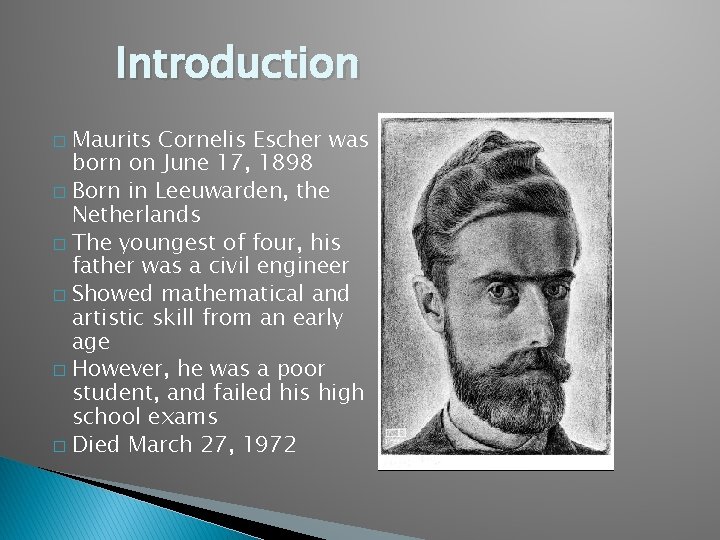
Introduction Maurits Cornelis Escher was born on June 17, 1898 � Born in Leeuwarden, the Netherlands � The youngest of four, his father was a civil engineer � Showed mathematical and artistic skill from an early age � However, he was a poor student, and failed his high school exams � Died March 27, 1972 �
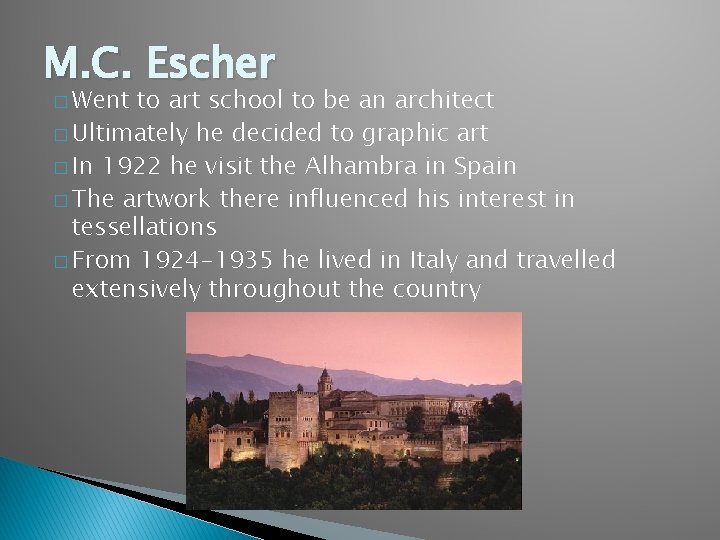
M. C. Escher � Went to art school to be an architect � Ultimately he decided to graphic art � In 1922 he visit the Alhambra in Spain � The artwork there influenced his interest in tessellations � From 1924 -1935 he lived in Italy and travelled extensively throughout the country
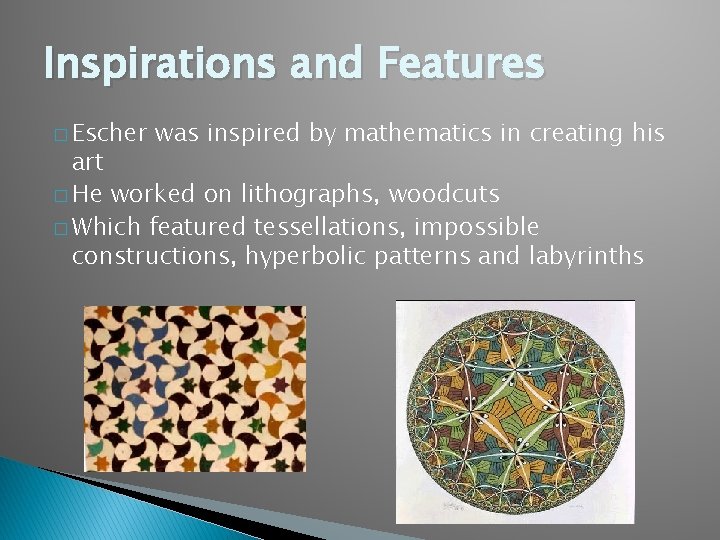
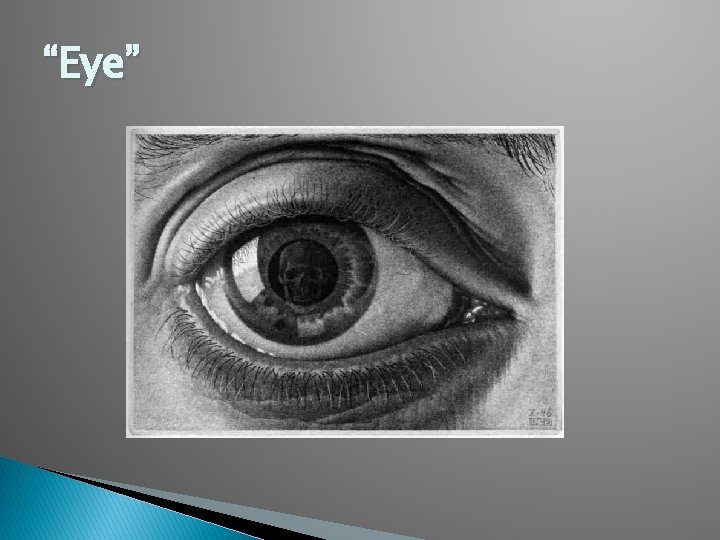
Inspirations and Features � Escher was inspired by mathematics in creating his art � He worked on lithographs, woodcuts � Which featured tessellations, impossible constructions, hyperbolic patterns and labyrinths
Reaction to Artwork Combination of artistic ideas and mathematics � His artwork continues to amaze and be enjoyed by millions around the world � He expressed his fantasies through his art � Escher shows us the wonders of reality in his fascination of distorting it � “Mathematicians go to the garden gate but they never venture through to appreciate the delights within. ”- M. C. Escher �
Escher’s Artwork � Was captivated by the conflict between the representation of 3 D pictures on a 2 D plane � Passion for creating art using tessellations, but his fans preferred his work that portrayed worlds that cannot exist � Escher was inspired by the Italian landscapes around him and used it to create a lot of his artwork
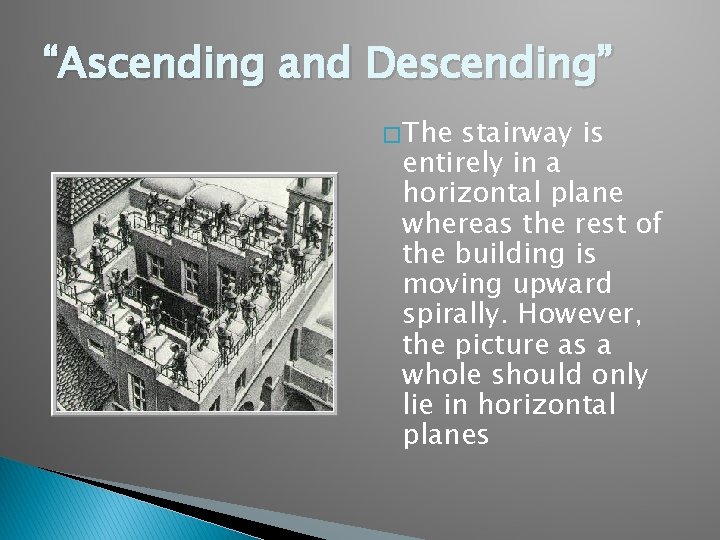
“Ascending and Descending” � The stairway is entirely in a horizontal plane whereas the rest of the building is moving upward spirally. However, the picture as a whole should only lie in horizontal planes
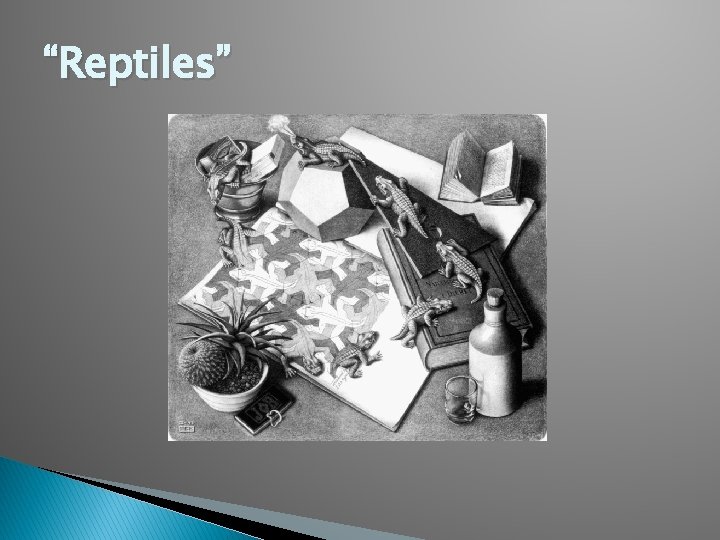
Tessellations � “Tessa” in Latin means a small stone cube. These stone cubes were used to make mosaic pictures on floor and tilling in Roman buildings AKA “tessellatas” � A tiling of a plane that fills the whole plane without gaps or overlaps � Escher- “the regular division of a plane” � Inspiration from the Alhambra, Polya’s 17 wallpaper patterns, crystalline patterns and symmetry
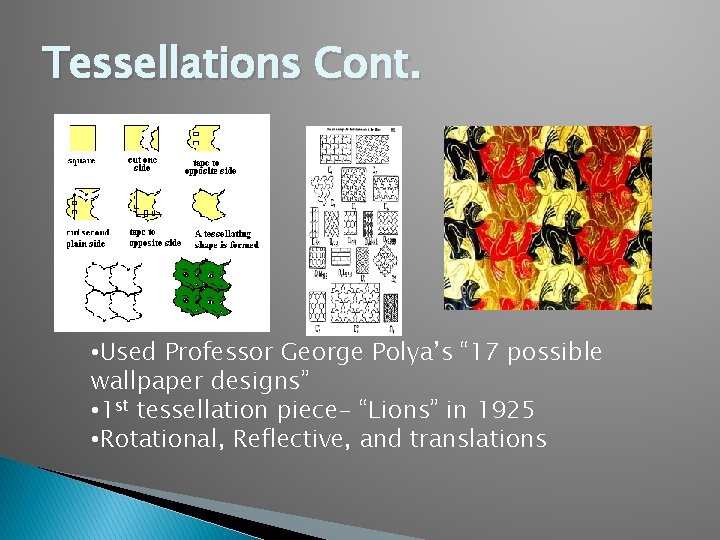
Tessellations Cont. • Used Professor George Polya’s “ 17 possible wallpaper designs” • 1 st tessellation piece- “Lions” in 1925 • Rotational, Reflective, and translations
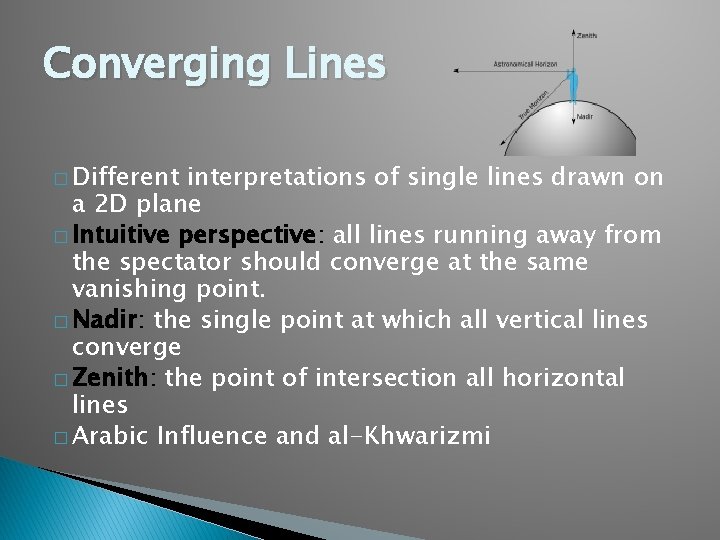
Converging Lines � Different interpretations of single lines drawn on a 2 D plane � Intuitive perspective: all lines running away from the spectator should converge at the same vanishing point. � Nadir: the single point at which all vertical lines converge � Zenith: the point of intersection all horizontal lines � Arabic Influence and al-Khwarizmi
Parallel Lines � Horizontal and vertical lines running parallel to the picture are to be depicted as horizontal and vertical lines, respectively. Like distances along these lines in reality are to be shown as like distances in the picture � Parallel lines that recede from us are to be depicted as lines passing through a single point. For example, a vanishing point. Like distances along these lines are not to be depicted as like distances in the picture
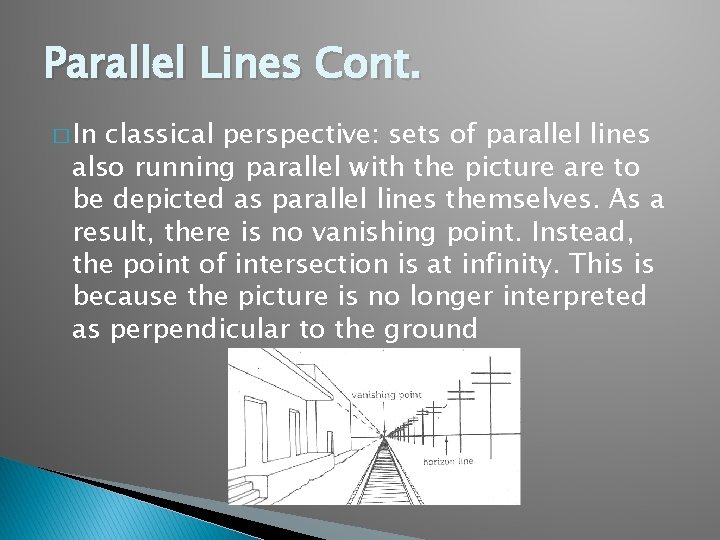
Parallel Lines Cont. � In classical perspective: sets of parallel lines also running parallel with the picture are to be depicted as parallel lines themselves. As a result, there is no vanishing point. Instead, the point of intersection is at infinity. This is because the picture is no longer interpreted as perpendicular to the ground
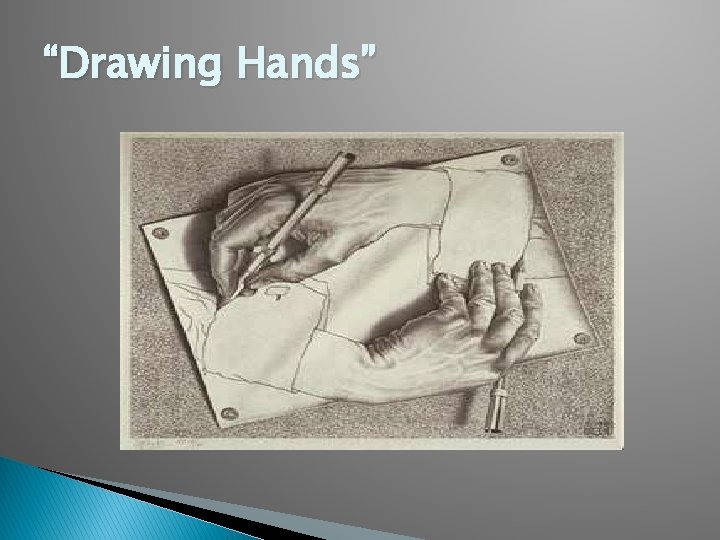
Strange Loops � Occurs whenever, by movement upwards or downwards through the levels of some hierarchal system, we unexpectedly find ourselves right back where we started � A strange loop categorizes a pattern and outputs its essence, so that as you get closer and closer to your essence the further you get down your strange loop � In Escher's artwork his images lead us further into, and then back out of, a particular scene
“Drawing Hands”
“Reptiles”
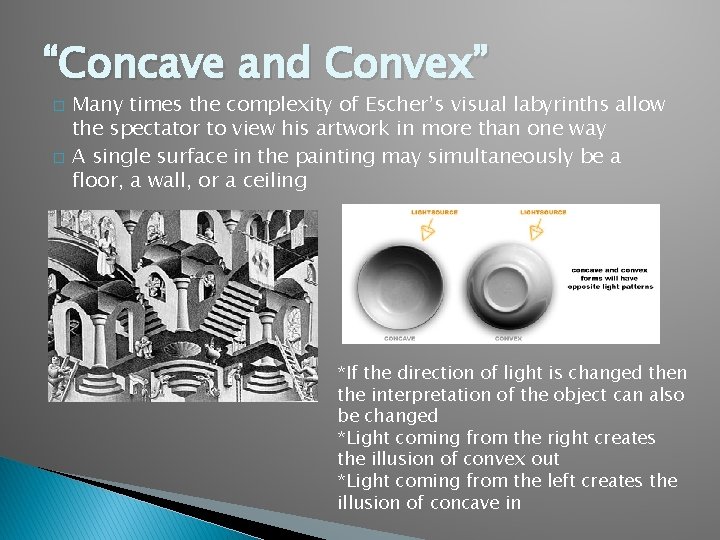
“Concave and Convex” � � Many times the complexity of Escher’s visual labyrinths allow the spectator to view his artwork in more than one way A single surface in the painting may simultaneously be a floor, a wall, or a ceiling *If the direction of light is changed then the interpretation of the object can also be changed *Light coming from the right creates the illusion of convex out *Light coming from the left creates the illusion of concave in
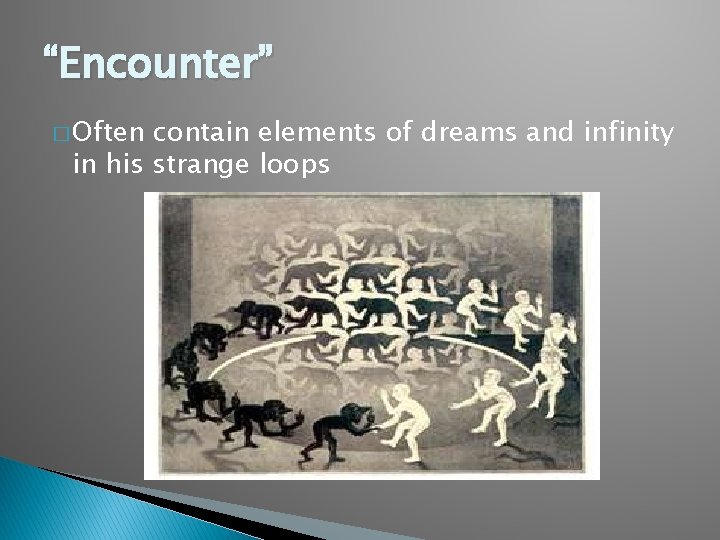
“Encounter” � Often contain elements of dreams and infinity in his strange loops
Why So Strange? � Strange in that it goes against our own values of perception � Automatically engrained in our minds that moving from the origin makes you father away from the origin � Moreover, goes against our step by step through process as seen for, for example, in The Elements � Escher enjoyed playing around and manipulating our minds with paradoxes � Similar to Gödel's Incompleteness Theorem, Escher forced the spectators of his art to step back and think outside the realms of what our world thinks of as normal and what we presume to be true
Escher’s Dreams � Escher used his dreams and linkage of reality and unreality in order to draw his viewers in � Thus, Escher wanted to explore the ideas of infinity and yet at the same time wanted to do so in a manner that was appetizing � One could make an argument that Escher’s incorporation of the dream world makes him more of an artist than mathematician. Portray the world
The Fantasy World � Wanted to question the realms of reality � In Escher’s fantasy world “even the wildest fantasy remains subject to the rules of the game…higher laws of logic and mathematics that draw the universe and all opposing elements together” � In order to portray fantasy worlds, Escher used his dreams as a useful device to link different aspects of reality and unreality
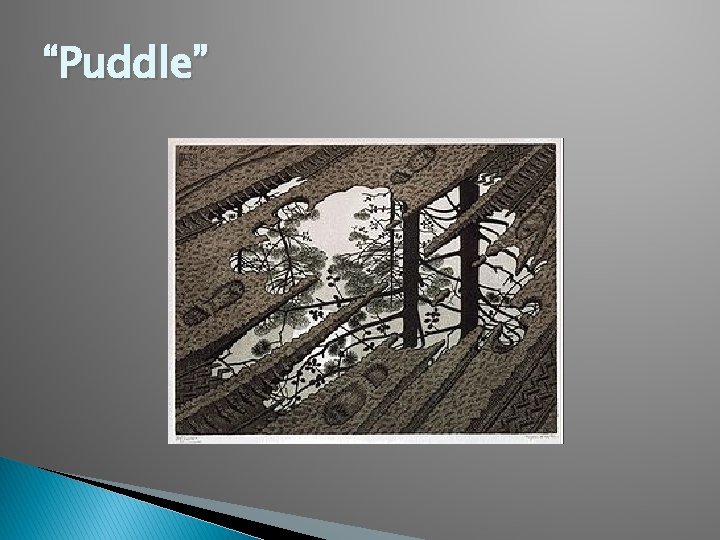
“Puddle”
Is it Really Art? � Artists called many of his prints “too cerebral to be actual art” � However, it is his own portrayal of the world (goal of art). Done by many artists before including Pablo Picasso (cubism)