
M 1 4 Understanding the Therapeutic Community Prisonbased
M 1 -4. Understanding the Therapeutic Community Prison-based Therapeutic Communities: A Comprehensive Staff Training Course
Contents • • The 3 phases of the TC 14 basic components of the TC The basic structure & its purpose TC groups and their purpose Modified TCs for special populations TCs & addiction theory (bio-psychosocial model) The “Right Living” concept in TCs Prison-based Therapeutic Communities: A Comprehensive Staff Training Course
Therapeutic Community: Three Phases 3 stages: Welcome House; Therapeutic Community; Re-entry (or Re-integration) House • Welcome House (Induction or Orientation) – more staff and family interaction, observing the TC, emphasis on caseworking/planning • Therapeutic Community – structured environment counterbalanced by groups, meetings and seminars, emphasis on community as method • Re-entry house – self-structured sober living, including contributions to the community, an emphasis on work/education & self-reliance Prison-based Therapeutic Communities: A Comprehensive Staff Training Course
Therapeutic Community: 14 Components 1. 2. 3. 4. 5. 6. 7. Community separateness Community environment Community activities Staff as community members Peers as role models Structured day Stages of the programme/treatment phases Prison-based Therapeutic Communities: A Comprehensive Staff Training Course
Therapeutic Community: 14 Components (contd. ) 8. Work as therapy and education 9. Instruction & repetition of TC concepts 10. Peer encounter groups 11. Awareness training 12. Emotional growth training 13. Planned duration of treatment 14. Continuation post TC completion Prison-based Therapeutic Communities: A Comprehensive Staff Training Course
Therapeutic Community: Basic Structure • A clear hierarchy of residents with a clear command structure • Provides short-term goals and effective role-models • The ‘act as if’ concept encourages impulse control • Senior residents gain increasing responsibilities and privileges • With this come an expectation to mentor and support new members (see concept below) • “You don’t get to keep it unless you give it away” Prison-based Therapeutic Communities: A Comprehensive Staff Training Course
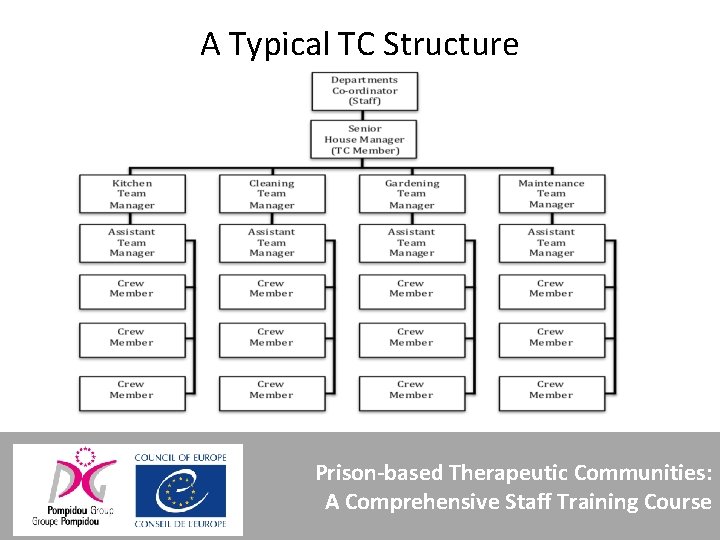
A Typical TC Structure Prison-based Therapeutic Communities: A Comprehensive Staff Training Course
Notes TCs are traditionally built around the concept of total immersion in a therapeutic environment where every waking part of the day is designed to allow the individual member to use the community to learn new ways of living and behaving both for themselves and for other community members. So whilst the busy daily work programme serves the purpose of keeping members occupied and preventing negative reflection, it is also a key element of the treatment process. Working ‘on the floor’ is not simply to provide something to do between treatment episodes like groups, counselling, seminars etc. It is actually a deliberately constructed environment which is an integral part of the treatment and change process. The hierarchical structure of the daily work departments allows each member to see how far they have progressed in their own treatment and to set new goals (to be an Assistant Department Head, to be a House Manager etc. ). The speed with which an individual moves through the programme will depend on their needs and progress. Thus, not only does floorwork with its work programme and command structure provide a therapeutic and sometimes stressful immersive environment, it also provides short term goals, role models (for new entrants) and opportunities to exercise responsibility and concern for others (for older, more senior residents) Prison-based Therapeutic Communities: A Comprehensive Staff Training Course
Therapeutic Community Groups • Groups, meetings and seminars counterbalance the structure. • In groups, there is no formal structure and the hierarchy can thus be challenged • Resident seminars – vital for residents to understand what the community is doing with them or for them (never to them). • Morning and Evening meetings provide a forum to celebrate individual and community achievements • And to nurture a sense of community ownership Prison-based Therapeutic Communities: A Comprehensive Staff Training Course
Notes The main dynamic of the TC is the group. TCs use various types of meetings and groups including: morning meetings, house meetings, encounter groups, seminars, teaching/education (learning) groups, peer encounters etc. In modern TCs, the encounter group remains a central element of the overall TC process. Research shows that this is an extremely powerful tool which requires skill and insight from the facilitator to make sure that it is used for the positive benefit of its members. The basic principles which apply to the correct running of an encounter group – apply to all groups within the TC. Structured groups are delivered by staff and/or a senior member or graduate. All available (and appropriate) community members are expected to attend these groups as required. Groups and other structured meetings cover a wide variety of subjects aimed at raising awareness and allowing members scope for discussions, role play, skills practice, etc. Meetings and groups in the TC have a variety of rules to ensure the safety of the community, respect for individuals and what is being said, and to keep order and control. These would normally include injunctions around violence and threats of violence; punctuality; attentiveness; respect; ‘rescuing’; entry and exit etc. Prison-based Therapeutic Communities: A Comprehensive Staff Training Course
Modified TCs – Special Populations • • • A number of organisations have modified the TC approach to improve treatment response to specific groups TC approaches have been adjusted to meet the needs of people with co-occurring mental ill-health (‘dual diagnosed’); adolescent drug users; women, pregnant women and women with children Modifications have generally been of two types: either alterations to intensity, programme length, cross-agency collaboration etc. or additions to the overall TC programme Research has shown that this can be achieved without significantly diluting the core elements of TC methodology. See M 1 -vi for research evaluation of modified TCs for special populations Prison-based Therapeutic Communities: A Comprehensive Staff Training Course
Modified TCs – Alterations • • Alterations for women’s TCs have included reduction/dilution of confrontational elements, greater emphasis on ‘push-ups’ and more programme time on parenting for members with children. Alterations for TCs for ‘dual-diagnosed’ members have included reduction/dilution of confrontational elements, adjustments in terms of medication and greater emphasis on socialisation Alterations for juveniles/adolescents have included shorter programme times, greater emphasis on structured (parent-involved) after-care, and more programme time on educational and employability issues Alterations for members from other cultures and/or immigrants have included more programme time on understanding other cultures and systematic adjustment of the structure to reflect members’ diversity Prison-based Therapeutic Communities: A Comprehensive Staff Training Course
Modified TCs – Additions • • Additions for women’s TCs have included specific groupwork on post-traumatic stress disorder (PTSD) and additional programme time on specialist parenting interventions such as “Parenting Under Pressure (PUP)”. Additions for TCs for ‘dual-diagnosed’ members have included diagnosis-appropriate work skills, additional psychotherapy sessions and impulse training similar to relapse prevention inputs Additions for juveniles/adolescents have included alternating programme time with home time (weekend leave etc. ) and alternating treatment with educational inputs Additions for members from other cultures and/or immigrants have included cultural awareness seminars, language classes and enhanced emphasis on TC cultural issues Prison-based Therapeutic Communities: A Comprehensive Staff Training Course
Notes The TC approach has been successfully modified for a variety of specific groups. These have included women, pregnant women, women with children, adolescents, drug users with co-occurring mental illness, homeless drug users and migrants and/or others from different cultures. In some cases, these groups have been accommodated within pre-existing ‘generalist’ TCs whilst in others, specialist TCs have been established. In the majority of cases, these modifications have been achieved by adjusting or altering specific elements of the programme rather than by adding specific interventions. In many cases, the modifications are simply about emphasising certain aspects of the TC programme. Thus, where TCs are established to treat members with a history of violent offending, greater emphasis will be put on the structure and more time will be allocated to reflective exercises such as meditation and massage. TCs for women will need to be aware that members will probably have experienced emotional or sexual abuse and the ethos of the programme will need to be adjusted accordingly. Where modifications require the introduction of additional interventions, it will be important to ensure that these elements can be added without undermining the core principles of the TC method. Research suggests that this has been the case in most modified TCs (see: M 1 -vi in the background reading for this module). Prison-based Therapeutic Communities: A Comprehensive Staff Training Course
The Bio-psychosocial Model #1 • This commonly accepted addiction theory emerged in the late 1970 s in response to general dissatisfaction within the field with the lack of utility in the existing uni-dimensional models. • Multi-dimensional models were developed by theorist practitioners such as Zinberg and Engels. • Bio-psychosocial models see drug or alcohol misuse as the result of complex interaction between the drug, the social situation and the psychic health of the individual. • This is the Drug, Set and Setting of Zinberg’s work. • Brings together a number of preceding theories and is much more practical Prison-based Therapeutic Communities: A Comprehensive Staff Training Course
The Bio-psychosocial Model #2 • This means that addiction interventions should: • Drug - reduce or eliminate drug use, develop skills for managing cravings, parallel disorders etc. • Set - improve self-esteem, encourage resilience, support efforts to assist the recovery of others • Setting - encourage changed environments, communities, activities etc. • Therapeutic Communities are among the few interventions to systematically offer these three interventions Prison-based Therapeutic Communities: A Comprehensive Staff Training Course
The Model in TCs - Drug • The TC structure teaches impulse control in a safe setting • Complete withdrawal is managed • Normal sleep-patterns are re-established • Physical health is systematically improved • Parallel disorders are explored and management strategies devised Prison-based Therapeutic Communities: A Comprehensive Staff Training Course
The Model in TCs - Set • The TC honestly explores the individual’s feelings of self-worth • Good behaviour is acknowledged, poor behaviour is challenged • Individual creativity is encouraged and nurtured • Support for the recovery of other members is encouraged as away of building personal recovery capital • Individual members are given increasing levels of control over their own recovery process Prison-based Therapeutic Communities: A Comprehensive Staff Training Course
The Model in TCs - Setting • • • The TC encourages the building of new positive peer relationships Positive former relationships and networks are restored and/or repaired Educational and vocational inputs improve the members future employability New, positive activities are encouraged and nurtured (see: creativity in Set) The TC structure is deliberately designed to encourage positive citizenship & care for others Prison-based Therapeutic Communities: A Comprehensive Staff Training Course
The Importance of Set • Of the three, SET is by far the most important • We know from resilience studies that a strong SET will resist poor biology and environment • With strong resources in SET the individual can facedown environment and physical difficulties • But with low self-esteem, relapse is inevitable – even with good physical well-being and supportive networks Prison-based Therapeutic Communities: A Comprehensive Staff Training Course
Notes Addiction theory matters not simply because it underpins the approaches used in drug treatment interventions, but because it also has implications for recovery and for the long-term sustainment of recovery. If indeed, addiction is a result of a fluid interaction between the biological propensity, the environmental setting and the self-esteem and selfbelief of the individual, then clearly, an intervention must address all three elements if it is to be successful. Treatment interventions, which are limited to a concentration on the addicts consumption of substances will at best, deliver a level of stability. At the worst, they will result in attempts at abstinent recovery for which the individual will – without radical changes to his/her environment and their own self-esteem – be both ill-prepared and ill-equipped. Best & Laudet have argued that recovery capital can be viewed as social, human and cultural capital ‘reserves’. These categories bear a striking resemblance to the bio-psychosocial model. What is argued here is that the use of the bio-psychosocial model in all phases of the recovery journey can provide a coherence to the role of various interventions throughout the process and enable drug treatment practitioners –even those who remain sceptical of the so-called ‘recovery agenda’– to view their role in the process from within an accepted scientific framework. . Prison-based Therapeutic Communities: A Comprehensive Staff Training Course
- Slides: 21