
LYRA the LargeYield Radiometer onboard PROBA 2 LYRA
LYRA the Large-Yield Radiometer onboard PROBA 2 LYRA Calibration, Data Products, Cross-Calibration I. E. Dammasch, ROB/SIDC EUV Irradiance Workshop, LASP Boulder, Colorado, 25 -27 Oct 2011
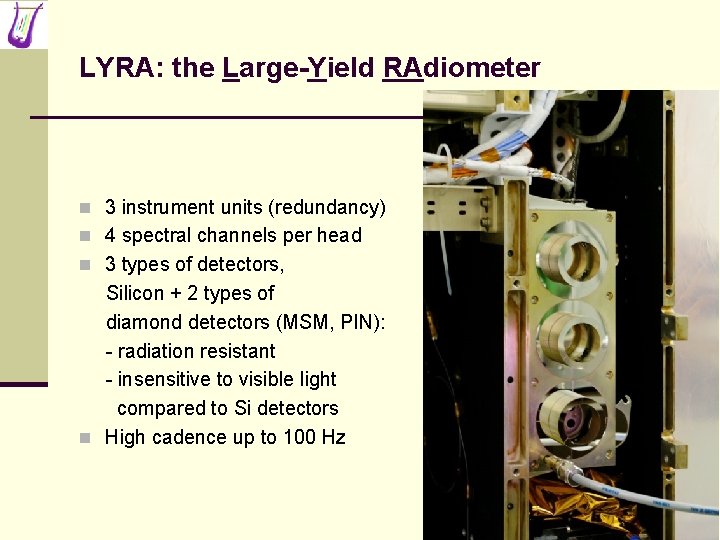
LYRA: the Large-Yield RAdiometer n 3 instrument units (redundancy) n 4 spectral channels per head n 3 types of detectors, Silicon + 2 types of diamond detectors (MSM, PIN): - radiation resistant - insensitive to visible light compared to Si detectors n High cadence up to 100 Hz
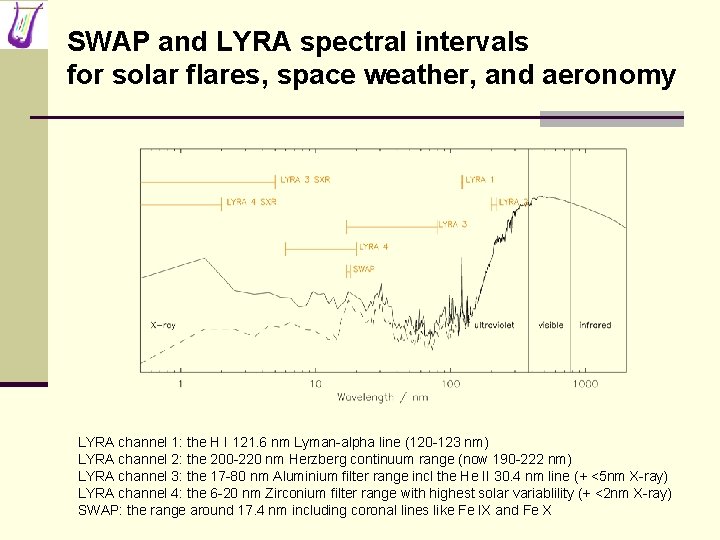
SWAP and LYRA spectral intervals for solar flares, space weather, and aeronomy LYRA channel 1: the H I 121. 6 nm Lyman-alpha line (120 -123 nm) LYRA channel 2: the 200 -220 nm Herzberg continuum range (now 190 -222 nm) LYRA channel 3: the 17 -80 nm Aluminium filter range incl the He II 30. 4 nm line (+ <5 nm X-ray) LYRA channel 4: the 6 -20 nm Zirconium filter range with highest solar variablility (+ <2 nm X-ray) SWAP: the range around 17. 4 nm including coronal lines like Fe IX and Fe X
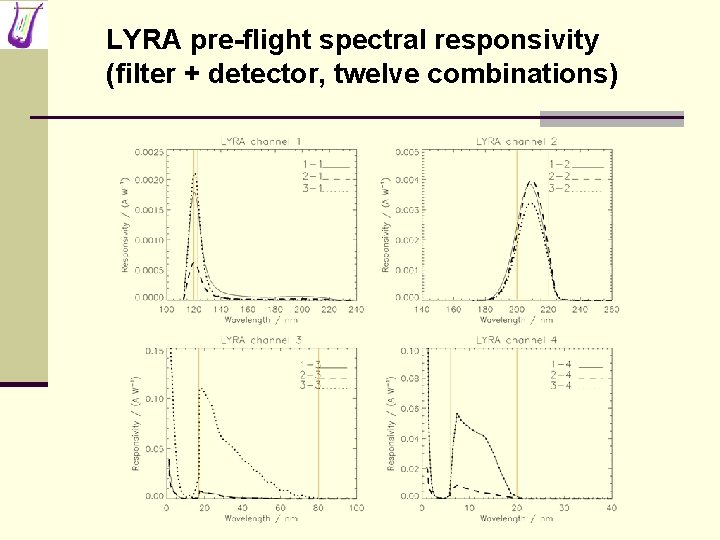
LYRA pre-flight spectral responsivity (filter + detector, twelve combinations)
LYRA calibration … … was not as easy as anticipated (surprise!) Problems: 1. Unrealistic nominal intervals 2. Fast degradation 3. Periodically varying dark currents
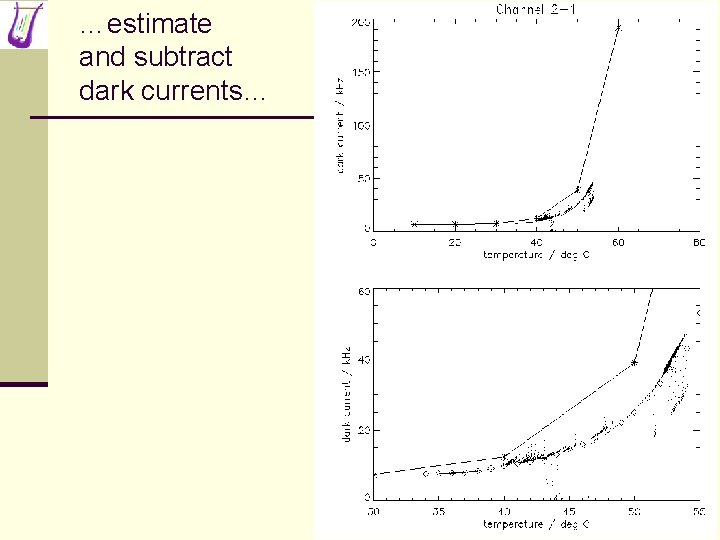
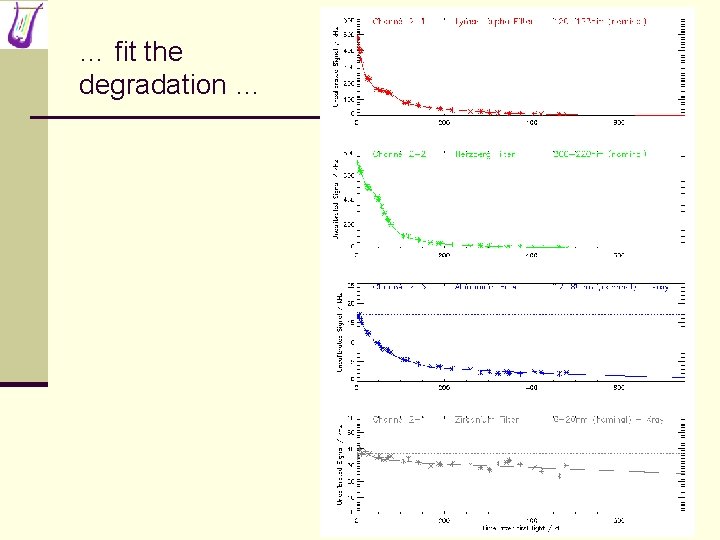
Possible solutions 1. Re-define realistic nominal intervals, at least for a start 2. Estimate and correct degradation by internal means (LYRA Head 2 vs. Head 3) 3. Estimate and correct dark currents by using detector temperatures Then calibrate according to First Light Day (i. e. before degradation begins)
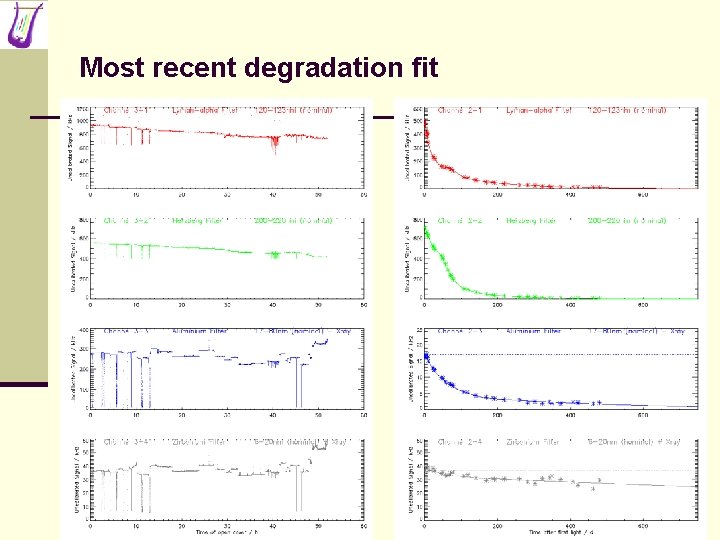
Most recent degradation fit
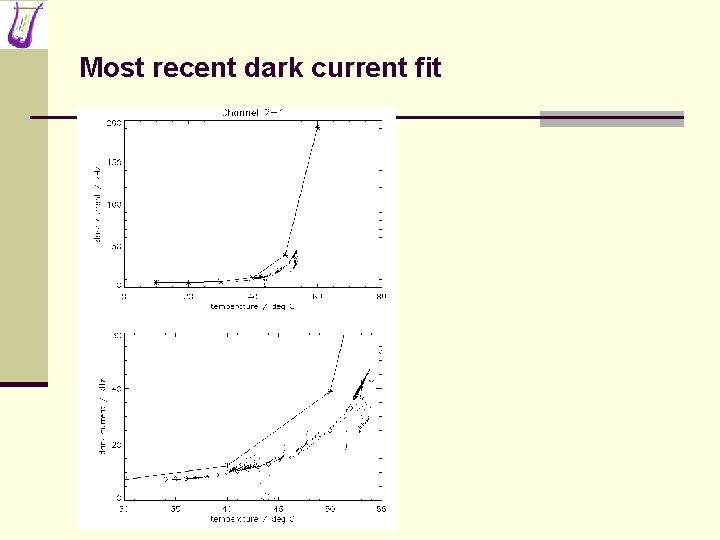
Most recent dark current fit
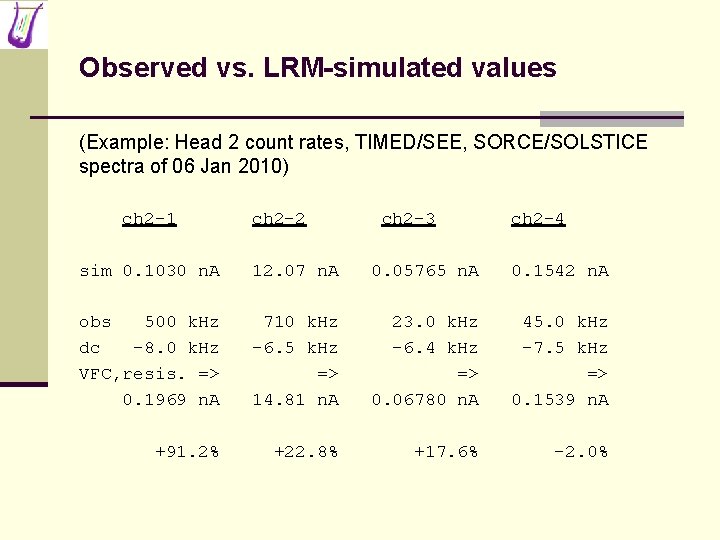
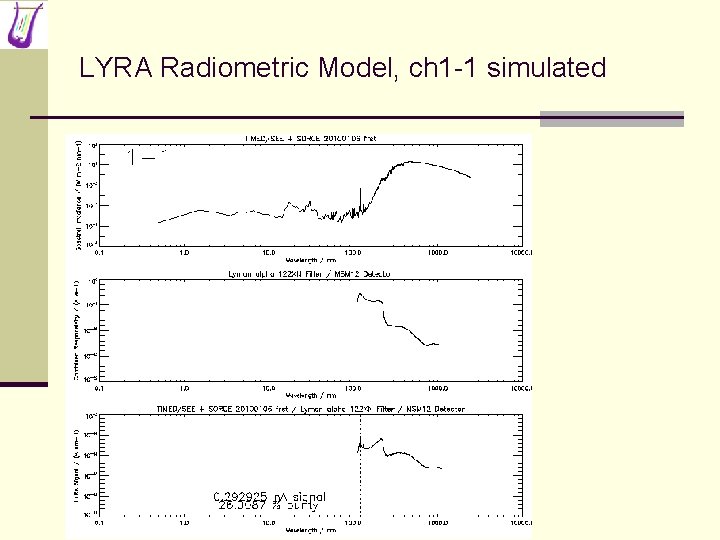
Observed vs. LRM-simulated values (Example: Head 2 count rates, TIMED/SEE, SORCE/SOLSTICE spectra of 06 Jan 2010) ch 2 -1 ch 2 -2 ch 2 -3 ch 2 -4 sim 0. 1030 n. A 12. 07 n. A 0. 05765 n. A 0. 1542 n. A obs 500 k. Hz dc -8. 0 k. Hz VFC, resis. => 0. 1969 n. A 710 k. Hz -6. 5 k. Hz => 14. 81 n. A 23. 0 k. Hz -6. 4 k. Hz => 0. 06780 n. A 45. 0 k. Hz -7. 5 k. Hz => 0. 1539 n. A +91. 2% +22. 8% +17. 6% -2. 0%
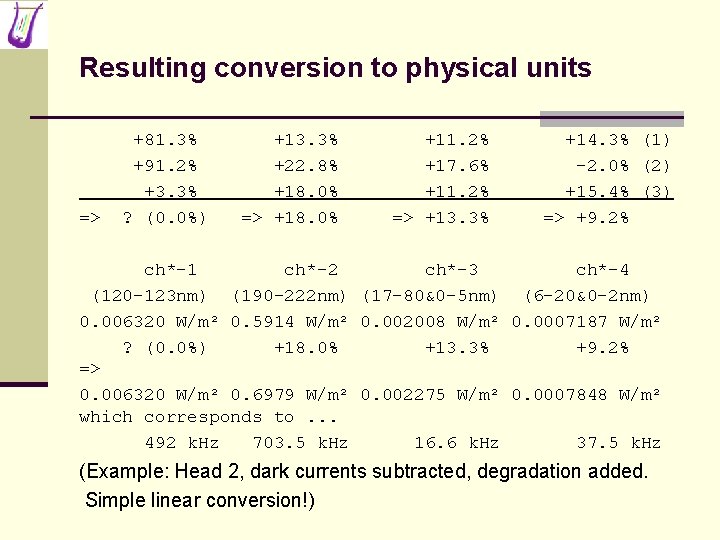
Resulting conversion to physical units => +81. 3% +91. 2% +3. 3% ? (0. 0%) +13. 3% +22. 8% +18. 0% => +18. 0% +11. 2% +17. 6% +11. 2% => +13. 3% +14. 3% (1) -2. 0% (2) +15. 4% (3) => +9. 2% ch*-1 ch*-2 ch*-3 ch*-4 (120 -123 nm) (190 -222 nm) (17 -80&0 -5 nm) (6 -20&0 -2 nm) 0. 006320 W/m² 0. 5914 W/m² 0. 002008 W/m² 0. 0007187 W/m² ? (0. 0%) +18. 0% +13. 3% +9. 2% => 0. 006320 W/m² 0. 6979 W/m² 0. 002275 W/m² 0. 0007848 W/m² which corresponds to. . . 492 k. Hz 703. 5 k. Hz 16. 6 k. Hz 37. 5 k. Hz (Example: Head 2, dark currents subtracted, degradation added. Simple linear conversion!)
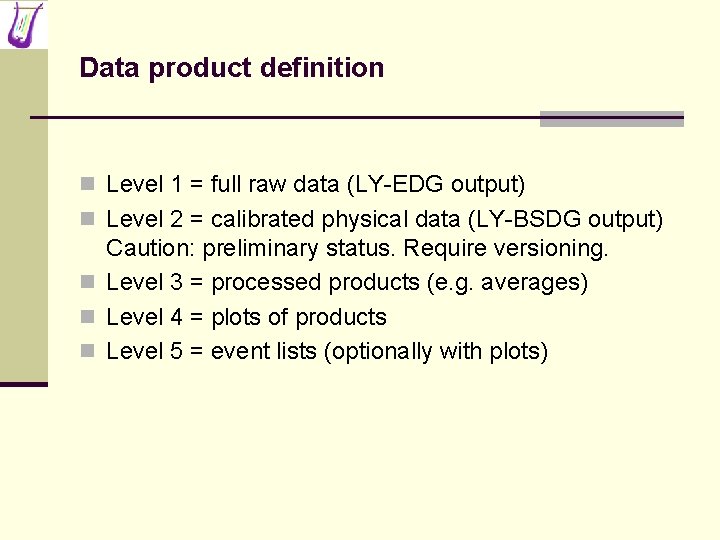
Data product definition n Level 1 = full raw data (LY-EDG output) n Level 2 = calibrated physical data (LY-BSDG output) Caution: preliminary status. Require versioning. n Level 3 = processed products (e. g. averages) n Level 4 = plots of products n Level 5 = event lists (optionally with plots)
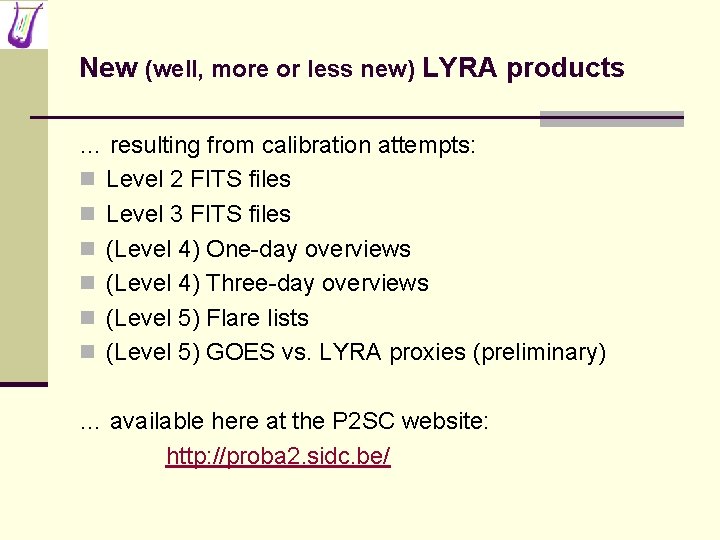
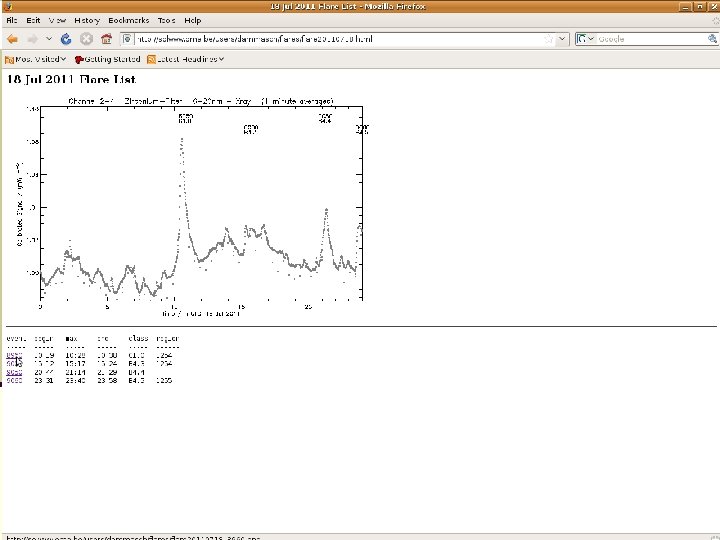
New (well, more or less new) LYRA products … resulting from calibration attempts: n Level 2 FITS files n Level 3 FITS files n (Level 4) One-day overviews n (Level 4) Three-day overviews n (Level 5) Flare lists n (Level 5) GOES vs. LYRA proxies (preliminary) … available here at the P 2 SC website: http: //proba 2. sidc. be/
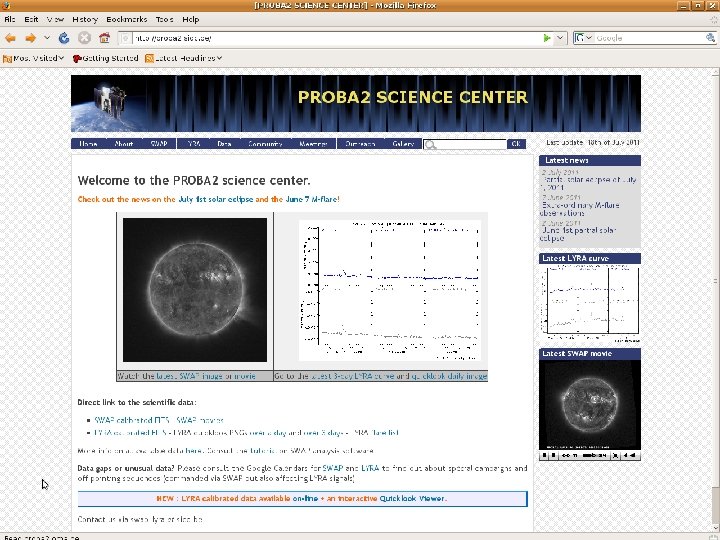
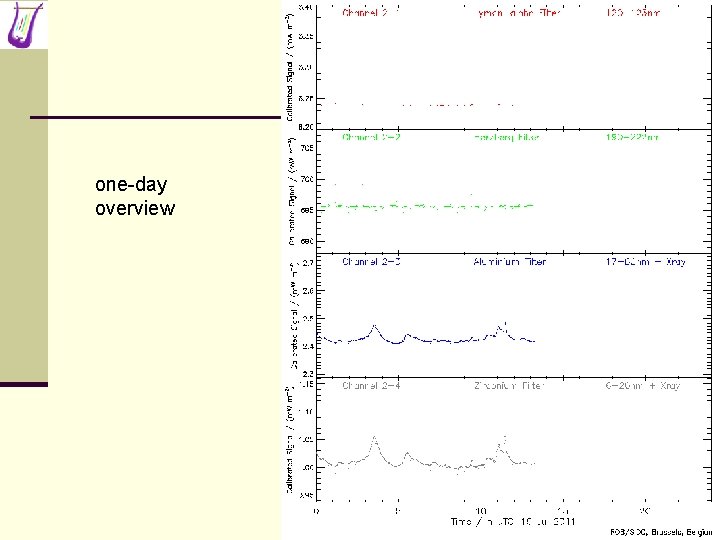
one-day overview
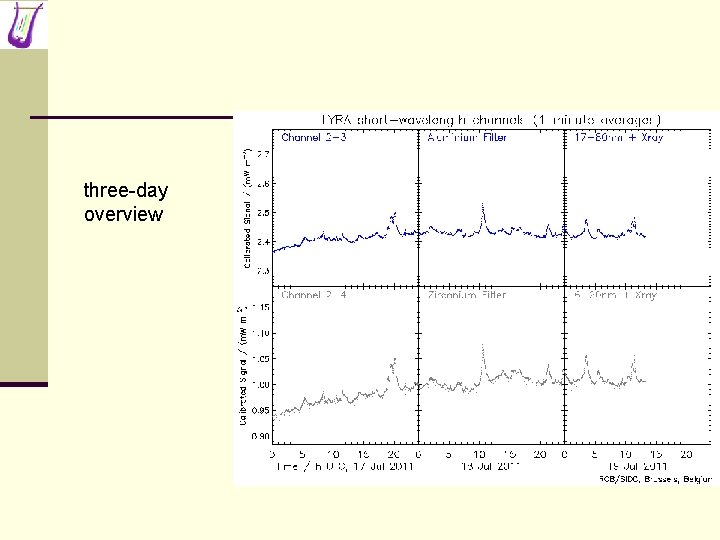
three-day overview
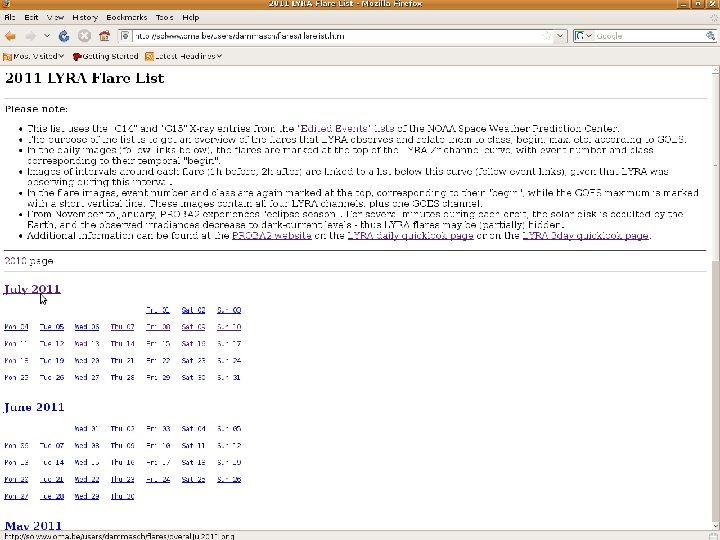
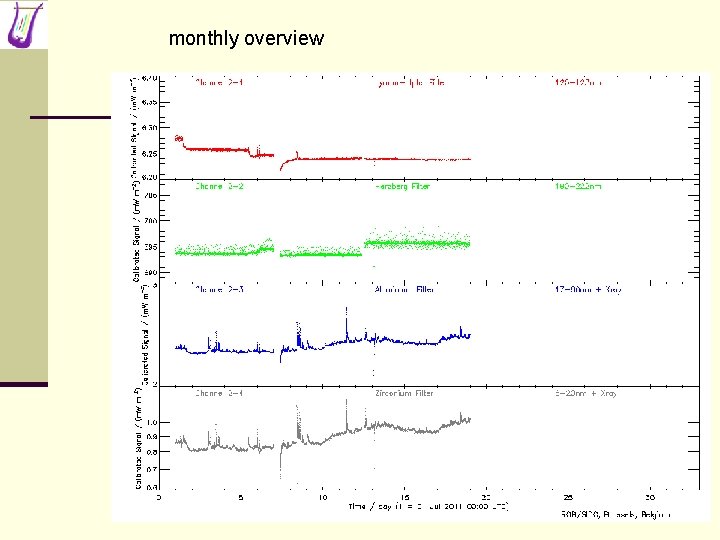
monthly overview
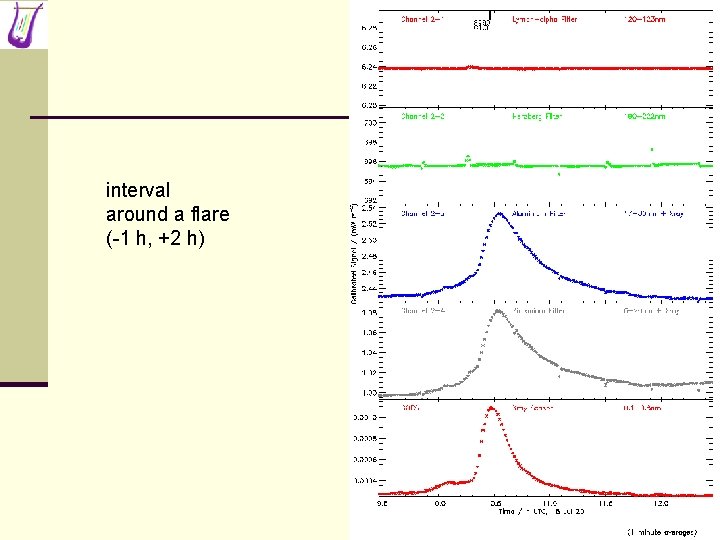
interval around a flare (-1 h, +2 h)
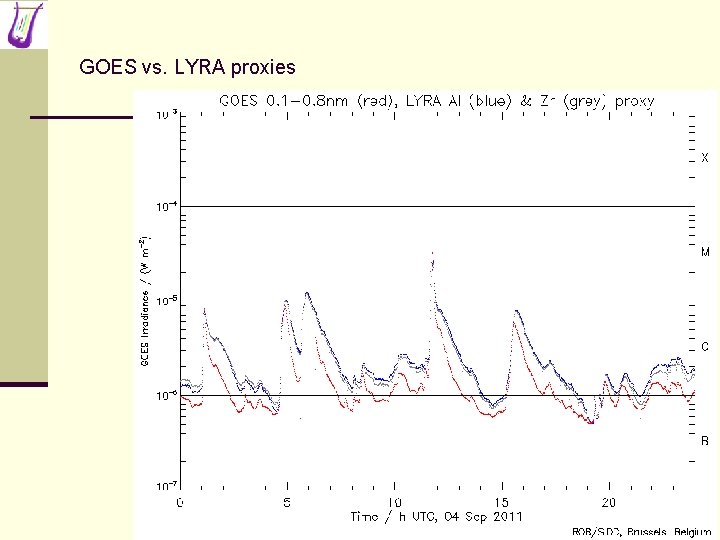
GOES vs. LYRA proxies
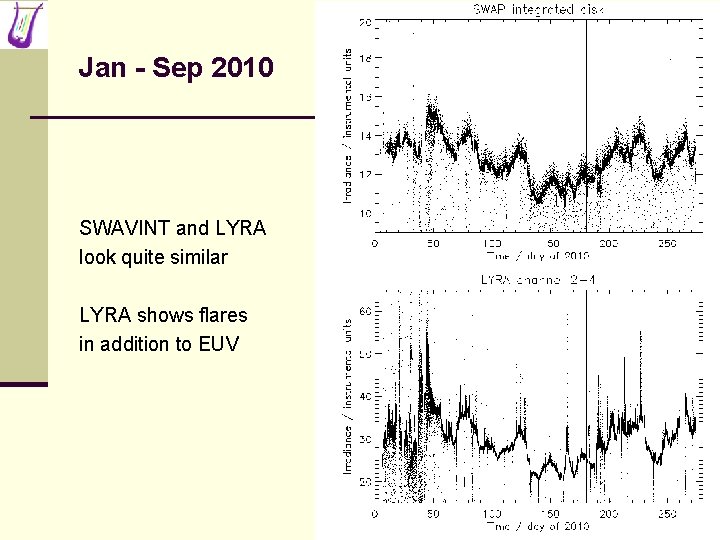
Jan - Sep 2010 SWAVINT and LYRA look quite similar LYRA shows flares in addition to EUV
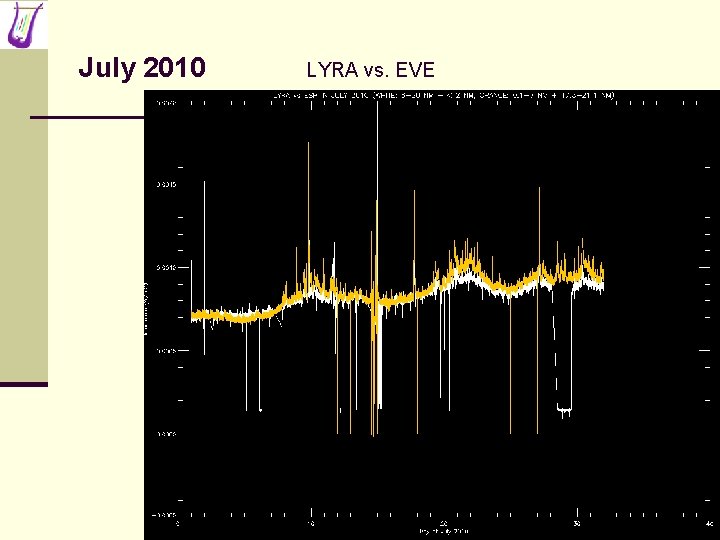
July 2010 LYRA vs. EVE
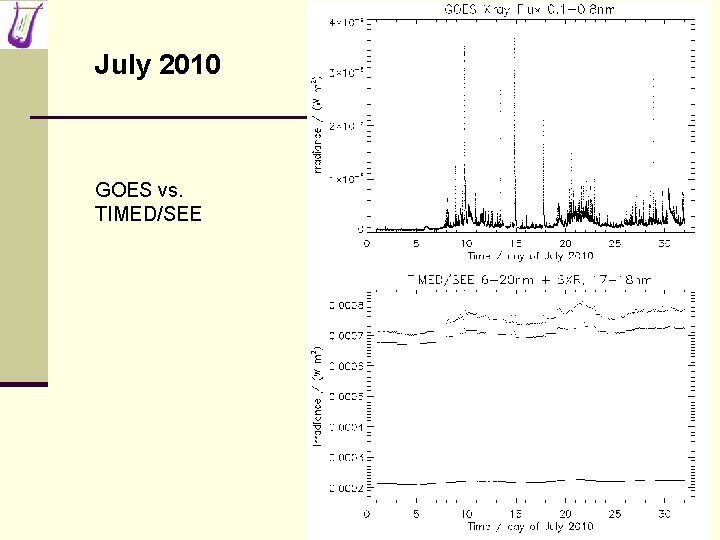
July 2010 GOES vs. TIMED/SEE
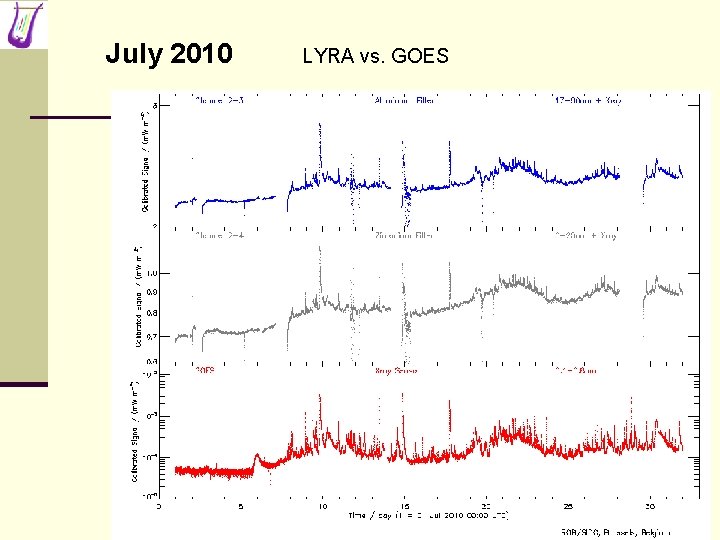
July 2010 LYRA vs. GOES
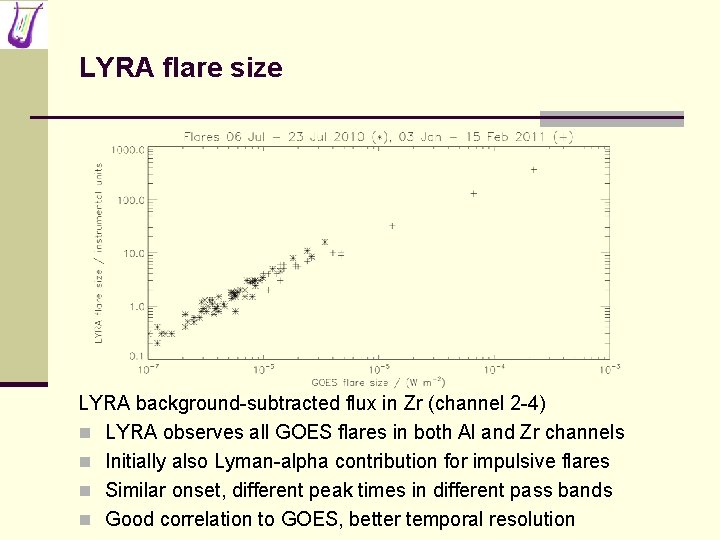
LYRA flare size LYRA background-subtracted flux in Zr (channel 2 -4) n LYRA observes all GOES flares in both Al and Zr channels n Initially also Lyman-alpha contribution for impulsive flares n Similar onset, different peak times in different pass bands n Good correlation to GOES, better temporal resolution
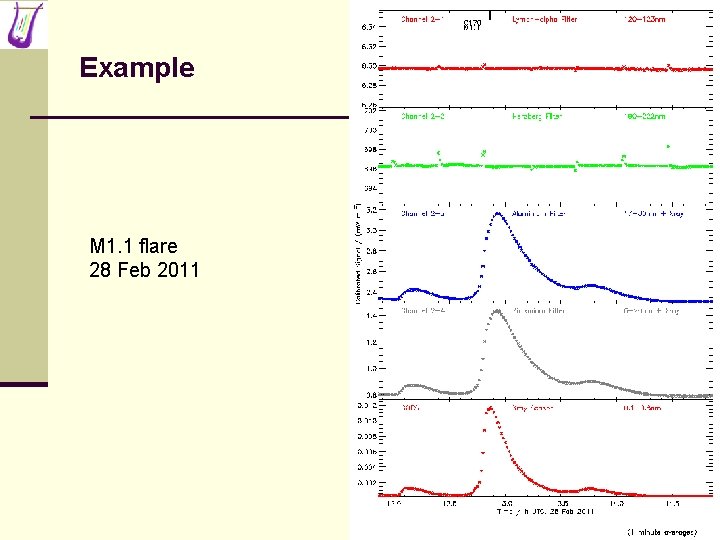
Example M 1. 1 flare 28 Feb 2011
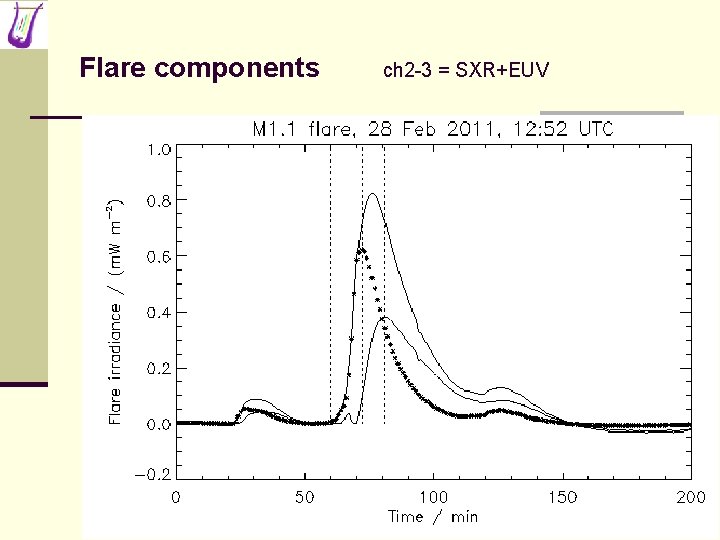
Flare components ch 2 -3 = SXR+EUV
0. 03 MK 0. 7 MK 1. 4 MK 3. 7 MK 7. 7 MK
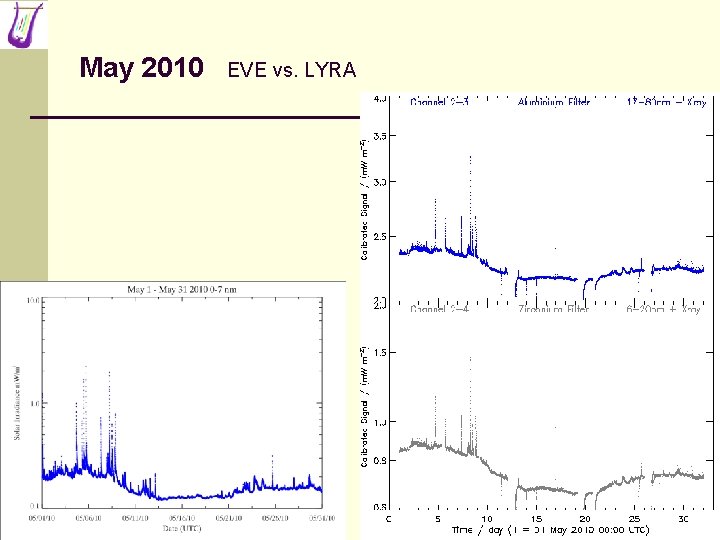
May 2010 EVE vs. LYRA
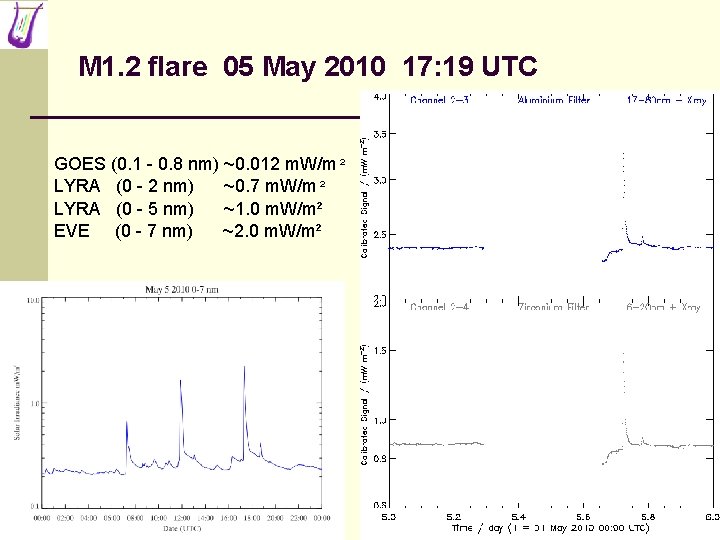
M 1. 2 flare 05 May 2010 17: 19 UTC GOES (0. 1 - 0. 8 nm) ~0. 012 m. W/m² LYRA (0 - 2 nm) ~0. 7 m. W/m² LYRA (0 - 5 nm) ~1. 0 m. W/m² EVE (0 - 7 nm) ~2. 0 m. W/m²
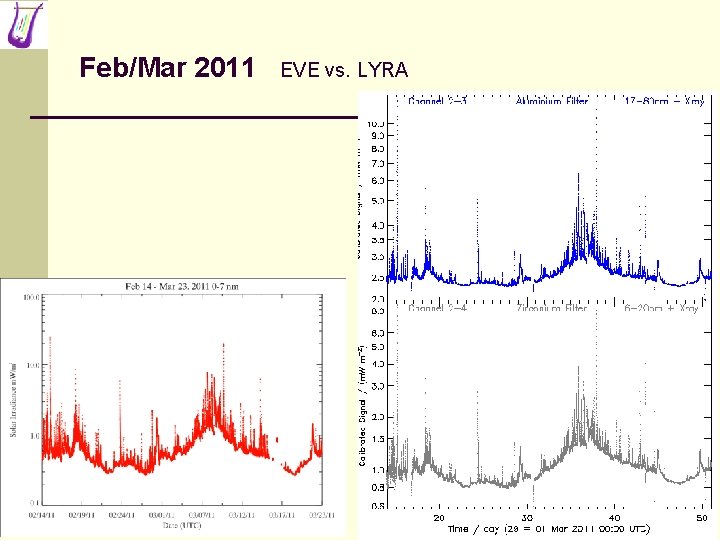
Feb/Mar 2011 EVE vs. LYRA
Appendix LYRA calibration details
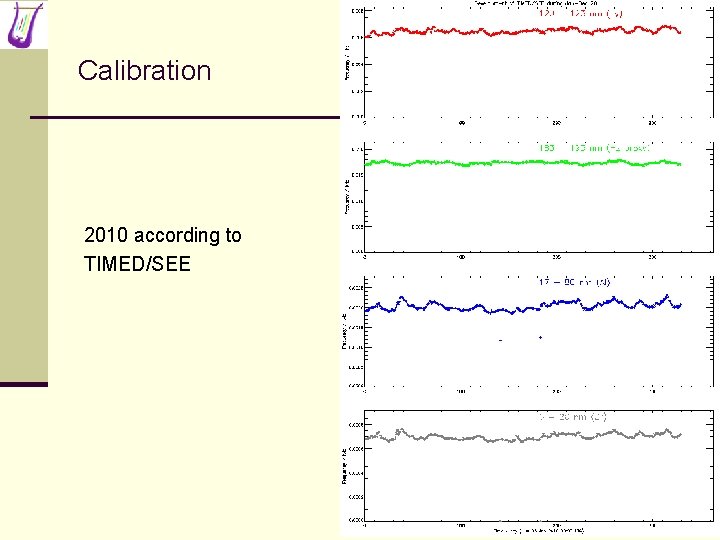
Calibration 2010 according to TIMED/SEE
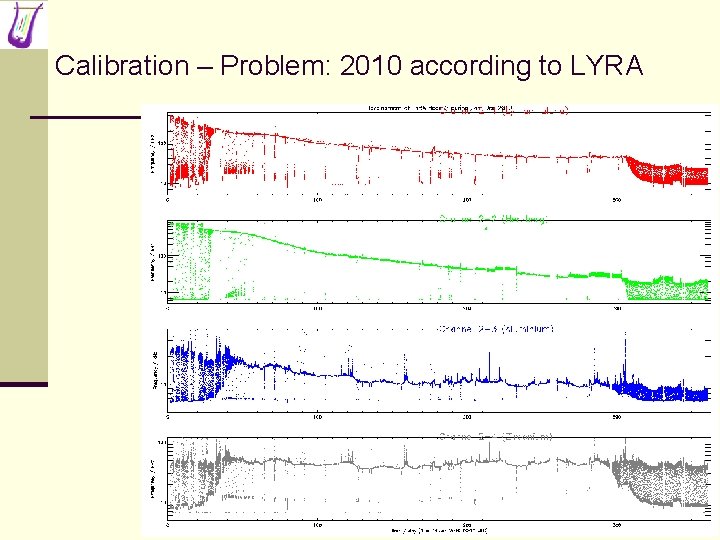
Calibration – Problem: 2010 according to LYRA
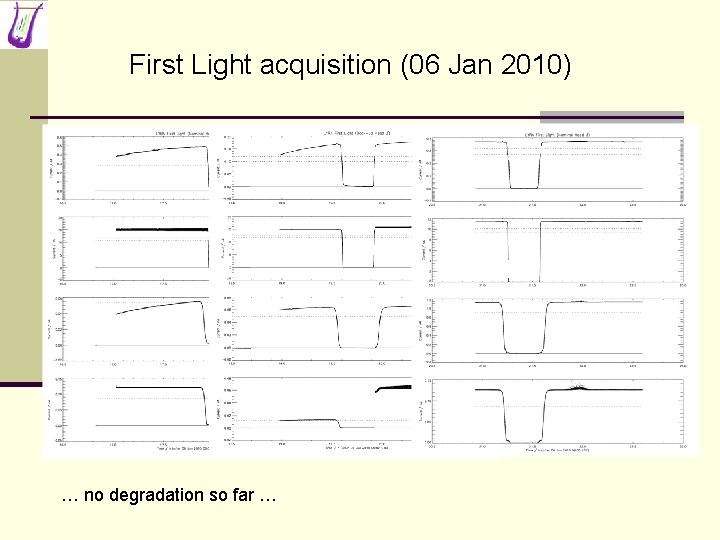
First Light acquisition (06 Jan 2010) … no degradation so far …
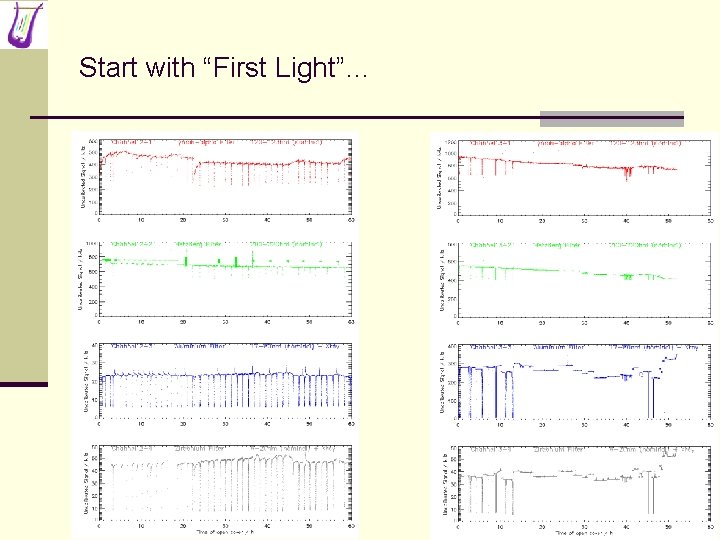
Start with “First Light”…
…estimate and subtract dark currents…
… fit the degradation …
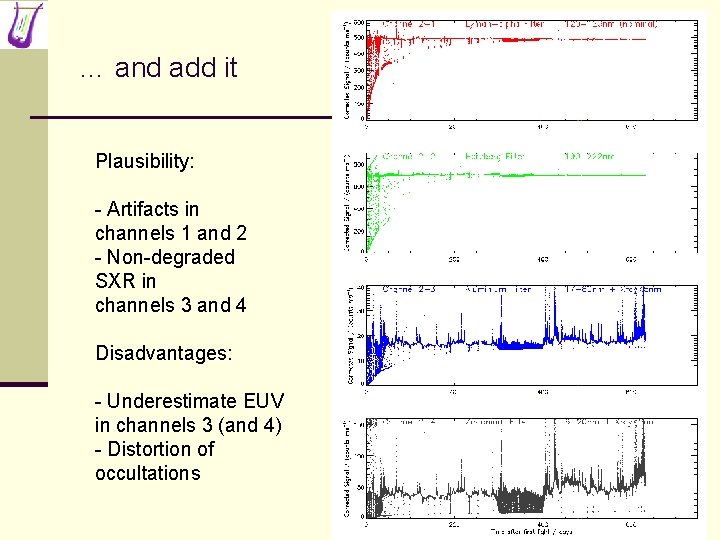
… and add it Plausibility: - Artifacts in channels 1 and 2 - Non-degraded SXR in channels 3 and 4 Disadvantages: - Underestimate EUV in channels 3 (and 4) - Distortion of occultations
LYRA Radiometric Model, ch 1 -1 simulated
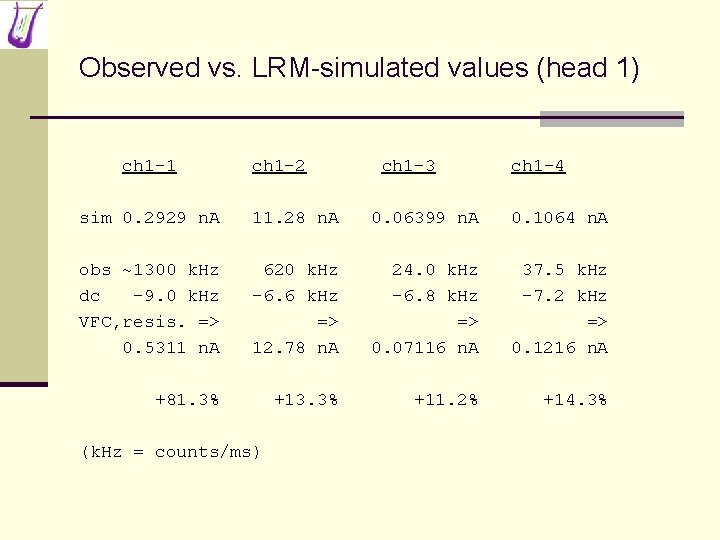
Observed vs. LRM-simulated values (head 1) ch 1 -1 ch 1 -2 ch 1 -3 ch 1 -4 sim 0. 2929 n. A 11. 28 n. A 0. 06399 n. A 0. 1064 n. A obs ~1300 k. Hz dc -9. 0 k. Hz VFC, resis. => 0. 5311 n. A 620 k. Hz -6. 6 k. Hz => 12. 78 n. A 24. 0 k. Hz -6. 8 k. Hz => 0. 07116 n. A 37. 5 k. Hz -7. 2 k. Hz => 0. 1216 n. A +81. 3% +13. 3% +11. 2% +14. 3% (k. Hz = counts/ms)
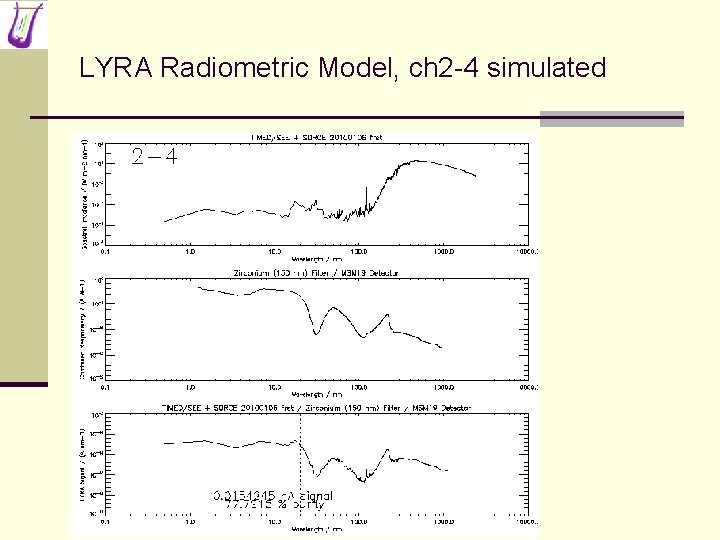
LYRA Radiometric Model, ch 2 -4 simulated
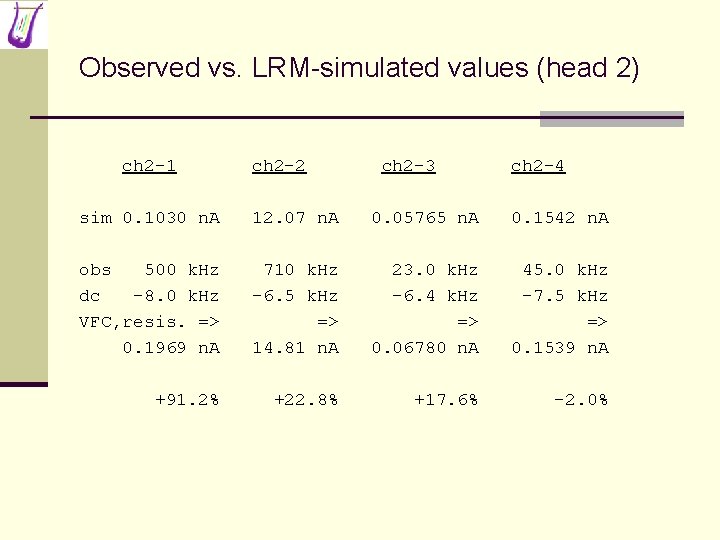
Observed vs. LRM-simulated values (head 2) ch 2 -1 ch 2 -2 ch 2 -3 ch 2 -4 sim 0. 1030 n. A 12. 07 n. A 0. 05765 n. A 0. 1542 n. A obs 500 k. Hz dc -8. 0 k. Hz VFC, resis. => 0. 1969 n. A 710 k. Hz -6. 5 k. Hz => 14. 81 n. A 23. 0 k. Hz -6. 4 k. Hz => 0. 06780 n. A 45. 0 k. Hz -7. 5 k. Hz => 0. 1539 n. A +91. 2% +22. 8% +17. 6% -2. 0%
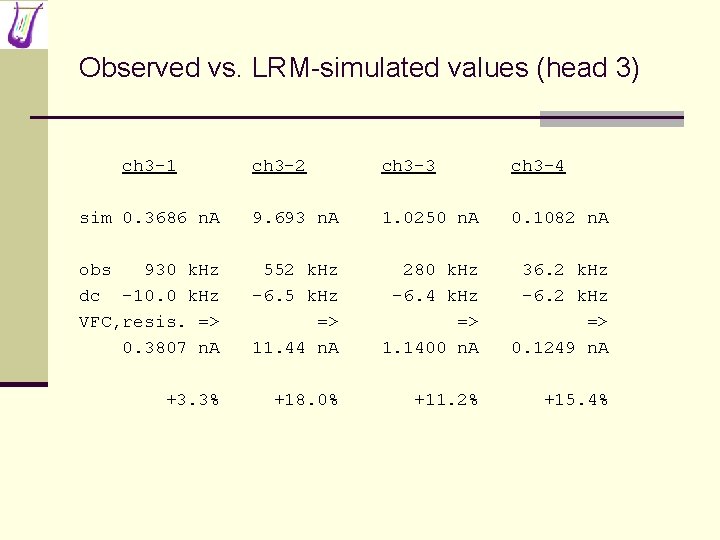
Observed vs. LRM-simulated values (head 3) ch 3 -1 ch 3 -2 ch 3 -3 ch 3 -4 sim 0. 3686 n. A 9. 693 n. A 1. 0250 n. A 0. 1082 n. A obs 930 k. Hz dc -10. 0 k. Hz VFC, resis. => 0. 3807 n. A 552 k. Hz -6. 5 k. Hz => 11. 44 n. A 280 k. Hz -6. 4 k. Hz => 1. 1400 n. A 36. 2 k. Hz -6. 2 k. Hz => 0. 1249 n. A +3. 3% +18. 0% +11. 2% +15. 4%
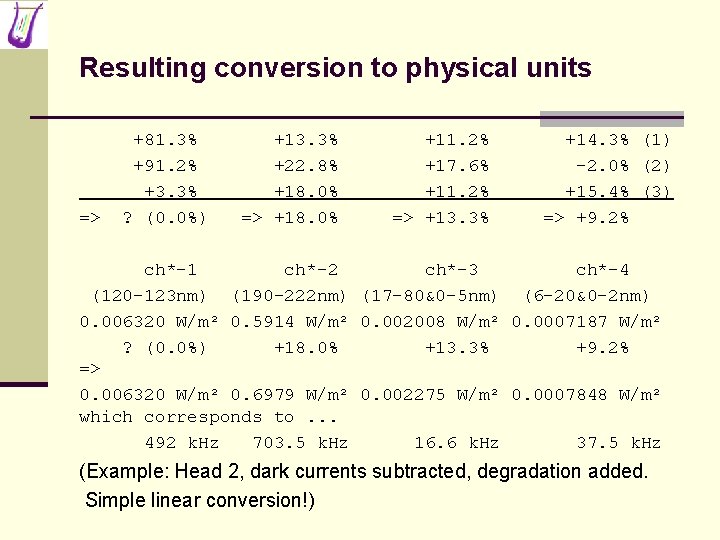
Resulting conversion to physical units => +81. 3% +91. 2% +3. 3% ? (0. 0%) +13. 3% +22. 8% +18. 0% => +18. 0% +11. 2% +17. 6% +11. 2% => +13. 3% +14. 3% (1) -2. 0% (2) +15. 4% (3) => +9. 2% ch*-1 ch*-2 ch*-3 ch*-4 (120 -123 nm) (190 -222 nm) (17 -80&0 -5 nm) (6 -20&0 -2 nm) 0. 006320 W/m² 0. 5914 W/m² 0. 002008 W/m² 0. 0007187 W/m² ? (0. 0%) +18. 0% +13. 3% +9. 2% => 0. 006320 W/m² 0. 6979 W/m² 0. 002275 W/m² 0. 0007848 W/m² which corresponds to. . . 492 k. Hz 703. 5 k. Hz 16. 6 k. Hz 37. 5 k. Hz (Example: Head 2, dark currents subtracted, degradation added. Simple linear conversion!)
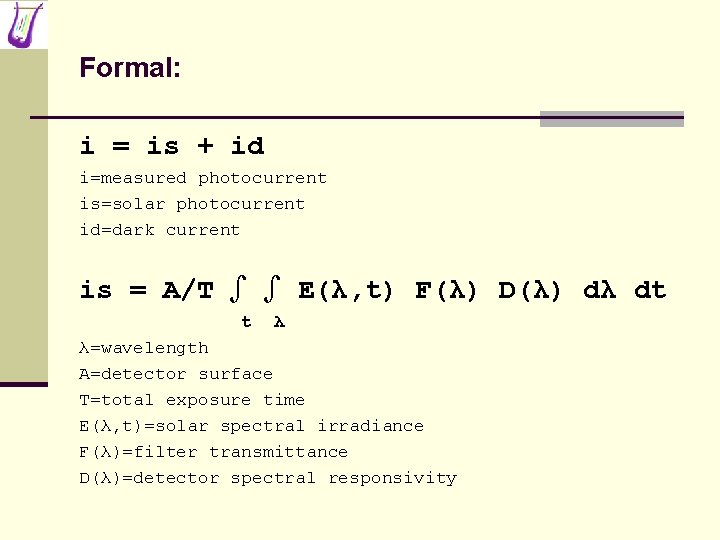
Formal: i = is + id i=measured photocurrent is=solar photocurrent id=dark current is = A/T ∫ ∫ E(λ, t) F(λ) D(λ) dλ dt t λ λ=wavelength A=detector surface T=total exposure time E(λ, t)=solar spectral irradiance F(λ)=filter transmittance D(λ)=detector spectral responsivity
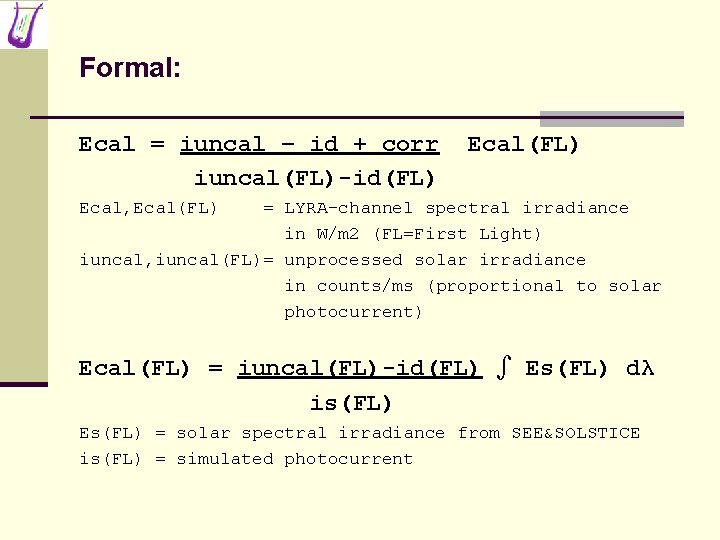
Formal: Ecal = iuncal – id + corr iuncal(FL)-id(FL) Ecal, Ecal(FL) = LYRA-channel spectral irradiance in W/m 2 (FL=First Light) iuncal, iuncal(FL)= unprocessed solar irradiance in counts/ms (proportional to solar photocurrent) Ecal(FL) = iuncal(FL)-id(FL) ∫ Es(FL) dλ is(FL) Es(FL) = solar spectral irradiance from SEE&SOLSTICE is(FL) = simulated photocurrent
- Slides: 47