
Lynkurs Prosessregulering Crash course process control Sigurd Skogestad
- Slides: 5
Lynkurs Prosessregulering (Crash course process control) Sigurd Skogestad Institutt for kjemisk prosessteknologi Rom K 4 -232 skoge@ntnu. no
• Pensum (syllabus): Lectures/exercises • • • Literature (see www. ntnu. no/users/skoge/prosessreguring_lynkurs): 1. Nybraaten og Svendsen, "Kort innføring i prosessregulering" (1986) (det kan synes gammelt, men det står faktisk mye bra her) 2. 12 sider fra F. Haugen, "Anvendt reguleringsteknikk", 1992 3. S. Skogestad, "Prosessteknikk", 2. utgave, Tapir 2003: Kap. 11. 3 (tidsrespons) og 11. 8 (prosessregulering) 3. S. Skogestad, ”Chemical and Energy Process Engineering”, CRC Press, 2009: Ch. 11. 3 (Dynamic analysis and time response) + Ch. 11. 6 (Process control) • • • ARK 0: Block diagram shower ARK 1: Prosedyre reguleringsstruktur, parring, Eksempel 2 ARK 2: Eksempel 3 (=oppg 1. på øving) ARK 3: Oppg. 2 øving, Oppgave 3 øving, sprangrespons 1. ordens system ARK 4: PID-regulering, Eksempel innstilling PID • Forelesningsplan (delvis integrert med gjennomgang av øving) • • • F 1: Oversikt over regulering, forover- og tilbakehobling, dusjeksempel F 2: Klassifisering av variable, ARK 0, prosedyre for utforming av reguleringssystem ARK 1 F 3: Eksempler ARK 2, ARK 3 F 4: Prosessdynamikk, tidskonstant, dødtid, PID-regulering, ARK 4 F 5: Stabilitet, Tuning PID, Forsøk, Eksempler,
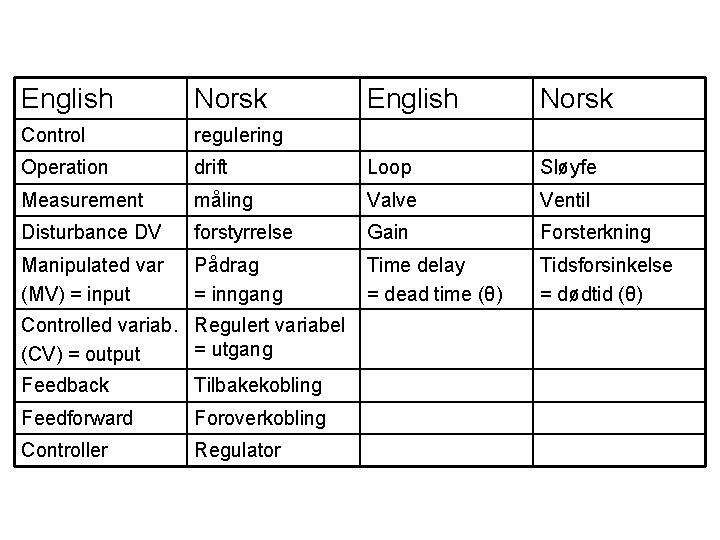
English Norsk Control regulering Operation drift Loop Sløyfe Measurement måling Valve Ventil Disturbance DV forstyrrelse Gain Forsterkning Manipulated var (MV) = input Pådrag = inngang Time delay = dead time (θ) Tidsforsinkelse = dødtid (θ) Controlled variab. Regulert variabel = utgang (CV) = output Feedback Tilbakekobling Feedforward Foroverkobling Controller Regulator
Why control? • Until now: Design of process. Assume steady-state • Now: Operation
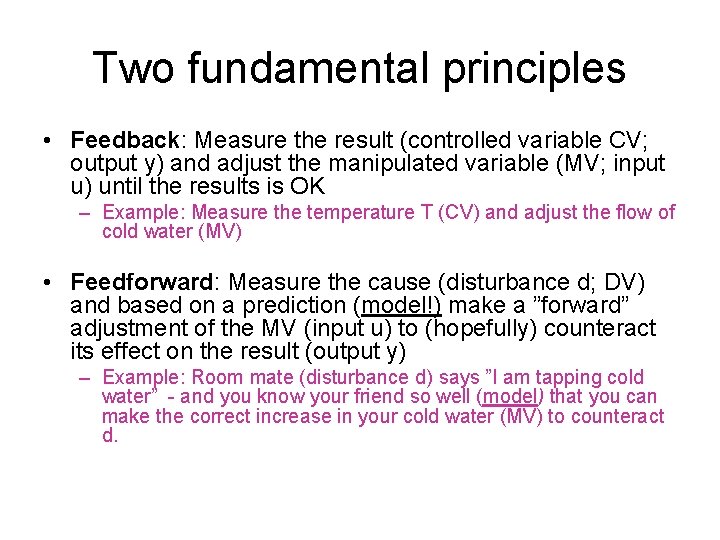
Two fundamental principles • Feedback: Measure the result (controlled variable CV; output y) and adjust the manipulated variable (MV; input u) until the results is OK – Example: Measure the temperature T (CV) and adjust the flow of cold water (MV) • Feedforward: Measure the cause (disturbance d; DV) and based on a prediction (model!) make a ”forward” adjustment of the MV (input u) to (hopefully) counteract its effect on the result (output y) – Example: Room mate (disturbance d) says ”I am tapping cold water” - and you know your friend so well (model) that you can make the correct increase in your cold water (MV) to counteract d.