
LymphaticImmune System The lymphatic system consists of 2


- Slides: 13
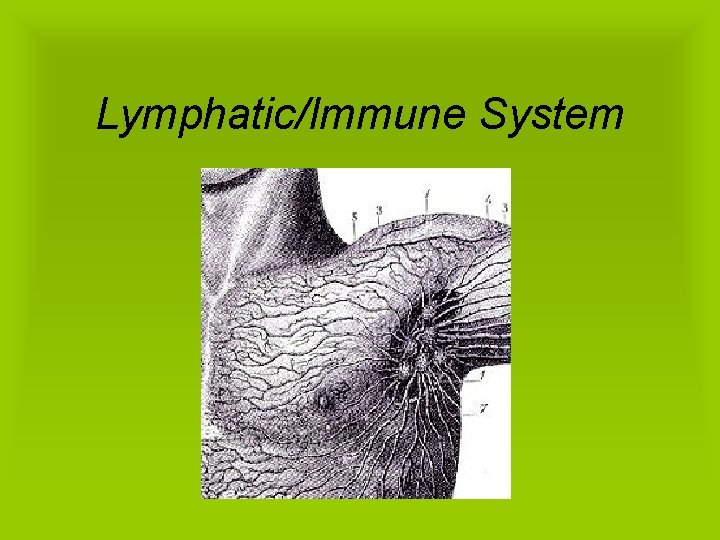
Lymphatic/Immune System
The lymphatic system consists of 2 semi-independent parts: JNetwork of Lymphatic Vessels - function primarily to return interstitial fluid to the vascular system. J Various Lymphoid Organs scattered throughout the body - function primarily in immune defense. Interstitial fluid needs to be returned to the vascular system lest we totally deplete our blood volume. Additionally, any plasma proteins that have escaped through the capillary walls must also be returned. This returning of lost fluid and proteins is the occupation of the lymphatic system.
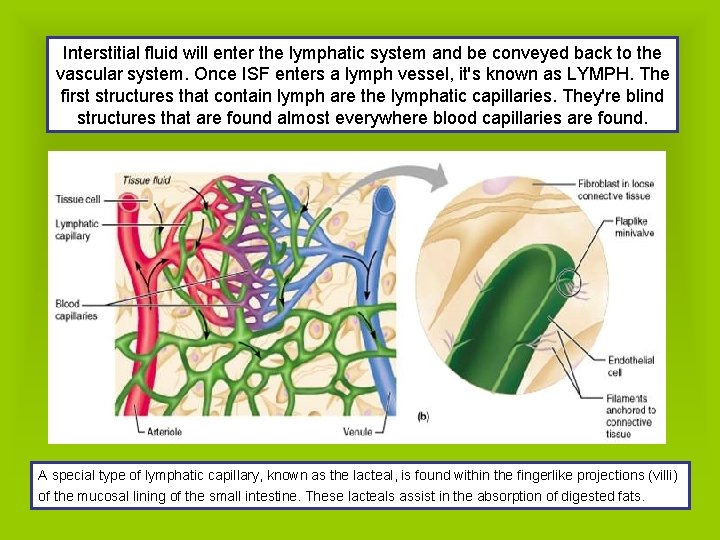
Interstitial fluid will enter the lymphatic system and be conveyed back to the vascular system. Once ISF enters a lymph vessel, it's known as LYMPH. The first structures that contain lymph are the lymphatic capillaries. They're blind structures that are found almost everywhere blood capillaries are found. A special type of lymphatic capillary, known as the lacteal, is found within the fingerlike projections (villi) of the mucosal lining of the small intestine. These lacteals assist in the absorption of digested fats.
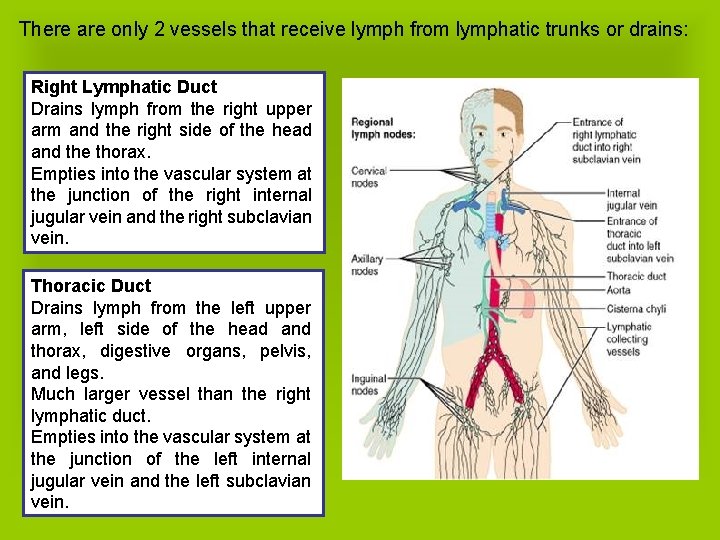
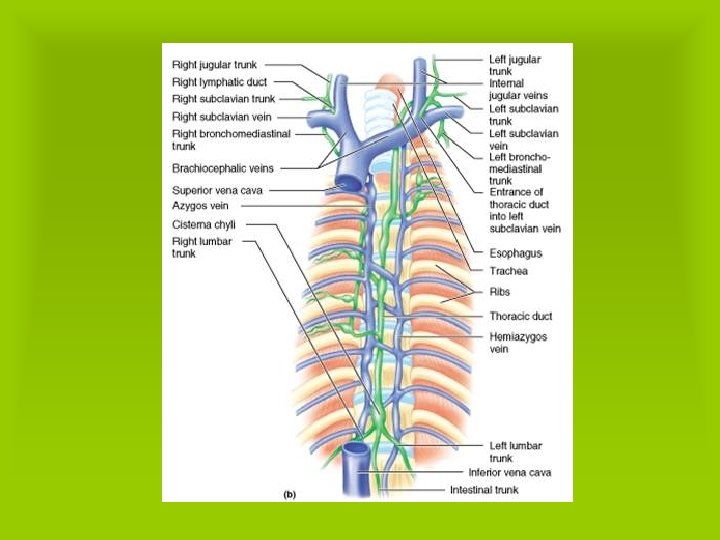
There are only 2 vessels that receive lymph from lymphatic trunks or drains: Right Lymphatic Duct Drains lymph from the right upper arm and the right side of the head and the thorax. Empties into the vascular system at the junction of the right internal jugular vein and the right subclavian vein. Thoracic Duct Drains lymph from the left upper arm, left side of the head and thorax, digestive organs, pelvis, and legs. Much larger vessel than the right lymphatic duct. Empties into the vascular system at the junction of the left internal jugular vein and the left subclavian vein.
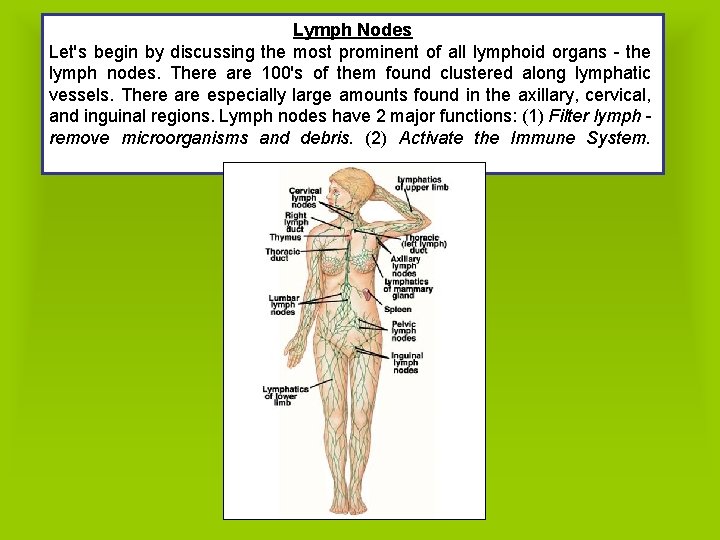
Lymph Nodes Let's begin by discussing the most prominent of all lymphoid organs - the lymph nodes. There are 100's of them found clustered along lymphatic vessels. There are especially large amounts found in the axillary, cervical, and inguinal regions. Lymph nodes have 2 major functions: (1) Filter lymph remove microorganisms and debris. (2) Activate the Immune System.
As the lymph percolates through the sinuses, it's examined by the macrophages and lymphocytes, who are ready to attack any foreign organisms and alert the immune system. Lymph usually has to pass through several nodes before it's "clean. " Note that there are more afferent than efferent lymphatic vessels. This decreases the rate of fluid flow through the lymph node. (Think about 4 lanes on a highway merging into 2 lanes!) This decreased flow velocity is going to give more time for the macrophages and lymphocytes to examine the lymph.
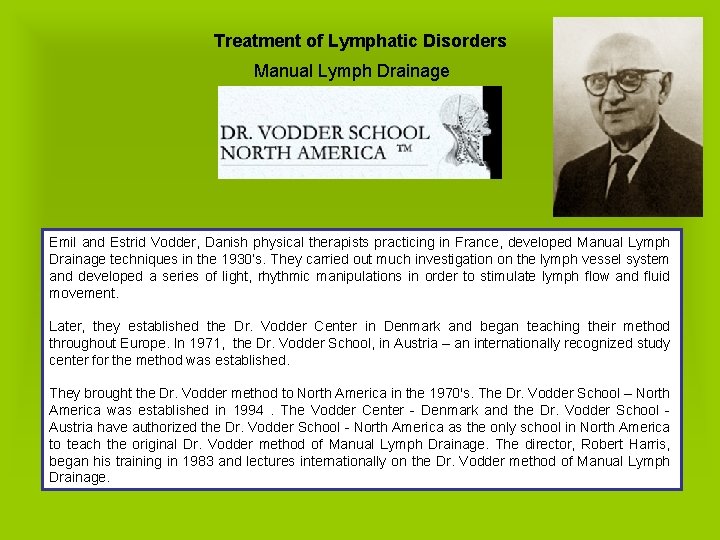
Treatment of Lymphatic Disorders Manual Lymph Drainage Emil and Estrid Vodder, Danish physical therapists practicing in France, developed Manual Lymph Drainage techniques in the 1930’s. They carried out much investigation on the lymph vessel system and developed a series of light, rhythmic manipulations in order to stimulate lymph flow and fluid movement. Later, they established the Dr. Vodder Center in Denmark and began teaching their method throughout Europe. In 1971, the Dr. Vodder School, in Austria – an internationally recognized study center for the method was established. They brought the Dr. Vodder method to North America in the 1970's. The Dr. Vodder School – North America was established in 1994. The Vodder Center - Denmark and the Dr. Vodder School Austria have authorized the Dr. Vodder School - North America as the only school in North America to teach the original Dr. Vodder method of Manual Lymph Drainage. The director, Robert Harris, began his training in 1983 and lectures internationally on the Dr. Vodder method of Manual Lymph Drainage.
Academy of Lymphatic Studies 11632 High Street, Suite A Sebastian, FL 32958 (772) 569 -3355 150 Hours Training Manual Lymph Drainage and Complete Decongestive Therapy is the treatment of choice for the condition known as Lymphedema. The Academy of Lymphatic Studies is the leading school in the U. S. to provide comprehensive lymphedema certification training for the training and certification of health care professionals in this specialized treatment technique. The Academy of Lymphatic Studies has offered lymphedema certification courses in the U. S. since 1994. Before and After photo of actual case histories Lymphedema Patients before and after CDT Treatment
Complete Decongestive Therapy consists of the following four basic components: Manual Lymph Drainage (Vodder Technique) MLD is a gentle manual treatment technique, which improves the activity of the lymph vessels and in the case of lymphedema re-routes the lymph flow around the blocked areas into more centrally located lymph vessels that drain into the venous system. Compression Therapy Compression therapy increases the tissue pressure and is applied between treatments to prevent re -accumulation of evacuated lymph fluid. In phase one of therapy this is achieved with the application of multi-layered short-stretch bandages, in phase two with compression garments Exercises Decongestive exercises performed by the patient wearing the compression bandages or garments as well as proper breathing techniques, which are also part of CDT, aid the lymphokinetic effects of the joint and muscle pumps Skin Care Infections, such as cellulitis attacks or fungal infections, can be a serious complication in lymphedema. Teaching the patients meticulous skin and nail care is an essential part of the treatment program.
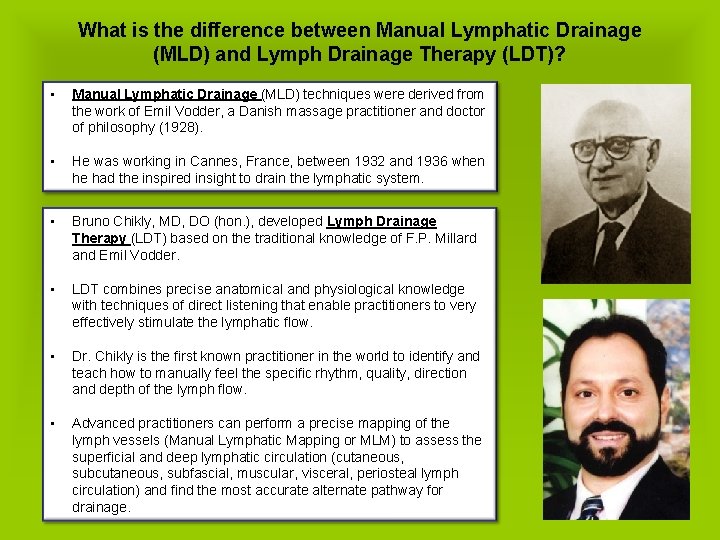
What is the difference between Manual Lymphatic Drainage (MLD) and Lymph Drainage Therapy (LDT)? • Manual Lymphatic Drainage (MLD) techniques were derived from the work of Emil Vodder, a Danish massage practitioner and doctor of philosophy (1928). • He was working in Cannes, France, between 1932 and 1936 when he had the inspired insight to drain the lymphatic system. • Bruno Chikly, MD, DO (hon. ), developed Lymph Drainage Therapy (LDT) based on the traditional knowledge of F. P. Millard and Emil Vodder. • LDT combines precise anatomical and physiological knowledge with techniques of direct listening that enable practitioners to very effectively stimulate the lymphatic flow. • Dr. Chikly is the first known practitioner in the world to identify and teach how to manually feel the specific rhythm, quality, direction and depth of the lymph flow. • Advanced practitioners can perform a precise mapping of the lymph vessels (Manual Lymphatic Mapping or MLM) to assess the superficial and deep lymphatic circulation (cutaneous, subfascial, muscular, visceral, periosteal lymph circulation) and find the most accurate alternate pathway for drainage.
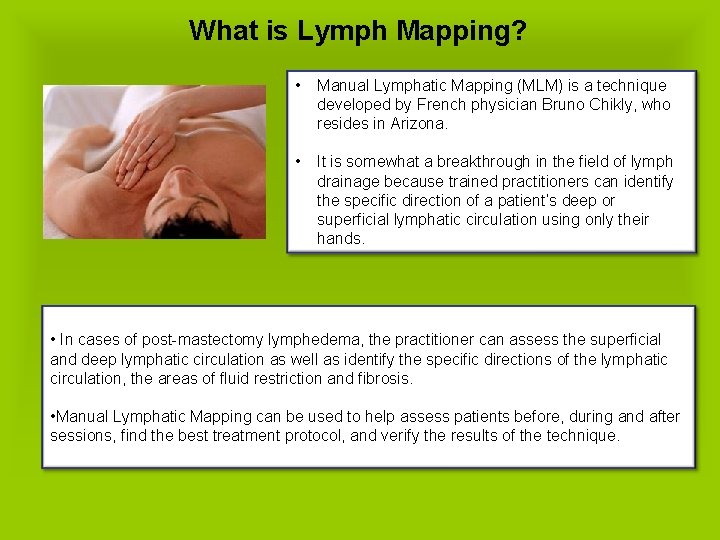
What is Lymph Mapping? • Manual Lymphatic Mapping (MLM) is a technique developed by French physician Bruno Chikly, who resides in Arizona. • It is somewhat a breakthrough in the field of lymph drainage because trained practitioners can identify the specific direction of a patient’s deep or superficial lymphatic circulation using only their hands. • In cases of post-mastectomy lymphedema, the practitioner can assess the superficial and deep lymphatic circulation as well as identify the specific directions of the lymphatic circulation, the areas of fluid restriction and fibrosis. • Manual Lymphatic Mapping can be used to help assess patients before, during and after sessions, find the best treatment protocol, and verify the results of the technique.
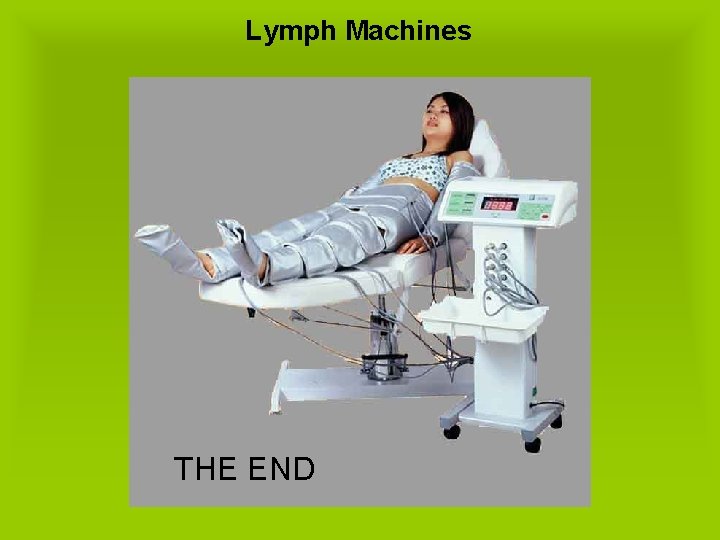
Lymph Machines THE END