
Lymphatic System the body harbors about 10 000
Lymphatic System • the body harbors about 10, 000 times as many bacterial cells as human cells – some beneficial – some potentially disease causing • immune system – not an organ system, but a population of cells that inhabit all of our organs and defend the body from agents of disease – especially concentrated in the true organ system – lymphatic system • • network of organs and vein-like vessels that recover fluid inspect it for disease agents activate immune responses return the fluid to the bloodstream 21 -1
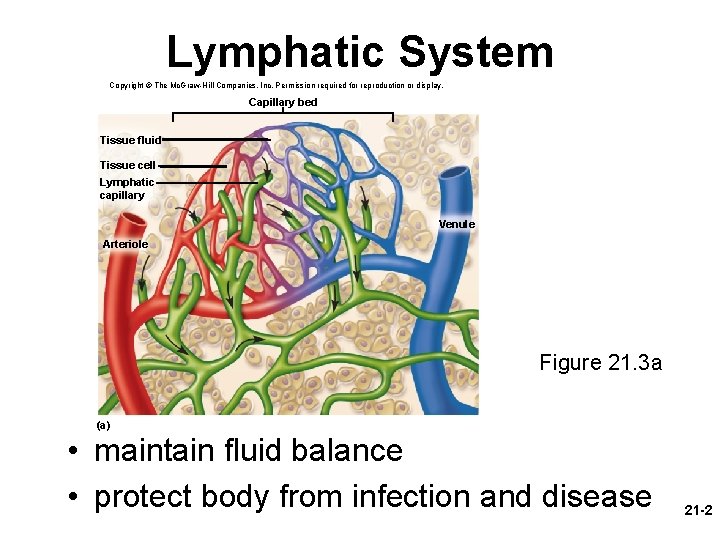
Lymphatic System Copyright © The Mc. Graw-Hill Companies, Inc. Permission required for reproduction or display. Capillary bed Tissue fluid Tissue cell Lymphatic capillary Venule Arteriole Figure 21. 3 a (a) • maintain fluid balance • protect body from infection and disease 21 -2
Functions of Lymphatic System • fluid recovery – fluid continually filters from the blood capillaries into the tissue spaces • blood capillaries reabsorb 85% • 15% (2 – 4 L/day) of the water and about half of the plasma proteins enters lymphatic system and then returned to the blood • immunity – excess filtered fluid picks up foreign cells and chemicals from the tissues • passes through lymph nodes where immune cells stand guard against foreign matter • activate a protective immune response • lipid absorption – lacteals in small intestine absorb dietary lipids that are not absorbed by the blood capillaries 21 -3
Components of the Lymphatic System • lymph – the recovered fluid • lymphatic vessels – transport the lymph • lymphatic tissues – composed of aggregates of lymphocytes and macrophages that populate many organs in the body • lymphatic organs – defense cells are especially concentrated in these organs – separated from surrounding organs by connective tissue capsules 21 -4
Lymph and Lymphatic Capillaries • lymph – clear, colorless fluid, similar to plasma, but much less protein – extracellular fluid drawn into lymphatic capillaries • lymphatic capillaries (terminal lymphatics) – penetrate nearly every tissue of the body • absent from central nervous system, cartilage, cornea, bone and bone marrow – sacs of thin endothelial cells that loosely overlap each other – closed at one end – cells tethered to surrounding tissue by protein filaments • gaps between cells are large enough to allow bacteria and cells entrance to lymphatic capillary – endothelium creates valve-like flaps that open when 21 -5 interstitial fluid pressure is high, and close when it is low
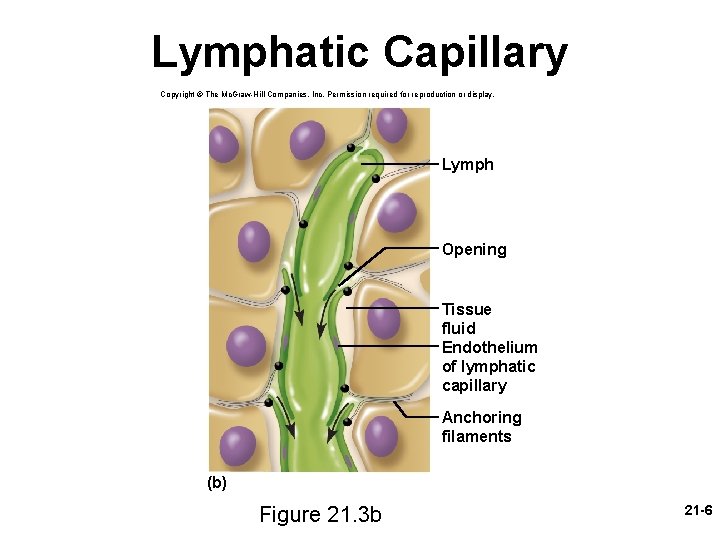
Lymphatic Capillary Copyright © The Mc. Graw-Hill Companies, Inc. Permission required for reproduction or display. Lymph Opening Tissue fluid Endothelium of lymphatic capillary Anchoring filaments (b) Figure 21. 3 b 21 -6
Lymphatic Vessels • larger ones composed of three layers – tunica interna: endothelium and valves – tunica media: elastic fibers, smooth muscle – tunica externa: thin outer layer • converge into larger and larger vessels 21 -7
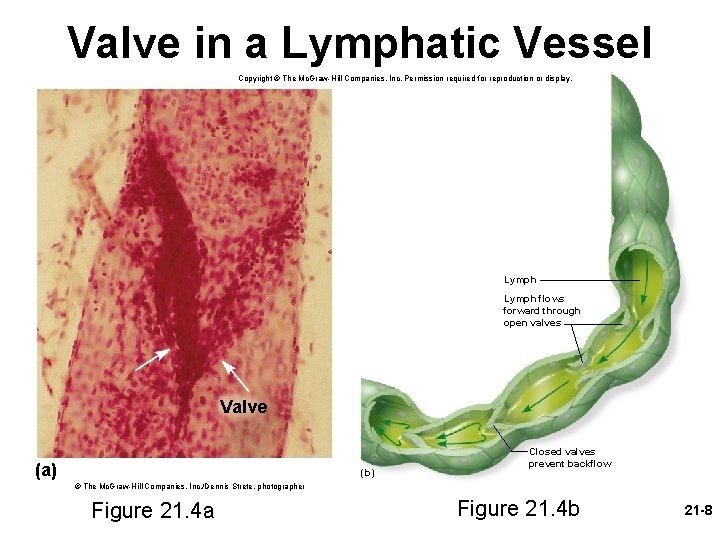
Valve in a Lymphatic Vessel Copyright © The Mc. Graw-Hill Companies, Inc. Permission required for reproduction or display. Lymph flows forward through open valves Valve (a) (b) Closed valves prevent backflow © The Mc. Graw-Hill Companies, Inc. /Dennis Strete, photographer Figure 21. 4 a Figure 21. 4 b 21 -8
Route of Lymph Flow • lymphatic capillaries • collecting vessels: course through many lymph nodes • six lymphatic trunks: drain major portions of body • two collecting ducts: – right lymphatic duct – receives lymph from right arm, right side of head and thorax; empties into right subclavian vein – thoracic duct - larger and longer, begins as a prominent sac in abdomen called the cisterna chyli; receives lymph from below diaphragm, left arm, left side of head, neck, and thorax; empties into left subclavian vein • subclavian veins 21 -9
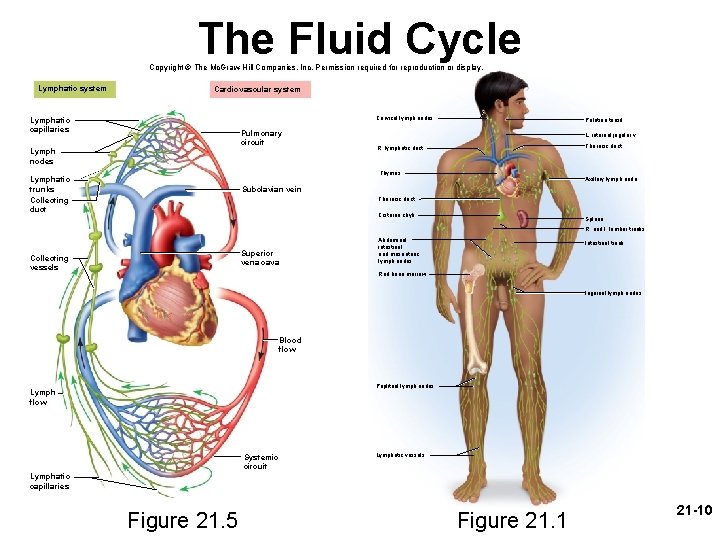
The Fluid Cycle Copyright © The Mc. Graw-Hill Companies, Inc. Permission required for reproduction or display. Lymphatic system Cardiovascular system Cervical lymph nodes Lymphatic capillaries Pulmonary circuit Lymph nodes Palatine tonsil L. internal jugular v. Thoracic duct R. lymphatic duct Thymus Lymphatic trunks Collecting duct Axillary lymph node Subclavian vein Thoracic duct Cisterna chyli Spleen R. and l. lumbar trunks Abdominal, intestinal, and mesenteric lymph nodes Superior vena cava Collecting vessels Intestinal trunk Red bone marrow Inguinal lymph nodes Blood flow Popliteal lymph nodes Lymph flow Systemic circuit Lymphatic vessels Lymphatic capillaries Figure 21. 5 Figure 21. 1 21 -10
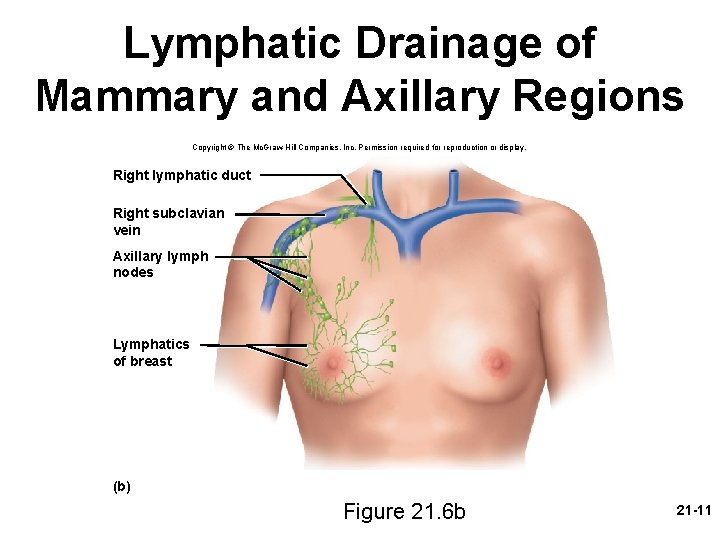
Lymphatic Drainage of Mammary and Axillary Regions Copyright © The Mc. Graw-Hill Companies, Inc. Permission required for reproduction or display. Right lymphatic duct Right subclavian vein Axillary lymph nodes Lymphatics of breast (b) Figure 21. 6 b 21 -11
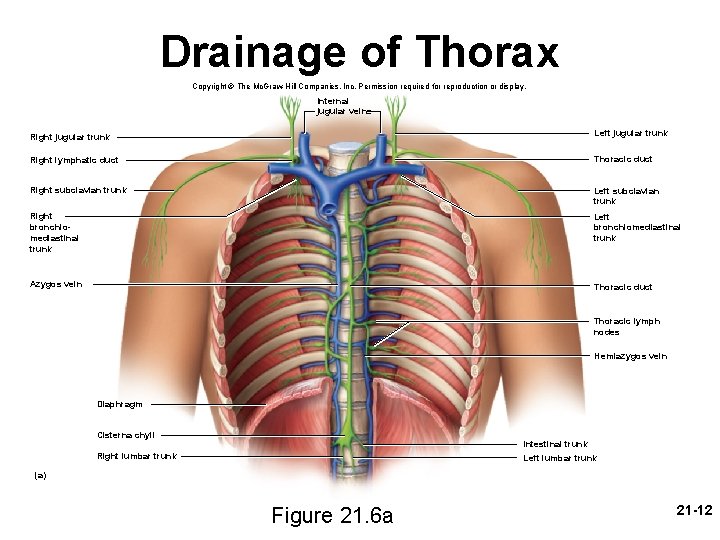
Drainage of Thorax Copyright © The Mc. Graw-Hill Companies, Inc. Permission required for reproduction or display. Internal jugular veins Right jugular trunk Left jugular trunk Right lymphatic duct Thoracic duct Right subclavian trunk Left subclavian trunk Right bronchiomediastinal trunk Left bronchiomediastinal trunk Azygos vein Thoracic duct Thoracic lymph nodes Hemiazygos vein Diaphragm Cisterna chyli Intestinal trunk Right lumbar trunk Left lumbar trunk (a) Figure 21. 6 a 21 -12
Mechanisms of Lymph Flow • lymph flows under forces similar to those that govern venous return, except no pump (heart) • lymph flows at low pressure and slower speed than venous blood • moved along by rhythmic contractions of lymphatic vessels – stretching of vessels stimulates contraction • flow aided by skeletal muscle pump • arterial pulsation rhythmically squeeze lymphatic vessels • thoracic pump aids flow from abdominal to thoracic cavity • valves prevent backward flow • rapidly flowing blood in subclavian veins, draws lymph into it • exercise significantly increases lymphatic return 21 -13
Lymphatic Cells • natural killer (NK) cells – large lymphocytes that attack and destroy bacteria, transplanted tissue, host cells infected with viruses or have turned cancerous – responsible for immune surveillance • T lymphocytes (T cells) – mature in thymus • B lymphocytes (B cells) – activation causes proliferation and differentiation into plasma cells that produce antibodies 21 -14
Lymphatic Cells • macrophages – very large, avidly phagocytic cells of the connective tissue – develop from monocytes – phagocytize tissue debris, dead neutrophils, bacteria, and other foreign matter – process foreign matter and display antigenic fragments to certain T cells alerting the immune system to the presence of the enemy – antigen presenting cells (APCs) • dendritic cells – branched, mobile APCs found in epidermis, mucous membranes, and lymphatic organs – alert immune system to pathogens that have breached their surface • reticular cells – branched stationary cells that contribute to the stroma of a lymphatic organ – act as APCs in the thymus 21 -15
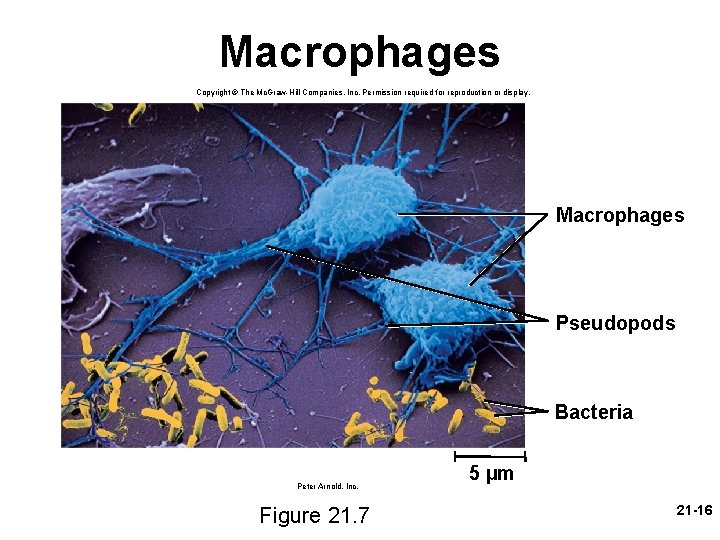
Macrophages Copyright © The Mc. Graw-Hill Companies, Inc. Permission required for reproduction or display. Macrophages Pseudopods Bacteria Peter Arnold, Inc. Figure 21. 7 5 µm 21 -16
Lymphatic Tissue • lymphatic (lymphoid) tissue – aggregations of lymphocytes in the connective tissues of mucous membranes and various organs • diffuse lymphatic tissue – simplest form – lymphocytes are scattered, rather than densely clustered – prevalent in body passages open to the exterior • respiratory, digestive, urinary, and reproductive tracts – mucosa-associated lymphatic tissue (MALT) • lymphatic nodules (follicles) – dense masses of lymphocytes and macrophages that congregate in response to pathogens – constant feature of the lymph nodes, tonsils, and appendix – Peyer patches – dense clusters in the ileum, the distal portion of 21 -17 the small intestine
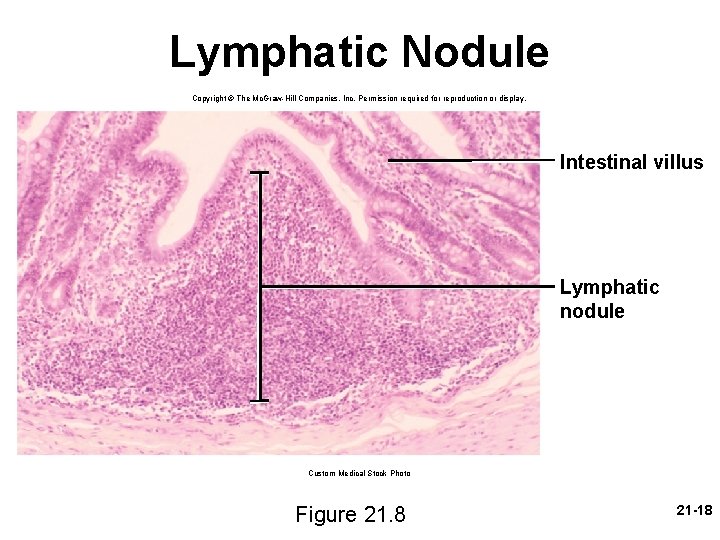
Lymphatic Nodule Copyright © The Mc. Graw-Hill Companies, Inc. Permission required for reproduction or display. Intestinal villus Lymphatic nodule Custom Medical Stock Photo Figure 21. 8 21 -18
Lymphatic Organs • lymphatic organs have well-defined anatomical sites – have connective tissue capsule that separates the lymphatic tissue from neighboring tissues • primary lymphatic organs – red bone marrow and thymus – site where T and B cells become immunocompetent – able to recognize and respond to antigens • secondary lymphatic organs – lymph nodes, tonsils, and spleen – immunocompetent cells populate these tissues 21 -19
Red Bone Marrow • red bone marrow is involved in hemopoiesis (blood formation) and immunity – soft, loosely organized, highly vascular material – separated from osseous tissue by endosteum of bone – as blood cells mature, they push their way through the reticular and endothelial cells to enter the sinus and flow away in the blood stream 21 -20
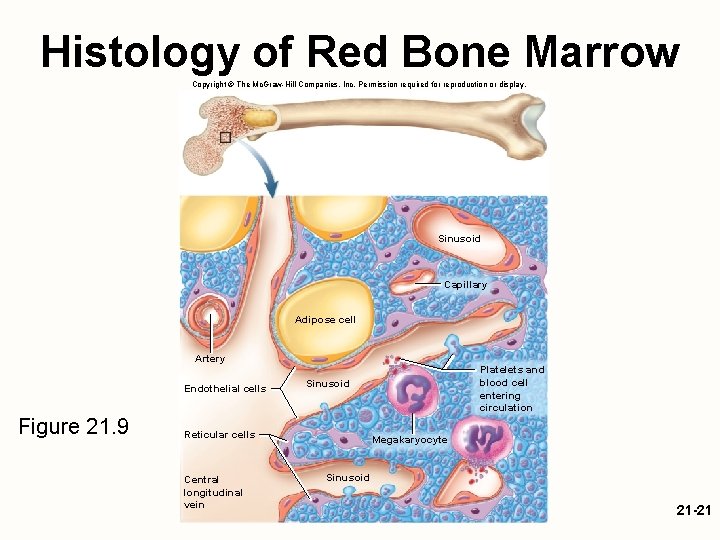
Histology of Red Bone Marrow Copyright © The Mc. Graw-Hill Companies, Inc. Permission required for reproduction or display. Sinusoid Capillary Adipose cell Artery Endothelial cells Figure 21. 9 Reticular cells Central longitudinal vein Platelets and blood cell entering circulation Sinusoid Megakaryocyte Sinusoid 21 -21
Thymus • thymus – member of the endocrine, lymphatic, and immune systems – houses developing lymphocytes – secretes hormones regulating their activity – bilobed organ located in superior mediastinum between the sternum and aortic arch – degeneration or involution with age – fibrous capsule gives off trabeculae (septa) that divide the gland into several lobes • lobes have cortex and medulla populated by T lymphocytes – reticular epithelial cells seal off cortex from medulla forming blood-thymus barrier • produce signaling molecules thymosin, thymopoietin, thymulin, interleukins, and interferon 21 -22
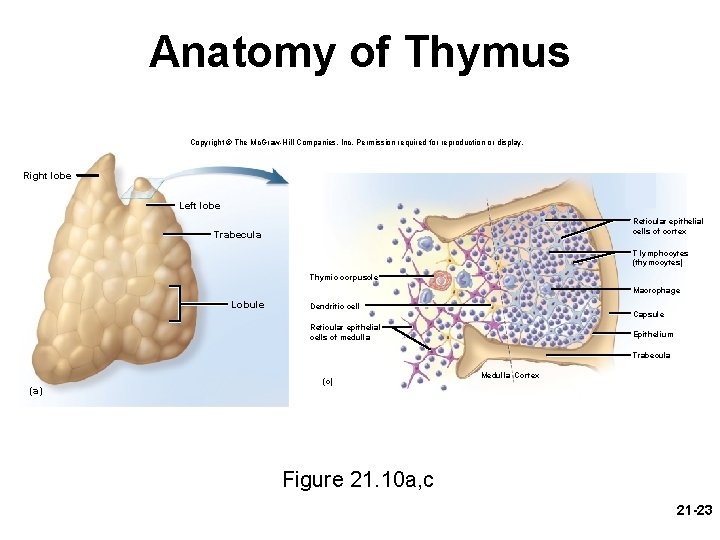
Anatomy of Thymus Copyright © The Mc. Graw-Hill Companies, Inc. Permission required for reproduction or display. Right lobe Left lobe Reticular epithelial cells of cortex Trabecula T lymphocytes (thymocytes) Thymic corpuscle Macrophage Lobule Dendritic cell Capsule Reticular epithelial cells of medulla Epithelium Trabecula (a) (c) Medulla Cortex Figure 21. 10 a, c 21 -23
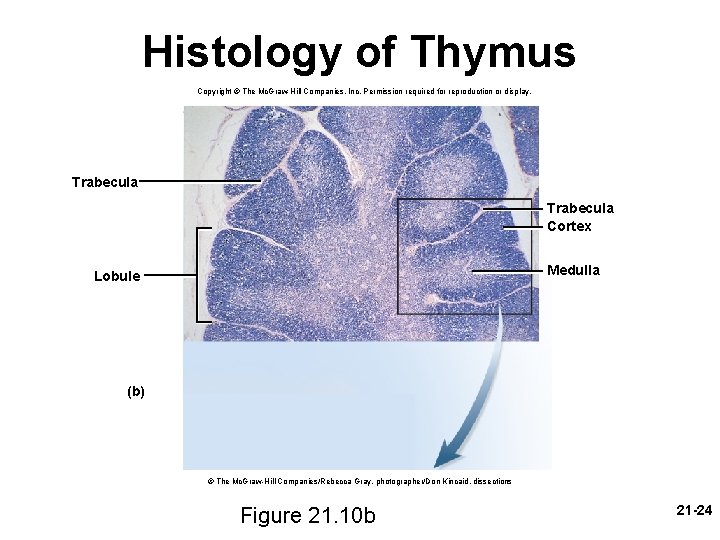
Histology of Thymus Copyright © The Mc. Graw-Hill Companies, Inc. Permission required for reproduction or display. Trabecula Cortex Medulla Lobule (b) © The Mc. Graw-Hill Companies/Rebecca Gray, photographer/Don Kincaid, dissections Figure 21. 10 b 21 -24
Lymph Node • lymph nodes – the most numerous lymphatic organs – about 450 in typical young adult – serve two functions: • cleanse the lymph • act as a site of T and B cell activation • elongated, bean shaped structure with hilum • enclosed with fibrous capsule with trabeculae that divide interior into compartments – stroma of reticular fibers and reticular cells • parenchyma divided into cortex and medulla – germinal centers where B cells multiply and differentiate into plasma cells • several afferent lymphatic vessels lead into the node along its convex surface – lymph leaves the node through one to three efferent lymphatic vessels that leave the hilum 21 -25
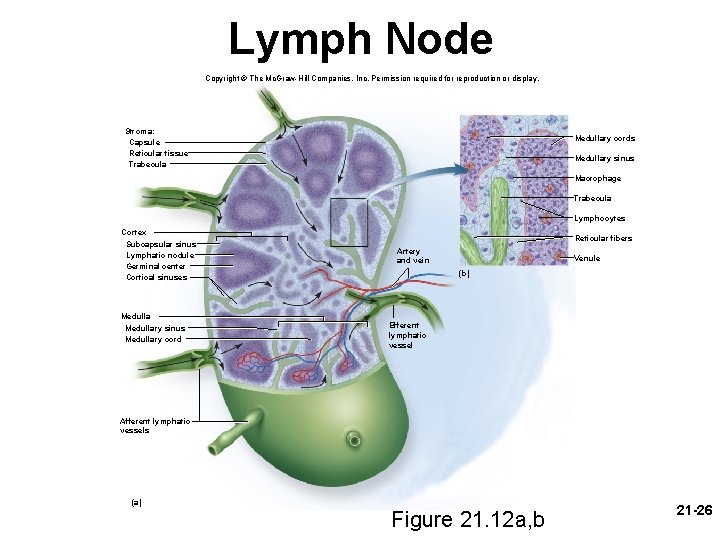
Lymph Node Copyright © The Mc. Graw-Hill Companies, Inc. Permission required for reproduction or display. Stroma: Capsule Reticular tissue Trabecula Medullary cords Medullary sinus Macrophage Trabecula Lymphocytes Cortex Subcapsular sinus Lymphatic nodule Germinal center Cortical sinuses Medullary sinus Medullary cord Reticular fibers Artery and vein Venule (b) Efferent lymphatic vessel Afferent lymphatic vessels (a) Figure 21. 12 a, b 21 -26
Lymph Node Locations • cervical lymph nodes – deep and superficial group in the neck – monitor lymph coming from head and neck • axillary lymph nodes – concentrated in armpit – receive lymph from upper limb and female breast • thoracic lymph nodes – in thoracic cavity especially embedded in mediastinum – receive lymph from mediastinum, lungs, and airway 21 -27
Lymph Node Locations • abdominal lymph nodes – occur in posterior abdominopelvic wall – monitor lymph from the urinary and reproductive systems • intestinal and mesenteric lymph nodes – found in the mesenteries, adjacent to the appendix and intestines – monitor lymph from the digestive tract • inguinal lymph nodes – in the groin and receive lymph from the entire lower limb • popliteal lymph nodes – occur on the back of the knee – receive lymph from the leg proper 21 -28
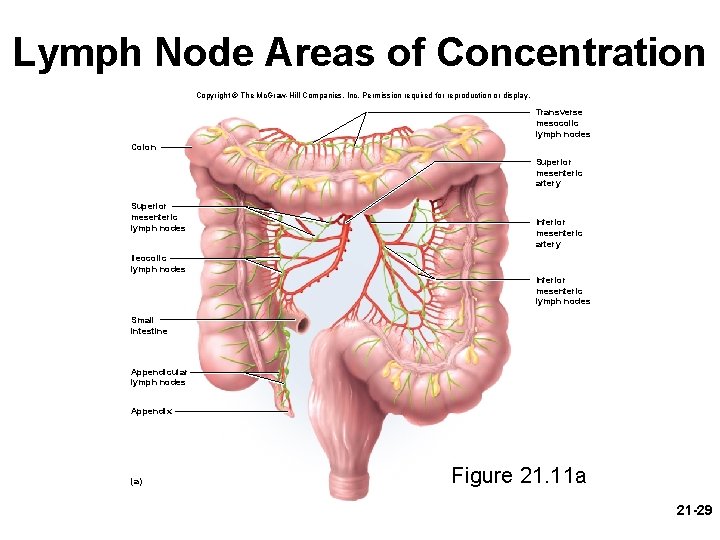
Lymph Node Areas of Concentration Copyright © The Mc. Graw-Hill Companies, Inc. Permission required for reproduction or display. Transverse mesocolic lymph nodes Colon Superior mesenteric artery Superior mesenteric lymph nodes Inferior mesenteric artery Ileocolic lymph nodes Inferior mesenteric lymph nodes Small intestine Appendicular lymph nodes Appendix (a) Figure 21. 11 a 21 -29
Lymphadenopathy • lymphadenopathy - collective term for all lymph node diseases • lymphadenitis - swollen, painful node responding to foreign antigen • lymph nodes are common sites for metastatic cancer – swollen, firm and usually painless 21 -30
Lymph Nodes and Metastatic Cancer • metastasis – phenomenon in which cancerous cells break free from the original, primary tumor, travel to other sites in the body, and establish new tumors. – metastasizing cancer cells can easily enter the lymphatic vessels – tend to lodge in the first lymph node they encounter – multiply there and eventually destroy the node • swollen, firm, and usually painless – tend to spread to the next node downstream – treatment of breast cancer is lumpectomy, mastectomy along with removal of nearby axillary nodes 21 -31
Tonsils • tonsils – patches of lymphatic tissue located at the entrance to the pharynx – guard against ingested or inhaled pathogens – each covered with epithelium – have deep pits – tonsillar crypts lined with lymphatic nodules – tonsillitis and tonsillectomy • three main sets of tonsils – palatine tonsils • pair at posterior margin of oral cavity • most often infected – lingual tonsils • pair at root of tongue – pharyngeal tonsil (adenoid) • single tonsil on wall of nasopharynx 21 -32
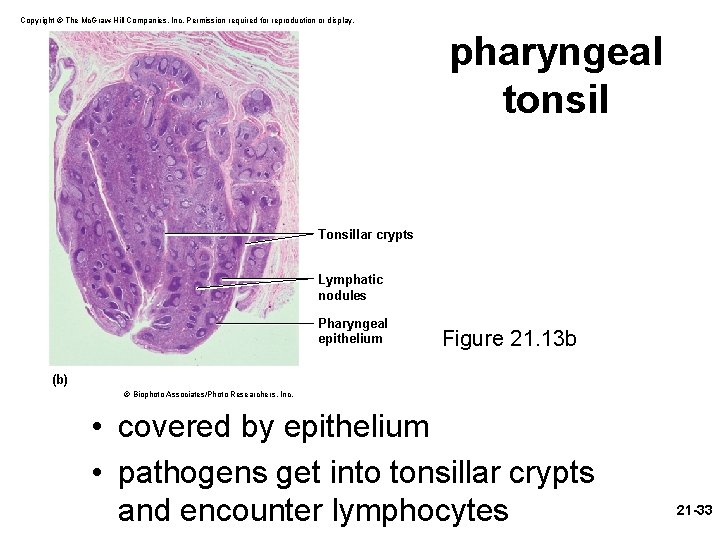
Copyright © The Mc. Graw-Hill Companies, Inc. Permission required for reproduction or display. pharyngeal tonsil Tonsillar crypts Lymphatic nodules Pharyngeal epithelium Figure 21. 13 b (b) © Biophoto Associates/Photo Researchers, Inc. • covered by epithelium • pathogens get into tonsillar crypts and encounter lymphocytes 21 -33
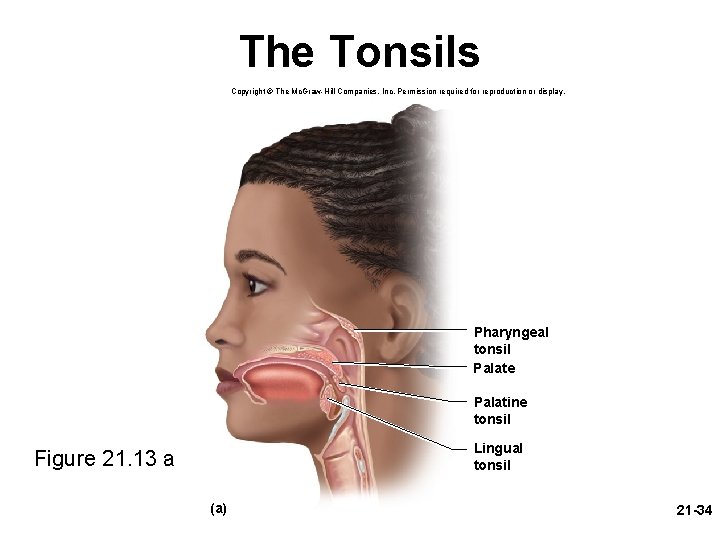
The Tonsils Copyright © The Mc. Graw-Hill Companies, Inc. Permission required for reproduction or display. Pharyngeal tonsil Palate Palatine tonsil Lingual tonsil Figure 21. 13 a (a) 21 -34
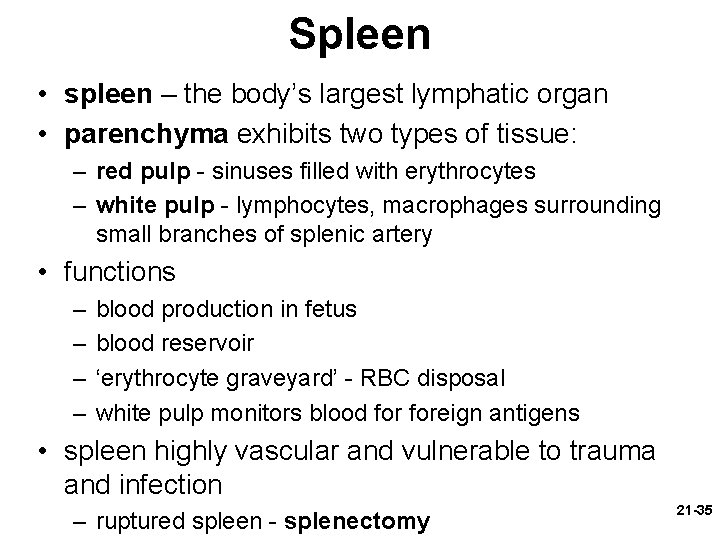
Spleen • spleen – the body’s largest lymphatic organ • parenchyma exhibits two types of tissue: – red pulp - sinuses filled with erythrocytes – white pulp - lymphocytes, macrophages surrounding small branches of splenic artery • functions – – blood production in fetus blood reservoir ‘erythrocyte graveyard’ - RBC disposal white pulp monitors blood foreign antigens • spleen highly vascular and vulnerable to trauma and infection – ruptured spleen - splenectomy 21 -35
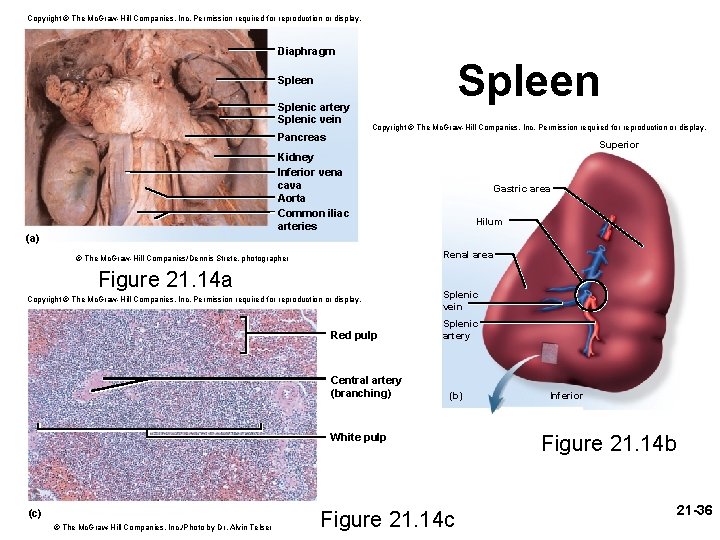
Copyright © The Mc. Graw-Hill Companies, Inc. Permission required for reproduction or display. Diaphragm Spleen Splenic artery Splenic vein Pancreas Copyright © The Mc. Graw-Hill Companies, Inc. Permission required for reproduction or display. Superior Kidney Inferior vena cava Aorta Common iliac arteries (a) Gastric area Hilum Renal area © The Mc. Graw-Hill Companies/Dennis Strete, photographer Figure 21. 14 a Copyright © The Mc. Graw-Hill Companies, Inc. Permission required for reproduction or display. Red pulp Central artery (branching) Splenic vein Splenic artery (b) White pulp (c) © The Mc. Graw-Hill Companies, Inc. /Photo by Dr. Alvin Telser Figure 21. 14 c Inferior Figure 21. 14 b 21 -36
- Slides: 36